
EPISODE · Jan 21, 2026 · 1H
Being dishonest to feel better (Khajehnejad et al 2026) | FT50 AOS
from Revise and Resubmit - The Mayukh Show · host Mayukh Mukhopadhyay
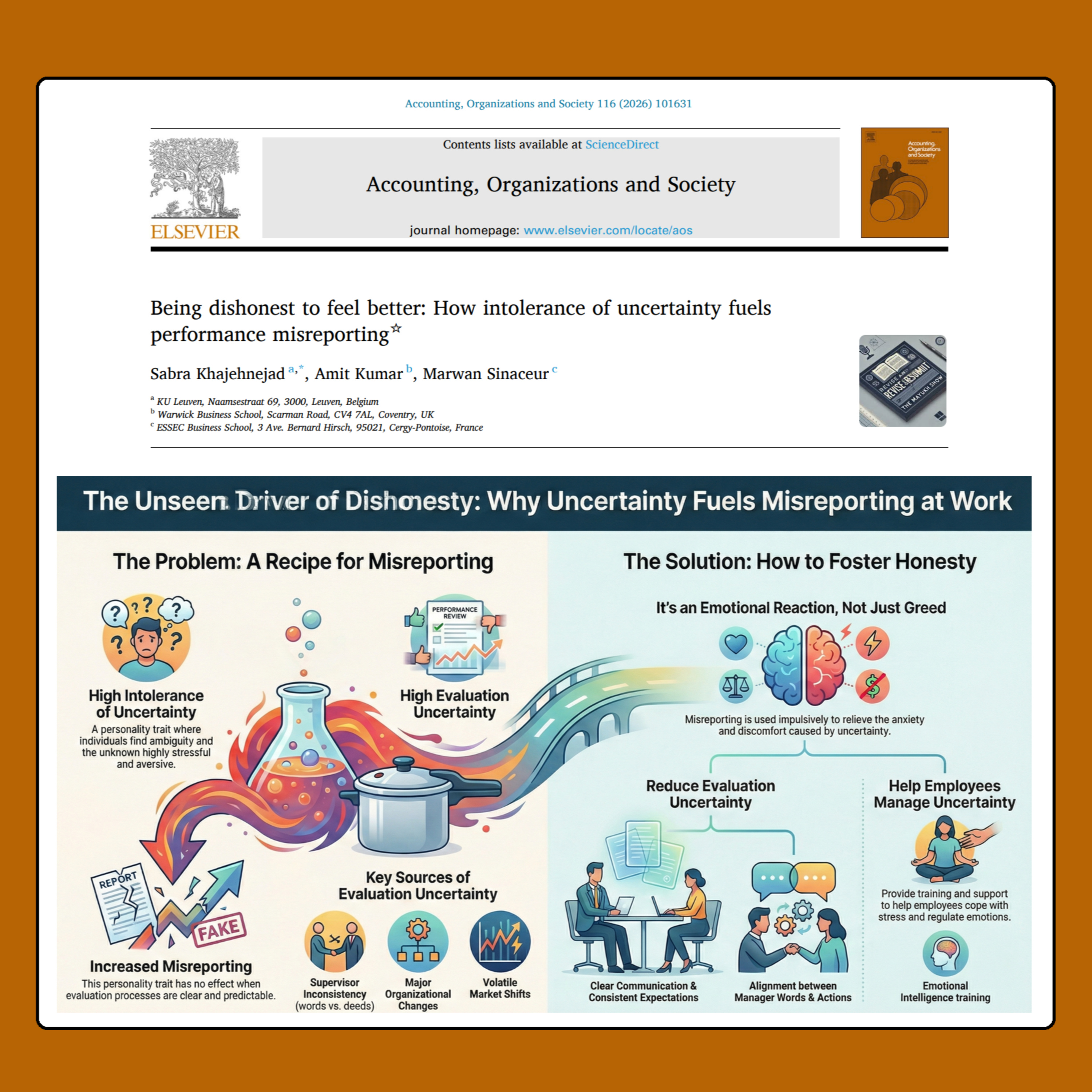
English Podcast starts at 00:00:00Bengali Podcast starts at 00:18:47Hindi Podcast starts at 00:32:18Danish Podcast starts at 00:44:57ReferenceKhajehnejad, S., Kumar, A., & Sinaceur, M. (2026). Being dishonest to feel better: How intolerance of uncertainty fuels performance misreporting. Accounting, Organizations and Society, 116, 101631. https://doi.org/10.1016/j.aos.2025.101631Youtube Channelhttps://www.youtube.com/@weekendresearcherConnect over linkedinhttps://www.linkedin.com/in/mayukhpsm/Welcome to Revise and Resubmit 🎙️✨ where real research meets real life, and where the footnotes quietly confess what our workplaces try hard not to say out loud.Picture a familiar scene. A spreadsheet. A dashboard. A weekly check-in. You are asked a simple question that is never actually simple: “So, how did it go?” And somewhere between what happened and what will be judged, there is a fog. Not the poetic kind. The corporate kind. The kind made of shifting expectations, vague criteria, and leaders who say one thing on Monday and reward another on Friday. 😬📉In that fog, a strange thing can happen. Not the dramatic, movie-villain kind of dishonesty. More like a small, human tilt of the truth. A number rounded up. A success story told a bit too cleanly. A performance polished until it shines. Not because someone is greedy, necessarily, but because someone is anxious. Because uncertainty is not just a condition. For some people, it is a sensation. It is unbearable. 🧠⚡Today’s episode dives into a brand-new paper with a title that feels like a whisper and a warning: “Being dishonest to feel better: How intolerance of uncertainty fuels performance misreporting” by Sabra Khajehnejad, Amit Kumar, and Marwan Sinaceur, published online on 26 December 2025 in Accounting, Organizations and Society 📚🏛️, a truly prestigious FT50 journal. The paper is scheduled for June 2026, Volume 116, and it is published by Elsevier.Across six studies, the authors show something both unsettling and deeply recognizable: when performance evaluation uncertainty runs high, people who hate ambiguity are more likely to misreport performance, impulsively, almost like reaching for oxygen. Supervisor word-deed inconsistency, organizational change, market turbulence, all of it can crank up that uncertainty. And then come the feelings: discomfort, anxiety, that restless need to make the story tighter than reality. And the misreporting becomes less a scheme and more a coping mechanism. 😮💨📊If you love research that doesn’t just measure behavior but listens for the emotion underneath it, you are in the right place. So hit subscribe to “Revise and Resubmit” on Spotify 🎧✅ and subscribe to the YouTube channel “Weekend Researcher” ▶️🔔. You can also find the show on Amazon Prime and Apple Podcast 🍎📻.And before we begin, heartfelt thanks to the authors, and to Elsevier, the publisher of this research article, for bringing this work into the world. 🙏📄Now here’s the question that will stay with us: when the rules of evaluation get blurry, are people lying to get ahead, or are they lying just to finally feel steady again? 🤔🕯️
Embed this episode
Ready to play
Being dishonest to feel better (Khajehnejad et al 2026) | FT50 AOS
No transcript for this episode yet
Similar Episodes
No similar episodes found.
Similar Podcasts
No similar podcasts found.