
EPISODE · Dec 27, 2024 · 59 MIN
Breaking NATO Radio Encryption (38c3)
from Chaos Computer Club - archive feed · host Lukas Stennes
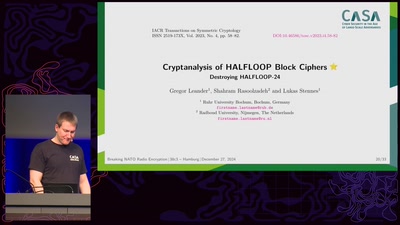
We present fatal security flaws in the HALFLOOP-24 encryption algorithm, which is used by the US military and NATO. HALFLOOP-24 was meant to safeguard the automatic link establishment protocol in high frequency radio, but our research demonstrates that merely two hours of intercepted radio traffic are sufficient to recover the secret key. In the talk, we start with the fundamentals of symmetric key cryptography before going into the details of high frequency radio, HALFLOOP-24, and the foundation of our attack. High frequency (HF) radio, also known as shortwave radio, is commonly used by the military, other government agencies and industries that need highly robust long-distance communication without any external infrastructures. HF radio uses frequencies between 3 and 30 MHz. These frequencies enable skywave propagation, where the radio signals are reflected by electrically charged particles in the upper atmosphere. While this effect enables communication across very large distances, historically, it required trained and experienced operators to establish a radio link. This dependence on operators was reduced by the introduction of the automatic link establishment (ALE) protocol. In a nutshell, an ALE-enabled radio establishes a link to another radio by selecting a suitable frequency according to a propagation model and then transmitting a call frame. If the frequency is good, the other radio receives the frame and the two radios perform a handshake to set up a link. The encryption of these ALE frames is known as linking protection. It is primarily meant to protect unauthorized users from establishing links with radios in a network or interfering with established links. Additionally, encryption of ALE frames also protects the network from certain types of traffic analysis, which is the analysis of operating data such as network structure, frequencies, callsigns and schedules. The first ALE standard did not specify a cipher, but specified how to integrate a stream cipher with ALE. Later standards introduced the 56-bit key Lattice/SoDark cipher, which is now recommended to be replaced with HALFLOOP whenever possible. HALFLOOP, which is standardized in US standard [MIL-STD-188-14D](https://quicksearch.dla.mil/qsDocDetails.aspx?ident_number=67563) since 2017, is essentially a downscaled version of the Advanced Encryption Standard (AES), which effectively is the most used encryption algorithm today. While this downscaling led to many strong components in HALFLOOP, a fatal flaw in the handling of the so-called tweak enables devastating attacks. In a nutshell, by applying a technique known as differential cryptanalysis, an attacker can skip large parts of the encryption process. In turn, this makes it possible to extract the used secret key and hence enables an attacker to break the confidentiality of the ALE handshake messages and also makes an efficient denial-of-service attack possible. These attacks are described in the two research papers, [Breaking HALFLOOP-24](https://doi.org/10.46586/tosc.v2022.i3.217-238) and [Destroying HALFLOOP-24](https://doi.org/10.46586/tosc.v2023.i4.58-82). They were initiated by the presentation of the [Cryptanalysis of the SoDark Cipher](https://doi.org/10.46586/tosc.v2021.i3.36-53), the predecessor of HALFLOOP. Licensed to the public under http://creativecommons.org/licenses/by/4.0 about this event: https://events.ccc.de/congress/2024/hub/event/breaking-nato-radio-encryption/
What this episode covers
We present fatal security flaws in the HALFLOOP-24 encryption algorithm, which is used by the US military and NATO. HALFLOOP-24 was meant to safeguard the automatic link establishment protocol in high frequency radio, but our research demonstrates that merely two hours of intercepted radio traffic are sufficient to recover the secret key. In the talk, we start with the fundamentals of symmetric key cryptography before going into the details of high frequency radio, HALFLOOP-24, and the foundation of our attack. High frequency (HF) radio, also known as shortwave radio, is commonly used by the military, other government agencies and industries that need highly robust long-distance communication without any external infrastructures. HF radio uses frequencies between 3 and 30 MHz. These frequencies enable skywave propagation, where the radio signals are reflected by electrically charged particles in the upper atmosphere. While this effect enables communication across very large distances, historically, it required trained and experienced operators to establish a radio link. This dependence on operators was reduced by the introduction of the automatic link establishment (ALE) protocol. In a nutshell, an ALE-enabled radio establishes a link to another radio by selecting a suitable frequency according to a propagation model and then transmitting a call frame. If the frequency is good, the other radio receives the frame and the two radios perform a handshake to set up a link. The encryption of these ALE frames is known as linking protection. It is primarily meant to protect unauthorized users from establishing links with radios in a network or interfering with established links. Additionally, encryption of ALE frames also protects the network from certain types of traffic analysis, which is the analysis of operating data such as network structure, frequencies, callsigns and schedules. The first ALE standard did not specify a cipher, but specified how to integrate a stream cipher with ALE. Later standards introduced the 56-bit key Lattice/SoDark cipher, which is now recommended to be replaced with HALFLOOP whenever possible. HALFLOOP, which is standardized in US standard [MIL-STD-188-14D](https://quicksearch.dla.mil/qsDocDetails.aspx?ident_number=67563) since 2017, is essentially a downscaled version of the Advanced Encryption Standard (AES), which effectively is the most used encryption algorithm today. While this downscaling led to many strong components in HALFLOOP, a fatal flaw in the handling of the so-called tweak enables devastating attacks. In a nutshell, by applying a technique known as differential cryptanalysis, an attacker can skip large parts of the encryption process. In turn, this makes it possible to extract the used secret key and hence enables an attacker to break the confidentiality of the ALE handshake messages and also makes an efficient denial-of-service attack possible. These attacks are described in the two research papers, [Breaking HALFLOOP-24](https://doi.org/10.46586/tosc.v2022.i3.217-238) and [Destroying HALFLOOP-24](https://doi.org/10.46586/tosc.v2023.i4.58-82). They were initiated by the presentation of the [Cryptanalysis of the SoDark Cipher](https://doi.org/10.46586/tosc.v2021.i3.36-53), the predecessor of HALFLOOP. Licensed to the public under http://creativecommons.org/licenses/by/4.0 about this event: https://events.ccc.de/congress/2024/hub/event/breaking-nato-radio-encryption/
NOW PLAYING
Breaking NATO Radio Encryption (38c3)
No transcript for this episode yet
Similar Episodes
Jun 9, 2026 ·50m
Jun 1, 2026 ·31m
May 25, 2026 ·39m
May 17, 2026 ·37m
May 8, 2026 ·39m
Apr 28, 2026 ·25m