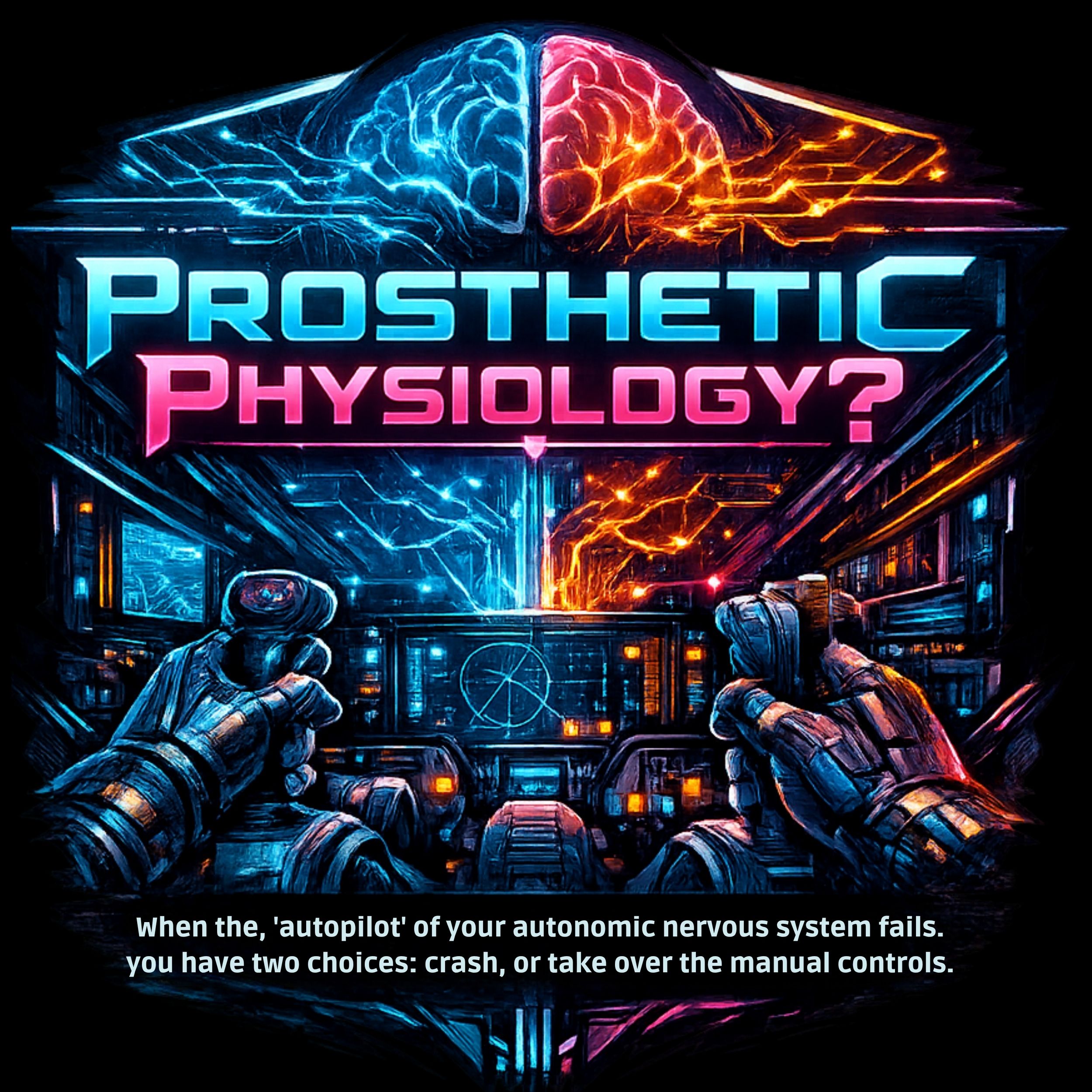
Built in the Dark episode artwork

EPISODE · May 11, 2026 · 26 MIN

Built in the Dark

from Prosthetic Physiology

Every component of the Prosthetic Physiology framework exists because something else stopped working. This episode is about what that actually looks like from the inside.The six components did not arrive as theory. They were built under operational conditions, one failure mode at a time, across two decades of a body dismantling its own regulatory infrastructure. Baroreflex failure. Complete GI dysmotility. Absent pain signalling. Haemodynamic instability that crosses the threshold for medical emergency fifteen times on an ordinary Tuesday.This episode covers the failure states the framework was designed to address: why the Cognitive component exists when somatic signals arrive too late or not at all; why the Mechanical component treats continuous motion as a haemodynamic intervention rather than exercise; why the Nutritional component uses controlled micro-feeding as an infusion protocol rather than conventional fuelling; why the Data component treats HRV and trend patterns as primary sensory input; and why the Environmental component manages heat, cold, compression, and posture as active regulatory tools deployed with the same precision as any other clinical intervention.It also covers the specific risk the framework cannot fully mitigate: a well-meaning clinician with one blood pressure reading and the correct protocol. 203 over 141 demands an antihypertensive injection. In a body with no functional autonomic correction mechanism, that injection ends the story. The framework anticipates this. It cannot prevent the scenario. That is the boundary condition no architecture fully solves.The framework was built without a map because no map existed. Nobody with this specific convergence of failures, at this scale, across this many systems, had stayed functional long enough to draw one.This is what was built in the gap between the prognosis and right now.Full framework documentation at prostheticphysiology.com

Episode metadata supplied by the publisher feed · Published May 11, 2026

NOW PLAYING

Built in the Dark

0:00 26:25

No transcript for this episode yet

We transcribe on demand. Request one and we'll notify you when it's ready — usually under 10 minutes.

The Prosthetic Paradigm Drew Nutter Prosthetic care is a ever changing field with learning at the center. The prosthetic paradigm podcast endeavors to further learning in the field of prosthetics, adaptive athletics, orthotics, limb loss, and more. Interviews with people who are pioneering techniques, technology, or training highlight and contribute the knowledge to further and facilitate knowledge in the field. Sleep Science Podcast Penny Lewis We spend a third of our lives sleeping, and this podcast is all about understanding sleep. We know a lot about what the brain does in sleep, but we are just starting to understand why it does some of these things, and even more excitingly, how we can take full advantage of sleep and also manipulate it for our own ends. In each episode, neuroscientist Penny Lewis interviews a different sleep researcher, talking about a various aspect of sleep science. Topics include sleep physiology and medicine, circadian rhythm, how sleep impacts on our memories and creativity, Sleep Engineering for enhanced health and cognition, and the most recent technologies to promote sleep.©SleepSciencePodcast 2021. These materials may be downloaded for personal use only. They may not be shared, distributed or reproduced in any form or for any reason without express permission Hit Play Not Pause Hit Play Not Pause Perimenopause and menopause hit active women differently. We have a different lifestyle and different goals. And we know our bodies. Whether you run and hike or do CrossFit and ski (or a little of everything!), you’ve had a way of eating and exercising that worked…until the menopause transition, when it all goes out the window as body composition changes, fatigue, body aches, sleepless nights, hot flashes, brain fog, mood swings, and low mojo blindside you out of the blue—despite doing everything right. Your doctor may (or may not) help with hormone replacement therapy. But what about all the active stuff you love? You’re already exercising and eating well. What you want is to feel and perform like you used to. That doesn’t mean fasting, swearing off carbs for life, or just slowing down. It means adjusting your nutrition, training, recovery, and mindset to work with your changing physiology as you hit this phase of life. And we’re here for it.At Hit Play Not Pause, we know the potenti Channel Your Enthusiasm Channel Your Enthusiasm A chapter by chapter recap of Burton Rose’s classic, The Clinical Physiology of Acid Base and Electrolyte Disorders, a kidney physiology book for nephrologists, fellows, residents and medical students.

Frequently Asked Questions

How long is this episode of Prosthetic Physiology?

This episode is 26 minutes long.

When was this Prosthetic Physiology episode published?

This episode was published on May 11, 2026.

What is this episode about?

Every component of the Prosthetic Physiology framework exists because something else stopped working. This episode is about what that actually looks like from the inside.The six components did not arrive as theory. They were built under operational...

Can I download this Prosthetic Physiology episode?

Yes, you can download this episode by clicking the download button on the episode player, or subscribe to the podcast in your preferred podcast app for automatic downloads.
URL copied to clipboard!