
PODCAST · health
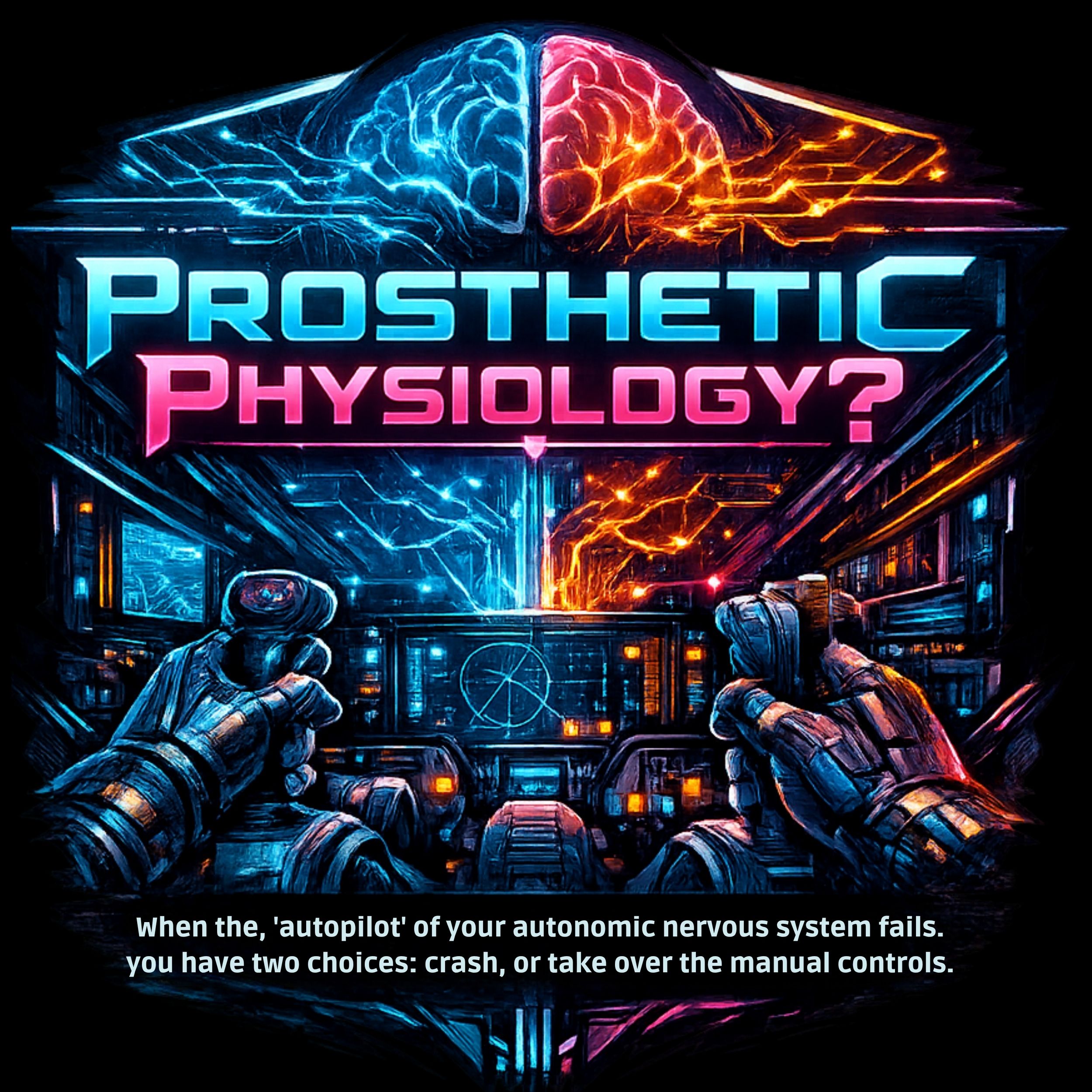
Prosthetic Physiology
by The Tenacious Cyclist | David Bainbridge
Prosthetic Physiology is a podcast about what happens when the body's automatic systems stop working and you have to build replacements for them.David Bainbridge is an ultra-endurance adaptive cyclist living with Classical Ehlers-Danlos Syndrome, structural baroreflex failure, complete GI dysmotility, dysautonomia, Complex Regional Pain Syndrome, coronary heart disease, and narcolepsy. He takes no oral medications. His gut cannot absorb them.In December 2022 he was ending his 19th year as a full-time wheelchair user. He has since ridden over 6,000 miles, including 148 miles solo and unsupported at the Dunwich Dynamo Plus, and a 450-mile Yorkshire Divide with 30,000 feet of climbing.None of that is the subject of this podcast.The subject is the framework that makes it possible. Six components built to replace autonomic functions the body no longer performs: cognitive anticipation in place of absent reflexes; continuous motion as a circulatory pump; precision timing governing effort,
-
1
Built in the Dark
Every component of the Prosthetic Physiology framework exists because something else stopped working. This episode is about what that actually looks like from the inside.The six components did not arrive as theory. They were built under operational conditions, one failure mode at a time, across two decades of a body dismantling its own regulatory infrastructure. Baroreflex failure. Complete GI dysmotility. Absent pain signalling. Haemodynamic instability that crosses the threshold for medical emergency fifteen times on an ordinary Tuesday.This episode covers the failure states the framework was designed to address: why the Cognitive component exists when somatic signals arrive too late or not at all; why the Mechanical component treats continuous motion as a haemodynamic intervention rather than exercise; why the Nutritional component uses controlled micro-feeding as an infusion protocol rather than conventional fuelling; why the Data component treats HRV and trend patterns as primary sensory input; and why the Environmental component manages heat, cold, compression, and posture as active regulatory tools deployed with the same precision as any other clinical intervention.It also covers the specific risk the framework cannot fully mitigate: a well-meaning clinician with one blood pressure reading and the correct protocol. 203 over 141 demands an antihypertensive injection. In a body with no functional autonomic correction mechanism, that injection ends the story. The framework anticipates this. It cannot prevent the scenario. That is the boundary condition no architecture fully solves.The framework was built without a map because no map existed. Nobody with this specific convergence of failures, at this scale, across this many systems, had stayed functional long enough to draw one.This is what was built in the gap between the prognosis and right now.Full framework documentation at prostheticphysiology.com
We're indexing this podcast's transcripts for the first time — this can take a minute or two. We'll show results as soon as they're ready.
No matches for "" in this podcast's transcripts.
No topics indexed yet for this podcast.
Loading reviews...
ABOUT THIS SHOW
Prosthetic Physiology is a podcast about what happens when the body's automatic systems stop working and you have to build replacements for them.David Bainbridge is an ultra-endurance adaptive cyclist living with Classical Ehlers-Danlos Syndrome, structural baroreflex failure, complete GI dysmotility, dysautonomia, Complex Regional Pain Syndrome, coronary heart disease, and narcolepsy. He takes no oral medications. His gut cannot absorb them.In December 2022 he was ending his 19th year as a full-time wheelchair user. He has since ridden over 6,000 miles, including 148 miles solo and unsupported at the Dunwich Dynamo Plus, and a 450-mile Yorkshire Divide with 30,000 feet of climbing.None of that is the subject of this podcast.The subject is the framework that makes it possible. Six components built to replace autonomic functions the body no longer performs: cognitive anticipation in place of absent reflexes; continuous motion as a circulatory pump; precision timing governing effort,
HOSTED BY
The Tenacious Cyclist | David Bainbridge
Loading similar podcasts...
Frequently Asked Questions
How many episodes does Prosthetic Physiology have?
Prosthetic Physiology currently has 1 episodes available on PodParley. New episodes are automatically indexed when they're published to the podcast feed.
What is Prosthetic Physiology about?
Prosthetic Physiology is a podcast about what happens when the body's automatic systems stop working and you have to build replacements for them.David Bainbridge is an ultra-endurance adaptive cyclist living with Classical Ehlers-Danlos Syndrome, structural baroreflex failure, complete GI...
How often does Prosthetic Physiology release new episodes?
Prosthetic Physiology has 1 episodes. Check the episode list to see recent publication dates and frequency.
Where can I listen to Prosthetic Physiology?
You can listen to Prosthetic Physiology on PodParley by clicking any episode. We provide an embedded audio player for direct listening, and you can also subscribe via your preferred podcast app using the RSS feed.
Who hosts Prosthetic Physiology?
Prosthetic Physiology is created and hosted by The Tenacious Cyclist | David Bainbridge.
URL copied to clipboard!