
EPISODE · Jun 5, 2026 · 10 MIN
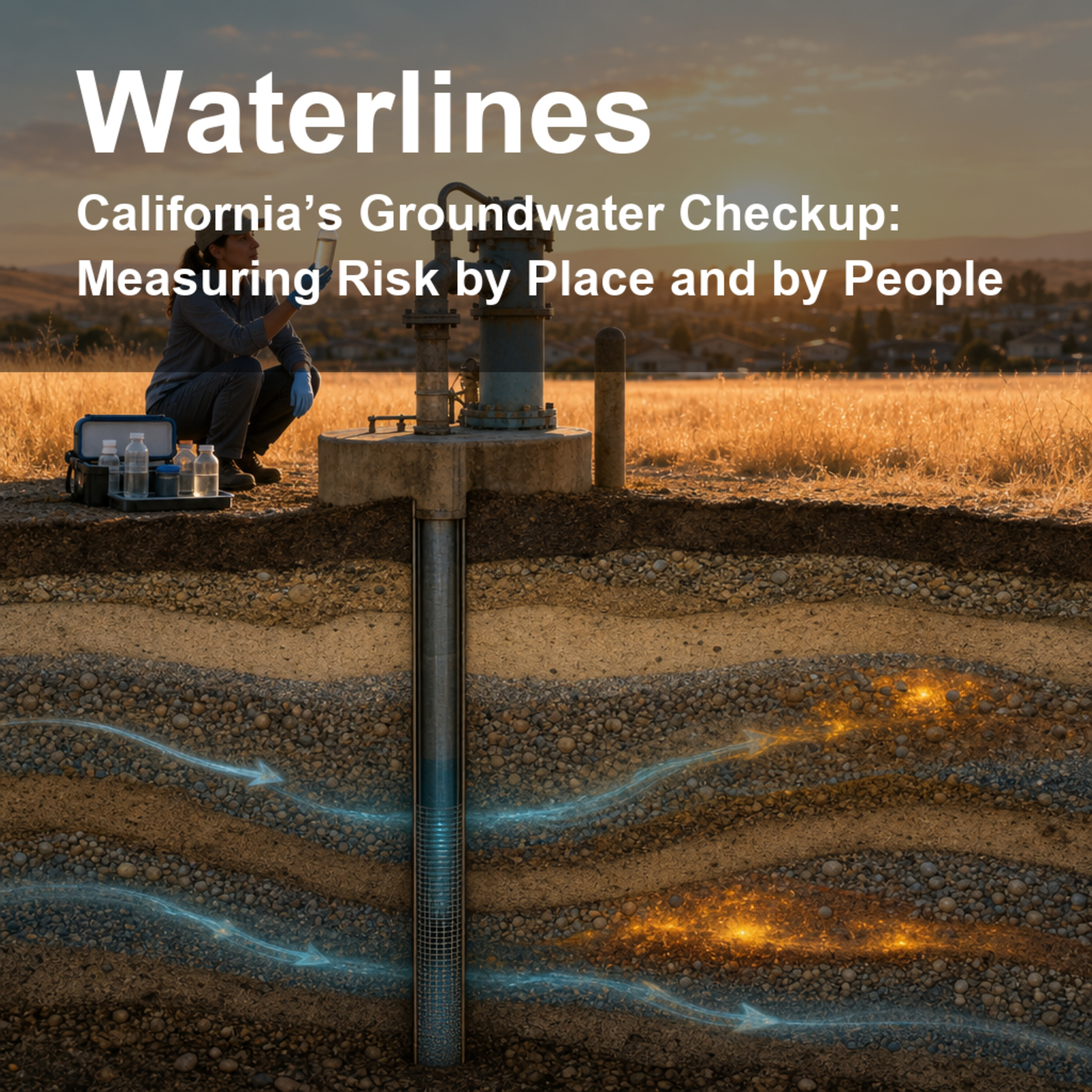
California’s Groundwater Checkup: Measuring Risk by Place and by People
from Waterlines: How Water Shapes Our World · host jaywen
Groundwater is easy to forget because it is out of sight, but millions of people depend on it every day. This episode follows a statewide California effort to answer a deceptively simple question: when a well test finds a problem, how do we describe the size of that problem fairly? Is it the number of wells, the amount of aquifer area affected, or the number of people who rely on that water? We unpack how USGS scientists used data from about 11,000 public-supply wells across 87 study areas to build two clearer yardsticks: affected area and equivalent-population. Along the way, we talk about arsenic, uranium, manganese, nitrate, solvents, farm chemicals, urban history, and why groundwater quality is not the same everywhere, even inside one state. The study found that roughly one-fifth of California groundwater used for public supply had high concentrations of at least one constituent, with trace elements more widespread than nitrate or organic compounds at statewide scales. We also look at what this does and does not mean for tap water, since utilities may blend or treat water before delivery. Citation: Belitz, K.; Fram, M. S.; Johnson, T. D. “Metrics for Assessing the Quality of Groundwater Used for Public Supply, CA, USA: Equivalent-Population and Area.” Environmental Science & Technology 2015, 49, 8330–8338. https://doi.org/10.1021/acs.est.5b00265. Disclosure: this Waterlines episode package is written for production with AI-generated voices.
Embed this episode
NOW PLAYING
California’s Groundwater Checkup: Measuring Risk by Place and by People
No transcript for this episode yet
Similar Episodes
No similar episodes found.
Similar Podcasts
No similar podcasts found.