
EPISODE · Jan 28, 2026 · 17 MIN
CHAPTER 12: THE SHEMA - THE FUNDAMENTAL PRAYER
from Judería medieval Zaragoza/Jewish quarter Zaragoza
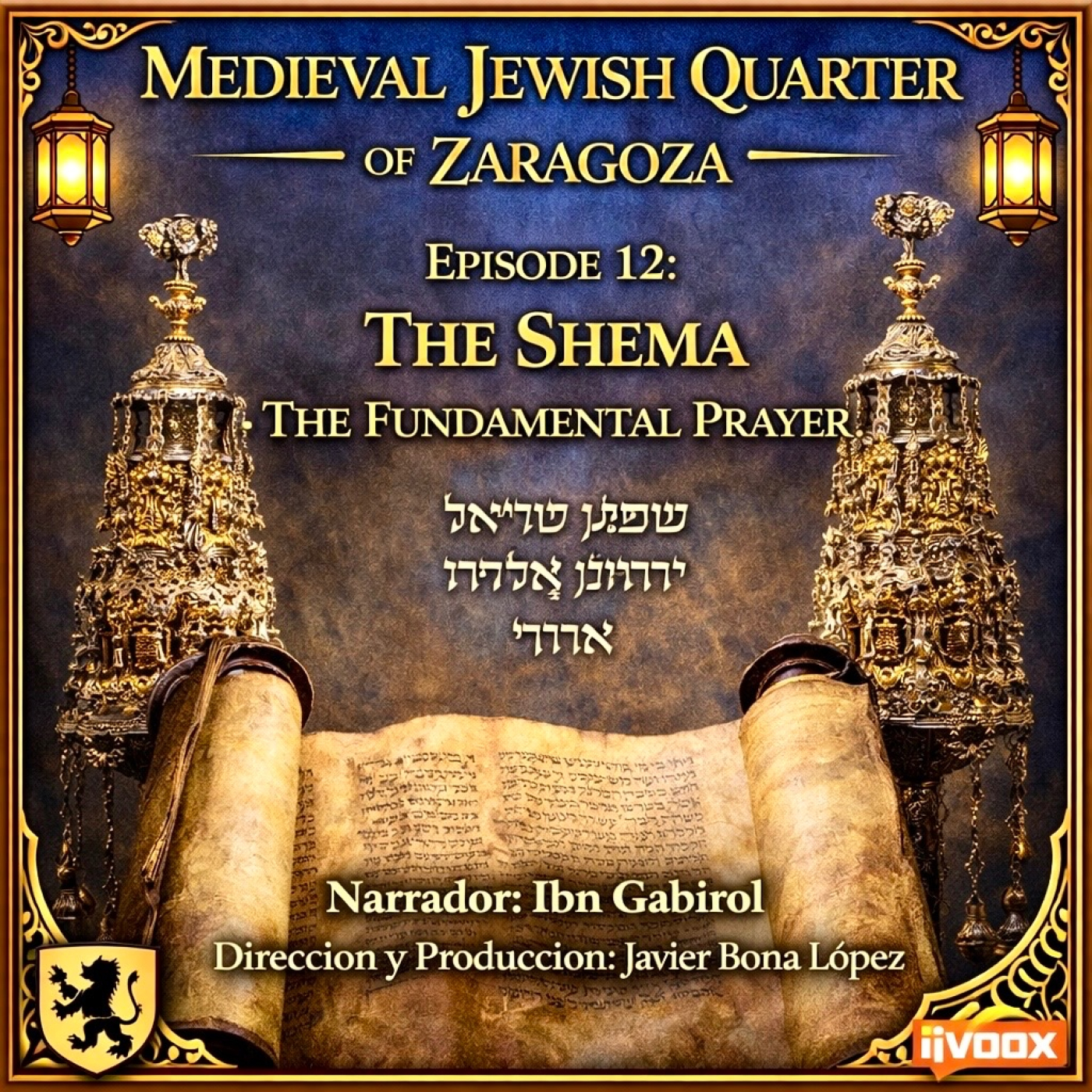
CHAPTER 12: THE SHEMA - THE FUNDAMENTAL PRAYER Narrator: Ibn Gabirol Direction and Production: Javier Bona López Documentation and Advisory: Miguel Ángel Motis Dolader (San Jorge University of Zaragoza) Episode Summary In this deeply moving chapter, Ibn Gabirol guides us through the most sacred prayer of Judaism: the Shema. These six words in Hebrew—"Shema Yisrael, Adonai Eloheinu, Adonai Echad" (Hear, O Israel, the Lord is our God, the Lord is One)—are the heart of Jewish faith, the declaration that has resonated on the lips of the Jewish people for over three thousand years. This is not merely a prayer; it is an affirmation, a declaration of faith, an oath of loyalty, and an anchor in the midst of the storm. It is the first words a Jewish child learns and the last words an elder pronounces before surrendering their soul to the Creator. It is the battle cry of the Jewish people, the proclamation that differentiates them from all other nations of the world. The Shema in Medieval Zaragoza In the medieval aljama of Zaragoza, the Shema permeated every aspect of Jewish life: In the Great Synagogue: The united voice of the entire community recited the Shema with the chazzan, creating a vibration that seemed to shake the temple's foundations. The melody, ancient and transmitted from generation to generation, rose in the central nave, with voices intertwining in an almost hypnotic harmony. In the Homes: Families whispered the Shema upon waking and before sleeping, transmitting it from generation to generation. Children learned it in the heder, the elementary school, repeating it over and over until it was engraved in their memory. In the Mezuzot: Artisans wrote the verses of the Shema on small scrolls that were rolled and placed inside the mezuzot, those little boxes nailed to the doorposts. Every time Jews entered or left their homes, they touched the mezuzah and brought their fingers to their lips, a gesture of reverence and love for God's word. In the Tefillin: Men bound on their arm and forehead the tefillin, small leather boxes containing scrolls with the Shema. It was a way of literally fulfilling the commandment to bind God's words as a sign on the hand and between the eyes. As a Shield in Persecution: Many martyrs ascended the scaffold with the Shema on their lips, shouting "Shema Yisrael!" while the flames consumed their bodies. It was their last act of defiance, their last affirmation of faith in a world that denied them the right to exist. On the Deathbed: The last word a dying Jew pronounced, if they had the strength, was "Echad" (One). It was the final affirmation that, even on the threshold of death, their faith in the one God remained unshakable. The Thread That Wove the Community: The Shema united the rich with the poor, the wise with the ignorant, the elder with the child. Everyone recited the same Shema, everyone proclaimed the same truth. The Shema as Practice But the Shema was not just a word. It was a constant practice, a ritual that permeated every moment of life: Morning and Night: Every morning upon waking and every night before sleeping, Jews recited the Shema, renewing their covenant with God each new day. In the Heder: Children learned the Shema even before learning to read, syllable by syllable, letter by letter. When they could finally recite the complete Shema, it was a moment of celebration in the family. In the Synagogue: The Shema was the heart of the service, recited twice a day in Shacharit and Maariv. On Yom Kippur, the Day of Atonement, it was recited with particular intensity and emotion. In the Festivals: At Pesach, the Shema was the prayer of freedom. At Shavuot, it was the prayer of acceptance of the Torah. At Sukkot, it was the prayer of gratitude. In Moments of Crisis: When a Jew faced illness, loss, or persecution, they recited the Shema. It was a light, a hope, a connection with something greater than immediate suffering. The Quintessence of Judaism The Shema is the quintessence of Judaism. It is theology, commandment, identity, and resistance. It is the word that has kept the Jewish people united throughout millennia of exile and dispersion. It is the melody that has cradled their children and consoled their dying. It is the beacon that has guided their steps in the darkness. It is the word that defines, sustains, and redeems them. In medieval Zaragoza, the Shema was more than a prayer. It was the deepest expression of Jewish identity. It was the word that united them with their ancestors and connected them with future generations. It was the word that made them Jews, that made them part of an eternal people, a people that had suffered but had never renounced its faith. The Secret of Survival In those six words, in that simple and profound declaration of faith, lies the secret of the survival of the Jewish people, the mystery of their eternity. The Shema is the word that defines, sustains, and redeems the Jewish people. It is the secret of their survival, the mystery of their eternity. Series: Medieval Jewish Quarter of Zaragoza If you enjoyed this chapter, we invite you to share and spread it. You can also listen to our other series on the medieval Jewish quarters of Calatayud, Tarazona, and Híjar on the three main podcast platforms. CREDITS AND SOURCES Narrator: Ibn Gabirol Direction and Production: Javier Bona López Documentation and Advisory: Miguel Ángel Motis Dolader (San Jorge University of Zaragoza) Main Sources: Asunción Blasco Martínez. La Judería de Zaragoza en el siglo XIV. Instituto Fernando el Católico (IFC), 1988. Asunción Blasco Martínez. Instituciones Sociorreligiosas Judías de Zaragoza (Siglos XIV-XV). Sinagogas, Cofradías, Hospitales. University of Zaragoza. Miguel Ángel Motis Dolader. La judería de Zaragoza: Centro de la vida económica y social. Rolde de Estudios Aragoneses. Miguel Ángel Motis-Dolader, Ana Ruiz-Varona, Lourdes Pérez-López. Urban Morphology and Functional Hierarchy of the Jewish Quarter of Zaragoza (Spain) at the End of the Fifteenth Century. Journal of Urban History, 2023. Ángel Canellas López. La Judería Zaragozana. Cuadernos de Zaragoza, no. 2, 1974. Asunción Blasco Martínez & Susana Lozano Gracia. La Judería de Zaragoza - Paso a Paso. Ayuntamiento de Zaragoza, 2023. Sefarad Aragón. La desaparecida judería de Zaragoza. Self-published, 2010. Leopoldo Torres Balbás. Trabajos sobre la judería de Zaragoza y sus baños. Patrimonio Cultural de Aragón. Institutional records. Guía de la Judería de Zaragoza. Ayuntamiento de Zaragoza. Zaragoza Municipal Archive (AMZ). Historical maps. Final Note: "If you enjoyed this chapter, I invite you to share and spread it. You can also listen to our other series on the medieval Jewish quarters of Calatayud, Tarazona, and Híjar on the three main podcast platforms." Zakhor. Remember. Shalom. .
Embed this episode
NOW PLAYING
CHAPTER 12: THE SHEMA - THE FUNDAMENTAL PRAYER
No transcript for this episode yet
Similar Episodes
No similar episodes found.
Similar Podcasts
No similar podcasts found.