
EPISODE · Jan 28, 2026 · 39 MIN
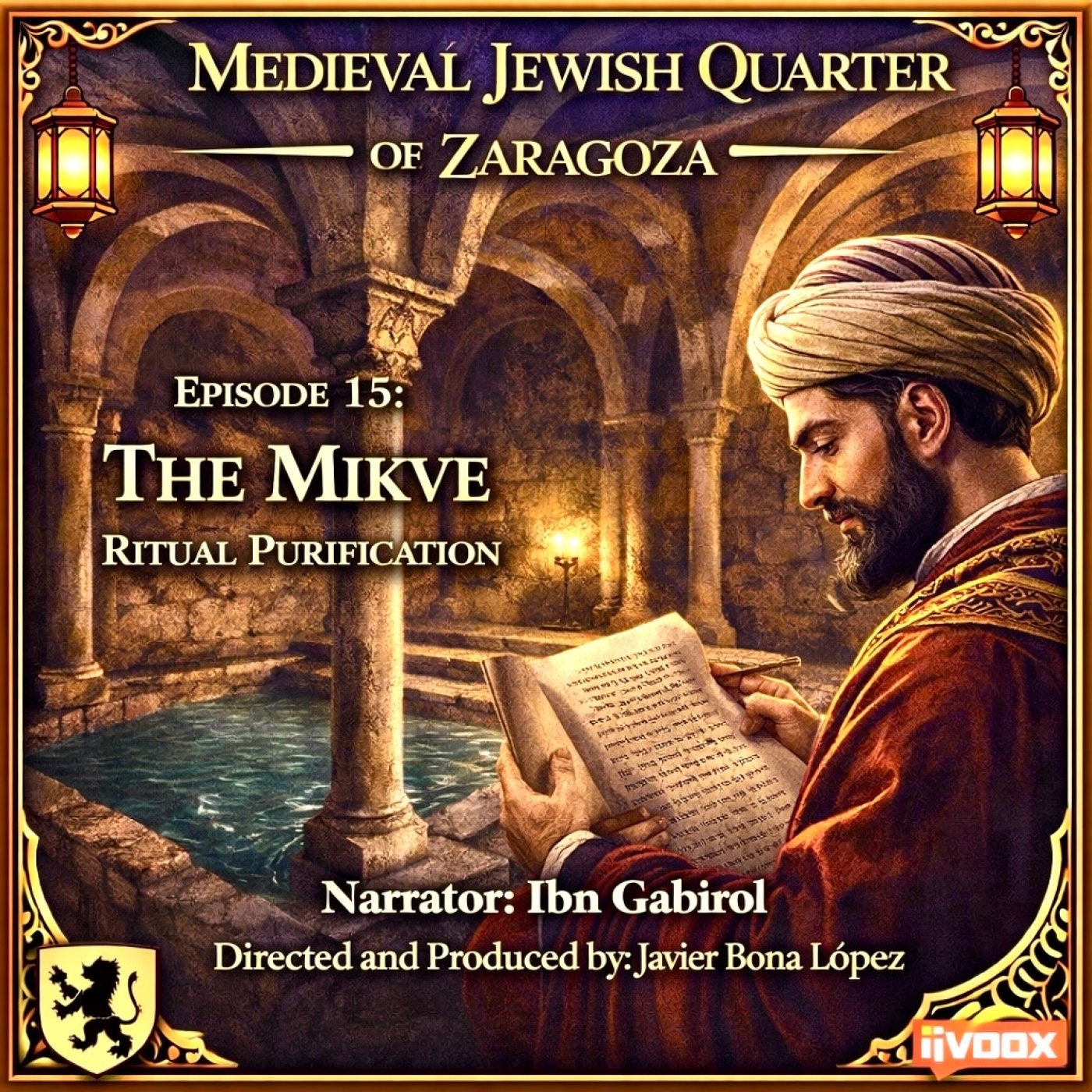
CHAPTER 15: THE MIKVÉH – RITUAL PURIFICATION
from Judería medieval Zaragoza/Jewish quarter Zaragoza
CHAPTER 15: THE MIKVÉH – RITUAL PURIFICATION Narrator: Ibn Gabirol (Shlomo ibn Gabirol, 1021–1058/70) Direction and Production: Javier Bona López Research and Consultation: Miguel Ángel Motis Dolader (San Jorge University of Zaragoza) Zakhor. Remember. Remember the whisper of water in the darkness, the echo of a blessing on the damp stone, the rebirth of a soul in the liquid embrace of the earth. Today, my steps lead me to a place that does not resonate with the clamor of the market nor with the debate of the academies. I head to the secret heart of the Jewish quarter, to a space of silence and mystery, where body and spirit meet, where life is purified and renewed. Today, I will speak to you of the mikvéh. In our tradition, the world is governed by a delicate balance between the pure and the impure, between taharah and tumah. It is not a moral judgment, not good versus evil. It is a state of being, a spiritual condition that brings us closer to or farther from the sacred. Death, certain illnesses, the vital flow of existence… all immerse us temporarily in a state of tumah, a ritual distance that prevents us from presenting ourselves before the Eternal in His fullness. And to restore that bridge, to return to the state of taharah, we need a primordial element, a divine gift older than humanity itself: water. But not just any water. We need mayim jayim, living water. Living water is that which has not stagnated nor been drawn by human hand. It is the water of rain falling from the sky, the water of a spring bursting from the earth’s depths, the water of a river flowing steadily toward the sea. It is the water of Creation, upon which the spirit of God hovered at the first dawn of time. And the mikvéh, our ritual bath, is the sacred vessel designed to contain that living water, to allow us to immerse ourselves in it and be reborn. It is not a mere bath for bodily hygiene; it is a sanctuary for the purification of the soul. A womb of stone and water where life regenerates, a portal that returns us to original purity. Come with me. Descend the steps into the gloom, feel the moisture in the air, listen to the silence heavy with prayers. Let us unveil the history of the mikvéh of Zaragoza, a place as fundamental to our existence as the synagogue or the home, a secret jealously guarded in the heart of the aljama. A STONE AND TIME ERROR: THE KING’S BATHS AND THE MIKVÉH Before immersing ourselves in the sacred waters of our mikvéh, I must untie a knot in the memory of this city, a stone and time error that has confused generations. If today you stroll along the Coso Bajo, near where our Jewish quarter began to breathe, you will find baths of Mudéjar architecture, a jewel of the 13th century. For a long time, the inhabitants of Zaragoza have called them “the Jewish baths.” It is an understandable mistake, but a mistake nonetheless. Those baths, known as the King’s Baths, were a public establishment. Their vaulted halls, alabaster columns, and pools of hot and cold water welcomed Christians, Muslims, and Jews alike. They were a place for cleanliness, health, and social life, a space where bodies relaxed and conversations flowed. It is true that, during the 15th century, my own family, the Cavallería, managed them by royal concession. Don Benvenist de la Cavallería, his wife Doña Tolosana, and their children zealously administered those facilities, ensuring their proper functioning. But their function was public, not ritual. They were a business, a service to the city, not a sanctuary for the Jewish soul. Our mikvéh was something else. Its essence, purpose, and location were radically different. Do not look for it on the bustling facade of the Coso. To find it, you had to venture into the labyrinth of our aljama, into the sacred space nestled beside the imposing Roman wall, those old “Piedras del Coso” that saw us born and grow. The mikvéh was there, in the heart of communal life, very close to the Great Synagogue. Its access was discreet, through a callizo, a dead-end alley that opened onto the Plaza del Castillo de los Judíos, our fortress and archive. It was not a place of passage, but a destination. One did not arrive there by chance, but with intention. The difference is fundamental. The King’s Baths were for the body; the mikvéh, for the soul. The former were a meeting place between cultures; the latter, an exclusive sanctuary for the observance of the Halajá, our law. To confuse them is like confusing the market with the temple, the public square with the home. Therefore, today, I ask you to forget the image of the baths of the Coso and accompany me to the true heart of Jewish purity in Zaragoza, to that hidden and sacred place that defined our spiritual life. ARCHITECTURE OF THE SACRED: BUILDING THE MIKVÉH The mikvéh was not a building that rose toward the sky, but a construction that sank into the earth. It was, by necessity and symbolism, a semi-subterranean work. Its design did not seek ostentation, but a direct connection with the sources of life, with the primordial waters lying beneath our feet. In a city like Zaragoza, embraced by the mighty Ebro, finding those waters was not difficult. The builders, masters in the art of reading the earth, dug until reaching the water table, allowing the underground water, pure and living, to spring directly into the ritual pool. Imagine the scene. Workers digging into the clayey earth of the aljama, not to raise walls, but to find a spring. The structure was built around this natural source. The walls were of sturdy stone and brick, materials speaking the architectural language of Aragón, perhaps with some alabaster detail brought from nearby quarries. There were no large windows nor superfluous adornments. The light, if any, was scarce, filtered from above, creating an atmosphere of gloom and introspection. The mikvéh was a womb, a sacred cave, a return to origin. The design had to scrupulously comply with the precepts of the Halajá, Jewish law, which is precise and demanding in the construction of a mikvéh. The ritual pool, the heart of the complex, had to contain a minimum volume of forty seah of water, an ancient measure equivalent to about 575 liters. This amount is not arbitrary; the sages calculated it as the volume necessary for a human body of average size to immerse completely, so that no part, not even the tip of a hair, remains outside the water. The water, as I have said, had to be mayim jayim, living water. This means it had to reach the pool naturally. It could not be drawn with buckets, nor pumped by a waterwheel, nor transported in containers. It had to flow directly from a natural source (a spring, an underground river) or be rainwater collected and channeled to the mikvéh. For this reason, many mikvés had a secondary reservoir, called bor ha-tevilá, where rainwater was gathered, then brought into contact with the water of the main pool to “vivify” it. Moreover, the pool itself could not be a movable object, like a tub or basin. It had to be built directly into the ground, forming part of the building, an extension of the earth itself. A staircase, generally of seven steps symbolizing the seven days of Creation, descended to the bottom of the pool, allowing a gradual and respectful immersion. Next to the ritual pool, there was usually a preparation room. It was a space where the person could undress and wash thoroughly before immersion. Because for the purification to be valid, the living water must touch every millimeter of the body. There can be no barrier, no chatzitzah: not a speck of dust, not a knot in the hair, not a jewel, not even nail polish. The body had to be completely clean and naked before entering the sacred waters. Although archaeology has yet to unearth our Zaragoza mikvéh, documents and logic allow us to reconstruct it in the imagination. A humble yet powerful space, dug into the earth, where architecture served the deepest faith, creating a tangible bridge between human being and the waters of Creation. THE WATERS OF LIFE: FUNCTIONS OF THE MIKVÉH The mikvéh was the epicenter of ritual life in the aljama, a place whose waters touched every aspect of our existence, from birth to death, from the most intimate to the most communal. Its functions were multiple, all aimed at restoring purity and maintaining holiness amid daily life. The Secret of Women: The Purification of Niddah The most important and frequent function of the mikvéh was linked to the cycle of life, to the mystery of the female body. According to the Torah, a woman, during her menstrual period and the seven days following, is in a state of niddah, a ritual impurity that implies a temporary separation in marital life. It is not a stigma nor a punishment, but the recognition of a powerful vital process. Blood is life, but also a symbol of life that could have been and was not. This state of niddah demands a time of respect and distance. At the end of this period, on the night of the seventh day without flow, the Jewish woman had the duty and right to go to the mikvéh. It was a deeply personal and spiritual moment. First, in the preparation room, she washed meticulously. She combed her hair to undo any knots, trimmed her nails, removed any adornments. Her body had to be a clean canvas to receive the embrace of living water. Then, naked as on the day of her birth, she descended the seven steps to the ritual pool. There, under the attentive and respectful gaze of the balanit, the mikvéh attendant, she performed the tevilá, the immersion. She submerged completely, ensuring every part of her body, every hair, was covered by the water. Upon emerging, she recited the blessing: “Baruch atá Adonai, Eloheinu Melech ha'olam, asher kideshanu bemitzvotav vetzivanu al ha-tevilá” (Blessed are You, Lord our God, King of the universe, who has sanctified us with His commandments and commanded us concerning the immersion). The immersion was often repeated three times, a number loaded with symbolism in our tradition. Upon leaving the mikvéh, the woman was reborn. The state of niddah disappeared, and she returned to a state of taharah, purity. She could resume intimate life with her husband. This monthly cycle, known as taharat ha-mishpajá (family purity), was not a burden but a pillar of Jewish marital life. It imposed a rhythm of closeness and distance, of longing and reunion, which, according to our sages, kept passion alive and elevated the marital relationship to a sphere of holiness. The mikvéh was, therefore, the guardian of the sanctity of the home and the continuity of our people. Preparation for the Sacred: Festivals and Conversion The mikvéh was not an exclusively female space. Men also came to its waters, especially before great festivals. Before Yom Kippur, the Day of Atonement, immersion helped purify the soul before presenting oneself before divine judgment. Before the three pilgrimage festivals—Pesaj, Shavuot, and Sukkot—tevilá was a way to prepare spiritually to celebrate the great milestones of our history. Likewise, the mikvéh was a gateway to our community. When a gentile, a non-Jew, decided to embrace the faith of Israel, immersion in the mikvéh was the final and indispensable step of conversion. After studying the Torah and being circumcised (in the case of men), the convert immersed in the living waters before the presence of a bet din, a tribunal of three rabbis. Upon emerging, he was considered a full Jew, a new soul born within the people of Israel. The mikvéh was, literally, the womb of his new identity. Purifying the Everyday: Utensils and the Ebro River The need for purity extended also to everyday objects. When acquiring metal or glass kitchen utensils from a non-Jew, they had to be immersed in the mikvéh before being used to prepare kosher food. It was a way to purify them of any ritual impurity they might have contracted and consecrate them to the service of a Jewish home. But what happened if the mikvéh was unavailable or if the quantity of objects to purify was immense, as in the great cleaning before Pesaj? For this, we had an alternative, a natural mikvéh of colossal dimensions: the Ebro River. We know of this practice thanks to an extraordinary document: a letter from King Pedro IV, dated 1341. In it, the monarch orders his officials to protect the Jews of Zaragoza and not allow anyone to disturb them “when, before their major festivals, they purify their utensils and clothes in the river.” This document is a jewel. It not only confirms the practice of purification in the river but shows the royal protection that sheltered our customs. However, purifying oneself in the river was not without dangers. It implied public exposure, the risk of currents, and the discomfort of cold water. Therefore, although the Ebro was a valid option according to Halajá, the mikvéh of the Jewish quarter remained the preferred place: an intimate, safe space designed specifically for the sacred encounter with the waters of life. GUARDIANS OF PURITY: THE ROLE OF WOMEN IN THE MIKVÉH If the mikvéh was the heart of family purity, women were its guardians. This space, although occasionally visited by men, belonged essentially to the female universe. It was a world of women, governed by women, for the holiness of women and, through them, of the entire community. The Balanit: Wisdom and Discretion At the center of this universe stood a figure of immense importance and respect: the balanit, the mikvéh attendant. She was not a mere employee. The balanit was a wise woman, often elderly, with deep knowledge of the complex laws of niddah and tevilá. Her role was crucial to ensure that purification was performed correctly. She was the one who received the women who came at dusk. With a mixture of authority and tenderness, she guided them through the process. She ensured that the mikvéh water was clean and at the right temperature, and that its level was correct. But her most delicate task was to supervise the immersion. With trained eyes, she verified that the woman submerged completely, that not a single hair floated on the surface. If she detected any impediment (chatzitzah), she discreetly pointed it out so it could be corrected. Her word was law in this sacred domain. The balanit was also a confidante. In the intimacy of the mikvéh, women shared their joys and sorrows, their hopes of conceiving, their concerns about health and family. The balanit listened, advised, and above all, kept silence. Confidentiality was her most sacred vow. What happened in the mikvéh stayed in the mikvéh. She was a pillar of the community, a spiritual matriarch who watched over the continuity and holiness of our people. A Sacred Female Space The mikvéh was much more than a place of individual purification. It was a space of socialization and strengthening of female bonds. In a society where public life was dominated by men, the mikvéh offered women their own sanctuary. There, free from the male gaze, grandmothers, mothers, daughters, and daughters-in-law met. The elders transmitted their wisdom to the younger ones, not only about the laws of niddah but about the secrets of marital life, pregnancy, childbirth, and child-rearing. In the gloom of the mikvéh, an invisible network of support and solidarity was woven. Good news was celebrated, such as a long-awaited pregnancy. Sorrows were consoled, like difficulty conceiving or the loss of a child. Friendships and alliances were forged that later extended into daily life in the aljama. It was a space of female power, a silent and profound power, based on shared experience and common spirituality. The Laws of Niddah: Sanctifying the Home Understanding the role of women in the mikvéh is impossible without grasping the depth of the laws of taharat ha-mishpajá, family purity. From the outside, the temporary separation during the period of niddah may seem a restriction, an exclusion. But from within, it is lived as a spiritual discipline that sanctifies marriage. This monthly rhythm of separation and reunion creates a cycle of longing and renewal. It forces the couple to relate beyond the physical, to cultivate conversation, friendship, and mutual respect. When the moment of union arrives after immersion in the mikvéh, it is not a routine act but a celebration, a reunion full of expectation and holiness. It is as if every month were a new honeymoon. Women, by scrupulously observing these laws and attending the mikvéh, did not merely fulfill a religious precept. They became the architects of the sanctity of their own home. They were those who, through their body and faith, maintained the delicate balance between the sacred and the profane, ensuring that the divine presence, the Shejiná, dwelled in their houses and blessed their families. The mikvéh was the source from which that sanctity flowed, and women, its priestesses. THE BEATING HEART OF THE ALJAMA: SOCIAL CONTEXT The mikvéh was not an island. It formed part of an incredibly rich and organized social and religious ecosystem, a network of institutions that allowed the Jewish community of Zaragoza to live a full life according to its traditions, even amid a often hostile Christian environment. A Network of Ritual Services Imagine the life of a Jew in our aljama. Upon waking, he prays in one of our twelve synagogues. Then, he goes to the market, but not to just any stall. He buys meat in the kosher butcheries, where the shojet, the ritual slaughterer, has performed sejitá according to the Torah’s rules. He buys bread, but if it is Pesaj season, he ensures it is matzá, unleavened bread baked in the communal ovens. He drinks wine, but only judiego wine, supervised by the rabbinate to guarantee its purity. In this network of services, the mikvéh was a central piece. It was the place that guaranteed the purity of people and, by extension, of everything they touched and consumed. Without the mikvéh, kosher life would be impossible. It was the starting point, the source from which the holiness that permeated every corner of communal life emanated. The Government of the Aljama and Mutual Aid This complex ritual life was governed by the aljama itself, which functioned as a city within the city, with its own government and laws. The Adelantados or Mucaddemin were our mayors, representatives before the king. The Dayyamin were our judges, resolving disputes according to Halajá. The Bedín was our prosecutor, ensuring compliance with ordinances. But government was not everything. The true strength of the community lay in its social fabric, in the haburót, mutual aid brotherhoods. If someone fell ill, the Bicurholim brotherhood sent doctors and volunteers to care for them. If a family fell into poverty, Malbish Arumim provided clothing and Guemilut Hasadim offered interest-free loans. If a child lacked resources to study, Talmud Torá financed their education. And if someone died, Nocé Amita and Cabarim ensured a dignified burial according to our rites. In this context of solidarity and self-organization, the mikvéh was a symbol of the community’s collective responsibility to maintain its identity and holiness. Its construction and maintenance were financed by the aljama, and access was guaranteed for all, rich and poor alike. It was a common heritage, a spiritual good that united us all. TRACES ON PARCHMENT: DOCUMENTARY MEMORY Although the pickaxe of time and intolerance erased our mikvéh from the face of the earth, its memory survives in the folds of old parchments, in documents that have slept for centuries in archives. They are faint traces, whispers of history that today’s scholars, like my good friend Miguel Ángel Motis Dolader, strive to decipher. In the Historical Archive of Protocols of Zaragoza (AHPZ), 15th-century documents speak of the mikvéh indirectly. They are contracts for the sale of houses and lands in the Jewish quarter. When describing the boundaries of a property, the scribe notes: “…and borders to the east with the women’s bath…” or “…next to the alley that leads to the ritual bath…”. They do not describe the building but confirm its existence and location in the heart of the aljama, near the synagogue and the castle. A document from 1495, published by the great researcher Serrano y Sanz in 1923, already mentioned this reality, although perhaps without giving it all the importance it deserved. It is these small mentions, these clues hidden in the legal language of the time, that allow us today to reconstruct the map of our lost Jewish quarter and place on it, with moving certainty, the place where our women were reborn in the water. And then there is the aforementioned letter from Pedro IV of 1341, that treasure that speaks to us of purification in the Ebro River. This document not only offers us a vivid vision of ritual life outside the walls of the aljama, but by contrast, underscores the importance of the mikvéh. If the king had to issue an order to protect those who purified themselves in the river, it was because this practice involved risks. The mikvéh, in contrast, offered safety, privacy, and the dignity that such a sacred act required. It is also important to mention again the Cavallería family. Their name appears linked to the baths, yes, but to the King’s Baths on the Coso. They were entrepreneurs, managers of a public business. Their history is fascinating and reveals the power and influence of Zaragoza’s Jewish elite. But we must not confuse their role. They were not the guardians of the mikvéh. The mikvéh had no owners; it belonged to the entire community. Its guardian was the balanit, and its beneficiaries, all the women of Israel in Zaragoza. These documents are our time machine. They allow us to look over the shoulder of a 15th-century scribe, hear the voice of a 14th-century king, and reconstruct, piece by piece, the reality of a vanished world. The mikvéh of Zaragoza is not a legend; it is a historical reality, engraved in ink and parchment. THE SOUL AND THE WORD: GIANTS OF THOUGHT I cannot speak of the spiritual life of Zaragoza without honoring the memory of the giants who walked these same streets, men whose thought and poetry illuminated not only our aljama but the entire world. Their souls, like the water of the mikvéh, sought purity, connection with the source of all wisdom. I myself, Shelomó ibn Gabirol, though born in Málaga, found in Zaragoza my poetic and philosophical voice. It was here, under the protection of the vizier Yekutiel ben Isaac, that I composed many of my poems and conceived my great work, Fons Vitae, The Fountain of Life. I sought the source of all being, the universal matter and form, in an effort to unite Plato’s philosophy with Abraham’s faith. But my thought was bold, perhaps too much for my time. I suffered the incomprehension of many of my co-religionists, who accused me of straying from tradition. In 1045, the community of Zaragoza pronounced against me a herem, an excommunication, which forced me to depart, with a broken heart, southward. My story is a bitter reminder that the search for truth is often a lonely path. But I was not alone in this quest. Before me, in the 11th century, the judge of our aljama, Bahya ibn Paquda, wrote an immortal work, the Duties of the Heart. Bahya taught us that faith does not consist only in fulfilling external rites, but in cultivating internal virtues: humility, gratitude, trust in God. His book is a mikvéh for the soul, a guide to purify the heart of pride, envy, and vanity. And centuries later, at the crossroads of the 14th and 15th centuries, rose the imposing figure of Hasdai Crescas, chief rabbi of Zaragoza and one of the most original philosophers in Jewish history. In his work Or Adonai, The Light of the Lord, Crescas dared to challenge the giant Maimonides and his synthesis of faith and Aristotelianism. With astonishing intellectual audacity, he criticized Aristotelian concepts of space, time, and infinity, proposing ideas that, according to today’s sages, anticipated modern physics. Crescas taught us that faith should not fear reason, but inspire it to reach new heights. These men, and many others like them, created in Zaragoza a vibrant intellectual atmosphere. Their debates and writings were the spiritual nourishment of our community. And although their works soared to the highest spheres of metaphysics, their feet were firmly planted in the life of the aljama, a life governed by Halajá and sanctified by the waters of the mikvéh. Because in Judaism, body and soul, reason and ritual, are not separate. They are two sides of the same coin, two paths leading to the same God. SCENES OF DAILY LIFE: THE MIKVÉH IN ACTION Let us leave for a moment the books and documents, and try to imagine, to see with the eyes of the heart, what life around the mikvéh was like. Let the everyday scenes speak to us of its importance. Imagine a young wife, let us call her Rahel. It is her first time in the mikvéh after her wedding. She is nervous. Her mother has explained the laws, but everything is new and solemn. The balanit, an elderly woman with kind eyes, receives her with a smile. “Do not fear, my daughter,” she says. In the preparation room, Rahel washes carefully, thinking of her mother’s words: “Each immersion is a renewal of your covenant with God and your husband.” She descends the steps; the cold water makes her skin prickle. She closes her eyes, recites the blessing with a trembling voice, and submerges. Upon emerging, she feels different, complete. A woman of Israel. Now, imagine a craftsman, David the coppersmith. He has just bought a batch of copper pots from a Christian merchant. They are good quality but not kosher. David takes them to the mikvéh. It is not night, but broad daylight. The space is empty, silent. One by one, he immerses each pot in the living water, reciting the corresponding blessing. It is a simple, almost mechanical act, but for David it is charged with meaning. He is transforming a profane object into a sacred utensil, fit to cook the food that will nourish his family according to the laws of the Torah. Visualize now the eve of Pesaj. The Jewish quarter is a hive of activity. Houses have been cleaned of any trace of chametz, leaven. At the river, outside the wall, a group of men and women purify large quantities of dishes, taking advantage of the protection granted by the king’s letter. The water of the Ebro is cold, but the atmosphere is festive. It is a communal work, a collective preparation for the great Festival of Freedom. Finally, imagine a stranger, a man arrived from the distant lands of Germania. He has decided to join our people. After months of study and the painful test of circumcision, the day of his rebirth arrives. Three rabbis, among them the great Hasdai Crescas, accompany him to the mikvéh. They ask the final questions to ensure the sincerity of his heart. Then, the man immerses in the water. Upon emerging, he is no longer the same. He is a Jewish soul. The rabbis embrace him and welcome him with the words of the psalmist: “Happy is the man who does not follow the counsel of the wicked.” He has been born again in the waters of the mikvéh of Zaragoza. These scenes, and a thousand more like them, formed the living fabric of our community. The mikvéh was not a monument, but a stage of life, a place where faith became flesh, where the great principles of the Torah translated into daily gestures of purification and holiness. THE SYMBOLISM OF WATER: AN OCEAN OF MEANING Why water? Why this element, and not another, has the power to purify? To understand the mikvéh, we must immerse ourselves in the ocean of symbolism that water represents in our tradition. From the very first page of the Torah, water is present as the source of all life. “And the spirit of God hovered over the face of the waters,” we read in Genesis. Before light, before earth, before man, there was water. It is the primordial element, the womb of Creation. To immerse in the mikvéh is, in a way, to return to that original state, to that moment before creation, to emerge anew, purified and renewed. It is a return to the cosmic womb. The water of the mikvéh also symbolizes the maternal womb. By immersing completely, we find ourselves in a state similar to the fetus in its mother’s womb: floating in a vital liquid, in a world without air, without sound, without individuality. Upon emerging, we breathe again, like a newborn. That is why conversion is considered a birth, and the purification of niddah, a monthly rebirth. Water cleanses, washes, dissolves. This physical property becomes a powerful spiritual symbol. By immersing, we not only wash our body but symbolically dissolve our impurities, our mistakes, our sorrows. The water of the mikvéh is not magical water that erases sins; repentance and the will to change are indispensable. But immersion is the physical act that seals that internal process, making it real and tangible. In our tradition, water is also a symbol of the Torah. Just as water descends from the heavens to give life to the earth, the Torah descended from Sinai to give life to our souls. Just as there is no physical life without water, there is no Jewish spiritual life without Torah. To immerse in the mikvéh is like immersing oneself in the ocean of divine wisdom, to come out strengthened and vivified. Finally, the water of the mikvéh connects us with the great moments of our history. It reminds us of the waters of the Flood, which purified the world of its corruption. It reminds us of the waters of the Red Sea, which parted to let us pass from slavery to freedom. It reminds us of the waters of the Jordan, which our people crossed to enter the Promised Land. Each immersion is an echo of those foundational moments, a reaffirmation of our covenant with God and our place in the history of salvation. For all these reasons, the tevilá, the immersion, is an act of immense depth. It is not a simple bath, but a cosmic drama in miniature, an act of creation, birth, purification, and redemption. It is the secret hidden in the heart of stone and water of the aljama. SILENCE AND MEMORY: THE DISAPPEARANCE OF THE MIKVÉH But hearts, even those of stone, can stop beating. The vibrant ecosystem of the Jewish quarter of Zaragoza was not eternal. Dark clouds began to gather on the horizon of Sefarad, and our carefully built world began to crumble. The year 1391 was a terrible omen. A wave of anti-Jewish violence, preached by the archdeacon of Écija, Ferrán Martínez, swept the peninsula. Although Zaragoza did not suffer the same devastation as Seville or Barcelona, the violence reached our doors. The Jewish quarter was attacked, and many of our brothers were killed or forced to convert under threat of death. Trust was broken. Fear, a slow poison, began to seep into the cracks of our community. The 15th century was the century of great pressure. Theological disputes, like the famous Disputation of Tortosa, became conversion machines. The preaching of saints like Vicente Ferrer, with his mix of eloquence and threat, pushed thousands of Jews to baptism. Entire families, some of great lineage, abandoned the faith of their fathers to become “new Christians,” the conversos, often viewed with suspicion by both old Christians and Jews who remained faithful. And then, the end came. In 1492, the Catholic Monarchs, Isabel and Fernando, signed the Edict of Expulsion. They gave us a choice: baptism or exile. For most of us, there was no choice. Abandoning the Torah was like tearing out the soul. And so, within a few months, we had to sell our houses, our workshops, our memories, and prepare to leave. Imagine the silence that fell over the aljama in those last days. The synagogues, once full of songs, fell silent. The market, once a hive of activity, emptied. And the mikvéh, the heart of our ritual life, was left without women coming to its waters. The last balanit closed the door for the last time, perhaps with tears in her eyes. The living water continued to spring in the dark, but there was no one to receive its blessing. After our departure, the aljama was occupied by Christians. The synagogues became churches or private homes. The cemetery was desecrated. And the mikvéh, our best-kept secret, was probably sealed, filled with earth and rubble, and forgotten. A new building was constructed above it, erasing its memory from the city’s surface. But memory is more resilient than stone. The exiles of Zaragoza, the Sarakustim, carried their traditions with them wherever they went. In the new Jewish quarters of Salonika, Smyrna, Istanbul, Jerusalem, they built new mikvés, and in them, women continued to fulfill the rite of purification, telling their daughters the story of the lost community, of distant Sefarad. The physical mikvéh of Zaragoza disappeared, but its spirit, its essence, survived in the heart of our scattered people. Today, archaeologists search for its remains beneath the streets of the modern city. Perhaps one day, an excavator will stumble upon a stone staircase descending into darkness, a pool still holding the echo of ancient blessings. It would be a miracle, a reunion with our past. But even if they never find it, the mikvéh of Zaragoza is not lost. It lives in documents, in tradition, in memory. And it lives in these words, which I have woven for you, so that you do not forget. ZAKHOR. REMEMBER. Remember the mikvéh. Remember that in the heart of our bustling aljama, there was a place of silence and water, a sanctuary for the soul. Remember that purity was not an obsession, but a way to sanctify life, to elevate the everyday to a sacred sphere. Remember the women of Zaragoza, the guardians of that purity. Remember their courage, their faith, their silent devotion. They were the pillars upon which the holiness of our people rested. Their monthly immersion in the living waters was not an act of submission, but of spiritual power, a power that renewed life and ensured the future. Remember that, although the stone building has disappeared, the tradition of the mikvéh continues. In every corner of the world where a Jewish community lives and prays, there is a mikvéh. The living water continues flowing, purifying, renewing. The legacy of the mikvéh of Zaragoza is not a pile of ruins, but an uninterrupted current of faith that has crossed the centuries. Water always finds its way. It flows, adapts, skirts obstacles, but never ceases to advance toward the sea. Such is the memory of our people. It can be buried, silenced, persecuted, but it always finds a crack through which to spring anew, to bear witness to a life that was and a faith that is. The water of the mikvéh of Zaragoza still flows in the river of memory. You only have to lean down, listen, and drink. CREDITS AND SOURCES Narrator: Ibn Gabirol (Shlomo ibn Gabirol, 1021–1058/70) Direction and Production: Javier Bona López Research and Consultation: Miguel Ángel Motis Dolader (San Jorge University of Zaragoza) Main Sources: • Asunción Blasco Martínez. The Jewish Quarter of Zaragoza in the 14th Century. Instituto Fernando el Católico (IFC), 1988. • Miguel Ángel Motis Dolader. The Jewish Quarter of Zaragoza: Center of Economic and Social Life. Rolde de Estudios Aragoneses. • Miguel Ángel Motis-Dolader, Ana Ruiz-Varona, Lourdes Pérez-López. “Urban Morphology and Functional Hierarchy of the Jewish Quarter of Zaragoza (Spain) at the End of the Fifteenth Century.” Journal of Urban History, 2023. • Ángel Canellas López. The Jewish Quarter of Zaragoza. Cuadernos de Zaragoza, no. 2, 1974. • Asunción Blasco Martínez & Susana Lozano Gracia. The Jewish Quarter of Zaragoza—Step by Step. City of Zaragoza, 2023. • Sefarad Aragón. The Disappeared Jewish Quarter of Zaragoza. Self-published, 2010. • Leopoldo Torres Balbás. Studies on the Jewish Quarter of Zaragoza and Its Baths. • Cultural Heritage of Aragón. Institutional files. • Guide to the Jewish Quarter of Zaragoza. City of Zaragoza. • Municipal Archive of Zaragoza (AMZ). Historical maps. • Joseph Pérez. The Jews in Spain. Marcial Pons Historia, 2005. Final Note: “If you enjoyed this chapter, I invite you to share and spread it. You can also listen to our other series on the medieval Jewish quarters of Calatayud, Tarazona, and Híjar on the three main podcast platforms.” Zakhor. Remember. Shalom. Shalom.
Embed this episode
NOW PLAYING
CHAPTER 15: THE MIKVÉH – RITUAL PURIFICATION
No transcript for this episode yet
Similar Episodes
No similar episodes found.
Similar Podcasts
No similar podcasts found.