
EPISODE · Feb 15, 2026 · 23 MIN
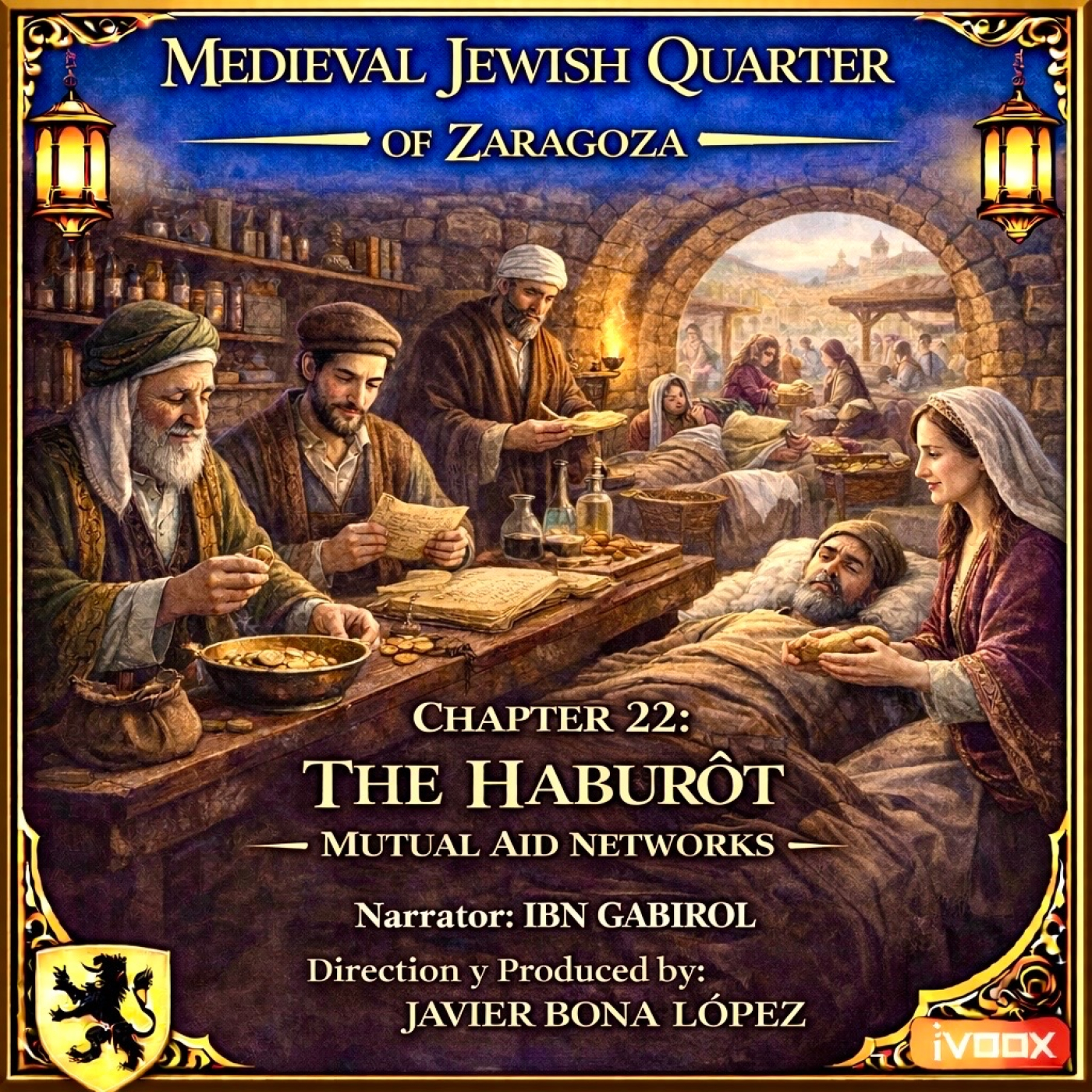
CHAPTER 22: THE HABURÔT – A NETWORK OF MUTUAL AID
from Judería medieval Zaragoza/Jewish quarter Zaragoza
CHAPTER 22: THE HABURÔT – A NETWORK OF MUTUAL AID SYNOPSIS Chapter 22 explores the solidaristic heart of the medieval Jewish quarter of Zaragoza through its Haburot (חברה), the brotherhoods or confraternities that formed an invisible yet indestructible network of mutual aid. Narrated by Shelomó ibn Gabirol, this episode reveals how the Jewish community of Sarakusta built an extraordinarily advanced social welfare system for its time, based on the religious principle of Tzedakah (צדקה): justice as a sacred obligation, not merely charity. The chapter documents the structure, functions, and meaning of these fundamental institutions that covered every need of communal life, from the education of children to the care of the sick, from the dignity of the poor to the burial of the deceased. MAIN CONTENT 1. DEFINITION AND FUNCTIONS OF THE HABUROT The Haburot were brotherhoods that combined mutual aid among members with charitable assistance for the most disadvantaged. Their legal establishment required: • License from the King of Aragon (legal status and protection) • Ratified statutes (Takkanot – תקנות) • Affiliation with a synagogue (or construction of their own oratory) Their internal organization included wardens or stewards who managed funds from dues and donations, deciding how and to whom assistance would be given. 2. THE GREAT BROTHERHOODS Talmud Torah (תלמוד תורה) – 1329–1492 • Mission: Free education for poor children • Functions: Payment of teachers (melamedim), purchase of parchment and tablets • Impact: Social mobility through education • Infrastructure: Own synagogue in Abarraná Square Malbish Arumim (חברת מלביש ערומים) – 15th century • Mission: “Those who clothe the naked” • Functions: Collection of used clothing and production of new garments • Objective: Preserve the dignity (kavod) of those in need • Special activity: Intensified before major festivals (Shabbat, Passover, Rosh Hashanah) Bikur Holim (ביקור חולים) – From 1382 • Mission: “Visiting the sick” • Functions: Moral and material support for the sick and their families • Activities: Psalm readings, provision of food, temporary financial aid • Collaboration: Close relationship with the Jewish hospital • Infrastructure: Own synagogue Other important confraternities: • Hozé-Hezt: Dawn almsgiving (to avoid shame) • Nozé amitá: Bearers of coffins (dignified burial) • Rotfecédech, Lelezmuroz, Cabarim, Cefarim 3. GUILD CONFRATERNITIES Professional brotherhoods combining economic protection with mutual aid: • Hasquafim (חשקופים) – Shoemakers (statutes 1386) • Leather dressers – Lambskin tanners • Furriers (documented 1485) • Possibly turners and silversmiths Functions: • Weekly financial assistance in case of illness • Payment of physicians • Pensions for widows • Protection against Christian guild competition 4. THE JEWISH HOSPITAL Located near the Callizo del Toro, the spital de la judería was the institutional center of welfare. Infrastructure (14th century): • Two large communal halls (“palaces”) • Five private rooms • Nine beds + two pallets • Equipped kitchen • Wine cellar with reserves • Bedding and blankets Personnel: • Hospital wardens: daily management • Collaboration with confraternities (especially Bikur Holim) Services: • Care for poor sick individuals • Refuge for the destitute • Shelter for needy travelers 5. SOCIAL AND RELIGIOUS SIGNIFICANCE The Haburot embodied the Jewish concept of Tzedakah (צדקה): • Not charity, but justice and sacred obligation • Reflection of the conviction that no one should be abandoned • Social welfare system ahead of its time • Network covering life “from cradle to grave” Community impact: • Social cohesion • Social mobility through education • Preservation of human dignity • Economic and medical protection • Strengthening against external pressures 6. DECLINE WITH THE EXPULSION The Haburot system, which had functioned for more than two centuries, disappeared with the Expulsion of 1492, taking with it a unique model of communal solidarity in medieval Europe. If you have enjoyed this journey to the heart of our aljama, I invite you to share it. You can listen to other chapters and series about the medieval Jewish quarters of Aragon on major podcast platforms, including those of Calatayud, Tarazona, and Híjar. Zakhor. Remember. Shalom. CREDITS AND SOURCES Narrator: Ibn Gabirol (Shelomó ibn Gabirol, one thousand twenty-one to one thousand fifty-eight/seventy) Direction and Production: Javier Bona López Documentation and Advising: Miguel Ángel Motis Dolader (San Jorge University of Zaragoza) BIBLIOGRAPHY [1] Blasco Martínez, Asunción. "Jewish Socio-Religious Institutions of Zaragoza (Fourteenth–Fifteenth Centuries)." Sefarad, vol. fifty, no. two, nineteen ninety, pp. 279–302. [2] Canellas López, Ángel. "The Jewish Quarter of Zaragoza." Cuadernos de Zaragoza, no. two, nineteen seventy-four. [3] A.C. Sefarad Aragón. The Disappeared Jewish Quarter of Zaragoza. Self-published, two thousand ten. [4] Motis Dolader, Miguel Ángel. Various investigations on the Jewish quarter of Zaragoza. [5] Provincial Historical Archive of Zaragoza (AHPZ). Notarial protocols of the fourteenth and fifteenth centuries. Zakhor. Remember. Shalom.
Embed this episode
NOW PLAYING
CHAPTER 22: THE HABURÔT – A NETWORK OF MUTUAL AID
No transcript for this episode yet
Similar Episodes
No similar episodes found.
Similar Podcasts
No similar podcasts found.