
EPISODE · Feb 22, 2026 · 25 MIN
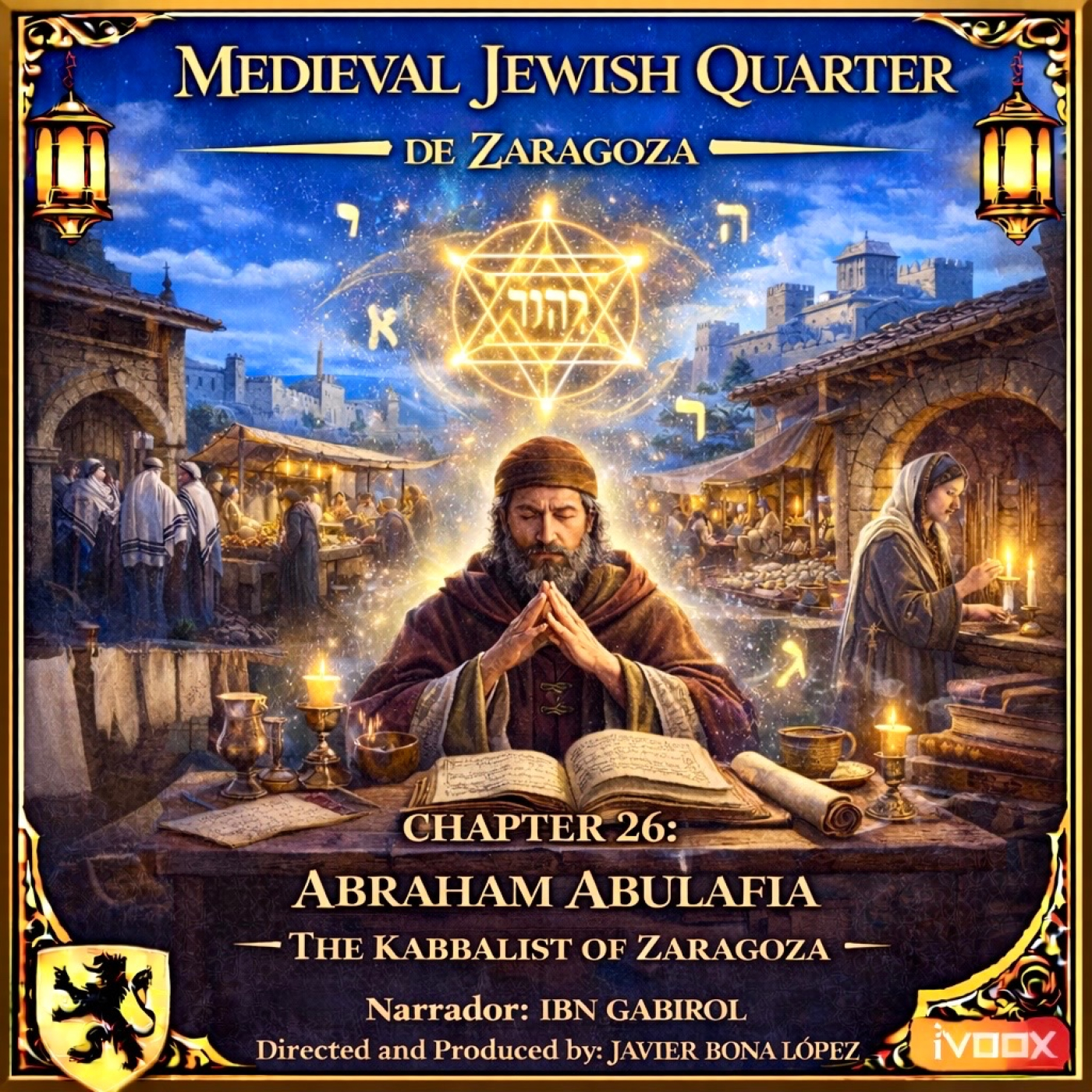
CHAPTER 26: ABRAHAM ABULAFIA – THE KABBALIST OF ZARAGOZA
from Judería medieval Zaragoza/Jewish quarter Zaragoza
CHAPTER 26: ABRAHAM ABULAFIA – THE KABBALIST OF ZARAGOZA Direction and Production: Javier Bona López Chapter 26 examines the figure of Abraham ben Samuel Abulafia (1240–c.1291), born in the Jewish quarter of Zaragoza, as one of the most radical and transformative thinkers of medieval Jewish mysticism. His trajectory represents a turning point between the rationalist tradition inherited from Maimónides and a new mystical path centered on the direct experience of prophecy. 1. Zaragoza as an Intellectual Crucible Thirteenth-century Zaragoza is portrayed as a space of cultural synthesis: Hebrew, Arabic, and Romance coexisted in a city shaped by the intellectual legacy of figures such as Ibn Gabirol and Bahya ibn Paquda. In this environment—where Aristotelian logic coexisted with Hebrew spirituality—the young Abulafia was formed. The Jewish aljama of Zaragoza provided access to philosophical texts, Hebrew grammar, and Talmudic tradition. This ecosystem allowed Abulafia to develop an independent and critical mindset, conceiving Judaism not as mere repetition of tradition but as a spiritual laboratory. 2. Wandering Youth and Inner Transformation After his father’s death in 1258, Abulafia embarked on an itinerant life across the Mediterranean. He attempted to travel to the Holy Land in search of the mythical River Sambation and the Lost Tribes of Israel, but the failure of this endeavor redirected his quest inward. This episode marked a symbolic turning point: sacred geography ceased to be external and became an inner experience. Exile and wandering were transformed into a spiritual method. 3. The Maimonidean Turn: Reason and Prophecy In Italy, Abulafia studied the Guide of the Perplexed intensively under Hillel of Verona. His reading of Maimonides was esoteric: he interpreted union with the Active Intellect as equivalent to prophetic experience. Here lies his doctrinal audacity: prophecy would not be an arbitrary divine gift, but a science of the soul attainable through disciplined technique. This democratized mystical experience and weakened rabbinic monopoly over divine mediation. 4. Prophetic Kabbalah versus Theosophical Kabbalah Abulafia established a crucial distinction: • Kabbalah of the Sefirot (theosophical): centered on the internal structure of the divine. • Kabbalah of the Names (ecstatic or prophetic): centered on the transformative experience of the individual. He criticized the hypostatization of the sefirot as bordering on polytheism. His approach was anthropocentric: the transformation of the subject through linguistic meditation techniques. 5. Hokhmat ha-Tzeruf: The Science of Combination The technical core of his system is Hokhmat ha-Tzeruf (the science of letter combination). Inspired by the Sefer Yetzirah, Abulafia conceived Hebrew letters as the atoms of creation. The method consisted of: • Permuting letters and divine names. • Reciting them with controlled breathing techniques. • Accompanying them with bodily movements. • Saturating the mind until discursive thought dissolved. The goal was to attain bitul ha-yesh (annihilation of the ego) and union with the divine source. The described experience is ecstatic, luminous, and profoundly transformative. 6. The Roman Episode and Messianic Tension In 1280 he traveled to Rome intending to reveal his doctrine to Pope Nicholas III. The sudden death of the pontiff before their meeting was interpreted by Abulafia as a providential sign. This act reinforced his messianic claims and alarmed rabbinic authorities, particularly Solomon ben Adret (Rashba), who regarded him as dangerous both theologically and politically. 7. Excommunication and Exile In 1285 the Rashba issued a herem (ban of excommunication) against Abulafia. Marginalized, he withdrew to the island of Comino (near Malta), where he composed major works including: • Sefer ha-Ot • Imrei Shefer • Otsar Eden Ganuz His isolation did not mean silence, but mystical deepening. 8. Later Influence and Legacy Although condemned in his lifetime, his influence proved decisive: • In the Safed Kabbalah (16th century), especially in Moses Cordovero and Chayyim Vital. • In Eastern European Hasidism. • In Renaissance humanism through Giovanni Pico della Mirandola. • In contemporary literature, notably El péndulo de Foucault by Umberto Eco, where a computer named “Abulafia” permutes data in homage to his method. In the twentieth century, scholars such as Gershom Scholem and Moshe Idel reclaimed him as a central figure in Jewish mysticism. 9. Conceptual Conclusion The chapter presents Abulafia as: • A spiritual revolutionary. • A synthesizer of reason and ecstasy. • A precursor to an “informational” conception of language. • A tragic figure caught between charisma and institution. His proposal shifts the center of gravity of religion from hierarchy to inner experience. Language ceases to be merely descriptive and becomes generative: it does not only name the world—it configures it. In essence, Abraham Abulafia represents a silent revolution: the idea that spiritual transformation depends not on temple or territory, but on disciplined work with consciousness and sacred language. His legacy is not a closed system, but a perpetual invitation to reorder the letters of one’s own existence. If you have enjoyed this journey to the heart of our aljama, I invite you to share it. You can listen to other chapters and series about the medieval Jewish quarters of Aragón on major podcast platforms, including of Calatayud, Tarazona, and Híjar. Narrator: Shelomó ibn Gabirol Direction and Production: Javier Bona López Documentation and Advising: Miguel Ángel Motis Dolader (San Jorge University of Zaragoza) Zakhor. Remember. Shalom SOURCES AND BIBLIOGRAPHY Primary Sources 1. Abraham Abulafia. Otsar Eden Ganuz (manuscript). 2. Abraham Abulafia. Sefer ha-Ot (manuscript). 3. Abraham Abulafia. Imrei Shefer (manuscript). Major Scholarly Studies 4. Moshe Idel. The Mystical Experience in Abraham Abulafia. State University of New York Press, 1988. 5. Moshe Idel. Kabbalah: New Perspectives. Yale University Press, 1988. 6. Gershom Scholem. Major Trends in Jewish Mysticism. Schocken Books, 1995. 7. Jiménez, Iosa Octa. “Abraham Abulafia.” Revista del Centro de Estudios Merindad de Tudela, no. 32 (2024). 8. Canellas López, Ángel. “La judería zaragozana.” Cuadernos de Zaragoza, no. 2 (1974).
Embed this episode
NOW PLAYING
CHAPTER 26: ABRAHAM ABULAFIA – THE KABBALIST OF ZARAGOZA
No transcript for this episode yet
Similar Episodes
No similar episodes found.
Similar Podcasts
No similar podcasts found.