
EPISODE · Feb 23, 2026 · 23 MIN
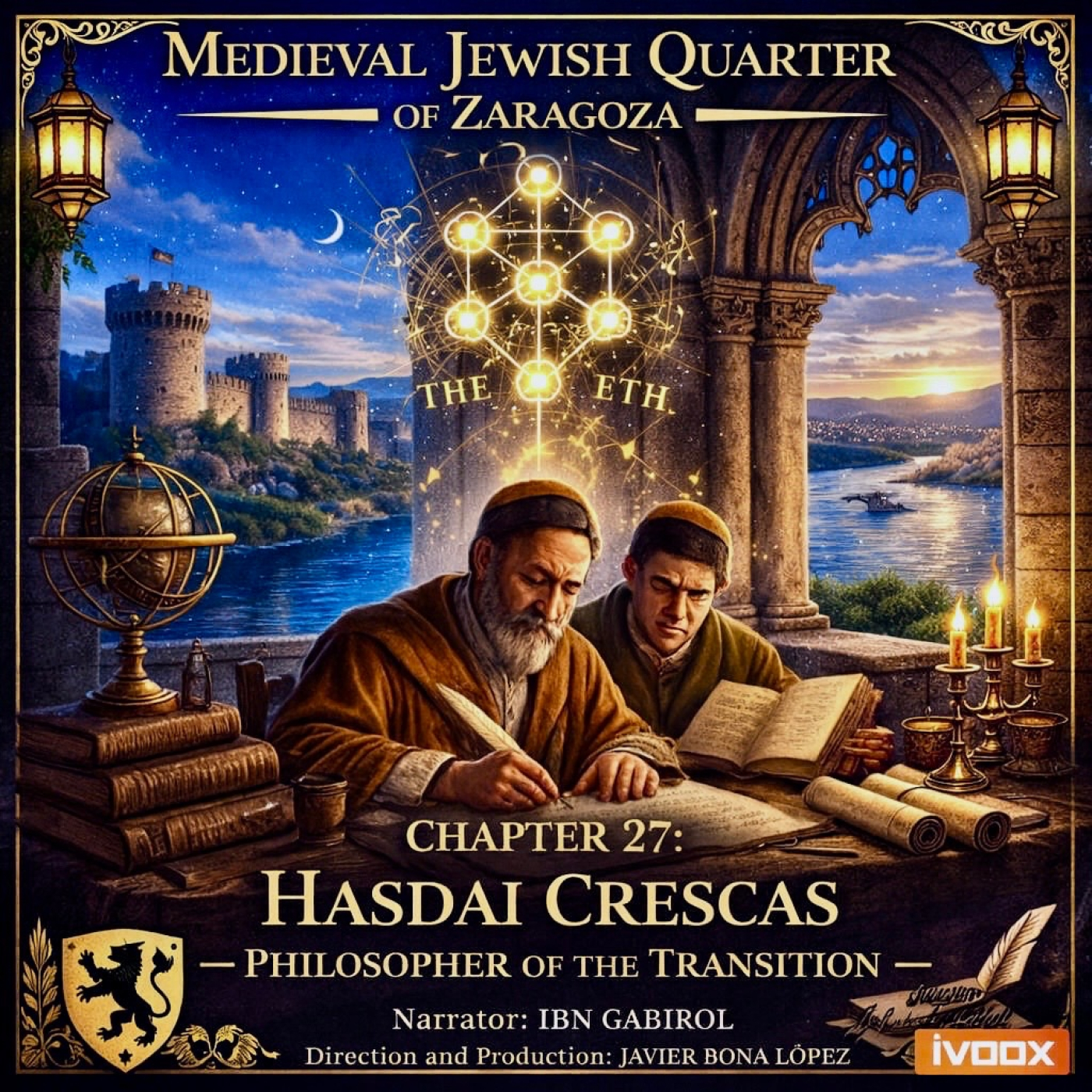
CHAPTER 27: HASDAI CRESCAS – PHILOSOPHER OF TRANSITION
from Judería medieval Zaragoza/Jewish quarter Zaragoza
CHAPTER 27: HASDAI CRESCAS – PHILOSOPHER OF TRANSITION Chapter 27 transports us to the tumultuous end of the 14th century in Sepharad, a time of profound existential crisis for the Jewish people, marked by the devastating massacres of 1391. In the midst of this darkness, the monumental figure of Hasdai ben Abraham Crescas (c. 1340-1410) emerges, the last great philosopher of Aragonese Jewry and a thinker who would lay the foundations for the transition from medieval thought to modernity. Born in Barcelona into an aristocratic family, Crescas was a direct witness to the violence that ravaged the aljamas of the Peninsula. Tragedy struck his life in the cruelest way with the murder of his only son, an event that became the catalyst for his intellectual revolution. Broken by grief, but imbued with an unwavering resilience, Crescas moved to Zaragoza, a city that stood as the last bastion of Jewish hope in Aragon. From there, he assumed the leadership of the decimated communities, acting not only as a rabbi and judge, but as a true statesman who reorganized community life and defended his people before kings and courts. The heart of the chapter delves into Crescas's magnum opus, "Or Adonai" (The Light of the Lord). This text is not just a philosophical treatise, but a bold and systematic deconstruction of the intellectual edifice of Aristotle that had dominated Jewish thought since Maimonides. Crescas argues that the dependence on Greek rationalism had left Judaism spiritually disarmed. With implacable logic, he attacks the 25 propositions of Aristotle's physics, demonstrating their inconsistencies to free God from the "chains" of philosophical necessity. Crescas's revolution is manifested in his conception of an infinite universe, populated by infinite possible worlds, and an empty space independent of matter. These ideas, which prefigure those of giants like Giordano Bruno, Galileo, and Newton, returned to God his absolute omnipotence. For Crescas, faith should not be subject to reason, but reason should serve to explore the depths of a faith anchored in love and will. The script explores how Crescas redefined the pillars of Judaism, shifting the center of gravity from the intellect (proper to Maimonides) to the love of God (devekut) and the joyful observance of the commandments. In his vision, salvation was accessible to all, not just to an elite of philosophers. This "democratization" of faith was his direct response to the crisis of 1391, offering a path of hope and meaning to a traumatized people. In addition to his metaphysical work, the chapter addresses his facet as a polemicist in his work "The Inconsistency of Christian Dogmas", a manual of intellectual resistance written in Catalan to defend the Jewish faith against the pressure of conversions. His complex position on determinism and free will is also analyzed, and his profound influence on later thinkers, especially Baruch Spinoza, who found in Crescas a precursor to his own theories on the divine attributes, extension, and the affects. In conclusion, the chapter presents Hasdai Crescas as a tragic and heroic figure, a "philosopher of the transition" who, from late medieval Zaragoza, transformed his personal pain into an intellectual light whose radiance reaches us to this day. His life and work are a testament to the power of human resilience and the ability of thought to forge new worlds even in the darkest moments of history. CONCLUSION: THE LIGHT OF THE LORD IN THE TWILIGHT OF SEPHARAD Hasdai Crescas was much more than a medieval rabbi; he was a revolutionary thinker who had the audacity to challenge the intellectual consensus of his time to save the spiritual integrity of his people. In Zaragoza, amidst the pain of losing his son and the destruction of his native communities, he was able to conceive of an infinite universe where divine love was not limited by crystal spheres or rigid syllogisms. His work represents the swan song of Jewish philosophy in Spain, a final radiance that, before the final expulsion, cast its seeds into the future, decisively influencing the birth of modern scientific and metaphysical thought. His life and work in 14th-century Zaragoza remain a testament that the most powerful reason is that which is born from a commitment to truth and unconditional love for one's own identity in times of greatest adversity. The transition that Crescas embodies is not just the passage from one century to another, but the transformation of a God-Intellect into a God-Love and of a closed cosmos into an infinite universe. In this sense, Crescas is not only a figure in Aragonese Jewish history, but a universal citizen of the republic of ideas. His "Light of the Lord," lit in the besieged Zaragoza of the 14th century, crossed the centuries to illuminate the corridors of the Renaissance academy and the writings of the fathers of modern philosophy. His legacy, although often subterranean and not always recognized, is proof that ideas, when powerful enough, cannot be contained by exile, censorship, or tragedy. The light of Hasdai Crescas, the light of an infinite universe driven by an infinite love, continues to cast its radiance on the foundations of our own understanding of the world. The story of Hasdai Crescas is, ultimately, a story about the resilience of the human spirit. It is the story of a man who, faced with the worst of tragedies, chose not despair, but reconstruction. Who, instead of cursing the darkness, lit a light so powerful that its brightness still reaches us. A light that reminds us that even in the darkest nights of history, the search for truth and the power of love can open the way to a new dawn. If you have enjoyed this journey to the heart of Jewish philosophy, I invite you to share it. You can listen to other chapters and series about the medieval Jewries of Aragon on the main podcasting platforms such as those of Calatayud, Tarazona, and Híjar. Zakhor. Remember. Shalom. CREDITS AND SOURCES Narrator:** Ibn Gabirol Direction and Production:** Javier Bona López Narrator: Shelomó ibn Gabirol Direction and Production: Javier Bona López Documentation and Advising: Miguel Ángel Motis Dolader (San Jorge University of Zaragoza) Documentation and Advice:** Based on the works of Asunción Blasco Martínez, José Lomba, Warren Zev Harvey, Moshe Idel, and Gershom Scholem. BIBLIOGRAPHY 1. Blasco Martínez, Asunción. "Azday/Hasday Cresques/Crescas: líder espiritual y hombre de Estado." *Tamid: Revista Catalana Anual d’Estudis Hebraics*, no. 15 (2020): 95-182. 2. Blasco Martínez, Asunción. *La Judería de Zaragoza en el siglo XIV*. Zaragoza, Institución Fernando el Católico, 1988. 3. Harvey, Warren Zev. *Physics and Metaphysics in Hasdai Crescas*. Amsterdam, Gieben Publisher, 1998. 4. Lomba Fuentes, Joaquín. *La filosofía judía en Zaragoza*. Zaragoza, Diputación General de Aragón, 1988. 5. Lomba Fuentes, Joaquín. *El Ebro: Puente de Europa. Pensamiento musulmán y judío*. Zaragoza, Mira Editores, 2002. 6. Pérez, Joseph. *Los judíos en España*. Madrid, Marcial Pons, 2005. 7. Ramón Guerrero, Rafael. “Hasday Crescas.” In *Pensamiento y mística hispanojudía y sefardí*, coordinated by J. Tarragona, Á. Sáez-Badillos, and R. Izquierdo, 145-164. Cuenca, Ediciones de la Universidad de Castilla-La Mancha, 2001. 8. Sáenz-Badillos, Ángel, and Judit Targarona Borrás. *Diccionario de autores judíos (Sefarad. Siglos X-XV)*. Córdoba, Ed. Almendro, 1988. 9. Sirat, Colette. *La philosophie juive médiévale en pays de Chrétienté*. Paris, Presses du CNRS, 1988
Embed this episode
NOW PLAYING
CHAPTER 27: HASDAI CRESCAS – PHILOSOPHER OF TRANSITION
No transcript for this episode yet
Similar Episodes
No similar episodes found.
Similar Podcasts
No similar podcasts found.