
EPISODE · Feb 24, 2026 · 21 MIN
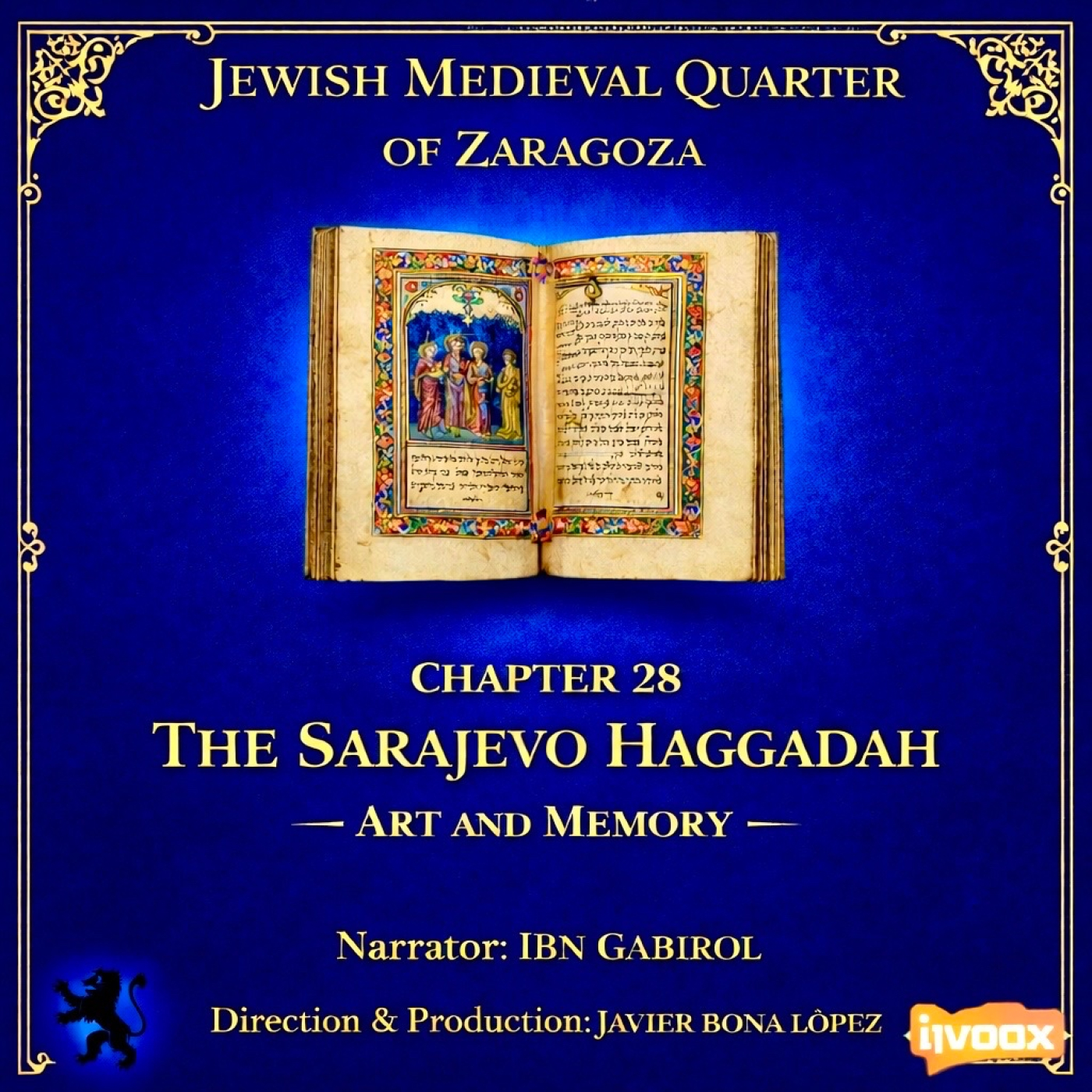
CHAPTER 28: SARAJEVO HAGGADAH – ART AND MEMORY
from Judería medieval Zaragoza/Jewish quarter Zaragoza
CHAPTER 28: SARAJEVO HAGGADAH – ART AND MEMORY Chapter 28 explores the history, artistic significance, and extraordinary survival of the Sarajevo Haggadah, one of the most important medieval Hebrew illuminated manuscripts in Europe. Far more than a liturgical book for Passover, it stands as a symbol of collective memory, Sephardic identity, and cultural resilience. Framed through the evocative voice of Ibn Gabirol, the episode presents the manuscript as a “bridge of paper and gold” connecting fourteenth-century Crown of Aragon to twenty-first-century Sarajevo. Its journey mirrors that of the Sephardic people themselves: splendor, persecution, exile, and survival. I. Birth in the Crown of Aragon The Haggadah was created around 1350, likely in a workshop in Zaragoza or Barcelona within the Crown of Aragon under Peter IV. Commissioned by a prominent Jewish family—possibly linked to the Alazar family of Zaragoza and the Shoshan family of Catalonia—the codex combines exceptional materials (fine vellum, burnished gold, rich pigments) with the aesthetic ambition of International Gothic art. Its iconographic program includes 69 miniatures, spanning from Creation to the Passover Seder, integrating biblical and midrashic traditions. The visual language is unmistakably European, while the narrative structure remains deeply Jewish—an exemplary synthesis of Sephardic cultural dialogue. II. Heraldic Clues and the Zaragoza–Barcelona Connection One folio displays heraldic shields: the bars of Aragon and two family emblems (a rose and a wing), suggesting a matrimonial alliance between influential Jewish lineages. The manuscript may have been a luxurious wedding gift—an expression of prestige, devotion, and symbolic capital. This context situates the Haggadah within a cultivated Jewish elite fully engaged in the economic and cultural life of the kingdom while maintaining strong religious identity. III. Art as Visual Theology The manuscript functions as theology in images. Biblical figures are dressed in fourteenth-century Aragonese courtly fashion, bringing sacred history into the lived present of its medieval audience. Scenes such as the synagogue exit or the Seder meal not only illustrate scripture—they document architecture, clothing, and material culture of Aragonese Jewish communities. The Haggadah operates simultaneously as: • A liturgical text • A pedagogical family guide • A visual historical document • A declaration of Sephardic identity Art historian Galia Pik has demonstrated how the miniatures provide insight into textiles, domestic interiors, ritual arrangement, and social hierarchies. The manuscript becomes a primary visual source for fourteenth-century Jewish daily life. IV. From Aragon to Exile After the 1492 Edict of Expulsion, the manuscript left Iberia with its owners. In 1609, in Italy, the inquisitorial censor Giovanni Domenico Vistorini certified that it contained nothing contrary to Christian doctrine—ironically ensuring its preservation. It later reached Sarajevo, where the Sephardic community safeguarded it under Ottoman rule. For centuries it remained a living book, used during Passover celebrations, as evidenced by wine stains and marginal notes. V. Heroism in the Twentieth Century During the Nazi occupation of Yugoslavia in 1941, Muslim librarian Derviš Korkut hid the Haggadah in a rural mosque to prevent its confiscation. He was later recognized by Yad Vashem as “Righteous Among the Nations.” Half a century later, during the Siege of Sarajevo in the Bosnian War, the manuscript again faced danger. It was secured in the Central Bank vault and publicly displayed in 1995 as a symbol of Bosnia’s multiethnic identity and resistance. The Haggadah thus became an emblem of interreligious solidarity and cultural endurance against totalitarian destruction. VI. Reconnection with Aragon Today preserved in the National Museum of Bosnia and Herzegovina and listed by UNESCO in the Memory of the World Register, the manuscript has been the subject of renewed scholarly research. Historians such as Miguel Ángel Motis Dolader have strengthened the Aragonese connection, reintegrating the Haggadah into the historical memory of Zaragoza and Spain’s Sephardic heritage. The manuscript compels a broader reflection: Spanish history cannot be fully understood without its Jewish dimension. The Sarajevo Haggadah embodies that intertwined legacy. Conclusion The Sarajevo Haggadah is not merely a medieval codex. It is: • A testament to Sephardic cultural brilliance • A material map of exile • A symbol of interfaith solidarity • A case study in cultural resistance Its survival across expulsions, inquisitions, occupations, and sieges demonstrates that memory—when guarded with courage—can outlast empire and violence alike. Zakhor. Remember. Shalom. Credits • Narrator: Shelomó ibn Gabirol • Direction and Production: Javier Bona López • Research and Advisory: • Miguel Ángel Motis Dolader (Universidad San Jorge, Zaragoza) • Galia Pik Bibliography 1. Motis Dolader, Miguel Ángel. The Jewish Quarter of Zaragoza in the Fourteenth Century. Zaragoza: Institución Fernando el Católico, 1988. 2. Motis Dolader, Miguel Ángel. “The Hispano-Jewish Material Legacy.” In The History of the Jews in Aragon: A History to Be Discovered. Zaragoza: Prensas de la Universidad de Zaragoza, 2016. 3. Pik Wajs, Galia. Daily Life of the Jews in Medieval Aragon: A Journey Through the Scenes of the Sarajevo Haggadah. Zaragoza: Diputación de Zaragoza, 2005.
Embed this episode
NOW PLAYING
CHAPTER 28: SARAJEVO HAGGADAH – ART AND MEMORY
No transcript for this episode yet
Similar Episodes
No similar episodes found.
Similar Podcasts
No similar podcasts found.