
EPISODE · Feb 25, 2026 · 15 MIN
CHAPTER 29: PHYSICIANS OF KINGS – THE ALCONSTANTINI LINEAGE
from Judería medieval Zaragoza/Jewish quarter Zaragoza
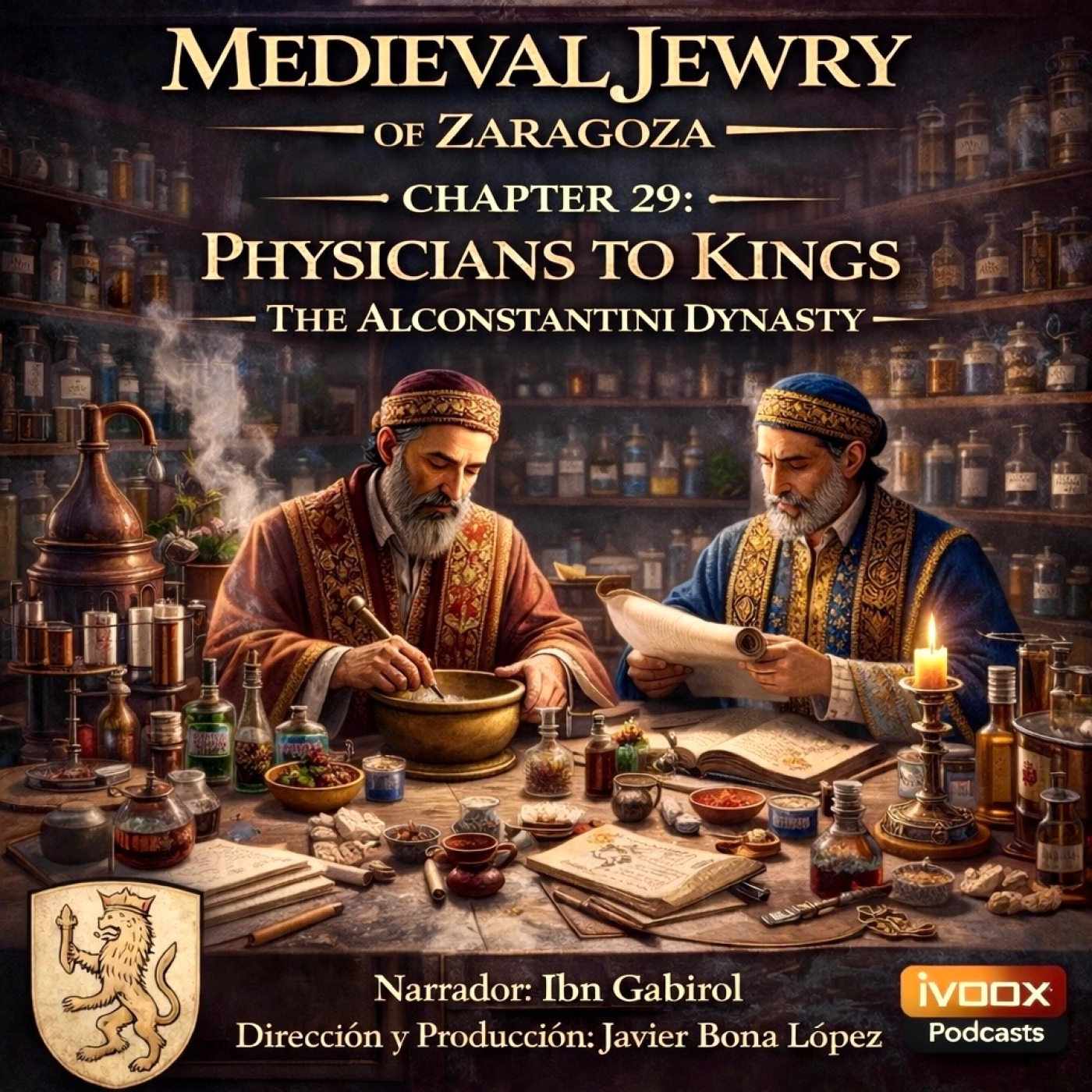
CHAPTER 29: PHYSICIANS OF KINGS – THE ALCONSTANTINI LINEAGE This chapter examines the historical, scientific, and political trajectory of the Jewish Alconstantini family, one of the most influential medical dynasties in medieval Zaragoza and the Crown of Aragon. Their story illustrates how medicine, scientific knowledge, diplomacy, and royal administration converged in the Middle Ages, elevating Jewish physicians to positions of extraordinary prominence within Christian courts. ORIGINS AND MEDITERRANEAN NETWORKS The surname Alconstantini emerges in the twelfth century across different regions of the Mediterranean world. The traveler Benjamin of Tudela, in his Sefer ha-Massaot (Book of Travels), mentions members of the family in Jerusalem and Aleppo, indicating an early geographic dispersion and transregional intellectual network. Simultaneously, the family established itself in the Crown of Aragon, particularly in Calatayud and Zaragoza. There, the name Alconstantini became permanently associated with medical excellence and royal service. This dual presence—Eastern Mediterranean and Iberian Peninsula—suggests a lineage connected to trade, scholarship, and medical expertise, capable of transmitting scientific knowledge across cultural and political boundaries. THE APOTHECARY OF ZARAGOZA: A SCIENTIFIC HUB The Alconstantini apothecary in thirteenth-century Zaragoza functioned not merely as a pharmacy, but as a laboratory, research center, and intellectual archive. It contained: • Medicinal substances imported from India, the Levant, and North Africa • Precision instruments such as scales, mortars, and distillation alembics • Medical manuscripts in Hebrew, Arabic, and Latin • Cultivated medicinal gardens along the Ebro and Jalón rivers Their medical practice drew from the Andalusi scientific tradition and pharmacological works such as Al-Musta’ini by Ibn Biklarish, a pioneering systematic classification of drugs. The Alconstantini practiced preventive medicine, emphasizing hygiene, dietetics, and regulated living—principles remarkably aligned with later modern medical thought. From the late thirteenth century onward, medical practitioners in Aragon were required to pass official examinations before mixed Jewish-Christian commissions. Mastery of Arabic and Hebrew granted access to foundational scientific texts, giving Jewish families a decisive intellectual advantage. PHYSICIANS, DIPLOMATS, AND ROYAL ADMINISTRATORS The Alconstantini were not solely court physicians; they were polyvalent state actors. 1. Royal Physicians They served as personal doctors to the kings of Aragon, overseeing not only treatment of illness but also preventive regimens and dietary systems for the royal household. 2. Diplomats and Linguistic Intermediaries Fluency in Arabic, Hebrew, and Romance languages made them indispensable in diplomatic negotiations. Bahiel Alconstantini accompanied King James I during the conquest of Mallorca in 1229, acting as chief negotiator in surrender agreements with Muslim authorities. 3. Financial and Administrative Officials Members of the family held high administrative offices: • Bahiel Alconstantini served as baile (royal administrator) of Zaragoza. • His son Mosse Alconstantini continued as royal physician and fiscal manager. • They controlled tax networks, monopolies such as the Aragonese saltworks, and major financial operations. Their influence extended from the apothecary bench to the fiscal core of the Crown. HERALDIC SYMBOLISM Remarkably, a branch of the family adopted a heraldic coat of arms—an exceptional privilege among Jewish families. The blazon described in heraldic sources includes: • A crowned rampant lion • A sword held upright The lion signifies nobility and courage; the crown emphasizes proximity to royalty; the sword reflects political agency. This emblem visually codified their quasi-noble standing within Christian society. PRESTIGE AND STRUCTURAL VULNERABILITY The chapter highlights a central paradox. Prestige • Royal protection • Economic privilege • Political access • Social distinction Vulnerability • Dependence on the monarch’s favor • Resentment from segments of the nobility and clergy • Fiscal tensions within Jewish communities • Popular suspicion toward Jewish physicians The turning point came with the General Privilege of Aragon (1283), which restricted Jews from exercising authority over Christians. Although often circumvented in the case of royal physicians, it marked the beginning of gradual marginalization. CRISIS, CONVERSION, AND DIASPORA The fourteenth century brought escalating instability. The massacres of 1391 fractured many Jewish communities. Some members of the Alconstantini family converted to Christianity to preserve status; others remained Jewish until the expulsion of 1492. After the expulsion, branches of the lineage reappear in Italy (notably Ancona), southern France, and the Ottoman Empire, carrying their medical tradition into the Sephardic diaspora. HISTORICAL SIGNIFICANCE The Alconstantini lineage compels a reassessment of medieval medicine in Aragon. Their legacy includes: • Professionalization of royal medicine • Systematic pharmacological methodology • Transmission of Greco-Arabic science into Latin Europe • Integration of medicine with diplomacy and statecraft They represent proto-Renaissance intellectual figures—physicians, translators, financiers, and diplomats in one. CONCLUSION The Alconstantini family embodies the zenith of Jewish medical culture in medieval Zaragoza. Their history demonstrates how scientific knowledge could function as both a tool of power and a bridge between civilizations. Although their physical presence in Aragon ended with persecution and expulsion, their intellectual legacy endured within European science and the Sephardic diaspora. The apothecary of Zaragoza was more than a medical shop—it was a crucible where Eastern wisdom was distilled for Western practice. Their story stands as testimony to a period when Zaragoza was one of the Mediterranean’s leading centers of science, intercultural exchange, and technical excellence. If you have enjoyed this journey to the heart of Jewish philosophy, I invite you to share it. You can listen to other chapters and series about the medieval Jewries of Aragon on the main podcasting platforms such as those of Calatayud, Tarazona, and Híjar. CREDITS AND SOURCES Narrator: Ibn Gabirol (Shelomó ibn Gabirol, 1021–1058/70) Direction and Production: Javier Bona López Documentation and Academic Advisory: Miguel Ángel Motis Dolader (Universidad San Jorge, Zaragoza) BIBLIOGRAPHY • Ascoli, Luca. Notes on the History of the Jewish Alconstantini Family of Calatayud before the Expulsion of 1492. • Benjamin of Tudela. Sefer ha-Massaot (Book of Travels). • James I of Aragon. Llibre dels feits. • Castro, Américo. España y su historia. • Gómez Miedes, Bernardino. La historia del rey don Jayme de Aragón. • Bascapè, Giacomo C. Insegne e simboli. Araldica pubblica e privata, medievale e moderna. Ministero per i beni culturali e ambientali, 1983. • Roth, Cecil. “Stemmi di famiglie ebraiche italiane.” In Scritti in memoria di Leone Carpi, 1967.
Embed this episode
NOW PLAYING
CHAPTER 29: PHYSICIANS OF KINGS – THE ALCONSTANTINI LINEAGE
No transcript for this episode yet
Similar Episodes
No similar episodes found.
Similar Podcasts
No similar podcasts found.