
EPISODE · Jan 23, 2026 · 15 MIN
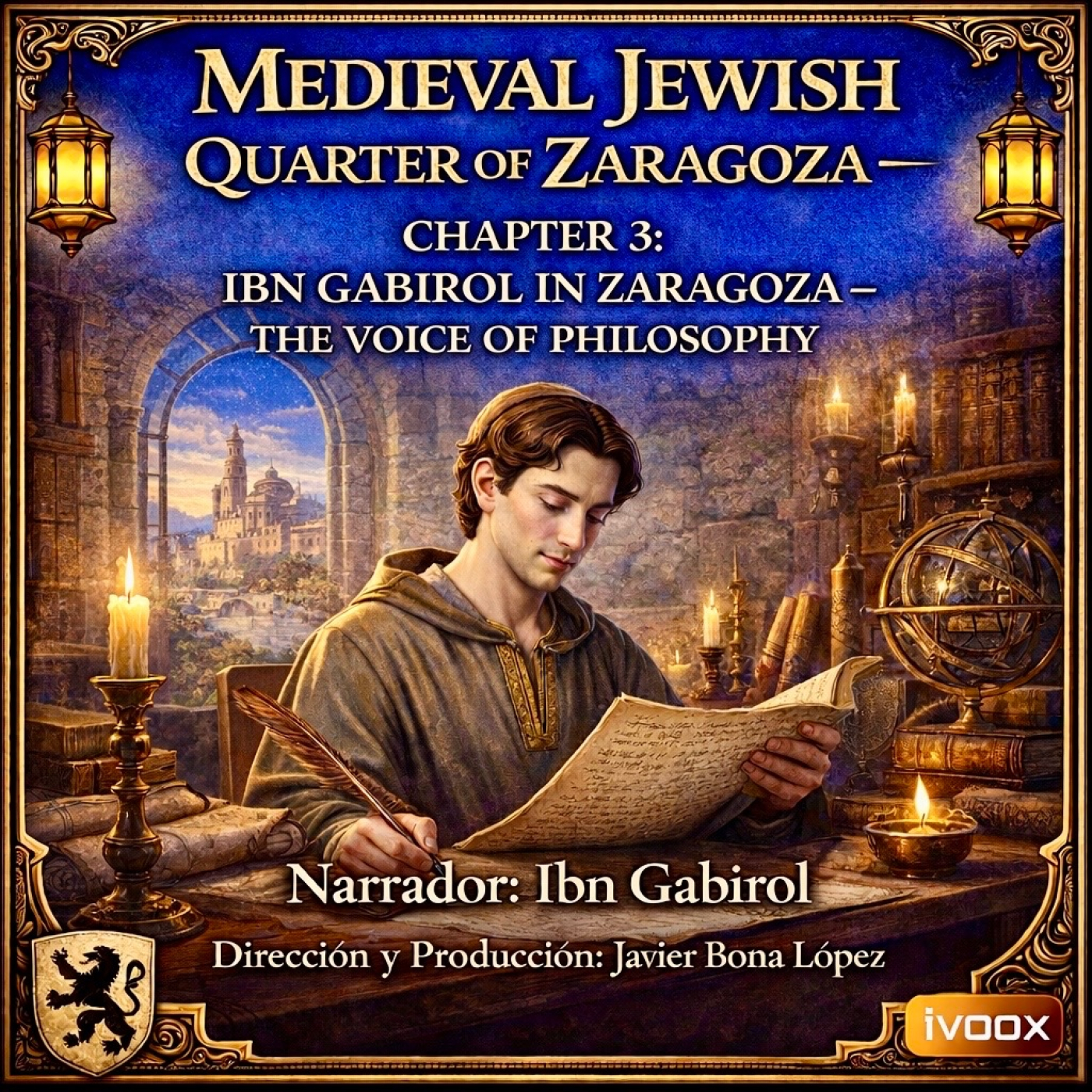
CHAPTER 3: IBN GABIROL IN ZARAGOZA - THE VOICE OF PHILOSOPHY
from Judería medieval Zaragoza/Jewish quarter Zaragoza
CHAPTER 3: IBN GABIROL IN ZARAGOZA - THE VOICE OF PHILOSOPHY Series: Medieval Jewish Quarter of Zaragoza Narrator: Ibn Gabirol (Shelomó ibn Gabirol, 1021-1058/70) Direction and Production: Javier Bona López Shalom. In this chapter, the voice of Solomon ben Judah ibn Gabirol transports us to 11th-century Zaragoza, the Saraqusta of the Banu Hud, where his tormented soul and ailing body found refuge in the pursuit of wisdom. Born in Málaga in 1021, orphaned as a child, Ibn Gabirol arrived in Zaragoza, a city that under the reign of Al-Muqtadir had become a beacon of culture and intellectuality. Here, under the tutelage of the great Hebrew grammarian Marwan Yonah ben Yanah, the young poet developed his precocious genius, composing at sixteen verses that spoke of his physical suffering and existential anguish. His life changed when he met Jekuthiel ben Isaac ibn Hasan, vizier to King Mundir II, who became his patron and protector. Under his patronage, Ibn Gabirol lived his "golden age" in Zaragoza, composing panegyrics and immersing himself in Greek philosophy through Arabic translations. But in 1039, a palace revolt ended the life of his protector. Jekuthiel was beheaded, and Ibn Gabirol's world collapsed. He then composed one of the most beautiful elegies in Hebrew literature: "Behold the reddish sun of the evening / as if dressed in scarlet... the heavens darken, clad in black, mourning Yequti'el." In his solitude and bitterness, Ibn Gabirol took refuge in philosophy. He wrote two fundamental works in Arabic: The Improvement of the Qualities of the Soul, an ethical treatise linking virtues and vices to the senses and humors of the body; and his magnum opus, Meqor Hayyim ("The Source of Life"), a revolutionary philosophical dialogue on the constitution of all beings, with no trace of the Bible or Talmud. This work, translated into Latin as Fons Vitae, would make him famous in the Christian world under the name Avicebrón. But his "Greek" and "secular" philosophy, his difficult character, and his biting satires earned him the enmity of the aljama leaders. In 1045, the community decreed against him a herem, an anathema of expulsion. Ibn Gabirol left Zaragoza with a torn heart, feeling "buried alive in his own house." His final years are a mystery. It is said he died in Valencia around 1058, without reaching forty years of age. Legend has it he was murdered by an envious Muslim poet and buried under a fig tree that, from then on, bore fruit of supernatural sweetness. His legacy is a paradox: the Jewish world ignored him as a philosopher but acclaimed him as the "prince of poets." His Keter Malkut ("Royal Crown") is still recited today in synagogues on Yom Kippur. The Christian world, on the other hand, knew him as Avicebrón, an Arab philosopher, without knowing he was a Jew from Málaga who had lived and suffered in Zaragoza. Today, a thousand years later, Zaragoza recovers his memory as a bridge between cultures, as a symbol of the intellectual greatness that can flourish when different traditions meet and enrich one another. Zakhor. Remember. Shalom. Nota Final Si este capítulo te ha gustado, te invito a compartirlo y difundirlo. También puedes escuchar nuestras otras series sobre las juderías medievales de Calatayud, Tarazona e Híjar en las tres plataformas principales de podcasting. Zakhor. Recuerda. Shalom. CRÉDITOS Y FUENTES Narrador: Ibn Gabirol (Shelomó ibn Gabirol, 1021-1058/70) Dirección y Producción: Javier Bona López Documentación y Asesoramiento: Miguel Ángel Motis Dolader (Universidad San Jorge de Zaragoza) Fuentes Principales: • Shelomó ibn Gabirol. Poesía secular. Prólogo Dan Pagis, traducción Elena Romero, edición bilingüe (1978). • Shelomó ibn Gabirol. Si me olvido de ti, Jerusalén. Cantos de las sinagogas de al-Ándalus. Edición del texto hebreo, introducción, traducción y notas de Israel Levy y Ángel Sáenz Badillos. Ediciones El Almendro, Córdoba 1992. • Shelomó ibn Gabirol. Fons Vitae (La Fuente de Vida). Obra filosófica neoplatónica. • Asunción Blasco Martínez. La Judería de Zaragoza en el siglo XIV. Instituto Fernando el Católico (IFC), 1988. • Miguel Ángel Motis Dolader. La judería de Zaragoza: Centro de la vida económica y social. Rolde de Estudios Aragoneses. • Bahya Ibn Paquda. Deberes del Corazón. Obra de filosofía judía medieval. © Serie: Judería medieval de Zaragoza Producción: Javier Bona López
Embed this episode
NOW PLAYING
CHAPTER 3: IBN GABIROL IN ZARAGOZA - THE VOICE OF PHILOSOPHY
No transcript for this episode yet
Similar Episodes
No similar episodes found.
Similar Podcasts
No similar podcasts found.