
EPISODE · Feb 28, 2026 · 21 MIN
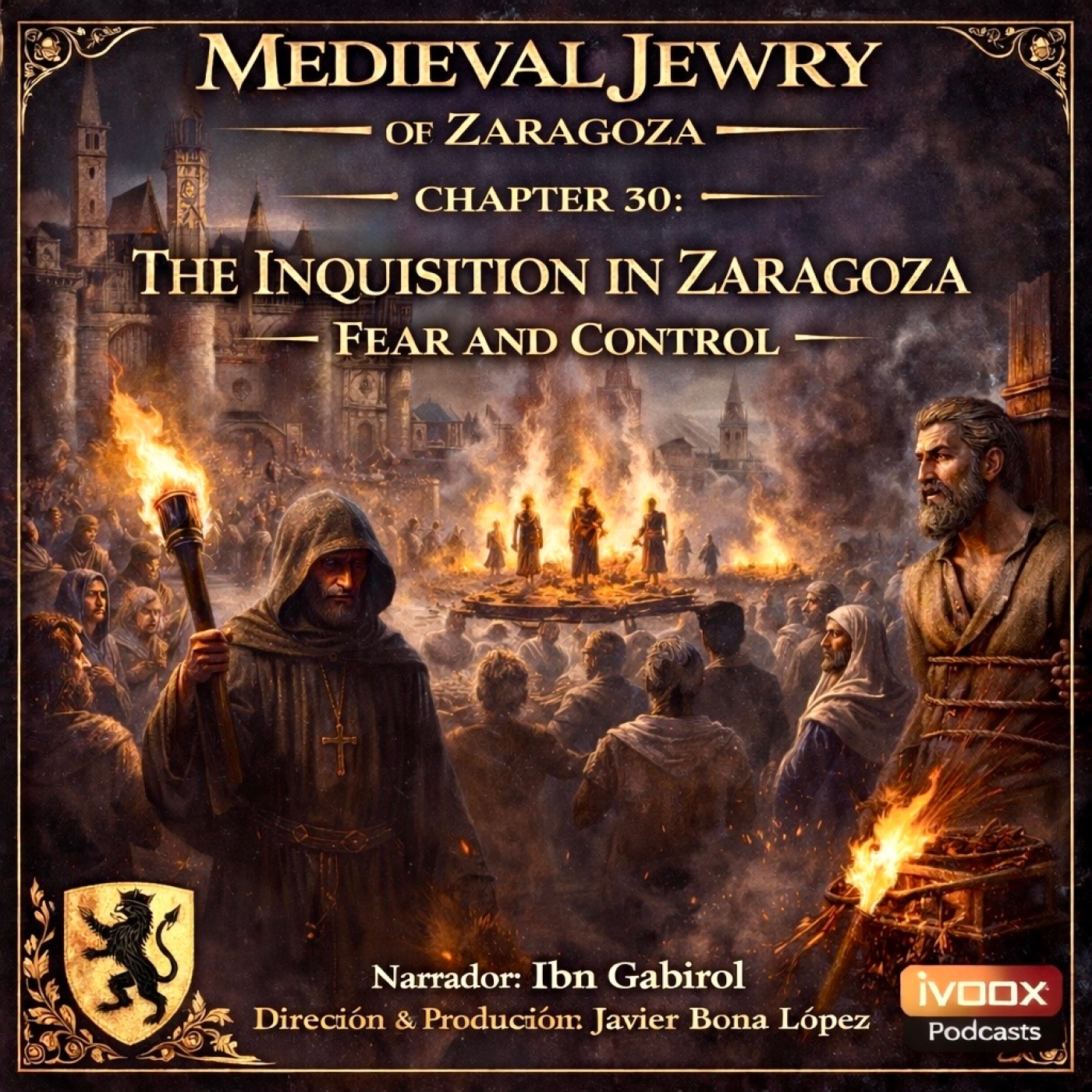
CHAPTER 30: THE INQUISITION IN ZARAGOZA – FEAR AND CONTROL
from Judería medieval Zaragoza/Jewish quarter Zaragoza
CHAPTER 30: THE INQUISITION IN ZARAGOZA – FEAR AND CONTROL Narrator: Ibn Gabirol Direction and Production: Javier Bona López SUMMARY This chapter offers an in-depth analysis of the establishment and consolidation of the Tribunal of the Holy Office in Zaragoza at the end of the fifteenth century, situating it within the social crisis that followed the mass conversions of 1391 and the growing obsession with “purity of blood.” 1. Conversos and Social Conflict After the anti-Jewish pogroms of 1391, thousands of Jews in the Crown of Aragon accepted baptism. A powerful converso elite emerged—families such as the Santángel, Caballería, and Sánchez—who occupied key roles in administration, banking, and commerce. Their rapid ascent generated resentment. Accusations of “Judaizing” (secretly practicing Judaism) became a political and social weapon. Boundaries between Jews and conversos remained porous: family ties, shared customs, and collective memory preserved Sephardic identity beneath outward conformity. King Ferdinand II recognized the opportunity to implant a royal Inquisition directly dependent on the Crown rather than on local bishops, thereby reinforcing political centralization in Aragon. 2. Aragonese Foral Resistance The tribunal’s arrival in 1484 clashed with Aragon’s historic legal system (the fueros), which limited torture, protected due process, and restricted external appointments. Opposition in Zaragoza and Teruel was intense. The appointment of local inquisitors such as Pedro Arbués sought to provide legitimacy, but tensions escalated. 3. The Assassination of Pedro Arbués (1485) On the night of September 14–15, 1485, Inquisitor Pedro Arbués was mortally attacked while praying in Zaragoza’s cathedral. The assassination—intended to halt the tribunal—produced the opposite effect. Arbués became a martyr, and the Crown gained moral justification for sweeping repression. Between 1485 and 1487, numerous autos de fe led to executions, imprisonments, and confiscations that dismantled Zaragoza’s converso elite. 4. The Aljafería: Palace Turned Prison The Palacio de la Aljafería, originally an eleventh-century taifa palace (Qasr al-Surur, “Palace of Joy”), became the Inquisition’s headquarters. Mudéjar halls turned into courtrooms; the Tower of the Troubadour into a prison. Graffiti carved by inmates still survive, bearing silent witness to their suffering. The architecture of royal power was transformed into architecture of fear. 5. Inquisitorial Procedure The system was bureaucratically structured: • Edict of Grace • Anonymous denunciations • Secret proceedings • Regulated torture (the rack, strappado, water torture) • Public autos de fe The auto de fe functioned as a ritualized spectacle of terror. Zaragoza’s Market Square became a stage for humiliation. The condemned wore the sanbenito; the unrepentant were handed over to secular authorities for execution. 6. Economic Impact Confiscation of property was integral to the system. Wealth accumulated by converso families flowed into the coffers of the Crown and the tribunal. This altered Zaragoza’s economic structure: financial networks collapsed, commercial capital disappeared, and key sectors entered decline. 7. The Expulsion of 1492 Although formally directed at conversos, the Inquisition created an environment hostile to practicing Jews. The 1492 Edict of Expulsion was the logical culmination of escalating intolerance. Zaragoza lost artisans, physicians, merchants, and scholars. The main synagogue was converted, and the aljama ceased to exist as a living community. 8. Long-Term Continuity (16th–19th Centuries) The tribunal remained active until its definitive abolition in 1834. Over time, executions diminished, and the Inquisition shifted toward moral and ideological surveillance—blasphemy, bigamy, Protestantism, Enlightenment thought. Yet its presence sustained a culture of suspicion and self-censorship for generations. HISTORICAL INTERPRETATION The Inquisition in Zaragoza functioned as: • An instrument of royal centralization • A mechanism of social discipline • An economic system based on confiscation • A rupture in the intellectual continuity of the “Three Cultures” The damage was not only human but civilizational: a vibrant bridge between Jewish and Christian intellectual traditions was severed. If you have enjoyed this journey to the heart of Jewish philosophy, I invite you to share it. You can listen to other chapters and series about the medieval Jewries of Aragon on the main podcasting platforms such as those of Calatayud, Tarazona, and Híjar CREDITS AND SOURCES Narrator: Ibn Gabirol (Shelomó ibn Gabirol, 1021–1058/70) Direction and Production: Javier Bona López Documentation and Academic Advisory: Miguel Ángel Motis Dolader (Universidad San Jorge, Zaragoza) Bibliography • Blasco Martínez, Asunción. The Inquisition in Aragon. Institución Fernando el Católico, 2015. • Motis Dolader, Miguel Ángel. The Jewish Quarter of Zaragoza in the Fifteenth Century. IFC, 2008. • Kamen, Henry. The Spanish Inquisition: A Historical Revision. Yale University Press, 2014. • Pérez, Joseph. The Spanish Inquisition: A History. Profile Books, 2005. SERIES CONTINUITY This episode forms part of Javier Bona López’s broader historical podcast project on medieval Sephardic Aragón. You can also listen to: • Medieval Jewish Quarter of Calatayud • Medieval Jewish Quarter of Tarazona • Medieval Jewish Quarter of Híjar Available on iVoox, Spotify, and major podcast platforms. Each series explores: • Urban and archaeological context • Documented historical figures • Manuscripts and archival sources • Economic and commercial networks • Synagogues and communal spaces • Expulsion and Sephardic diaspora CONCLUSION The Inquisition in Zaragoza was not an isolated episode but a structural transformation lasting centuries. Fear became institutionalized. Suspicion replaced coexistence. Uniformity supplanted diversity. Remembering this history is not about reopening wounds, but about understanding how political power can instrumentalize faith—and how a society, in pursuit of imagined purity, can dismantle its own cultural richness. Zakhor. Remember.
Embed this episode
NOW PLAYING
CHAPTER 30: THE INQUISITION IN ZARAGOZA – FEAR AND CONTROL
No transcript for this episode yet
Similar Episodes
No similar episodes found.
Similar Podcasts
No similar podcasts found.