
EPISODE · Mar 1, 2026 · 16 MIN
CHAPTER 31: 1492 – THE KEYS THAT NEVER OPENED
from Judería medieval Zaragoza/Jewish quarter Zaragoza
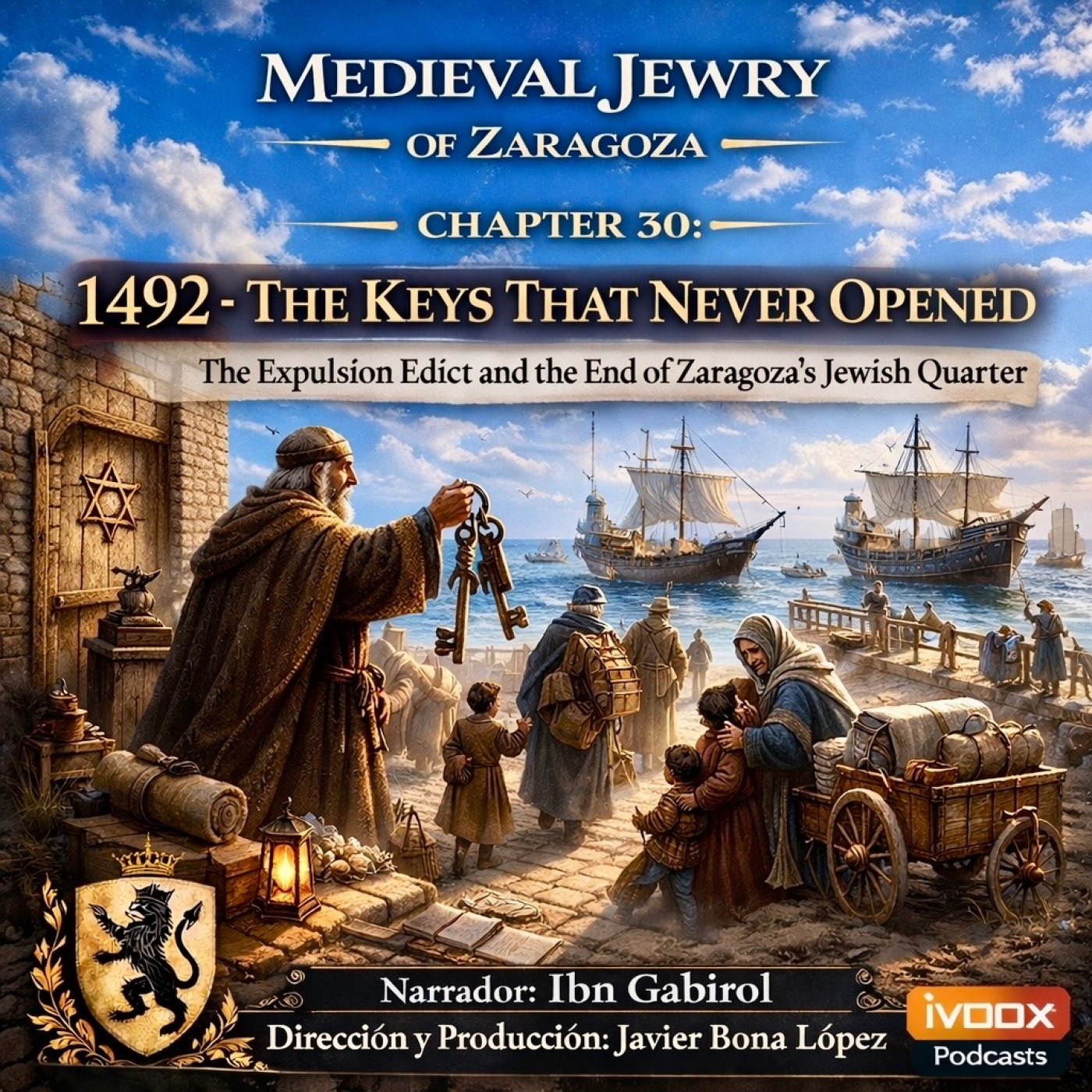
CHAPTER 31: 1492 – THE KEYS THAT NEVER OPENED Narrator: Ibn Gabirol Direction and Production: Javier Bona López Chapter 31 represents the emotional and historical culmination of the series devoted to the medieval Jewish Quarter of Zaragoza. Through the narrative voice of Ibn Gabirol, the episode reconstructs 1492 not merely as a political event, but as a civilizational rupture: the forced erasure of a community that had shaped Sefarad for centuries. The opening evokes a luminous Zaragoza—where Hebrew, Arabic, and Romance languages coexisted in markets, schools, and intellectual circles. Philosophy, commerce, poetry, and science intertwined in an urban fabric that had long embodied pluralism. This memory is not ornamental nostalgia; it functions as structural contrast. What follows is the systematic dismantling of that world. 1. The Edict of Granada: Legal Architecture of Exclusion On March 31, 1492, in the halls of the Alhambra in Granada, the Catholic Monarchs signed the Edict of Expulsion. The ideological driving force behind the decree was the Inquisitor General Tomás de Torquemada, who argued that Jews were corrupting conversos and undermining Christian unity. The edict mandated: • A four-month deadline to leave the kingdoms of Castile and Aragon. • A prohibition against taking gold, silver, or minted currency. • Full settlement of debts owed to the Crown. • A formal alternative: baptism or exile. From a state-building perspective, the decree functioned as an instrument of religious homogenization, reinforcing a centralized confessional monarchy. From a human perspective, it constituted the forced displacement of thousands who had lived in Iberia for over a millennium. 2. The Liquidation of Life: Economic Dispossession The Jewish community of Zaragoza owned approximately 460 houses, along with orchards, vineyards, workshops, and commercial establishments. With only months to sell and no competitive market, property values collapsed. Research by Miguel Ángel Motis Dolader demonstrates: • Drastic undervaluation of real estate. • Direct fiscal supervision by royal commissioners. • Accelerated transfer of wealth into Christian hands. The expulsion thus became one of the most systematic episodes of forced asset liquidation in Iberian history. Economically, it deprived Aragon of a crucial mercantile and professional class deeply integrated into Mediterranean trade networks. 3. Urban Reconfiguration and Symbolic Erasure On August 1, 1492, Zaragoza awoke to silence. The Jewish quarter—once vibrant with artisans, merchants, scholars, and physicians—stood empty. Synagogues were consecrated as churches. Communal institutions were absorbed into Christian structures. This was not merely a change of ownership; it was a re-inscription of space. Sacred geography was overwritten. The loss was not only demographic but functional: • Commercial networks collapsed. • Specialized crafts declined. • Intellectual mediation between Christian and Islamic worlds diminished. The expulsion reshaped the city’s morphology and memory simultaneously. 4. Conversos and the Culture of Suspicion Not all Jews left. Some converted to Christianity, hoping to preserve their property and social standing. Yet conversion did not erase suspicion. Under inquisitorial scrutiny, conversos were monitored for signs of “Judaizing”: • Sabbath observance. • Dietary practices. • Candle lighting rituals. The Inquisition institutionalized distrust. Social cohesion fractured under denunciation and fear. Conversion became less an act of integration than an entry into perpetual vulnerability. 5. The Sephardic Diaspora: Redistribution of Knowledge Approximately 211 families departed from Zaragoza. Many traveled through Tortosa and Tarragona toward Italy, North Africa, or the Ottoman Empire. The Ottoman Sultan Bayaceto II reportedly recognized the strategic value of these exiles, welcoming them into his domains. In Ottoman lands: • Hebrew printing flourished. • International trade networks expanded. • Ladino emerged as a durable vehicle of cultural continuity. The expulsion thus redistributed intellectual and economic capital across the Mediterranean. Spain’s loss became another empire’s gain. 6. The Keys: A Metaphor of Memory The central symbol of the episode is the key. Many families preserved the keys to their homes in Zaragoza—not as practical tools, but as mnemonic artifacts. These keys came to represent: • The permanence of memory. • The continuity of identity. • The refusal of cultural annihilation. The key does not open a physical door; it opens remembrance. It embodies the Hebrew imperative Zakhor—Remember. Interpretative Conclusion The episode advances a clear thesis: the expulsion of 1492 was not solely a Jewish tragedy; it was a structural impoverishment of the Crown itself. Religious uniformity was achieved at the cost of economic vitality and intellectual pluralism. Through the voice of Ibn Gabirol, the narrative reframes history not as vengeance but as ethical memory. Zakhor is not a political slogan; it is a civilizational obligation. Within your broader project on Zaragoza, Calatayud, Tarazona, and Híjar, this chapter serves as a hinge point—where archival research, literary reconstruction, and historical analysis converge into a meditation on loss and continuity. CREDITS AND SOURCES Narrator: Ibn Gabirol (Shelomó ibn Gabirol, 1021–1058/70) Direction and Production: Javier Bona López Documentation and Academic Advisory: Miguel Ángel Motis Dolader (Universidad San Jorge, Zaragoza) Main Bibliography 1. Motis Dolader, Miguel Ángel. La expulsión de los judíos de Zaragoza. Institución Fernando el Católico, 2015. 2. Blasco Martínez, Asunción. La judería de Zaragoza en el siglo XV. Institución Fernando el Católico, 2008. 3. Pérez, Joseph. History of a Tragedy: The Expulsion of the Jews from Spain. Crítica, 2013. 4. Kamen, Henry. The Spanish Inquisition: A Historical Revision. Crítica, 2011.
Embed this episode
NOW PLAYING
CHAPTER 31: 1492 – THE KEYS THAT NEVER OPENED
No transcript for this episode yet
Similar Episodes
No similar episodes found.
Similar Podcasts
No similar podcasts found.