
EPISODE · Mar 3, 2026 · 18 MIN
CHAPTER 32: THE GREEN BOOK OF ARAGON – INQUISITION AND REPRESSION
from Judería medieval Zaragoza/Jewish quarter Zaragoza
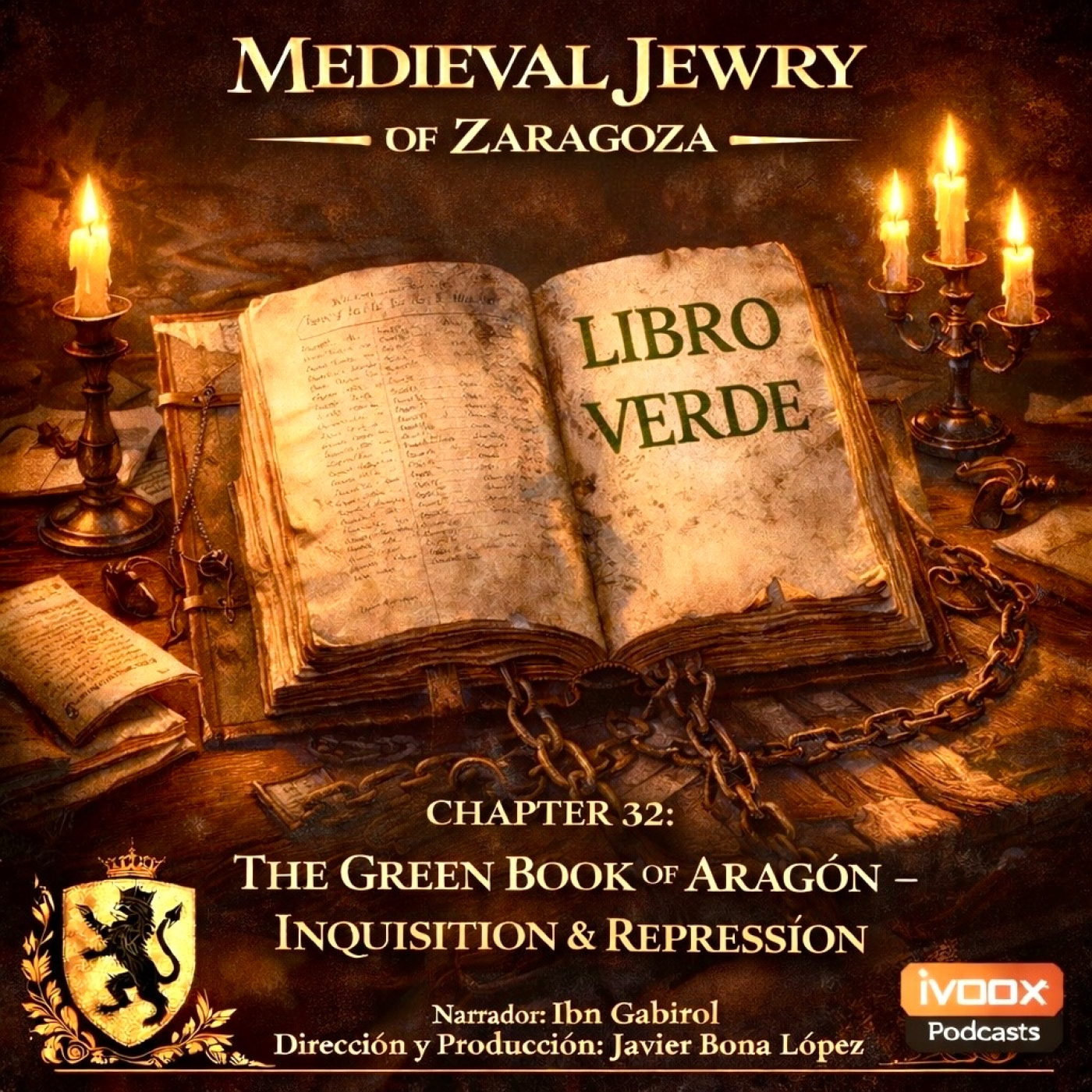
CHAPTER 32: THE GREEN BOOK OF ARAGON – INQUISITION AND REPRESSION Narrator: Ibn Gabirol Direction and Production: Javier Bona López Chapter 32 examines one of the most disturbing documentary instruments of early modern Aragon: the so-called Green Book of Aragon, a clandestine sixteenth-century manuscript that functioned as a mechanism of social exclusion, genealogical denunciation, and civil destruction against converso families in the Kingdom of Aragon. Through the symbolic voice of Ibn Gabirol, the narrative contrasts two kinds of books: those that illuminate the spirit and those born from fear and hatred. The Green Book belongs to the latter. It was not conceived as neutral historiography, but as a political and social weapon in a society increasingly obsessed with “purity of blood.” WHAT WAS THE GREEN BOOK? The Green Book was not an official illuminated codex preserved in cathedral archives. It was a clandestine manuscript circulating in sixteenth-century Zaragoza and beyond. Its “green” designation did not refer to its binding, but to the green candles carried by penitents in public autos-de-fe. Green symbolized infamy and public shame. Its contents included: • Detailed genealogies of prominent converso families. • Documentary tracing of Jewish ancestry. • Lists of individuals condemned by the Inquisition. • Extracts of confessions obtained under coercion. • Accounts of the conspiracy surrounding the assassination of the inquisitor Pedro Arbués. In a society governed by statutes of limpieza de sangre (purity of blood), being named in the Green Book meant civil death: exclusion from public office, social suspicion, and permanent stigma. THE AUTHOR: JUAN DE ANCHÍAS Modern historiography, especially the research of Manuel Serrano y Sanz, attributes authorship to Juan de Anchías, notary of secrecy of the Inquisition of Zaragoza. Anchías had privileged access to: • Inquisitorial trial records • Confessional transcripts • Confiscation inventories • Genealogical investigations The book’s power lay in its documentary foundation. It did not fabricate lineages; it exposed them using archival data, transforming bureaucratic records into instruments of reputational annihilation. HISTORICAL CONTEXT The chapter situates the Green Book within the broader transformation of Aragonese society: • The pogroms of 1391 and mass forced conversions • The social and economic ascent of conversos • Growing resentment among Old Christian elites • The assassination of Pedro Arbués (1485) • The consolidation of the Spanish Inquisition • The Edict of Expulsion (1492) After the expulsion of the Jews, the Inquisition redirected its scrutiny toward New Christians. The Green Book served as a genealogical index of suspicion. FAMILIES TARGETED The manuscript named some of the most powerful families in Aragon: • The Santángel family, including Luis de Santángel, royal official and financier of Columbus’s 1492 voyage. • The Caballería family, long-standing administrators of the Crown. • The Zaporta family, influential merchants and financiers of Zaragoza. Despite their service to the monarchy, their Jewish ancestry rendered them vulnerable in a society that equated lineage with identity. THE INQUISITORIAL PROCESS: THE MECHANICS OF TERROR The chapter reconstructs a typical inquisitorial prosecution: 1. Anonymous denunciation 2. Night arrest 3. Immediate confiscation of property 4. Isolation in secret prisons 5. Interrogation without disclosure of charges 6. Use of torture (strappado, rack, water torture) 7. Forced confession 8. Public auto-de-fe The auto-de-fe is portrayed as a ritualized spectacle of power — a pedagogical performance of fear designed to discipline society. HISTORICAL SIGNIFICANCE The Green Book symbolizes: • The weaponization of genealogy • The bureaucratization of hatred • The transformation of faith into repression • The institutionalization of hereditary suspicion The persecution of conversos intensified after 1492. With Jews expelled, the Inquisition focused almost exclusively on New Christians. The Green Book functioned as a theoretical and documentary justification for decades of surveillance and prosecution. CONCLUSION The Green Book of Aragon stands as a stark example of how administrative documentation can become a mechanism of systematic exclusion. An obsession with blood purity fractured society and converted ancestry into inherited guilt. The text demonstrates how memory can be distorted into a tool of repression. Yet the memory of Sefarad endured — in language, liturgy, song, and diaspora. Against the archive of hatred stands the archive of memory. Zakhor. Remember. True nobility resides not in blood, but in compassion. Within your broader project on Zaragoza, Calatayud, Tarazona, and Híjar, this chapter serves as a hinge point—where archival research, literary reconstruction, and historical analysis converge into a meditation on loss and continuity. CREDITS AND SOURCES Narrator: Ibn Gabirol (Shelomó ibn Gabirol, 1021–1058/70) Direction and Production: Javier Bona López Documentation and Academic Advisory: Miguel Ángel Motis Dolader (Universidad San Jorge, Zaragoza) BIBLIOGRAPHY • Serrano y Sanz, Manuel. “El Libro Verde de Aragón.” Revista de Archivos, Bibliotecas y Museos, 1905. • Kamen, Henry. The Spanish Inquisition: A Historical Revision. Yale University Press, 2014. • Motis Dolader, Miguel Ángel. La Inquisición de Aragón en el siglo XV. Institución Fernando el Católico, 2018. • Pérez, Joseph. The Spanish Inquisition: A History. Yale University Press, 2005.
Embed this episode
NOW PLAYING
CHAPTER 32: THE GREEN BOOK OF ARAGON – INQUISITION AND REPRESSION
No transcript for this episode yet
Similar Episodes
No similar episodes found.
Similar Podcasts
No similar podcasts found.