Competing Platforms and Transport Equilibrium (Rosaia 2025) | FT50 ECTA episode artwork

EPISODE · Dec 22, 2025 · 1H 5M

Competing Platforms and Transport Equilibrium (Rosaia 2025) | FT50 ECTA

from Revise and Resubmit - The Mayukh Show · host Mayukh Mukhopadhyay

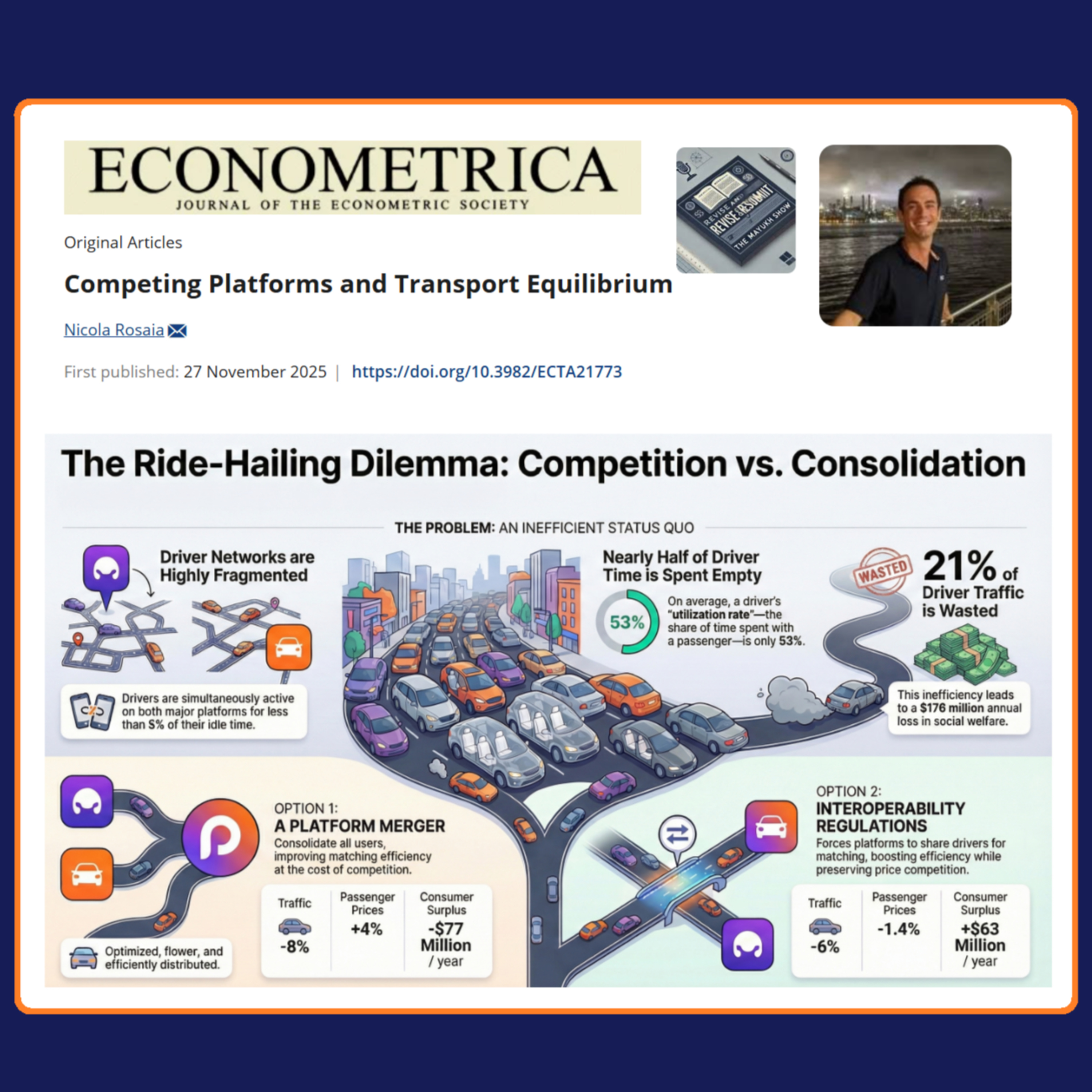
English Podcast Starts at 00:00:00Bengali Podcast Starts at 00:18:48Hindi Podcast Starts at 00:36:12German Podcast Starts at 00:50:09ReferenceRosaia, N. (2025). Competing Platforms and Transport Equilibrium. Econometrica, 93(6), 2235–2271. https://doi.org/10.3982/ecta21773Supplement and Replication Package: https://www.econometricsociety.org/publications/econometrica/2025/11/01/Competing-Platforms-and-Transport-Equilibrium‌Youtube Channel⁠https://www.youtube.com/@weekendresearcher⁠Connect over linkedinhttps://www.linkedin.com/in/mayukhpsm/Welcome to “Revise and Resubmit” 🎙️📚 — where heavyweight theory puts on headphones, gets in a cab, and rides through the real world with you.Tonight, we’re not just hailing a ride. We’re hailing a market. 🚕📱Two apps. One city. Millions of tiny decisions: tap here, wait there, surge now, cancel later.On your screen, it’s a simple map with a moving car.Underneath, it’s a battle of platforms, traffic flows, and social welfare measured in millions. 💸🌆Our paper for this episode is👉 “Competing Platforms and Transport Equilibrium”by Nicola Rosaia, published in Econometrica — a prestigious FT50 journal — Volume 93, Issue 6, November 2025, from The Econometric Society and Wiley. 🏛️✨Here’s the puzzle:When Uber and Lyft (or any big platforms) compete, do we get efficiency… or waste?Are we seeing smart competition, or just two half-empty networks clogging the same streets? 🚗🚗💨Nicola Rosaia builds a spatial model of the ride-hailing market in New York City, powered by detailed data from two major platforms. Then comes the twist: by running counterfactual worlds, the paper asks, “What if we changed the rules?” 🧪The results hit hard:Fragmented platforms and market power together burn 176176 million dollars of social welfare every year and waste 21% of driver-generated traffic.A platform merger would pool everyone into one big network, cutting traffic by 8%, but at a cost: prices up 4%, consumer surplus down 7777 million per year.Interoperability regulation — letting networks talk and drivers multi-home — captures most of the efficiency: wasteful traffic down 6%, while consumer surplus rises by 6363 million a year. 📉🚦📈So one simple tap on a ride-hailing app turns out to be anything but simple.It’s a choice shaped by algorithms, pricing power, and who is allowed to work for whom.Competition gives you options. Fragmentation gives you traffic. Regulation reshapes the game. ⚖️A huge thank you to Nicola Rosaia, to The Econometric Society, to Wiley, and to the prestigious FT50 journal Econometrica for this sharp, data-rich look at how platforms move people—and money—through our cities. 🙏📖If you enjoy this kind of deep dive into cutting-edge research, hit subscribe to🎧 “Revise and Resubmit” on Spotify, Amazon Prime, and Apple Podcast,and don’t forget our 🎥 YouTube channel “Weekend Researcher” for more geeky-yet-fun explorations of academic work.So as we roll into this episode, here’s the question I want to leave circling in your mind like a car around the block:🤔 When you open a ride-hailing app, are you just choosing a ride—or are you quietly choosing what kind of city, what kind of market, and what kind of equilibrium you want to live in? 🚕📱🌃

English Podcast Starts at 00:00:00Bengali Podcast Starts at 00:18:48Hindi Podcast Starts at 00:36:12German Podcast Starts at 00:50:09ReferenceRosaia, N. (2025). Competing Platforms and Transport Equilibrium. Econometrica, 93(6), 2235–2271. https://doi.org/10.3982/ecta21773Supplement and Replication Package: https://www.econometricsociety.org/publications/econometrica/2025/11/01/Competing-Platforms-and-Transport-Equilibrium‌Youtube Channel⁠https://www.youtube.com/@weekendresearcher⁠Connect over linkedinhttps://www.linkedin.com/in/mayukhpsm/Welcome to “Revise and Resubmit” 🎙️📚 — where heavyweight theory puts on headphones, gets in a cab, and rides through the real world with you.Tonight, we’re not just hailing a ride. We’re hailing a market. 🚕📱Two apps. One city. Millions of tiny decisions: tap here, wait there, surge now, cancel later.On your screen, it’s a simple map with a moving car.Underneath, it’s a battle of platforms, traffic flows, and social welfare measured in millions. 💸🌆Our paper for this episode is👉 “Competing Platforms and Transport Equilibrium”by Nicola Rosaia, published in Econometrica — a prestigious FT50 journal — Volume 93, Issue 6, November 2025, from The Econometric Society and Wiley. 🏛️✨Here’s the puzzle:When Uber and Lyft (or any big platforms) compete, do we get efficiency… or waste?Are we seeing smart competition, or just two half-empty networks clogging the same streets? 🚗🚗💨Nicola Rosaia builds a spatial model of the ride-hailing market in New York City, powered by detailed data from two major platforms. Then comes the twist: by running counterfactual worlds, the paper asks, “What if we changed the rules?” 🧪The results hit hard:Fragmented platforms and market power together burn 176176 million dollars of social welfare every year and waste 21% of driver-generated traffic.A platform merger would pool everyone into one big network, cutting traffic by 8%, but at a cost: prices up 4%, consumer surplus down 7777 million per year.Interoperability regulation — letting networks talk and drivers multi-home — captures most of the efficiency: wasteful traffic down 6%, while consumer surplus rises by 6363 million a year. 📉🚦📈So one simple tap on a ride-hailing app turns out to be anything but simple.It’s a choice shaped by algorithms, pricing power, and who is allowed to work for whom.Competition gives you options. Fragmentation gives you traffic. Regulation reshapes the game. ⚖️A huge thank you to Nicola Rosaia, to The Econometric Society, to Wiley, and to the prestigious FT50 journal Econometrica for this sharp, data-rich look at how platforms move people—and money—through our cities. 🙏📖If you enjoy this kind of deep dive into cutting-edge research, hit subscribe to🎧 “Revise and Resubmit” on Spotify, Amazon Prime, and Apple Podcast,and don’t forget our 🎥 YouTube channel “Weekend Researcher” for more geeky-yet-fun explorations of academic work.So as we roll into this episode, here’s the question I want to leave circling in your mind like a car around the block:🤔 When you open a ride-hailing app, are you just choosing a ride—or are you quietly choosing what kind of city, what kind of market, and what kind of equilibrium you want to live in? 🚕📱🌃

NOW PLAYING

Competing Platforms and Transport Equilibrium (Rosaia 2025) | FT50 ECTA

0:00 1:05:57

No transcript for this episode yet

We transcribe on demand. Request one and we'll notify you when it's ready — usually under 10 minutes.

Frequently Asked Questions

How long is this episode of Revise and Resubmit - The Mayukh Show?

This episode is 1 hour and 5 minutes long.

When was this Revise and Resubmit - The Mayukh Show episode published?

This episode was published on December 22, 2025.

What is this episode about?

English Podcast Starts at 00:00:00Bengali Podcast Starts at 00:18:48Hindi Podcast Starts at 00:36:12German Podcast Starts at 00:50:09ReferenceRosaia, N. (2025). Competing Platforms and Transport Equilibrium. Econometrica, 93(6), 2235–2271....

Can I download this Revise and Resubmit - The Mayukh Show episode?

Yes, you can download this episode by clicking the download button on the episode player, or subscribe to the podcast in your preferred podcast app for automatic downloads.
URL copied to clipboard!