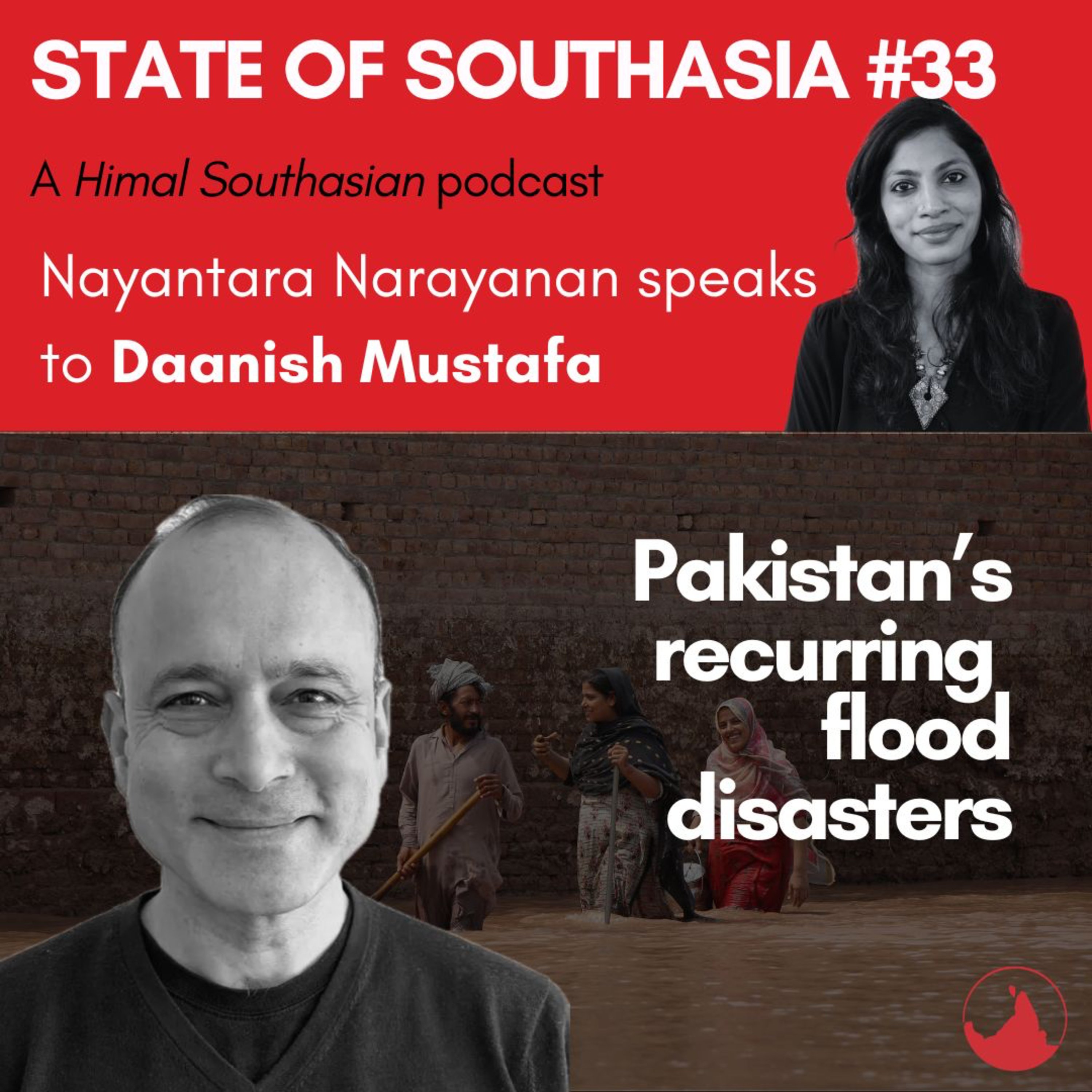
Daanish Mustafa on Pakistan’s recurring flood disasters: State of Southasia #33 episode artwork

EPISODE · Sep 29, 2025 · 42 MIN

Daanish Mustafa on Pakistan’s recurring flood disasters: State of Southasia #33

from Himal Southasian Podcast Channel · host Himal Southasian Podcast Channel

Since June, Pakistan has experienced yet another season of severe monsoon flooding, with particularly heavy impacts across the Punjab region. Flood waters and landslides have claimed many hundreds of lives and displaced hundreds of thousands more. The Pakistan Disaster Management Authority announced that, by 10 September, that 900 people had died and about four million were impacted by the floods. The 2025 floods mark the third major event in the past 15 years – following the catastrophic flooding of 2010 and 2022. Climate change-induced weather phenomena are making extreme rainfall more common. But there is also unplanned development and dam mismanagement that are turning these extreme events into disasters. In this episode of State of Southasia, Daanish Mustafa, a professor of critical geography and an expert on hydropolitics talks to Nayantara Narayanan about how climatic variability, unregulated development, and colonial water governance intersect to exacerbate Pakistan and other Southasian countries’ vulnerabilities to floods. Mustafa questions planning paradigms that rely on statistical "normality" and outdated colonial models and advocates for a shift toward participatory, democratic forms of environmental governance, grounded in local knowledge systems, social equity, and an understanding of water as both an ecological and cultural entity.You can also listen to this episode on:🎧 YouTube: https://youtu.be/_6rWl2S8yxM🎧 Apple podcasts: https://apple.co/3WboIQnEpisode notes:Daanish Mustafa’s recommendations:The disastrous redesign of Pakistan’s rivers - Vox (video)The Indus Rivers: A Study of the Effects of Partition - Aloys Arthur Michel (non-fiction)Drowned and Dammed: Colonial Capitalism and Flood Control in Eastern India - Rohan D’Souza (non-fiction)Further reading from Himal’s archives:Pakistan loses nothing from India’s suspension of the Indus WatersTreatyUnpacking the floods in PakistanManaging floods inBangladeshExplainer: Why embankments won’t solve Nepal’s flood woesIsKerala’s pokkali the rice of the future? Himal Southasian is Southasia’s first and only regional news and analysis magazine. Stretching from Afghanistan to Burma, from Tibet to the Maldives, this region of more than 1.4 billion people shares great swathes of interlocking geography, culture and history. Yet today neighbouring countries can barely talk to one another, much less speak in a common voice. For three decades, Himal Southasian has strived to define, nurture, and amplify that voice. Read more: https://www.himalmag.com/Support our independent journalism and become a Patron of Himal: https://www.himalmag.com/support-himalFind us on: https://twitter.com/Himalistanhttps://www.facebook.com/himal.southasianhttps://www.instagram.com/himalistan/

Since June, Pakistan has experienced yet another season of severe monsoon flooding, with particularly heavy impacts across the Punjab region. Flood waters and landslides have claimed many hundreds of lives and displaced hundreds of thousands more. The Pakistan Disaster Management Authority announced that, by 10 September, that 900 people had died and about four million were impacted by the floods. The 2025 floods mark the third major event in the past 15 years – following the catastrophic flooding of 2010 and 2022. Climate change-induced weather phenomena are making extreme rainfall more common. But there is also unplanned development and dam mismanagement that are turning these extreme events into disasters. In this episode of State of Southasia, Daanish Mustafa, a professor of critical geography and an expert on hydropolitics talks to Nayantara Narayanan about how climatic variability, unregulated development, and colonial water governance intersect to exacerbate Pakistan and other Southasian countries’ vulnerabilities to floods. Mustafa questions planning paradigms that rely on statistical "normality" and outdated colonial models and advocates for a shift toward participatory, democratic forms of environmental governance, grounded in local knowledge systems, social equity, and an understanding of water as both an ecological and cultural entity.You can also listen to this episode on:🎧 YouTube: https://youtu.be/_6rWl2S8yxM🎧 Apple podcasts: https://apple.co/3WboIQnEpisode notes:Daanish Mustafa’s recommendations:The disastrous redesign of Pakistan’s rivers - Vox (video)The Indus Rivers: A Study of the Effects of Partition - Aloys Arthur Michel (non-fiction)Drowned and Dammed: Colonial Capitalism and Flood Control in Eastern India - Rohan D’Souza (non-fiction)Further reading from Himal’s archives:Pakistan loses nothing from India’s suspension of the Indus WatersTreatyUnpacking the floods in PakistanManaging floods inBangladeshExplainer: Why embankments won’t solve Nepal’s flood woesIsKerala’s pokkali the rice of the future? Himal Southasian is Southasia’s first and only regional news and analysis magazine. Stretching from Afghanistan to Burma, from Tibet to the Maldives, this region of more than 1.4 billion people shares great swathes of interlocking geography, culture and history. Yet today neighbouring countries can barely talk to one another, much less speak in a common voice. For three decades, Himal Southasian has strived to define, nurture, and amplify that voice. Read more: https://www.himalmag.com/Support our independent journalism and become a Patron of Himal: https://www.himalmag.com/support-himalFind us on: https://twitter.com/Himalistanhttps://www.facebook.com/himal.southasianhttps://www.instagram.com/himalistan/

NOW PLAYING

Daanish Mustafa on Pakistan’s recurring flood disasters: State of Southasia #33

0:00 42:49

No transcript for this episode yet

We transcribe on demand. Request one and we'll notify you when it's ready — usually under 10 minutes.

That Hoarder: Overcome Compulsive Hoarding That Hoarder Hoarding disorder is stigmatised and people who hoard feel vast amounts of shame. This podcast began life as an audio diary, an anonymous outlet for somebody with this weird condition. That Hoarder speaks about her experiences living with compulsive hoarding, she interviews therapists, academics, researchers, children of hoarders, professional organisers and influencers, and she shares insight and tips for others with the problem. Listened to by people who hoard as well as those who love them and those who work with them, Overcome Compulsive Hoarding with That Hoarder aims to shatter the stigma, share the truth and speak openly and honestly to improve lives. The Small Business Startup School – Business Notes | Financial Literacy | Retail Psychology – For Professionals & Entrepreneurs The Small Business Startup School Inc. Starting or buying a small business? While personal circumstances may vary, business patterns remain timeless. On The Small Business Startup School, we explore strategies, insights, and practical solutions to help entrepreneurs confidently navigate their journey.Hosted by Ola Williams—a retail entrepreneur, fintech founder, and financial coach with over two decades of experience—this podcast marries financial awareness and retail psychology with optimism to deliver actionable takeaways.Join us to learn, grow, and connect as we uncover the keys to business success.Let’s continue to learn together and be encouraged to keep on connecting! DIOSA. Carolina Sanper This podcast is a sacred space created by Carolina Sanper where you connect with your inner wisdom and embody your magnetic feminine power.It is the realization that the mystical realm is where you plant the seeds of your desired reality.It is a portal to your true essence: awareness, presence, and receiving with ease. Welcome home, DIOSA. 🖤 XXX Tech by SOVRYN Dr. Brian Sovryn The crossroads between technology, sensuality, and metaphysics - and the longest running anarchist podcast in the world! Brought to you by Dr. Brian Sovryn.

Frequently Asked Questions

How long is this episode of Himal Southasian Podcast Channel?

This episode is 42 minutes long.

When was this Himal Southasian Podcast Channel episode published?

This episode was published on September 29, 2025.

What is this episode about?

Since June, Pakistan has experienced yet another season of severe monsoon flooding, with particularly heavy impacts across the Punjab region. Flood waters and landslides have claimed many hundreds of lives and displaced hundreds of thousands more....

Can I download this Himal Southasian Podcast Channel episode?

Yes, you can download this episode by clicking the download button on the episode player, or subscribe to the podcast in your preferred podcast app for automatic downloads.
URL copied to clipboard!