
EPISODE · Mar 6, 2026 · 11 MIN
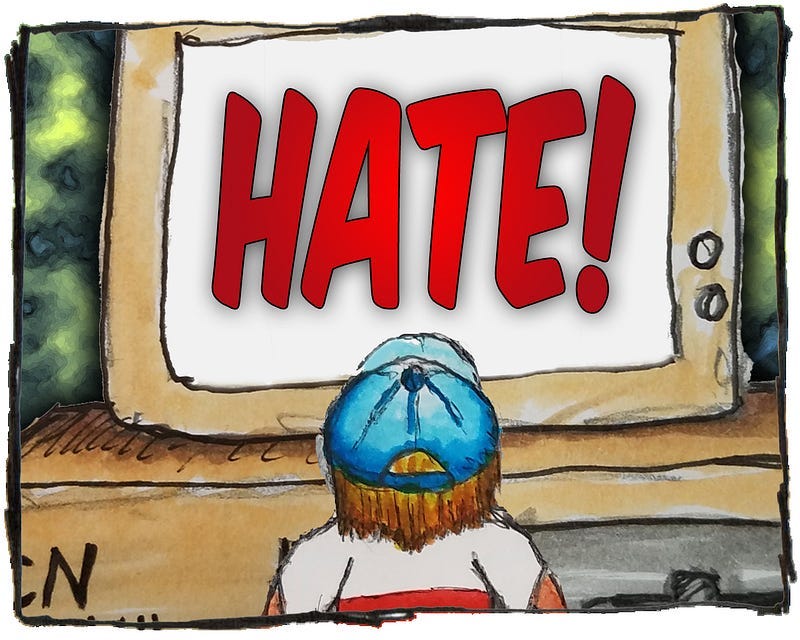
Do Writers Have a Responsibility to Flee Platforms that Feature Hate Content?
from Walter Rhein Podcast · host Walter Rhein
This is from February of 2025, but I see people talking about this concept again. It’s an ongoing problem. Here are my thoughts.If I walk into a restaurant and I see a bunch of men with hate symbols on their jackets, I’m going to turn around and walk right back out the door. I would prefer to spend my money in establishments where hatred is not welcome. Unfortunately, in both the physical and digital spheres, those places are getting harder and harder to find.As a consumer, I have a certain amount of economic power. Where I choose to spend my money has an influence on my community. Business owners notice when potential customers walk into their establishment, look around, and bolt for the door. The money a member of a hate group has to spend loses its value when the presence of hate drives a hundred other potential customers away.This is why businesses post signs that say, “We have a right to refuse service to anyone.”Today, more and more business is being done online, and hate groups have figured out how to insert themselves into digital communities. Responsible writers must consider the consequences of posting their work on a platform that shows too much tolerance for hate.The complex issue of hateBlatant hate symbols are easy to spot. Unfortunately, the waters get murky fast.We are right to celebrate the fact that we live in a society were the vast majority of the population have accepted that nazi flags are unacceptable. Yes, there are too many shameful instances where nazi groups make public protests or demonstrations (usually with their faces covered). But you rarely see nazi symbols on display at a family restaurant.It’s a matter of contentious debate whether or not allowing hate protests is truly necessary as a protection of freedom of speech. As for me, I don’t think it should be permitted. It is, however, important to recognize that members of these groups must change out of their hate uniforms before they’re able to go and get served.We have to acknowledge our victories where we find them.Business owners enforcing acceptable conductFor decades, it’s worked well to rely on business owners to moderate the proliferation of hate messaging. But with the advent of digital platforms, hate messaging has become a problem once again and there’s no clear answer in sight.In years past, a bartender could refuse service to anyone promoting a hate ideology. Removing such an individual from a public place deprived them of their platform. Today, individuals can go on social media and recruit at any hour of the day.Modern hate groups have also evolved to disguise their true objective. In the old days, they’d try to sneak into a business and pretend to be polite. They knew that by normalizing their presence, they could expand. Business owners figured this strategy out and forced them to move on.Today, rather than brazenly display known hate symbols, hate groups rely on suppressed or disguised messaging. They claim they’re “only asking questions,” or they insist they’re defending “free speech.”They use a lot of deceitful tactics. They’re always recruiting. They rarely engage in honest conversation, and it’s enough to leave anyone bewildered. Some people think they’re having an honest conversation, when really they’re being indoctrinated with hate ideology.The complex question of boundariesThe question rational people have to contend with is: How much hate they are willing to let pass? What constitutes the difference between a sincere question and a poison pill designed to trick you into entertaining the fundamental misconceptions of hate ideology?Another aspect of this is that various forms of hate have been normalized in our society. Most people would turn away if they saw nazi symbols. But what if they saw symbols from groups that spread false and disparaging comments about immigrants? What if they saw symbols from groups that spread scorn for the LGBTQ+ community.Some Christian groups condemn homosexuality as a sin. Therefore, you could make the argument that the Christian cross is a hate symbol. Can you effectively respond to the prejudice religious groups show for the LGBTQ+ community by refusing to eat at the same restaurants as Christians?I don’t think that’s an effective form of activism.Can you oppose hate without being corrupted by it?The question before us is when should you walk away, and when should you remain as an ally and advocate for an alternative viewpoint?I would also suggest that there is no universal correct answer for this problem. There are many ways to contribute to the creation of a better society.Most people have a strong response in the presence of irrefutable symbols of hate. But it’s infrequent that we’re actually in such a situation. More often, we’re presented with nuance. We can’t expect to always use blunt tactics in situations that call for finesse.We must also recognize that standing fast in the presence of hate is not always capitulation.Sometimes it’s defiance.We are allies in a common causeIn most scenarios, we’re called to make accommodations for groups and ideologies that don’t make us entirely comfortable. In activist Loretta Ross’s recent book Calling In, she discusses the need to form a coalition with like-minded people in pursuit of a common goal. She emphasizes that a movement consists of people with diverse perspectives, where a cult is made up from a uniform ideology of people rigidly marching in lock step.I think that’s a profound realization.There’s a pervasive belief that if we go into a digital sphere and find hate, we have to flee at the risk of being tainted ourselves or inadvertently drawing others in. However, I think we must instead respect the choice of those that flee and of those that remain.We should resist the temptation to label people as “part of the problem” because they chose to employ a different strategy to bring about the same change we all desire.Should you fear the echo chamber?Another argument that’s made its way into the conversation is the idea of echo chambers. If you chose to leave a place that’s gotten too hostile, people will, perhaps unfairly, criticize your choice. They’ll contend that if you do not tolerate all viewpoints, you risk entering an echo chamber where you’re only exposed to the ideas you already believe.I feel the concept of the echo chamber is sometimes leveraged as another deceitful tactic of hate groups who want to silently recruit rather than truly engage in intellectual inquiry. One result of the echo chamber argument is that people are reluctant to block abusive individuals from their sphere of influence. They tolerate people who make them uncomfortable because they’re fearful of the consequences of removing alternative viewpoints.As for me, I see no merit whatsoever in enduring abusive or disrespectful comments. We need to feel empowered to set boundaries of appropriate conduct, and anyone who violates those boundaries needs to be expelled without apology or explanation. First and foremost, you must protect yourself.Echo chambers can’t survive true intellectual inquiryI contend that echo chambers are a feature of radicalized hate groups. I don’t believe echo chambers are likely to form in communities that follow appropriate mechanisms of intellectual inquiry.Consider the process of peer review. That’s the opposite of an echo chamber. Academics propose theories in the form of papers with the intention that their colleagues will find flaws. The same is true in the debates that take place in university lecture halls. Individuals who have cultivated a commitment to rational thinking expect their viewpoint to be challenged.Echo chambers only develop when you have a push for unquestioned conformity. Rational thinking embraces diversity, and that serves as a deterrent to the formation of echo chambers.The problems arise when it comes to the setting of boundaries. Boundaries that are too lax allow the inclusion of intellectually dishonest hate ideologies, and boundaries that are too rigid limit intellectual advancement.The only way to navigate these troubled waters is through trial and error. The pendulum must be free to swing between the extremes. That means the consequences can’t be too extreme if the pendulum goes too far in one direction or the other.The responsible writerI don’t believe you’re likely to truncate your own intellectual development if you remove yourself from a platform that is too tolerant of hate speech. I’ve left platforms myself. In other cases, I use the block feature so I can control the kind of content I see.It does concern me that people who come to a platform to read my content might then be exposed to the hate ideologies that are allowed to proliferate there.Unfortunately for me, I don’t have the technical understanding that would allow me to build my own platform and self-host all my content. To some extent, my choice to remain on certain platforms might be an unfair justification based on my lack of the technological skill required to move.On the other hand, large platforms allow me the opportunity to expand my reader base and my influence. Self-hosting might cut me off from the very people who most need to hear my message.Arguments for establishing a base in hostile territoryI think we must consider the merits of establishing a point of reason and allyship in an otherwise hostile environment. It seems to me it would be wrong to cancel an activist because that activist marched into enemy territory to confront the rhetoric of a hate group. That being said, I understand there’s a significant amount of risk in that scenario.A willingness to embrace a diversity of viewpoints is the defining characteristic of a rational perspective, even when some of those viewpoints make uncomfortable encroachments into the territory of hate.For decades, allowing business owners to moderate public spaces served as an effective means to discourage the proliferation of hate ideologies. However, it appears as if technological advancements have created the need for a new approach to this problem.Perhaps we need to overcome our conditioned response that compels us to rely on an outdated mechanism. I feel that this question needs more debate. It’s not my intention to propose that I have the answer.Don’t alienate your alliesAs a community I fear we haven’t yet figured out how to effectively moderate digital spaces. If somebody on a platform says something objectionable and you leave, you might preserve your mental health at the expense of relinquishing your power.What we lack is an element on the digital platform that fulfills the role of the business owner. In the old model, customer protests would provoke the business owner to take action. But leaving a digital platform doesn’t seem to apply the economic pressure necessary to stop the proliferation of hate.I see the need for people to leave. I also see the need for others to stay and resist. I think the lesson might be that we should recognize we are allies and not be overly critical if people decide to stay on platforms where the pendulum sometimes swings too far in the direction of hate, or leave them because it becomes too toxic.Diversity is the embrace of a variety of strategies. There’s merit in both approaches.Rather than being critical of each other for staying or leaving a platform, we need to focus on the shared purpose of working for a better future. It’s important to recognize the contributions our allies make in pursuit of this common goal.You all make this newsletter happen! Thanks for your sponsorship! I have payment tiers starting at as little as twenty dollars a year.Upgrade at 30% offUpgrade at 40% offUpgrade at 50% offUpgrade at 60% offI’m so happy you’re here, and I’m looking forward to sharing more thoughts with you tomorrow.My CoSchedule referral linkHere’s my referral link to my preferred headline analyzer tool. If you sign up through this, it’s another way to support this newsletter (thank you).I'd Rather Be Writing is a reader-supported publication. To receive new posts and support my work, consider becoming a free or paid subscriber. Get full access to I'd Rather Be Writing at walterrhein.substack.com/subscribe
NOW PLAYING
Do Writers Have a Responsibility to Flee Platforms that Feature Hate Content?
No transcript for this episode yet
Similar Episodes
Mar 26, 2026 ·1m
Jan 2, 2026 ·47m
Dec 21, 2025 ·46m