Does U.S. empire have boundaries or walls?
from The Healing Hype Hosted by Nisha Mody
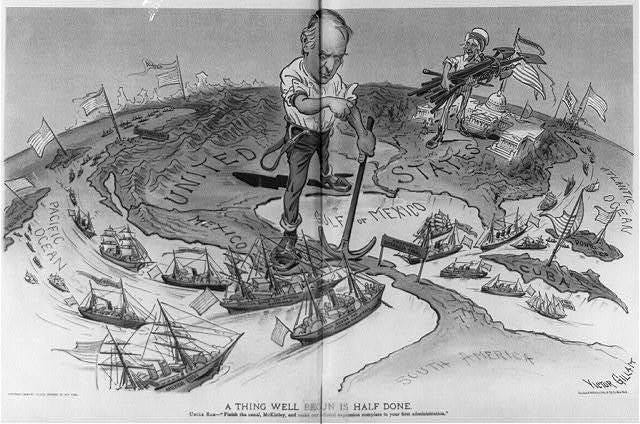
As I am in the process of offering my new group coaching program “Boundaries for BIPOC”, a 6-week group container for Black, Indigenous, and/or People of Color (BIPOC) looking to set and hold boundaries, I’ve been thinking about the different contexts we consider boundaries in our lives. According to Nedra Glover Tawwab, the author of Set Boundaries, Find Peace, there are 6 types of boundaries: physical, sexual, intellectual, emotional, material, and time - with 5 different contexts we might encounter them: family, work, romance, friendships, and technology. I wanted to take this a step further into the macrocontext of these contexts which ultimately are the systems we live, including U.S. empire. What goes along with U.S. empire is colonization and capitalism, massive wealth accumulation and massive wealth (and health) disparities. A land that allows healthcare and utilities to be privatized. And one that has an extractive and detached relationship to the land, juxtaposed with Indigenous peoples who see the land as kin. So this makes me ask the question: does U.S empire and its associates have boundaries? Or walls? First, I think it’s important to define these terms. Boundaries, according to Tawwab, are defined as “expectations and needs that help you feel safe and comfortable in relationships.” On the other hand, “[w]alls are rigid boundaries through which you intend to protect yourself by keeping people out. By offering very little flexibility in your boundaries, you keep out both harmful and positive things and people. Walls are an unhealthy way of protecting yourself from abusive or dangerous situations, as they are rigid and indiscriminate,” Tawwab writes. Basically, walls keep people out and boundaries show how you can have a relationship with someone. Does the U.S. put up boundaries or walls? While it’s not exactly the same, we can apply these definitions to how nations relate to each other, while not forgetting how power and control are critical factors. Given that both Obama and Trump built a literal wall at the U.S.-Mexico border makes me think the latter for the United States. This wall was intended to keep people out, people who were deemed to be “dangerous”, instead of recognizing the deep history of Mexican immigration to the United States. Walls often avoid issues and gaslight others into thinking they are the problem. Is the U.S. embargo on Cuba a boundary or a wall? Is not allowing trade from the U.S. to Cuba a way to have a better relationship and encourage safety, or is it a way to punish a population by withholding food, clean water, and medicine from them? Is Cuba abusive or does the power of U.S. empire make us think so? What about redlining? What about blockbusting? Who are we keeping out and who are we keeping in? And is there a more relational approach that addresses the “problems” we feel make it necessary to employ these tactics? It seems that creating these walls also makes someone an “American” or a “patriot” - people who enjoy claiming the United States is the greatest nation on Earth. By deeming we are the best, someone has to be the worst, or at least worse. And in order to be the best, relationships are destroyed at worst or politicized at best, land is exploited, and labor must be made cheap. The U.S. military apparatus is itself the greatest tool of U.S. empire. One example of this is the United States’ relationship with Afghanistan, a country where we had a close friendship with Osama bin Laden, once providing over $3 billion in military training and weapons to him and the Afghan mujahideen before deciding he was an enemy. A brilliant, dear friend of mine, scholar on Islamophobia, and author, Dr. Nazia Kazi, writes about this and the other connections to U.S. empire’s global reach, including in the Middle East, in her book Islamophobia, Race, and Global Politics. She writes: Iraq’s history is marked by meddling by foreign powers (British and American, primarily)—meddling that involved disrupting democratic movements, establishing dictatorships, and arming unsavory characters, in large part to enrich themselves (for instance, through the extraction of oil wealth). When the United States was reckoning with the “threat” of Iranian power in the Middle East, Iraq (and Saddam Hussein specifically) had served as a key ally to the United States. Hussein received handy support, even when acting as a brutal dictator, when he was protecting US interests in the region. Eventually, though, he would stop acting on behalf of the United States. In 1991 the United States went to war with Iraq after Hussein ordered an invasion of Kuwait. Two separate UN humanitarian coordinators resigned from the post after declaring that the civilian costs of US and British bombing campaigns in Iraq were unconscionable. What followed that war was years of sanctions that left a whole generation of Iraqis to suffer malnutrition, hunger, and poverty. While President Clinton officially issued these sanctions as a punishment for Saddam Hussein, their impact was on ordinary Iraqis. When then-Secretary of State Madeleine Albright appeared on a 60 Minutes news segment in 1996, where Lesley Stahl asked about the Iraq sanctions, “We have heard that half a million children have died. That’s more children than died in Hiroshima. Is the price worth it?” Albright replied, “It is a hard choice, but we think the price is worth it.” My students are stunned to learn of the close relationship that existed between the United States and the very Saddam Hussein who was later dubbed the ultimate threat to US stability. This history—of alliances, destabilizations, sanctions, and invasions—has left an Iraq so devastated, so destabilized, that it seems almost natural that a group like ISIS should form. ISIS took hold in the midst of a toppled Iraqi state and the desperation of a population that had lived through far too much trauma. Today, many in the United States have a vague understanding of ISIS as the “bad guy” in the region, but very little historical understanding about how this militant Sunni Muslim group rose to power on the global stage. The borders of Iraq, Afghanistan, and the many places U.S. empire wants to mold in its hands were and are in service to U.S. interests. Those “relationships” were about resources, and when these resources were no longer available, sanctions or embargoes or some type of punishment get enforced. Sanctions themselves are defined as “an action that is taken or an order that is given to force a country to obey international laws by limiting or stopping trade with that country, by not allowing economic aid for that country”, and, ultimately, it is about control and power. When an abusive person wants to control the person they abuse, they put up a wall, withhold their attention, and gaslight in order to have power. Is this much different? I’ve only given a few examples of the gravity of punishment and control exercised by the United States. Asking if the U.S. puts up boundaries or walls was probably a bit leading of me, but when American exceptionalism only desires relationships based in supremacy, not in reciprocity, which harms the people within and outside the country, it’s hard not to be leading. Indigenous erasure and sustainability Indigenous erasure within the U.S. is another example of figuratively and literally bulldozing land to create borders that served the state rather than the peoples who lived on it, the peoples who knew how to relate to it, and the peoples who granted it safety, not extraction. It is not a made up Thanksgiving story of happy and communal relationships. As Howard Zinn said in A People’s History of the United States, “Nations are not communities and never have been. The history of any country, presented as the history of a family, conceals the fierce conflicts of interest (sometimes exploding, often repressed) between conquerors and conquered, … This is a public episode. If you would like to discuss this with other subscribers or get access to bonus episodes, visit healinghype.substack.com
Embed this episode
No transcript yet.