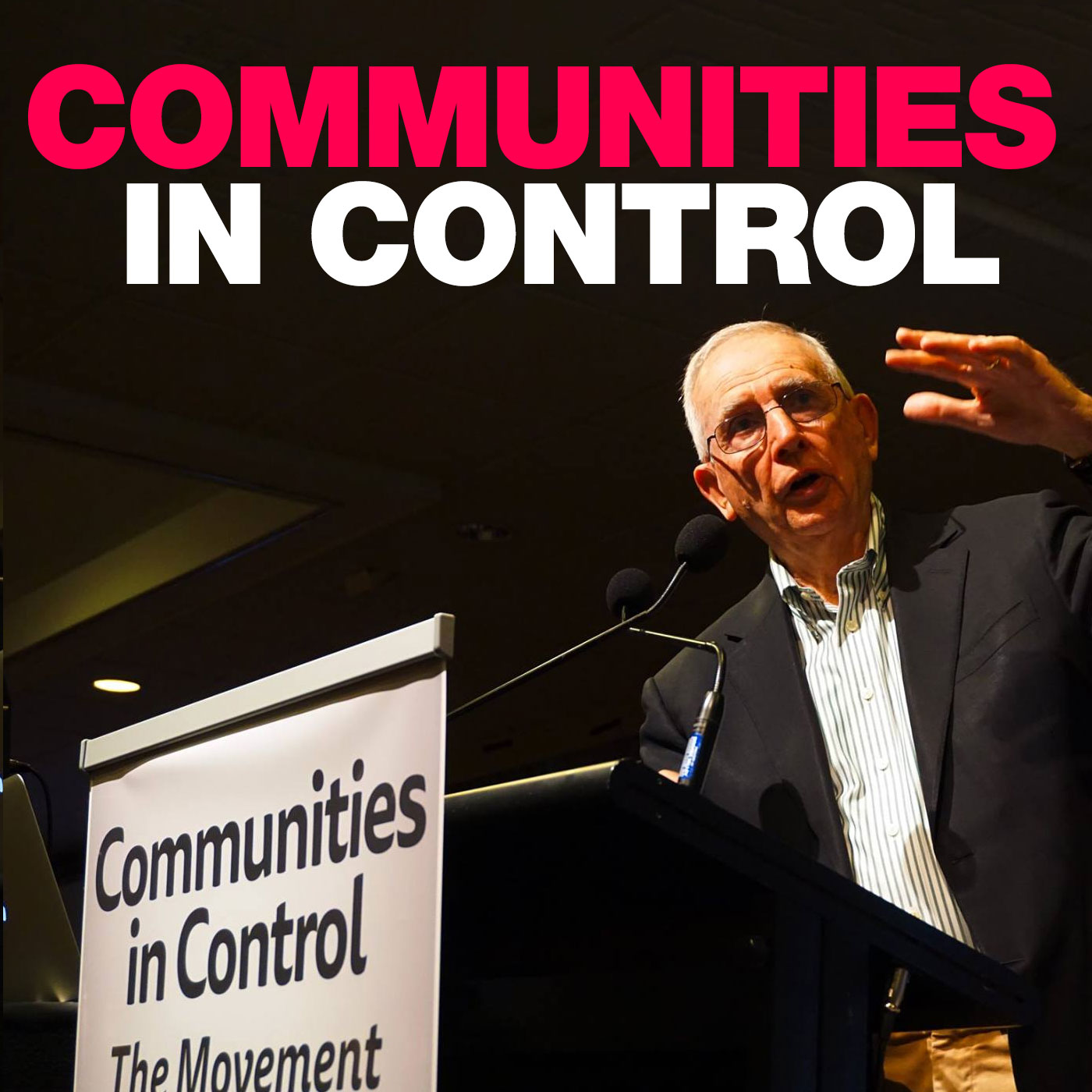
Here's another inspiring speech recorded at Communities in Control, Australia's biggest and best annual community sector gathering. I'm really honoured to have this opportunity to speak with you all here today. I'd like to thank the custodians of the lands that were on, the Wurundjeri people. In the next 25 minutes, I want to speak to you about the role of economics in creating a better world, introducing you to seven big ideas in political economy. I think that'll leave us about 20 minutes for discussion. We can engage in some co-informing dialogue then and perhaps also later in the day.
You can only ever say so much in a conference presentation like this. So to manage around the constraints, I'm currently putting together a free set of supporting resources which back up and extend everything that I'm saying today. I think that'll be finished in the next 24 hours or so. The glue's not quite set on it yet, but you're free to check that out and also to get in touch with me. Okay.
So, there's my plan. I don't think you even need to see that slide, so let's just move on. Economics is for everybody. Let me start by calling out the fact that most people are intimidated by economics. Economic processes are often seen and often presented as being mysterious, highly technical and beyond the reach of the average person. Some parallels can be made with the regular segment of the comedy show Little Britain, where one person goes to the counter of an organisation and asks whether some entirely reasonable thing is possible. The answer given is always the simple statement, computers says no.
The questioner then accepts this mysteriously arrived-out answer, albeit somewhat bemusedly. Nobody should have to see economic processes in such fatalistic, mysterious or mystical terms. As Cambridge University's Ha-Jung Chung points out, 95% of economics can be understood by the average person. The remaining 5% can also be understood, at least in its broad principles, with just a little bit of guidance. The economy is a human-made construction, subject to human comprehension and no small amount of human control.
It's important for democracy that economic analysis is more widely understood and debated, not just left to a small section of society, one that's sometimes prone to engage in uncritical and insular groupthink. In saying all of this, I'm not running down the role of expertise, or economic expertise in particular. To really master any area of knowledge is life's work, and economics is certainly no exception to that. But what I am saying is it's possible for people from all walks of life to engage with economic reasoning and conjectures in an intelligent and productive manner. There are some good reasons to engage with economics. First, because economics are so tied to values, ideologies and material interests of particular groups in society. Few ideas influence life circumstances more than economic ideas and theories. Economics, in part because it impacts so directly on people's lived existence, also exhibits a very high level of disagreement between the experts. Indeed, as the post-Keynesian economist Joan Robinson argued, the main purpose of studying economics is not to acquire a set of certain and ready-made answers, but to avoid being deceived by other economists.
So, the theme of this conference is Think Big, Change Everything. So my suggestion is for everybody here to consider themselves as an emerging economist and one who probably already knows more about economics and can have more to say about economics than they might currently realise. Economics versus political economy. When you look at something as complex as social and economic systems, you can't simultaneously assess all the variables nor contemplate all the causal linkages between them. So you have to decide how to look. You have to decide... And then how you decide to look will then heavily influence what you see, why you think it's occurring, and what you think should be done in response. Every way of looking, then, each intellectual framework is, to a greater or lesser degree, a set of glasses which might illuminate some things clearly, but is likely to be less illuminating to others. Furthermore, it might distort our view of other things. It might blinker our vision into something approaching tunnel vision.
Given this, we should obviously pay the greatest attention to which pair of spectacles we're being asked to look at the world through. We should also think about which purposes and values shape the construction of those lenses, and the values and purposes are necessarily always involved in economic and social analysis. Economics can't be objective or value-free. Don't let anybody, including any economist, convince you otherwise. Okay, so let me now introduce these two broad frameworks.
There can be some overlap between these frameworks, but a whole lot less than you might think. It's due in applied work, the frameworks can be combined, sometimes, but it's still very valid and useful to consider a great divide in economic thought. So let's look at what lies on either side of this divide. Standard economics is often taught and practised as a type of social physics. Indeed, it's sometimes taught and practised as a type of physics envy. This explains why so many students find economics difficult, boring, irrelevant or even just plain offensive. In no other discipline do students so regularly rebel at the content of their instruction. The focus in standard economics is on putting forward a particular explanation of the way prices and incomes prompt small, marginal changes in the consumption and production of goods and services.
Various strong simplifying assumptions are utilised and many non-quantitative variables are simply ignored in order to facilitate a largely mathematical mode of analysis. This way of doing economics can be illuminating and useful. If we consider economists as intellectual tradies, let's say this way of doing things has its place in the toolbox. However, like any tool, using it safely requires us to know its strengths and limitations and being upfront about that with ourselves and also with others. One always needs to think carefully about the appropriate domain and applicability of any particular tool and to also consider whether other tools need to be used in conjunction with it. Of course, you need to have more than one tool in your toolbox. If the only tool you have is a hammer, then everything starts to look like a nail.
An alternative to the social physics approach is the political economy approach, which is actually the traditional name for economics. It changed in about 1870. So in some ways, I'm the traditionalist here. The political economy approach more fully recognises that economic activity always occurs within a social, political, historical and environmental context. And that other variables, such as people's preferences, beliefs, rules, power, perception, history, uncertainty, ethics, irreversibility, these are central in economic processes.
Of course, this broader and richer view of things can also include quantitative variables and analysis. The political economy approach to economic analysis is open to the full methods of the social sciences, such as case studies, field work, comparative analysis, historical analysis, etc. The political economy approach is not only intellectually pluralist in its methods... It's also genuinely interdisciplinary and in genuine co-informing dialogue with other academic disciplines. You'll notice how broadly I set the boundaries of political economy later in this presentation. This is exactly how it should be, given that the economy is always embedded in a social and political context. Let me say something about intellectual pluralism, because what's distinctive about much economics is its lack of plurality. By contrast, the political economy wing of the discipline embraces pluralism of theory. As the classical political economist John Stuart Mill noted long ago...
If you don't understand the arguments against your own arguments, you don't understand your own arguments. Accordingly, students, practitioners and policy makers always need to know something of both the political economy approach and the narrower traditional economic approach. Furthermore, they need to know about the various sub-schools within this broad divide and to also think carefully about the sometimes fuzzy boundary lines between them. The traditional social physics approach to economics can make a contribution and I draw upon it here and there later in this very presentation. However, it is the economics as a social science or political economy approach that offers the more comprehensive, intellectually warranted and more useful way of understanding and responding to most contemporary challenges. While some universities, such as Sydney University, offer dedicated programs in political economy, most Australian universities have been unable to recognise their responsibilities or identify the opportunities.
This is why the School of Political Economy was established in 2019, to offer tertiary level instruction in political economy from outside the constraints, problems and inertias of the university system in Australia. Okay, let's get the rubber to hit the road and talk about seven big ideas. Having now made the case that economics is for everybody and that a pluralist and interdisciplinary political economy often offers the most appropriate way to do economic analysis. Let's get started. Now, I've picked seven ideas. I thought really carefully about what I wanted to talk about, and they all pretty much pertain to change, because that's the theme of this conference. Then to show how the ideas apply in practice, I decided to apply them to the issue of climate change, because the other sub-theme of this conference is fix everything, and I certainly believe if we don't very quickly fix this, it will quickly and permanently break most everything we value and need. First point. Economic and social systems can change very quickly.
The general idea in standard economics is the concept of equilibrium, whether it's convergence towards an entirely static end state, with that end state predetermined by the assumptions embedded in the analysis. This type of equilibrium framework is seldom relevant to real-world phenomena, which are generally characterised by being fluid and unstable. Real-world processes of change are more likely to be circular and cumulative, with change feeding back on itself, creating further change. Let's look at economic history to back the claim I've just made. History demonstrates our capacity to change social and economic systems, particularly in emergency situations, can be head-spinningly quick. For example, during times of war, societies and economies have, in a very short period of years, significantly reconstituted themselves. Production of certain goods and services is cut back dramatically. Other goods and services are expanded rapidly. The state expands its role as a regulator and coordinator of activity. Private firms operate viably within the negotiated framework set for them. Civil society plays its part. This capacity to quickly change one's own economy and society...
is usually a precondition for success in any sustained war or crisis. Of course, rapid economic and social transformation is not just confined to war and crises. Maria Mazzucato, one of the world's most interesting economists today, most of them are all women, actually, doing the really interesting work, her latest book, Mission and Economy, shows how the public and private sectors collaborated on a massive scale during the space race of the 1960s. Mazzucato correctly calls for the same levels of ambition and experimentation to be applied to the major problems of our time. Again, let's specifically consider climate change as one of those challenges. What's most interesting to me about this challenge?
Actually, what's most frustrating to me about this challenge is that the solution is well within our grasp, technologically and economically speaking. We need to spend about 2.5% to 3% of gross domestic product per year investing in renewable energy, fully transitioning to electricity, energy efficiency measures and reforestation. That's the nub of it. This is a small fraction of GDP. Also, it should be understood as an investment that delivers a massive and multifaceted social, economic and environmental return rather than simply being framed as a cost.
Technological progress in recent years has now resulted in renewable energy being cheaper than coal and gas, and new technologies in battery storage mean that a 100% renewable electricity grid is possible right now. Indeed, the federal government's sometimes covert, sometimes overt and very expensive war on renewable energy is intensifying, not because renewables can't replace coal and gas, but because they can. Okay, well... With that little feisty tale on things, let me just talk about a second point, which is the political economy of predation. Given that the vast majority of Australians currently support the pursuit of an ambitious climate target, why are we regularly ranked with the world's worst, or sometimes as the world's worst, in international surveys on climate change responses? It is shameful. Why is it that we can have a government that through its policies, if not its words, effectively say to its citizens that we can't afford the future, yet still have prospects of being democratically voted back into power?
Of course, there's not a short and simple answer to this question. However, political economy has something distinctive to contribute. I think we might best understand our current public policy perversities, at least in regard to the issue of climate change, via recourse to what the institutional political economist James Galbraith calls a predator state. In such circumstances, one narrowly based group in society takes what is on offer in a decaying system that once served broader interests. This predatory group may be opposed by others who also possess wealth, power and influence.
However, a carefully constructed network built on political donations, ideological affinity and personal relationships produces an influence over the government that results in the interests of the predatory class prevailing over the interests of the majority. In Australia, state predation mainly takes a form of predatory delay in relation to climate change, whereby dying industries such as coal and gas ick out a last few years of existence, quite possibly killing any sort of future for humanity in the process. It is the taxpayers and consumers who primarily pick up the tab for this. The Australia Institute estimates fossil fuel subsidies currently cost Australians a staggering $10.3 billion per year, which effectively amounts to roughly $20,000 a minute being given to coal, oil and gas companies and major users of fossil fuels. Other nations are currently using taxpayer funds to engage in nation-building infrastructure. By contrast, we are using taxpayer funds to build nation-destroying infrastructure. What then is to be done? The situation, frustrating though it is, is also inherently fragile.
Given that in a democracy, there's always the means to produce outcomes that reflect the collective interest. The fact that there will be an election sometime in the next 12 months presents the opportunity for every electorate in the country to utilise the well-established community mobilising techniques so successfully implemented in seats like Warringah, Tony Abbott's old seat, and the seat of Melbourne, to replace major party representatives with independents or minor parties that are genuinely prepared to respond effectively rather than tokenistically to the climate challenge. Furthermore, the social researcher Rebecca Huntley has produced some great work on how to talk effectively to every section of Australian society about climate change and to guide people in how they can take action in support of their own future. Of course, beyond electoral politics, there are also a host of other actions and organisations that we can associate ourselves with to achieve political economic change.
and I'll put a small sample of those on the School Political Economy website. So, the political economy of state predation is currently a big problem in Australia, but it's capable of being reversed and negated. My third point, third of seven. Just because change can happen quickly, this does not necessarily mean it will. As I've just discussed, predatory delay illustrates that all too clearly. What then to do? I think there's a lot of merit in getting the clearest intellectual and practical understanding of the different ways that change can be thought about and the different ways in which change can be pursued. The best introduction to change studies that I'm personally aware of is How Change Happens by Oxfam's Duncan Green, which systematically looks at how best we might think about change and pursue what he calls a power and systems approach.
The book's specifically written for people that work in that very difficult, challenging and uncertain area of international development, but I think it's applicable to any change agent. I'll put links to this book on the SPE website, including a short summary of the book, so you can get a sense of whether it's worth reading for you. The ancient oracle, who I otherwise call Greta Thunberg, has quite reasonably asked us to do... everything we can, with everybody we can, as often as we can. I think if we can combine Greta's great overall writing instructions with Duncan Green's power and systems approach, it's a winning combination to achieve the required changes in time. My fourth of seven points. We're a cooperative species. The pursuit of self-interest in a context of competition with others, other self-interested agents, is a central idea in standard economics. Indeed, it's often presented as the primary engine of improved economic and social welfare.
The idea is worth understanding and it can be one of the many different ideas that can inform our thinking and actions. However, giving such centrality to self-interest and competition is, in many circumstances, overly simplistic and regularly misleading and harmful. Indeed, there's now solid evidence that so heavily foisting this self-interest plus competition story to students of economics damages their moral and ethical development. And I'll put links to those reports as well. What the anthropological...
And archaeological evidence shows us, and remember political economists are interdisciplinary, we're interested in what other social scientists do, what it shows is that humans, uniquely amongst animals, our most distinctive characteristic is our ability to cooperate in large numbers to advance projects for the common good. Both our genetic and cultural evolution has produced a species in which substantial numbers of people continue to make significant sacrifices to uphold ethical norms and to even help total strangers. This has actually been the key to our survival in the past, and remains so today. Indeed, the recent COVID situation in Australia also provides some support for that view. So economists really need to get...
to much better grips with cooperation. Indeed, I think there's a very strong case for the Australian Competition and Consumer Commission to expand its title a little bit and become the Australian Competition, Consumer and Cooperation Commission. OK, so it sounds like a gag, but I'm being really serious. Similarly, the Productivity Commission, I think, would be a whole lot more productive themselves if they knew a little bit more about cooperation. A good place for anybody seeking to make a more cooperative world, and I suspect there's a few of you out there today, would be to look at David Sloan Wilson's website, ProSocial.
which is focused on generalising Nobel Prize-winning economist Eleanor Ostrom's work, the first woman to get the Nobel Prize, generalising that, which was initial work, which was on environmental commons and social governance and polycentric governance. There's a big idea in itself. Generalising those ideas in order to promote the effectiveness of any group. So that's another hot tip. OK.
Idea number five of seven. The economy is a system of institutions, rules. The economy is often presented to students as if it were just a system of markets. This is a very bad intellectual foundation on which to build because the economy is actually a system of institutions, by which I mean formal and informal rules. Rules are necessarily all about power. So the interesting implication of this is that the economy is actually a system of power.
Where do markets sit inside the vision that I've just outlayed to you? Well, markets are part of the economic system, but they're just one institution that sits inside many other institutions. And it's this larger system of rules that heavily influences how markets play out in practice. And in many ways, markets are dependent on those other institutions to even function. For example, government regulations, labour standards, the allocation of property rights, social norms, social etiquette. Many other institutions profoundly affect market outcomes.
Indeed, conceiving of a market economy outside of its institutional structure is like trying to study the movement of blood without reference to the body. The fact that people might spend their lives doing that doesn't make it any less absurd. Many of the struggles we have in making a better world are as much to do with battles around the institutions around markets as it is with the opposing or supporting markets themselves. So what's the take-out from this fifth idea? I think it's good to think about markets in a multi-stage manner.
First, we have to determine whether they make sense or not in a particular task. Second, we need to think about what institutions to nest the market inside, both formal and informal. Third, we need to think about whether we can put those supporting institutions in place. Fourth, we then need to consider how we can best adapt or protect that institutional structure in light of changing circumstances and changing balances of power. This quite structured and sequential way of thinking about markets I think can really improve the way we interact and shape them.
Okay, idea number six of seven. Growth of what? Economic growth is usually measured by a metric called gross domestic product, which measures the total monetary or market value of all finished goods and services produced within a country's border in a specific time period, usually 12 months. Political economists, and also some orthodox economists, it must be acknowledged, argue that it's well past time to get beyond such a heavy reliance on such an astonishingly crude metric. Indeed, many debates between people that believe in green growth versus degrowth versus regrowth are conducted on the basis of GDP as the foundation stone of the analysis. This often generates needlessly high levels of division and confusion.
Certainly in the here and now, the basic question is growth of what? Clearly some things need to grow very rapidly. Renewable energy, public transport, various social services. And clearly other things need to contract or degrow, such as fossil fuels. So then to talk in terms of a general debate about being pro or anti-growth doesn't make sense, at least not for the moment.
There are a range of alternative measures of economic and social progress. No single measure is perfect, so a dashboard approach is probably required to get a better hold on how we are travelling economically and socially. GDP can be one of the dials on that dashboard, but it's just one metric that needs to be interpreted in relation to other metrics. If all of this sounds like common sense to you, I assure you it's not that common, at least not in economics. OK, my final idea, which is probably a meta idea in a sense. Beliefs about social and economic systems are working parts of those systems.
What we believe about societies and economies really tend to set the boundaries of what is then possible. So, a political economy view of the world and any good engagement with economic history prompts me to argue that the future is more wide open and more fundamentally uncertain and fluxy than most people think. There is a tendency simply to extrapolate the recent past into the future in a way that's not intellectually warranted or practically useful. We simply don't know what will happen. But what we do know is we have some individual agency and we have some collective agency to shape what happens. So...
What this suggests, at least to me, is we shouldn't really be optimistic because that can easily engender complacency, inaction and delusion. Neither should we be pessimistic, which can easily engender passivity, surrender and despair. We should instead be opportunistic. That's all about action, creativity, learning, utilising the opportunities that are there and then seeking to create other opportunities, either by yourself or working with others. My final thoughts. So...
Economics is a discipline that either wittingly or unwittingly all too often diminishes people's sense of what is possible and limits their view of what pathways of change are viable and desirable. I hope I've provided some counterpoint to this by providing you with the conception of economics as a contest of ideas, interests and ideologies and by introducing the political economy approach to economic analysis. It's been such a pleasure and a privilege to be part of this wonderful conference and I want to thank you all for the work that you do in making a better world. We hope you've enjoyed this highlight from the Communities in Control library. If you did, we'd love you to rate or review this podcast in the iTunes store and for you to share it with your friends. For further information about Communities in Control, visit ourcommunity.com.au forward slash CIC.