
EPISODE · Aug 26, 2025 · 1H 5M
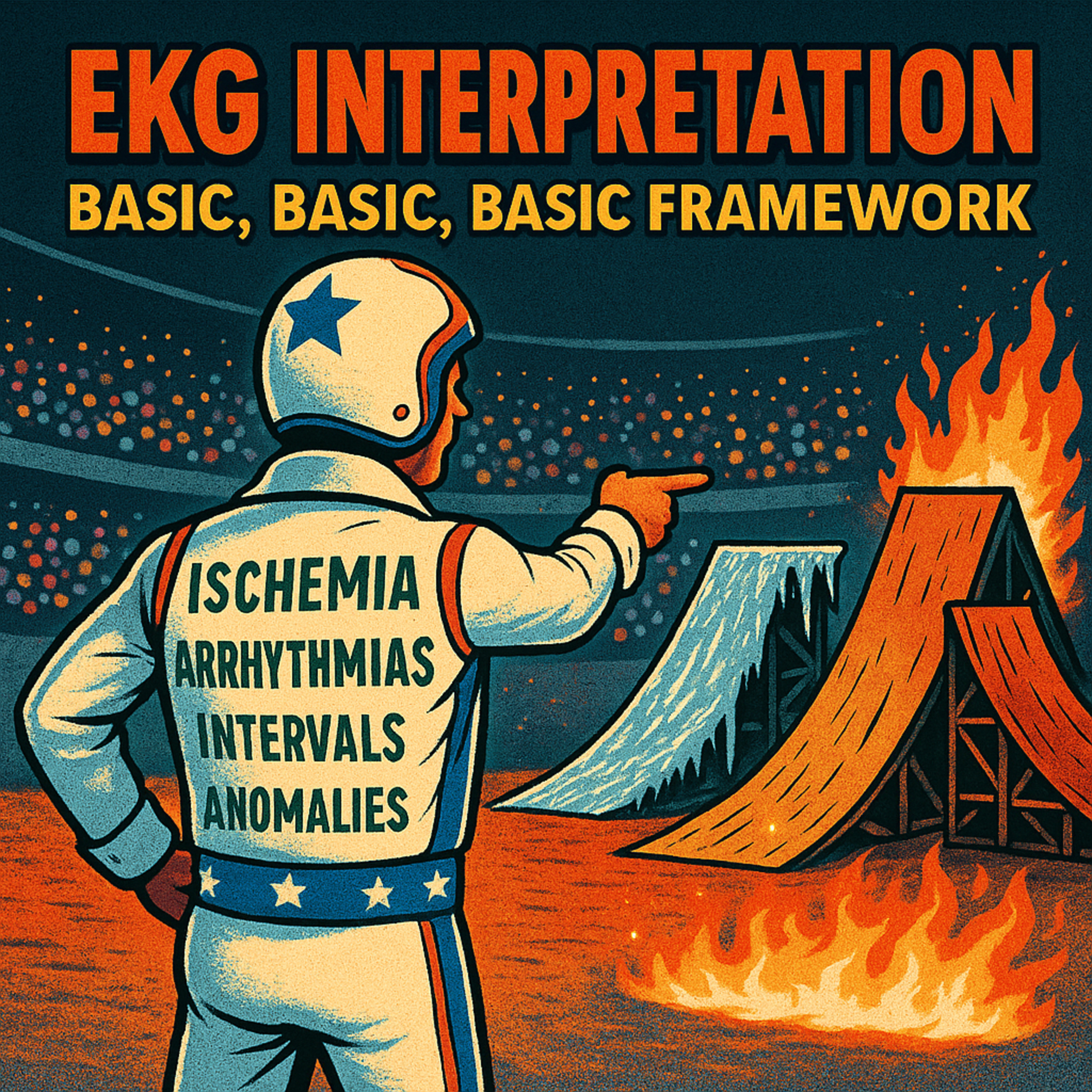
EKG Basic Basic Basic Framework for EM Docs: Ischemia, Arrhythmias, Intervals, Anomalies
from Emergency Medicine Mnemonics · host Aaron Tjomsland
This is the most basic, essential framework for EKG interpretation — built for emergency medicine clinicians who need clarity, speed, and confidence in the heat of the moment.Our brains are wired for movement and story. Just like remembering your morning routine — wake up, brush teeth, grab caffeine — we naturally recall sequences that follow a simple, visual narrative. In this episode, we harness that power by turning EKG interpretation into Evel Knievel’s most daring stunt ride. It’s not just a fun story — it’s a high-yield, easy-to-remember mental checklist that sticks, even under pressure.🏥 Why it works in the ED:In emergency medicine, chaos is the norm. We don’t have time to think academically when a STEMI or arrhythmia is staring us in the face. That’s why we built this vivid, memorable sequence — rooted in the high-performance principle Michael Phelps used to win 23 Olympic gold medals: a set routine. You don’t rise to the occasion. You fall back on your training.🏁 What you’ll hear in this episode: 🏍️ Evel Knievel enters the EKG stadium: First, he scans for the big stuff — STEMI and reciprocal changes. 🛠️ Check engine light: T-wave inversions on his digital monitor. 📈 RPMs climbing: Smooth R-wave progression across the precordial leads. 🔍 Arrhythmia check: Is there a P for every QRS? 📏 The perfect ramp: PR interval = Evel’s takeoff — 120–200 ms. 🛵 Mobitz moped warning: PR lengthens before crashing (Wenckebach). ❌ Sudden moped disappearance: Mobitz II. ⚫ Unicycle of doom: Third-degree block — P and QRS totally disconnected. 🧠 Anomalies & Final Scan: Brugada, hyperkalemia (peaked Ts), Osborn waves, and when to order a posterior EKG.🚨 Key Takeaways to Remember: This story is your reliable sequence: scan for ischemia → check for arrhythmia → assess intervals. STEMI? Look for elevation + reciprocal depression — including the often-missed posterior wall (V7–V9). Rhythm? Ask: Is there a P for every QRS? PR = takeoff ramp. QT = safe landing zone. Mobitz I = gradual PR lengthening → dropped beat. Mobitz II = PR stays the same → sudden drop. Third-degree block = P and QRS divorced — high risk of instability. Brugada = beware of the “grave cross” in V1–V2. Ask about family history of sudden cardiac death. Prolonged QT = risk of torsades, syncope, or V-fib — know when to shock.🎧 This is your EKG blueprint. Your Michael Phelps routine. Your Evel Knievel ride to interpretation mastery.Let’s ride.
Embed this episode
NOW PLAYING
EKG Basic Basic Basic Framework for EM Docs: Ischemia, Arrhythmias, Intervals, Anomalies
No transcript for this episode yet
Similar Episodes
No similar episodes found.
Similar Podcasts
No similar podcasts found.