Embody Your Worth and Impact the World: A Framework
from The Healing Hype Hosted by Nisha Mody
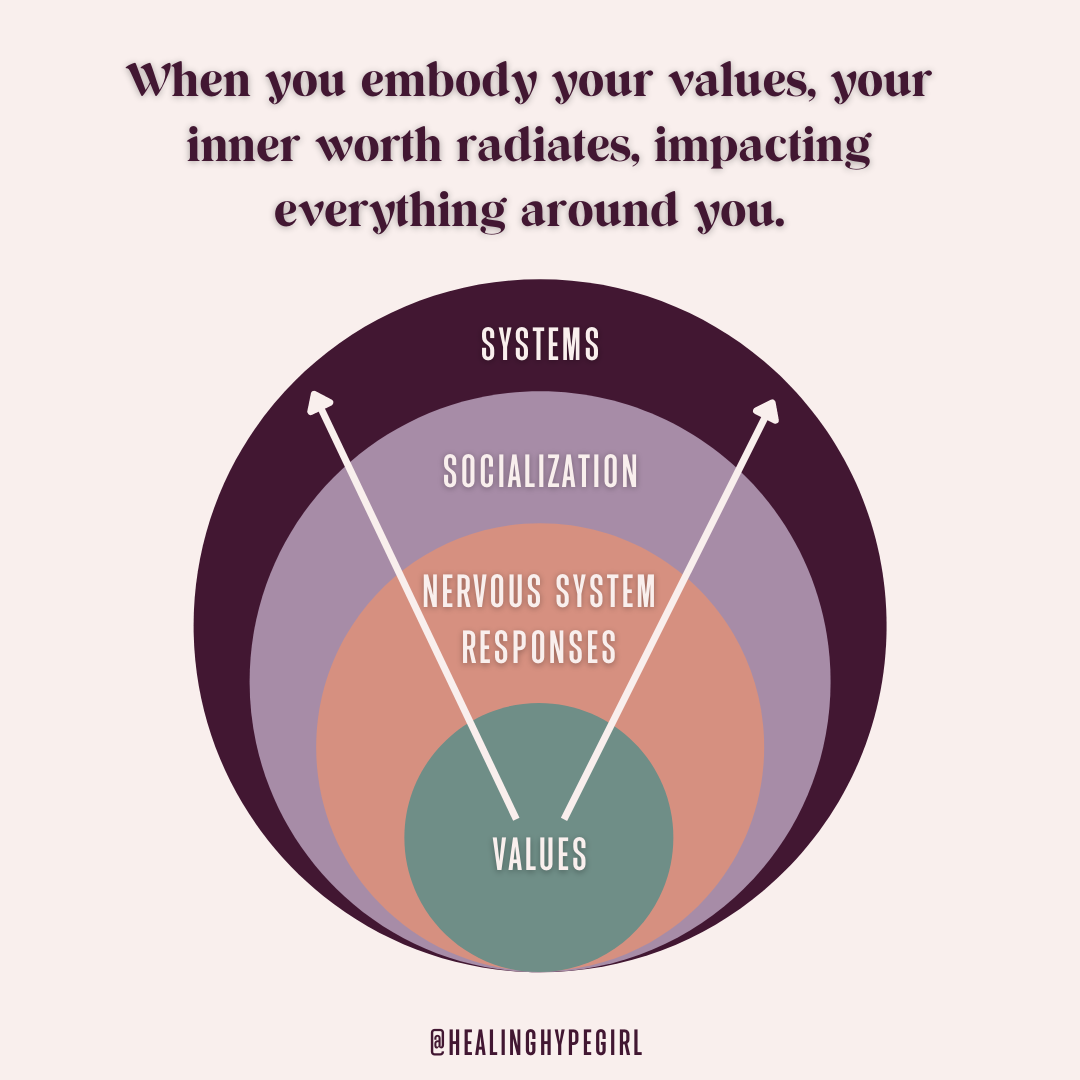
A few weeks ago, someone in my Boundaries for BIPOC program asked a great question: “I make boundaries with my sons and partner (all men), but I just can’t hold or maintain them, why is that?” The following words and thoughts ran through my head: patriarchy, minimizing voice and values, freeze, people pleasing. In that moment I thought of a Venn diagram of sorts I wanted to create that looked at socialization, the nervous system, and values as domains to investigate how we hold boundaries. After more thought, it turned into this series of images that I posted on Instagram in April 2022. And I thought I’d expand upon it more here on The Healing Hype. First I’ll explain the four components of this framework and how they typically manifest. Then I’ll share another image to talk about how we can be empowered within this framework. What affects your sense of self, boundaries, safety, and worth? I decided against a using Venn diagram because I couldn’t really derive what would come at the intersections, AND I saw all of these concepts as deeply embedded within each other. The nesting circles made so much more sense because we cannot avoid systems or socialization. Even if we actively investigate them or take actions to challenge them, they are still there and affect us, especially when we might feel a threat, aka nervous system responses. At first, I thought about socialization, nervous system responses, and values being the three components for this model. Then I started to discern systems from socialization. I believe systems end up socializing us from a universal lens of supremacy, yet they affect us differently based on identity, as well as our lived experience, especially if that experience includes (or excludes) adverse childhood experiences (ACEs). So this is why I also added systems as a fourth component because, while there is overlap, I see systems as global influences whereas socialization has more nuance. Systems Systems include capitalism, white supremacy, colonization, imperialism, meritocracy, heteronormativity, classism, patriarchy, ableism, religion, and healthcare. There are probably others, so feel free to add more in the comments. I thought to add education, but I felt meritocracy covered it. No matter who you are, these systems play a role in your life. For example, you might notice a significant increase in refugees arriving in your city during a period of time. Or you could be part of the actual refugee family who is forced out of their home country due to imperialist-driven unrest. This eventually effects jobs, class, discrimination, housing, economics, etc. The reason I included ableism as part of systems is because of its direct connection to capitalism. Productivity is often based upon our ability to produce and our efficiency. Increased productivity leads to more profit. In this world, having a disability or chronic illness, renders those who are unable to produce as much as less worthy humans. Systems assign value and worth to humans who are just as much part of this world as the grass outside your home or the birds you hear chirping in the morning. There is no “less than” or “better than” until we make it that way. After reading Disability Visibility and Care Work, I more clearly see how concepts like “crip time” and creating possibility and ideas for all from a place of care can be so transformative. And yet, when systems do not cater to this (or when they cater to it in a neoliberal way), people who are less “productive” are deemed worthless. Moreso, who we are is based on doing rather than being. Religion and healthcare can definitely fall under socialization. I find these systems, specifically at their intersection so pervasive in the development of many nation’s norms - so much so that they are embedded in the “justice” system. When it becomes illegal to have an abortion, and this decision is something that is determined by the State, there are larger systemic forces at work. (I wrote this sentence two days before the leaked Supreme Court draft on Roe v. Wade. Reading it now gives me chills.) I added healthcare because, at least in the United States, healthcare access is so problematic that it is enmeshed in class and ability, limiting where someone can or cannot work or live. When we talk about choice, values, and our nervous system, systems always have a role in shaping our baseline. Socialization Socialization is clearly affected by systems, yet it varies based on cultural background, geography, our role in our families, our personal identities, vocation, gender, or colorism. And, again, there’s overlap in here. As shown in the image, the arrow start with systems pushing down to socialization, reinforcing these systems. As a Brown daughter of immigrants, I was the parentified mediator in my family and academic achievement was my top priority. The model minority myth lurched above me in subconscious and conscious ways, feeling like a failure if I got an A- (ahem, meritocracy). This myth has systemic origins, and it created a wedge between Asian Americans and Black folks. Being a parentified perfectionist made me an expert people pleaser. Because if I wasn’t making others happy, did I even have any value? Did I belong? For me, the intersection of systems and socialization were crystal clear in my life. What about you? Nervous System Responses I talk and think about the nervous system A LOT. This is because after I learned about it, it was impossible to ignore. We have all heard of fight or flight, but it is often contextualized as an individual trait or response. When in reality, our nervous system responds to threats that are bigger than ourselves or our immediate environment. In fact, our bodies often response to perceived threats, signals that indicate to our nervous system (which doesn’t have eyes, nor does it know our age) there there is a *THREAT *! The next time we label someone who runs away from a social situation as “immature” or someone who gets into a fight as “violent”, it’s important to reframe this response from a trauma-informed lens. This doesn’t absolve someone of harm, bigotry, or responsibility, but it does help to explain how they are perceiving a threat, which can inform our response as well as larger systemic policy. Whether it’s real or not (ahem, white folx being threatened by immigrants “taking” their jobs and other BS), that response is true for them. I define safety as “the absence of threat and the presence of connection”. (I wish I knew where I saw this definition so I could give the human appropriate credit, so if you’re out there and you see this, let me know!) I think safety is often just considered as “the absence of threat”, so I love how acknowledging connection is also a reminder that human connection is necessary for humans to survive. We are not here to do everything on our own. We need each other. So when forces like white supremacy and colonization disenfranchise BIPOC, when imperialism reinforces classism and economic inequality, when healthcare systems make people jump through hoops to get basic care, especially in some countries more than others, human survival is threatened. And as I explained in one of my very early posts, intergenerational trauma passes these survival and trauma responses to future generations. This image below by therapist Ayan Mukherjee, is a perfect illustration of how systems and socialization inform nervous system responses. So considering the framework I illustrated, the forces pushing down from systems, socialization, and nervous system responses can literally take over our bodies. These forces, especially if you are marginalized, minimize your worth and, subsequently, your values. OR they might be so strong that you adjust your values to what is dominant. OR your value system aligns with values embedded in dominant systems. One way or another, these forces influence the values we choose to live our life by. Values If you have worked with me before, you know how much I val… This is a public episode. If you would like to discuss this with other subscribers or get access to bonus episodes, visit healinghype.substack.com
Embed this episode
No transcript yet.