
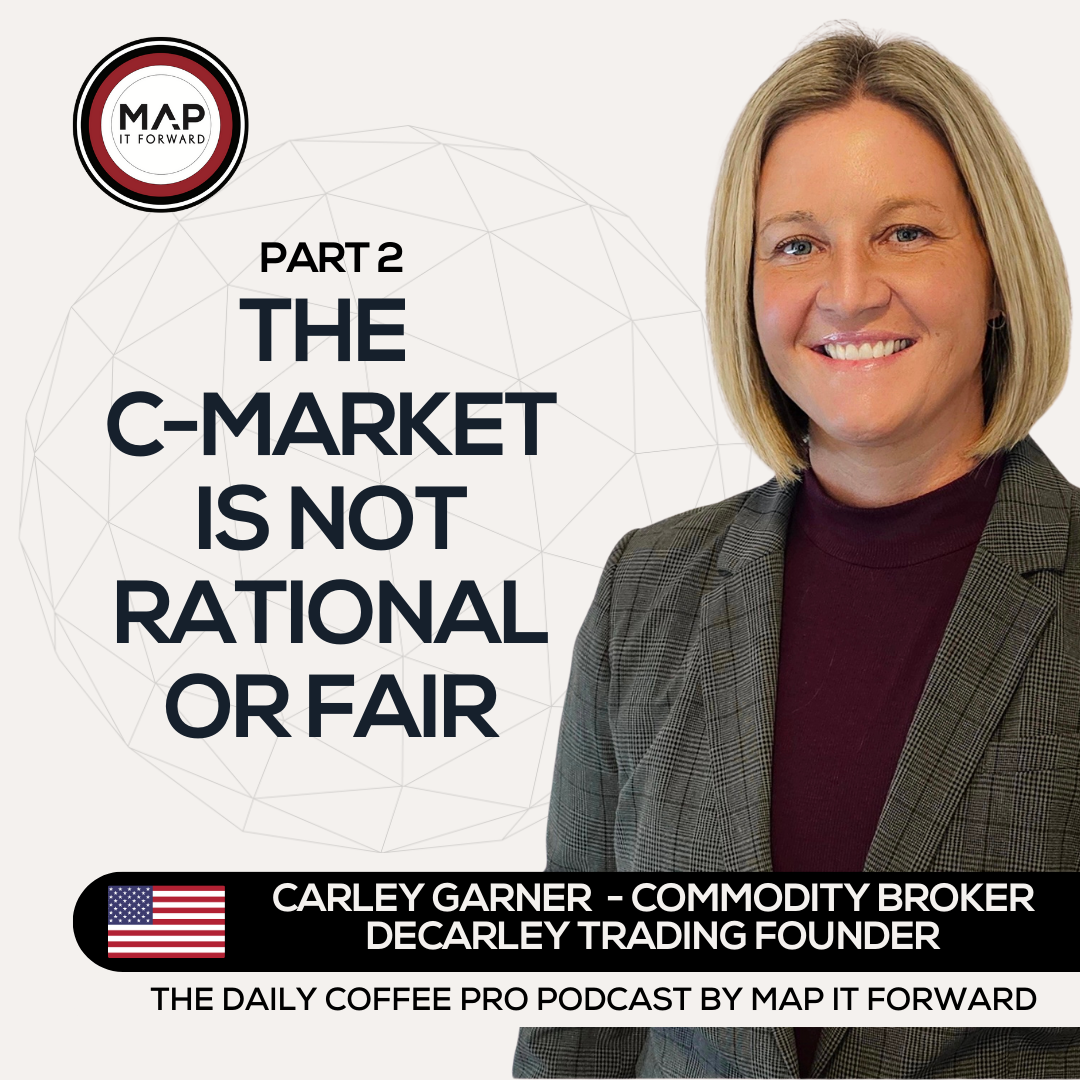
At the market's rational? No. In the long run, yes, in the short run, no. And it's because markets are, it's humans, like we're buying and selling because of our emotions, which is not why you should ever buy and sell, but that's what we do, and things get out of hands.
And markets are, they're not rational in the short run, and they're not really fair either. When we first talked in 2018 or whenever that was, everyone were you asking me, why can't we just set a floor? Why can't it just be like a minimum price so that farmers always know they can make this money? That makes sense much.
And the, I'm gonna mention in the US, we've kind of done something similar to that. It's not as simple as that, but we've done that in corn. And the unintended consequences have been really catastrophic for society. Communities aren't fair to anyone.
They're either in an oversupply situation, and prices are too low, and farmers are getting, you know, holding the bag and struggling, or they're too high, and it's the buyers and the roasters that are suffering. There's very few times where we're just in a happy medium, which is very unfortunate. But as market participants, we have to learn to try to hopefully manage it, but maybe even take advantage of these types of cycles because we know they're gonna come. Initiating direct trade and making it work at a small or medium sized scale is hard, especially ahead of harvest.
Arcana coffee marketplace connects roasters directly with small holder farmers in Ethiopia and builds in the hard parts, integrated QC, logistics support and to produce a lead to transparency. Ethiopia's harvest is underway, and samples will be ready in February. We know we're early, but that's the point. With coffee supply as volatile as it has been in 2025, getting in now helps you understand timelines and can assist in planning your 2026 buying with confidence, even if you've never bought direct before.
The minimum is around 20 bags, and Arcana can pull multiple roasters to meet the M.O.Q. so you can participate without overcommitting. If you're curious, listen to our recent conversation on the podcast with founder Matthew Thornton, then explore the marketplace via the link in our show notes. You can also book a meeting with Matthew and he'll walk you through requesting samples, the order process, pooled orders, QC, and shipping once coffees are ready.
Supporting our advertisers is a great way to support our mission at Mapper Forward to build responsible businesses with responsible pricing models. Check the show notes for details and explore Arcana coffee marketplace today. Welcome to the Daily Coffee Pro by Mapper Forward Friends. I'm your host, Lee Safar, and this is episode two of a five part series with Kali Garner from the Kali Trading.
In this series, we're talking about the coffee market in 2025 and 2026. We are not talking about the cash market, we are talking about the futures markets. And in this episode, we're gonna talk about what are the different forces that have moved the markets they see. And I guess Kali, a great place to start that is perhaps, let's talk about what's the difference between the cash markets and the futures markets.
Well, the futures markets is the idea of futures markets as it's a centralized place for people to buy and sell coffee, whatever commodity is, to accomplish some sort of goal. So if you are a producer, you might buy yourself futures on the futures markets to basically lock in your price, mostly be selling if you're a producer. You're locking in price and the ideas you're shifting your price risk to speculators. So for example, a coffee's at $4 and you feel like this is a price where you can confidently make money and your budget looks great at $4, you can sell a futures contract, lock that price in on 375,000 pounds and basically go about your day.
If the market goes up, you make money in the cash market, so that's okay, that you're losing on your futures if the market goes down, that's okay too, the cash market is getting weaker for you, but you're making up the difference on the future side. The idea is you're eliminating or reducing risk. Unfortunately, people use the futures markets to expose themselves to risk or in the case of producers or end-users, a lot of times they opt to hedge, they opt to not to use these tools, these futures, or options we'll talk about those in a minute too, to reduce the risk of their business, because obviously if you're a commodity, if you're a copy producer and prices go up, things are great, if they go down, you're starting to feel the pain, the reality isn't commodities, not just coffee, but all commodities, and it's been since the history of time, they go down more than they go up. When you see commodity prices rally, there's usually some sort of disruption in the system.
Supply issue, and that's almost always, in fact, yet to date, it's always been temporary. It might be a month, it might be two years, but it's always been temporary. But the futures market is basically a mechanism to sell us tape buying and selling if you are a producer, you could in theory, sell a contract on the exchange, and use that to deliver your coffee to the exchange. Most people don't do that, because it's very inconvenient to me.
But technically, that's what it's there for. So in short, brings buyers and sellers together to ideally find a fair price point that both parties can live with, and it never works out that way, but that's really the idea of it. And so you're, I guess I hopefully answered your question. Yeah, you absolutely did.
And in the next episode, we're gonna talk about some of the specifics of those tools that are related to producers and how they can take advantage of those tools. But in the last episode, something, go ahead, you're gonna say something. I am so sorry, I really should mention this. So the great thing about the futures exchanges, I mentioned they're centralized, but they're standardized, and that's really what the key is.
Because they're standardized, each coffee producer or each end user or each participant doesn't have to go out and find a buyer or seller to match up with, the exchange does it for them, and they can do that because every commodity contract is exactly the same. There's not the qualities of a specific grade. So there's no negotiating as much as I'm saying. It's all standardizing.
Nobody cares if they're buying from this person or that person, they're just hitting the buy button and then it goes. A contract is a contract. Yes, correct. Right, sorry.
Whereas in the cash market, we're differentiating based on quality, based on origin, based on a flavor profile, based on a whole bunch of things. That is not present in the futures market, right? There's no concept. You are absolutely right.
Yes, you're absolutely right. And so one thing I would suggest to people, when we're doing this with some of our cattle producers, they're finding they don't really care for what goes on in the futures markets because they believe that their product is superior. So they're going outside of the system and they are, in their opinion, and probably I believe them creating a superior product that they can, it's not as convenient to sell because they're not just selling it all at once and moving on, they have to find individual buyers but they can charge a premium for that. Yeah, and here's where I'm gonna give a shameless plug because I just found out before this conversation, in our next monthly discussion group, we're going to be talking about pricing coffee and how people can, it's gonna be a two hour conversation with, it's somewhere around 35 people now, that it really, big thinkers in coffee that we're gonna talk about, what are the different mechanisms that we can use in the specialty market that can perhaps create some independence for people to get them away from being hooked into the same market price.
And look guys, we have to come together to figure out these solutions. We're all doing it separate from each other. We've gotta come together and stop reinventing the wheel individually. So if you're interested in that, go to our Patreon.
It's $20 a month to be a part of this conversation. We've made it that price so that everybody can forward to be able to be a part of it. And it is an incredible group of people and really great discussions. So shameless plug, I know I'm sorry about that.
But going into the end, it's really the idea of direct-to-consumer kind of middleman. Direct trade. I think we can all agree in our lives, if there is a solution that's convenience, it's someone else is generally making all the money, right? We're accepting convenience because we enjoy the convenience but we are paying in some other form on the back end.
Somebody else is profiting off of our work. So if it's very convenient, it's probably not the best solution for you. And people say to me, but I need logistics people. You can't get rid of the importer.
You can't get rid of the exporter. We don't want you to get rid of the importer and the exporter. They're very valuable in this process. But you can have direct relationships with people where you're using your importer and your exporter, exporters as your logistics partners, rather than as necessarily the people who do all the buying and the selling and the risk mitigation.
You do yourself and you're producing partners of service by learning how to use these tools to manage your risk. Over time, you don't have to learn all of it in one year. But I have learnt so much from watching Kali do so much of the trend analysis that she does. And I study it and I try and understand it.
And the one thing that I have come to realise is, none of us are going to learn this and won't go. This is going to be something that we have to learn over a period of time. And if you're just going to turn around and say, well, fuck it, I'm just going to let other people do it for me. And I'm just going to try and figure out how to sell the coffee.
The coffee industry is changing so quickly that you're going to have to adapt with it. So yeah, anyway, that's enough of me rambling on about that. I'm sorry, Kali. Not great.
So this year, there's been a lot that's happened when we look at tariffs, when we look at what's been going on with regards to the stock market, geopolitics, blah, blah, blah, blah. What have been the forces amongst all of the forces that have really moved the markets this year? Well, I mean, we've already talked about the money supply. I think that's really a big component and the speculators jumping on.
But I think it's also, the tariffs have been, they've added a lot of chaos and uncertainty. And when humans are under a lot of uncertainty, humans don't like uncertainty, none of us do that. And we tend to overreact, right? And so that overreaction causes volatility in both directions, we've seen it in both directions.
It's my understanding that the Brazilian tariffs in the US have basically been eliminated at this point. But everybody in the back of their mind is like, well, it's not tomorrow about it. It seems like things have been fixed, not fixed, but simplified, but they really haven't, because nobody can get comfortable. And we're seeing this, not just in coffee, we're seeing it in livestock.
There was also Brazilian imports, a beef that were coming to the US, and that was kind of a contentious point as well. So it's not just coffee, you probably aren't following other markets, but it's the same idea. And these tariffs have really caused a lot of havoc. I will say, when the 40%, the original 10 was manageable, then there was a 40% tariff put on for Brazilian coffee.
Prices went from the twos, high twos, back up to where we are today in the fours. I would say it's probably reasonable to assume now that that tariff is gone, once the market starts to trust, if they ever, if they do, we probably are heading back to where we started pre-tariff announcement. Seasonality probably isn't gonna let that happen right away. I do think that, I don't think it's gonna be next week.
I think we probably go up and retest highs before we get any type of selling coming in, and any type of comfort level, because everybody's still on their toes waiting, what's next? What's next? I'm surprised. And you can't get comfortable, trust me, it's 2025.
No, I mean, we've been left home the bag a couple of times done. Yeah, we plan things out, we do all of our research. Again, I don't have a crystal ball, but I know what probably is most likely to happen, as we put on our trade, and then literally 30 minutes later, or the next day, it all just, everything that we thought was the case on wines, and we're looking at the exact opposite scenario. So I know business owners, producers, everybody's dealing with the same thing, and it's tough, it's tough.
I will also mention this for coffee. The relationship between coffee and the Brazilian realt has been highly correlated. So a lot of the rally that we saw here in the last year or so has been, I mean, again, I'm not saying this is the only reason coffee's rallying, but the strength in the realt has really allowed coffee to move higher than maybe it wouldn't have otherwise. When it comes to commodities, currency fluctuations matter dramatically.
Sometimes we forget that, because we're so focused on supply and demand and this and that, but currencies are a really, really big factor. And I think the higher result has allowed coffee to get up to these levels. And I'll also mention the realt is up against really good resistance. So there's a trend line that dates back, I think three or four or five years, even longer than that.
And we're at a 200 week moving average. These aren't guarantees that the realt is gonna roll over and start in the other way, but the odds are pretty good that it does. And if that happens, instead of the currency market, being a tailwind for coffee, it's gonna be a headwind. So it's something to keep an eye on.
And is your sub stack the place where people can find that information out? Yes. So we are kind of a, we don't only focus on coffee or only focus on one particular market. We're kind of looking at all the things.
So some people get turned off and they get overwhelmed. Yeah, cause they're seeing all this post about stocks. I just wanted to know about brains, you know, but we hit on every topic eventually and we only charge 25. So it's not gonna be great.
And you'll have access to analysis. Some of it you may not be interested in, but some of it might really genuinely help you and hopefully help you more than $25 or $50 you paid to get access. Yeah. And I watched a video that you posted on your YouTube channel a couple of days ago.
So I'll also make sure that there's links to that. Well, the one thing that I have learned about this is that this is a language that you have to learn in layers. And I've really felt quite dumb in many of the conversations that we've had, not because of you at all, but because I thought that everybody else understood this stuff instead of me. And I just came to realize like, it's a whole different language.
It's as though you're learning a brand new language and you've got to be patient and you've got to have repeated exposure to it. I wouldn't want anyone to see the conversations I have with chat JPT and the amount of times I ask it to repeat not can you explain like I'm like two years old, what a put option is and why currency matters. It's, yeah, it's difficult. It's a lot.
I have a specific question that people keep asking me about these forces and these markets. Why, when there's something that affects the cash market, why sometimes does it affect the futures market and other times it doesn't? I'll give you an example, if you want one. So for example, if we hear that there's something going on in Brazil, oh no, no, let's say Vietnam, what you and I were talking about this before we got on, about three or four days ago, there were these huge floods that happened in Vietnam and they had only picked 15% of the crop, shout out to Felipe for sending me the videos about this.
And it sounds like it's gonna be pretty devastating for the crop of robust in Vietnam. Now, I anticipate that that will impact the Arabica market as well because people who found Arabica was too expensive were secretly going and buying robust and now they're gonna have to come back to the Arabica market because Vietnam is a number one producer of robust in the world. So if that stuff like that has happened throughout this year and it did not impact the futures market or the futures market did something completely different to what you thought it might do, why does that happen? Well, a lot of times, and I've experienced this myself this year, and sometimes this kind of information is priced in advance, so I don't know enough about that flooding to know, but let's say people close to the source say, no, what's going on and they leak it to whoever, maybe even big players, maybe not.
And so sometimes that kind of stuff is already built in by the time we hear it, especially if we're talking about information coming from countries that are maybe not at, they're not on, I don't wanna say they're not on X, but maybe the information flow comes out a little slower. So I can't speak to that specifically, but I can't say there's been times where I look at a market and I'm like, what is going on? And then the next day I hear it and I'm like, okay, that's what happened, but somebody knew before we knew because they're already reacting, so that's some of it. Some of it is, like as you mentioned, there's really on the future side of things, there's really not enough volume and robust a coffee for anybody to do anything with.
So that's not really gonna, I mean, it will, eventually if it's a global supply issue, but I'm not sure, maybe on a percentage basis, it wasn't enough of a scare tactic. Plus, I'll be 100% honest, there's so many moving pieces that probably got lost in the sauce, because probably it sounds like it was right around the same time of the time. It was, it was, it was, all that kind of stuff. So there's just so many things going on, maybe it did react, but so maybe had that not happened, maybe coffee would have been down on the lowest, down 40, not 20, I don't know, but yeah, it's markets are emotional and it's, I have, I'll just add one more thing.
I have found it to be almost impossible to predict what a market's gonna do based on fundamental news because of the reasons I just mentioned, but also because like markets are forward looking. So if somebody out there is anticipating something, it's already priced in, and not just one person, but generally the markets are pricing and something before happens. So why this is important is if you take a market, like coffee or crude oil in 2008 or natural gas in 2022, there was zero fundamental reasons to go short crude oil in 2008 or natural gas in 2022. All the news was bullish, there was, I mean, nobody thought either of those prices could ever go lower in crude oil.
We were talking about, we were running out of oil and this was the end of the beginning of the end. And as it turns out, when the fundamentals are the most bullish is when the market peaks out and we don't really generally start learning about the bearish fundamentals until prices are 20, 30, 40% lower. So it's a really delayed reaction. The fundamentals are kind of delayed versus the price action.
And I'll mention one other thing in coffee. The market knows this. Like if you look at coffee futures, we're looking at the front month, right? You're looking at December's going off the board, March is now the front month.
March is trading in the high threes. I think it probably gets up to four, maybe a little above. December seems to be maybe going off the board somewhere around four. But if you look at the December of 2026, it's around 320.
If you look at December of 2027, it's under three. So the futures markets, they're pricing in catastrophic pricing today because of supply issues and all the things going on. But if you look down the chain, the market actually is expecting coffee to be below $3 or at least below $3 in the next couple of years. And that could all change based on whatever happens in the more news that they get in.
These prices are going to shift and change, but that's okay. Yes. Are the markets rational? No.
In the long run, yes, in the short run, no. And it's because markets are, it's humans. Like we're buying and selling because of our emotions, which is not why you should ever buy and sell it. That's what we do.
And things get out of hand. And markets are, they're not rational in the short run. And they're not really fair either. When we first talked in 2018 or whenever that was, everyone were you asking me, why can't we just set a floor?
Why can't I just be like a minimum price so that farmers always know they can make this money? That makes sense much. And I'm gonna mention in the US, we've kind of done something similar to that. It's not as simple as that, but we've done that in corn.
And the unintended consequences have been really catastrophic versus tidy. So I'll name a few of those. Well, let me go back to my last about it. Kind of got sidetracked.
I'm gonna finish this, but what I was saying is commodities aren't fair to anyone. They're either in an oversupply situation and prices are too low and farmers are getting, you know, holding the bag and struggling or they're too high and it's the buyers and the roasters that are suffering. There's very few times where we're just in a happy medium, which is very unfortunate. But as market participants, we have to learn to try to hopefully manage it, but maybe even take advantage of these types of cycles because we know they're gonna come.
If you're a producer, we've only seen coffee above $3 handful of months in your lifetimes. No reason to expect them to stay up here forever. Maybe they will. But a lot of that happened.
They're waiting, right? A lot of farmers are sitting there saying, we're just waiting for it to drop down. Yes, the people, I see this, I saw it in the green. I mean, I see this over and over with producers I deal with in all commodities.
They have a bit of a chip on their shoulder because commodities aren't fair. There's gonna be years where they're struggling and then there's gonna be years where they feel like they fit the lottery. And they get really, you know, they have emotions just like anyone else. They get greedy when things are going well and when things are going poorly, they get overly emotional, you know, it's the opposite.
So I'll just go back to my corn example in the US. The United States hasn't put a floor on corn but what they do is they set a particular price. The corn is below this particular price. We're gonna give, we're gonna send checks to farmers.
Subsidies, they subsidize. And it's kind of behind the scenes. So not everybody's probably even aware of it. And then they also offer things like, like in the US, you could really grow anything you want, correct?
But most farmers are growing the same couple of crops because there are so many subsidies. Most farmers are growing corn because the government subsidizes the prices, they subsidize the insurance. They, you know, for these reasons, farmers plant as much corn as they can. They don't, that's really their goal.
Plant as much. We have people plowing into their parking lots like they decided we need this parking. We'll just plant corn here because they know it, they're gonna get something out of it. And then they've also kind of fallen into this trap because the government subsidizes, they're not managing the risk.
What it's led to is number one, a mass over supply of corn. We just more than we know what to do with, which is the problem. So it keeps prices perpetually low. So while these subsidize are created for kind of a handout because we want food security and we're trying to support farmers, we know farming is a tough business and everybody wants to support farmers and it's great.
But the unintended consequences is most of the time they're gonna suffer from very low prices. So it actually is kind of hurting them instead of helping them because we're always oversupplied. And then the government has done a couple other things. Because rubber supplied, they've started subsidizing ethanol, which is not the most efficient fuel.
So, and they've also started subsidizing like seed oils and high fructose corn syrup because we have all these grains that are supplied because we're incentivizing that with our programs. Now we're killing everybody with a poor diet. So it's really been catastrophic to be fair. It sounds like there's not just the primary effects.
You've got the secondary and tertiary effects that end up happening from that. Okay, wow. And I don't see any winners. So I keep looking and I don't really see the winners.
I know the intention was good. We were trying to help farmers, we're trying to stabilize prices, but it actually did the opposite in my opinion. It really makes you look at an ecosystem very differently when things start to get skewed in one direction in the negative and you've tilted the balance out of whack. With the intention of bringing balance into the system, you've ended up tipping it in the other way.
And this is the thing that I hear farmers talk a lot about and why they're so angry about the futures market is because it sounds like, this is a thing that was created for farmers. It was created to help farmers manage their risk. And now that has tilted so far away from helping farmers in their mind. Right now it's helping farmers because the prices are so high, but historically that hasn't been the case.
And the one thing that they keep saying is, I can't pass this down to my children because there's so much volatility in it, they don't want it. And so this is the situation that a lot of farmers find themselves in and they don't know quite how to use these tools. So in the next episode, folks, we're gonna talk about how farmers can take advantage of these tools so that they can bring a little bit more stability and manage their risk. So join us for that.
Peace, love and peanut butter, have an amazing rest of your day. This episode is part of a five part series produced by Map of Forward. Check the full playlist and guest details in the show notes as well as how you can support our work in the coffee industry. Become a premium YouTube subscriber, explore our Patreon and any brands we've partnered with to bring you this podcast.
Please don't forget to like, share and subscribe. It really does help us grow our audience.