
Before I started the business, I looked for not only financial investors who put their money with my money, but also their time and brains with mine. It's easy for anybody in this part of the world to start a business or to find funds to start a business, but it's about the right funds. It's not about where to get the money from. You can approach a bank.
You can go to venture capital companies. You can go to engine investors. I've had equity. I've had equity.
You can go to family and friends. You can raise funds. It's easy. I didn't want to raise to just raise funds.
I wanted people who put their hands with me in the business and these people were my friends. This episode is brought to you by Belco. Belco is above all the story of the journey that started in 2008 with a simple intuition. To truly understand coffee, you have to be closer to the people who grow it.
Today, that journey looks like a team of around 80 coffee professionals spread across France, Ethiopia, Colombia and Guatemala. Agronomists, quality specialists, logistics experts and buyers. All united around three core values, sustainability, quality and transparency. Along the way, they realized something essential.
You can't really know coffee from a distance. So they took a bold step and became exporters at Origin on the ground year-round. In 2015, Belco opened its first origin office in Ethiopia, the birthplace of Aravika. From Guji to Yoga Chefe, Sadama to Jima, they built a sourcing model rooted in presence, learning and trust.
A few years later, they brought that same philosophy to Colombia. Working from Kindeor, with producing communities in Kalka, Wheeler and Santander. Now, in 2026, Belco wants to open this journey to you. To celebrate 10 years in Ethiopia, they're launching a roasters camp in Addis Ababa.
Two days of cuppings, conversations and shared expertise. With a second camp in Colombia in June 2026. If you're curious, passionate or simply wanted to deepen your understanding of origin work, they'd love to have you join. Check the show notes for contact details to be a part of these experiences.
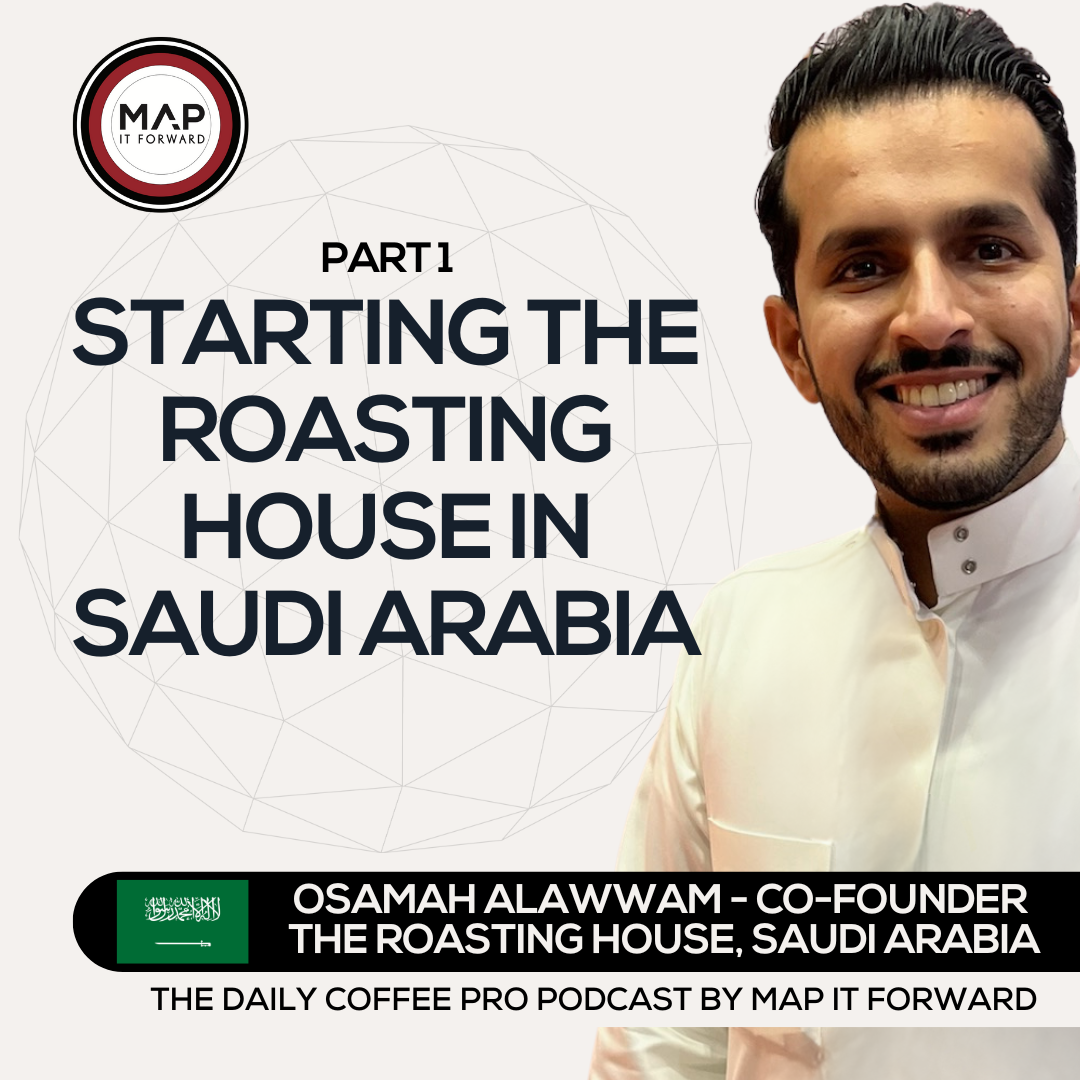
Welcome to the Map of Forward Middle East podcast friends. I'm your host Lee at Safar and this is episode one of a brand new five-part series with sort of a returning guest. This is Asama's first time on the podcast Not Life. So Asama has been, Asama I went from roasting House Ladies and Gentlemen, Asama, welcome to the podcast.
Thank you very much for having me again this time, not life. Not life. So what I was about to say is Asama has been on the podcast a few times, but that's at world of coffee and so I have been hounding, and hounding is the right word. I have been hounding Asama for a couple of years to come on the podcast and have a long format conversation.
It's finally happening and the great thing about this, I'm a believer that things happen when they need to happen and this is one of those things that happen when it needed to happen. Given all that's going on in the world with the coffee crisis, with the global challenges let's say that are happening right now, there are many of them. This is like the perfect time to have somebody like you on the podcast. So in these series folks, we're talking about the challenges of running a business in the Middle East.
The data that we're recording this is the 18th of June, and for context, there is a lot of geopolitical challenges that are happening around the world right now. We don't know if we're going to enter a world war or not enter a world war, there's a lot going on. And as is the way when these kind of global challenges happen, commodities become a weapon for different countries, which means that the challenges that are happening in coffee already, the coffee crisis, could either get worse or nothing happens to them, typically and historically, these challenges get more strained. So Osama, I'm honored to have you on to discuss this conversation.
Our first episode of our five part series is we're addressing, well, we're talking about how you became an entrepreneur. And I think this is a really great way for us to start the conversation because for those who, and there are going to be very few people in the region who don't know who you are, but the reach of the Middle East podcast has gone global, which is hummed aloud, it's really fantastic. And so it's exciting for me to get to present you to those on a global level who aren't aware of who you are and who roasting houses. Roasting houses are power house in the Middle East, hummed aloud.
And so that's why I say it's an honor for me to have you on the podcast. Our approach with the podcast in the Middle East is to present entrepreneurs and business owners who we think people should aspire to be like, and you're definitely one of those people. So let's start by having you tell people who you are and a little bit about roasting house and then we'll talk about your journey to becoming an entrepreneur. So first of all, thank you once again for having me once again in this beautiful, beautiful arena where coffee talk is exchanged and challenges and communities and the way forward is mapped out.
Oh, boom. Yes. It's exciting. It's at the same time challenging because it's a unique time frame that we're living in.
And I think that that's helped to shape what San Malawam is today. So, San Malawam, graduate of business law and international business from, from London. I grew up in the UK because my father used to work for a Saudi company that's based in the UK. So my whole family also spent some time in the UK as well.
So this is where I got to know and smelled coffee really, waking up smelling the coffee every day, whether it's being roasted for Saudi coffee or brewed for a simple cup of coffee every day with a fan. So I grew up smelling coffee every day, much like a lot of people in our region who, who feel that coffee is an imperative part of their daily, daily regime essentially. Coffee has always been part of every, every Arab's family. And this, I think adds to the, to the entire ecosystem of coffee, to Arabs, where coffee is part of our generosity, coffee is part of our way of exchanging talks and poetry and politics and philosophy and religion.
So coffee has shaped me ever since I've been a young boy. Ever since I graduated from, from London, I've always had this dream to make an impact and a difference, whether it's to my family or to the, to the community at large. It wasn't necessarily about coffee, it was about something that I would present to them that would enable them to live a better life or experience something in a better way. So my studies have enabled me to achieve entrepreneurship successfully, I suppose, because I was able to apply the skills that I learned and developed at, at school, college and university.
But also experience has also developed who I am today. I started roasting at home with a popcorn roster, much like you do, much like everybody who started roasting as passion. Was, how many years ago was that? Did you start with popcorn machine?
Years, maybe 16. No more. Yeah, more. Wow.
Yeah, yeah, yeah. 20 years. Can I ask, can I ask, like, what makes you think I'm going to get a, I mean, everybody starts with a popcorn roster. Yes, of course.
I'm always fascinated by how you got to the popcorn machine. Sure. So it all started when I got green beans that my mother was from Saudi. So that's, that's maybe 20 years ago.
Not sure. I was asking myself, what is Arabic coffee? Is it because it's grown in, Arabic land, it's grown in Saudi Arabia and Turkish coffee is grown in Turkey and that's makes it, makes it Turkish and espressals grown in Italy and that's why it's espressal. Right.
So the very, very, very first thing that I did was to take a bunch of, or a pinch of coffee essentially from my mother's trash, which she got from Saudi. And I put it in foil and I just closed, wrapped up the foil and put it on the stove, on the gas there. Oh, straight on the burners. Straight on the gas.
Yes, yes. Wow. And this is my first experience with roasting coffee. How did that go?
Telling this, of course. It started to burn a little bit and then I started to smell, a little bit like what coffee should smell like. I think it started to crack. And it was the first time that I hear what first crack is about, and this is when I got scared and turned off the gas and I slowly opened it, got the roasted, or semi roasted burnt coffee beans out and then crossed it with a pestilent mortar, also again, veg or a mini has or a mini names for it, the mini names for it, the mortar essentially.
And I started to crush it and grind it and pound it to a fine powder. And I had a small espresso machine and I made the worst espresso ever. Wow. Dude, you went from that, like you crushed that old school Arab style and you put it straight into an espresso machine.
Right into an espresso machine. I never thought of doing that. It's interesting. You start to learn.
You screw up, please. You won't. It's good. My hat off to you.
So it's well done. The courage required there. And I made sure that I did this with my mum and that we're not at home, so they don't. As you would.
As you would. Because you could have burnt the house down. Wait, I could have burnt the house down. Wait, I could have burnt the house down.
But the same hand the light was safe. Safe to Ryan. I realized that coffee roasting is not as easy as it is and there are things that you need to go through when I started to read online. There was a forum called Coffee League.
I think it still exists. I owe them a lot of knowledge that I was able to get from them, whether it's from hosting or grinding or latte art. And ever since I've spent immense hours just reading on Coffee League and whatever content that I was able to access. Of course, one of it was in English, I'll be content in one existence at the time.
And in fact, it still scares and that put a mandate on us as coffee owners, coffee business owners to increase content in Arabic and awareness for sure. So I started reading and I realized that people who want to roast coffee move onto airpoppers, air popcorn roasters. And this is why I started to save money and invest into a 20 pounds, 20 pounds air popcorn roaster. And I bought my first roaster and I then started to look for green bean traders or roasters, traditional roasters would sell green beans.
Traditional, I mean, again, in Africa, sort of ethnic stores in London would sell Turkish coffee or Arabic style coffee and I would ask them for an exception to sell me green beans. And then I realized there is a place called Home Foods, which was at the time just starting in the UK who would agree to sell me green beans for me to host at home. And this is why I got into university and I had less time to roast. But of course, I had a little bit more experience in roasting and reading and latte art and everything else.
And it all started from there. It all started from foil that I almost burnt down my family's house with. But the story ends very, very well, folks. So you go to university, you get your your law degree and your business degree.
Yeah. So it's a it's a dual, yeah, it's a dual, yeah, yes. And then you leave and go into the corporate world or you leave and decide I want to start a business. No, leave and go to the corporate world.
But in my own business, I was trading as my sales employee essentially and for business development between GCC companies and UK big stuff in the UK. Awesome. So I was hosting my own coffee. I would roast whatever I want for the week and just brew it really quickly before I adapt to the office.
I worked with a company that was based in a hotel in London in a five-star hotel and we did trade shows for them. We did business development with anything from selling a airplane, engine oil to airplane fuel to property in the UK to real estate, commercial real estate to funds to it's a variety of things that I did and nothing to do with coffee for sure. But then came the economic crisis in 2008, 2009 and down, which made me think about the next step which is moving back to Saudi where business was growing essentially as opposed to where things were happening in the UK and the rest of the world. And I saw that there is better potential for me to move back to Saudi and be closer to my family.
And this is when I moved back to Saudi with a passion for coffee but definitely no idea that I will start a business in coffee. Really? Yeah. Yeah.
So I helped people understand the landscape at the time. I've had the privilege of working with Saril Ali. So I understand the 2030 vision for Saudi, et cetera, et cetera. Would you mind explaining to people that as you talk about how when you returned to Saudi, the business landscape was changing and it hasn't stopped since.
Would you help give them an understanding of why entrepreneurship was kind of booming at the time? Of course. Of course. So when I moved back at the end of 2009, I started my first job in November 2009.
So it's actually almost 2010. And this is when I realized that things are changing, things are starting to change. And I went into the corporate world as an employee for the Saudi Central Bank, one of the Saudi Central Bank's private companies essentially, we're doing payment systems. And I realized that the government solutions that the government was investing in or heavily investing in is going to shape our future in a much better way.
I realized I saw in depth what it is moving from paper-based government transactions to something that is entirely automated. And that really inspired me to see what's going to happen for the future and to see a lot more younger generations involved into the business, both male and female. I've seen enablement move from, because I would spend a year in the UK and then we would visit for 10 days, two weeks and then we would come back next year. And every single year, I would see the changes happening.
Oh, wow. But they were a little bit slow. So yeah, you would see the changes happening. But ever since 2016, 2016, 17, the changes were so fast and so fast.
At the same time, everybody was ready. Everybody was dreaming and everybody is like, yes, bring it on, let's make it happen. And that enables me to say, okay, 2016, I'm ready, baby. I'm ready to lead the world and continue my business.
So 2015 is when I officially launched the Roasting House after a year's development, a year's research. And I'm going to say research, we went immensely into both financial models as well as the technical side of Miss Coffee. Yeah, Coffee. So the technical side of this is where will we get the green beans or salmon is really specific about his green beans, but green bean traders for specialty coffee or coffee with the story were non-existent at the time.
All you had was Colombia, Yemen, Haurar, maybe a little bit of Kenya and that's it. India is robust. And that's it. You don't know where it comes from, don't know the story.
Sometimes they would even refer to coffee as coffee from America, being from Wachawa, Costa ica or Colombia. Ah, okay. They do differentiate it. And they still use the same term for cardamom, for instance, American or Indian cardamom.
But then when you turn back out to the back, you say product of Guatemala or whatever. Okay. Oh, okay. That makes a lot of sense now.
I was confused when I bought some cardamomom from Dira the other day. Yes. So the gentleman, where from America, California, he said, and he looked at me like I was silly for considering, okay, now I get it. Thanks.
Yeah. Yeah. So that's the market that I had to deal with. So how am I going to import the green beans?
Where am I? What are the legalities behind importing greens, food and drug authority regulations that I had to follow? And so before I started the business, I looked for not only financial investors who put their money with my money and that, but at the same time and brains with mine. It's easy for anybody in this part of the world to start a business or to find funds to start a business, but it's about the right funds.
It's not about where to get the money from. You can approach a bank. You can go to venture capital companies. You can go to engine.
I have equity. I have equity. You can go to family and friends and you can raise funds easy, but I didn't want to raise to just raise funds. I wanted people who put their hands with me in the business and these people were my friends.
The closer ones who saw me roast and try on them and believed in the dream that I had and that dream was to spread specialty coffee culture, elevate coffee standards and elevate the customer experience, that dream that I had as a young boy, which is to make an impact and to change people's lives to the better. I'm glad. As I said, folks, it's a story that has a lovely ending to it. So in the next episode, we're going to talk about how you build to Roasting House to be the business that it is today.
So folks, join us for that in the next episode. Peace off and peanut butter. Have an amazing rest of your day. This episode is part of a five part series produced by Mapper Forward.
Check the full playlist and guest details in the show notes as well as how you can support our work in the coffee industry. Become a premium YouTube subscriber, explore our Patreon and any brands we've partnered with to bring you this podcast. Please don't forget to like, share and subscribe. It really does help us grow our audience.
. .