
EPISODE · Dec 29, 2025 · 1H 17M
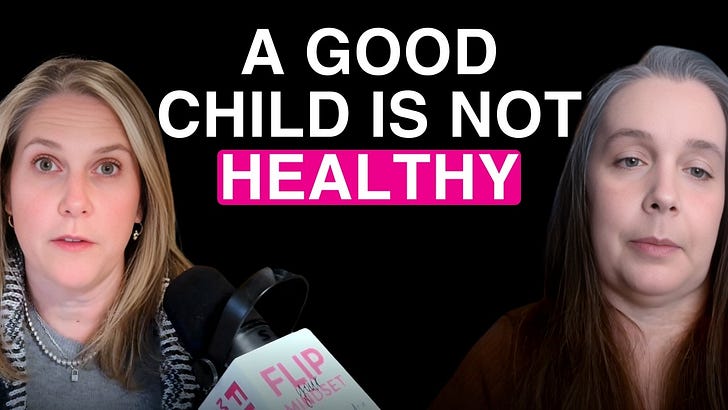
Ep 165: The “Good Child” Myth: Why Quiet Doesn’t Mean Regulated
from Flip Your Mindset · host Stacey Uhrig
We love the “easy” kid.You know the one. The child who sits quietly while the adults talk. The one who comes home from school, goes straight to their room, and never causes a scene.We praise them. We say, “They are such an old soul,” or “They are so well-behaved.”But I have a question for you: Is that behavior? Or is it a coping strategy?I recently sat down with Lisa Ramos, a trauma-informed specialist and mother of eight, on the Flip Your Mindset podcast. We stripped away the surface-level labels we put on kids (and ourselves) to look at the biology underneath.And Lisa dropped a truth bomb that stopped me in my tracks:“A good child isn’t a regulated child.”The “Fawn” Response in ActionWe tend to think of dysregulation as the loud stuff, the tantrums, the screaming, the “fight or flight” chaos.But Lisa explained that there is a flip side. Sometimes, when a child feels unsafe or overwhelmed, they don’t explode. They implode. They go into a “hypo” state where they disconnect and hide.They become the “fixer.” They become the “peacekeeper.” They realize that if they make themselves small and quiet, they won’t add to the stress in the house.They aren’t calm. They are in survival mode.We Parent Through Our Own WoundsThis hits hard because many of us were that child.We learned that to get love (or to avoid conflict), we had to perform. We had to be the “good girl” or the “strong boy.”Lisa and I talked about how, as parents, we often parent through these unhealed wounds. If you felt unheard as a kid, a quiet child might feel like a relief to you. But if we aren’t careful, we miss the fact that their nervous system is screaming for connection.The Fix: Co-Regulation (Not Correction)So, what do we do? We stop looking at behavior and start looking at the nervous system.Kids cannot regulate themselves. They are biologically incapable of it. They need us to “co-regulate” with them.This means lending them our calm. It means sitting with them not to fix the behavior or shame the silence but to let our regulated nervous system bring theirs back into balance.It’s about showing up and saying, “I see you. You don’t have to perform for me. You just have to be.”A Next Step for YouIf you are realizing that you might be raising a “good child” who is actually just a dysregulated one or if you are still that child living in an adult’s body—it is time to look at the hidden load you are carrying.Here are three ways to move forward today:* Watch the full episode: We dive deep into “rupture and repair” and how to heal these patterns. * Check your Hidden Stress Load: Take my free HURRT Assessment (Healing UnResolved Roots of Trauma). It helps identify the invisible backpacks you (and your kids) might be carrying. Take the Assessment Here* Get the Parenting Tool: Lisa shared a specific resource for parents looking to implement these strategies. You can access it here: Trauma-Informed Parenting Resource This is a public episode. If you'd like to discuss this with other subscribers or get access to bonus episodes, visit flipyourmindset.substack.com/subscribe
Embed this episode
NOW PLAYING
Ep 165: The “Good Child” Myth: Why Quiet Doesn’t Mean Regulated
No transcript for this episode yet
Similar Episodes
No similar episodes found.
Similar Podcasts
No similar podcasts found.