
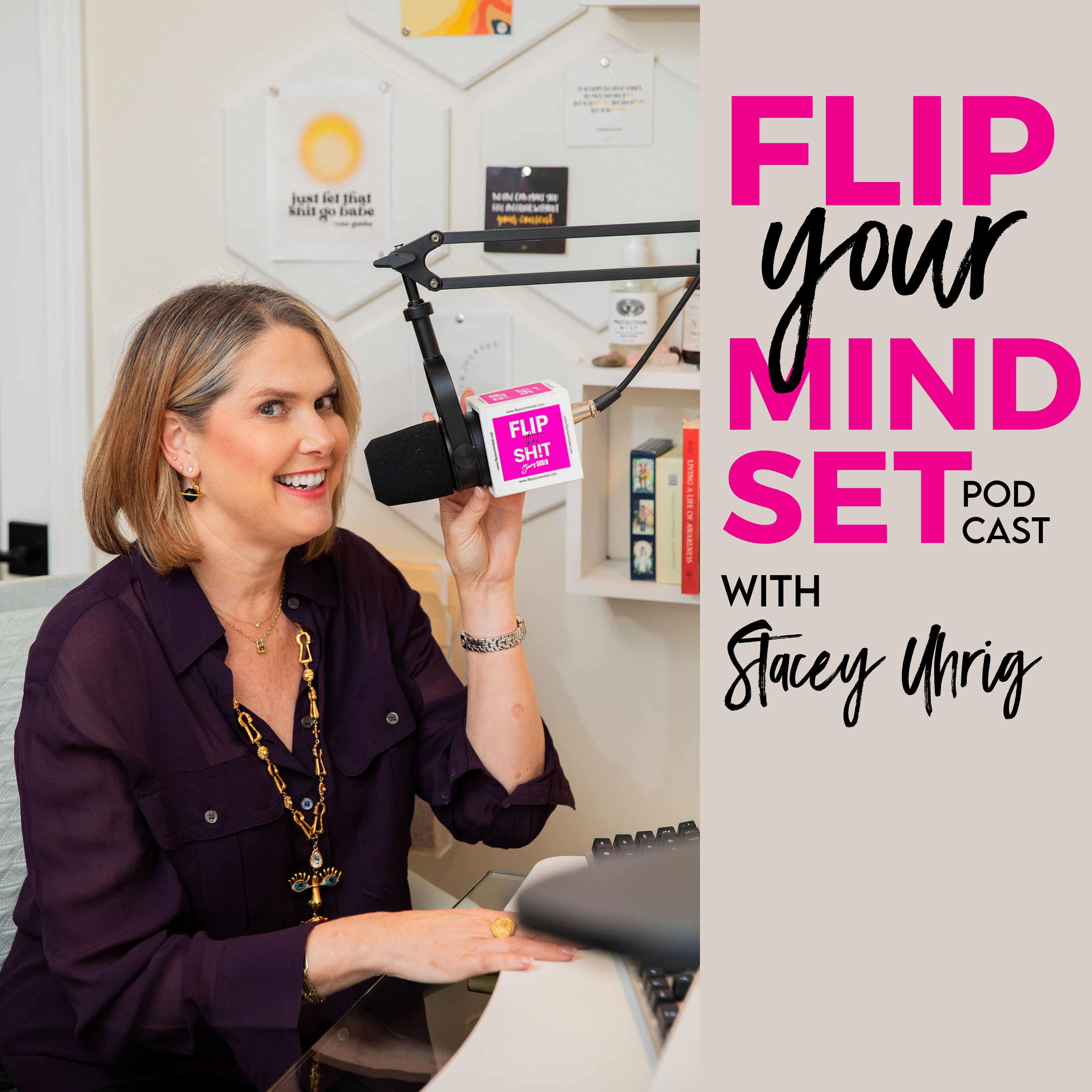
PODCAST · health
Flip Your Mindset
by Stacey Uhrig
Having spent over four decades overcoming childhood adversities and helping others with my post-traumatic wisdom, I decided to change careers and pursue my purpose at the age of 49.I became a Certified in Trauma Recovery, Rapid Transformational Therapy Practitioner, and Parts Work soon after, I launched Flip Your Mindset, a podcast that serves as a no-cost entry point for those looking to resolve their own traumas.Through Flip Your Mindset™, my goal is to help listeners transform their perspectives and see their lives through a new lens. As a foul-mouthed, unapologetic Buddhist enthusiast, I'm not afraid to use colorful language to express my emotions, but I draw the line at any derogatory or dehumanizing language. Join me and let's explore new ways to overcome life's challenges and emerge stronger and more resilient than ever before.Thank you for listening. flipyourmindset.substack.com
-
194
Ep 198: Time Doesn’t Heal Trauma. Here’s What Does. | Dr. Christopher Cortman
Time Doesn’t Heal Trauma. Here’s What Does. | Dr. Christopher CortmanWe’ve all heard the phrase: “Time heals all wounds.”But does it?In this episode of Flip Your Mindset, I sit down with Dr. Christopher Cortman, a Florida Licensed Psychologist with decades of clinical experience and more than 80,000 hours of psychotherapy, for a conversation that completely challenges the idea that we simply need to wait for painful experiences to heal.As Dr. Cortman puts it, time doesn’t necessarily heal old wounds. Time passes.Healing, on the other hand, is active.We talk about what happens when trauma, grief, loss, and painful experiences remain unfinished — sometimes for years or even decades. Dr. Cortman explains why the mind can continue protecting experiences that we haven’t fully processed and why avoidance can become one of the ways we survive.One of the most powerful ideas we explore is that trauma isn’t necessarily the event itself. Trauma is the aftermath — the impact that continues to affect how we see ourselves, other people, and the world around us.We also talk about what it actually means to process something.Dr. Cortman describes a healing process that involves remembering, feeling, expressing, releasing, and reframing what happened.And we go much deeper than that.In this conversation, we explore:* Why “time heals all wounds” can keep people stuck* What active grieving actually looks like* Why unprocessed experiences can continue affecting us decades later* How avoidance can become a survival mechanism* Why the mind and body can protect painful experiences rather than resolve them* The difference between a traumatic event and the aftermath of trauma* How childhood experiences can affect us even when we don’t consciously remember them* Why feeling safe is essential before someone can revisit painful experiences* How guided imagery can be used when working with trauma and grief* What “unfinished business” means in the healing process* How shame can keep people trapped in the belief that they are a bad person* Why our behavior can make sense when viewed through the context of what we’ve survived* What it means to “take me to the pain” rather than continue avoiding itDr. Cortman also shares some extraordinary stories from his clinical practice, including experiences with PTSD, childhood trauma, grief, and loss.One story that stayed with me involved a woman who had carried twelve years of depression and guilt after accidentally losing her younger brother in a tragic accident. Through guided imagery, she was finally able to reach a place where she could stop experiencing the memory only through guilt and begin moving forward with her life.We also talk about the importance of creating enough safety for someone to tell the stories they’ve spent years protecting themselves from.Because healing can’t be forced.Sometimes the hardest part is simply reaching the point where your nervous system trusts that it is safe enough to tell the truth.And ultimately, that’s what I hope you take away from this conversation:You don’t have to erase your past.You don’t have to pretend it didn’t happen.But if something is still hurting you, still interfering with your relationships, your work, your parenting, your sense of self, or your ability to fully experience your life, there may be something unfinished that deserves your attention.As Dr. Cortman says, his assignment to his clients is simple:“Take me to the pain.”And sometimes, that is where the healing begins.About Dr. Christopher CortmanDr. Christopher Cortman is a Florida Licensed Psychologist who has spent decades working with clients around emotional trauma, grief, anxiety, depression, relationships, and other challenges.He is the author of several books, including Keep Pain in the Past, Take Control of Your Anxiety, Praying for the Darkness, and The Guided Imagery Cure.You can learn more about Dr. Cortman and his work at:srqshrink.comA Note From MeIf you’ve been told that you just need to “give it time” and you’re frustrated because something that happened years ago still affects you, I hope this conversation gives you a different way to think about healing.Sometimes time isn’t the missing ingredient.Sometimes what we need is the opportunity, support, safety, and courage to finally process what never got processed.If this episode resonates with you, share it with someone who might need to hear it.And if you’re new here, subscribe to Flip Your Mindset for more conversations about trauma, shame, healing, and learning to see ourselves and our lives through a different lens.Listen to the episode and let me know:What is something you’ve been told that you now see differently?#TraumaHealing #TraumaRecovery #MentalHealth #Grief #PTSD #ChildhoodTrauma #Healing #GuidedImagery #EmotionalHealing #FlipYourMindset This is a public episode. If you'd like to discuss this with other subscribers or get access to bonus episodes, visit flipyourmindset.substack.com/subscribe
-
193
Ep 197: Trauma Is Not What Happened To You
Before you decide this one isn’t for you, stay with me.I know what happens when people hear the word trauma. Their mind goes straight to war, sexual assault, physical abuse, a natural disaster, a horrific accident. Something catastrophic. Something with a headline attached to it.And all of those things absolutely can be traumatic. I am never going to dismiss that.But those images have also quietly shaped what most of us believe trauma is. So when none of them apply, we close the door. I guess this isn’t about me. Nothing that bad ever happened. I had a good childhood. My parents loved me. We didn’t want for anything. Other people have had it so much worse.I hear those sentences constantly.And very often, the same people saying them are the ones sitting across from me describing anxiety, people pleasing, perfectionism, difficulty trusting, difficulty setting boundaries, relationship struggles, burnout, panic attacks, or that persistent hum of not being good enough. Not worthy. Not deserving of good things.So I keep asking the same question. Could there be a connection we were simply never taught to see?A wound is not defined only by what caused itThe American Psychological Association calls trauma an emotional response to a terrible event. Merriam-Webster calls it a disordered psychological or behavioral state resulting from severe mental or emotional stress.Both are useful. Neither one changed my life.The one that did came from Dr. Gabor Maté. Trauma is not what happens to you. Trauma is what happens inside you as a result of what happens to you.The first time I heard that, something shifted. Because suddenly trauma wasn’t only about the event. It was about the aftermath. The impact. The injury.The wound.Which makes sense, because the word trauma comes from the Greek word for wound. And I love that, because every single one of us understands what a wound is.Here is the part we skip. A wound is not defined only by what caused it. It is also shaped by what happens after.Was it noticed? Was it cleaned? Was it protected from further injury? Was it given what it needed to heal?Or was it ignored?Two people can go through remarkably similar experiences and come out the other side completely differently. The event matters. It is just not the whole story. What was available afterward matters. The support matters. The relationships around it matter. Feeling seen matters. Feeling believed matters. Feeling safe matters. Having someone help you make sense of what happened matters enormously.That is why I don’t think the most important question is only what happened to you. I think we also have to ask what happened inside you as a result. And maybe more importantly, what happened after it happened. Who was there? Who listened? Who helped your nervous system find its way back to safety?The cut on your handImagine you are working in the yard. Trimming a bush, clearing branches, doing some project in the garage. You slip and cut your hand. Not a paper cut. A deep one. The kind that gets your attention immediately.You know exactly what to do. Clean it. Stop the bleeding. Maybe stitches. Cover it. Protect it. Give it time.And while it heals, you naturally change how you move. You stop using that hand the same way. You avoid bumping it. If someone reaches toward it, you pull back without thinking.Not because you are weak. Not because you are irrational or too emotional or too sensitive. Because that is exactly what a healthy body does. It protects a wound.Now imagine the same cut, but nobody notices.Nobody cleans it. Nobody bandages it. Nobody tells you it is going to be okay. You are expected to keep working. Keep carrying things. Keep pretending it doesn’t hurt. And maybe somebody says, you’re fine, stop being dramatic, it’s not that bad, other people have it worse.The wound does not disappear because it was minimized. It does not heal because someone denied it. If anything it gets more vulnerable. Maybe it gets infected. Maybe it heals wrong. Maybe every single time it gets bumped, it hurts exactly as much as it did on day one.So what do you do?You protect it more. You compensate. You get careful. And without ever deciding to, you begin organizing your entire life around never letting that wound get touched again.Eventually those protective movements stop feeling like protection. They just become how you move through the world.And then we call them our personalityThis is the part that gets me.Those adaptations become so familiar that we stop recognizing them as adaptations. We start calling them who we are.I’ve always just been an anxious person. I’m just a people pleaser. I’m just a perfectionist. I’m type A. I’ve never trusted anyone. That’s just me.Nobody is born that way.What if those aren’t personality traits? What if they are protective strategies? What if they are the emotional equivalent of guarding an injured hand?That question changes the whole conversation. Because instead of asking what is wrong with me, you get to ask something far more useful. What has my nervous system been working so hard to protect me from?To be clear, this does not mean every behavior comes from trauma. And it certainly does not mean harmful behavior gets excused. Understanding a behavior is never the same as excusing it. We are all still responsible for our choices and accountable for how we treat people.But understanding gives us something judgment never will. It gives us context. And context changes everything.What my own shift looked likeI drowned in anxiety for thirty years.For most of that time I believed with everything in me that anxiety was the worst thing that ever happened to me. A problem. An enemy. Something to manage, control, quiet, get rid of. I was convinced that if I could finally beat it, my life would start.Then, after hitting bottom more than once, I asked a different question.What if anxiety is not the problem? What if anxiety is protecting the problem?That question changed the direction of my healing. I stopped fighting my nervous system and started trying to understand it. And the dots were not hard to connect once I actually looked.Here is what I want you to sit with. I was in therapy from age fifteen to age forty. Nobody ever asked me what happened. Nobody asked me what didn’t happen. Nobody asked what wound I might still be protecting.I got a diagnosis in my thirties. Generalized anxiety disorder. What I never got was a question.What the adaptations actually look likeAs you read this, please do not diagnose yourself. Please do not diagnose someone you love. Just get curious and ask one thing. What if it makes sense?Anxiety. Often a nervous system asking am I safe, over and over. If your early experiences taught you that life was unpredictable, that conflict could erupt without warning, that love felt uncertain, that criticism could arrive out of nowhere, wouldn’t it make sense to stay one step ahead? To scan constantly? To rehearse conversations before they happen? That is not a broken brain. That is an intelligent nervous system making sure you never get blindsided again.People pleasing. I’m too nice. I care too much. I hate conflict. I’m an empath. Maybe. Or maybe your nervous system learned that connection depended on keeping other people happy. That no wasn’t emotionally safe. That keeping the peace protected something important. If that is true, people pleasing isn’t a weakness. It’s a strategy that once worked.Perfectionism. We assume perfectionists are trying to impress. Sometimes. But very often perfectionism is fear wrapped in a pretty bow. Fear of criticism, rejection, abandonment, failure, disappointing someone. If mistakes once carried real emotional consequences, perfection makes sense.Hyper-independence. I don’t need anyone. It’s easier to do it myself. Maybe. Or maybe depending on people went sideways. Maybe your needs weren’t consistently met. Maybe asking for help wasn’t safe, and you learned that if you only rely on yourself, you don’t get hurt.Overthinking. When someone tells me they think too much, I usually don’t think they’re thinking too much. I think they’re protecting too much. Overthinking is often an attempt to predict, prepare, and prevent pain before it can arrive.Shutting down in conflict. Someone raises their voice and your mind goes blank. You freeze. People judge themselves hard for this. But if conflict once meant danger or disconnection, your nervous system isn’t choosing to shut down. It’s remembering.Anger. Sometimes anger was the only emotion that felt safe to express. Sometimes it was the only way to create enough distance to feel protected. Sometimes anger is the only power a child has.Every adaptation has a story. Every protective layer has a purpose. Every nervous system has reasons for responding the way it does.One of the real tragedies in how we approach mental health is that people spend years asking how do I get rid of this, before anyone ever asks where it began.What surprised me in the HURRT resultsI built the HURRT assessment for exactly this reason. HURRT stands for Healing Unresolved Roots of Trauma. It is not a diagnostic tool and I have no authority to diagnose anyone. I built it to help people start asking different questions.Recently I went back and reviewed the first ninety completed assessments. This is not a scientific study. These are people who found my work and chose to answer. I am only telling you what I observed.Most people assume the highest responses would cluster around obvious trauma. Abuse. Violence. Something catastrophic.What stood out most was what was missing.Nearly two out of three said they lacked consistent emotional support growing up. More than sixty percent said they often felt not good enough. More than half said they didn’t have anyone they could truly talk to about what they were going through.Only about fifteen percent felt their parents truly prioritized emotional connection. Fewer than one in five felt consistently understood as a person. Only twenty percent remembered their feelings being regularly acknowledged and validated.And two thirds said childhood emotional connection still affects their adult relationships today.That last one stopped me.Because if you have spent years wondering why relationships feel so hard, maybe the better question isn’t what is wrong with me. Maybe it’s what did my earliest relationships teach my nervous system about connection.That is a completely different conversation.Trauma is not destinyBefore anyone reads this and concludes they are doomed, hear this part.Many of the same people also reported protective experiences. A trusted adult. A teacher. A coach. A grandparent. A close friend. Someone who believed them. Someone who saw them. Someone who made them feel safe.In my work I call those resilience factors, and they matter enormously. The nervous system is not shaped only by adversity. It is also shaped by connection, by repair, by being understood. Even by one person.That is one of the most hopeful things I know. If relationships help shape a wound, relationships can also help shape the healing.When people start connecting these dots, their internal language changes. Instead of I’m too much, they start saying no wonder I responded that way. Instead of I’m broken, they say my nervous system learned to survive.Instead of shame, curiosity. Instead of criticism, a little compassion.In my experience, that is where healing actually starts.Why understanding alone isn’t enoughI want to be honest about the limits of everything I just wrote.I built The Calm Code because I kept meeting people who understood themselves intellectually and were still stuck in the same pattern. They could explain their anxiety. They knew their attachment style. They had read the books, listened to the podcasts, watched the documentaries, some had even worked with me one to one. And their nervous system was still living in survival mode.Knowledge matters. But knowledge alone does not create healing. Healing happens through experience. That is why we meet live every week and practice instead of only learning. You cannot think your way into safety. You have to experience your way into it.Over the past year I have watched people who spent decades believing they were broken start to realize they were adapted. Watching someone say for the first time in my life I understand why I do what I do, or I finally have compassion for myself, or I spent years trying to fix myself and now I see I don’t need fixing. Those moments never get old.That is why I do this work. Not to convince anyone they are traumatized. Not to hand out another label. To help people put down the shame they have been carrying for adaptations that once made perfect sense.Before you goUnderstanding your story is not about blaming your parents. It is not about living in the past, collecting diagnoses, or becoming a victim of your history.It is about finally making sense of yourself.Because it is very hard to change something you have spent your entire life misunderstanding and hating.I’m just an anxious person. I’m just a perfectionist. I’m just too sensitive. I’m just bad at relationships. I’m just broken.Those are not explanations. They are conclusions. And conclusions end curiosity.So here is my question for you, and I would love to read your answer in the comments.What is one thing you have judged yourself for that makes just a little more sense now?Sit with it. Be gentle about it. Understanding is not the finish line. It is the place where healing begins.We cannot heal what we do not understand.I’ll see you next time.Where to go from hereTake the HURRT assessment. It’s free, it takes about eight minutes, and it is not going to tell you who you are. It might just help you connect a dot you have never connected before. flipyourmindset.com/hurrtThe Calm Code. If you are ready to move past understanding and start creating new experiences of safety and connection, this is where we do that work together. flipyourmindset.com/thecalmcodeTwo films I recommend constantly: The Wisdom of Trauma with Dr. Gabor Maté, who has done more than almost anyone to move the question from what is wrong with you to what happened to you. thewisdomoftrauma.com Traumality, a newer documentary covering many of the same themes. Childhood adversity, attachment, the nervous system, and how understanding your story changes how you understand yourself. traumality.com This is a public episode. If you'd like to discuss this with other subscribers or get access to bonus episodes, visit flipyourmindset.substack.com/subscribe
-
192
Ep 196: Leaving the Mormon Church: Religious Trauma and Rebuilding Identity with Audra Phelps
Hi friend,I want to tell you about a moment from this week’s episode that I have not stopped thinking about.My guest, Audra Phelps, had been out of the Mormon church for eight years. Eight years. She was making Thanksgiving dinner from scratch, the way a good Mormon wife does it, and she noticed she felt resentful in her own kitchen. So she did what I would want any of us to do. She got curious about the feeling instead of pushing it down.Why am I resentful?Because I don’t like making apple pie.Okay, so why am I making apple pie?Because it’s my husband’s favorite. Except he had never once asked her to make it.So she decided right there she would make her own favorite instead. And she stood in that kitchen, a woman in her forties who had been baking pies her entire adult life, and realized she had no idea what kind of pie she liked.That is what identity loss actually looks like. Not a breakdown. Not a dramatic scene. A blank where an answer should be.Here is what stayed with meYour nervous system keeps the rules long after you stop believing them.Audra had already said out loud that she was not Mormon. She had already told her husband, her kids, her parents. The belief was gone. The programming was not. Eight years later it was still running the pie.This is the part people miss when they talk about leaving anything, whether it’s a church, a marriage, a family role, a job that shaped who you thought you were. Deciding is the fast part. Your body takes longer, because your body learned those rules as a survival strategy, and survival strategies do not release just because you changed your mind.She was taught to distrust herself before she could speak in full sentences.When Audra questioned something as a child, she was told those feelings came from Satan and that it meant her faith was weak. Pray more. Read more. Obey more.Sit with that. A curious child asks a question, and the answer she gets is that her own inner signal is dangerous.I told her while we were recording that my nervous system was activating just hearing it, and I meant that literally. Because I know what happens to a person who is trained to treat her own knowing as a threat. She stops asking. Then she stops noticing. Then one day she cannot answer a question about pie.The pattern is not about religion.Audra works with women leaving the Mormon church. I work with women leaving narcissistic relationships. We got about twenty minutes in and realized we were describing the same thing with different vocabulary.Conditional love. Isolation from anyone outside the system. A smear campaign when you leave. Family recruited against you. And on the other side, a woman who says the same sentence I hear in my practice constantly: I know what I’m not, but I don’t know what I am.The container changes. The wound does not.The part I want you to take with youIf you are somewhere in the middle of this right now, questioning something big, not ready to name it out loud, please hear what Audra said. It took her ten years. Ten. She did not wake up one day and walk out. She moved through it letter by letter, and the last letter came when she read something and finally had a visceral reaction she could not talk herself out of.You are not behind. You are not weak for taking a long time. Slow is how people leave things that were built to keep them.And when you get to the other side and someone asks you what you want, and you have no answer, that is not failure. That is the starting line.Start with the pie.Connect with Audra Phelps Website: https://mamaaudra.com Free masterclass: Five Shifts Every Former Mormon Mom Needs to Make Program: Reclaimed, her 8 week identity rebuild for women leaving the churchP.S. Audra ordered a different pie every week until she found her answer. It was blackberry. If you cannot answer a question that small about yourself right now, the HURRT Survey is a good place to start looking at why. It maps how what happened to you before 18 may still be running the show today. Take it free here: https://www.flipyourmindset.com/hurrtP.P.S. If anxiety has been driving the bus for too long, The Calm Code is my 8 week small group program where you learn to heal it from the inside out instead of managing it forever. Details here: https://www.flipyourmindset.com/thecalmcode This is a public episode. If you'd like to discuss this with other subscribers or get access to bonus episodes, visit flipyourmindset.substack.com/subscribe
-
191
Ep 195: Making Sense of Human Behavior
Have you ever caught yourself saying, why am I like this?Why can’t I stop overthinking. Why am I still replaying that conversation three days later. Why do I apologize when nothing is wrong. Why do I say yes when every part of me wants to say no.Or maybe you’ve never asked those questions about yourself. Maybe you’ve asked them about someone else. Why is my partner so angry. Why can’t my spouse talk about feelings. Why would anyone stay in that relationship. Why does my mother criticize everyone.Notice that almost every meaningful question we ask about ourselves or the people we love starts with the same word.Why.We are desperate to understand behavior. But I don’t think we’ve ever really been taught how. I think we were taught something else. I think we were taught how to judge.We label before we ask a single questionA child melts down in a grocery store and before anyone has asked anything, someone decides that kid is spoiled. Someone drinks too much and we say no self control. Someone doesn’t leave an abusive relationship and we ask why don’t they just walk away. Someone cries easily and we say too sensitive. Someone takes care of everyone else and we say they need boundaries.Lazy. Needy. Manipulative. Weak. Difficult. Codependent. Selfish. Dramatic. Toxic. Broken.Sometimes the labels aren’t completely wrong. Here’s what I wonder instead: do labels create understanding, or do they sometimes stop us from being curious?The moment I believe I already know why somebody behaves the way they do, I stop asking questions. I stop wondering. And I think curiosity is exactly what’s been missing.What a detective knowsOne of my favorite things to do is watch detective shows. Not because I’m fascinated by crime. I’m fascinated by the investigation.Think about what a detective does not do. They don’t walk into a scene, look down at a footprint and say well, there’s the problem. The footprint isn’t the problem. The footprint is a breadcrumb. It tells us someone was here. It tells us something happened. It points toward a story.What if behavior works the same way?What if anxiety is evidence. What if perfectionism is evidence. What if people pleasing is evidence. Or emotional shutdown, or controlling behavior, or rage, or avoidance.Not evidence that someone is broken. Evidence that something happened, or something was learned, or something had to be adapted to.I think most of us spend our lives trying to erase the evidence instead of understanding what the evidence is pointing to. We spend years trying to stop a behavior without ever becoming curious about why the behavior existed in the first place.Before you write back to tell me I’m excusing peopleI know some of you are already pushing back. Are you saying every behavior makes sense? Because some behaviors are flat out awful.It’s a fair question, and it’s one of the biggest misunderstandings of my work. When I say behavior always makes sense in context, I am not saying every behavior is acceptable.I’m not saying abuse is okay. I’m not saying coercive control gets a pass. I’m not saying manipulation should be tolerated because we understand where it came from.Understanding is not excusing. Understanding is not permission. Understanding does not mean staying in an unsafe relationship. Understanding does not remove accountability from the person doing the harm. When someone is violent or controlling, safety comes first. Always. No wavering.We can work to understand how a pattern developed while also saying clearly: this is harmful, this has consequences, this cannot continue.Compassion and accountability are not opposites. If we only have accountability, we become judgmental. If we only have compassion, we become permissive. Healing requires both.Curiosity asks how did this happen. Wisdom asks what needs to happen now. Two very different questions, and we need them both.The sentence that guides almost everything I doBehavior always makes sense in context.Not because every behavior is healthy. Not because every behavior is acceptable. Not because every behavior should continue. But because every behavior has a history. Every behavior has a function. Every behavior solved a problem for someone, or at least tried to.So the question is not does this behavior make sense. The better question is this:What context would have to exist for this behavior to make perfect sense?The moment you ask it, you’ve stopped judging. You’ve become an investigator. And curiosity opens a door that judgment slams shut.The smoke detectorIf your smoke detector keeps going off, you might be tempted to rip it off the ceiling. I’ve watched people do it. But that’s not where we should start. We should ask what does it think it’s detecting?Maybe it’s a real fire. Maybe it’s burnt toast. Maybe my oven is at 500 degrees because I’m making pizza and there’s no fire at all, just heat. Either way, the detector is doing exactly what it was designed to do. It’s working with the information it has. Sense heat, go off. It doesn’t have eyes.So I wonder how many of us are walking around with nervous systems that respond to burnt toast as though the house is on fire.For years I thought anxiety was attacking me. That my body was betraying me. Then one day I asked a different question. What if anxiety isn’t the problem? What if it isn’t trying to hurt me? What if it’s trying to help me, just with dated instructions?That is a completely different conversation.Two childrenImagine a little girl who learned that the safest thing she could do was never upset anyone. So she becomes agreeable, helpful, easy. She learned to read a room before she ever learned to read herself. She noticed when mom was overwhelmed. She sensed when dad was frustrated. She figured out that if everyone else was okay, she was probably okay too.Everyone praises her. So mature. Such a good kid.And she grows into an adult with no idea how to ask for what she needs, who feels responsible for other people’s emotions, who apologizes for taking up space and feels guilty for resting.Should she keep abandoning herself? Of course not. But should she hate the little girl who figured out how to survive something? I don’t think so either. That little girl did exactly what children are wired to do. She adapted.Now imagine a different child. This one isn’t anyone’s favorite. Impulsive, reactive, loud, labeled defiant. Constantly corrected. Why can’t you just behave. What’s wrong with you. You always cause problems. Maybe there’s a diagnosis. Maybe there’s chaos at home. Maybe the only attention available came from creating more of it.Hear those messages enough times and they stop sounding like something other people say. They become something you say. I’m always the problem. I mess everything up. People would be better off without me.A child doesn’t just learn how to behave. A child learns who they believe they are. And once those beliefs take root, the brain gets remarkably good at collecting evidence to support them.Neither of those children is broken. One survived by becoming the good one. One survived by becoming the problem. One adaptation was rewarded and one was punished. Both made sense in the context they developed in.The part that gives me hopeIf those beliefs were learned, they can be questioned. If those patterns were learned, they can be updated. If your nervous system adapted once, it can adapt again.It doesn’t happen overnight, and it isn’t an event. It’s a relationship with yourself. It’s the slow work of teaching your mind and body that the world you’re in today is not the world you learned to survive.Which brings me to the biggest misunderstanding about healing. People think healing means becoming somebody else. It doesn’t. Healing is becoming less driven by survival and more guided by your Self. The version of you that existed before fear started writing the script. Healing isn’t creating a new self. It’s uncovering the one that’s been there the whole time, dimmed out in the background.That’s why I say healing begins with safety. No nervous system gives up protection until it believes the protection is no longer necessary. You don’t argue a nervous system into feeling safe. You help it experience safety over and over and over, until one day you pause instead of panic, or you say no without apologizing, or you ask for help, or you finally rest.Three questions to sit with this week* What’s one behavior you’ve spent years criticizing that now makes a little more sense?* What’s one person you’ve judged whose story you’re suddenly a little more curious about?* What’s one belief about yourself you no longer want to accept without getting curious about it?My hope isn’t that you finish this episode thinking well, that was interesting. My hope is that you finish it thinking, maybe I’m not broken.Because when behavior begins to make sense, people begin to make sense. When people begin to make sense, shame begins to loosen its grip. Curiosity replaces judgment. Self compassion replaces self criticism. And healing finally has somewhere to begin.Until next time, please be curious.We cannot heal what we don’t understand.P.S. If you’ve been asking what’s wrong with me for a long time, the HURRT Survey is a good place to start asking a better question. It maps how what happened before 18 may still be running the show today, and you get a personal snapshot right away. Take the HURRT SurveyP.P.S. The smoke detector analogy in this episode is one of the core frameworks inside The Calm Code, my program for people who are done managing anxiety and ready to understand it. Learn more about The Calm CodeWant to talk it through with me directly? Book a free 75 minute consultation.Listen elsewhere: Spotify | Apple Podcasts | YouTube | Instagram This is a public episode. If you'd like to discuss this with other subscribers or get access to bonus episodes, visit flipyourmindset.substack.com/subscribe
-
190
Ep 194: The Truth About Adoption Trauma, Attachment, and the Nervous System
“A baby doesn’t remember that? Well, their nervous system does.”That line stopped me in my tracks this week.My guest on Flip Your Mindset is Kelly Tondre, a trauma therapist, therapeutic coach, adoptive sibling, and adoptive mom of three. Kelly has lived every side of the adoption constellation. And she told me something I wish every adoptive parent heard on day one.The wound starts before wordsIn the adoption world we call it the primal wound. A baby comes into the world wired for one thing above all: connection. When that first attachment breaks, even at birth, even in the most loving adoption, the nervous system registers it as a threat to survival.People love to say “they were adopted at birth, they won’t remember anything.”The mind doesn’t remember. The body does. We call it preverbal trauma, and it shapes how a child scans the world for safety long before they can explain what they feel.When trauma gets the wrong nameHere’s where it gets heavy. These kids grow up, their survival responses get bigger, and the only place most families know to go is a general therapist working from a checklist of symptoms.So the child collects labels. ADHD. ODD. Anxiety. Bipolar. What Kelly calls the alphabet soup.But the diagnosis that actually fits, developmental trauma disorder or complex PTSD, is not even in the manual American clinicians use. So kids get treated for conditions they may not have, the treatment doesn’t work, and parents walk away believing they’re failing.Kelly has spoken one on one with hundreds of adoptive parents. 99% of the ones who sought therapy told her the same thing: I had to educate my own therapist.Sit with that.Love is not enoughBoth Kelly and I were handed the same mantra when we adopted: just love them. Love heals all wounds.It doesn’t. Love matters. Love is the ground everything grows from. But love without trauma education sets the whole family up to fail. You cannot love a nervous system into feeling safe while you’re dysregulated yourself.That’s the part nobody says out loud. The parent’s nervous system is the most powerful tool in the house. A regulated parent is what helps a dysregulated child find calm. Kelly calls the alternative co-dysregulation: your child’s storm sets off yours, your storm confirms their fear that home isn’t safe, and the loop feeds itself.Kelly lived that loop for years. She describes it as driving with the gas pedal and the brake fully pressed at the same time. On the outside, fixing, advocating, problem-solving. On the inside, shutting down.The way throughThe work Kelly does now with adoptive and foster parents starts with the parent, not the child. Widening your own window of tolerance. Naming the grief you were never allowed to feel. Accepting the parts of you that are angry, resentful, exhausted, without letting them write the story.And underneath all of it, one shift: stop asking what’s wrong with this child, and start asking what happened to them.Not everyone is called to foster or adopt. But every one of us knows a family in this constellation. They don’t need our judgment. They need our curiosity and our support.Connect with Kelly at tondretherapeutics.comBooks we mentioned: What Happened to You by Dr. Bruce Perry and Oprah Winfrey, The Body Keeps the Score by Bessel van der Kolk, The Boy Who Was Raised as a Dog by Dr. Bruce Perry.Until next time, I’ll see you on the flip side. Work with me → https://partners.simply.coach/stacey-uhrig/1-1-consultation] This is a public episode. If you'd like to discuss this with other subscribers or get access to bonus episodes, visit flipyourmindset.substack.com/subscribe
-
189
Ep 193: Boundaries Are About Self-Trust, Not Saying No
Pause for a second before you read on. When you hear the word boundaries, what happens in your body? Tight chest? Stomach drop? A specific person’s face?Most people think boundaries are a communication problem. Another script for the hard conversation. Another lesson in saying no. I don’t see it that way anymore.Boundaries are about trust. More specifically, boundaries are what self-trust looks like in action. And if trusting yourself feels hard, it is not because you are weak or broken. It makes perfect sense, because behavior always makes sense in context.We were born trusting ourselvesWatch a toddler. They say no immediately. No guilt, no apology, no explanation. They are hungry, they are tired, they are done. They do not wonder if you will still love them after they say it.So what happens between that two-year-old and the 42-year-old who says yes while every part of their body screams no?Children are born trusting themselves. They have to learn not to.Imagine being four and needing one thing above all else: connection. For a child, connection is not a nice to have. It is survival. So the nervous system asks one question over and over: what do I need to do to stay connected? Not, what do I need to honor myself.Now imagine every time you cried you were told you were too sensitive. Every time you had a need you were called too much. You adapt. Not consciously. No child wakes up and decides to stop trusting themselves. It happens one experience at a time until the question changes from what do I know to what will everyone else think.That is not weakness. That is adaptation.Protection mistaken for pathologyPeople-pleasing. Perfectionism. Conflict avoidance. Reading the room. Walking on eggshells. Never asking for help. None of these developed because something is wrong with you. They developed because at some point they worked. At some point they protected something, usually connection.You are not your adaptations. You are the person who adapted. Those are two different things.We stop leaving relationships and start leaving ourselvesSelf-abandonment is quiet. It looks like being nice, being flexible, being low maintenance, being easy to love. You go to the dinner you did not want to go to. You say “it’s fine” when it wasn’t. You explain away the thing that hurt. Small inches. Until one day someone asks what you want and you honestly don’t know.We don’t lose ourselves all at once. We lose ourselves one compromise, one swallowed truth, one ignored feeling at a time.Rebuilding trust, slowlyTrust is not rebuilt in one giant leap. It is built in a thousand tiny moments where you keep your word to yourself. You admit you’re tired and you rest. You notice you don’t want to and you pause.Four statements I keep coming back to: know your truth, trust your knowing, lead yourself, protect your peace.And one more thing worth sitting with: you are responsible for your behavior. You are not responsible for someone else’s reaction to your healthy behavior. Their discomfort does not make your feelings wrong. Your feelings are information.Before you goNo homework this week. Just one question:Where in your life have you become so committed to preserving a relationship with someone else that you have begun losing the relationship with yourself?If the answer is somewhere, be gentle. Don’t judge it. Ask what happened that this makes sense. Understanding always comes before change.And if no one has ever said this to you: I believe you. I believe what you’re feeling makes sense. I believe that underneath every adaptation, there has always been you.Listen to the full episode → https://flipyourmindset.substack.com/podcast] Work with me → https://partners.simply.coach/stacey-uhrig/1-1-consultation] This is a public episode. If you'd like to discuss this with other subscribers or get access to bonus episodes, visit flipyourmindset.substack.com/subscribe
-
188
Ep 192: Stop People Pleasing & Set Boundaries: How to Become "Shouldless" with Pam Brown
Have you ever felt completely exhausted from trying to be the person everyone else expects you to be? Not because you are doing anything wrong, but because you carry around a lifetime of expectations, obligations, and invisible rules about who you think you are supposed to be.This week, I am joined by Pam Brown, a professional certified coach and the author of Build a Life That is Becoming Shouldless. We had an incredible conversation about breaking free from people-pleasing and learning to set boundaries without guilt.The Hidden Cost of “Should”In our conversation, we unpack how the word “should” functions as a direct form of self-judgment. When you say, “I should do this,” you are implicitly suggesting that your current state or desire is wrong. I often equate the word “should” with shame. It masks our primal fear of disconnection; we worry that if we break the unspoken rules, we will face rejection.“I believe that when people should on themselves, they are judging themselves, and we can judge ourselves, we can judge others, we can judge situations.” (Pam Brown)Saboteurs and Parts WorkWe spent time comparing two powerful psychological frameworks:* Positive Intelligence: Pam explains that we all have an internal judge supported by “saboteurs,” such as the pleaser, the controller, or the victim. The goal is to weaken these saboteurs and operate from the “sage,” a state of ease and flow.* Internal Family Systems (IFS): I shared how this mirrors parts work, where the inner critic aligns with the people-pleaser or perfectionist. In IFS, we aim for the core “Self” to lead, creating harmony rather than eliminating the parts.The “Shouldless” Audit ExerciseIf you are feeling overwhelmed (especially around the holidays or busy seasons), Pam recommends a simple auditing exercise. Make a list of all your obligations and sort them into three columns:* I want to do this.* I should do this.* I want to do this, but edited (reframed).By checking the facts and asking if people will truly be disappointed if you drop the “shoulds”, you will likely find that most of those expectations were self-imposed.The Necessity of DisappointmentOne of the most profound takeaways from this episode is the realization that avoiding disappointment stunts personal growth. Whether it is an adult friend or a child, protecting others from every ounce of discomfort prevents them from building resilience. Resilience is a superpower, and it is strictly built through facing adversity.Connect with Pam BrownIf you are ready to stop abandoning yourself to keep the peace, be sure to check out Pam’s resources:* Book: Build a Life That is Becoming Shouldless on Amazon* Website: becomingshouldless.com* Instagram: @becoming_shouldless* Email: [email protected] you so much for tuning in. If this episode brought you insight, please like, comment, and share it with a friend who might benefit. This is a public episode. If you'd like to discuss this with other subscribers or get access to bonus episodes, visit flipyourmindset.substack.com/subscribe
-
187
Ep 191: I Spent 30 Years Thinking Anxiety Was the Problem (It Wasn't)
For most of my life, if you’d asked me whether I had trauma, I would have said no. Without hesitation. At 30, no. At 40, no. Honestly, even at 48, probably no. What I would have told you instead is that I had anxiety. Generalized anxiety disorder, to be exact, diagnosed after my first nervous breakdown at 30.For years, that diagnosis became the lens I saw myself through. And if anxiety was the problem, then fixing anxiety was the whole job. So that’s what I did. Therapy on and off since 15. Every self-help book you can name. Personal development, meditation workshops, podcasts, anything that might explain why I felt the way I felt. And still, I kept circling the same question: why do I understand what’s happening to me, but nothing ever changes?Turns out I was asking the wrong question.In this solo episode, I’m sharing the shift that changed everything for me. Part of why I never considered trauma was because of what I thought trauma was. Violence, abuse, war, assault. Catastrophic, in your face. So I disqualified myself. I looked at my own life and thought, that doesn’t count, other people have it worse, I should be over this by now. What I didn’t see was that I was measuring trauma by the event instead of the wound it left behind. Those are not the same thing, guys.When I trained in Rapid Transformational Therapy, I watched client after client trace unrelated struggles back to a quiet moment, a hurt, a belief they picked up that was never true. Then I took the ACE assessment myself and scored higher than I expected, not because the number felt big, but because I’d spent years deciding those experiences didn’t matter. For the first time, I stopped asking whether it counted and started asking whether it had an impact. And once I saw the impact, I couldn’t unsee it.Here’s what I’ve come to believe. Human beings do three things remarkably well. We assess, we address, and we adapt. Something happens, we figure out what it means, we handle it the best way we can with what we know at that age, and then we adapt. That’s not pathology. That’s survival. The anxiety, the hypervigilance, the caretaking, the need to stay one step ahead, those weren’t flaws. They were adaptations that once kept me safe.And the kicker is, some adaptations get pathologized and others get praised. The anxious person gets sent to therapy. The workaholic gets promoted. The people pleaser gets called nice. The caretaker gets admired. We were all adapting. Mine just looked like anxiety.So I stopped asking what was wrong with me. I started asking what happened that made these adaptations make sense. Because I learned the hard way: you can’t heal what you don’t understand.In this episode:* Why I think anxiety is a breadcrumb, not the problem* Trauma as the wound, not the event* What RTT showed me about where our struggles actually start* The ACE study, and the experiences it leaves out* My assess / address / adapt framework* Why some adaptations get pathologized and others rewarded* What healing actually means to me nowYou’re not broken. You adapted the best way you knew how.If this resonated, take the free HURRT Survey and start mapping how your early experiences may still be shaping you today: https://www.flipyourmindset.com/hurrtThanks for spending 20 minutes with me. Until next time, stay curious. I’ll see you on the flip side.Resources Mentioned* The Calm Code™ (8-week program): https://www.flipyourmindset.com/thecalmcode* HURRT Assessment (free survey): https://www.flipyourmindset.com/hurrt* Free Masterclass – “What If Anxiety Isn’t the Problem?”: https://www.flipyourmindset.com/masterclass* Adverse Childhood Experiences (ACES): https://www.flipyourmindset.com/aces* Rapid Transformational Therapy (RTT): https://www.flipyourmindset.com/rtt* You Are Not Broken (home): https://www.flipyourmindset.comBefore you go: This episode was brought to you by the HURRT Assessment — a free tool I created to help you uncover the hidden patterns that might be holding you back. Take it at flipyourmindset.com/hurrt. This is a public episode. If you'd like to discuss this with other subscribers or get access to bonus episodes, visit flipyourmindset.substack.com/subscribe
-
186
Ep 190: You're Not Anxious. You're Out of Capacity
What if it’s not anxiety?After twelve weeks of back-to-back loss, I realized the tight chest, the daily tears, and the constant overwhelm I felt weren’t anxiety at all. They were something I almost never hear anyone name: a nervous system carrying more than it could hold.In this episode, I challenge the word “anxiety” and the habit we have of dumping grief, exhaustion, overwhelm, and stress into one giant bucket. When everything gets the same label, we stop investigating, and we start treating the wrong thing.I get into the difference between capability (what you can do) and capacity (what you can do right now), the phone-storage analogy I use to explain why you feel slower and more drained than you did six months ago, why I think we’ve misunderstood resilience, and the two questions I come back to again and again: “What do I mean by that?” and “What makes this make sense?”If you’re carrying too much right now, I want you to hear this: your nervous system may not be malfunctioning. It may be communicating.If this resonated, share it with someone who needs it. Before you go: This episode was brought to you by the HURRT Assessment — a free tool I created to help you uncover the hidden patterns that might be holding you back. Take it at flipyourmindset.com/hurrt. This is a public episode. If you'd like to discuss this with other subscribers or get access to bonus episodes, visit flipyourmindset.substack.com/subscribe
-
185
Ep 189: Is Your Need to Overachieve Actually a Trauma Response? | Lena Fein
Welcome back to Flip Your Mindset. Have you ever asked yourself if everything you built was not really about ambition, but about survival? Today I sit down with Lena Fein to discuss exactly that. Lena is the author of “Shattering the Mirror,” a memoir about confronting a traumatic childhood.In this episode, Lena shares her story of being raised by a mother who used power and control to parent. We talk about how she learned to disassociate and hide inside achievements so the shame in her household could not reach her. We look closely at the reality that the things bringing us praise, like promotions and pay raises, are often a trauma response. Lena also explains her path to healing and how she claimed her feminine energy later in life.About Lena Fein* Lena spent 30 years in the tech sector.* She holds a master’s degree in engineering from UC Berkeley.* She founded a nonprofit that funded health and education projects globally.* Now in her late 60s, Lena enjoys painting, singing, dancing, and writing.* She spends her time taking walks by the Bay, hugging her grandbabies, and living between San Francisco and Lisbon.Get Lena’s Book* Shattering the Mirror: Available on Amazon: https://www.amazon.com/Shattering-Mirror-Memoir-Lena-Fein/dp/B0FDX5R89C* Also available on Audible, BookBaby, and Barnes & Noble.Resources Mentioned* Wondering what hidden patterns might be holding you back? Take the free H.U.R.R.T. Assessment to gain clarity on your emotional well-being. Discover your results at: https://flipyourmindset.com/h-u-r-r-tIf this episode spoke to you, please hit that subscribe button and share it with a friend. It helps the algorithm show this content to more people who might need it. Hope to see you on the flip side.Before you go: This episode was brought to you by the HURRT Assessment — a free tool I created to help you uncover the hidden patterns that might be holding you back. Take it at flipyourmindset.com/hurrt. This is a public episode. If you'd like to discuss this with other subscribers or get access to bonus episodes, visit flipyourmindset.substack.com/subscribe
-
184
Ep 188: Not Everything Painful Is Trauma
I almost didn’t write this. I debated it in the shower, while I was getting dressed, the whole morning. But there’s so much going on in my personal life right now, and I’ve always believed these real experiences can be teaching moments. So here we are.Between April 1 and May 23, life piled on and up. Not one hard thing. Not one stressful moment. Multiple emotionally significant experiences stacked on top of each other, without enough time in between to fully process and recover.On April 1, I woke up and my dog, three years old and an absolute abundance of light, was paralyzed. One minute she was fine. The next she couldn’t walk. The first hospital told us she wasn’t paralyzed. My intuition said otherwise. We rushed her to emergency care elsewhere, and within hours we were told she needed major spinal surgery or we’d have to put her to sleep. They gave her less than a 50% chance of walking even with surgery. We chose surgery. She’s walking. She is the light in this whole story.Two days later it became clear my stepdad would pass in April. On April 29, he did, after a seven and a half year battle with cancer. Grief is complicated, especially when relationships are complicated. Sometimes it’s sadness. Sometimes relief. Sometimes love. Sometimes unresolved pain. Sometimes all of it at once.Three days after that, one of my closest friends entered the hospital for an infection. Less than two weeks later, hospice. A week later, he passed.Somewhere in the middle of all of it, I noticed my body. A tightness in my chest, raw and fiery and heavy. Deep fatigue, like I was swimming upstream in mud. Crying at the drop of a hat. My nervous system had way too many tabs open at once.So I sat with the question: is this grief? Stress? Trauma? Burnout?I don’t think it’s trauma. And I think that distinction matters, because we’ve entered a culture where almost every painful human experience gets labeled as trauma. But not every difficult experience becomes one.Stress is the nervous system responding to demand. Compounded stress is what happens when those demands stack one on top of the other without a breath in between. Nervous system overload is when your internal system temporarily exceeds its capacity. Trauma is different. The root word for trauma is “wound.” It’s what remains in the nervous system, unresolved, living in the body long after the experience is over.Right now I feel impacted, but not shattered long term. Exhausted, grieving, activated, but still connected to myself. That’s the difference.Hard things are part of being human. Grief is. Loss is. Stress is. The goal isn’t to avoid difficult experiences, because we can’t. The real question is how we support the nervous system through them so they don’t become chronic overwhelm.My nervous system has been keeping count. Not just of the experiences, but of the load. The decision fatigue. The anticipation. Witnessing other people suffer. Witnessing my own. And overload rarely looks dramatic. Sometimes it’s brain fog, irritability, that tightness in the chest, feeling worn thin, needing more downtime, wanting to withdraw, being exhausted but unable to rest.So this season, I’m not pushing through. More sleep, hydration, nature, walking, quiet, fewer unnecessary inputs, my regulation tools, and allowing grief instead of running from it. I’ve gone to clients, guests, and family and said, “I just can’t right now.” And I don’t feel bad about that. Twenty or thirty years ago I would have pushed through. Not today.Not everything painful becomes trauma. But that doesn’t mean the body is unaffected. The nervous system still needs care. The body still needs recovery. The mind still needs space to process. And awareness changes everything, because once you understand what your system is carrying, you stop the moral judgments. You stop calling yourself lazy, weak, unmotivated, broken. You start asking a better question.What does my nervous system need right now? Not forever. Not for the rest of my life. Right now.That question alone can change how we move through hard things. I’ll see you on the flip side.Before you go: This episode was brought to you by the HURRT Assessment — a free tool I created to help you uncover the hidden patterns that might be holding you back. Take it at flipyourmindset.com/hurrt. This is a public episode. If you'd like to discuss this with other subscribers or get access to bonus episodes, visit flipyourmindset.substack.com/subscribe
-
183
Ep 187: “I Didn’t Believe He Existed” — Finding Love Again After a 20-Year Toxic Marriage
Some conversations stay with you long after you stop recording. My conversation with Junie Moon was one of them.If you’ve ever smiled on the outside while quietly falling apart on the inside, this episode is for you. Junie spent 20 years in a marriage where she walked on eggshells, managing everyone’s moods, micromanaging every detail, making herself smaller so she wouldn’t rock the boat. From the outside, she looked like she had it all together. Inside, she was 200 pounds, miserable, and completely disconnected from herself.What struck me most is how far back it actually went. Junie thought her story started with the marriage. But as we talked, she realized the eggshells started in childhood, with a mother whose illness made the house unpredictable, and a father she idolized who died when she was just 14. She learned early: be the good little girl, don’t drop the ball, don’t lose the love. So she became the fiercely independent one. The woman who could handle anything on her own and never needed to rely on anyone.That’s a trauma response. And like she said, it works beautifully, until it doesn’t.The moment everything changedFor Junie, the turning point had a face. Her son.When he was 12, getting bullied at school and then coming home to be bullied again, she watched her six-foot husband tower over her child. And something in her body said enough. She stepped between them. She broke the rule she’d been trained to follow her whole life, don’t stand up, don’t make it worse and she protected her son.That was the moment she picked up the sword. She was no longer willing to witness abuse, or to accept it. Everything changed from there.Our kids really are our greatest teachers, if we’re willing to look in that mirror.Why “just let them go” doesn’t work for everyoneWe got into something I think a lot of you will feel in your body. When The Let Them Theory went viral, I moderated several packed book clubs on it. And what came up wasn’t the relief everyone expected. For a lot of people, it brought up shame. Because some folks can just let go, while for others, releasing control feels like cutting off a leg.Here’s the thing Junie and I both keep coming back to: that’s not a mindset problem. It’s a nervous system thing. The part of you that learned control equals safety isn’t going to surrender just because a book told it to. That part kept you alive. Of course it doesn’t want to let go.In my work, we call this parts work. In Junie’s world, it’s shadow work, shining a light on the pieces of ourselves we decided long ago were too much, too vulnerable, too angry, too bright, and learning to bring them back in a healthy, integrated way. Different language, same heart. We’re helping people move from being part-led back to being Self-led.Self-trust is an inside jobSo many of the women Junie works with single women in midlife, often after narcissistic abuse, believe they’ve already done the healing. They’ve rebuilt their lives, they feel good, they think they trust themselves again. But one foot is on the gas (I’d love to meet someone) and one foot is quietly on the brake (what if I crash and burn again, what if I can’t trust myself?).That brake is the part that never got healed.Junie said something I wrote down: trust is an inside job. Yes, there are bad actors out there. But the real work is cultivating a relationship with yourself where you know — in your body, not just your head, that you’ll have your own back. That you’ll see the red flag and get out of dodge. She keeps a little pink sign in her space that says, “Know your truth and trust your knowing.” Because so often we do know our truth. It’s the trusting of it that gets eroded in these relationships, where self-doubt and self-judgment grow up together.The naked truth about shameI have to tell you about the bravest thing Junie has ever done.A few years into her healing, she was interviewing a well-known body painter for her streaming show. Mid-conversation she had a wild thought: what if he painted me, live, on camera? Then it hit her, he paints naked people. And after a lifetime of body shame, big and small, of not wanting to leave the house because someone might comment on her thighs, she realized she’d come far enough to do it. To be naked and body-painted for the world to see.It became a mini-documentary called Shed the Shame. It went viral, played in film festivals, and has racked up over 50,000 views.But here’s what she wants you to hear: it was never about getting naked. It was about deep self-love. The body was just the metaphor. As she put it, if she could do that, she could do anything.That fearlessness is the whole point. When you truly have your own back, there’s almost nothing you can’t face.Love beyond her wildest dreamsSo where is Junie today?She told me she was voice-messaging her partner that very morning, in tears, because she’s so happy. She has, in her words, a man beyond anything she could have imagined. “I didn’t believe he fully existed,” she said. She would have happily taken far less and still been amazed. Instead she got love beyond her wildest dreams, with a partner who’s done his own work and meets her fully.She’s not white-knuckling through her days anymore. She launched her own live talk show, Your Best Life (think Oprah meets the dating game), and she’s pitching a reality show about love in the second half of life.And no, she’s not claiming to live on the mountaintop. She’s in her sixties, her body is changing, and there are still hard moments. The difference is that what used to take her out for months or years now takes minutes or hours. She feels it, she brings herself love and compassion, and she comes back to herself. That’s emotional freedom. That’s the real prize.The one thing she wants you to take with youWhen I asked for her parting message, it came out organically: be curious about what you might not know.Because if you’re certain you already know everything, there’s no room for something new. And it’s the stuff we can’t yet see that holds the ticket to our freedom.So I’ll leave you with her invitation. Get curious about the blind spots that might be quietly keeping you from your best life. Then go live it.Connect with Junie Moon: Junie is a best-selling author (Loving the Whole Package), creator of the award-winning film Shed the Shame, and host of the Midlife Love Out Loud podcast. You can find her work, her podcast, and her free quiz to see how ready you are for love at midlifeloveoutloud.com and on Instagram and Facebook at @midlifeloveoutloud.Before you go: This episode was brought to you by the HURRT Assessment — a free tool I created to help you uncover the hidden patterns that might be holding you back. Take it at flipyourmindset.com/hurrt.If this one spoke to you, share it with someone who needs it, and hit subscribe. The more of us who tune in, the further this work travels.See you on the flip side. This is a public episode. If you'd like to discuss this with other subscribers or get access to bonus episodes, visit flipyourmindset.substack.com/subscribe
-
182
Ep 186: Why Anxiety Starts Before We Have Words (Most Don't Realize This) | Nervous System Regulation
For a really, really long time, I thought anxiety meant something was wrong with me. I thought I was broken, that I had generalized anxiety disorder, and that I was too sensitive, emotional, or tightly wound. But looking back now through a nervous system lens, I see something very differently. I see adaptation, overwhelm, and protective layers.To understand this, I want to share a story about a very specific day, January 14, 1984. I had just turned 12 years old, and the next morning, my mom was getting remarried. In isolation, that moment doesn’t seem especially significant. However, that night was the accumulation of months of dysregulation.Why Anxiety Starts Before We Have the WordsFor a really, really long time, I thought anxiety meant something was wrong with me. I thought I was broken, that I had generalized anxiety disorder, and that I was too sensitive, emotional, or tightly wound. But looking back now through a nervous system lens, I see something very differently. I see adaptation, overwhelm, and protective layers.To understand this, I want to share a story about a very specific day, January 14, 1984. I had just turned 12 years old, and the next morning, my mom was getting remarried. In isolation, that moment doesn’t seem especially significant. However, that night was the accumulation of months of dysregulation.In the five months prior, my parents both divorced, my father remarried, we put my childhood dog to sleep, we moved to a completely different town, and I started a new school. I lost my friends, my routines, and my sense of groundedness and predictability. A holiday came and went, my great-grandmother passed away, and now suddenly, my mom was getting remarried too.The Body Learns FirstLaying in my bedroom that night, everything felt unfamiliar and deeply unsettling. It wasn’t dramatic or hysterical, but rather an internal, unsteady feeling, as if the ground underneath me emotionally had shifted. At 12 years old, I did not have language for any of this. Nobody was talking about nervous systems, emotional overwhelm, or panic in 1984.What appeared was a constancy of rumbling in my entire body, a constant vibration that went from my gut to my throat.Children do not need intentional harm in order for overwhelm to occur. A child can become overwhelmed simply because there is too much change, unpredictability, or emotional movement without enough support and safety. Anxiety rarely comes out of nowhere. More often, a nervous system quietly crosses a threshold where too much has happened too quickly.The body learns long before the mind has language for it. Because children are meaning-making machines, they internalize these events and form conclusions like “I’m on my own,” “I need to stay alert,” or “I’m not safe to fully relax”.The Limits of InsightFor years, this dysregulation became a constant hum underneath my life. I was in and out of therapy starting around 15 years old, and was eventually diagnosed with generalized anxiety disorder in my 30s.Therapy worked and helped me in many ways, but insight alone did not rest my nervous system. I understood the lack of safety intellectually, but my body did not feel safe. I learned a vital lesson: cognition and physiology are not the same thing. You can understand your patterns and still live inside of them.It wasn’t until my 40s, when I began exploring trauma-informed healing, inner child work, reparenting, and nervous system education, that things finally began to click. I stopped asking what was wrong with me, and I started asking what happened inside of me. I began understanding anxiety not as something to be pathologized, but as a level of protection and an adaptation that once served a purpose.The Invisible BackpackThis realization led me to a concept I teach called the “invisible backpack”. This backpack is what we all carry unconsciously through life, filled with our experiences, the beliefs we formed, and the strategies we learned to cope and survive. We even inherit fears and emotional wounds from the people who raised us.Because that backpack is invisible, we often mistake what we carry for simply who we are.Many adults minimize experiences that profoundly shaped them because they don’t believe those experiences were “bad enough” by cultural standards. But the nervous system doesn’t measure trauma the way culture does; it measures safety, connection, predictability, and overwhelm.Today, when I look back at 12-year-old me, I don’t see weakness or someone who is broken. I see a young nervous system trying to organize enormous amounts of change without the proper tools to process it. I see adaptation, and I see someone worthy of deep compassion.If you have absorbed compounding moments of instability or unspoken loneliness while life kept moving around you, please hear this clearly. You are not weak because your nervous system adapted to what it lived through. You are not broken because your body learned survival.Healing begins not when we finally defeat anxiety, but when we actually begin to understand it.* Take the Assessment: Are hidden patterns holding you back? Gain clarity on your emotional well-being by taking my free H.U.R.R.T. self-assessment at https://www.flipyourmindset.com/hurrtSee you on the flip side! This is a public episode. If you'd like to discuss this with other subscribers or get access to bonus episodes, visit flipyourmindset.substack.com/subscribe
-
181
Ep 185: The Trauma Debate That’s Dividing The Internet
For years, one phrase has shaped the way millions of people understand trauma:“The Body Keeps the Score.”It became more than the title of a bestselling book.It became a framework. A movement. A language people used to finally explain why anxiety, hypervigilance, burnout, chronic stress, emotional overwhelm, and even physical symptoms felt so deeply connected.But recently, a neuroscience paper started making waves online with a headline that stopped many people in their tracks:“The body does not keep the score.”And instantly, the internet did what the internet always does.People picked sides.Some celebrated it as the “debunking” of trauma science. Others felt angry, defensive, invalidated, or even retraumatized by the conversation itself.But I think something deeper is happening here.I think we’re watching what happens when nuanced conversations collide with social media culture.Because healing was never meant to become a slogan.The Problem With Internet Healing CultureSomewhere along the way, many trauma conversations online became increasingly black and white.Metaphors started being treated as literal biology.Phrases designed to help people emotionally understand their experiences slowly transformed into scientific “facts” repeated without context.And when science pushes back against oversimplification, people often hear:“Your lived experience isn’t real.”But that’s not what this conversation is actually about.The authors behind this neuroscience paper are not saying trauma isn’t real.They are not saying the nervous system isn’t impacted.And they are definitely not saying:“Just think differently.”What they are challenging is the literal interpretation that trauma is physically “stored” inside muscles, fascia, or tissue like files sitting in a storage unit waiting to be released.And honestly?That distinction matters.Your Body Still Responds To TraumaEven if trauma is not literally stored in the body the way social media sometimes describes it, our bodies absolutely respond to prolonged stress and emotional survival patterns.The nervous system learns.The brain predicts.The body adapts.Over time, the body can become conditioned toward tension, hypervigilance, inflammation, disrupted sleep, anxiety, shallow breathing, muscle tightness, emotional reactivity, and chronic stress responses.That is real.And for many people, deeply personal.As someone who has personally experienced years of chronic stress, survival mode, unresolved emotional wounds, and anxiety, this conversation hits close to home for me.Over time, I developed autoimmune conditions including:* Raynaud syndrome* endometriosis* and more recently, seronegative rheumatoid arthritisNow, to be clear:I am not saying trauma directly caused these conditions.Human biology is far too complex for simplistic cause-and-effect narratives.But we do know chronic stress impacts:* inflammation* cortisol* immune function* hormones* sleep* nervous system regulation* and even gene expression through epigeneticsAnd I know from lived experience that when my body is under prolonged stress, my symptoms flare.Every time.Healing Is More Nuanced Than Social MediaThis is why I think this conversation matters so much.Not because one side is “right” and the other side is “wrong.”But because healing deserves more nuance than the internet usually allows.We are not “team brain” versus “team body.”Human beings are embodied nervous systems shaped through lived experience.The body may not be a literal storage locker for trauma…but it is absolutely part of the adaptation.Part of the learning.Part of the survival response.Part of the feedback loop.And maybe that’s where the real conversation begins.The Bigger Issue Nobody Is Talking AboutWhat concerns me most is not the neuroscience paper itself.It’s how quickly online conversations become polarized.A metaphor becomes treated as concrete science.Science reacts aggressively to correct the metaphor.Then people feel invalidated all over again.And suddenly the original purpose of healing conversations gets lost entirely.Because healing is not supposed to become dogma.It’s supposed to deepen understanding.So What Do We Do With This Conversation?We stay curious.We allow complexity.We stop reducing healing into viral slogans and oversimplified soundbites.And maybe most importantly:we stop forcing human experiences into black-and-white narratives.Because the goal is not to “win” the debate.The goal is deeper understanding.And perhaps that’s the part social media struggles with most.If this conversation resonates with you, I’d genuinely love to hear your thoughts.Do you think social media has oversimplified trauma conversations?Or do you think science sometimes overlooks lived experience?Let’s talk about it in the comments.And if someone you know needs this conversation right now, share this post with them.Because as I always say:We cannot heal what we do not understand.* Take the Assessment: Are hidden patterns holding you back? Gain clarity on your emotional well-being by taking my free H.U.R.R.T. self-assessment at https://www.flipyourmindset.com/hurrtSee you on the flip side! This is a public episode. If you'd like to discuss this with other subscribers or get access to bonus episodes, visit flipyourmindset.substack.com/subscribe
-
180
Ep 184: Why Calm Feels Dangerous: Understanding Your Child's Nervous System
Welcome back to the Flip Your Mindset Substack. We are thrilled to bring you another insightful conversation. Today, Dr. Bethany Bilodeau is back with us. While our previous episode explored childhood diagnoses like ADHD and ODD , today we are focusing strictly on the challenging behaviors you are dealing with inside your home.About the Guest: Dr. Bethany BilodeauDr. Bethany Bilodeau is a leading behavior specialist and the author of Ease the Pain in the Classroom. She specializes in identifying the root causes of severe behavioral challenges for individuals from ages 3 to 22. Her work shifts the paradigm away from strict compliance and moves toward creating deep emotional connection and safety.When Picking a Fight is Actually a Cry for RegulationIt is incredibly easy to view a confrontational child as acting out maliciously. However, starting conflicts can actually be a way for a child’s scattered nervous system to regulate itself. When a child picks a fight, the conflict activates and engages their brain. It forces them to focus on a single point, allowing them to momentarily think and problem-solve.Often, children have no idea they are intentionally causing conflict. They are seeking the intense emotional feedback that an argument provides. To navigate this, caretakers must prioritize connection over correction.Here are a few ways to implement this strategy:* Do not take the bait when a child attempts to pull you into an argument.* Instead of repeatedly asking them to stop the behavior, offer an unexpected hug to distract and divert their attention.* Provide generous positive feedback during the moments when they are not instigating conflict.* Acknowledge their restraint when they successfully navigate a situation without starting a fight, even if the peaceful moment only lasted a few seconds.The Hidden Threat of CalmMany parents are baffled when their home finally reaches a calm state, only for a child to immediately create a new crisis. This cycle is not a coincidence. The body releases stress hormones, such as cortisol and norepinephrine, which help keep the brain aroused and focused. Over time, individuals can become addicted to these stress hormones.For a child or adult whose nervous system is conditioned for hypervigilance, sudden calmness can feel foreign, disarming, and even threatening. They subconsciously trigger chaos as a protective mechanism because it feels familiar and safe. Teaching your child to sit comfortably in stillness is a critical skill.Productivity: Discipline or Trauma Response?We are a culture that frequently praises a fully packed schedule. We reward students who pile on extracurricular activities and push themselves to the limit. Yet, constantly needing to be busy can actually serve as a nervous system strategy to avoid discomfort.Here are ways to assess and support your busy child:* Ask your child if their activities are actually fun, or if they are participating purely to seek external validation.* Discuss the concept of physical and mental recovery, emphasizing that the body requires downtime to rebuild.* Pay attention to whether a loved activity has turned into a dreaded chore, which often happens when the focus shifts entirely to competition instead of play.Rethinking Laziness and LethargyOn the opposite end of the spectrum, a child who appears apathetic, withdrawn, or lethargic is quickly labeled as lazy. This hypoaroused state is often just another form of dysregulation.Behaviors like procrastination and lethargy are frequently the nervous system’s way of conserving energy. Furthermore, what looks like a lack of motivation might actually stem from biological factors:* Difficulty accessing certain areas of the brain due to different types of attention challenges.* Underlying physical needs, such as a lack of proper hydration, poor diet, or insufficient sleep.Moving ForwardParenting happens in the deepest depths of the trenches, and it is exhausting work. By replacing harsh criticism with empathy and connection, we can propel our children toward greatness. By utilizing a comprehensive approach to emotional and physical well-being, we can better support the kids who need it most.Links and Resources* Get the Book: Ease the Pain in the Classroom: A Guide to Safety and Regulation by Dr. Bethany Bilodeau is available through The Behavior Bootcamp.* Website: Visit The Behavior Bootcamp to learn more about her programs and strategies.* Take the Assessment: Are hidden patterns holding you back? Gain clarity on your emotional well-being by taking my free H.U.R.R.T. self-assessment at https://www.flipyourmindset.com/hurrtSee you on the flip side! This is a public episode. If you'd like to discuss this with other subscribers or get access to bonus episodes, visit flipyourmindset.substack.com/subscribe
-
179
Ep 183: The Primal Wound: Healing Hidden Trauma Through Neurofeedback With Dolly Regier
What if you could train your brain to find calm after living in a constant state of high alert? This week on the podcast, I sat down with Dolly Regier, an expert in neurofeedback and the founder of Balanced Brains + Bodies. Dolly brings a wealth of knowledge with her Master of Education in Neuroscience and Trauma, but she also brings her deeply personal experience as both an adoptee and an adoptive mother.We discussed the complex layers of developmental trauma and how emerging technologies are offering new paths to healing. Here are my biggest takeaways from our conversation.The Primal Wound and Implicit MemoryWe often think of trauma as a specific, terrible event. However, as Dolly and I discussed, trauma is actually what happens inside the body as a result of an event. For adoptees, this often begins with what is known as the primal wound.When a baby is separated from its biological mother, there is an immediate loss of connection. These are pre-verbal, implicit memories stored deep within the nervous system. The body remembers this lack of safety, keeping the nervous system in a chronic state of fight or flight. For Dolly, this hypervigilance showed up as overachievement and people-pleasing: coping mechanisms she used to secure connection and safety.The Limits of Talk TherapyWhen we experience trauma, our standard response is to seek talk therapy. But what happens when talking about the trauma actually re-triggers the nervous system?Talk therapy relies heavily on the prefrontal cortex, which is the logical, decision-making part of the brain. Trauma, however, lives in the amygdala, the brain’s survival center. The amygdala does not process language; it processes instinct and safety. This is why traditional therapy can sometimes feel like you are spinning your wheels while your body remains in a state of panic.What is Neurofeedback?This is where neurofeedback comes in. Dolly described it beautifully: it is like holding a mirror up to the brain.During a session, sensors are placed on the scalp to monitor cortical activity. As you listen to a soundtrack, the software detects turbulence or dysregulation in your brainwaves and creates tiny pauses in the audio. These pauses alert the brain to its own dysregulation.Think of it like defragging a computer hard drive. The brain recognizes the disorganized information, intuitively self-corrects, and brings itself back to a state of calm and present-moment regulation. It is entirely passive. You do not have to relive painful memories or even speak a word.Parenting Trauma: Why Love Is Not Always EnoughOne of the most profound parts of our conversation centered on parenting children with trauma histories. The old advice of “just love them and they will be fine” falls incredibly short.When an adopted child exhibits challenging behaviors, they are rarely acting out of malice. These behaviors are survival adaptations. The child is trying to take control in a world that fundamentally feels unsafe. Traditional parenting methods, or even approaches that worked for biological children, often fail because they do not address the dysregulated nervous system underneath the behavior.Final ThoughtsHealing the nervous system is a vital component of emotional wellness, especially within the adoption space. Our brains possess an incredible capacity for change, meaning we do not have to remain stuck in survival mode.Resources for You:* Connect with Dolly Regier: To learn more about at-home neurofeedback training, visit her website at https://www.balancedbrainsandbodies.com/* Take the Assessment: Are hidden patterns holding you back? Gain clarity on your emotional well-being by taking my free H.U.R.R.T. self-assessment at https://www.flipyourmindset.com/hurrtSee you on the flip side! This is a public episode. If you'd like to discuss this with other subscribers or get access to bonus episodes, visit flipyourmindset.substack.com/subscribe
-
178
Ep 182: Exposing the Patterns: Inside “The Narcissist’s Playbook”
Today’s conversation is not a standard discussion about narcissism. It is not a simple checklist of traits , nor is it a basic “five signs you are dealing with a narcissist” type of overview.In our latest episode, I sit down with Kimberly Weeks to discuss a deeply uncomfortable but incredibly necessary new documentary called The Narcissist’s Playbook. Directed by Mark Vicente, who spent over a decade inside the Nexium organization before realizing the truth about its leader, the film asks one central question: “How did I not see it?”.This documentary does something completely different. It lets you hear directly from self-aware malignant narcissists who openly explain how they think, how they operate, and why they manipulate. There are no filters and no softening. They lay out their tactics in real time.The Illusion of the HookOne of the most insidious patterns Kimberly Weeks and I discuss is the initial fast-moving connection, often recognized as love bombing. When a predatory personality hones in on you, it can feel intoxicating. It feels like you have finally met someone who sees you, understands you, and appreciates every detail about your life.However, as Kimberly Weeks explains in our interview, this is not a genuine connection. It is a highly calculated strategy. The offender acts like a chameleon, shape-shifting to become the exact character you need in order to feel attached. They study you, mirror your desires, and lull you into a sense of absolute safety. Once the hook is in, the psychological abuse begins.The Covert Threat in Plain SightWe also explore the dangerous reality of covert or communal narcissists. Unlike the loud, grandiose personalities we often picture, covert narcissists are the “undercover” operators. They are the people pulling strings behind closed doors to pit others against one another, all while maintaining an altruistic public image.They purposely hide in positions of trust. They are community leaders, mentors, and individuals running charitable organizations. They seek out these positions to access vulnerable populations, utilizing people to feed their own need for power with total disregard for the devastating harm they cause.Facing the RealityRealizing that you have been on the receiving end of this manipulation is shattering. It forces you to question your entire reality and watch the whole house of cards fall. But as we emphasize in our conversation, accepting the reality of what happened is the bravest thing you can do. It moves you out of the confusion and gives you the clear agency to make different choices moving forward.The knowledge shared in this documentary is vital for survivors, families, and anyone trying to navigate these complex, toxic dynamics. The film is self-funded and relies on a grassroots effort to reach the people who need it most.If this message resonates, be part of getting this truth out:➡ Donate to help complete and distribute The Narcissist’s Playbook film: https://www.narcissistsplaybook.com/short-trailer-landing-page?utm_source=weeks_aff_uhrig This is a public episode. If you'd like to discuss this with other subscribers or get access to bonus episodes, visit flipyourmindset.substack.com/subscribe
-
177
Ep 181: What the News Hides About Gun Violence Trauma (Listen Now)
We see the statistics on the news constantly, but we rarely hear about the families left to pick up the pieces.Today on Flip Your Mindset, we are having a conversation that society often tries to avoid. It is a heavy topic, but it is an incredibly necessary one. We are talking about the hidden, long-term trauma of gun violence and how it physically alters our bodies and our communities.I sat down with Jill McMahon, a licensed professional counselor who spent 20 years specializing in suicide loss and bereavement. She is also a survivor herself. Jill brings a perspective that challenges the mainstream narrative and offers a real path forward for those struggling to find safety in an unpredictable world.During our conversation, Jill shared insights that literally made me catch my breath. Here are just a few realities we face today:* The 50% Reality: Over 50% of adults in the United States report being impacted or threatened in some way by gun violence. This means half the people you interact with daily are carrying this specific weight.* The Ripple Effect: For every death by firearm suicide, an average of 135 individuals are impacted. It is not just the immediate family; it is the first responders, the coworkers, and the witnesses.* The Invisible Brain Injury: Trauma literally changes our neurobiology. If we looked at a brain scan before and after a traumatic event, they would physically look different.* The Generational Burden: Our children are growing up hardwired for hypervigilance. They sit in classrooms identifying the fastest exits instead of just learning. The cortisol and stress placed on their nervous systems at such a young age is changing an entire generation.One of the most profound moments of the interview was when Jill explained how our bodies process fear. She noted that we are really good at putting on a mask for society, but if you do not clean the trauma out, your body will eventually show you what your brain tries to hide.However, this episode is not just about the heavy statistics. It is about hope, recovery, and regulating our nervous systems. Jill utilizes a concept in her workshops called “The Lemon Test” to prove a very simple fact: your brain believes what you tell it whenever you tell it. The amygdala does not have a filter. If you tell yourself you are broken, your body responds in kind.Jill wants every survivor to know one vital truth: You are not broken. You are bruised. We are wounded, but healing is completely possible.This is an episode I believe everyone needs to hear. Whether you have been directly impacted, or you simply want to understand the anxiety walking through our communities, there is something in this conversation for you.If you found value in this conversation, please hit the like button, leave a comment, and share this post with someone who might need to hear it. Let’s keep this important dialogue going.See you on the flip side,Stacey Uhrig*** Resources Mentioned in the Episode:* Take my free Hurt Self-Assessment: flipyourmindset.com/hurt* Learn more about Jill McMahon’s practice: jillmcmahoncounseling.com* Read Jill’s book: Bulletproof: Healing after gun violence and trauma (Available on Amazon) This is a public episode. If you'd like to discuss this with other subscribers or get access to bonus episodes, visit flipyourmindset.substack.com/subscribe
-
176
Ep 180: Are Your Limiting Beliefs Actually Survival Skills?
Have you ever noticed the same negative thoughts showing up again and again? These thoughts are automatic and usually not very kind. You might have an active inner critic, which I like to call the itty bitty shitty committee.I recently recorded a solo podcast episode about this exact topic. My amazing podcast manager, Starlin Santos Cruz, encouraged me to start sharing more of the insights I usually save for my one-on-one clients. We often think our limiting beliefs are just facts about who we are, but the truth is much more complex.Redefining SurvivalI want to start by saying something clearly: the stories that you tell yourself are not random. They formed during survival.When people hear the word survival, they often think of extreme situations. But survival happens quietly and covertly. In this context, it means your nervous system is doing whatever it needs to do to maintain connection, predictability, or emotional stability.Survival can mean:* Learning to stay small because taking up space could create conflict.* Learning to stay alert because changing moods did not feel safe.* Learning not to need too much because your needs were not met consistently.Survival is not just about danger; it is about adaptation.Beliefs are Survival StrategiesHere is the reframe that changes things for people: beliefs are not opinions. They are survival strategies. They answer questions like: what do I need to believe to stay safe here?For many of us, those questions were answered early in life. Children are self-referential by nature. When trying to make sense of a confusing or painful experience, the conclusion often becomes “it must be me.” That single belief can shape an entire adult life. It turns into feeling like you need to work harder, stay in control, or not need too much.These are not personality traits. They are survival strategies.Why Forcing Positive Thoughts FailsThis is why arguing with your beliefs rarely works. When you try to force a new positive belief on top of an old survival story, your nervous system will resist.From the perspective of your nervous system, that old belief once kept you safe. It does not know that you are older now or that you have more choice. It only knows what worked in the past.Compassion Over ConflictYou cannot heal what you do not understand. Instead of asking how to get rid of a belief, try asking what was happening when this belief became necessary. That question changes your entire relationship with yourself. It brings compassion in instead of conflict.Just because a story helped you survive does not mean it gets to run your life forever.If you are ready to explore this further, you can check out my eight-week live course called The Calm Code, where we gently update those old stories through safety and community, next cohort begins April 22, 2026: https://flipyourmindset.com/thecalmcode This is a public episode. If you'd like to discuss this with other subscribers or get access to bonus episodes, visit flipyourmindset.substack.com/subscribe
-
175
Ep 179: The Hidden Link Between Toxic Stress, Safety, and ADHD With Dr. Bethany Bilodeau
Welcome back to the Flip Your Mindset Substack! I recently sat down for a raw, honest conversation with Dr. Bethany Bilodeau, an expert in human behavior. I actually found Bethany scrolling on social media because she was speaking the exact same language I use with my clients. I had been researching literature to help the parents I work with, and everything she was saying aligned perfectly with what I was looking for. I had to get her on the show, and this conversation completely shifted my perspective.If you are a parent or educator feeling overwhelmed by challenging behaviors, this episode is going to change how you look at everything. Bethany is a behaviorist, but she does not rely on traditional behavior modification tactics like forced compliance. Instead, she focuses on finding out where a person feels unsafe and what underlying needs are not being met.Here is a breakdown of the core lessons from our powerful conversation.Behavior is a Smoke Signal, Not a Character FlawParents often come to me when their children are having meltdowns, struggling to focus, or showing complete apathy. In the traditional mental health model, these children are frequently slapped with labels like ADHD, ADD, or Generalized Anxiety Disorder.Bethany views these actions through a completely different lens. She argues that behavior is simply a sign or a “smoke signal” that something is off. At our most basic level, humans are mammals. When an animal in the wild feels unsafe, it reacts with survival instincts like fight, flight, freeze, or submit. We are no different. Behaviors are adaptations to survive circumstances, and absolutely no child is born a problem. People love to say, “Oh, I’m just this way.” B******t. Everybody has learned how to survive their environments.The True Meaning of “Safety”Safety is the entire missing link when it comes to addressing behavior. But a lack of safety does not just mean physical danger. Bethany explained to me that a nervous system can feel threatened by a variety of hidden factors:* Environmental Triggers: A child’s nervous system might feel unsafe due to loud heating systems, fluorescent overhead lighting, or even toxic mold in the home.* Relational Disconnection: Children have a foundational need to know they matter and are lovable. If we are physically present but emotionally distracted by text messages or our phones, it can send a signal to the child’s body that they are not safe.* Neuroception: This is when the body senses something is off before the conscious mind is even aware of it. It is that feeling of the hair on your arms standing up.Rethinking Trauma and DiagnosesTrauma plays a massive, often ignored role in behavior. Bethany noted something that literally made me stop in my tracks: if you have been born, you have experienced post-traumatic stress disorder.She gave a profound example regarding a 17-year-old student who was adopted at birth. That child experienced relinquishment trauma because her body biologically sensed she had been removed from her source of origin. The nervous system reacts to this deep sense of abandonment and rejection, which can lead to extreme fight or flight reactions. These reactions are routinely misdiagnosed as ADHD or Bipolar Disorder.Even Oppositional Defiant Disorder (ODD) is completely misunderstood. It actually comes from a part of the brain called the anterior cingulate gyrus. When a child cannot shift or move forward because they do not feel safe, their automatic response is to shut down and say “no.” It is not defiance; it is a lack of perceived safety.The Danger of Compliance ModelsTraditional compliance models are dangerous because they force kids to stuff their emotions down. Bethany shared her own experience of being diagnosed with ADHD as a child. She was repeatedly told by well-meaning teachers to sit down and shut up, which caused her to stifle her true energy and identity for years.Changing an identity is terrifying for a child. A kid known for having meltdowns might be scared to become a “better person” because their bad behavior currently yields a predictable response from the adults around them. The crisis feels normal to them. They fear that if they change, they might lose the love and acceptance they rely on.The Ultimate TakeawayWe cannot heal what we do not understand. If the goal is just to modify a child’s behavior with positive reinforcement, you are screwed. You will fail because you are never addressing the core wound.I am viscerally passionate about this. I want to scream it from the rooftops because I hate seeing people being judged when all they are trying to do is survive the world. We need less judgment and more compassion. Instead of looking at a struggling child and asking “What is wrong with you?”, we must start asking “What happened to you?”To hear our full conversation, check out the latest episode of Flip Your Mindset. You can also find Dr. Bethany Bilodeau’s tools for educators and caregivers using the links below:* Get Dr. Bethany Bilodeau’s Book: “Ease the Pain in the Classroom: A Guide to Safety and Regulation”: https://www.thebehaviorbootcamp.com/* Visit The Behavior Bootcamp: https://www.thebehaviorbootcamp.com/ This is a public episode. If you'd like to discuss this with other subscribers or get access to bonus episodes, visit flipyourmindset.substack.com/subscribe
-
174
Ep 178: The Invisible Backpack: Why You Feel Emotionally Exhausted
Have you ever felt emotionally exhausted without being able to point to a clear reason why? Or have you ever reacted strongly to something and wondered, “why did that hit me so hard?” Have you ever noticed that certain patterns keep repeating, even though you have worked so hard to break them?If any of those questions landed for you, I want to introduce a metaphor that sits at the very heart of my work: the invisible backpack.What Are You Actually Carrying?The invisible backpack is the emotional weight that you have been carrying without realizing it was ever placed on your shoulders. It is filled with beliefs, expectations, and protective patterns that made sense at one point in your life.You did not wake up one day and decide to pack it. Backpacks do not get filled all at once; they get filled slowly over small moments and experiences. Every time a need was not met or safety felt conditional, those moments were thrown into the backpack and carried forward.Surviving Other People’s WorldsHere is what goes deeper. Some of what you are carrying was never a response to your direct experience. It was a response to the environment you grew up in. We do not just learn to survive our own experiences; we learn how to survive inside other people’s emotional worlds.You might have inherited:* Hypervigilance from an anxious parent.* Responsibility from a caretaker who needed emotional support.* Silence from a family that did not know how to talk about emotions.* The need to control chaos that was never named or explained.We do not choose these strategies; as children, we absorb them and become fluent in them.My Own BackpackFor most of my life, I did not know I was carrying this backpack, but I knew I was exhausted and overwhelmed. I would ask myself why things were so hard for me, and I often bought into the narrative that I was the problem.In my early 30s, the weight caused a nervous breakdown. I got help, I got stabilized, and then I put the backpack right back on. I did not examine what I was carrying, and I became an incredibly high-functioning person who was dying on the inside.About ten years later, in my 40s, I had a second nervous breakdown. That time, something shifted. Instead of asking how to just get past it, I asked what I was supposed to learn and why I was carrying this weight.Taking It OffI finally took the backpack off, not to throw it away, but to investigate and get curious. I realized that some of those protective strategies were smart and wise for the time, but they just did not belong in my life anymore. Other things were simply inherited and never mine to carry to begin with.Healing is not about pushing through, moving forward, and being resilient. It is about learning how to take that backpack off and deciding with absolute self-compassion what can stay and what can finally go.If you feel like you are carrying too much, it does not mean you are broken or defective. It simply means you have not had the chance yet to take the backpack off, get curious, and look inside.Go Beyond Managing Anxiety. Heal It from Within. Introducing The Calm Code, an 8-week group coaching experience to gently untangle the roots of your anxiety, befriend your nervous system, and reclaim your inherent sense of inner safety and peace.The Calm Code runs two times per year.Next cohort begins April 22, 2026: https://flipyourmindset.com/thecalmcode This is a public episode. If you'd like to discuss this with other subscribers or get access to bonus episodes, visit flipyourmindset.substack.com/subscribe
-
173
Ep 177: The Reality of an Autism Diagnosis: Healing Parental Trauma with Dr. Theresa Lyons
When a child receives an autism diagnosis, parents are often met with a wall of clinical logic and a list of things that their child supposedly cannot do. You walk out of the doctor’s office feeling like the floor just dropped out from under you, completely overwhelmed by the lack of clear, actionable guidance.But what if the mainstream narrative is missing a massive piece of the puzzle?In a recent conversation with Dr. Theresa Lyons, a scientist and mother of a non-speaking autistic daughter , we discussed a statistic that completely changes how we look at an autism diagnosis. We also explored the dark, hidden psychological trap that many special-needs parents fall into without even realizing it.Here is the truth about the 37% statistic, and why it is causing an identity crisis for parents.The Statistic That Changes EverythingThere is a long-standing belief that an autism diagnosis is a fixed, lifelong label. However, the data tells a different story.According to recent research from Boston Children’s Hospital, 37% of kids with an autism diagnosis actually lost it.This is a staggering number. It means that with the right targeted approaches, dietary changes, and therapies, many children gain massive levels of independence. Some become fully independent, and some lose their diagnosis entirely.But this incredible progress introduces a very unexpected problem for the parents.The Hidden Trauma of the “Advocate” IdentityWhen you are thrust into the world of special-needs parenting, you have to become a fierce advocate. You fight with insurance, you battle the school system for IEP accommodations, and you manage a team of doctors. You live in a constant state of hyper-vigilance.Your entire identity becomes deeply tied to being the caretaker and the protector.So, what happens when your child starts getting better and putting on their own jacket?* The Grief of Not Being Needed: Some parents actually experience grief when their child gains independence because their personal value is so deeply aligned with providing constant care.* The Comfort of Chaos: A parent’s nervous system adapts to constant stress. When the house finally calms down, that peace can actually feel completely dysregulating.* Becoming the Roadblock: If a parent cannot let go of their crisis-mode identity, they might unintentionally hold their child back because they fear not knowing who they are without the struggle.Finding Peace After the StormDr. Theresa Lyons highlighted that the ultimate goal for a parent is to put yourself out of a job. When the crisis begins to fade, parents must do the hard internal work to shift out of trauma mode.You have to ask yourself a tough question: are you addicted to the hum of the chaos?If you are accustomed to functioning in overdrive, a calm and regulated life will feel unsettling at first. Recognizing this is the first step toward letting your child thrive while finally reclaiming your own peace.Resources Mentioned in This EpisodeIf you want to explore these topics further, check out the resources discussed in the interview:* Navigating Autism: Visit Dr. Theresa Lyons’ website at https://www.navigatingautism.com to learn more about her platform and approach.* AWETISM YouTube Channel: Dr. Lyons shares extensive scientific videos and guidance on her YouTube channel: https://www.youtube.com/@navigatingawetism* The H.U.R.R.T. Self-Assessment: Are you wondering what hidden patterns or past experiences could be holding you back? Take this free tool to gain clarity on your emotional well-being at flipyourmindset.com/HURRT.Over to you: Have you ever caught yourself struggling to let go as your child became more independent? How do you balance being a fierce advocate with maintaining your own identity outside of your kids? Let’s get real in the comments. This is a public episode. If you'd like to discuss this with other subscribers or get access to bonus episodes, visit flipyourmindset.substack.com/subscribe
-
172
Ep 176: Why Your Anxiety is Actually Your Fiercest Protector
Welcome back to my thoughts, straight from the Flip Your Mindset podcast. Today, I really want to talk about anxiety, and I want to give you a reframe.Let me start with something that might sound a little surprising: anxiety is actually not your biggest problem. I know that might feel really hard to believe, especially if it has been running your life, stealing your sleep, and making everything feel so much harder than it needs to be.Most people experience anxiety as intrusive. It shows up uninvited, hijacks the body, and makes small things feel huge. Naturally, people want it gone, saying they just want it to stop and want their old self back. For a long time, that is exactly how I saw anxiety: as something to fight, control, and outthink. Nothing would have made me happier than to wrap it in a really heavy chain and drop it to the bottom of the ocean. But the harder I fought it, the louder it got.A New Way to Look at AnxietyHere is the reframe that changed things for me. Anxiety is not a character flaw, a weakness, or a malfunction. What I can tell you is that anxiety is actually a protective response. It is your nervous system saying it doesn’t like a familiar feeling, it doesn’t want to be caught off guard, and it is trying to keep you safe.When we feel anxiety, we experience real physiological changes. We might feel it in our stomach, our chest gets tight, our heart races, our blood pressure goes up, and our mind races. But what you are really describing is a response to something, and anxiety does not always mean there is imminent danger. Instead of a random malfunction, anxiety is a collection of brilliant, devised coping strategies your nervous system learned to keep you prepared and safe. The strategy worked when you needed it at a specific time, and then it just became chronic.Stop Fighting and Start ListeningWhen you fight anxiety, your nervous system interprets it as danger, so it doubles down. Anxiety does not respond well to force and elimination. It responds very well to understanding, listening, and safety. We feel as though the goal is to silence it, but the goal should actually be to understand what it is trying to tell you. Anxiety is a messenger. It is trying to tell you that it doesn’t feel like you are safe, even if you likely are safe right now.If your anxiety isn’t something to conquer, but rather something to listen to, you can talk to it differently. What if instead of asking how to stop this, you start asking what this is trying to tell you?. That single question can change your relationship with anxiety completely. It is not your enemy; it is your fiercest, most loyal protector that has not been updated yet to know that you are not in danger anymore.Discover Your Roots: The Free HURRT AssessmentAre you ready to explore how your past might be affecting your present? I invite you to take our free assessment, called the HURRT Assessment. HURRT stands for Healing Unresolved Roots of Trauma. It is designed to help you see how your lived experiences may have impacted you in ways you might not have fully appreciated before.Take the free assessment here: https://www.flipyourmindset.com/hurrtFree Anxiety MasterclassIf you are tired of understanding your anxiety without actually feeling any relief, I want to invite you to take the next step.I am hosting a free masterclass where we will explore how to regulate your nervous system and create the safety your body needs.* Dates: March 24 and March 25* Time: 7:00 PM ET* Register here: https://www.flipyourmindset.com/masterclassanxiety This is a public episode. If you'd like to discuss this with other subscribers or get access to bonus episodes, visit flipyourmindset.substack.com/subscribe
-
171
Ep 175: Why Understanding Your Anxiety Is Not Healing It
Have you ever asked yourself why you still struggle with anxiety even though you know exactly where it comes from? Many people spend years in therapy reading books and listening to podcasts. They can explain their patterns perfectly. Yet, their bodies do not cooperate, and the panic remains.If this sounds familiar, you are not broken, and you have not failed at healing.The Gap Between Knowing and HealingThis was my reality for a very long time. I started therapy at 15 years old and was in and out of it until I was 42. I had an incredible amount of insight into my past. I knew my backstory, and I had forgiven and forgotten. But during my second nervous breakdown in my early 40s, I realized something was missing. I understood the problem, but my anxiety was still completely off the charts.It is easy to assume that if you understand the root of your experiences, the relief will naturally follow. When it does not, it is incredibly discouraging. People often assume they are doing something wrong or that they are simply therapy resistant.The Real Difference Between Your Brain and Your BodyHere is the shift that changed everything for me: Insight lives in the thinking brain, but trauma lives in the nervous system.Trauma is not stored as a logical story. It is stored as a sensation, a reflex, and a physical response. Your mind and your body have one primary job, which is to keep you alive. Your nervous system is constantly scanning your environment, asking if you are safe right now.Because trauma operates as a reflex, your body can react and trigger a panic attack long before your logical mind has a chance to catch up. This is exactly why you can understand your triggers perfectly and still feel completely hijacked by them. Your body is not ignoring your logic. It is simply operating on a completely different system.Moving From Insight to True ReliefInsight is absolutely essential, but it is just the doorway rather than the final destination. Understanding helps you recognize your patterns, while regulation helps your body experience something different.Talking about our past does not always fix the problem because healing does not happen through understanding alone. It happens through real physical experience. If your nervous system does not actively experience safety, it will always operate as if it is in danger, no matter how clearly you understand your past.You simply need a new framework that teaches your nervous system how to feel safe in the present moment.Free Anxiety MasterclassIf you are tired of understanding your anxiety without actually feeling any relief, I want to invite you to take the next step.I am hosting a free masterclass where we will explore how to regulate your nervous system and create the safety your body needs.* Dates: March 24 and March 25* Time: 7:00 PM ET* Register here: https://www.flipyourmindset.com/masterclassanxietyUnderstanding is just the beginning. Let us start experiencing real safety together. This is a public episode. If you'd like to discuss this with other subscribers or get access to bonus episodes, visit flipyourmindset.substack.com/subscribe
-
170
Ep 174: The Hidden Trauma of Transracial Adoption
The Hidden Trauma of Transracial AdoptionWelcome back to Flip Your Mindset. Today I am sharing a deeply moving conversation with Eisner-nominated comic creator Sarah Myer. Sarah is the author and illustrator of the graphic memoir “Monstrous, a Transracial Adoption Story”. We connected after Sarah reached out to me on Instagram regarding a previous episode I recorded about adoption.I wanted to bring Sarah on the show to share the vital perspective of the adoptee. As an adoptive parent myself, I know we must be willing to sit with uncomfortable truths and listen to the lived experiences of adoptees.Growing Up Different and Adapting to TraumaSarah is a Korean adoptee who was raised in a rural, predominantly white community. In our interview, Sarah opened up about the severe bullying and racism they experienced from a young age. When you feel alienated and rejected for racial characteristics you cannot change, it leaves a lasting impact on your sense of self.We discussed how children adapt to trauma and difficult environments. For Sarah, the primary coping mechanism was rage. Sarah fought back physically when pushed to the limit by peers. Interestingly, Sarah’s sister, who is also adopted from Korea, took a completely different approach. Her sister chose to be quiet and blend in to avoid conflict and racist jabs. It is fascinating how two people in the exact same household can develop entirely different survival tactics to get through the day.The Adoption Industrial ComplexWe also explored the larger system of adoption, which is an industrial complex. Sarah brought up the recent PBS documentary “Korea’s Adoption Reckoning”. This report exposed heartbreaking truths about the Korean adoption industry:* The investigation revealed that many records were destroyed.* There is evidence that records on both the Korean and American sides were falsified.* In some tragic cases, babies were stolen or trafficked from hospitals and sold to agencies while the biological families were told the infants had died.As adoptive parents, we are often sold the narrative that adoption is simply about love. However, we must acknowledge the inherent loss and trauma that comes from a child being separated from their birth origin. It is a primal wound.The Burden of HealingOne of the most profound moments of our talk was acknowledging a difficult truth about the adoptee experience. Adoptees carry a wound they did not create, but the heavy burden falls entirely on them to heal it. This realization can feel isolating, but it can also be empowering because it means the adoptee holds the ultimate power to shape their own identity.Sarah’s incredible graphic novel beautifully illustrates this process of confronting inner demons, processing anger, and finding self-compassion.Thank you for reading and for holding space for these difficult conversations. I truly believe that we cannot heal what we do not understand. This is a public episode. If you'd like to discuss this with other subscribers or get access to bonus episodes, visit flipyourmindset.substack.com/subscribe
-
169
Ep 173: Why Calm Feels Uncomfortable (And Why You Are Not Broken)
Welcome to another solo episode of the Flip Your Mindset podcast. Before we explore today’s topic, I want to share a big goal of mine. I am putting it out to the universe to host my own radio show in 2026, hopefully on XM radio. It is a lifelong dream to talk with other experts in the trauma space about the struggles we all face.But today, we are focusing entirely on the idea of rest.The Problem with RelaxingHave you ever finally had a moment to rest, but instead of feeling relaxed, you felt on edge? You might sit down after a long day only to feel restless, unsettled, or oddly uncomfortable.If this sounds familiar, you are not alone, and you are not doing anything wrong. For many nervous systems, calm does not actually feel calming at all; it feels unfamiliar.Why Your Nervous System Rejects CalmWhen I was training as a Rapid Transformational Therapy (RTT) practitioner, I learned a vital rule of the mind. Our mind and body will always yield to what is familiar, even if that familiar state is not functional.If calm is not a familiar feeling, your nervous system will resist it because it feels exposing and unsafe. This is not a matter of willpower. It is entirely about how your nervous system learned to feel safe.Calm is not just the absence of stress; it is a state of safety. If you learned to feel safe through vigilance, readiness, or always being prepared, slowing down feels like letting your guard down. To a nervous system that learned to stay alert, calm feels like a threat.Signs That Calm Feels UnsafeYou might be experiencing this if you notice the following things happening in your life:* You feel uneasy when there is nothing planned.* You reach for your phone the moment things get quiet.* You feel more regulated and in control during a crisis than during your downtime.* You get restless on vacation when you finally have nothing to do.* You constantly need structure, noise, or movement to feel okay.When you force yourself to be calm before establishing a sense of safety, your nervous system interprets that push as a loss of control. It responds with more activation instead of less.Finding True RestUnderstanding that calm can feel uncomfortable before it feels peaceful is a core part of what I call The Calm Code. I am releasing a book by this name in 2026, and I also teach a live eight-week course to help nervous systems learn safety slowly. We desperately need access to better information that removes shame and explains how our bodies actually work.Take the Next StepIf you are tired of feeling restless and want to learn how to help your nervous system feel safe, I invite you to join my upcoming training.Join the Anxiety Masterclass happening Tuesday 24! Secure your spot here: https://www.flipyourmindset.com/masterclassanxiety This is a public episode. If you'd like to discuss this with other subscribers or get access to bonus episodes, visit flipyourmindset.substack.com/subscribe
-
168
Ep 172: High-Functioning Trauma: Why Your “Perfect” Life Feels Empty
You are doing all the “right” things.You go to therapy. You drink the green juice. You journal. You go on your mental health walks. On paper, your life looks stable maybe even successful.But internally? You still feel disconnected, anxious, and stuck.In this week’s episode of Flip Your Mindset, I sat down with Alyssa Booth, a licensed therapist and empowerment coach, to discuss a phenomenon she calls “Survival Mode 2.0”.This isn’t the chaotic survival mode of a crisis. This is the “over-functioning” survival mode where you carry the mental load for everyone else, say yes to everything, and look like you have it all together while completely abandoning yourself in the process.Here are the three biggest takeaways from our conversation on why “looking healed” is very different from being healed.1. The Gap Between Knowing and LivingAlyssa pointed out a massive frustration many of us feel: The gap between information and integration.We often go to therapy and gain tremendous self-awareness. We know our triggers. We know our childhood patterns. We know why we are the way we are. But then we leave the session and go back into the real world, and when a trigger hits, we still freeze.Therapy is incredible for understanding the “why,” but we often need support in the “how.” As Alyssa notes, we aren’t meant to heal in isolation. We are conditioned to handle it all alone, but true regulation often happens in community, where we can practice these new skills in real-time.2. Guilt vs. Shame (And Why It Matters)One of the most powerful moments in this episode was dissecting the difference between guilt and shame. We often use them interchangeably, but they are fundamentally different:* Guilt says: “I did something bad.” (I made a mistake, I have remorse) .* Shame says: “I am bad.” (I am wrong, I am broken) .Alyssa shared her personal story of becoming pregnant at 21 and rushing into a marriage to avoid a “broken home”. She wasn’t just dealing with the guilt of a mistake; she was drowning in the shame of feeling like she was the mistake.When we operate out of shame, we self-abandon. We try to perform “goodness” to prove we are worthy of love. We over-function to hide the parts of ourselves we think are unlovable.3. Are You “Performing” Healing?Alyssa introduced the concept of Survival Mode 2.0 a state where you are no longer in the trenches of trauma, but your nervous system hasn’t caught up to your safety yet.You might be safe now. You might be in a healthy relationship. You might be financially stable. But if your body is still reacting to old wounds, you will continue to over-work and over-give just to feel secure.We often try to “perform” healing. We want to be seen as the “good person” who is reliable for the PTO, the bake sale, and the family, because we are terrified that if we stop doing, we will stop being worthy.The Solution: IntegrationSo, how do we close the gap?Alyssa argues that we need to treat our mental health like a gym membership not just something we fix when it’s broken, but a consistent practice of community and support.We have to move from knowing we are safe to feeling safe. And that doesn’t happen by reading another self-help book. It happens by retraining the nervous system and refusing to abandon ourselves, one small decision at a time.Quotes to Remember:“Self-abandonment is the neglect to take care of your mental, emotional, and physical needs... you’re just deprioritizing yourself period, end of story.” — Alyssa Booth“Guilt is ‘I did something bad.’ Shame is ‘I am bad.’ We can’t heal what we don’t understand.” — Stacey UhrigIf this episode resonated with you, please share it with a friend who might be “over-functioning” right now. Let’s heal together. This is a public episode. If you'd like to discuss this with other subscribers or get access to bonus episodes, visit flipyourmindset.substack.com/subscribe
-
167
Ep 171: Why Your Body Doesn’t Believe You’re Safe
Why Your Body Doesn’t Believe You’re SafeHave you ever felt like you could logically list all the reasons why you should be fine, yet your body is telling a completely different story? Maybe it is a tightness in your chest, a clenched jaw, or a stomach that never quite feels settled.This disconnect between what you know and what you feel is one of the most misunderstood aspects of trauma. When I say your body doesn’t believe you’re safe, I don’t necessarily mean you feel like you are in immediate danger. Instead, it often shows up as a constant state of readiness.Readiness vs. FearFor many of us, this lack of internal safety doesn’t look like panic; it looks like being “on edge” even when things are calm. It shows up as:* Difficulty fully relaxing even when nothing is wrong.* Feeling uncomfortable the moment you sit down to rest.* Holding your breath without realizing it.* Feeling calmer during a crisis than during quiet moments.Your nervous system hasn’t learned how to stand down yet. It is scanning your history, not your current facts, to decide if you are safe. If your past taught you that safety was unpredictable, your body stays braced for protection.The Language of SafetyYou cannot simply convince your body it is safe through logic, but you can help it experience safety. Healing begins when we stop arguing with our bodies and start listening to them. We have to move past “neck up” solutions and understand how the mind and body interact through the nervous system.As we move through 2026, my goal is to bring you more of these solo episodes to share the tools and data needed to heal from the inside out. We cannot heal what we do not understand.Take ActionIf you are ready to connect the dots between your lived experience and your current sensations, I invite you to use the resources below:* Take the HURRT Survey: This “Healing Unresolved Roots of Trauma” survey is designed to help you understand how your past may be impacting you today. Click here to take the HURRT Survey.* Join the Free Live Class (Feb 10): Tomorrow, I am hosting “What Is Anxiety, Really?” to help you reframe anxiety as a protective response rather than a flaw. We have two sessions available:* Afternoon: 12:00 PM – 1:00 PM EDT* Evening: 7:00 PM – 8:00 PM EDT Register for the Masterclass HereI look forward to seeing you there and helping you find the missing link in your healing process. This is a public episode. If you'd like to discuss this with other subscribers or get access to bonus episodes, visit flipyourmindset.substack.com/subscribe
-
166
Ep 170: Befriending Anxiety: How to Heal with Internal Family Systems
Have you ever hesitated to correct someone who mispronounced your name? For today’s guest, Hui Ting Kok, allowing people to call her “Hui” instead of her full name, “Hui Ting,” was a way to avoid being seen as difficult. It was a survival strategy to ensure she wasn’t a burden.This small example speaks volumes about the internal contracts we make to feel safe, especially within immigrant families and high-pressure cultures.In this episode of Flip Your Mindset, I sit down with Hui Ting Kok, a licensed mental health counselor who specializes in helping Asian Americans and children of immigrants navigate anxiety and identity through Internal Family Systems (IFS).We discuss the complex intersection of cultural expectations, filial piety, and the heavy backpack of “invisible contracts” passed down through generations.Heirlooms vs. BurdensOne of the most powerful concepts Hui Ting introduces is the distinction between an heirloom and a burden.* The Heirloom: This is a trait you choose to carry because it serves you. For example, being hardworking because you are curious and ambitious.* The Burden: This is a trait you carry out of fear. You work hard not because you want to, but because if you don’t, you will be shamed, seen as lazy, or cast out.For many children of immigrants, boundary setting is incredibly difficult because their parents did not have the luxury of saying “no”. Previous generations operated in survival mode where rest was not an option. Today, when we try to set boundaries, it can feel like a betrayal of that sacrifice.Shame vs. GuiltWe also break down the critical difference between shame and guilt.* Guilt is feeling bad about something you did (e.g., “I feel bad I was late”).* Shame is believing you are bad because of your actions (e.g., “I am a bad person because I was late”).In many cultures, shame is used as a tool for discipline and motivation. Hui Ting explains how we can use IFS to separate our true selves from these cultural burdens, allowing us to respect our heritage without being crushed by it.About Our GuestHui Ting Kok, LMHC, CASAC Hui Ting is the founder of Helix Mental Health Counseling. She is a bilingual counselor (Mandarin and Cantonese) based in Brooklyn who works virtually with clients in New York and Florida. She is currently planning an IFS healing circle for 2026.* Website: helixmhc.comFree Live Workshop: What Is Anxiety, Really?If this episode resonated with you, and you are ready to understand the “why” behind your stress, I invite you to join my upcoming free live class.Date: February 10th Sessions: 12:00 PM EDT or 7:00 PM EDTIf you have tried therapy, tools, or medications and still feel stuck, it is not because you are failing. It is because anxiety is often misunderstood. In this 60-minute live webinar (30 minutes of teaching + 30 minutes Q&A), we will reframe anxiety so you can finally understand what your system is trying to tell you.We will cover:* Why anxiety is not a personal flaw or weakness.* The difference between mental illness and mental injury.* How anxiety forms as a protective response to emotional wounds.* Why logic alone doesn’t resolve it.This is not about “managing” symptoms; it is about understanding the root.Secure Your Free Spot Here: https://www.flipyourmindset.com/masterclassanxietyRemember, we cannot heal what we do not understand. I hope to see you there. This is a public episode. If you'd like to discuss this with other subscribers or get access to bonus episodes, visit flipyourmindset.substack.com/subscribe
-
165
Ep 169: You Look Fine, But You Feel Broken: The Truth About High-Functioning Dysregulation
If someone looked at your life from the outside, what would they see?For many of us, they would see success. They would see someone who is capable, self-sufficient, and “getting a lot of s**t done”. They might see a successful career, a comfortable home, and a strong network of friends.But if they could look inside, the picture might be radically different.In the first solo episode of 2026, I wanted to address a specific, confusing, and often isolating experience: being high-functioning but deeply dysregulated.The Disconnect Between “On Paper” and “In Body”In my early 30s, I checked every box of success. I had a new marriage, a new home, and a company I owned that helped create jobs. Yet, inside my body, there was no calm.I lived with a constant tightness in my throat and chest, a “buzzing under the surface like... a slow train,” and a sense of being “on” even when absolutely nothing was wrong. I remember sitting on my couch, completely safe, watching a simple commercial for a job board, and spiraling into a panic attack.It was deeply confusing because the data didn’t line up. I knew logically I was safe, but my body was on fire.If this resonates with you, you likely know the frustration of trying to “think” your way out of it. You might tell yourself you should be fine. You might feel defective or broken because you can’t just “get over it”.It’s Not a Contradiction, It’s an AdaptationHere is the reframe that changed everything for me: High-functioning dysregulation is not a flaw; it is a survival adaptation.For many of us, our nervous systems learned early on that staying alert was safer than slowing down. We learned that safety came through vigilance, responsibility, and being in control.From the outside, this adaptation looks like strength. It looks like having your life together. But internally, your nervous system never received the message that it was allowed to rest. It is doing exactly what it was designed to do: survive environments that felt inconsistent or unpredictable.The “Burnout” TrapWhen we don’t have language for this, we often mislabel it. We call it stress, anxiety, or being “high strung”. Eventually, we hit a wall.We love to call this wall “burnout,” but I view it differently. I believe burnout is often just a polite term for a nervous breakdown. It is your body saying, “I don’t have the capacity for life right now” because it is physiologically stuck in overdrive or underdrive.When we try to push through this exhaustion with willpower—trying to force a “growth mindset” on a physiological problem—we often end up more exhausted and confused. You cannot simply think your way out of a pattern that started as a felt experience in the body.A New QuestionIf you recognize yourself in this description, I want you to stop asking, “What is wrong with me?”Instead, start asking: “What happened to me, and what did my body learn to do to keep me safe?”.We cannot heal what we don’t understand. Recognizing that your high-functioning nature and your internal dysregulation are connected is the first step toward relief.Want to go deeper?If you are ready to stop overriding your body and start understanding your nervous system, I have a new tool to help. I’ve developed the HURRT Assessment (Healing Unresolved Roots of Trauma).It is designed to give you insight into how your lived experiences may have impacted you in ways you haven’t yet realized. You can find it right on the homepage at FlipYourMindset.com. This is a public episode. If you'd like to discuss this with other subscribers or get access to bonus episodes, visit flipyourmindset.substack.com/subscribe
-
164
Ep 168: The Saint Who Wasn't: Exposing a 20-Year Cover-Up
In the latest episode of Flip Your Mindset, we sat down with author Ted Neal to discuss his two powerful memoirs, Two Years of Wonder and 20 Years of Unraveling. While his first book touches on the soulful yet challenging experience of working in a Kenyan orphanage in the early 2000s, his second book exposes a much darker reality: the systemic abuse that occurred there and the fight to bring it to light.This conversation explores the complexities of humanitarian work, the resilience required to be a whistleblower, and how we can hold space for both tragedy and hope.A Return to “Rainbow”Ted Neal originally lived at the orphanage (referred to as “Rainbow” in his books) from 2002 to 2004. Years later, in 2019, the organization asked him to join their board of directors. He was the only board member with significant field experience and personal relationships with the children who had grown into young adults.Ted joined with a professional goal: to professionalize the organization and eventually sunset the institutional orphanage model in favor of community-based care. To do this effectively, he began conducting in-depth interviews with the alumni to document their outcomes.The UnravelingWhat Ted uncovered during these interviews was not a success story. Instead, he found that the children had endured nearly 20 years of sexual abuse from various predators. The number of victims was in the dozens.When Ted brought these findings to the board of directors, people he assumed would want to protect the children, he was met with denial and hostility. The organization had been founded by a Jesuit priest and later run by an Irish nun who was viewed as a “living saint,” honored by the White House and treated like a rock star at the UN. By questioning her, Ted was challenging their hero and their identity.The board turned on him and the survivors, issuing cease and desist letters and threatening legal action.The Fight for JusticeDespite the threats and the immense stress, Ted refused to back down. He utilized a specific strategy: limiting the board’s choices until they had no option but to do the right thing.* Federal Intervention: Ted contacted the Office of Inspector General at USAID. Because the orphanage received U.S. taxpayer funding, federal agents had jurisdiction and quickly flew to Nairobi to investigate.* Media Pressure: He collaborated with The Washington Post to expose the story, working with journalist Rael Ombuor. Once the official investigation created a paper trail, the story could be published safely.* The Result: After years of pressure, the US board finally cut ties with the orphanage management and the nun. They redirected their $3 million reserve fund directly to the survivors and alumni. The nun was ordered to leave Kenya and is now under investigation by the Vatican.Finding Purpose in DualityThroughout this ordeal, Ted relied on the tools he learned during his previous recovery from severe depression. He emphasizes that mental health recovery involves accepting “life on life’s terms.”This acceptance requires embracing duality: the ability to acknowledge horror without losing sight of innocence. Ted notes that even in the midst of tragedy, children still laugh and play, and preserving that sense of wonder is vital.“The mental illness came when I would try to resist the duality... And health was learning to accept life on life’s terms. It’s already to accept... that tragedy exists alongside the beauty and the wonder.” — Ted NealThe Takeaway: Life does not owe us happiness; it owes us purpose. For Ted, that purpose was serving others, even when it came at a great personal cost. By surrendering to the reality of the situation rather than resisting it, we can find the resilience to navigate even the most difficult storms.Resources & Links* Follow Ted on Instagram: https://www.instagram.com/therealauthortedneill* Get the Books:* Two Years of Wonder* 20 Years of Unraveling This is a public episode. If you'd like to discuss this with other subscribers or get access to bonus episodes, visit flipyourmindset.substack.com/subscribe
-
163
Ep 167: When Your Body Screams “Help”: The Hidden Link Between Trauma and Chronic Illness
Have you ever felt like your body was fighting against you? Maybe it is a rash that won’t go away, chronic fatigue that sleep cannot fix, or joint pain that doctors cannot fully explain. We are often taught to manage these symptoms with medication and move on. But what if those physical symptoms are not the enemy? What if they are actually a message?In a recent conversation, we explored the profound connection between unprocessed emotional wounds and physical illness with Cindy Costley. Her experience challenges the way we look at chronic conditions and invites us to ask a difficult but necessary question: Is my body keeping the score of a past I have tried to forget?The Girl Allergic to the WorldCindy’s story is extreme, yet it highlights a pattern many might recognize on a smaller scale. For the first few years of her life, she had mild allergies. Then, at age 15, she woke up one day and everything had changed.She was suddenly covered in rashes from head to toe. After extensive testing, doctors discovered she was allergic to almost everything. At that time, she could only eat four foods. For the next 34 years, Cindy lived in a state of constant reaction. She normalized the suffering, telling herself she just had to work around it. She even joked that she had won the “allergy lottery”.It was not until her late 40s, when her liver and kidneys began to shut down, that she realized she could no longer ignore what was happening. She had been diagnosed with Mast Cell Activation Syndrome, a condition where the body is in a constant state of allergic response. But the diagnosis was only part of the puzzle.The Body Keeps the ScoreTrauma is often defined as an unhealed wound. When we experience something painful that we cannot process—either because we are too young or because we lack the support to speak about it—the emotion has to go somewhere.For Cindy, her body decided early on to process her emotions somatically. Instead of feeling depression or anxiety, her body created physical reactions.Through a process of deep healing and investigation, Cindy identified two major traumatic events she had suppressed:* Age 6: She was molested by a neighbor.* Age 14: She was group raped and left in a forest.The severe allergic reactions she developed at age 15 were not random. Her body was reacting to the trauma she had endured just a year prior. As one healer told her, “Your body has been screaming at you all these years because you’re not addressing this issue”.This phenomenon is supported by research, including the ACEs (Adverse Childhood Experiences) study. This study showed a deep correlation between childhood trauma and adult health issues like asthma, autoimmune disorders, and coronary disease.Healing at the Cellular LevelCindy’s path to recovery required her to stop treating the symptoms and start treating the cause. She realized that her symptoms were not her body working against her; they were her body working for her, trying to get her attention.She utilized a method called desensitization. This process involves:* Releasing Trapped Emotions: Acknowledging the specific trauma associated with the physical reaction.* Reprogramming the Brain: Teaching the brain that it is now safe so it stops sending danger signals to the cells.* Cellular Clearance: Addressing the “cellular imprint” that trauma leaves behind, which can alter things like inflammation pathways and hormone regulation.Cindy eventually developed her own modality called Electromagnetic Body Desensitization Technique (EBDT). This technique scans a person’s timeline—starting from the womb—to clear these cellular stamps.The Result: FreedomThe results of this work were life-altering. After decades of anaphylactic reactions to dairy, Cindy can now eat cheese without issue. She is no longer “the girl allergic to the world”. She is completely non-reactive to the things that used to hospitalize her.This transformation mirrors my own experience. Diagnosed with seronegative rheumatoid arthritis at 48, I found that my joint pain was inextricably linked to emotional stress. When I began to listen to my body and address the underlying emotional roots, my blood work normalized over the course of a year.Start Your Own InquiryIf you are suffering from chronic conditions that do not seem to respond to traditional treatment, I invite you to get curious. This does not mean you must blame yourself or feel overwhelmed by the past. It simply means asking: Is there a part of me that is still hurting?As Cindy reminds us, we cannot heal what we do not understand. Six or eight years are going to pass whether you address your trauma or not. You can spend those years managing symptoms, or you can spend them healing the root cause so the rest of your life is full of ease and peace.The body is brilliant. It knows what we need. We just have to learn how to listen.Connect with Cindy CostleyIf you are ready to explore the underlying causes of your physical symptoms, you can reach out to Cindy directly. She is currently offering listeners free access to her Healing Impact Audit (for healers/coaches) and a Body Awareness Audit (for individuals).* Website: https://theunderlyinganswers.com/* Instagram: https://www.instagram.com/theunderlyinganswers/ This is a public episode. If you'd like to discuss this with other subscribers or get access to bonus episodes, visit flipyourmindset.substack.com/subscribe
-
162
Ep 166: Why you feel like a fraud (it’s not what you think)
True story:My guest this week was sitting in a high-level corporate meeting.She was brilliant.She was capable.She had the MBA and the expertise.But she was terrified to speak up.Then a senior leader looked her dead in the eye and asked a question that changed everything.“Why are you hiding in plain sight?”That woman is Dorlee Michaeli.Today she is a trauma-informed psychotherapist and EMDR clinician. But back then? She was just trying to survive.She realized she was dimming her own light on purpose.Not because she wasn’t smart.But because somewhere along the way she learned that being “too visible” wasn’t safe.Here is the takeaway:We don’t just wake up one day with Imposter Syndrome.Nobody decides to be anxious or to play small.These are survival strategies.Dorlee shared a powerful realization with me. Growing up, her role was to be the supporting actor so her mother could be the star.If she shined too bright, it felt dangerous.So she adapted.She assessed her environment. She addressed it the best way she knew how. And she adapted by hiding.That is not a defect. That is a brilliant adaptation by a young nervous system trying to stay safe.Now, how does this apply to you?If you feel like a fraud at work...Or if you freeze up when it’s time to present...It’s probably not a confidence issue. It’s a safety issue.Your body is remembering an old rule: Stay small to stay safe.This is why I love EMDR (Eye Movement Desensitization and Reprocessing).It helps us go back to those old emotional imprints. The ones that tell us we aren’t enough or that we need to hide.It helps us process them so they stop running the show from the background.Dorlee and I dug deep into this.We talked about how “benign” neglect—like a parent who is physically there but emotionally checked out—can leave massive scars.In fact, when people take my HURRT Assessment, the Emotional Neglect scores are almost always higher than the classic trauma scores.We cannot heal what we don’t understand.So if you are tired of the “Itty Bitty Shitty Committee” telling you to hide...Then you need to listen to this episode.We talk about:* How to spot High-Functioning Anxiety before it leads to burnout.* Why “benign” childhood experiences might be keeping you stuck.* What EMDR actually is (and why it works).* How to step out of self-doubt and into leadership.Listen to the full conversation with Dorlee Michaeli here.And if you are wondering what hidden patterns might be holding you back...My free tool is designed to help you gain clarity on your emotional wellbeing.Take the HURRT Assessment hereYou aren’t broken. You’re just adapting.Let’s flip that mindset.P.S. You can connect with Dorlee and learn more about her work with EMDR here:* Website: DorleeMichaeli.com* Offer: She is offering 3 “Curiosity Calls” for listeners who want to see if EMDR is a good fit. This is a public episode. If you'd like to discuss this with other subscribers or get access to bonus episodes, visit flipyourmindset.substack.com/subscribe
-
161
Ep 165: The “Good Child” Myth: Why Quiet Doesn’t Mean Regulated
We love the “easy” kid.You know the one. The child who sits quietly while the adults talk. The one who comes home from school, goes straight to their room, and never causes a scene.We praise them. We say, “They are such an old soul,” or “They are so well-behaved.”But I have a question for you: Is that behavior? Or is it a coping strategy?I recently sat down with Lisa Ramos, a trauma-informed specialist and mother of eight, on the Flip Your Mindset podcast. We stripped away the surface-level labels we put on kids (and ourselves) to look at the biology underneath.And Lisa dropped a truth bomb that stopped me in my tracks:“A good child isn’t a regulated child.”The “Fawn” Response in ActionWe tend to think of dysregulation as the loud stuff, the tantrums, the screaming, the “fight or flight” chaos.But Lisa explained that there is a flip side. Sometimes, when a child feels unsafe or overwhelmed, they don’t explode. They implode. They go into a “hypo” state where they disconnect and hide.They become the “fixer.” They become the “peacekeeper.” They realize that if they make themselves small and quiet, they won’t add to the stress in the house.They aren’t calm. They are in survival mode.We Parent Through Our Own WoundsThis hits hard because many of us were that child.We learned that to get love (or to avoid conflict), we had to perform. We had to be the “good girl” or the “strong boy.”Lisa and I talked about how, as parents, we often parent through these unhealed wounds. If you felt unheard as a kid, a quiet child might feel like a relief to you. But if we aren’t careful, we miss the fact that their nervous system is screaming for connection.The Fix: Co-Regulation (Not Correction)So, what do we do? We stop looking at behavior and start looking at the nervous system.Kids cannot regulate themselves. They are biologically incapable of it. They need us to “co-regulate” with them.This means lending them our calm. It means sitting with them not to fix the behavior or shame the silence but to let our regulated nervous system bring theirs back into balance.It’s about showing up and saying, “I see you. You don’t have to perform for me. You just have to be.”A Next Step for YouIf you are realizing that you might be raising a “good child” who is actually just a dysregulated one or if you are still that child living in an adult’s body—it is time to look at the hidden load you are carrying.Here are three ways to move forward today:* Watch the full episode: We dive deep into “rupture and repair” and how to heal these patterns. * Check your Hidden Stress Load: Take my free HURRT Assessment (Healing UnResolved Roots of Trauma). It helps identify the invisible backpacks you (and your kids) might be carrying. Take the Assessment Here* Get the Parenting Tool: Lisa shared a specific resource for parents looking to implement these strategies. You can access it here: Trauma-Informed Parenting Resource This is a public episode. If you'd like to discuss this with other subscribers or get access to bonus episodes, visit flipyourmindset.substack.com/subscribe
-
160
Ep 164: Why Your Job Is Not Your Family (And What Your Body Is Trying to Tell You)
We have all heard the line before during an interview or an all-hands meeting: “We are a family here.” It sounds comforting. It suggests safety, loyalty, and belonging. But as my recent guest Katie Jean explains, this sentiment is often a trap that blurs professional boundaries and keeps us in toxic environments longer than we should stay.In this episode of Flip Your Mindset, I sat down with Katie, a somatic trauma-informed coach and the founder of Work Is Not Family. We discussed the physical cost of toxic workplaces, why we ignore our body’s warning signals, and how to reclaim your agency.The “Family” MythThe concept of work as family might have roots in agrarian history where families actually worked together. However, in the modern corporate world, employers use this language to extract loyalty. They want you to feel personally invested so that you give more of yourself than the contract requires.Katie puts it simply: Work is an agreement. You agree to perform a series of tasks, and your employer agrees to pay you money for those tasks. When we confuse this transaction with the unconditional bonds of family, we leave ourselves open to manipulation.When the Body Keeps the ScoreKatie shared her own harrowing experience of leaving a 15-year corporate career for what she thought was a dream job in recruiting. For the first four months, it was perfect. Then, the mask slipped. She dealt with an emotionally abusive boss who engaged in coercive control, including harassment during work trips and late-night texts.Despite the abuse, Katie tried to rationalize it. She told herself she could handle it and that she didn’t want to lose her new income or status. But while her mind tried to push through, her body began to scream. She experienced insomnia, daily crying spells, stomach issues, and an exaggerated startle response.She didn’t know it at the time, but these were signs that her nervous system was picking up on threats. The situation eventually came to a head in a conference room meeting that re-triggered a past trauma, leaving her physically shaking and unable to function.Trauma is the AftermathA key takeaway from our conversation is that trauma is not just the event itself; it is the aftermath. It is the fact that you continue to feel unsafe long after the event has passed.When Katie eventually moved to a healthy workplace, she found herself reacting to standard feedback with intense internal dysregulation. Her body was still protecting her from the previous danger. This is why we cannot simply “move on” without doing the healing work. We have to learn to listen to the sensations in our bodies rather than ignoring them or labeling them immediately as clinical anxiety.Practical Advice for the WorkplaceIf you feel dysregulated at work, Katie offers a few powerful pieces of advice:* Don’t use clinical labels with your boss: If you tell a manager you are having a “panic attack,” it triggers legal and HR protocols regarding accommodations. Instead, describe the sensation and the immediate need. Say something like, “I have a fluttering in my chest. I need to take a walk and get some water”.* The “Fake Cough” Technique: If you are on a Zoom call and feel emotionally activated, put yourself on mute and pretend to cough. Use that moment to take deep, regulating breaths or release energy without drawing attention to your emotional state.* Redefine Success: Start viewing your job as a contract rather than a source of emotional fulfillment or family connection.Healing is PossibleYou are not broken if you are struggling with this. As Katie says, “It is possible to heal, and you are not alone”. Whether that means leaving a toxic job or learning to regulate your nervous system while you stay, the first step is understanding that work is not family. It is just work.Connect with Katie Jean:* Website: workisnotfamily.com* TikTok: @katie.jean.traumaResources from Stacey:* Join the Masterclass: Ready to shift your perspective? Join my Masterclass here.* Take the HURRT Survey: If you are looking to understand your own healing process better, please take the HURRT survey. This is a public episode. If you'd like to discuss this with other subscribers or get access to bonus episodes, visit flipyourmindset.substack.com/subscribe
-
159
Ep 163: How to finally silence your inner critic
True story:My guest today, Tosca DiMatteo, was born with a cleft lip and palate.As a kid, she dealt with painful surgeries and years of speech therapy.But the hardest part wasn’t the physical pain...It was the emotional sting of watching other kids walk away from her once they saw her face.She felt different.She felt “less than”.So she made a subconscious decision...If she couldn’t be the “pretty” one, she was going to be the “smart” one.She spent years over-giving, over-performing, and accepting breadcrumbs in relationships just to prove her worth.Moral of the story is:You don’t need a physical scar to feel this way.Most of us have what I call an “Itty Bitty Shitty Committee” living in our heads.It’s a drill sergeant constantly telling us we aren’t enough... and that we have to hustle just to be accepted.That’s why I’m so excited about this week’s episode.On the latest episode of Flip Your Mindset, Tosca and I go deep on how to finally transform your relationship with that inner critic.We break down the “three trip wires” that hook people up:* Not feeling enough* Believing being different is bad* And believing success isn’t available to youPlus, we talk about how to stop abandoning yourself to please others...And how to retrain your brain to feel safe being your authentic self.If you’re ready to kick that committee out of your head and reclaim your confidence...Then tap the link below to listen to the full conversation now:See you there,Stacey Urig This is a public episode. If you'd like to discuss this with other subscribers or get access to bonus episodes, visit flipyourmindset.substack.com/subscribe
-
158
Ep 162: Is It Burnout or a Nervous Breakdown? (And How to Reconnect with Your Body)
We often wear our exhaustion like a badge of honor. In a culture that glorifies the “grind,” admitting you are tired can feel like a weakness. But what happens when that tiredness goes beyond needing a nap and becomes a complete systemic shutdown?In this episode of Flip Your Mindset, I sat down with Deidre Gestrin, a licensed mental health professional and founder of Abundant Wellness Essentials. Deidre isn’t just an expert on paper; she has navigated three severe episodes of burnout herself. Her experience led her to a crucial realization: to truly heal, you must treat the mind and body as one.If you have ever felt like your capacity to handle life has suddenly vanished, or if you are a high achiever running on fumes, this conversation is for you.Recommended Resource: If you are tired of coping strategies that don’t last, check out this free 15-minute masterclass. It breaks down the biology of anxiety and teaches you a somatic tool to reset your nervous system immediately.Redefining the Crash: Burnout vs. BreakdownWe tend to think of burnout as simply needing a vacation. However, Deidre defines it as functioning in a state of chronic stress for so long that you begin to question what you are doing and feel a sense of detachment or depersonalization.I often refer to my own experiences with burnout as “nervous breakdowns”. While that term might sound intense, it is accurate from a nervous system perspective. When we stay in a hyper-vigilant, “fight or flight” state for too long, our system eventually decides it can no longer outrun the threat. It shuts down. This is often why, during extreme burnout, you might not feel sad, you might just feel nothing at all, a state known as dorsal vagal shutdown.Deidre agrees that these experiences exist on a continuum. When chronic stress keeps your nervous system activated without relief, your body eventually stops functioning correctly.The Physical Cost of Ignoring the SignsOne of the most powerful takeaways from this episode is that burnout is never just “in your head.” It manifests physically.* Deidre’s Experience: Before her crash, she developed arthritis in her mid-30s. By the end, she physically hit a wall where she couldn’t walk 100 feet or stand for more than a few minutes without pain.* My Experience: Similarly, I was diagnosed with seronegative rheumatoid arthritis in my 40s.We both realized that these physical ailments were manifestations of deep inflammation caused by unprocessed emotions and chronic stress. As Deidre points out, you cannot separate the mind from the body. If you are ignoring your emotional health, your physical health will eventually force you to pay attention.Why Do We Do This to Ourselves?If burnout is so painful, why do we drive ourselves toward it? We discussed the “engine” beneath the hustle. Often, high achievers are driven by core beliefs formed in childhood, such as:* “I have to say yes to feel valued.”* “If I set boundaries, people will leave me.”* “I am responsible for everyone else’s happiness.”For many of us, high achievement is actually a pursuit of safety or validation. We might dissociate or “freeze” to cope with stress, effectively disconnecting from our own bodies. This makes it easy to ignore the warning signs until it is too late.How to Start Healing (Keep It Simple)If you feel like you are on the edge of a cliff, the solution isn’t a complicated, elaborate plan. In fact, Deidre emphasizes that your nervous system needs simple and doable strategies.Here are three steps to start preventing or recovering from burnout:* Reconnect with Your Body: You cannot heal what you cannot feel. Start paying attention to subtle changes in your body and listen to them. If you are anxious, where do you feel it?* Protect Your Sleep: This is a non-negotiable. Sleep is often the first thing we sacrifice, but it is essential for recovery.* Set Boundaries: You have to decide what is most important. Prioritize your tasks and recognize that you cannot do it all.A Special Offer for ListenersHealing requires us to look at the root causes of our stress, not just the symptoms. If you are ready to find a path forward, Deidre is offering a free 30-minute consultation for our listeners to help you identify where to start.You can book your consultation at https://abundantwellnessessentials.com This is a public episode. If you'd like to discuss this with other subscribers or get access to bonus episodes, visit flipyourmindset.substack.com/subscribe
-
157
Ep 161: The Myth of the “Social Clock” (and What Happens When It Breaks)
Do you ever feel behind?There is a pervasive, silent pressure many of us feel—the idea that we are supposed to be at a certain career level by 30, married by another age, and owning a home soon after. If we miss these invisible deadlines, we feel like we are failing.In this week’s episode, my guest calls this pressure the “social clock.” It is the belief that “I’m supposed to be here at this age... and if I’m not, I’m a failure”.We build our lives around this scaffolding to guide us toward “success,” but we rarely stop to ask if the scaffolding itself is structurally sound or just an arbitrary, man-made concept.My guest on this episode, Ted Neill, knows firsthand what happens when that scaffolding collapses.At 34 years old, Ted seemed to have an enviable setup. After a career setback, he had secured a rare full-ride scholarship for an MBA program and was working at the university. Yet, despite these achievements, he was internalizing deep feelings of failure. He had been laid off and was wrestling with societal concepts of masculinity and what it means to be a “provider”.“It’s amazing the way depression messes with your head,” he tells me in the episode. “There are so many things that I had going for me... But all I could see was that as a failure”.This disconnect between his external reality and his internal state led to a harrowing mental health crisis. In this incredibly vulnerable conversation, Ted shares the timeline of a year-long spiral into suicidal ideation, which began in 2011 and intensified until the impulse to end his life was a constant presence in his mind.We also explore the deep roots of this pain, touching on the profound trauma he experienced years prior while working in an orphanage. Witnessing the death of innocent children from preventable diseases “broke” the religious framework he had inherited and left him with lasting survivor’s guilt—a feeling that he had abandoned children he couldn’t save.This episode is a difficult but necessary listen. It challenges us to examine how much we rely on external rewards and validation to feel a sense of “enoughness”.If you have ever felt crushed by the weight of expectation or felt like you are falling behind a schedule you never agreed to, this conversation is for you. It’s time to smash the social clock.About the GuestTed NeillTed Neill is a mental health advocate, writer, and speaker who openly shares his journey of healing and recovery. A former hospice nurse’s aide and international aid worker, Ted’s experiences in Kenya and other regions informed his master’s in public health and his subsequent career with organizations like Care, Save the Children, and UNICEF. After a personal crisis led to a hospitalization for depression and suicidal ideation, Ted began the work of processing his past trauma. He is the author of the memoir Two Years of Wonder, which chronicles his time working in an orphanage, and 20 Years of Unraveling, which details his experience as a whistleblower and his healing journey.* Website: tedneillauthor.com* Books: Two Years of Wonder and 20 Years of UnravelingIf you or someone you know is struggling with suicidal thoughts, help is available. Dial 988 in the US and Canada, or dial 111 in the UK. These services are free, confidential, and available 24/7. This is a public episode. If you'd like to discuss this with other subscribers or get access to bonus episodes, visit flipyourmindset.substack.com/subscribe
-
156
Ep 160: “I Thought I Broke My Child”: The Truth About Anxiety, Trauma, and the Resilience Myth.
In 1989, Stacy Schaffer was 11 years old. She was an A-student, a perfectionist, and on the surface, she looked “fine.”But at home, she was hiding in a closet. She was surviving the silence of sexual abuse she had tried to report but wasn’t believed. Her mother, battling her own demons and illness, didn’t know how to handle a child who was internally collapsing.So, she paid four men $100 to come into Stacy’s room in the middle of the night, pull her out of bed, and take her away to a wilderness facility.It was what was known in the industry as a “Goon Grab.”Stacy wasn’t “healed” by this. She was trafficked into a system that stripped her of her voice. And yet, decades later, Stacy is now a renowned children’s therapist helping a new generation of kids who feel unseen, unheard, and unsafe.In this week’s episode of Flip Your Mindset, I sat down with Stacy to talk about the “anxiety epidemic,” but we ended up talking about something much deeper: The cost of silence.Here are the three hardest truths we uncovered in our conversation.1. The “Resilience” LieWe love to say, “Kids are resilient.” It makes us feel better as adults. It absolves us of the guilt that our chaos, or the world’s chaos, is hurting them.Stacy stopped me dead in my tracks with this:“We say kids are resilient... but the kids aren’t fine. What choice do they have? They have to survive. But they aren’t fine.”We are raising a generation whose nervous systems are constantly hijacked. Stacy works in the school district of Evergreen High (site of a recent shooting threat). She told me heartbreaking stories of students who won’t use the bathroom at school because they are terrified a lockdown will start while they are in the stall, leaving them trapped in the hallway.They aren’t just “worried.” They are living in a biological state of threat. When we tell them “It’s going to be okay,” we are gaslighting their reality.2. You Cannot Parent a Modern Child with 1990s LogicA common refrain parents use is, “I was a kid once, too. I get it.”Stacy’s advice? Stop saying that.You were a kid in a world without social media algorithms, active shooter drills, and Life360 tracking your every move. When you tell a child “I understand,” they shut down because they know you don’t.The gap between your childhood and theirs is a canyon. If you try to bridge it with your own nostalgia, you will miss the person standing right in front of you.3. Stop Silencing Your Inner ChildThis was the “lightbulb moment” of the episode. Stacy admitted that for years, she “shushed” the little girl inside her—the one who was hurt at 3, the one who was kidnapped at 11—so she could be the “shiny, professional” therapist.But you cannot help a child regulate their emotions if you are suppressing your own.If you find yourself having a level 10 reaction to a level 2 problem (screaming at your kid for spilled milk, raging at a disrespectful tone), that is not “adult you” reacting. That is your inner child, screaming to be heard because they weren’t heard 20 years ago.The One Question That Changes EverythingIf you feel like you are losing connection with your child (or even a partner), Stacy offered a script that is more powerful than any advice I’ve heard in years.Instead of trying to fix it, or saying “I know how you feel,” ask this:“Help me understand what it’s like to be you.”And then? Listen. Don’t correct them. Don’t offer a silver lining. Just let them be seen.Because as Stacy’s story proves, the most traumatic thing isn’t always the event itself—it’s having to go through it alone, unseen, and unheard.📖 Read Stacy’s Book: With Love from a Children’s Therapist is available now. It is part memoir, part guide, and fully heartbreaking and healing. Get it here.Take the Assessment: Are you wondering what hidden patterns are holding you back? Take the free HURT assessment at flipyourmindset.com/hurt.— Stacey Uhrig This is a public episode. If you'd like to discuss this with other subscribers or get access to bonus episodes, visit flipyourmindset.substack.com/subscribe
-
155
Ep 159: She Jumped Out of Helicopters, But Was Terrified of Being Seen: Healing "Silence Over Violence" with Angie Hawkins
My guest on the Flip Your Mindset podcast this week, Angie Hawkins, has done things most of us only see in movies. She’s jumped out of helicopters Navy Seal style. She’s bungee jumped off cliffs.And yet, as she told me, she was still terrified of being truly seen.How can both of these things be true? How can someone be so physically brave yet so internally frightened?The answer, as we explored in this raw and vulnerable episode, often lies in an invisible, insidious wound. It’s a concept I talk about often: “Silence over Violence.”It’s the idea that trauma doesn’t always come from overt, “big T” events of abuse or aggression. Sometimes, the deepest wounds come from the silence—from emotional neglect. It’s the pain of not being seen, heard, or valued by the people who were supposed to be our world.For Angie, this “silence” was the emotionally unavailable home she grew up in. It created a single, devastating core belief that dictated her entire life: “I don’t deserve to be loved.”This is the exact kind of hidden pattern that can go undetected for decades. You tell yourself, “My childhood was fine,” or “Other people had it so much worse,” and you gaslight yourself into believing you don’t have a reason to feel so stuck.This is why this episode is sponsored by the H.U.R.R.T. self-assessment.If you’ve ever felt that disconnect—that “on paper” your life is fine, but you’re still struggling—this tool is for you. It’s a free assessment I designed to help you gain clarity on your emotional well-being and discover hidden patterns from past experiences that might be holding you back.It’s not about blame; it’s about understanding. You cannot heal what you don’t understand.Discover your results for free at: flipyourmindset.com/hurtFor Angie, that one core belief (”I’m not lovable”) became a self-fulfilling prophecy. It turned her into a high-achieving people-pleaser, desperately searching for the external validation she never got as a child.She built a life that looked impressive from the outside, but inside, her light was dimming.She moved to Hawaii for a fresh start, only to find you can’t outrun yourself. A series of back-to-back-to-back stressors, a potential job loss, a condo flood, a breakup during COVID, piled up until her “Window of Tolerance” completely snapped shut.We talk a lot about this “window” in the episode. When we’re regulated, our window is wide, and we can handle life’s ups and downs. But Angie, like so many of us, was living in a state of constant, low-grade threat.* She was hypervigilant (chronic anxiety, “I must and I have to”).* Then she’d crash into hypovigilance (depression, “I just can’t anymore”).It was in that “I just can’t anymore” state, feeling completely hopeless, that Angie intentionally overdosed on her anxiety medication.That, she says, is what finally “cracked open everything.”Waking up in the hospital, she called a friend and said, “I can’t believe I didn’t die.” Her friend’s response changed her life: “It’s not your time.”That was the hook. The realization that she had a purpose. It was the start of her “healing journey in earnest.”She finally found a coach who did what talk therapy hadn’t: he gave her actionable, behavior-based homework. He taught her how to set boundaries, how to show up confidently. Through doing, her beliefs began to change.Now, Angie is an “Inner Glow Coach” herself, and she shared her GLOW Method with us. It’s a beautiful, simple framework for coming back home to yourself:* Go back to your childhood (to find the root).* Light yourself up (rekindling joy and what you love).* Overcome external validation (the big one).* Welcome yourself back home (it’s not about fixing you, it’s about finding you).This conversation is a powerful reminder that our rock-bottom moments, while terrifying, can also be the catalyst for the most beautiful transformations. Angie’s story is a testament to the fact that you are worthy of a happy and fulfilling life, even if you don’t believe it right now.You can listen to our full conversation here: [Link to Podcast Episode]And Angie is generously offering listeners a free 60-minute “Find Your Glow” Session. You can book your call and find her memoir, Running in Slippers, at runninginslippers.com.A Question for You...I’d love to hear your thoughts in the comments.What was an “invisible rule” from your childhood that you only recently realized was holding you back?Thank you for being here. Remember, you cannot heal what you don’t understand.— Stacey This is a public episode. If you'd like to discuss this with other subscribers or get access to bonus episodes, visit flipyourmindset.substack.com/subscribe
-
154
Ep 158: They Gave Her Daughter a 0% Chance to Live. The Trauma That Followed Broke Her.
Today’s episode of Flip Your Mindset is one of those conversations that sits with you, one that changes the way you see the systems we trust.My guest is Lisa Ramos, a doctoral candidate and the founder of the Trauma-Informed Care Institute. Her story begins with a parent’s absolute worst nightmare: watching her child fight for her life in the ICU.In 2015, her 15-month-old daughter was exposed to MRSA. It spiraled into a catastrophic medical crisis. She was diagnosed with spinal meningitis, RSV, and MRSA all at the same time. After a medication mistake put her in a coma, Lisa knew something was wrong. But as she and her husband tried to advocate, they were dismissed. As Lisa said, “they didn’t listen to us because we weren’t medical professionals”.Her daughter’s MRSA abscess burst, and she was given “no chance of survival”.Miraculously, after 23 agonizing days, her daughter survived.But this is where the real story begins.The crisis was over, but Lisa was “broken mentally”. She came home consumed by survivor’s guilt. Why was she struggling when her daughter had survived?Her body was shutting down. She couldn’t get out of bed. She was in constant physical pain , suffering from heart palpitations, digestive issues, and reproductive problems. She was eventually diagnosed with PTSD.What I found so powerful in our conversation was Lisa’s realization that her trauma wasn’t just about the fear of losing her child. It was about the “loss of, of autonomy, that loss of just the ability to do anything”. The medical professionals had given them “no autonomy, no choice” , which triggered her own childhood wounds of not having her voice heard.Her nervous system was stuck.This is something I think so many of us can relate to on different levels. We have these patterns, these physical responses, and we can’t figure out why. We feel broken.This is why this episode is so fittingly sponsored by the H.E.R.T. self-assessment. It’s a free tool I want you all to check out. It’s designed to help you gain clarity on your own emotional well-being and discover those hidden patterns from past experiences that might be holding you back.You can discover your results at flipyourmindset.com/hurt. That’s H-U-R-R-T.When Lisa tried to get help, the system failed her again. She was told she couldn’t see the same therapist consistently.So, she did the most incredible thing. She decided, “I have to regain my own power”. In her 30s, with a house full of children, she went back to college to get a psychology degree so she could figure out how to heal herself.That journey led her to create the Trauma-Informed Care Institute, and her mission is one I am 100% behind. She’s teaching medical professionals, teachers, and parents that being “trauma-informed” isn’t just about setting up a room so the yoga mats face the door.It’s about the professional understanding their own triggers, their own coping mechanisms, and their own compassion fatigue. It’s about giving the patient a “sense of agency” and a choice to restore their power.This hit home for me. I shared my own story of being diagnosed with three different autoimmune conditions, all rooted in extreme inflammation. I know that inflammation was my body’s response to my own childhood—it was my nervous system trying to protect me.The link between our unresolved emotional experiences and our physical health is real.I want to leave you with the single most important thing Lisa said, which is a core truth of this podcast:“Every behavior, every action, every reaction has a purpose... That is not a broken piece of you. That is your nervous system doing exactly what it was designed to do.”This is an episode every single person needs to hear. Please listen, and then share it.We cannot heal what we don’t understand.All my best, StaceyEpisode Links* Guest: Lisa Ramos, founder of the Trauma-Informed Care Institute.* Learn More from Lisa: traumainformedcareinstitute.comThis episode is sponsored by the H.U.R.R.T. self-assessment.It’s a free tool designed to help you gain clarity on your emotional well-being and discover hidden patterns from past experiences that might be holding you back.You can discover your results at: flipyourmindset.com/hurt. This is a public episode. If you'd like to discuss this with other subscribers or get access to bonus episodes, visit flipyourmindset.substack.com/subscribe
-
153
Ep 157: A Dual-License Therapist: “Why Talk Therapy Is Failing You!” The Missing Piece You Need To Heal!
Have you ever found yourself nodding along in therapy, intellectually understanding every single word, analyzing your past, identifying your patterns... yet still feeling utterly stuck? Still battling that familiar anxiety? Still catching yourself people-pleasing or abandoning your own needs?If so, you are not alone. And you are not failing at therapy. The truth, as I discovered in my latest conversation, is that therapy might be failing you.In this week’s deeply resonant episode of the Flip Your Mindset podcast, I sat down with Trine Schmidt, a dual-licensed psychotherapist and empowerment coach. Trine isn’t just an expert; she’s walked this path herself, having moved from a decade-long dysfunctional marriage marked by self-abandonment to reclaiming her authentic self and developing a powerful “soul-plus-science” approach to healing.And what she shared with me completely shifted my perspective, echoing struggles I’ve felt for years.The “Missing Piece” Nobody Talks AboutOne of the most profound takeaways for me (and something I know will hit home for many of you) was this realization:“I intellectually get it up here. But my body’s not... catching up.”This is the core of the “missing piece” Trine and I unpacked. Traditional talk therapy, while incredibly valuable for gaining insight and awareness, often stops short. It focuses heavily on the mind and emotions, teaching coping mechanisms, but it can miss the most crucial element for lasting change: the body.As Trine explained, anxiety, trauma, and old patterns aren’t just in your head; they’re deeply wired into your nervous system. Your body remembers, reacts, and holds onto things your mind might have “understood” years ago. Until you address the physiological, somatic aspect of healing – until your body catches up to your mind – you’ll likely find yourself cycling through the same patterns, no matter how much you talk about them.Beyond Awareness: Towards “Relationship Freedom”Trine’s journey, from being an “empty shell” in her marriage to achieving what she calls “Relationship Freedom,” is a testament to this holistic approach. She shared:“Relationship Freedom is showing up as who you truly are and having deep committed relationships without losing yourself.”Think about that. How many of us have lost ourselves trying to maintain peace, gain approval, or simply survive in relationships? Trine’s work helps high-achieving women move past this self-abandonment, learn to set boundaries (without guilt!), and truly embody their authentic selves. She calls this path the “Integration Code” – moving from just knowing to fully accepting and living your truth.This episode is a must-listen for anyone who:* Has been in therapy but still feels stuck.* Struggles with people-pleasing or setting boundaries.* Feels disconnected from their authentic self.* Wants to move beyond just intellectual understanding to deep, embodied healing.Ready to Find Your Missing Piece?This conversation will challenge what you thought you knew about healing and empower you with a new roadmap for true transformation.Click below to watch the full episode and uncover the “missing piece” in your own healing journey:[CLICK HERE TO WATCH THE FULL EPISODE ON YOUTUBE]Connect with our incredible guest, Trine Schmidt:* Free Gift to Start Your Healing Journey: https://trineschmidt.com/freegift * Join Her Free Conscious Relationships Facebook Community: https://www.facebook.com/groups/consciousrelationshipsgroup/Liked this post? Share it with someone who needs to hear this message, and subscribe to my Substack for more insights on flipping your mindset! This is a public episode. If you'd like to discuss this with other subscribers or get access to bonus episodes, visit flipyourmindset.substack.com/subscribe
-
152
Ep 156: Why Small Things Feel Like Big Catastrophes
Have you ever had one of those days where a small inconvenience feels like a personal attack on your sanity?Maybe a spilled coffee sends a jolt of rage through you. A mildly critical email from your boss makes you spiral into self-doubt for hours. Or a simple change of plans from a friend feels like a massive, day-ruining betrayal.You know, logically, that your reaction feels bigger than the situation warrants. A little voice inside might even be saying, ‘Why are you getting so upset about this? Just shake it off.’If any of that sounds familiar, I want you to take a deep breath and hear this: You are not overreacting, and you are not broken. Your nervous system is likely overwhelmed, and it’s doing exactly what it was taught to do to survive.Think of your nervous system as your body’s smoke detector. Its job is to keep you safe from fire. But for many of us, because of our past experiences, that smoke detector has become exquisitely sensitive. It’s not just going off for a five-alarm fire; it’s blaring every time we make toast.A minor stressor—the toast—feels like a major threat, and our body sounds the alarm. We go into fight, flight, or freeze. This is why you might snap at a loved one (fight), feel a sudden urge to cancel all your plans (flight), or find yourself unable to make a simple decision (freeze). It’s exhausting, and it’s not your fault.So, where does this hyper-sensitivity come from?It often comes from the ‘invisible backpack’ we’ve been carrying since childhood. Into this backpack went all the things we experienced and absorbed:* The stress our parents were under.* The pressure to be perfect.* The times our feelings were dismissed or ignored.* The difficult events we were told not to talk about.We carry it for so long we forget it’s even there. We just assume life is supposed to feel this heavy. We spend our energy trying to manage the symptoms—the anxiety, the self-doubt, the disproportionate reactions—without ever having been taught how to look at the roots.This is the exact reason I created a new, powerful tool I want to share with my Substack community first.It’s called the HURRT Self-Assessment, which stands for Healing UnResolved Roots of Trauma.This isn’t a test to be passed or failed. It is a private, gentle, and compassionate way to finally take off the backpack and look inside. It’s a roadmap to help you connect the dots between your past experiences and your present-day feelings. It walks you through three key areas:* Adverse & Intergenerational Experiences: The tangible events and inherited family patterns you’ve carried.* Emotional Neglect: The profound impact of what didn’t happen—the emotional support you may have missed.* Strengths & Support Systems: The incredible resilience and points of light that have helped you survive.Your reactions are not random. They are a story. Understanding that story is the first step toward regulating your nervous system and finding a sense of safety and peace within yourself.If you are ready for clarity, I warmly invite you to take the assessment.It’s completely free, 100% private, and takes about 5-10 minutes to complete. The insight you will gain is yours forever.Click Here to Take the Free HURRT Self-Assessment NowLink: https://www.flipyourmindset.com/hurrtTaking this step is a profound act of self-care. It’s you, telling yourself: “My story matters, and I am ready to understand it.”With support,Stacey Uhrig This is a public episode. If you'd like to discuss this with other subscribers or get access to bonus episodes, visit flipyourmindset.substack.com/subscribe
-
151
Ep 155: Is Stress Secretly Lowering Your IQ? How to Realign and Find Your Flow
What if I told you that emotional stress could be lowering your IQ? It’s a startling thought, but it points to a deeper issue many of us face. According to one staggering statistic, 75% of successful professionals feel misaligned, even when they appear to be thriving on the outside. For many, chasing a version of success that isn’t their own has led to a crisis of burnout, stress, and anxiety.This feeling of being perpetually overwhelmed and disconnected is something I discuss frequently, and it’s why I was so excited to have my friend and intuitive healer, Chitra Rochlani, on the podcast. She’s here to talk about the hidden cost of being emotionally disconnected and her groundbreaking solution to fix it.Chitra defines alignment as the harmony between your thoughts, your words, and your actions. Misalignment, she explains, is when you feel something internally but can’t say it or act on it for fear of judgment or consequence. In our conversation, we explored how modern life has caused many of us to lose touch with our inner wisdom, leaving us feeling stuck and exhausted.Key Insights from Our ConversationIn this episode, you will learn:* How to tell if you’re living from your ego (which operates on fear) versus your soul (which operates on love).* Why so many of us have forgotten how to listen to our intuition and the steps to start trusting that inner voice again.* How to break the vicious cycle of seeking hacks and quick fixes, and instead do the real “inner work” that creates lasting change.* Chitra’s powerful “peel, feel, deal, heal” framework for processing old conditioning and trapped emotions.* The secret to attracting what you want instead of chasing it, and how alignment makes it feel effortless.A Gym Membership for Your SoulChitra has created a groundbreaking virtual membership called the Align Lab, which she describes as a “gym membership for your soul”. It was born from the idea that after an inspiring retreat, we often return to our daily lives and feel that sense of connection fade away.The Align Lab is designed to provide community and consistency through live, virtual weekly sessions. It’s a space where you can just show up and have someone hold space for you. The schedule is packed with opportunities to reconnect with yourself, including:* Monday Manifestation Circles to set your intentions for the week.* “Attract Don’t Chase” sessions to shift your energy.* EFT Tapping on Wednesdays to move through emotional blocks.* Soulful Chapters, my own weekly book club where we dive deep into one chapter at a time.* Mandala Art Meditation for a nervous system reset.* Finding the Funny, a session with a stand-up comedian to find humor in life’s challenges.Ready to get off the hamster wheel and find your flow? This conversation is your invitation to stop chasing and start attracting a life that feels true to you.Find out more about Chitra Rochlani and try a free week of the Align Lab at the official website: https://www.fitwarriorlife.com/alignlab This is a public episode. If you'd like to discuss this with other subscribers or get access to bonus episodes, visit flipyourmindset.substack.com/subscribe
-
150
Ep 154: Your Past Has a Blueprint. Here’s How to Read It.
Have you ever felt like you’re running into the same invisible walls in your life?Maybe it’s in your relationships, where you keep finding yourself in the same dynamic over and over. Maybe it’s a constant, humming anxiety you can’t quite explain. Or maybe it’s just a persistent feeling of being ‘stuck,’ like you’re paddling as hard as you can, but the current keeps pulling you back.If any of that resonates, it’s not because you’re failing. It’s because you’re operating from a blueprint that was created long ago, and most of us were never taught how to read it. Our past experiences, especially those from childhood, create the foundation for our adult lives—how we connect, how we react to stress, and the beliefs we hold about ourselves.For years in my work, I’ve seen how transformative it is when a person finally gets access to their own blueprint. The confusion gives way to clarity. The self-blame is replaced by self-compassion.That is why I created a brand-new, free tool that I am so excited to share with you. It’s called the HURRT Self-Assessment, which stands for Healing UnResolved Roots of Trauma.Today, I want to give you a brief tour of this powerful assessment, so you can see how it can provide the roadmap you’ve been missing.A Tour of Your Own StoryThe HURRT Self-Assessment is broken down into three critical sections. Each one helps to paint a more complete picture of your blueprint.Part 1: Adverse & Intergenerational Experiences This section looks at the tangible ‘rocks’ in your backpack. Based on the groundbreaking ACEs (Adverse Childhood Experiences) study, it explores the clear link between difficult childhood events and adult well-being. But it also goes a step further, asking about the subtle, inherited patterns of intergenerational trauma. Sometimes the anxiety we feel isn’t even ours; it’s a pattern of worry we learned from our parents, who learned it from theirs. This section helps you see those connections.Part 2: Emotional Neglect This is often the hardest part for people to identify, because it’s not about what did happen; it’s about what didn’t happen. Emotional neglect is the absence of having your feelings seen, heard, and validated as a child. For many, this section provides the biggest ‘aha’ moment, giving a name to a lifelong feeling of emptiness or loneliness they could never quite place.Part 3: Strengths & Support Systems This is the most important part. You are not just your wounds; you are also your incredible capacity to heal. This section helps you identify the “gold.” It measures your resilience factors—the trusted adult who believed in you, the hobby that helped you cope, the inner strength that got you through. These are the points of light and the foundation upon which we build healing.Your Score is Not a Label—It’s a Starting PointOnce you complete the assessment, you’ll instantly get a score that places you in one of four tiers.I need to say this very clearly: This score is not a judgment. It is not a label. It is not a measure of your worth. It is simply a measurement of the weight in your backpack. It’s a starting point for compassion.The goal isn’t to feel bad; it’s to finally be able to say, “Oh, that’s why I feel this way. It all makes sense.” That self-validation is where true healing begins.Acknowledging the weight of your backpack is the only way you can begin to gently set it down. Taking this assessment is an act of courage and profound self-care. It’s you, telling yourself: ‘My story matters. I matter. And I am ready for clarity.’If you feel ready, I personally invite you to take the assessment now. It’s completely free, 100% private, and takes about 10 minutes to complete.Click Here to Take the Free HURRT Self-AssessmentLink: https://www.flipyourmindset.com/hurrtYou deserve to understand your own story.With support,Stacey Uhrig This is a public episode. If you'd like to discuss this with other subscribers or get access to bonus episodes, visit flipyourmindset.substack.com/subscribe
-
149
EP 153: The ‘Good But...’ Childhood: 5 Signs of an Invisible Wound
When people ask about your childhood, do you find yourself saying something like, “Oh, it was fine,” or “It was good, I guess. I had everything I needed…”?On the surface, it’s true. There was food on the table, a roof over your head, and no big, overt traumas to point to. Yet, deep down, there’s a part of you that feels like something was missing. You might carry a persistent feeling of emptiness, loneliness, or a sense that you’re somehow fundamentally different from other people.If that resonates, you are in the right place. We’re going to talk about one of the most common but least understood forms of childhood wounding: Emotional Neglect.It’s the invisible wound. And today, we’re going to make it visible.Defining the Wound of OmissionSo, what exactly is emotional neglect?Unlike abuse or physical neglect, which are acts of commission (things that were done to you), emotional neglect is an act of omission.It’s not about what your parents did; it’s about what they failed to do.It is the failure of parents or caregivers to notice, respond to, and validate your emotional needs. They may have loved you, provided for you, and wished the best for you. But they didn’t have the capacity to connect with you on an emotional level. They didn’t help you name your feelings, they didn’t show you that your inner world was important, and they didn’t truly see you for who you were.As a child, you don’t have the words for this experience. You just internalize the consequences. You learn that your feelings don’t matter, that your needs are a burden, and that you are, in a very deep way, on your own. This creates a profound wound, and it shows up in very specific ways in your adult life.Five Signs You Grew Up with Emotional NeglectLet’s look at five of the most common signs that you might be carrying this invisible wound. See which of these feel true for you.* A Persistent Feeling of Emptiness or Numbness.This is the hallmark sign. You might have a good life on the outside—a decent job, friends, a partner—but you feel a chronic emptiness inside, like a piece is missing. This is because the emotional connection and validation you were supposed to receive as a child left a void that material things can’t fill.* You Are Your Own Harshest Critic.When your feelings weren’t validated as a child, you learn not to trust them. You internalize the message that something is inherently wrong with you for having those feelings. This evolves into a loud inner critic that judges you for your emotions, your mistakes, and your very needs. Self-compassion feels foreign and undeserved.* You Have Difficulty Identifying and Expressing Your Feelings.Does your mind go blank when someone asks, “How are you feeling?” Children learn to identify and manage their emotions through their interactions with caregivers. If no one helped you do this, you likely grew into an adult who is disconnected from your own inner world. You might know you feel “bad,” but you can’t pinpoint if it’s anger, sadness, shame, or fear.* You Feel Deeply Uncomfortable Asking for Help or Having Needs.You probably learned very early on that your needs were an inconvenience, a burden, or simply invisible. As an adult, this translates into a fierce, often isolating, independence. You feel guilty, weak, or anxious for needing anything from anyone. You do everything yourself, often to the point of exhaustion and burnout, because it feels safer than relying on others.* You Struggle with Self-Discipline and Nurturing Yourself.This one might seem counterintuitive, but consistent self-discipline is really just an act of self-parenting. If you weren’t shown how to nurture yourself, care for your own needs, or create helpful structure, it can be very difficult to do it for yourself as an adult. You might know what you “should” do to take care of yourself, but you struggle to follow through.Connecting the Dots: Your Story Makes SenseIf you resonated with one, or maybe even all five of those signs, I want you to take a deep breath.You are not broken. You are not overly sensitive. What you are feeling makes perfect sense based on what you didn’t receive.Giving a name to this experience—”Emotional Neglect”—is the first, most powerful step toward healing. The next step is to get a clearer picture of how these patterns fit into your unique story. It’s time to connect the dots between your past and your present.This is exactly why I included a section dedicated entirely to Emotional Neglect in my HURRT Self-Assessment. It’s a free, private tool I created to help you explore these patterns alongside your other life experiences and your incredible strengths. It’s designed to help you see the full picture with clarity, not judgment.It’s a starting point for giving yourself the understanding you may have never received.Take the FREE HURRT Self-Assessment and start connecting the dots.A Simple First Step You Can Take TodayUnderstanding this is one thing, but what can you do right now? Here is one simple practice to begin building the skill of self-validation.Start a ‘Feelings Journal.’A few times a day, simply pause and ask yourself: “What am I feeling in my body right now?”Don’t judge the answer or try to fix it. Just name it. “I feel a tightness in my chest.” “I feel a buzzing in my hands.” “I feel a hollowness in my stomach.” You are simply practicing the act of noticing your own inner experience. This is how you begin to fill that void from the inside out.You Deserve This ClarityHealing from emotional neglect is about learning to give yourself the emotional attention and validation you didn’t receive. It’s a process of coming home to yourself.If you are ready to get clear on your own story and see how these pieces fit together, I warmly invite you to take the free HURRT Self-Assessment. It’s a powerful, illuminating step toward understanding yourself more deeply.Click here to get started with the free HURRT Self-Assessment.You deserve this clarity.With warmth,Stacey Uhrig This is a public episode. If you'd like to discuss this with other subscribers or get access to bonus episodes, visit flipyourmindset.substack.com/subscribe
-
148
Ep 152: Why You Can't Outwork Your Brain: A Deep Dive into Thought Habits with Amy Kemp
Is It Your Personality, or a Survival Tactic?Uncovering the hidden 80% of your mind that dictates your success.We all have a story we tell ourselves about who we are. "I'm a perfectionist," "I'm a workaholic," "I'm just someone who avoids the spotlight." We treat these traits as fixed parts of our personality, the fundamental building blocks of us. But what if they aren't?In a recent fascinating conversation with Amy Kemp, a certified Habit Finder Coach, we explored a powerful idea: many of the traits we consider to be our personality are actually just brilliant survival adaptations we developed years ago. And while they once kept us safe, they may now be the very things holding us back.The Subconscious Engine Running Your LifeAmy’s work focuses on a crucial distinction: it's not about behavioral habits like what time you wake up, but about our deep-seated "habits of thinking". The most startling fact? The subconscious mind makes up more than 80% of our thought life, and we are largely unaware of its immense impact on our decisions, relationships, and follow-through.These subconscious patterns are grooves carved into our brain over years of repeated thoughts, strengthened by our innate drive to survive. The thought patterns that helped us feel safe or seen as a child became deeply embedded. But here’s the critical turning point:"When you employ a survival mechanism past the point of needing it, it becomes damaging and detrimental."Recognizing Your "Gatekeepers"Think about the roles we play. The host of the show calls these our "protective parts" or "gatekeepers"—subconscious strategies we use to protect ourselves. Do any of these sound familiar?* The extreme people-pleaser* The no-boundary setter* The fly-under-the-radar part* The extreme perfectionist* The workaholicThese aren't character flaws; they are often brilliant strategies for surviving an experience that was overwhelming. For one of Amy’s clients, growing up with an alcoholic parent meant safety depended on not being seen. Decades later, long after the threat was gone, her subconscious still screamed "DANGER" at any decision that felt extravagant or visible, like choosing to buy a plane ticket instead of driving.The cost of these outdated programs can be devastating. Another of Amy's clients grew up with the unwritten rule that rest was lazy and work was always praised. She internalized this so deeply that she worked herself into a silent heart attack, a powerful and terrifying example of how our thought habits can override even our most basic physical needs.The Work of Rewriting Your StoryUncovering these layers isn't easy. It’s often the point where coaching meets deeper healing work to address the root of the trauma or unmet expectations. The goal is to move from a state of conditional value—"I am valuableif I achieve this, if I look this way, if my kids succeed"—to a state of inherent value: "I am, therefore I am valuable. Period the end".Every decision we make has an explanation below the surface. The work is not about blame, but about curiosity and understanding. As Amy reminds us, the people who are willing to do the brave work of healing have her utmost respect, because it is the most courageous and worthwhile journey we can take.You can get through life without doing this work. As my own father once told me after reading about my journey with anxiety, "You can, but not without a cost". That cost is paid in our relationships, our potential, and our ability to live a fully connected life.What "unwritten rules" from your past might still be running your present?To hear the full conversation, listen to the latest episode here: [Link to Podcast Episode]You can learn more about Amy Kemp, her book "I See You," and take her free Habit Finder Assessment at her website, amykemp.com.add amy website https://amykemp.com/Mostrar razonamientoOf course. Here is the updated Substack post with the website link included.Is It Your Personality, or a Survival Tactic?Uncovering the hidden 80% of your mind that dictates your success.We all have a story we tell ourselves about who we are. "I'm a perfectionist," "I'm a workaholic," "I'm just someone who avoids the spotlight." We treat these traits as fixed parts of our personality, the fundamental building blocks of us. But what if they aren't?In a recent fascinating conversation with Amy Kemp, a certified Habit Finder Coach, we explored a powerful idea: many of the traits we consider to be our personality are actually just brilliant survival adaptations we developed years ago. And while they once kept us safe, they may now be the very things holding us back.The Subconscious Engine Running Your LifeAmy’s work focuses on a crucial distinction: it's not about behavioral habits like what time you wake up, but about our deep-seated "habits of thinking". The most startling fact? The subconscious mind makes up more than 80% of our thought life, and we are largely unaware of its immense impact on our decisions, relationships, and follow-through.These subconscious patterns are grooves carved into our brain over years of repeated thoughts, strengthened by our innate drive to survive. The thought patterns that helped us feel safe or seen as a child became deeply embedded. But here’s the critical turning point:"When you employ a survival mechanism past the point of needing it, it becomes damaging and detrimental."Recognizing Your "Gatekeepers"Think about the roles we play. The host of the show calls these our "protective parts" or "gatekeepers"—subconscious strategies we use to protect ourselves. Do any of these sound familiar?* The extreme people-pleaser* The no-boundary setter* The fly-under-the-radar part* The extreme perfectionist* The workaholicThese aren't character flaws; they are often brilliant strategies for surviving an experience that was overwhelming. For one of Amy’s clients, growing up with an alcoholic parent meant safety depended on not being seen. Decades later, long after the threat was gone, her subconscious still screamed "DANGER" at any decision that felt extravagant or visible, like choosing to buy a plane ticket instead of driving.The cost of these outdated programs can be devastating. Another of Amy's clients grew up with the unwritten rule that rest was lazy and work was always praised. She internalized this so deeply that she worked herself into a silent heart attack, a powerful and terrifying example of how our thought habits can override even our most basic physical needs.The Work of Rewriting Your StoryUncovering these layers isn't easy. It’s often the point where coaching meets deeper healing work to address the root of the trauma or unmet expectations. The goal is to move from a state of conditional value—"I am valuableif I achieve this, if I look this way, if my kids succeed"—to a state of inherent value: "I am, therefore I am valuable. Period the end".Every decision we make has an explanation below the surface. The work is not about blame, but about curiosity and understanding. As Amy reminds us, the people who are willing to do the brave work of healing have her utmost respect, because it is the most courageous and worthwhile journey we can take.You can get through life without doing this work. As the host's own father once said after reading about her journey with anxiety, "You can, but not without a cost". That cost is paid in our relationships, our potential, and our ability to live a fully connected life.What "unwritten rules" from your past might still be running your present?You can learn more about Amy Kemp, her book "I See You," and take her free Habit Finder Assessment at her website, https://amykemp.com/. This is a public episode. If you'd like to discuss this with other subscribers or get access to bonus episodes, visit flipyourmindset.substack.com/subscribe
-
147
What if Your Anxiety Isn't a Flaw to Be Fixed?
Hey everyone,Have you ever felt like you're constantly "on alert," carrying a heavy, invisible backpack you can't seem to put down? That underlying hum of anxiety, the one that whispers in the background even when everything logically seems okay?If so, you're not alone. And I’m here to tell you something truly important: it’s not your fault.For years, I lived with what I now call "high-functioning anxiety." On the outside, I was capable, driven, and seemingly fine. But on the inside, I was exhausted, perpetually vigilant, and constantly searching for a sense of calm that felt just out of reach.I tried all the things, just like many of you might have: the deep breathing exercises, the meditation apps, the positive affirmations. And yes, they offered moments of respite, brief periods where the hum quieted. But it always returned. It felt like I was patching over symptoms without ever getting to the root. I even found myself blaming myself, wondering why these "simple fixes" didn't create lasting change for me.My Breakthrough Moment: When Anxiety Became My TeacherIt took two nervous system breakdowns to truly shake me awake. Those challenging experiences became my biggest breakthroughs. They taught me that my anxiety wasn't a flaw, or something to be "fixed" or fought against. Instead, it was an overworked protector, a part of me trying desperately to keep me safe, operating from old programming.This profound realization led me down a different path. I became a Certified Trauma Care Practitioner, diving deep into body-based approaches like Polyvagal Theory and Parts Work – tools that don't just address symptoms but gently untangle the roots of distress and create lasting change. I learned how to befriend my nervous system, understand its language, and finally reclaim an inherent sense of inner safety and peace.And now, after walking this path myself, I'm here to show you how to do it too.Introducing: The Calm CodeI created The Calm Code, an 8-week group coaching journey, because I believe everyone deserves to put down that invisible backpack and find their way back to an authentic, deep sense of calm.This isn't about quick fixes or surface-level bandaids. This is about a guided journey of discovery and healing, structured around three powerful pillars:* Clarity: We start by understanding. What is trauma, really, and how does it show up in your body? We'll explore the 'Invisible Backpack' of intergenerational patterns and the core beliefs that might be unconsciously holding you back.* Healing: This is where we get practical. Using powerful tools from Polyvagal Theory, Parts Work, and somatic awareness, we'll learn to gently shift your system from a state of survival to one of true safety. You'll learn to understand the subtle cues of your anxiety, not as an enemy, but as a messenger.* Integration: The final stage is about making these changes stick. We'll practice somatic anchors and daily regulation techniques that help you create internal safety, build resilience, and truly reclaim the calm you've been searching for.What You Can Expect When You Join Us:The Calm Code is a powerful and compassionate container designed for deep transformation. When you join, you’ll receive:* 8 x 90-Minute Live Group Coaching Calls via Zoom: Intimate, guided sessions where you'll learn, share, and grow.* A Private, Off-Social-Media Community Hub: A safe space to connect with your cohort, share insights, and support each other between sessions.* A comprehensive Companion Book: Filled with journal prompts and exercises to deepen your understanding and integration.* Lifetime Access to All Session Recordings: Revisit the material anytime, at your own pace.* Special Bonus: Guided Hypnosis Recordings: Powerful tools to further support and soothe your nervous system.I intentionally limit each cohort to only 8 members to ensure an intimate, safe, and deeply supportive environment for everyone.Your Invitation to Inner PeaceThe Calm Code is a psycho-educational and coaching program – a powerful complement to your healing journey. If you're ready to move beyond surface-level fixes and truly untangle the roots of your anxiety, this is for you.The next cohort begins October 1st, and doors will close on September 27th to ensure everyone is prepared to start together. These spots will fill up quickly.Don't let this opportunity pass you by. It's time to stop carrying that invisible backpack. It's time to reclaim your calm.Click here to secure your spot before it's too late: I can't wait to walk this path with you.With warmth,Stacey Uhrig This is a public episode. If you'd like to discuss this with other subscribers or get access to bonus episodes, visit flipyourmindset.substack.com/subscribe
-
146
Ep 151: My Body Sent Me a Bill for an Unseen Past: How I Healed My Autoimmune Disease
I'm usually the one asking the questions. As the host of a podcast, I guide my guests through their stories. But recently, I felt compelled to share my own. I handed the microphone over to an expert I deeply respect, Dr. Veronique Mead of the Chronic Illness Trauma Studies blog, and became the guest on my own show.I needed to talk about my journey—a journey that led to three different autoimmune diagnoses. More importantly, I wanted to talk about the profound realization that my physical health was inextricably linked to my life experiences. It was a connection I had to explore if I was ever going to truly heal.A Body in RevoltIt all came to a head during the pandemic with a diagnosis of seronegative rheumatoid arthritis. The symptoms were overwhelming. The pain was severe and oddly specific, targeting the insides of my elbows, my wrists, my fingers, and my knees. The inflammation grew so extreme that it caused micro tears in my shoulders.But the fatigue was on another level. It wasn't just being tired. "I feel like I'm coming out of anesthesia," I'd tell my husband. I tried to explain the feeling by saying, "imagine if you have a grape and your grape is like a really healthy cell and it's full of energy... all of my cells feel like they're depleted like a raisin".When my lab work came back, my C-reactive protein (CRP), a marker for inflammation, was "off the charts". While I was missing the main rheumatoid marker, seeing those high numbers was a strange form of validation. It was concrete proof that the pain I felt was real.The Lifelong Fight to Be HeardGetting that proof was a battle in itself. My first attempt to see a doctor ended with me being "kicked out of the office" because I mentioned fatigue, and she immediately assumed it was a symptom of COVID. I felt the crushing reality of a medical system where doctors are so rushed they can't always stop and truly listen.That feeling was painfully familiar. A core part of my challenge growing up was not being heard and not being believed. Now, decades later, that same dynamic was being reenacted in the doctor's office. But this time, I knew I had to be my own best advocate. I showed up to appointments with notes, pictures, and a persistence that said I was not willing to be dismissed.It Wasn't Random, It Was TraumaHaving already been diagnosed with Raynaud's and endometriosis, I knew this third inflammatory, autoimmune condition wasn't random. I had been studying Adverse Childhood Experiences (ACEs) for years, and I suspected my physical illnesses had deep roots in my past.So, when the rheumatologist offered me steroids, I paused. I looked at her and asked, "What do you know about ACEs?". Intuitively, I knew that taking steroids would be like putting a "band-aid on a bullet wound". The wound wasn't in my joints; it was in my history.It wasn't just about the big, obvious traumas that are typically measured. It was about what I've come to call the "mist of dysfunction". It's that chronic, pervasive, and unseen stress that you can't quite put your finger on, but that soaks into every part of your childhood, making you feel unseen or alone. To survive it, we develop what I call "brilliant adaptations"—coping mechanisms that take a massive toll on our nervous system.A Whisper on the Acupuncture TableI asked my doctor to hold the steroids and give me three months. I chose a different path: intensive, trauma-informed acupuncture, twice a week.One day, lying on the table during a cupping session, everything changed. In that deeply relaxed state, I heard a whisper that felt like it came from nowhere and everywhere at once: "You were never alone. I was always with you".I started to cry. I instantly knew it was my body speaking to me. It had been with me through everything, absorbing the pain of the isolation I felt like a child. It had taken it all on me, and now it was breaking from the strain. That was the turning point in my healing. I finally understood why my body was so "jacked up".My Path to True WellnessThe healing journey wasn't a straight line. After those first three months, my CRP levels were actually higher than ever. But something incredible was happening: my pain was subsiding, and my fatigue was lifting. My amazing doctor agreed to "treat the patient, not the number". We decided to watch and wait.After about a year of this deep work, I went back for more blood work. My CRP was 2.7—a normal level. The chronic fatigue that had plagued me was completely gone, and it has never returned.Today, I still get flickers of pain from time to time, but my relationship with it has completely changed. It's no longer a sign that I'm broken. It's a signal to stop and get curious. It's my body asking me to check in. My goal isn't total elimination of symptoms, but a "decrease of frequency, duration, and intensity". And on that front, I have found profound success. My body was holding a story it needed me to hear. By finally stopping to listen, I was able to help him heal. This is a public episode. If you'd like to discuss this with other subscribers or get access to bonus episodes, visit flipyourmindset.substack.com/subscribe
-
145
Ep 150: The Real Reason Your Anxiety Keeps Coming Back
The Invisible Backpack You Can't Put DownLet me guess something about your daily experience.You feel constantly on alert, waiting for the other shoe to drop. You know logically that you're safe, but your body is telling you a completely different story. You're exhausted from carrying what I call the "Invisible Backpack"—this weight you can't seem to put down, no matter how hard you try.And here's what's truly frustrating: You've tried all the "right" things.Deep breathing? Helps for about five minutes.Meditation? Feels impossible because your mind won't quiet down.Positive affirmations? They bounce right off because there's a deeper voice inside saying, "Yeah, right."If this sounds familiar, you're not alone. I carried this same invisible weight for 30 years, through two nervous system breakdowns that ultimately became my biggest breakthrough.The Revelation That Changes EverythingHere's what changed everything for me, and what I wish someone had told me decades ago:Your anxiety isn't a character flaw. It's not something broken that needs fixing.Your anxiety is actually wise. Misunderstood, yes. But wise.It's a part of you that's working overtime to keep you safe. Think about it—anxiety is your nervous system's alarm system. If that alarm keeps going off, it's not because the alarm is broken. It's because something deeper is telling your system that you're not safe.This is precisely why surface-level solutions don't create lasting change. They're like putting a Band-Aid on a wound that needs deeper healing.You're not just managing symptoms anymore. You need to address the root cause.Why Fighting Your Anxiety Makes It StrongerMost anxiety advice tells you to fight it, overcome it, or push through it. But here's what I've learned through my own healing journey and working with hundreds of clients:Fighting your anxiety is like trying to calm a scared child by yelling at them.When we fight our anxiety, we're essentially telling this protective part of ourselves, "You're wrong, you're overreacting, you need to stop." But anxiety isn't logical—it's primal. It's operating from a place of perceived threat, and fighting it only confirms to your nervous system that there really is something to be afraid of.Instead of fighting, what if we got curious?What Your Anxiety Is Really Trying to Tell YouReal healing happens when we stop fighting our anxiety and start understanding its language. This means recognizing three fundamental truths:1. Your Anxiety Often Stems From Old WoundsYour nervous system might be responding to inherited beliefs, past experiences, or generational patterns that taught it to stay on high alert. That tightness in your chest might not be about your current presentation at work—it might be connected to feeling unsafe to be seen, a pattern that goes much deeper.2. Your Body Holds the WisdomYour nervous system isn't broken—it's doing exactly what it was designed to do based on the information it has. Learning to work with your nervous system rather than against it means tuning into what your body is telling you and responding with compassion rather than criticism.3. The Calm You're Searching For Is Already Within YouThe peace you're looking for isn't something you need to find outside yourself. It's something you can reclaim from within. You're not seeking to add more calm to your life—you're removing the barriers that prevent you from accessing the calm that's already there.The Science-Backed Path ForwardIn my work, I use specific approaches that go beyond surface-level symptom management:Polyvagal Theory helps us understand how our nervous system responds to safety and threat, and how to consciously shift from survival mode to connection mode.Parts Work recognizes that we all have different aspects of ourselves—including the anxious part that's trying to protect us. When we learn to dialogue with these parts instead of fighting them, profound healing becomes possible.Somatic Awareness teaches us to listen to the wisdom of our bodies and nervous systems, creating lasting change from the inside out.These aren't just fancy therapeutic terms—they're science-backed approaches that help you shift from constantly managing anxiety to actually feeling safe and connected in your own body.A Different Kind of Healing StoryOne of my clients recently told me: "I'm a completely different person than I was before. And yet, I'm exactly still me. Just a calmer, more enlightened version."This is what real healing looks like. You don't become someone else—you become who you've always been underneath all that protective armor.You wake up without that constant hum of anxiety. You trust yourself deeply. You feel genuinely calm and centered, not because you've managed your symptoms, but because you've healed the root cause.The Path ForwardThe journey isn't about fixing your anxiety or fighting it. It's about becoming curious about what it's trying to tell you and gently healing the parts of yourself that learned they needed to stay on guard.It's about recognizing that your anxiety has been working overtime to protect you, and it deserves compassion, not criticism.Most importantly, it's about understanding that you're not broken. You never were.You're just ready to reclaim the calm that's always been within you—and that's not too much to ask for. It's your birthright.If this resonates with you and you're ready to move beyond just managing your anxiety, I invite you to learn more about The Calm Code—an 8-week journey designed to help you understand your anxiety, befriend your nervous system, and reclaim your inner sense of safety and peace.What's one thing your anxiety might be trying to protect you from? I'd love to hear your thoughts in the comments below.Share this post if it helped you see your anxiety in a new light. Sometimes the most healing thing we can do is help someone else feel less alone in their struggle. This is a public episode. If you'd like to discuss this with other subscribers or get access to bonus episodes, visit flipyourmindset.substack.com/subscribe
We're indexing this podcast's transcripts for the first time — this can take a minute or two. We'll show results as soon as they're ready.
No matches for "" in this podcast's transcripts.
No topics indexed yet for this podcast.
Loading reviews...
ABOUT THIS SHOW
Having spent over four decades overcoming childhood adversities and helping others with my post-traumatic wisdom, I decided to change careers and pursue my purpose at the age of 49.I became a Certified in Trauma Recovery, Rapid Transformational Therapy Practitioner, and Parts Work soon after, I launched Flip Your Mindset, a podcast that serves as a no-cost entry point for those looking to resolve their own traumas.Through Flip Your Mindset™, my goal is to help listeners transform their perspectives and see their lives through a new lens. As a foul-mouthed, unapologetic Buddhist enthusiast, I'm not afraid to use colorful language to express my emotions, but I draw the line at any derogatory or dehumanizing language. Join me and let's explore new ways to overcome life's challenges and emerge stronger and more resilient than ever before.Thank you for listening. flipyourmindset.substack.com
HOSTED BY
Stacey Uhrig
Loading similar podcasts...
Frequently Asked Questions
How many episodes does Flip Your Mindset have?
Flip Your Mindset currently has 50 episodes available on PodParley. New episodes are automatically indexed when they're published to the podcast feed.
What is Flip Your Mindset about?
Having spent over four decades overcoming childhood adversities and helping others with my post-traumatic wisdom, I decided to change careers and pursue my purpose at the age of 49.I became a Certified in Trauma Recovery, Rapid Transformational Therapy Practitioner, and Parts Work soon after, I...
How often does Flip Your Mindset release new episodes?
Flip Your Mindset has 50 episodes. Check the episode list to see recent publication dates and frequency.
Where can I listen to Flip Your Mindset?
You can listen to Flip Your Mindset on PodParley by clicking any episode. We provide an embedded audio player for direct listening, and you can also subscribe via your preferred podcast app using the RSS feed.
Who hosts Flip Your Mindset?
Flip Your Mindset is created and hosted by Stacey Uhrig.
URL copied to clipboard!