
EPISODE · Mar 16, 2026 · 7 MIN
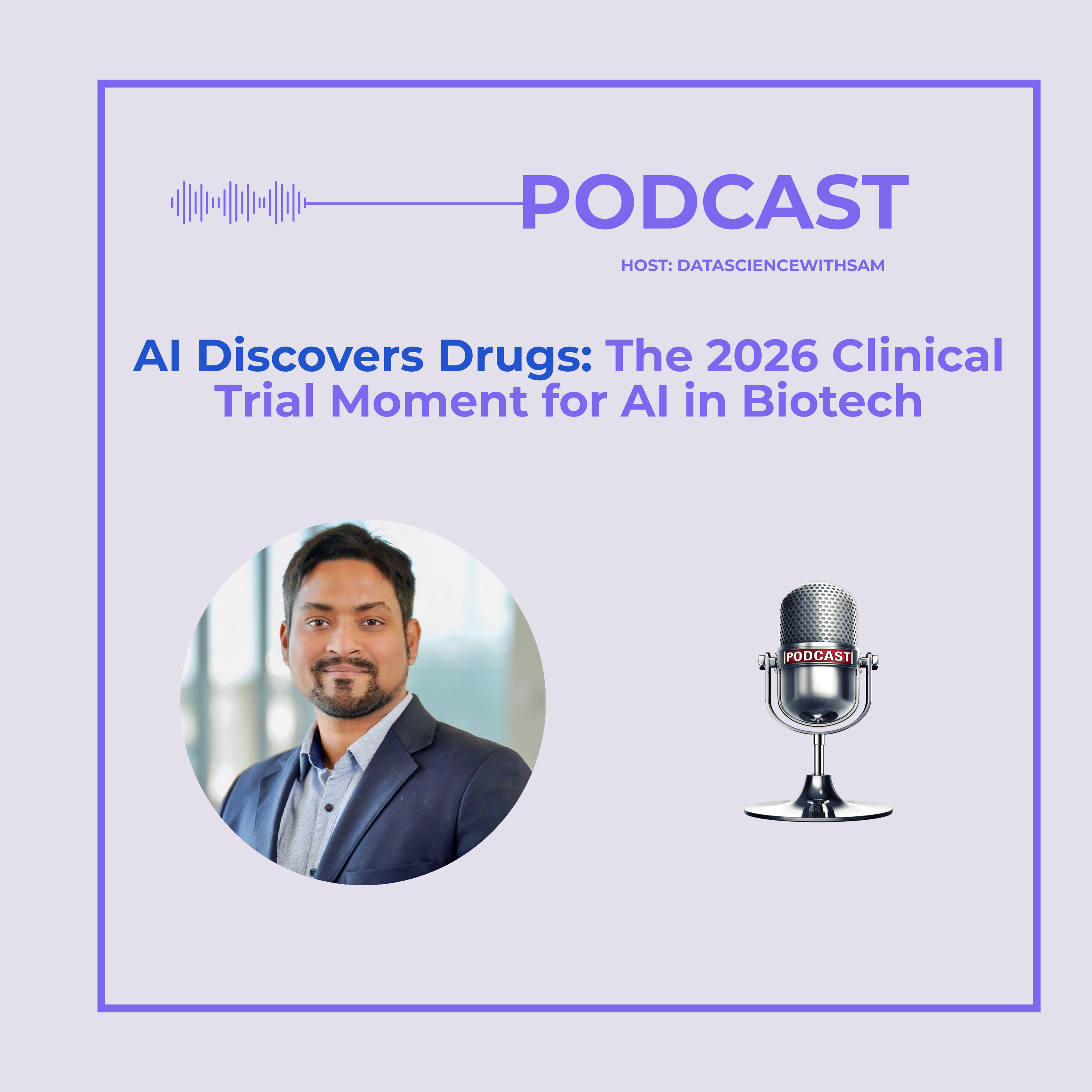
EP 32: AI Discovers Drugs: The 2026 Clinical Trial Moment for AI in Biotech
from Data Science With Sam · host Soumava Dey
For years, AI in drug discovery has been a promise—billions invested, hundreds of papers published, dozens of startups founded, but actual drugs coming out the other end? Not yet. This is changing in 2026. Several AI-discovered drug candidates are now entering mid-to-late stage clinical trials. This is the year the receipts arrive for AI in drug discovery. The biotech industry is calling 2026 a landmark year. For a sector that's been hyped as much as it's been scrutinized, the fact that we're finally getting real clinical data on AI-designed drug candidates is a big deal. Multiple candidates discovered and optimized using AI systems are now in Phase 2 and Phase 3 clinical trials, primarily focused on oncology and rare diseases—areas where existing options are limited and financial incentives for innovation are high. Companies furthest along include Insilico Medicine, Recursion Pharmaceuticals, and Exscientia. Their drug candidates were identified by AI systems analyzing massive biological datasets and predicting molecular structures likely to interact with disease targets in useful ways. What used to take teams of medicinal chemists years to accomplish, these systems can explore in weeks—a massive boost for clinical trial phases by reducing R&D time. Why this matters: Traditional drug discovery takes 10-15 years and over $1 billion per approved drug. Most candidates fail—the attrition rate in clinical trials is brutal. AI's promise is dramatically improving the hit rate by better predicting which candidates will actually work before spending money on trials. Even a modest improvement in clinical trial success rates would have enormous downstream impact on human health. But 2026 is a stress test. Clinical trials expose whether AI-predicted drug behavior holds up in actual human biology, which is extraordinarily complex. AI models are trained on known data; when candidates reach trials, you're testing the model's ability to generalize to real biological complexity that wasn't in training. Early signals have been mixed—some candidates performing well, others hitting unexpected toxicity issues. The honest answer: we don't know yet how much AI improves success rates at the clinical stage. For data scientists interested in this space, the most interesting current work is in molecular property prediction, protein structure modeling building on AlphaFold, and multi-objective optimization across efficacy, safety, and synthesizability simultaneously. Recursion's operating system approach treats drug discovery as a data problem end-to-end—one of the most ambitious attempts to apply ML infrastructure thinking to biology at scale. AI in drug discovery is no longer just a story about potential—it's now a story about evidence. The next two years of clinical data will either validate or seriously challenge what's been claimed.
What this episode covers
For years, AI in drug discovery has been a promise—billions invested, hundreds of papers published, dozens of startups founded, but actual drugs coming out the other end? Not yet. This is changing in 2026. Several AI-discovered drug candidates are now entering mid-to-late stage clinical trials. This is the year the receipts arrive for AI in drug discovery. The biotech industry is calling 2026 a landmark year. For a sector that's been hyped as much as it's been scrutinized, the fact that we're finally getting real clinical data on AI-designed drug candidates is a big deal. Multiple candidates discovered and optimized using AI systems are now in Phase 2 and Phase 3 clinical trials, primarily focused on oncology and rare diseases—areas where existing options are limited and financial incentives for innovation are high. Companies furthest along include Insilico Medicine, Recursion Pharmaceuticals, and Exscientia. Their drug candidates were identified by AI systems analyzing massive biological datasets and predicting molecular structures likely to interact with disease targets in useful ways. What used to take teams of medicinal chemists years to accomplish, these systems can explore in weeks—a massive boost for clinical trial phases by reducing R&D time. Why this matters: Traditional drug discovery takes 10-15 years and over $1 billion per approved drug. Most candidates fail—the attrition rate in clinical trials is brutal. AI's promise is dramatically improving the hit rate by better predicting which candidates will actually work before spending money on trials. Even a modest improvement in clinical trial success rates would have enormous downstream impact on human health. But 2026 is a stress test. Clinical trials expose whether AI-predicted drug behavior holds up in actual human biology, which is extraordinarily complex. AI models are trained on known data; when candidates reach trials, you're testing the model's ability to generalize to real biological complexity that wasn't in training. Early signals have been mixed—some candidates performing well, others hitting unexpected toxicity issues. The honest answer: we don't know yet how much AI improves success rates at the clinical stage. For data scientists interested in this space, the most interesting current work is in molecular property prediction, protein structure modeling building on AlphaFold, and multi-objective optimization across efficacy, safety, and synthesizability simultaneously. Recursion's operating system approach treats drug discovery as a data problem end-to-end—one of the most ambitious attempts to apply ML infrastructure thinking to biology at scale. AI in drug discovery is no longer just a story about potential—it's now a story about evidence. The next two years of clinical data will either validate or seriously challenge what's been claimed.
NOW PLAYING
EP 32: AI Discovers Drugs: The 2026 Clinical Trial Moment for AI in Biotech
No transcript for this episode yet
Similar Episodes
Mar 26, 2026 ·1m
Jan 2, 2026 ·47m
Dec 21, 2025 ·46m