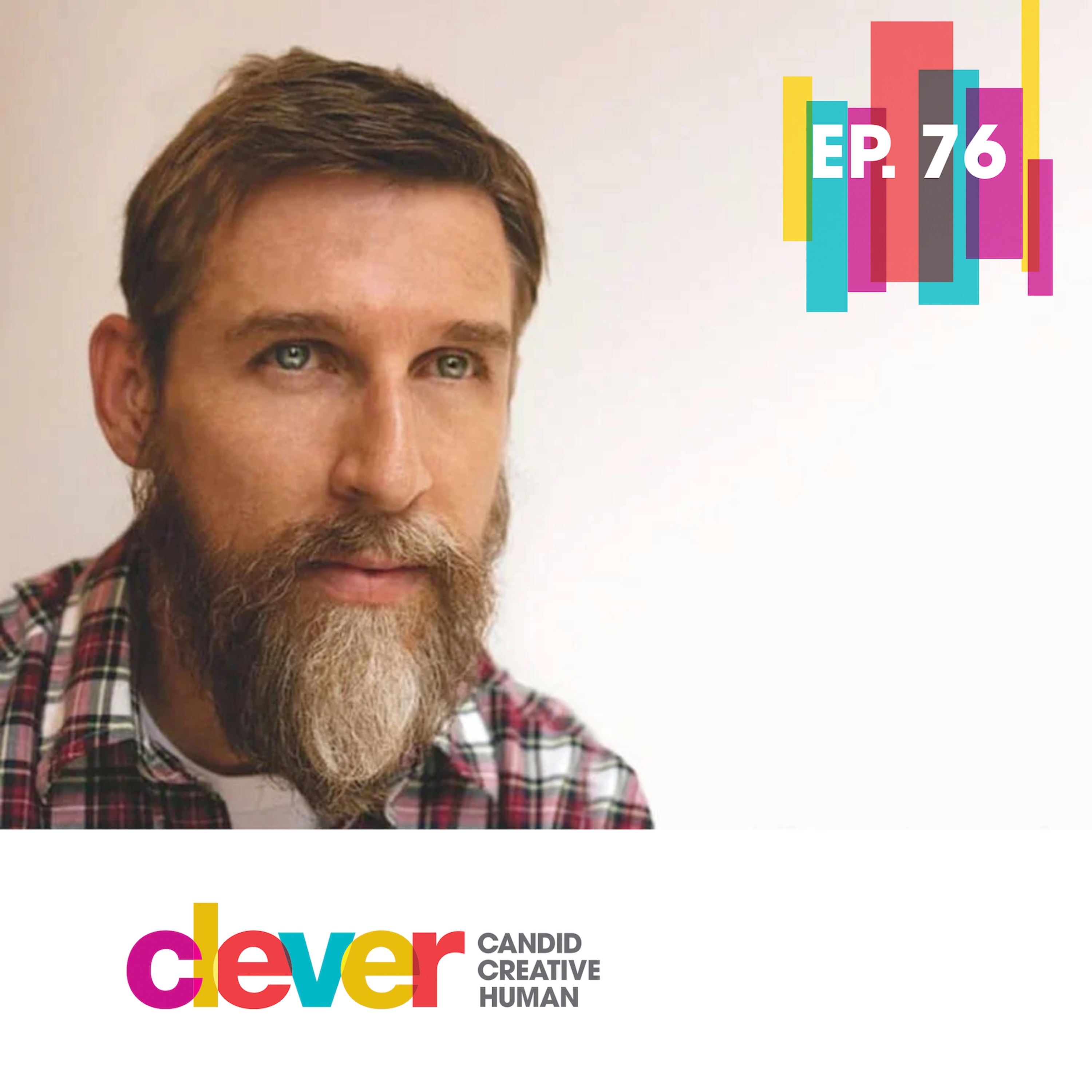
My version of Tiny Todd was pretty odd. I mean, I got hydrochloric acid for Christmas one year when I was, I guess, in fourth grade and loved it and wanted it. And I still have all my fingerprints. I remember it was safety rules for a little bit back then. Hi, everyone. I'm Amy Devers. I'm Jamie Derringer, and this is Clever. And today we're talking to Todd Oldham. Yeah, Todd Oldham. Love him. So you know him as a fashion designer, having built a fashion empire in the 90s, and as a DIY hero from his Todd Time segments on MTV's House of Style, which personally, I think that was the first time I was ever exposed to DIY, makeover, craft stuff. And I feel like it really had an impact on me growing up.
He's also a designer of almost everything and a publisher and author of 24 books, including Handmade Modern and most recently, Queer Threads, Crafting Identity and Community. Throughout his career, he's traversed the treacherous divides between class and genre with a deafness of skill and authenticity of spirit that serve to erase boundaries, invite collaboration, and champion all forms of creativity. And on top of that, he's a force for good in the world, helping the next generation of creatives to access their potential with his line of kid-made modern arts and crafts supplies, DIY projects, and more. This talk is full of solid wisdom, and we can't wait for you to hear it. So let's talk to Todd.
My name is Todd Oldham. I live in New York and I get to make all kinds of stuff because I can't breathe if I don't. Man, I know that feeling of suffocation. It's real. It really is. It's poppable. I feel things very strongly in my body when something's not right. And it's a real thing. Well, the world is blessed that we have you sort of championing that for everyone and showing us how it's done. So let's go back to the very beginning. If you could paint the picture of your childhood for us. I understand you grew up in Texas. Can you tell us about your hometown and your family? What was it like? I was born in Corpus Christi on the water, but it was sort of more of my family was just kind of moving around. And that's when I popped out.
My parents are remarkable and amazing and super brave. And we just moved around and had all kinds of adventures. We moved all over the States. We moved to Tehran, Iran when I was 12, I guess. We lived there for four years. So I've been to many, many different schools. Yeah. But what it does is it creates a new way of being where you're kind of at home no matter where you are. Home is more about just the community that's around you or your friends or your family. So I don't get so stuck about where I am. I travel well. That adaptability comes in handy for sure. It does. And then you just kind of, you develop more of a way of seeing instead of a what of seeing. And then things are a little easier. How did Tehran shape you?
Oh man, it was pure magic. We had moved from Fort Worth, Texas to Tehran in 1976, I guess, something like that. So indeed a contrast. And one of the most brilliant things, it was like somebody threw open the blinds for me and it happened in the airplane ride over there because I'd been on many airplanes around the States, but never overseas at that point. And looking down and just, I knew that there weren't lines between all the countries, but really seeing that this was one big glob, it created this strange thought of why we consider ourselves separate. If those boundaries are all false, then it just created a new way to kind of look at the world and cross-pollination of ideas and cultures and beauty.
It was like a permanent opening of my eyes at that that has never, ever closed. And I think that's why I've been so open to appreciating so many different cultures and trying to represent them all simultaneously in so much of my work, certainly during the fashion days, which I imagine I probably couldn't have had the fashion career I had if I was doing it today. We can get into how times have changed for sure. That opening of your eyes where you were able to see a boundary-less landscape is really important. I can understand how that has informed you and your career, but also your personality. How did that show up in your youth and adolescence? What were you making and creating?
And was that supported by your family or were they vexed by it? Oh, hardly vexed. No, I adore my family and we still continue to spend all of our time making stuff. We'd had a TV, but it was really inconsequential as a kid. We had a craft table in the living room that we just made stuff all the time. So our natural instinct was just sit down. Yeah, it was a great way to grow up. And I realized in hindsight that what it did, it created an appreciation of being process oriented instead of outcome oriented. And that has led me to so much personal success in my life because whether something sold or didn't sell doesn't have anything to do with my appreciation of my efforts or if it goes through my filters as a complete experience. So it really took a lot of pressure off.
Everybody seems to gather around the TV. In old days, it was the fireplace and the hearth and telling stories. But then that became replaced by the TV. But gathering around the craft table is amazing. No wonder. Oh, it's so great. The conversations that come out of a restful, relaxed mind are so, it's not just blather. You know, it's a really rich experience and it's easy to do. It's a little bit of a time shift. I don't know how, you know, now with all the digital interface we have with our phones in our hands way too often, I wonder if that's possible. You know, I'm so grateful that I had such an analog childhood. What about adolescents growing up in Texas and being such a...
Boundary list creative. Yeah. I mean, were you a weirdo? Oh, yeah. I'm very pleased to be. I come from a long line of them. So, yeah, it was slightly inevitable. I never really cared that much what other people thought about what I did or me really necessarily. So I kind of had an invisible adolescence, I guess, of sorts. I moved around for lots of school. So I was just that invisible guy in the corner that had weird shoes on that nobody has a story about, which is great. I just graduated and moved on. But my home life was super rich and my ideal life was very, very rich.
Just school was super boring. They weren't challenging you, were they? No, but that's why I just stopped going and spent all my time in the library in the art room. I have no idea how I graduated, but I did. But I just stopped. I missed the part about proving the learning. I loved the learning and I sucked it all in and remember it beautifully. But I just didn't know. I didn't care if you thought that I knew it or not. That's a bad attitude for school. But no, because I learned. I really did learn. Yeah, and you did graduate. So after graduation, you moved to Dallas, correct? Yeah, I was in this place called Keller, Texas, which we'd moved to after. Well, we came back from Iran and had a brief stay in Denver. I actually went to Columbine High School.
for one year. And then we moved to Texas for yet another year. I kind of gave up in 10th grade, I think. I'm not advocating this or suggesting this for anybody. But for me, it was just like, oh, this is not, I'm done. Which, you know, not great. But I thought I knew everything. And I just focused all my time on learning things I was interested in.
Well, there's value in that too. Yeah, I think there is. There is. I think so. If you're a hot house flower and you're willing to just know everything about your little world, yeah, that's the way to go. What did you end up doing after high school? What kind of job did you get? In 11th grade, I got hepatitis and I was in bed for a few months and I learned, I taught myself to embroider. And so I'd already known how to lightly do it, but I taught myself really to bead at that point. And I started making things for people in high school. So I've never remember a conversation about college with my parents or me bringing it up. And it was just so clearly that was not going to be for me. I set up my business in 12th grade.
And then got rid of the nuisance of school, as I was thinking at that point, and just started. And within, I guess, about a year, my first collection was at Neiman's in Beverly Hills. So it went really fast. Whoa. I have sort of a follow-up question. Did your parents have some sort of entrepreneurial gig that was moving you around? Or what gave you the confidence to know that you could participate in the economy with your creations? It wasn't the confidence. I think it was just the other choices. You know, I always think about trading time. You know, like, for me, money is like trading your time for money. And I was kind of always like, what am I willing to trade my time for?
And then you don't, it just feels better to go about, I think it feels better to go about life like that instead of trying to make everything so money-based. And it just kind of worked out. But my parents were, I have no idea why they were so brave. And I inherited that from them too, where they're brilliantly smart people, but they don't mind not knowing what they don't know. And they're very, they know that confidently that we can go learn it. So I think that's the part they passed down to me that's just been the fuel to do anything. I mean, if that's, if you think you can do that, you kind of can. Yeah, it's not that you have to know everything. You just have to have the confidence that you can learn it.
Yeah, yeah, figure it out. You know, being an autodidact is one of the best ways to go through life. School is great. Everything's great, but you have to have a thirst for knowledge and continue to suck it in and rearrange. And also, you know, as those of us that are involved in design, we reflect society through representation or perhaps we can offer healing or so many things. So we have to evolve and shapeshift, you know, by the hour practically. But once you have your foundation, your roots, the way your filter you put things through, it's very easy to do.
Yeah, I think that also reinforces the idea that we're not all the same. We don't all learn the same way and we don't all work the same way. And so, you know, it's important to recognize. And I think this goes back to Amy and I had a conversation about educators, like noticing certain kids learn in a certain way or certain kids have an interest in a specialty where you can kind of help shape them to go down the path that is best suited for them and trying instead of trying to force them into some strict way of doing things. It's so much smarter. And it's one of the things we address daily with this new adventure we have called Kid Made Modern. And whether you're a cognitive learner or a visual learner or whatever your method into new information is, we want to make sure that the doors are wide open and you know you're welcome and we're clapping for you. So it's a big deal, you know, this kind of flexibility. And we call it invisible safety net. You always want to have that invisible safety net that will catch you no matter what you could. All your decisions will be proper if you're over this invisible safety net. So I want you to connect the dots for me between what happened when you graduated high school and started working and getting the gig for MTV's House of Style, the Todd Todd gig. What happened in between that?
Well, there was a few years in between that. I was living in Texas at the time, so I started making collections there. And I'm often asked this in students when I'm at school, like, what do I do? So I always tell them just to miniaturize it, miniaturize any situation and reduce it to its core. So if you're going to be a fashion designer, you have to think of something to make, find someone to buy it, duplicate it, and then get paid. That's four things. I can do four things. So by keeping it fresh and boiled down, it felt like totally attainable. So I just started doing my four thing method and it started working and I would make something. And then I just happened to be in the right place that Neiman Marcus was in Dallas. And a friend of mine...
worked there actually everybody I knew worked at Neiman's I was the only person that didn't work at Neiman's and it just kind of I kept tripping sort of falling face first into all kinds of great situations and this was one of them and they were opening the Beverly Hills store and it just kind of all blasted off and then that kept going for a while and I had a lot of fun doing that I mean it was a great time a great learning experience and then I moved to New York I guess it was in 89 after I'd caught the eye of this Japanese company called Kashiama and Kashiama in the 90s was a really or late 80s and 90s was a big deal they represented sort of the world's most interesting artists in clothing like Jean-Paul Gaultier and Dolce & Gabbana, that stuff. So they brought me into the stable and things just blasted off immediately right from the start because I think I had been doing it for about 10 years now. My mom has always been my partner and we celebrated the same making techniques and all of our methods that we developed since I was a little boy and we were able to form and forge a great business out of it and do things that were very, very different. So in my second collection, I based the show on an episode of the Three Stooges I saw as a kid called Slippery Silks. Have you ever seen that one? No.
well three stooges are pretty great but this one slippery silks yeah amazing but the whole reason for me becoming a fashion designer was three stooges and it was this one called slippery silks they were plumbers and they went to this house and the lady thought they were fashion designers so they had to put on a fashion show as plumbers and i that i was like oh i understand this so it just stuck in my head from a little boy i never forgot that i've seen it a million times since and so i based this collection on that episode it was as though a plumber had designed or you know and it was a massive hit. Like that show was, was just blasted off for us. And this new show had just come on about one month prior to that on MTV called House of Style that was done by this amazing woman, Elisa Bellatini. And she just saw that there was this space in the world where people were interested in, but it was being covered by either like Elsa Clint. She was on CNN, loved Elsa, but you know, she had a very mature voice that no one terribly young was going to be resonant with. There was just nobody speaking to this young, new kind of thought process. So out came House of Style. MTV had come to that show and had liked that so much. They said, well, can you show us after we cover your show, can you show us where the inspirations come and like how you do it? So I said, sure.
And so we did it. And it was a massive hit. In the segment, we showed how to reupholster some furniture. And I pulled out all my DIY tricks from being a kid. And it worked. So it kind of blasted off. A whole generation, man. It kind of did. I'm kind of amazed at how...
It just seemed really natural for us because it was a very small group. It was Elisa, Cindy Crawford and I, and a handful of genius producers who's now, it's so fun to see call credits on like at the end of The Voice or all these, all the major shows now have all people that came from House of Style in the 90s. That was such an incredible brain trust of people that are now still in control of everything. You just don't know it. So they'd say, okay, you have four minutes and 19 seconds. What are you going to do? So I'd say this and then I'd go do it and I'd edit it, cut it and hand them the tape and MTV would put it in and broadcast it all over the world. I mean, it's insane. That would never be now.
Can you imagine just someone turning over tape on a worldwide network just playing it? I mean, it's insane. But that's just the way we worked. It was just a very different thing. And then we got to talk about the core of this, which is that style has nothing to do with money. I'd show you how to redo something from the thrift store, and then I'd interview John Galliano in a segment a bit later, and it was all the same to us. But I guess it wasn't the same to everybody, and it kind of created a new way of seeing. Researching and thinking about you and your life and your career, I see you as an eraser, like a very skilled illustrator with their hand on the eraser, just erasing all the stuff that doesn't need to be there.
think needs to be there or that think defines defines these arbitrary boundaries and you're the guy who's like nope that doesn't need to be there let's just embrace creativity and fuck class class and genre like that's not necessary here well I agree that's very kind of you to say thank you it's just I didn't I'm not haughty and it's all interesting like you know puddling the ground with spilled antifreeze is just as beautiful as a trip to the Louvre like I feel it in my body in the same ways so it's once again it's as I mentioned earlier it's the way of saying versus the what of saying and then it's everything's interesting Well, you've taken that eraser mentality, the way of seeing versus the what of seeing, and you've built it into a multidisciplinary design studio, which is a tremendous example for creatives who are trying to not get pigeonholed or want to be able to stay engaged and do the stuff that they're interested in, as opposed to what somebody's decided they're valuable for. It's absolutely possible. I'm not going to say that it's an easy thing to do to choose the other pathway. I never walk on paved roads, but I'm so comfortable on unpaved roads that the paved ones hurt my feet worse.
Between that and then realizing when I was about 16 that I was unemployable, that was the most beautiful, revelatory day of my life. Because I thought, why would I have to think? That was in no way depressing to me. It just was like, you have to create your own opportunities. This is a blessing for you. And I just embraced it and it never left. We've got to take a quick break, but we'll be right back after this message.
Support for Clever comes from Mitzi. Meet Mitzi by Hudson Valley Lighting. Everyone deserves to enjoy the benefits of good lighting in their home, and now everyone can. Mitzi mixes classic with contemporary in a full line of charming chandeliers, pretty pendants, versatile sconces, and fresh, flush, and semi-plush mounts. Mitzi is always on trend with thoughtfully simple fixtures at an attainable price point that work for apartment dwellers and homeowners. Learn more about Mitzi and enter to win a cute table lamp at mitzilighting.com slash clever. That's M-I-T-Z-I lighting.com slash clever.
Let's talk about the hard part, though. I mean, you said it's as hard as you want to make it. Are you referring to your own internal resistance? Most of the struggles, I can just tell you what personally I find to be a struggle, is when an idea doesn't bloom fully or a situation is chipping at an experience. I never lose the fact that I'm here to serve and designers can participate in these systems however they wish, but I don't think anybody needs anything. I mean, nothing I would do what I mean. No one needs anything I do. So I have an opportunity and then an obligation to make them as interesting and beguiling and helpful and useful and earth friendly and non-destructive as possible. It's really nice. Since it's not, since no one needs it, you have permission to make magic.
What kind of advice would you give somebody who's wanted to also build a multidimensional career or profession for themselves? Just do it. Nothing happens without the doing. And I had a really... beautiful experience happened in the 90s. It was the guy that ran Viacom, Tom Preston, was a really cool guy. And we were at dinner one night and he turned to me and said, you know, Todd, you have brand permission. And I said, what? And he said, you have done so many things now that no one will ever question whether you can do something if you want to do something new. And that was like, that was a gift from the heavens to me to realize that all of this crazy eyebrow raised expressions I've been getting my whole life actually added up to it all kind of working out at the end. It was really a nice thing. So I think that's seeking brand permission, I think is one of the best goals one could have for a varied and interesting career. And you get brand permission by just doing everything as well as you can.
Damn, I wish I had heard this years ago, but that is amazing. You know, I've been eating off my disc for 40 years now, and it's completely shocking to me that this is true, but it is possible. You know, all my advantages were loving parents and a creative mind. So, and that's a big, big, super big advantage. But if you can, you don't need society to help percolate you. You can force the percolations or instigate them yourselves.
Speaking of percolating things, so you've done, like you said, you've been doing this for 40 years and you've done so many different things. Is your creative process basically similar to just like a DIY project? Is it like a lot of trial and error? How do you come up with ideas and then how do you process them and figure out where they're going? Well, let's see. How can I explain this? I know this system really clearly and I know how to work with my creativity fully. I guess what happens is I kind of, it's a, oh God, I'm not using any proper words here. That's okay. This is free form. It is a free form thing. It's kind of like if someone said, go do the Watusi and everybody would do it a little different.
Mine is, I've kind of formed mine in a... a unique way. So it's like I have a hat on that I can spin really quickly to make it, to match whatever my task is. But most of the time my hat is on neutral. And I always prefer an idea for idea's sake because those are the ones that lead to, I think, the richest results. So you can keep going with it and, you know, working with it. And then eventually you want to make sure that, you know, you have all the ingredients to get it out there. But I have a, I kind of can wear test almost everything in my head at this point. That's one of the reasons I really lost interest in doing fashion is because I could build anything in my head as fully as I could build it with my hands. And it just, what's the point, you know? So you have to be able to build to know where you're going and build it. But I can remove a lot of the problems in my head, in my head before I have to start.
using my hands to do it. It's just, I guess it's from being fine-tuned. Yeah, definitely. A lot of experience. So once you've kind of formed that idea in your head and you're ready to execute it, is that easy to communicate to others? Because at this point, I assume there are other people working with you on these projects. So how does that work? My design team here is exquisite and I love them all. And I'm in all of them all. We run a very different kind of system here. We're pack mentality. We're not layered in the traditional ways that design studios are. There's not a lot of bosses here and we just trust that everybody's going to do their job and nobody's checking on you.
So we pull things apart and come back together. And that way the ingredients are never watered down. Every part of it is as rich and full as it can be. And when it comes back together, it gets even better. And the way that I've set my design studio up is to honor the instincts of design and making. And we start at 10 o'clock. We're really flexible. You got to let it kind of ebb and flow when it needs to be. The design of the studio, I think, is really helpful to that because I went so far out of my way to make this place not look like an office. And it doesn't. And it feels fantastic to be in here. I do think atmosphere is so important to creativity.
When the atmosphere is designed to just squeeze as much productivity out of you, but not valuing the essence of your creative genius, I think you start to feel a little bit like a... A drone or a robot. Yeah, and then you become less than. I'm much happier working with my office here that's full of people. I'm in awe of it would probably be challenged working in traditional modes. God bless them. And I'm so pleased for them that they have that challenge. Everybody in here really should be and will be heading their own stuff. You can just tell. We're so blessed to have an office full of artists that are as vibrant as this team. I want to know about creating products and clothing for children. You touched a little bit on some of the psychology and philosophy that goes into Kid Made Modern. But can you talk to us about how you get into designing and making those?
products? And do you scale back down to Tiny Todd when you're thinking about what kids would enjoy? I do a little bit. But remember, my version of Tiny Todd was pretty odd. I mean, I got hydrochloric acid for Christmas one year when I was in fourth grade and loved it and wanted it. And I still have all my fingerprints. So yeah, I love that my parents, I mean, I adore them so, but I'm always just that's one of my memories that makes me so impressed with them that they trusted me to hand hydrochloric acid to me. They're not stupid. They knew what it was, but they knew they could trust me. It was really sweet.
What is some of the psychology and philosophy that goes into the Kid Made Modern? First of all, can you give our listeners an overview of Kid Made Modern and then talk to us about the core tenets of it? Sure. I'll try not to use so many words because I love this so much I can talk way too long about it. Kid Made Modern sort of started out as a love note to my parents. I've made a lot of books. My 24th book came out last year called Queer Threads, which was the first LGBTQ overview of fiber artists. It's really something. So I've done a lot of these books, but a few books back was one called Kid Made Modern. And it was a love note to my parents who really just spent so much time teaching us all.
I wanted to kind of impart the beautiful ways they taught us teaching this technique but leaving things open so that we could express ourselves within it so it's kind of three parts there's that part one of them was a response to the when I get to go in design schools there was a time I was seeing this sort of bad habit developing where things are being torn out of magazines and duplicated and we're losing that beautiful ticklish joy that hits you when you stand in front of a painting that moves you or hear a song that you know brings it here those kinds of things we lose that passion that then turns into inspiration and removes the need to duplicate so we wanted to try to address that in a way and then also a third part is this thing called the all abouts which sort of demystify or explain art making or craft materials or techniques squished all those three things together, and we had a book I was really pleased with. So we started doing live events and fundraisers for the New York Public Library and different museums around with the book and started seeing that as we were using other people's supplies, there might be room for maybe something a little better because, I mean, I love duct tape, but it was vexed by the fibers that are in it. And if you want to make a wallet, I realize this is not what duct tape is made for, but should you wish to make a wallet and you tear it, then there's all those fibers. So I worked with a tape company to have the fibers removed, and we just did a lot of little things to sort of make it all better. So at the time, a pal of mine, Michael Francis,
was at Target stores. He was really great. He was a big visionary that was, you know, at the beginning of sort of Target turning into something spectacular. And he's always been a big fan and a big supporter of us. So we asked him to come in to show, and we made prototypes of Kid Made, what we were thinking it could be. And within a few moments, we had an all-store buy and a three-year guarantee with no tryout, which our jaws were on the ground. So clearly we had something that seemed to be in the air a little bit. And we started with Target, and it just snowballed and grew and grew and continues to.
To go, including what this season now we have partnership with J. Crew that just came out a couple of days ago. It's a really fun clothing collection. And I'm most honored that we're now working with MoMA making their kids art and craft kits and supplies. So it's been really fun watching it grow from this thing that was really dear to us to this thing that seems to be dear to others. Sorry, that was a lot of words. No, I love it. And I love the motivation behind it, starting out as a love letter to your parents. But in the same way, that's a love letter to the kind of childhood that...
supported and embraced whatever came of your curiosity. Yes, that's true. And nurtured it and gave you the tools to play around with it and then gave you the validation that that's a good way of learning and that's acceptable. It's so great. It's my mom and dad. They were, I mean, they were children themselves having children. And I don't know, maybe we all just raised ourselves at the same time, but they had such an amazing, I mean, at the time, I was born in 1961. I mean, certainly open-minded, but amazing that they felt no need to put these brackets on my brothers and sisters and I. They really just kept it really open.
And up for it. Yeah, that is amazing. And it's nice to hear that you recognize it and appreciate it so much. I mean, did you ever encounter challenges in life because you were allowed to be so open? Oh, yeah. No, I have a risk of development for sure. There's lots of things I'm terrible at. But what I'm good at, I'm really good at. So I guess that counts. So I want to ask a little bit about, I guess it's definitely professional, but it's also personal. I mean, from the outside looking in, you seem like a guy who's got...
who surrounded himself with a pretty solid tribe, like really great, creatively fruitful, long lasting relationships, both personal and professional. Your mom's your partner. I've, you know, I've met you and Tony and Tony's in there forever. And yeah, we've been together 37 years now. Wow. Yeah. Congratulations. Thank you. Yes, that is. Really? We switched it to five years about 10 years ago because I got so sick of people gasping. So now we just say five years. What would you say is the secret to creating these magical relationships? And let's.
I mean, if you could try and diagnose somebody who didn't have the parents that you had growing up, how would you offer some advice for putting the energy into relationships? Respect, I think, is pretty much the backbone to any relationship, no matter whether it's personal or professional, however you go. So that certainly is the most important part. But it's important to also realize how different we all are. And I appreciate that. So maybe if you had parents that weren't supportive, I mean, hopefully at a minimum, they might just not have been supportive of your ideas. And hopefully they were not cruel to your ideas. That's a different sort of situation, having to overcome some.
Terrible information. You get pounded with enough information as a kid that you can't do something or you're given the wrong supplies without assistance. You think it's your fault. And that's a ridiculous thing. So you're gonna have to, if you're not getting supported by those around you, you'll have to find the things to appreciate about them.
and move on to be sated in being appreciated in other ways. So be open-minded to find your tribe. And I think you find it. Moths to the flame, you know, if this is of your interest and you don't have support in your family, find a knitting bomb circle. Or if you live in New York, Taco Bell Drawing Club run by Jason Pollan stills all the time. So there's all kinds of groups you can kind of saddle up to and meet somebody new. But I always found that just by saying, wait, you know, like Taco Bell Drawing Club exists, that makes my heart feel good that these people gather at Taco Bell just to draw because just drawing is worth it. And there are going to be other people that believe like this too.
And if you don't believe it, that's fine. You know, cheers, go about your life. But for those of us that these sorts of things are very, very important, they're not just like a little important. They reassure you. They cuddle your heart. They give you like a reason to keep breathing because we're not normal. And that's great. So we have to understand that the things that are special about us are worthy and deserving of the anomaly behavior. I wish you were my brother. I adore my sisters.
They're really fun. My sister, Robin, was my fit model from very early on. And even when fashion got really big, she ever made my fit model. And the number of times I've stabbed that poor girl with pins. And in shop class, in 10th grade shop class, I made a pair of lathes platform shoes. Wow. Oh, my gosh. You must have given the best holiday presents. Oh, Christmas is so good at our house. It's excellent every year. Yeah, everybody makes lots of stuff. Okay, so let's time travel. So if you could go back in time and tell your, let's say your 20-year-old self, if you could tell your 20-year-old self one thing, what would it be?
Well, my issue is relaxing. So I would just say relax a little bit. It's not necessarily tension that reacts to a situation. It's my RPMs. Like when they get revved up, it feels, I feel it as, my body recognizes it as tension. I just don't attach the bad feeling to the tension. So develop a way to not feel it quite as strongly because it wears me out. Right. And you spend your energy spinning your hard drive or spinning your wheels as opposed to enjoying the process quite as much. Yeah, that's when it interrupts process. That's when, I mean, because that's all we really have, especially it's a very false idea to attach success in artistic ventures to.
what happened after you know whether uh if it sold if it whatever you know that's just you can't judge artistic that can be a unit of measure for artistic situations but it can't measure the success so you have to be really cognizant of did you were you as present as you can be during the process did you take the ideas as far as you can is it as conscionable to humans and the planet as it can be you have to decide those things and for me if they're not all met then that's not a lot of gray area it goes from fantastic to failure real fast which is slightly irritating. Well, yeah, just slightly. Man, the wisdom you're spewing, Todd, is just profound. I've just been lucky to tumble through life in this funny way. I recognize that I've had an unusual way, but I also know that I have a few good secrets to tell for those of us that need to know about how to get through it. It's not easy, but you can, if you really stick to your assessment of your successes as personal ones, then you're going to survive fine. Just getting to that place is sometimes pretty difficult, though, when the outside world is sort of, you know, when your survival depends on successes. Oh, exactly.
Or an awful boss. Imagine you would have like somebody with, I've seen this in many design studios where the, just the lead of the studio has got an agenda or they've got a cruel streak or it's just weird. It's kind of like the, I don't know. It's just not a system I wanted to participate in. So I wanted to make sure whatever situations that I can control. I mean, I do step into ones that I don't control that have attributes that I don't respect, but it is what it is. But things I do control, I try to make sure that we've all honored that. Cause in the end, all you have is the experience you've had with your, your pals and you know, maybe it brought some, and some great joy that it brought to others and maybe some financial success. So that's, that's fine. But really for us, all that is, is if we did it as well as we could.
So it sounds like you're able to recognize too when you're in a system where there are some people who are operating, let's call it from impure intentions. Their own dysfunction is getting in the way. They're cruel or their ego or whatever. Do you have any situations or advice for recognizing that and then navigating around it? I do, yes. And so the first thing is just that recognizing it without judgments because dickish behavior, they're just probably a dick and that's whatever. You can't just accept their dickishness and move on if you can or find ways to not judge. You're only going to get upset at their behavior if you're judging it. I'm not being taken.
seriously so if you just include that in trading your time i'm trading my time to endure this person's false information and do this work and then in your head it's all just part of it you can kind of survive it but i would say one of the best things is don't ride things into the ground it's important to stick with things and make sure your ideas can go all the way but if you're in a situation that you know in your heart that is not suiting you or you're not prospering or you're not doing your best work most importantly if you're not doing your best work then you need to go and uh you just and elsewhere just it doesn't matter where just elsewhere And then hopefully you'll find a community that works. But I was having dinner once with a friend of mine that writes a really popular TV show. And she was talking about the writer's room and how important it is in the writer's room that there's no poison. So if anybody in the writer's room does not have the perfect attitude, they get booted at once. And that was a good eye opener for me because I tend to let things kind of go. I don't mind crazy people at all. And so I can endure them very well. But there does come a time where it's like, ah, this is not a good fit. So I'm quicker to respond to that stuff. But I think for anyone personally going through it, just...
recognize your worth. If someone's belittling you, it's about them. It's not about you. If you've done something wrong, accept it and choose to do better next time. And if you're talking about wrong in a subjective field, just remember that. Because like if we're looking at a painting, I love it, you hate it. We're both right. Yeah, I think it's very important to recognize.
The toxicity, is that infecting the other people in the collaborative process? Or is that just something that I'm struggling to endure? You do. And it can be that any toxicity in a design studio must be removed. It's so counterintuitive. That is just the death nail to creativity is, you know, an unopened heart or a toxic situation. And it's such a shame because you're, you know, you're shooting your own foot off with a behavior like that. But as a creative, we have to, you know, we have to self-preserve. You have to kind of, you got to hang on to your heart and your center. And it's not easy, you know, it's not easy, but it's part of it. You just try to learn early on that your opinion is fine and that's enough.
Man, if I had learned that so many years ago. You've lived a very rich, full life, solid relationships, an amazing sort of creative studio that you get to satisfy your curiosity and keep on a learning curve for the bulk of your life. What? It's hard for me to even imagine, like, what would you add to that? What do you want more of? What would make your life even better? I'm very interested in new mediums, so I'm endlessly shuffling what's in front of me. I have the same approach no matter what I'm doing, but the ingredients change all the time, and I'm very interested in film these days. So I've been writing off and on for a while, and so I think that's probably going to be the next thing that I haven't, I'm pretty green at, but I'm super psyched about, is going into film. Well, can you tell us anything more? Well, I don't know if I've, I'm not comfortable really talking about the project yet, but it's... But you say you're writing? Yeah, I'm writing, yeah.
Yeah, my friend, John Bland. And we've, yeah, it's coming along. I'm sorry, I sound like I'm just being evasive, but I'm very, very excited about it. I love writing and I love reading. That sounds so simplistic, but it's very true. And then when you see some like magic, like a sentence structure by Dorothy Parker is just as gorgeous as the most epic couture gown. You know, it's just this when everything can be sparkly in the right hands. And that's when it becomes fascinating. So I'm excited to figure out what there is to say in film that.
someone might want to hear it's interesting because it's not like what we do at kid made which is you know we're in service to this is a different thing you're not as a director you're not in service to humanity you're trying to do something different so i like flipping the hats around I love this image of a rotating hat and you can just sort of spin it to be what you need it to be in the moment. Yeah, that's really what it feels like. Like a little propeller beanies is my visual image. Well, it works. It's just, you know, once the glue is there, you can turn it in any direction and figure out what to do. So what about you personally? Do you have any big adventures coming up or any goals that you want to accomplish? Well, I'm garden possessed. I just love it. I've always said we would go on walks as a kid and endlessly, but my mom would name every plant and we'd have to repeat it. So she was teaching us all the names of everything.
And it's stuck. So now I'm possessed in the greenhouse with propagation and I'm really, it's like almost to the point of actual possession. I can't wait to go see if the tomato plant's grown a quarter of an inch and it gets a little nutty. So that to me is my favorite. And then the way I was able to turn that passion is we debuted our first kid made modern garden collection comes out in February with Target stores. So we, you know, that's the thing. I really have found a way to enjoy all my passions and then find a way to share our sort of fine tuned knowledge of it. It's a nice way to go about things. Well, you mentioned a film related project you're working on that you can't talk about yet and a garden.
product for children with Kid Made Modern. What about anything else you might want to mention that's coming out or has just been released that you'd like to share with our listeners? Let's see. Well, we certainly spoke about the Kid Made stuff, but what we've just, just as now coming out is the home collection and the clothing. So we're finding our sensibilities. If you like what we do, it kind of works in a lot of different areas. And that's been really, really fun. I kind of reconstructed our old couture team from the design days and we're making a very small handful of completely handmade clothing hand embroidered hand.
So they're very, very beautiful and ridiculously expensive, which seems ridiculous in itself to make expensive children's clothes. But they are very, very, very beautiful. Well, beauty matters. We know that. It sure does matter. And yeah. And bothering to bother matters. Bothering to bother. Yep. It counts. It does.
Well, and figuring out which bothers are worth the bother. Yeah. Most people just aren't willing to throw themselves in, I think. And I think that comes from caution, not from a lack of ability. I've always found that almost anybody that told me they can't, that's not real. I mean, I can't jump to the moon. Yes, that's real. But if you think something about your abilities, like realistic abilities, it's just probably false or something you've heard parroted to you at some point. I recognize at my age now how truly blessed I was to have parents that were so encouraging. They just were.
I was like growing up with, what is that, that comedy rule that when you're doing a prov, you always go yes and, you know, it's never no. Yeah, I had yes and. Prov is agreement. Like you don't shut it down in the middle. Yeah. Exactly. And that's the, that's sort of my childhood. And I think that because I've embraced that, it's that method and approach to business or any of the projects has really served me pretty, pretty well and created a peaceful environment in most cases. Well, it served you pretty well. And then you've turned around and served us.
greater creative population pretty well, by example. Thank you for what you're doing. And thank you so much for sharing your story with our listeners. This is just so full of golden wisdom. I am very excited about this. Well, thank you very much. In my head, I'm kind of retired from doing this stuff. So I'm pleased you guys asked me and I'm glad I did it. So thank you for your time. We are too. Thank you.
So Todd, Aldo, Amy, this guy was like my tween hero. He's still my hero. He's even more my hero now that we've gotten to talk to him. I wasn't kidding. I really wish he was my brother. And no disrespect to my actual brother. I love him too. But I can't even imagine how my life would be.
different if I had a partner in crime like him or somebody that could just validate my kooky creativity all through my youth, you know? Seriously. He just seems like he has this uncanny way of keeping it all in perspective, too. That trip to Tehran when he was a kid blew my mind. Well, I mean, he talked about the fact that he looked out the plane window and he didn't see any divisions between space and that he realized that these divisions were, these boundaries were just made up constructs.
And that was like his eye-opening moment. And it kind of pervades everything he does and the way that he thinks and the way that he works. I thought it was so crucial, too, that, well, first of all, the craft table was the hearth of the home that he grew up in. And he's absolutely right. Like some of my fondest memories with my family, we weren't really a very craft-centric family, but my fondest memories were the times that we did family crafts together, like dyeing Easter eggs and making Christmas ornaments and cobbling things together in my dad's like sort of construction area. Like those are the moments when...
There's something activated when your hands are working in concert with your brain. And when your family has designated time and permission for you to do this, he's right. The conversations that come out of that, it's not fluff. It's dinner table conversation, but it's coming out of the craft table, which I think makes it even more activated. I thought what was so powerful about that whole rich family life, too, is he said that it made him process-oriented rather than outcome-oriented. Yeah, I wrote that down.
But he also said that he feels it in his body, which I thought was really interesting because like that sometimes that happens to me. You know, you're you get so emotional or so interested in something that it's almost like your your mind and your body are one. Oh, it's a very physiological response. I feel it, too. I feel like, you know, some of us have our senses are sort of hyperactivated. Like some of us are super tasters. I don't have more taste buds or whatever, but flavors are super strong. Yeah, I've always felt like my nervous system feels things.
really strongly like does that make sense like i react to things in a very strong way through my nervous system and i feel things that other people don't feel i don't know well he said that that feeling he's had it his whole life but that he you know found that sometimes it becomes tension and that could be a little bit of hindrance to you know him enjoying the process but he talked about how important that process is and that that's what is the ultimate goal um if he can be within that process I also thought it was really fascinating that he, because he went to so many different schools, that he was the invisible guy with weird shoes that nobody had a story about. Because I think that would be really painful for some people. But I think because he had such a rich and validating home life, he was able to sort of observe the world with a level of detachment that a lot of adolescents don't have the luxury to be able to do. Because they're still trying to seek validation or permission from the outside world if they're not getting it from home. And I thought that was really fascinating because he does have this...
The kind of wisdom that seems like he's always looking at everything from an airplane, you know, like this grand overview of how things work and how people interact and who's poison in the room. And he's seeing it from a higher vantage point, from a wiser perspective. He's just awesome. I wrote down so much goodness from this one. I think there's going to be a lot of fantastic quotes and there's just so much wisdom, little nuggets that can be pulled out of this. But what I really liked about the way he runs his office is that it seems very democratic and that everybody's opinion is important.
And everybody is a valid contributor to the whole project. And I love that because it really you're not working to please just your boss. You know, you're working toward the success of something coming together as a group. It's like a team. It's not like this hierarchy of like your boss has to say, you know, thumbs up and then has to go to his boss to get the thumbs up.
Yeah, and he's not training everybody in the Todd Oldham way of doing things or the Todd Oldham style. What he recognizes is that all these different perspectives, all these different ways of thinking that come into his studio, that's the greatest asset. That's the real richness. And if he interferes with that, he's not getting the maximum of their potential. And I think this is really key. I think he's kind of comfortable with the uncertainty of the outcome because he is so process oriented. He can actually get the best work out of these people, which makes them happier, which makes them more fruitful. Like everything is just enhanced because of it. I also wrote down that he's comfortable on unpaved.
roads and trading time yep and that it's a way of seeing mm-hmm and then also your opinion is fine and that's enough I'm gonna get a fucking t-shirt with that on it dude we need you know what we need is a motivational calendar like with a Todd quote for every month just live your life according to Todd Oldham and everything's gonna be okay I told you the story of when I met him once. I met him, Todd and Tony, backstage at a TCA event, which is the Critics Association. It's a TV thing. We were both, like, premiering new shows on Scripps Network. He had Handmade Modern coming on HGTV and Freeform Furniture was coming out on DIY for me. So we hung out in the green room. And he also dropped a wisdom treasure. He said, no is the new yes. And I loved that. Because at the time, I was overextending myself and I was saying yes to everything. Because I don't know. I was green and I didn't think I had a choice. And he said, no is the new yes. And I was like, oh, my God. I'm supposed to be.
really curating how I spend my energy. It's true. I mean, if you're doing all of this, I mean, I guess in the beginning of your career, it's okay to say yes to everything because you don't really know what you're good at or what's going to work out for you career wise. And I think it's good to be more open, especially when you have all that energy. But I think as you grow older, and you like know what you're good at and what you're not good at and what you want to do versus what you don't want to do, I think at that point, it's totally fine to pick and choose, you know, what you want to do.
Jamie, here's what I want to do. I want to keep having conversations with amazing people like that for the rest of my life because that is the kind of thing that absolutely lights my fire. Let's make it happen. Okay. Thanks for listening. To see images of Todd and Todd's work, you can click the link in the details for this episode on your podcast app or go to cleverpodcast.com where you can also sign up for our newsletter. Be sure to subscribe to Clever on Apple Podcasts or wherever you get your podcasts. And if you're in the mood, please rate and review us. It really helps us connect with new listeners and share these stories. We also love chatting with you on Twitter, Instagram, and Facebook. You can find us at Clever Podcast.
Clever is created, produced, and hosted by us, Amy Devers and Jamie Derringer, a.k.a. 2VDE Media, with editing by Jenny Josephson and music by L1011. Clever is proudly distributed by Design Milk.