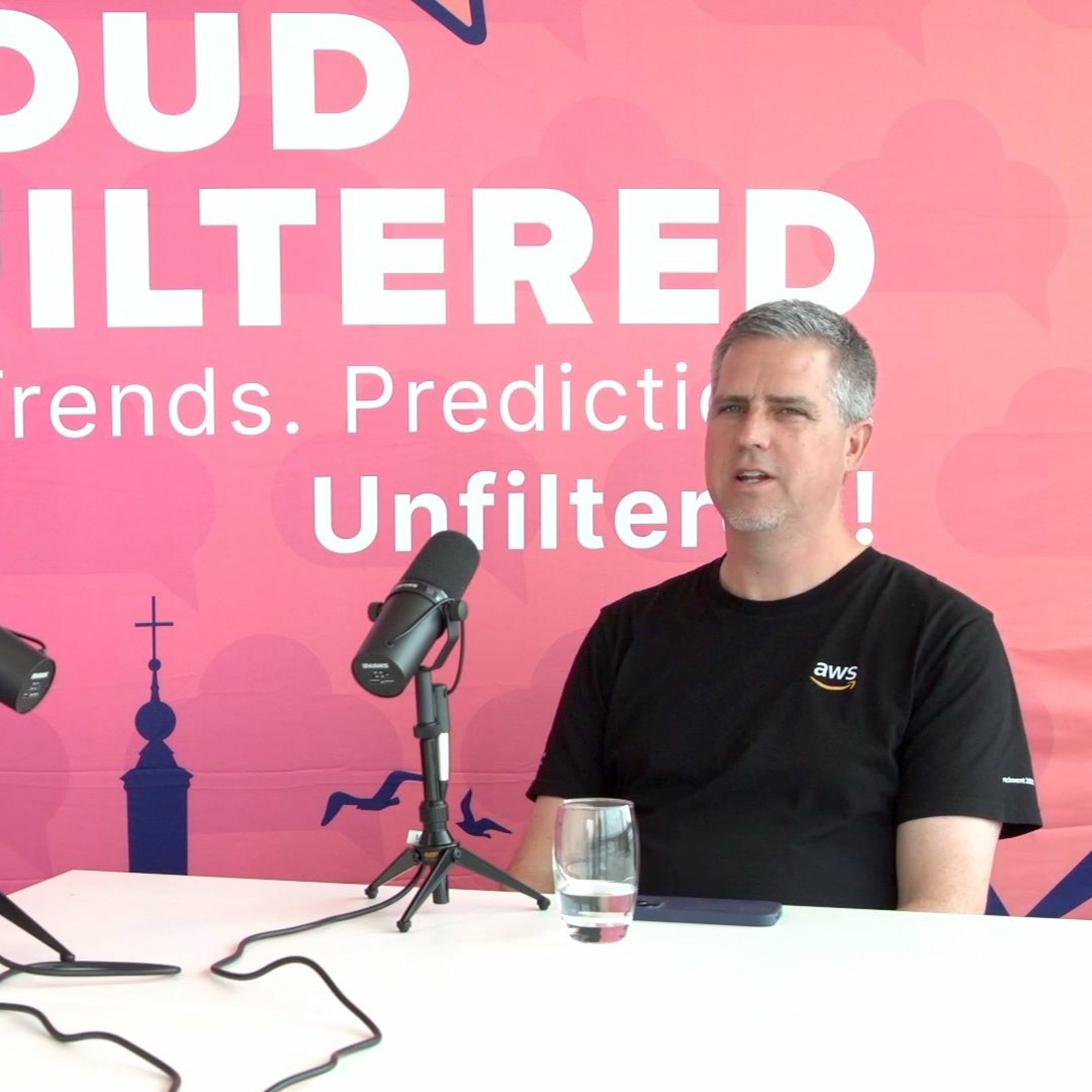
Welcome to another edition of Cloud Unfiltered. We are here with our special edition at KubeCon in Europe. And today my guest is Phil Estes from AWS. Thank you for coming here. Absolutely. It's good to be on the podcast. Yeah, absolutely. You know, we kind of missed each other in Valencia. So, you know, that's understandable. And, you know, so I was really, really excited to have you back, you know, and actually connect this time. Absolutely. Good to be here. Yeah. So, you know, you've done so many interesting things. And, you know, so I'd love for my listeners to understand a little bit about maybe your history, either pre-AWS or from AWS, wherever you want to start. You know, I'd love to understand that. Yeah. So.
Before AWS, I've been there just over two years and a few months. It was at IBM for a very, very long time, 26 years, all the way back to the university days. So I think a lot of people expected me to end up in that lifer category. But kind of separate from employer, I got very involved in open source around 2013, 2014, when Docker was just kind of coming on the scene. And at the time, I did a lot with Linux at IBM. We had the Linux Technology Center, very focused on open source, but my role was not.
publicly working upstream. So it was like, I'd done all this Linux, open source stuff, but I hadn't really done open source until 2013, 2014. And my manager at the time said, hey, you know, we'd done a PaaS, we'd been very involved in Cloud Foundry, IBM had helped with OpenStack, you know, days. It's like, we need some people to go see what this container thing is about, you know, go get involved in the community. That probably didn't take a lot of convincing. No, no, no. It was interesting, it was, you know, I was a Linux user, so containers made sense to me. So I jumped in 2014, 2015, I just, you know.
Grew into maintainer of the Docker engine as an external contributor for Docker. Became a Docker captain the next year after that. And so, you know, kind of these last seven, eight, nine years have been a massive shift in my career from doing all this internal quiet, you know, under the covers work, you know, with IBM servers and systems to, you know, being out in the community, going to conferences, which, you know, has been a lot of fun. Working at Docker during kind of its hype craze was amazing. Absolutely. Met tons of people.
So yeah, long story short, as my role in Docker kind of moved to, hey, let's create this common core layer separate from Docker, which became Container D, contributed to CNCF. At the same time, AWS and other cloud providers, as well as IBM, were saying, hey, our managed services could run with Container D as the runtime. So my expertise there was valuable to IBM and became valuable. And one of the reasons I came over to AWS is they built Fargate around Container D. UKS was moving to Container D.
So, yeah, it's been a fun kind of ride of just having this, you know, more of a public face in the community and meeting people at KubeCon and Open Source Summit, like, hey, I love your work at Docker or Container D or whatever. So, yeah, I've been having a blast. It's kind of been a highlight of my career, which is funny because I did it for 20-something years, just kind of behind the scenes, plugging away at my computer. Yeah, I think it's kind of that shift there. But it's funny when you're talking about IBM because growing up, my dad worked for IBM for three years. So that's how I grew up. He worked under Akers, who was the CEO at the time. He had stories of carrying him home from the bars and things like that.
Yeah, so I can totally relate to being like an IBM. And back then it was like the big blue still. It suits every day and all that kind of stuff. So yeah, I definitely understand that. And it's a much different company now. But yeah, I mean, I think we've kind of shifted from internally creating these like separate ecosystems that never get outside the walls to kind of, you know, now it's okay to...
work on solutions together. And it actually is driving so much more innovation. You know, it used to be that open source kind of trailed the corporate innovation. And now it's like corporations are starting to go the other way where they're trying to catch up to where the open source is. Right, right. Yeah, yeah, definitely. So yeah, it's been a fun couple of years at AWS because I feel like they've also been in a shift of sorts to be more visible in the community, you know, having large booths at KubeCons and open source summits, not just to talk about services and products, but to talk about what we're doing in community.
You've got NCD maintainers or people contributing to Kubernetes. Yeah, absolutely. So yeah, it's been a great time to be there because my history of working at open source, I can mentor some of the younger engineers who are like, what does it mean to work upstream? How does that look? Because it's different than your manager saying, okay, here's the thing we're going to build. And each of you take a couple functional areas and develop it. And it's all internal. And that's a really, it's a different skill. I mean, it's a different skill set. And it could be equally or even more hard because you're dealing with, you don't have as much control. So you have to like.
you know, figure out how to, how to manage that together with different perspectives and different ideas. And as the project grows, you have different, you know, different people that join in. So, so, you know, how do you, how do you kind of, you know, how do you work on, how do you do that? How do you start, how do you even attempt to start that? Yeah. Yeah. So it is interesting that in open source, your skills at the keyboard may not translate into success in community because, you know, we used to call them soft skills, but they're, you know, the important skills in community are how do you communicate? How do you, how do you not be annoying? But yet,
you know, move a community in a direction that's valuable to you or, you know, build trust. Sure. Building trust in communities takes, you know, way more than just being good at writing code. So, you know, a lot of it's just teaching people how to enter a community. Like, you know, first impressions matter. So.
you know, trying to get people to understand that, sure, you have this great new idea that radically changes the way this project works. Well, you can't start there. You're probably going to have to ask, hey, do you guys need help with like, you know, some tasks that are simpler to clean up CI or help with docs or something that starts to build that trust. Sure. So that then maybe you have a voice in the community. You can say, hey, I had this great idea. I don't know if it's interesting to other people. So, yeah, it's interesting because a lot of that mentoring is not so much how to open a pull request. Yeah, that's relatively easy. Yeah, it's way more about, you know.
How are we going to present ourselves to this community so that we earn trust, so that we bring value that's not just about us? So yeah, to be honest, there are people who... just may not have those skills to be successful in community. And there are others who rise very quickly to the top, like, oh, they get it. They really understand how this works, the give and take, the open debate without being offensive. Yeah, it's almost the same skill as you need as a politician, almost. But going back out of straight community, I know you work on a lot of projects. I know in Valencia, I think my real interest was starting to get into micro VMs and stuff like that. I think you were supposed to have a talk on that last time, maybe? Oh, yeah. So we have...
built a micro-VM-based Container D project called Firecracker Container D that uses Amazon's Firecracker project. So, you know, we've used that. We've shared about it. In fact, I was just talking to Alex Ellis a couple hours ago. He's built... I didn't realize he was using Firecracker in one of his projects. So, yeah, that's been interesting. You know, Amazon had this capability. They built it on some other pieces. They released that as open source. The container group took some of that and built her in Container D. So, you know, like a lot of open source, it's kind of evolutionary. You're taking...
you know, this project and that project and you're combining them or offering something, you know, built around that. And that was the, that was, I think I read somewhere that that was the core of Lambda or something like that. Yeah, so Lambda is built on Firecracker VM technology. So, you know, what I was trying to figure out is like, what was the core problem that you were trying to solve when you guys created something like Firecracker? Yeah. So, yeah, the only hesitation for me to answer that is I was yet to join AWS when those discussions happened. Yeah. I don't know all the backstory there. Or if there's something that, you know, that you think, you know, I won't hold it, I won't hold it to the people that are out there. Yeah. So, but clearly,
You know, VM isolation, for years we've talked about that's a stronger boundary than containers. Sure. And so AWS's primary focus on security is job one. Sure. I think led them to, okay, people love containers because of the fast start. They just start. There's no VM to boot. And Firecracker brought, married some of that together because, you know, paring down the machine profile to where you're not loading the driver for floppy disks or PCI. They really stripped it of everything except the essentials. They get down to where it's a few hundred milliseconds. Now it's like, okay, we could use VMs in a functions as a service type of model, serverless model, and still get VM isolation, but also some of the benefits that drew people to containers.
So I would say that's, you know, that's definitely part of the thinking that brought about a project like Firecracker. Yeah. And how do, you know, so for people that have used things like containers before, how would they even start to go down that path of like, or decide when to use it versus the other? And how do they start to use something like that? Yeah. I mean, you know, a lot of the interest of work in that area has been around untrusted workloads. So you have to decide what's my threat model in what I'm building. Does it matter that, you know, do I need strict isolation? You know, maybe there are people who have different opinions about container boundary.
trust it? Can I not trust it? Can I add things like rootless mode that even deprivilege it further? So yeah, it really depends on the person assessing what kind of technology they're going to use to say, do I have a threat model where I really want stronger isolation? And then maybe I make those choices about cata containers or firecracker or whoever's providing me kind of a micro-VM platform. Yeah, no, I think that's...
It's a great time that we have so many options, but it also can be very overwhelming that we have so many options. Yeah, definitely. But you've been working on some new projects, and I really want to talk about that, too. So tell me about your latest project, because this sounds really interesting to me. Yeah, so we just launched Fitch around Re-Invent. Actually, it was the week before we published a blog post. We didn't tie it to Re-Invent because it's not a product. It's an AWS product. It's an open-source project that is built out of projects that were already involved in, Container D, BuildKit. We've gotten more involved in Libo, which...
is, again, a simple VM technology for Mac that you can run Linux OSs inside QMU-based virtualization. So, you know, other people have married some of these same projects. Rancher has Rancher Desktop. But we had customers asking us for, like, just a simple, you know, on my developer laptop, which is probably, you know, many times a Mac. I just want to have that tight developer loop of I build a Docker file. I want to build an image. I want to run it and try some things. Now I change something. So that tighter loop where I don't want to deploy it somewhere. I don't want to push to a registry. You know, the things that people have traditionally used Docker on their laptop or Docker desktop. So as a response to those customers, we thought, well, we could join these communities we're already partially involved in and just start to build kind of this common layer that maybe others will want to use it as well. So again, it's got...
It's built on NerdCTL, which, again, Akihiro, one of our maintainers, he's built so many projects he can barely keep up. He's part of how rootless containers came to be. He's a run-sea maintainer. Anyway, NerdCTL gives you that same Docker-like command line, some syntax and commands. So Finch, on your back, gives you that same feel of, like, I've got the command line, I can build, I can run, I can push to registries. So at this point, it's really just a packaging of those projects. Some of our ideas for the future are adding Windows support, maybe Linux support as well.
And then having a plug-in model, just like Docker Desktop has an extension model. So vendors you see out here on the floor, they can plug in their container scanning tool or whatever additional features they'd like to have. And that allows us to keep Fitch just being pure open source. It's not going to tie you to AWS. You don't need an AWS account. You don't have to use our services, but you can have an extension that does something interesting if you're deploying to ECS or Fargate. So, yeah.
We're pretty excited about the initial response has been really positive. And, you know, we're trying to run it as a fully open source project, which means, you know, it's not just AWS people that could be maintainers. We want others to grow to be able to become maintainers of the project. contribute yeah absolutely yeah we'd love to build a community around that yeah no it sounds really neat and and you know i'm always interested when there's some kind of new technology to help me or even a packaging of that technology in the right way because i often you know i've said this so many times this even today is is that you know think about the new person coming into the into this environment you know we all we all grew with the environment and we started with kubernetes and then started the other projects so we looked at those and there was more projects we looked at those and there's more but think about somebody new that's that's just coming into this today trying to figure out like what do i even do i was told that i have to go to containers i have to put them in these things called microservices and there's this thing called kubernetes well what's the csi What's the CNI? What's the, you know, and all these projects, all these projects. So, you know, I feel like we as a community have to do a better job at simplifying some of this and creating documentation and creating, you know, paths, the easy path. Right, right. Yeah, you know, part of Fitch was.
recognizing that all the components are there, but telling someone, oh, you've got to go to this GitHub, release this page, and download this piece, and configure it this way. You're starting to bring that together. You get a single-click install, and it puts all that down. It updates what they're updating. So yeah, that simplification, like you said, is really important. Yeah, and I see a few cool projects popping up. I think I had Dinesh from Sivo on earlier, and he was telling me about this thing called KubeStart. That sounded pretty neat. I don't know if you've seen that yet, but it's like it will set up your whole pipeline for you, and then it creates the logs, and the logs will go in your Git in the right area, and then it will create a feedback loop, and it sets up everything.
need in like 15 minutes yeah so it's kind of like that's great for people that are just getting into it you know they don't know how to set up these pipelines they don't know how to do these things yeah you know so it's opinionated but you know it's it's it's it takes certain you know opinions and it's it does give you some choice like you know github get lab or even you know amazon or whatever you know it will it'll allow you to do that but but it's uh you know it's good for people coming into it you know so i'd love to see these projects that and even like like like you know i had shannon and shannon williamson um and Darren Shepard on before. And Acorn's interesting because they're doing stuff to make that part easier. So I love things that make things easier. Yeah, Darren's an old friend. He and I both were contributors to Docker Engine way back. He's got the perfect mentality of that.
Grumpy developer is always pushing to make things simpler, and why does this have to be hard? So I think Acorn is the result of that, pushing to try and simplify. Yeah, and that's really, when you think about the greatest innovation that comes out, it's really about, somebody got so frustrated at the way things were done that they actually codified and created a solution because of the fact that we don't want to do that anymore. You have to bang your head against the wall so many times, you don't want to do that anymore. So yeah, I love the innovation that comes out of these things, and really, really interesting to see. And I think we're at a state where this environment's premature.
So now we're just adding more. We're trying to look back and say, like, what is it that we can do to make things simpler? Yeah, definitely. Yeah, yeah. So, you know, your day job within AWS, like, you know, what do you work on there? Or can you talk about these things? Yeah, yeah, absolutely. So I joined because of my Container D involvement. There was an expectation that I would bring some open source leadership around the OCI, around Container D. Sure. So it's actually been a lot of fun because...
Many groups, you know, I'm affiliated with the container services organization. Fargate, again, as I mentioned, uses Container D directly. EKS has moved to Container D. So there's that natural fit of we have a container runtime team who contribute upstream, who also help these services, Fargate and others, use Container D, make it easier for them to adopt. So there's sort of a natural mentoring relationship with that team. That's awesome. We've grown it. We've doubled it since I joined.
And then we kind of have this nice organization where we've brought two sister teams. So Bottle Rocket, again, something AWS had created before I joined, a container-optimized OS built on Container D. That's a sister team. And then the Finch team, the project we just talked about. So there's a natural fit for me to be a principal engineer helping each of those teams with open source, with Container D, with OCI issues around new features, things we're trying to do upstream. And then it easily progresses from that. EKS obviously has a lot of expertise in Kubernetes.
But I'll be brought in to help with container D or node level concerns. Sure. The registry team obviously has an OCI compliant registry. So I work with ECR and the registry folks on work they're doing at OCI. So that, you know, that almost feels like a lot of open source consulting, like within AWS, where I could bring help, connections, benefit to. Yeah.
you know work we're trying to do upstream getting again venturing people to learn how does that work how should we do it what should we take and we've created a few other projects you know since i joined the sochi snapshotter for container d which is a lazy loading snapshotter to improve image download time how quickly can i get my container started which is important when you have large ai about images Yeah, we've already talked about Finch. And so, yeah, it's been a neat time to join, as I said, because I feel like there's a lot of value to just having more open source leaders. We have Dims, we have Nithya Ruff running the OSPO. So these are people I knew pre-AWS who are all there working together on open source. So there's a lot of times to David Alley's open source marketing group and Nithya and the OSPO. So there's a lot of cross-collaboration across these orgs.
And we're also getting more involved with OpenSSF. Yeah, everybody is. And I had a role there when I joined AWS, so I bridged that connection as well. So I definitely have plenty to do. Plenty of people looking for guidance and help and leadership upstream. So, yeah, I mean, talking a little bit about security, you know, how is it...
how do we enable better education about like security and containers and security with Kubernetes and security, you know, because, you know, I said this before too, that, you know, developers are designed for speed. They want to get the application out as soon as possible. Kind of security is kind of an afterthought right now for a lot of companies. You know, how do we provide that education and how do we enable people to kind of think about that? Yeah, I mean, you know.
I don't play directly in that space. I'm not a security expert. But since getting involved in containers, I've given talks on container security, what kind of choices do you have to make. And it's very clear that you can talk all day about the knobs and the switches. How do I make this more secure? How do I remove privilege? But like you said, because...
A developer's going to choose the fastest way to get from A to B. If we don't start building these into the default platforms that we're using, if you don't naturally just get security from the platform, or that it's an easy, those steps flow naturally with the work you're already going to do. Like when I build an image, it's going to be scanned. I don't have to turn it on. I don't have to worry about building out the platform that's going to show me results or set up policies that images with critical vulnerabilities aren't going to be run.
So I think a lot of the work that's happening right now is trying to make those into platforms so that you're not asking customers to go to five more webinars on here's how to secure container image, here's how to secure your Kubernetes platform. Because, like you said, people aren't going to have the time. Or maybe they have best intentions, but it just doesn't happen. So I think we're all going to have to find ways to make sure that those choices happen for you, or at least as naturally as part of the work you do. that you're going to have to do anyway. You're going to have to build a container. You're going to have to push it and set up the policy for how it gets deployed. So at least if those security capabilities come along with that, then...
then we'll all end up more secure rather than you know waiting for someone to learn all the things that they have to learn and turn out all the dumps that they have to figure out on their own yeah yeah i totally agree and i think that's that's probably the key there is it's kind of that delicate balance between between velocity and security you know it's like you don't want to slow people down because that's what they have to do but you also want to enable them you know probably through the pipeline or something to to make good choices you know automagically yeah yeah you know those are hard problems they are because you know people also don't like it when a odd by default security feature changes the way their workload runs or stops it from running so So there's all this balance in that world that's difficult. Yeah, absolutely. And add all the, you know, supply chain things now, trying to track that. Yeah, everyone's like, okay, now give me an S-ball. Yeah.
figure out what that means. That's a complicated problem. That is a super complicated problem. Yeah. Yeah. I mean, I had, I had Frederick on before. Yeah. And we were talking about that. And I mean, it's just, when you think about, you know, just compiling and languages and, you know, what you're using, everything is so different and you have so many choices and, you know, how do you validate that and how do you attest it and all those kinds of stuff, you know, it's, it's, it's a hard problem. Yeah. And each, each one of those areas has its own unique problem. So I want to build this reproducible. Well, there's a group of Linux people that have been trying to get reproducible Debian or RPMs for years. Yeah. I get date strings out, you know, just to get the same binary.
time is already a hard problem in itself yeah so now you think about s-bombs and attestations and like and then how do you manage those s-bombs how do you distribute it how do you how do you distribute hashes or whatever it is that you whatever the output of that is yeah yeah so i get to see this from an interesting vantage point because being at the oci now the image spec distribution spec and artifact discussions all relate to that that's why the oci is discussing these things because people want an image to have things that refer like oh here's the s-bomb here's the signature here's the attestation yeah and so uh you know all these things overlap each other in the end you know that people are doing work across our ecosystem it's almost like it was you know even though as far as we've gone and this stuff all has reasons for being here but the world has become so much more complicated than when we just had like vms running and something you know even just servers or vms or whatever you know right the world is it's such a different world and it's and it's you know partly because of velocity you know because we need to enable that velocity and we need to do and then by by and by we have to have the security on top of that so all that stuff adds way more complexity yeah Definitely, yeah. We live in a way more complex world than we started working in software. Absolutely. Yeah, I mean, I remember, you know, so, you know, I started working out in, you know, it makes me feel old now, but, you know, in the Solaris ecosystem and in the, you know, and all these things that, you know, a lot of these concepts came from, you know, a lot of those things in Unix, you know? Absolutely. So, really interesting. By the way, you know what I meant to ask you, and I, you know, I kind of wanted to walk back a little bit. So, when you got involved in Container D, or you, you know, what was that, you know, how did that start? How did you...
Yeah, that's an interesting story in and of itself. So I don't know how involved or how visible this was. You know, some of these things, there's a bubble where it's like everybody, you think everybody's involved, but like, oh, well, that was actually this group felt all that heat and pressure right there, but maybe nobody else saw much of it. Although part of this was definitely very public. As Docker gained popularity, Kubernetes was also sort of on a similar track. I think people think, oh, Docker was around a while, and then there was Kubernetes. If you look back, it's like, well, there were talks at early Docker cons about this new thing that people were just trying out.
But there was friction in that world pretty quickly because Docker came up with Swarm. Docker, the company, came up with Swarm. And Kubernetes was relying on the Docker engine to be the container runtime for your pod. And so that all kind of came to a head. I guess 2016 was maybe the height of that. And there were rumors about someone was going to fork Docker and make a more slow-moving version that Kubernetes could rely on that wouldn't have Swarm. So it was out of all those discussions. I was at IBM at the time, but heavily involved in Docker.
talking to Solomon from both a company perspective, but also a contributor, you know, I think everyone realized we need to solve this. Red Hat was also frustrated with Docker at the time. So container D was meant to be the answer of like, you know, I think it was Joe Bain that tweeted in that timeframe, like all we want is a core stable runtime that Kubernetes can rely on and Docker can rely on that doesn't have sort of the opinionated layers above it. And so Michael Crosby, one of probably the most prolific Docker employees at the time, and maintainer of the engine. sort of just on his own created this little process manager that he called container d uh this is also what the oci was for so a lot a lot of stuff happened in 2015 2016 and sometimes i don't even get the timeline right anymore but yeah essentially you had runc container d and docker you had these three discrete projects yep where you know if you i remember roll back the clock a year earlier you just had docker this one binary that did everything uh so that was kind of that that first kind of movement was this process manager and it was uh yeah through the rest of 2016 that
Again, some of this heat and firestorm ended up pushing to this decision of like, okay, well, container D could be just more than a process manager for run C. It could be this sort of core stable runtime that anybody could use. And so the CRI, again, was developed soon after the container runtime interface for the Kubelet to talk to a runtime. And it took years and years for Docker Shib to finally get deprecated just a year or so ago. But now we're in that world where container D is.
used both by Docker, it's used by Kubernetes via the CRI, they're used by other projects, all because of that sort of heat and pressure of like, you know. Kubernetes, Docker, you know, all these sort of tensions and debates, the Red Hat tensions. You know, out of that, I think something good came. Yeah, absolutely. We ended up with a project that spring 2017 was donated to the CNCF and graduated a year later. Yeah, no, I mean, first of all, I love backstories, so thank you. Because I think that, you know, my listeners also really love the backstory. Not everybody's involved in that, but the history and understanding why something happens, you know, is amazing. So I love that.
The one thing that I do remember, too, is I think when we used the Docker engine, it was much more fat. And this also answered the question, like, we don't need all that stuff in Kubernetes. We can slim it down and kind of, you know. Yeah, so Docker as a tool was growing, so you had volume plugins, and they had their own networking. And so if you used Docker underneath Kubernetes, one of the things was the Docker container would end up on the Docker network, but a CNI plugin was also creating a network. So you had people running a production saying, I don't want this other network. And yeah, so.
Container D sort of got rid of all those vestiges of the additional tools and features that were important if you're a Docker user, but they're not important if you're just wanting the Kubla to start a pod. Exactly. And also you want to kind of minimize that attack surface too. So less code, less, you know, all that kind of stuff is very important when you're considering those things. So yeah, I mean, I think the OCI has really helped tremendously too, you know, in terms of creating standards and those specs and everything. It's much easier now to kind of consume that stuff. Yeah, absolutely. Yeah, so...
You know, we're getting towards the end here, but I wanted to ask you, you know, I know you see a ton out here. What's new and interesting and, you know, kind of on your radar or something that you've seen? I mean, it's hard to ignore Wasm. Yeah. You know, this is the first conference that Wasm has been, you know, a trending topic, but I feel like it's a little more real. There's several vendors, you know, building around Wasm. Yeah. And with my Container D hat on, we have a ship for Container D so you can actually drive Wasm. I didn't know that. From Container D, contributed by Microsoft.
So we're seeing a lot, you know, there's a lot of growth there, and I'm curious to see where that goes. Again, like you said earlier, the problem with choice is now, like, why would I choose Wasm over a container? That's what I'm trying to figure out, you know, like, what is, you know, and I don't think anybody's figured this out yet. Like, what is the, what is going to be the use case for Wasm, or with, you know, or with Kubernetes, or Kubernetes with Wasm, or Wasm with Nomad, or, you know, whatever it is, you know? Yeah, yeah, I think, I think we're still, you know, there's people with opinions on those things. But that's just it, it's just opinions at this point. I don't think anyone's figured it out. Yeah, yeah. I mean, it's definitely interesting that, similar to containers, you know.
When you compile to WASA, you're not having these, you know, you start a Java jar file and it's got to load all these other class libraries and jars. With Wasm, you're back to that beautiful kind of instant start that everyone loves. My application just starts. It's already running in a sub-second. But isn't this just like a recreation of what we already have? I remember the early days of IIS. There were all these WSGI plugins or whatever. And that's kind of like what's old is new again. Well, true. I mean, yeah, I think if you've been in the industry long enough, the same ideas come back in a slightly different form. I mean, I know it's different. It's a little bit different in implementation, but the concept is kind of the same. Yeah, it's always been interesting to me because I remember one of my...
earliest jobs as a college grad at IBM was working on this like distributed RPC. thing, which was the best. It crashed all the time. It was a memory hog. It was kind of cool. It's like I'm calling to another system and executing work and getting a response. That's all we do now. Everything's RPC. REST APIs and gRPCs. It all comes back around. It's so funny to watch. It's almost like even at IBM when my dad was there, it was all about big systems and mainframes and things like that. It's kind of like going back into distributed systems. It's just all kinds of circular. It's really interesting. Thank you so much for coming, Adam.
Glad that we finally got to connect this time. And it's so interesting talking to you. So hopefully we'll have you on again sometime. Awesome. Thanks for having me. All right. Thanks.