
Welcome to the Movement Movement, the podcast for people who want the truth about having a healthy, happy, strong body. Remember, your body was meant to move. Now here's your host, Stephen Sashin. Should you be running longer, slower, or shorter, faster, which is better for your health?
Let's take a look today at high intensity interval training in the Movement Movement podcast. Hi, I'm Stephen Sashin, and the Movement Movement Podcast is for people who want to know the truth about what it takes to have a happy, healthy, strong body. We get rid of the mythology and the propaganda, and sometimes the outright lies that people tell you about what it takes to do that by moving naturally. You can follow us at www.jointhemovementmovement.com, which will point you to the various places that you can see us on YouTube, or Facebook, or Twitter, or Instagram, all over the place.
And, of course, make sure that you subscribe and like and share depending on what platform you're on. You will know which is the appropriate action to take. And depending on what platform you're on, you might notice that today I'm having a particularly large hair day, and I'm sunburn as hell, because it is me in Colorado when I'm recording this. And that's one of those times where it's still cool enough that you don't notice that it's the sun is pounding down on you as you're over a mile above sea level.
Now that's what happened. So be it. It's my rite of passage for the spring. I like to start the movement movement podcast by doing a movement and today's movement is going to be a non movement.
We're going to do something that's really, really important that is kind of an isometric thing and it engages your core. I hate the phrase core. It means so many different things to so many different people, but it's important to have a strong spring when you are moving. You don't want to be collapsing through your midsection when you walk or run or hike.
And this is a way that you can kind of work on that while sitting or standing. And here's what you do. A, tighten your abs. Just kind of squeeze your abs.
And then this is going to be a weird one. I don't know if I can talk while I do this. As you're squeezing your abs, push down. Like you want to try and see if you can get your entire abdominal area to expand outwards while not letting it.
So add internal pressure. And yes, this could feel actually, I'll say it differently. If it does feel like you're going to the bathroom, then you're pushing not quite in the right direction. So you want to kind of tighten your abs and then push.
And if you do this right, you'll actually feel like the sides of your body, the sides of your abdominal cavity and the back are extending out. And your, the front part is not going anywhere. And just feel what that's like to get that tension all the way around that sort of corset of tension just so you know you can activate that. And if you can't activate that yet, practice that.
You want to take to kind of get that tension and bear down a little bit. I wish I could think of a better way of describing that to get that corset of tension. And the thing you want to do next is while you're, well, first of all, you can just do that while you're sitting at your desk or walking around for just like five seconds at a time, maybe four or five times. And then you want to experiment with that when you're out walking or running as you're taking a little run and see what happens if you kind of try and get that corset of tension and see what that does for your running.
I can tell you what it did for me when I discovered natural movement was that it helped make my, all of my running faster easier and lighter because again, I wasn't compressing. I wasn't like a slinky. I was more like a taut spring. Forces were going through the ground better going through my body better, actually not going through my body is the important part.
And it really just helped me align my body, get my shoulders over at my hips, make sure my butt wasn't sticking out or too tucked under. So play with that and let me know how what your experience is in the comments below or on one of those social channels that we participated in. Okay. So let's not into the topic of du jour, high intensity interval training.
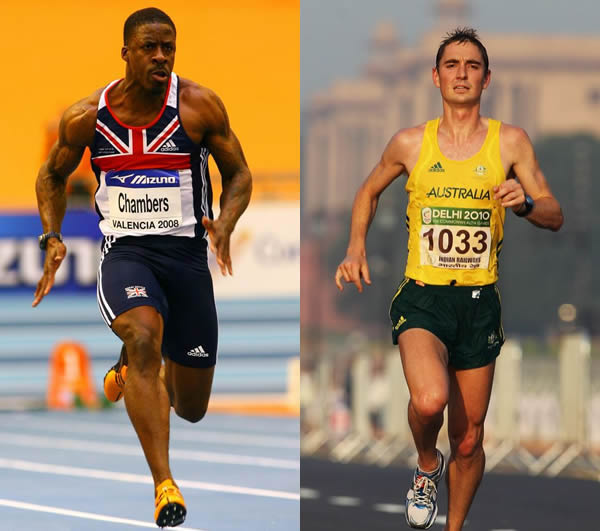
This has been a buzzword of late people have been talking about it for a while, but lately I've been seeing more and more people coming out with courses on high intensity intervals and saying why doing high intensity intervals is better for you than running long, doing long, slow distance, whether you're running or on an elliptical or on a cycle, whatever it is because you can apply high intensity intervals everywhere. And I'm going to start by showing you something. This is a picture that people love to use when they talk about the difference between doing high intensity intervals or long, slow distance training. They say which one of these people would you rather look like?
The sprinter, the muscled, chiseled, low body fat sprinter or the marathoner who, you know, it kind of looks like he at the very least needs a meal and at the very least is auditioning for a World War II documentary or fake documentary. You can get it moving. That was the word I couldn't find. So let me just address this part first.
When anyone shows you something like this and says, see, this is why sprinting or high intensity intervals is better for you because you end up looking like that. They are 100% completely full of crap. And I'm sorry, by 100% completely full of crap, I mean lying and hoping to steal money from your pocket because neither of those pictures is accurate. When you are a world champion athlete, there are two things that get you there.
One is freaky ass genetics. You are going to be at the far end of whatever spectrum you need to be on that's going to get you to be the kind of athlete that can be at an international or international level. And there's a natural weeding out process that occurs. The people who are built for one of those sports, they tend to gravitate towards and do better for those sports.
And over time, the people who aren't built for it, they fade away because they're not built for it. So the people who tend to be more muscular, more lean, well, faster sprinters tend to end up being kind of like that to begin with. The people who are more wired for doing long, slow distance, the ones who are the better ones are the ones who look like the guy who doesn't have a whole lot of weight. It's sort of like people will talk about athletes and say, why don't you train like someone so or what shoes is such and such as the guy who won the Boston University Marathon running, I don't care what that guy does.
I don't care what shoes that guy or woman is wearing because those people are, again, genetic freaks. I am not 105 pound Kenyan who likes running for three or four hours at a time. So what do I care about what that guy does? What differences make what someone who runs twice as fast as you do does if you're not someone who's already basically pretty disposed to doing that kind of training or frankly who's already running or moving whatever they're doing, like that.
So another thing about the sprinter distance runner thing. A lot of the professional sprinters that you see, sprinting is not their only sport. At least it's not the thing that got them to the point where sprinting became their only sport. A lot of these guys started out simultaneously playing football and football players spend a lot of time in the weight room.
And so a lot of these guys started out already bigger, already more muscular, already more lean. In fact, brings me to another point to be a successful sprinter owned by the way I'm a competitive sprinter at the age of 50, almost 57. Sprinters tend to spend time in the weight room. There's an aphorism that speed is made in the weight room.
Not totally accurate, but the point is sprinters more than distance runners spend time lifting and sprinters do a whole different kind of lifting. I had an argument with Dr. Daniel Lieberman from Harvard, Dan is the guy who really got this whole natural movement and barefoot running thing moving along with Chris McDougal and his book Born to Run. He's happened around the same time.
Daniel came out with this idea that human beings evolved to run in part because our ability to sweat and get rid of heat by sweating helped us get food. So what he proposes that we're all persistence endurance athletes. So if there's a gazelle, gazelle's pant, so they'll sprint for a while, but then they have to stop and pant so that they don't overheat. Then they sprint a little while and they pant, they have to stop and pant and eventually they just can't go any longer and our slow moving persistence endurance running friends would eventually catch up to them.
Well, my argument with Daniel, I said, hey, that's all well and good, but I'm not a persistence endurance athlete. I'm a sprinter. I've always been a sprinter. And he says, oh, no, no, you just didn't train properly.
That's what all you slow people say. No, whole different game. I was that kid and everyone knows one of these kids who all through elementary school and junior high and high school was the fastest kid someone knew. If you remember the presidential physical fitness, whatever they call it, metal or contest or whatever that was, different whole bunch of events that you would have to do and you would get the presidential fitness thing.
What was that called? If you remember, type that in. Anyway, whatever that presidential physical fitness thing was, I did exceptionally well in all of the events except for the 600 yard run. Man, I think the time that we had to get was like two minutes or maybe two minutes and 30 seconds, something frankly pretty slow.
I could barely make it around. I was at the top of the ranking for everything involving power and strength. Now, the softball throw was a little tricky because I had a small hand. I could barely hold that thing.
But that 600 yard run, holy smokes. That was the most difficult thing I ever did. The only thing that was better than my difficulty was a woman who was in our class. I'm not going to mention her name, but she was one of those people who matured well before anyone else.
She was much taller, just a bigger person than everyone. When she ran that 600 yard run, she never made it around in time. But she always ran really, really, really slow. That's not the important part.
The important part is that she also was looking down the whole time because she really didn't enjoy it. This is the field around our elementary school and next door high school. Basically, every time that she ran this run, she would find money, someone had dropped some money out of their pocket somewhere during a softball game or whatever. And so it was always really fun.
The 600 yard run would happen and everyone was like, did you make it? Did you qualify? Did you ever turn this one and go, how much did you find? So I think she probably had a better time than any of us when all is said and done.
I hope she has fond memories of getting money, even though she did not have a fond memory of doing the race. Okay, so backing up this brings us to an interesting... Oh, the thing I said to Dan Lieberman, I've actually accused me of not training properly. I said, yeah, yeah, that's what you slow people say.
I actually said it with a bit more colorful language. I will let you put in the appropriate F word wherever you think it fits. It'll work no matter where you find it. I said, the thing is that your persistence endurance guys, they would slowly run and track down or chase down the animal.
But then my guys would show up and we were really just walking. Maybe we would stop and get a drink somewhere, but we eventually show up and we would take that gazelle and we would throw it over our shoulders and then we would carry it home. Because my friends, all deadlift two and a half to three and a half times their bodyweight and your friends don't even know what a deadlift means. So it's a different group of people who gravitate and a lot of people just think that it's just a matter of training.
They'll ask questions like, how fast do you think you've seen Bolt can run a marathon? And my answer is, there is no answer for that because you've seen Bolt can never and will never run a marathon. Oh gosh, there's a guy who's a former Olympic middle distance runner. I'm not going to mention his name either, who is trying to become a sprinter right now.
And he did a couple of runs in a time that frankly is slower than what I run being 25 years older than he is. But he thinks that he's going to make this massive progress and get to a time that, well, let's just say that when you're sprinting a half a second is a very long amount of time. It's a very big amount of to improve. I'm trying to get literally that much faster.
Two tenths of a second faster will change my life. And it is everything I can do to get that fast. This guy's trying to come down from being a middle distance runner to being a sprinter. And it's just a whole different everything, which brings us to the question of high intensity intervals versus long slow distance, and which is better for you in some way.
Okay, first let's define the terms. No, first let's define better. So there's one of two ways that one of these things could be better or worse for you. One is if you are just trying to have cardiovascular health and the other is if you are trying to lose body fat and get leaner and maybe drop weight as well.
And weight is not the important part. Body fat is the more important thing. If you're losing weight by losing muscle, not a great idea, you're losing body fat, much better idea. So let's start with the first part, cardiovascular health.
Well, the jury is kind of out on this one because both doing high intensity. Oh, wait, I guess we have to define high intensity intervals before I can talk about which ones okay, better for the health side. All right, long slow distance, pretty simple. Go out for a run.
The longer you go, the better slow is totally fine. Whatever speeds appropriate for you. But the idea is, you know, you're just going to put in a lot of time and a lot of miles. The argument is that doing something different, putting in more intensity can be better for you.
And a high intensity workout could look like, and this is the way it's often described, sprint for 30 seconds, rest for 30 seconds, and then just repeat that eight times. All right, I'm about to rant for a second. So my first quick rant is that if you can, in fact, do this eight times on for 30, off for 30, you're not sprinting. You may be running as fast as you can, but you are not sprinting.
And I say this because sprinting is a very different thing than running as fast as you can. Sprinters put out a whole lot more force and a whole lot more power. They use a different energy system in the body than people who are even running as fast as they can, usually. So if you look at sprinters, they will finish a hundred-minute race and then you will watch them breathing as hard as they can, trying to catch their breath for sometimes minutes after that.
And then you say that any sprinter who really goes out all out for 30 seconds and then rest for 30 seconds repeats, the most they're going to be able to repeat is maybe two times maybe three. And sometimes high intensity intervals guys say, it's not about beating your time. It's just doing the best you can do. It's just doing as fast as you can.
I don't think you get it. After two or three of those 30 on 30 off, a real sprinter will be lying on the ground gasping for air, not being able to get up and do the best they can. They will not be able to get up. And of course our older sprinters, you know, maybe sometimes just one is all that takes.
Finally, I said to this one guy who's a young guy who's proposing this whole high intensity thing. When you go all out for 30 seconds, how far are you running? And he very proudly said about 180 meters. And I said I'm 30 years older than you.
And when I go all out for 30 seconds, I'm running about 260 meters. So clearly it's a very different thing. And this brings me to the question of which is better for you or back to the question of which is better for you. There are studies that show that you can get the same cardiovascular benefit by doing high intensity intervals versus long, slow distance, except there are also studies that show that there are and the way they measure whether you're getting more cardiovascular fit is with your VO2 max.
How much oxygen you are able to bring in and use in your body as you're doing whatever it is. The problem with that is different people have different levels of VO2 max and different people have different abilities to improve their VO2 max. And there's some people who suggest that they can use a genetic test to identify about 85 to 90% accuracy whether you are a high responder, someone who has the ability to have a better and improve VO2 max or a non responder, someone who can do as much training as they want their VO2 max doesn't change or medium responder or even a negative responder, someone who did training and get worse. I know that sounds crazy but can happen.
There are people who can do weightlifting training that's supposed to make them get stronger and bigger and actually get worse. In other words, people have very different response abilities to certain kinds of training and that's left out of this equation often of whether one of these is better for your worst. I can tell you I have a really low VO2 max and no matter what I do to try and improve that doesn't get any better. I'm a non responder for VO2 max training.
So when it comes to VO2 max which is better don't know. You may be someone who has a propensity for doing better by doing very long, very slow training. Arthur Lydiard the famous running coach from New Zealand who I think had more Olympians and world champion runners than almost any other coach and this is coming from the very tiny country of New Zealand. So one of the things in Lydiard training and you can look it up they do a lot of long slow distance to build a aerobic capacity.
That's great if you have the ability to build a aerobic capacity. If you're like me really doesn't do any good and it doesn't matter anyway because I could not want to do long slow distance less than anything I can imagine. Running for an hour I don't even like driving for an hour so that's not going to happen. So which is better for your cardiovascular health?
Don't know depends on you. So you might want to try that and see. The next argument has to do with body weight or losing fat and the argument is that by doing high intensity intervals takes less time and you burn more calories after you're done with the activity. And so you do this little activity and you're burning way more calories even more calories than people doing long slow distance burn and what they did takes longer to do.
So why don't you just do a really short workout and get all these extra benefits that are going to happen over time. Once again maybe, maybe not. So first of all most of the studies show that the amount of calories you end up burning is really not based on whether you did a short intense workout or a long slower workout. It's just how much energy you're putting out and you can put out a lot in a small amount of time and then get the caloric benefits of that or you can put out less amounts per unit time but a longer amount of time and burn a bunch of calories.
Suffice it to say it doesn't seem like you're getting this magic extra calorie burn by doing the high intensity thing. Except if you're someone who does. In other words that may be true for some people and not true for others. One group of people for whom it might not be true.
Sprinters. One way that I can demonstrate this go to a master's track meet and take a look at the sprinters. By and large you're going to see they're not super lean like those pictures of the late 20 or early 30 guys who were the world champion sprinters. Sprinters in fact have a propensity for gaining body fat around their abdomens.
Don't know why but there was some genetic research that was shown that was done that shows that. So I would argue that sprinters, people who are naturally inclined for power moves, for power athletics, for sprinting, for power lifting, for heavy weight lifting, etc. Are people who are not going to get the cardiovascular benefits maybe if they also are VO2 non-responders and they're not going to get the added bonus of whatever this magical post-exercise oxygen consumption thing because we are already built to work that way. It's not providing some unusual stimulus that's making our body do some crazy thing.
When a sprinter trains we're doing high intensity intervals. We're just putting in more rest because we need it because we put out more power. And B if you're trying to get stronger and sprinting is a function of sprinting. Then you want enough rest to fully recover to let your ATP system, the energy system the sprinters use, recover and get back so it's ready to put out another all-out effort.
Because the only way you get faster is a sprinter is by sprinting fast. And the only way you can sprint fast is by being fully rested between each thing that you do. So, which is better for losing body fat, once again, depends on you. And depends on what you like.
If you like sprinting then maybe you'll have an effect, maybe not. But let me back up actually or let me take a tangent or sideways. I don't know if I'm going backwards or forwards anymore. Maybe there is something about this sprinting or running all out.
Let's just call that in a way that really works for people who are not naturally sprinters and people for whom the idea of a short and tense workout feels good and more is more interesting than doing a long slow thing. It may be that people who are more am aerobically inclined, more inclined to be doing long slow distance. When they do a high intensity training program, it really does apply a whole different kind of stress to your entire physiology. And that's what makes it valuable.
It's not that you're burning more calories or that it's any better or worse per se. I think you know where I'm going with this. It may be that what you're doing is just putting an unusual kind of stress on your body and that's the thing that's doing it. Not even that it's a short workout or a short and tense workout.
It's just a different kind of stress. What makes me think of right away is I remember when I got into doing some circus acrobatic stuff and my body changed very, very quickly. Not because I was doing anything that was really difficult or heavy lifting or anything. It was just so different that I was having a hard time adapting and that hard time adapting was the thing that burned more calories and inspired my body to change to accommodate what I was trying to do.
So it may be that. Anyway, all that said, I'm hoping that what this conversation has done is giving you a way to think differently about information that's given to you about how to achieve the goals you're trying to achieve. I guess the best way I could say it if I had to sum it up is look for counterfactuals. Look for cases where there might be a different reason that someone gets the benefits that they're getting.
There might be someone who is doing the same activity and getting a different result or someone who's getting the same or getting a four by four grid. So you're going to have to imagine this. Just imagine four squares. Just divide a square in four.
So people always present something like here's the sprinter, here's the marathon runner. Do you want to look like which one do you want to look like? That's just the clear path from A to B from the top left square to the top right square. And if they tell a compelling story, then you're just going to go, well, that sounds good.
I want that top right square. And so the path they're presenting from how to get from left to right, that's what I want to do. You want to look for two things. You want to look for people who do that same activity and they don't end up in that top left square.
They end up in say the bottom left square. They end up getting a different result or you want to find people who do a different activity and get the same result. So they're starting in the bottom. Wait, so I'm doing this right?
So instead of starting from the top left and getting to the top right, maybe start at the top left and you went to the bottom right or you started at the bottom left and got to the top right anyway. If you're just listening to this, that was probably really impossible. My apologies. If you drew it out or watch me moving my fingers, maybe you get it.
The same cause and other causes that lead to the same effect. Probably should have started by saying it that way. And if you do that, you're going to become immune to the kind of ridiculous mythology, storytelling nonsense, frankly bullshit marketing that has sucked money out of people's pockets for millennia. And one of my goals is not only to help you move better, healthier, happier, but again to break through the mythology.
And if I'm just telling you what the mythology is and here's the other side, that's all fine. I have a lot of fun doing it. But it's way more fun if you start doing it yourself and calling me and emailing me and texting and leaving messages saying, dude, you would not believe what I just saw and here's what I discovered. But there's a whole bunch of people who tried this thing and got the exact opposite result where people who did some other thing and got the exact same result.
We may talk about diet at some point, like paleo or keto or high carb or low carb or high fat or low fat and how some people became the darling of say the paleo movement until they discovered, for example, that there were people doing the exact opposite of paleo and getting the same results. So we'll say that for another conversation because that's not movement per se, but blazing with everything we're doing. Anyway, I hope that was interesting and useful. In a certain way, I hope that it was completely useless and you go, well, now what am I going to do?
And my answer is go play. Go have fun. If it isn't fun, you're not going to want to do it. If you're having to force yourself to get up and do either long, slow distance or a high intensity interval, then you might want to try something different because why put yourself through something that you don't enjoy just to get to an imagined result that you think you're going to enjoy.
Probably if you get there, you're going to find is not quite as satisfying as you imagined. So if you can't find the happiness now, then maybe you want to rethink that. Backing to the story of dieting, I was with a whole bunch of people who were all healers of various kinds. They were talking about all the different diets they were on and after there was a pause in the conversation, I said, I'm on the, I don't know when I'm going to hit by a bus diet.
There's a bigger pause and then they were going, that sounds like a better one than that I'm on. So I'm going to recommend you go on the, I don't know when I'm going to hit by a bus workout plan, find what you enjoy. Can we get a little bit, see if you get a little stress or maybe add a little less stress and do something a little longer, slower or a little higher, more intense and see what that does. See if you enjoy it more, see if it has more effects.
Play. Find what works for you. There's no one size fits all. And if anyone tells you there is, then that is them trying to sell you something that isn't true.
Some people might argue that we do that with zero shoes where we're saying everyone should be doing natural movement in a lightweight minimalist shoe that lets your foot bend and move and flex and feel. In that case, I would say, yeah, even that's not one size fits all. It's one size fits almost all, but there's always going to be someone who needs something a little different either because of something going on physiologically for them or particular use case where what we're doing isn't necessarily the most appropriate thing. I get that.
But for us, you know, the one size fits almost all is simple. Human beings were built to have their feet bend and move and flex and feel to use your muscles, ligaments, and tendons of your lower body in particular as natural springs and shock absorbers. So we're not actually the intervention. The intervention is footwear where they claim that they can be helpful for everyone despite a lack of historical or even scientific proof for anything.
But we're saying, I think makes sense that your body is designed to move naturally. That's why we have what we're doing is creating a movement movement. And we would love you to be part of our movement movement to help make natural movement the obvious, better, healthy choice the way that natural food is. So if you've enjoyed this podcast, great.
If you want to be part of the tribe, please subscribe or like or share or thumbs up or all those various things you could do. Find us at join the movement movement.com. And that'll point you to all the various other places where you can participate and be part of what we're up to. Thank you so much.
As always, live life. You've been listening to the movement movement podcast with host Stephen Satchin. Remember to join the tribe and subscribe at jointhemovementmovement.com.