The odds of encountering a tornado in Canada are 1 in 412,371. But when the weather warnings take effect, you're running like the wind. But did you know that if you've had chicken pox, the odds of getting shingles are 1 in 3? Why leave it up to chance? Ask your healthcare professional about Shingrix. The Shingrix vaccine helps protect adults against shingles. 100% protection not guaranteed. Adverse reactions may occur. Visit Shingrix.ca.
There's a story that as St. Patrick of Ireland lay dying on March 17th, 461 AD, he turned to the well-wishers assembled around him and asked them for one final kindness before he passed away. He asked that after he finally slipped from this life, his friends would all toast his passage to heaven with a wee dram of whiskey. The gathered friends obliged the old man, and so a St. Patrick's Day tradition was born.
If this story is to be believed, then the indelible connection between St. Patrick's Day and alcohol was actually decreed by the saint himself. From then on in, getting a little turnt up on March 17th wasn't just a byproduct of the celebrations, it was practically a religious obligation. Now, it probably won't come as much of a surprise to learn that this story is a pure historical myth. This story has no roots in any proper historical source. It seems to be a folk tradition that's been kept alive by Irish tour guides looking to entertain tourists. I first came across this story in an article written by Dayton University professor James Farrelly, who in turn claims that he heard the tale from a guide in County Mayo, the home of one of St. Patrick's most popular pilgrimage sites. At the end of his article, Farrelly asks pleadingly, quote, I've always wondered.
It's an interesting way to end an article that's mostly a sober accounting of the history of St. Patrick's Day. I mean, the author clearly kept it in there to add a little bit of poetry. But, of course, this is one of the main ways that historical myths continue to spread. Good sources, or usually reliable speakers, toss these stories in as color. Before long, they take on a life of their own.
But with a little prodding, this story very quickly falls apart. First of all, whiskey did not exist in 461 AD. The art of distillation was still centuries away from being perfected in Europe. Historians seem to agree that traveling monks eventually introduced distillation to Ireland sometime around 1000 AD. But even then, it's unclear when exactly they started making something similar to whiskey. We don't get any written evidence of whiskey in Ireland until 1405.
Then, an entry in the Irish Annals of Clonmocnish tells us that the head of a clan died after, quote, taking an excessive amount of aqua vitae, end quote. This medieval leader drank himself to death with something they were calling aqua vitae, which would have been a distilled alcohol, which may or may not have been whiskey. The word whiskey doesn't really come into common use until the 1600s. So basically, in this story, St. Patrick is asking for his friends to take a slug of an alcohol that wouldn't be invented for at least another 1,000 years. To give you some historical perspective, it would be like King Henry VIII telling everyone at court to slam a Red Bull for his health.
It's also worth noting that our perception that St. Patrick's Day is this drunken debauch has less to do with Ireland than you might expect. The feast day of St. Patrick seems to have caught on in Ireland sometime around the 11th century, but notably, it wasn't officially made a part of the Catholic liturgical calendar until the early 1600s, a solid 1,200 years after the death of Patrick himself. In the early days, the tradition wasn't much different from other saints' feasts, but with a few local twists, like the tradition of revelers wearing garlands made of shamrocks. Since St. Patrick's Day fell during Lent, many of the Lenten restrictions were lifted for this particular feast. So you could chow down a little more on St. Patrick's Day than you could normally during Lent. It was like the feast before Easter. But for centuries, this was a predominantly religious festival in Ireland.
It certainly came with some feasting and revelry, but it was also a solemn occasion where you were expected to go to church. Interestingly, St. Patrick's Day didn't become a national holiday in Ireland until 1903. And at that time, the powers that be really tried to reinforce the solemn contemplative nature of the day. And so a law was passed that all pubs had to be closed on March 17th. This law stayed on the books in Ireland well until the 1970s.
As a result, for most of the 20th century, St. Paddy's Day celebrations were considerably more, shall we say, enthusiastic abroad than they were in Ireland. While this seems counterintuitive, it actually makes quite a lot of sense when you look at the history of St. Patrick's Day celebrations. In a way, St. Patrick's Day always meant more to the Irish abroad than it did to the folks back home. The very first St. Patrick's Day parade was actually held in St. Augustine, Florida in 1601, while Florida was still a Spanish colony.
The celebration was organized by an Irish Catholic vicar, and it was as much an expression of Irish settler identity as it was about honoring St. Patrick himself. So in the year that the St. Patrick's Day feast was first recognized by the Catholic Church, there was already a party in Florida rivaling the festivities back in Ireland. In 1737, Boston would hold its first St. Patrick's Day celebration. But 30 years later, the celebration would really come into its own in New York City when a group of Irish soldiers serving in the British Army organized a well-attended St. Patrick's Day parade. This parade set the tone for what St. Patrick's Day was going to be in America. It was a statement that the Irish were here and they were proud.
As Irish immigration to the United States boomed in the 1800s, charitable groups known as Irish Aid Societies started springing up in order to help recently arrived Irish immigrants find their feet in America. At one point, each of these societies was putting on their own parade on March 17th through the streets of New York City. In 1848, these societies finally came together and merged their celebrations into what would become the now famous New York City St. Patrick's Day Parade, which, at various times in its history, has held the title as the largest parade in the world. Not to be outdone, the city of Chicago has been dyeing the Chicago River a somewhat worrying shade of luminous green since 1962 as part of their St. Patrick's Day celebrations. After the success of the New York, Boston, and Chicago celebrations, similar parades would spring up around North America and eventually almost everywhere that there was a sizable Irish diaspora community. Even here in Canada, St. Paddy's Day is kind of a big deal. Montreal hosts one of the largest and longest-running St. Paddy's Day parades in the world, and my hometown of Toronto has been hosting a St. Patrick's Day parade since 1863.
So, while we see this day as quintessentially Irish, in many ways, it's evolved to be more about Irish immigrant identity than anything else. In the 1990s, the Republic of Ireland actually had to catch up to the rest of the world when it came to St. Patrick's Day revelry. Looking to cash in on the international enthusiasm for St. Paddy's Day, Dublin started holding a multi-day St. Patrick's Festival to promote Irish culture and drum up some tourism. Weirdly, Ireland was kinda late to the St. Patrick's Day party.
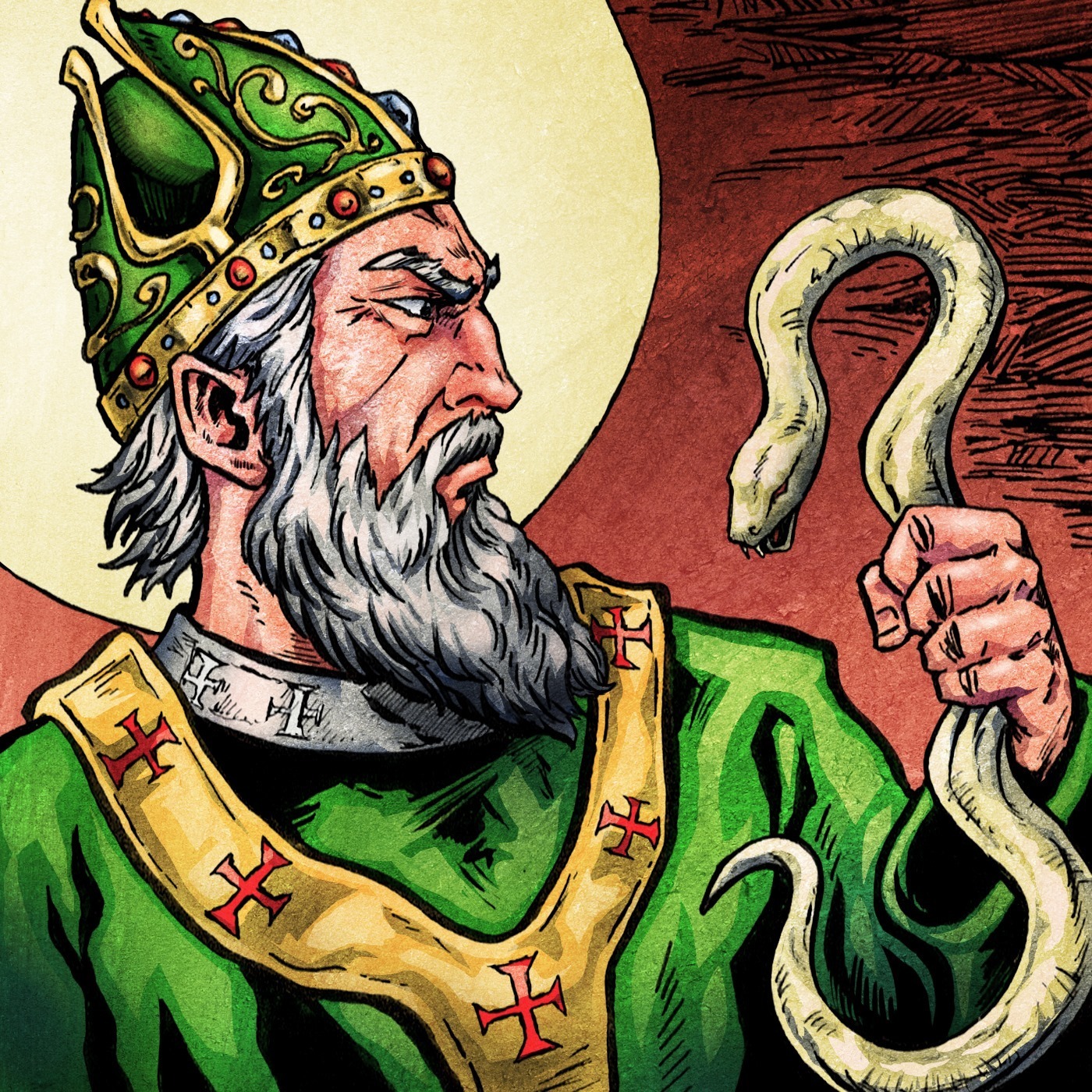
But this is kind of appropriate when you consider that Patrick, this enduring symbol of Irishness, was not himself Irish. And that's not the only surprising thing about the patron saint of the Emerald Isle. Now, like most saints, the life of Saint Patrick is embroidered with legend. He's credited not only with single-handedly converting all the Irish to Christianity, but also having magical duels with wizards and banishing all the snakes from Ireland. While much of this stuff is pretty unbelievable, that's just the start. Even some of the most basic facts about St. Patrick's life are up for debate. Some aren't even sure if St. Patrick was just one guy. Could there have been two Patricks? Let's find out today on Our Fake History. Episode number 128, Did St. Patrick Kill a Wizard?
Hello, and welcome to Our Fake History. My name is Sebastian Major, and this is the podcast that explores historical myths and tries to determine what's fact, what's fiction, and what is such a good story that it simply must be told. This week, we are exploring a figure that listeners have been suggesting almost since the podcast began. The patron saint of Ireland, St. Patrick. Now, why has it taken six seasons to get to Patrick?
Well, he's a seasonal figure. It would have been kind of ridiculous if I dropped my Santa Claus show at any other time than the lead up to Christmas. Well, St. Paddy is kind of the same deal. If you drop a show about St. Patrick too far from March 17th, it's like, what are you doing? In past years, I've often found myself in the midst of a three-part mega-series right around St. Patrick's Day, so the opportunity for a Patrick episode passed me by.
But this year, the stars aligned, and the time finally felt right for a St. Paddy show. So here we are. The other reason I've been hesitant to take on St. Patrick is because the lives of saints are almost too easy for this show. They are the low-hanging fruit of fake history. Every saint in the Christian pantheon has at least one amazing tale associated with them that can't be properly historically verified.
For some believers, the truth of these stories is just a matter of faith. And as I've said many times before on this show, the point of our fake history has never been to test the veracity of one faith tradition or another. Hagiographies, which is the fancy name for the books about the lives of saints, are read metaphorically by many modern believers. Even the word hagiography is sometimes used loosely as a synonym for favorable exaggeration. So if I ever got really lazy on this show, I could just start steadily working my way through the lives of the saints, and what do you know, we would find some fake history. But I do want you to keep that word in the back of your mind, hagiography, because I'm going to be using that a lot in this episode. So along the way, I've really tried to pick my saints carefully. I like to focus on those saints who either have truly amazing stories, like Olga of Kiev, or have cultural significance that is extended beyond the Christian religion, like Saint Nicholas.
Well, in this case, I think St. Patrick falls into both of those categories. Not only does St. Patrick have a handful of deeply entertaining stories associated with his life, in many ways, he has transcended Christianity. He's become synonymous with Irish identity. And Irish identity has proved to be amazingly elastic.
It's become a bit of a cliche that on St. Patrick's Day, everyone claims to be Irish, no matter how tendentious that claim may be. I mean, I've got one great-grandparent who was born in Ireland, and somehow I still feel like St. Patrick's Day is a celebration of my culture. And hey, I know that sounds crazy, but I know I'm not alone on that. The greatest irony in all of this is that St. Patrick's Day, the day where everyone claims to be Irish, is ostensibly celebrating someone who was not Irish. So, who was this guy then?
Why has he become such an enduring symbol of Irishness? If you don't know anything else about St. Patrick, then you probably know the tale that he drove the snakes out of Ireland, keeping the island reptile-free for the rest of history. Well, is there anything to that story? And what I really want to know is, did St. Patrick kill a wizard? Because, guys, he might have killed a wizard. Well, let's take a little tour through the life of St. Patrick, and we'll see what we can find out.
When you're dealing with a figure as ancient and as legendary as St. Patrick, the first thing you always need to ask is, did this guy even really exist? Remember, St. Patrick is said to have lived around the same time as King Arthur, so it's not out of the question that he could have been an entirely mythical figure.
But there is actually more historical evidence for the life of St. Patrick than there is for many people of that era, especially people living in Ireland and in the British Isles. We actually have two letters that are believed to be written by Patrick himself that survive to this day. One of these letters is the Confessio, or the Confession, and among other things, it's kind of a loose autobiography. The author of The Confessio claims to be Patricius, missionary to the Irish. Patricius being the Latin form for Patrick. And most experts find little reason to doubt that claim.
Now, the Confessio is an extremely helpful source for historical fact finders like yours truly. You see, details about St. Patrick's life tend to come from two sources. The Confessio, the other letter that he wrote, which is known as the Letter to Caroticus, or hagiographies written centuries after Patrick's death. So, the rule of thumb here is very simple. If there is an amazing story that appears in a hagiography, but doesn't turn up in the Confessio or the other letters, we can safely conclude that it didn't happen.
Or at least it didn't happen to the guy who wrote the Confessio. And we'll come back to why that's an important distinction a little later. According to Patrick's own writing, he was born sometime in the late 4th century. The year 373 is often given as Patrick's birth year, but there isn't much to substantiate that. Professor of Celtic Studies and Patrick biographer Philip Freeman gives a pretty wide window for Patrick's birth. He believes that Patrick could have been born at any point in the reign of the Roman Emperor Theodosius. That's from the years 347 all the way to 395. So, yeah, who knows? But according to the Confessio, Patrick was born in a place that he calls Bonaventa Bernia, which was somewhere in Roman Britain.
Now, there has been a ton of debate around where exactly this place was. Many think this place was somewhere in northeastern England, right near Hadrian's Wall at the northernmost extent of Roman power in Britain. However, others have argued that this place may have been in Wales or even Scotland. What's clear is that Patrick grew up in a culture that was a mash of Roman influences and traditional British elements. Take, for example, Patrick's name. He had both a British name and a Latin name. His British name was Mawin Suckat, which many have argued is a Welsh name. But he was also given the Latin name Patricius, which, as I said before, gets anglicized as Patrick. And I'm just going to keep using the name Patrick because that's the name we know.
But this name also gives us some clues about Patrick's family. The name Patricius is derived from the word patrician, which was the Roman aristocratic class. So this means that Patrick probably came from the upper crust of Romano-British society. And indeed, he tells us that he was descended from connected church people. In the Confessio, he writes, quote, My father was Calpurnius, a deacon of the church, and my grandfather was Podius, a priest, end quote.
So, he came from a long line of Christians, in a time and place where Christianity was still catching on. But even though his father and grandfather were involved in the early British church, Patrick admits in the Confessio that in his early years, he wasn't much of a believer. However, all of this changed when he was 13 years old. In that year, a group of Irish raiders swept into his village, carrying off as much movable wealth and as many people as they could reasonably sell into slavery. In this era, raids of this kind were exceptionally common. The western coast of Britain was constantly threatened by bands of raveners who ran a brisk human trafficking business back in Ireland. Boys Patrick Age were particularly valuable as slaves, as they were young enough to be easily dominated, while still old enough to be able to handle arduous physical labor. So, while Patrick may have grown up in the relative comfort of an upper-crust Roman villa, by the age of 13 he was living the hard existence of an agricultural slave in Ireland.
But in this period, he really found his religion. He tells us that he started praying more often. Eventually, he claims that he was praying to God every hour of the day. This experience of slavery clearly had a massive effect on the rest of Patrick's life. Not only would it give him a much deeper and more sincere faith, it would also give him an enduring empathy for the plight of enslaved people.
As Patrick himself would later write, That's quite a passage. Actually, all of Patrick's writing has the same tone. It's deeply humble and very humanistic in nature. In his writing, he doesn't come off as, well, a saint or some infallible perfect being. He seems like a regular guy who's very aware of his shortcomings. Take, for example, how he describes his poor education that resulted from the important formative years spent in slavery. In the Confessio, he would write, quote, I don't have much education compared to other people. I was not able to study both literature or theology year after year as they did. I write Latin as if it were a foreign language. Any reader can see what kind of an education I had, end quote.
Now, I love stuff like this, medieval sources that are somehow still super relatable. Now, part of that might have to do with Philip Freeman's very approachable translation of these letters. But still, there's nothing better than a saint going, guys, I'm not gonna lie, I suck at Latin. In the same way, Patrick doesn't really have many unexplainable moments in his confessio. He rarely speaks of miracles, especially the most flashy miracles that would eventually be attributed to him.
The only time he really speaks about divine intervention in his life has to do with his escape from slavery. After six years tending sheep and doing other menial tasks as a farm slave, Patrick tells us that he had a prophetic dream. In the dream, he claims that he heard the voice of God saying, quote, you have fasted well, soon you will be going home, end quote. Then, the next night, he claims that he heard the voice again, this time saying, quote, The voice went on to explain that some 200 miles away, at the seaside, he would find a ship that would bear him back across the Irish Sea to Britain. So, the next night, Patrick ran away from the master he had served for six years, and he headed in the direction that the voice had commanded. Sure enough, when he came to the designated seaside town, there was a ship.
With a little cajoling, Patrick was able to convince the captain to take him aboard and bear him back to Britain. According to Patrick, this was the big miracle of his life. No snakes, just a boat in the right place at the right time. The other moment of divine intervention described by Patrick came after his boat landed in Britain a few days later. In a strange turn of events that has confused historians ever since, Patrick doesn't describe the boat putting in at a port. Instead, for some unexplained reason, the boat heaved ashore in the middle of nowhere. Patrick tells us that he and the rest of the crew had to wander in the wilderness for 28 days before coming to an inhabited place.
It was during this time in the wilderness that Patrick describes another miracle. The group was starving, and Patrick tells us that the captain turned to him and said, quote, Well, Christian, what are you going to do? You say this god of yours is great and powerful. Why don't you pray to him for us? We're dying of starvation. I don't think we'll ever see another living soul again, end quote. The teenage Patrick assured his crewmates that God would provide, and he set to praying. Just then, miraculously, a family of wild pigs wandered on by.
The pigs provided more than enough food for the rest of their journey. So, what would you say is the best word for these kinds of miracles? Modest miracles? Realistic miracles? I'm not sure. Both the convenient ship and the handy pigs are things that I can totally believe happened. Now, whether or not you think they occurred because of divine intervention, that's a matter of personal faith. But I don't have to push my understanding of how physics or the laws of nature work in order to accept these stories. St. Patrick just attributes his good luck to his faith in God, like a lot of religious people do.
Anyway, we're told that eventually Patrick made it home and reunited with a family who had assumed he was dead. It was a joyous reunion, but Patrick was a changed man with a new mission in life, to serve the God he believed had delivered him from slavery. Patrick wouldn't be home for long before his new mission would be given an even greater specificity by yet another prophetic dream. Patrick tells us that in the dream, end quote.
Patrick interpreted this dream as meaning that God and the Irish people themselves wanted him to return to their island and bring his religion with them. Now, this is where the Patrick story starts to get kind of hazy. Philip Freeman has even gone so far as to call this period Patrick's lost years. The time between Patrick's emancipation from slavery until his ultimate return to Ireland as a missionary is basically missing from the sources. But in that time, somehow, he became a bishop.
It's believed that he joined the priesthood, traveled to France, and studied in the monasteries there, before steadily working his way through the ranks of the Church of Late Antiquity. But when he finally reappears in Ireland, boom, he's a bishop, and apparently he now has the blessing of the Church to go and convert the Irish. Honestly, it's kind of like how in Return of the Jedi, Luke just appears at Jabba's palace and, you know, he's a full-fledged Jedi. And it's like, how did that happen? Last I checked, you just spent like one weekend with Yoda? Anyway, you're left to assume that a lot of important training went down between episodes. Well, the life of St. Patrick is no different.
Although there is one fun story that appears in one of the hagiographies, that during this period, he traveled all the way to Rome, and along the way, he found the staff of Jesus. Yeah, like the staff that Jesus apparently carried around in the Holy Land. We're told that in the early 400s, some kids in Italy just happened to have this staff, and they had been commanded in a dream to give it to a stranger named Patrick. Now... This is pure legend. Patrick himself never claims that he had the staff of Jesus in any of his writings. But here we see the birth of the legendary Patrick, equipped with a powerful holy weapon ready to take on the task of converting the pagan Irish. This story of the journey to Rome culminates with the Pope himself sending Patrick back to Ireland. However, outside of the hagiographies, there is no evidence that this meeting ever took place.
Some academics have guessed that this story was a later invention used by Catholic authorities to insist that the Church of Ireland had always operated under the auspices of Rome. You see, there's some evidence to suggest that in the early medieval period, the Irish Church was somewhat independent. But the theory goes that this later hagiographic tradition that the Pope sent Patrick was cooked up to purposefully play down this early independent period. Now, every significant date in St. Patrick's life is hotly debated, and the year that he returned to Ireland is no different. You see, Patrick is often presented as the first and only missionary to the Irish. In legend, he converts the island more or less single-handedly, but the historical record is a bit more complicated. As it turns out, there was probably a Christian community in Ireland before Patrick's arrival, and there was definitely a bishop who predated Patrick.
This was a man named Palladius. A fairly reliable chronicle of the era records that this Palladius was sent by Pope Celestine I to be the first bishop to the Irish Christians in the year 431. Now, why is this such a big deal? Well, 431 is exactly when tradition states that Patrick turned up in Ireland. So, what's going on here?
One tradition has it that Palladius tried and failed to convert the Irish. The 11th century hagiographer Jocelyn of Furnace even claims that this spawned an Irish proverb that goes, quote, not to Palladius, but to Patrick, the Lord vouchsafed the conversion of Ireland, end quote. Man, that proverb does not roll off the tongue. But academic analysis has suggested that Palladius was actually a far more successful and influential figure in Irish history than that proverb would have us believe. Now, this is where the theories get cool. Some think that Pallidius and Patrick were actually the same person. Now, one of the most influential thinkers on this question was an Irish academic named T.F. O'Reilly. In 1942, he proposed something known as the Two Patricks Theory.
That is that there were two important early bishops in Ireland. One, Palladius, who served from 432 to 461 AD, and another, Patrick, who served from 462 to 490. He believed that it was that second bishop who was probably the author of the Confessio. In O'Reilly's estimation, the careers of both of these men were eventually attributed to a single saintly figure. But, he thinks, there were two Patricks.
By this, he meant that Palladius did some of the things we normally attribute to St. Patrick, and Palladius' successor, the author of the Confessio, did some other things that we attribute to the life of St. Patrick. So, together, they are the big St. Patrick. There were two Patricks.
Now, this is a super interesting theory, but it's worth noting that it's not universally accepted among experts in Irish history. But whether or not there were two Patricks, the fact that Palladius clearly predates Patrick is significant. This means that there were already Christians in Ireland before the author of the Confessio got there. Nevertheless, this return to Ireland is really where the Patrick story gets wild. You see, up to this point, the hagiographers don't really do much to contradict what Patrick himself had written in the Confessio. But as soon as Patrick lands in Ireland and he starts the work of converting people, well, that's when the tales become considerably more far-fetched. This is where the sources really start to depart.
After Patrick arrived in Ireland, he either spent the next 30 years steadily convincing Irish kings and peasants alike to embrace Christianity through impassioned sermons and works of charity, or he spent those years confronting demons, fending off snakes, magically growing trees, and fighting wizards. So let's take a quick break, and when we come back, we'll get into some of the best-known and the most fun stories about St. Patrick. When modern scholars study the life of St. Patrick, many are struck by how different he appears in the various sources. In the stuff attributed to Patrick himself, he comes across as humble, sincere, and even self-deprecating at times. He constantly expresses a real love and care for humanity.
His letter to Caroticus, that's the letter that survived that isn't the Confessio, is essentially an impassioned plea to a British king to release a group of Irish slaves. And while Patrick can certainly well up with righteous indignation, his arguments are always grounded in the more humanistic side of Christian teaching. But this contrasts sharply with the figure that appears in the hagiographies produced in the medieval period. The saint in those sources is sometimes called the Militant Patrick. This is a Patrick who is kicking ass and taking names in the name of Christ. In the hagiographies, the conversion of Ireland is presented as nothing less than a spiritual war, and St. Patrick is presented kind of like a medieval superhero.
This is perhaps best exemplified by my favorite part of the St. Patrick story, and that is his duels with wizards. I know, I was just as surprised when I found out about this too. So, let's break this down. According to the hagiographic tradition, when Patrick returned to Ireland as a missionary, sent by the Pope, he initially faced stiff resistance from the native Irish. He was often attacked or forced out of various ports where he landed.
In fact, there are still places along the eastern Irish coast that claim to be spots where Patrick hid out after he'd been attacked. But, slowly but surely, he started gaining converts. It was in this part of his ministry that St. Patrick allegedly picked a shamrock, a three-leaved clover, and used it as a teaching aid for his Irish converts. St. Patrick apparently explained that the shamrock has three leaves, and so too does God have three aspects, the Father, the Son, and the Holy Ghost. The shamrock explains the Trinity.
But this story is actually a very late addition to the St. Patrick legend. Not only does it not appear in any of Patrick's writings, but it doesn't even appear in the medieval hagiographies. The story only turns up in writing for the first time in the 17th century. So yeah, the Shamrock Trinity lesson is almost certainly a historical myth.
Anyway, while converting average folks was a good start, Patrick's grand strategy was to convert the Irish kings. And yes, that is kings plural. At the time, there wasn't just one paramount king of Ireland. Instead, Ireland was a patchwork of small independent kingdoms. The thinking was that if these kings could be converted, their subjects would follow suit. Now, in the hagiographies, these conversions often take place after violent confrontations between Patrick and the pagan priests who acted as the traditional advisors to these kings.
Now, depending on the source, these priests are sometimes identified as druids, sometimes as magicians, and sometimes as wizards. So, should we actually be calling these guys druids? Well, if you've been listening to this show for a while, then you know this isn't the first time that the druids have come up. As you might remember from our series on Boudicca, the druids were a class of priests, scholars, and scribes that existed in many places in the Celtic world, but were particularly associated with pre-Roman Britain. Now, as I've said before, but it's worth repeating now, Celtic society was not a monolith. There were almost as many differences as there were similarities between different quote-unquote Celtic societies. The Celtic peoples you found in Britain were quite different from the Celtic peoples you found in Spain. The Celtic peoples you found in Gaul were quite different from the Celtic peoples you found in Ireland. This has made some scholars question whether or not the term Celtic really has much meaning at all.
The point is that while Irish Celtic culture was certainly similar to British Celtic culture, the two were not identical. And so, it may not be entirely accurate to call the Irish pagan high priests Druids, even though they get that name put on them in a variety of sources. They were certainly Druid-ish, but were they actually bonafide Druids? Well, different scholars have different opinions on this. But to be honest, St. Patrick's hagiographies are not the best place to learn about the Druids, or any Irish pagans for that matter. They're reduced to simplistic caricatures. They are the stock villains of this conversion narrative, and they bear little resemblance to the real Druids or the Druid-like high priests of Ireland. They're presented simply as evildoers who are there to be overcome by the medieval superhero St. Patrick.
So, I'm going to keep calling these characters wizards. Because, firstly, it's fun. And secondly, I don't want people getting the idea that these caricatures at all represent the real religious leaders of pre-Christian Ireland. Okay, so with that said, let's get into the fun stuff. In the hagiographies, there are a number of descriptions of duels with wizards. That is, St. Patrick vanquishing magic-wielding pagans. But the best story has to do with the conversion of a king named King Leary.
Now, I know I just told you that Ireland was made up of a patchwork of independent kingdoms, but in tradition, Leary was considered the High King. Now, historians debate over how much power he actually had, but in this story, King Leary was as close as you got to top dog in Ireland at that time. So the story goes that King Leary had been warned about Patrick's coming to Ireland by his wizard advisors. They prophesied that Patrick's message would sweep across the island and would lead to the king's downfall. And sure enough, it wouldn't be long before King Leary found St. Patrick on his doorstep, causing all sorts of trouble. The initial issue was over competing sacred fires, and this is a little convoluted, but in a nutshell, only the king was allowed to have a sacred bonfire. But Patrick lit a bigger, brighter fire to celebrate Easter right across the valley from the king's fire.
When King Leary saw St. Patrick's fire, it was on, so he rounded up a crew of his best warriors and wizards and headed out to confront the saint. During this first confrontation, we're told that one of the king's wizards, a man named Lockru, lost it as soon as he saw St. Patrick and started blaspheming God using the worst language available to him. Now, this greatly offended Patrick, so he prayed to God that the Lord might smite this blasphemer.
And God obliged. We're told that Law Crew was lifted into the air by an invisible force and then had his head dashed against a rock. He died instantly. So, yeah, St. Patrick killed a wizard. Or at least, there's a story in the hagiographies where Patrick asked God to kill a wizard, and God hooked him up.
But this was just the start. After this display of God's power, the rattled King Leary retreated back to his castle. He then sent an invitation to Patrick, asking him to come to dinner. The king claimed that he wished to make peace and hear the missionary's message. So, of course, Patrick agreed to join him. But the king was secretly plotting to kill Patrick as soon as he had him in his grasp. So, the wine at the meal was poisoned.
But when Patrick got to his seat on that fateful night, he sensed something was amiss. So he said a prayer over his meal, and miraculously, the poison was removed. This enraged one of King Leary's wizards who had personally poisoned that wine. So right then and there, the wizard challenged St. Patrick to a magical duel to prove once and for all who had the most powerful gods.
The wizard challenged Patrick to demonstrate the power of his God. But Patrick said, that's not how it works. And like Christ during his temptation in the New Testament, St. Patrick said it was wrong to tempt God like that. So the wizard was all like, fine, if you're not going to do anything, check this out. And with a wave of his hand, he made a fresh layer of snow fall all around the dining hall. St. Patrick said, that's very impressive. You can make the people cold, but can you warm them up?
The wizard admitted that he could not. So St. Patrick goes, that's the problem with you guys. All you can do is evil. You can bring the cold, but you can't give people warmth. Then Patrick prayed, and the room was filled with a comfortable warm glow, and the snow melted away. Everyone was warm again. The wizard then cast another spell, filling the entire room with a dark cloud. But Patrick once again was unimpressed. Sure, you can make darkness, he said, but can you give the people light?
So Patrick prayed, and a light filled the room and eradicated the dark. Eventually, the contest came to its head, with both men consenting to being placed inside of a burning hut and seeing who survived. Of course, Patrick was saved by God, and the wizard was burnt to a crisp. In a final desperate effort, King Leary commanded his warriors to attack Patrick, but God simply opened up a hole in the earth and swallowed them into the abyss. After all of this, King Leary finally threw himself at Patrick's feet and repented his wicked ways. Now, why isn't everyone talking about this all the time? How is it that St. Patrick's wizard fights are an obscure part of this story? At every St. Patrick's Day parade, there should be a float showing St. Patrick fighting a wizard. This is a huge missed opportunity, and shame on all of us for not insisting on this earlier.
Okay, so perhaps it goes without saying that the veracity of this story is highly suspect. Firstly, Patrick says nothing about these fights in his autobiographical Confessio. And leaving out a wizard duel kind of seems like an oversight. Second, this scene is very reminiscent to the story in the book of Exodus when Moses takes on Pharaoh's magicians. In the hagiography by Jocelyn of Furness, the author even compares King Leary to the biblical Pharaoh, writing, quote, End quote.
It seems clear that the structure of this story was cribbed from that biblical source. And here in this hagiography, the author is basically telegraphing exactly what that source was. So as much as the wizard duels are awesome, they probably never happened. But I'm sure many of you are asking, Sebastian, what about those snakes? Well, the most often repeated legend about St. Patrick, as most of you know, was that he drove the snakes out of Ireland. So we have to ask, is there anything to that story?
Well, this one is interesting, because when you actually look at what's written in the hagiographies, you very quickly realize that snakes are just a small part of the story. The snake story actually comes near the end of the hagiographies. This moment is presented as the coup de grace in the conversion of Ireland. After years of fighting wizards, converting kings, and ministering to the meek, we're told that Patrick's mission in Ireland had almost been completed. But despite the saints' best efforts, the island was then beset by its greatest challenge yet, a three-fold plague.
Jocelyn of Furness describes it like this, quote, a swarm of poisonous creatures whereof the number could not be counted, a great concourse of demons visibly appearing, and a multitude of evildoers and magicians, and these venomous and monstrous creatures rising out of the earth and out of the sea so prevailed over the whole island that they not only wounded men and animals with their deadly sting, but slayed them with cruel bitings, end quote. So, in the Hagiographies, St. Patrick isn't just rounding up snakes. He's facing a three-pronged demonic attack, of which snakes are just a small part. He's got magicians, demons, and all sorts of other venomous creatures to contend with. In the Hagiographies, this is the final boss of Irish conversion. So, Patrick heads to a mountain, now known as Crow Patrick in County Mayo.
There, he fasts for 40 days and 40 nights, because as fans of the Bible know, that's how long it takes to do anything. And at the end of this period of purification, through the power of prayer, Patrick draws all the evil in Ireland towards him on that mountaintop. All the demons, all the magicians, and yes, all the snakes. And then we're told that, quote, By the power of his word, he drove the whole pestilent swarm from the precipice of the mountain headlong into the ocean. O eminent sign! O illustrious miracle! End quote. Now, I could tell you that there is no fossil evidence that snakes ever existed in Ireland. Because there is no fossil evidence that snakes ever existed in Ireland. And I could tell you that there is no references to snakes on the island before the time of Patrick in any written source.
I could even point you to pre-Patrick sources that actually note about how interesting it is that Ireland has no snakes. All the scientific evidence shows us that Ireland has never in its history had any indigenous snake species. But in a way, that misses the point. The story is barely about snakes. I'm actually kind of amazed that this tale about a man driving a horde of demons and magicians into the ocean has come down to us as St. Patrick got rid of the snakes.
The hagiographies describe a spiritual battle rivaling the book of Revelation, and what people took from that was, great, no more snakes. Like, if I'm going to make a point of telling you that there are no snake fossils in Ireland, I might as well tell you that there aren't any demon fossils in Ireland either, because that's what the story is really about. And once again, this tale of spiritual warfare, this moment when Patrick drove a three-fold plague of evil into the ocean, it's not mentioned in the Confessio. So either it didn't happen, or St. Patrick just thought that that time when he summoned those pigs through prayer was just a way more impressive miracle. So, I'm just baffled that this story got boiled down to an act of countrywide pest control. What an understatement.
Ultimately, I've been convinced that St. Patrick is one of Christianity's most misunderstood saints. This is a weird case where both the legend and the reality of Patrick have been misremembered. If we're going to celebrate Patrick's legend, then we really need to highlight the cool stuff. Wizard duels, threefold plagues, God opening the earth and swallowing warriors. How is that stuff obscure? And snakes and clovers are ubiquitous. I mean, if we're going to embrace the fairy tale version of Patrick, let's at least go all in for the good fairy tale.
However, in my research, I couldn't help but feel charmed by the historical Patrick, or whoever the author of the Confessio really was. Part of that may have been due to the very approachable translation done by Philip Freeman I mentioned earlier. But Patrick's sincerity and humanity really do come through in those pages. So, while Patrick never actually commanded it on his deathbed, this March 17th, I think I will have a little toast to St. Paddy. The real guy. The human. The person who wrote so eloquently about his care for his fellow man.
And if I'm feeling saucy, maybe I'll even pour one out for the Vanquished Wizards. Okay, that's all for this week. Join us again in two weeks' time when we will look at another historical myth. Before we go this week, I would like to give a shout-out to the following people. Big ups to Emily Paul, to Stacey Ford, to Ron Salazar, to Sam Delve, to Tanner, to Gary Lenz.
to Ken Jack, to Carl Keyes, and to Justin Old. All of these people have decided to pledge at $5 or more every month on Patreon, so you know what that means. You are beautiful human beings. Thank you, thank you, thank you for your support. Thank you to everyone supporting at all levels on Patreon. Thank you to those who give one-off donations through the website at ourfakehistory.com. Right now on Patreon, we've got all sorts of amazing extras. So if you want to get access to that stuff, go to patreon.com slash ourfakehistory and see if there's a level of support that works for you. You can also buy merch. You can go to ourfakehistory.com and follow the links to TeePublic or go to tpublic.com slash stores slash our-fake-history.
I love hearing from you guys, so if you want to get in touch, please send me an email at ourfakehistory at gmail.com. Hit me up on Twitter at ourfakehistory. Find me on Instagram at ourfakehistory. Or hit me up on Facebook. That's facebook.com slash ourfakehistory. As always, the theme music for the show comes to us from Dirty Church. You can check out Dirty Church at dirtychurch.bandcamp.com. And all the other music you heard on the show today was written and recorded by me. My name is Sebastian Major, and remember, just because it didn't happen doesn't mean it isn't real.
This message comes from Viking, committed to exploring the world in comfort. Discover the heart of Europe by river on an elegant Viking longship with thoughtful service, destination-focused dining, and cultural enrichment on board and on shore. And every Viking voyage is all-inclusive with no children and no casinos. Learn more at viking.com.