
Welcome to the Movement Movement, the podcast for people who want the truth about having a healthy, happy, strong body. Remember, your body was meant to move. Now here's your host, Stephen Sashin. When you get older, you get slower, or do you.
That's what we're going to find out on today's episode of the Movement, Movement, the podcast for people who want to know the truth about how to have a happy, healthy, strong body starting with a beat first, because we are your foundation, where we get rid of the mythology that probably end in sometimes the lies about what it takes to walk, to run, to hike, to dig, to yoga, to cross it, whatever it is you like to do, enjoy it. I'm Stephen Sashin, the host for the Movement Movement podcast. You may already know how to find us. Go to www.jointhemovementmovement.com.
That's where you can find all the places that you can interact with us. That's where you can find out where you can, of course, share and subscribe and like and review and all those things that you know how to do. I'm not going to tell you all about that. We like to get started.
Actually, before we get started, I want to introduce our guest, and then we're going to do something that I'm going to have him participate in. Our guest is Keith Bateman. Keith, I'm not going to give an intro about who you want to do, because I will never do it as well or as interestingly as you. Why don't you tell human beings, who the hell are you?
What are you doing here? Well, I'm a technique coach these days. I transform people's technique. Is the people who learn things that they're doing that you're coaching technique on?
No, basically a complete change. A complete rebuild. A complete change. That's right.
Yes, I'm trying to change it to what it should be for any human with two legs on the planet. If you notice that all the top runners in the past have all looked the same, they've got zonabats, mofara, they all basically have the same running action, and that's what we're getting for, the most efficient running action for each individual. Beautiful. For those of you listening or watching, you might notice that Keith has a distinctive accent clearly from New Jersey or New York, I'm guessing, correct?
Okay, so I'm a bit of a mongrel. I was born in Watford, which is near London, I was in England. I was there for 21 years and I was in Scotland for 20 years. Now I've been in Australia for 19, but I'm not moving from here.
Well, I have a friend who was a Brit who, when he got to Australia for the first time, he was going through customs and they asked the standard questions. They say, you know, why are you here? He said, I'm here on business. Where are you going?
He says, where are they going? And one of the questions is, you know, do you have a criminal record? And he says, oh, shit, you still need one to get in. Exactly.
Exactly. So before we jump into just our conversation, one of the things that I like to do at the beginning of the podcast is a movement, since this is the movement movement. And this is going to be a really simple one for those of you who are listening and watching. One of the most important things that you can do is have arch strength and one of the easiest ways to building arch strength is just by using them with a little isometric contraction.
You can do anywhere I do this when I'm cooking or doing the dishes or when I'm sitting at a desk, usually I'm standing at a desk. Actually, I do it pretty often when I'm standing at a desk, too. And it couldn't be easier. Just take your feet and just without trying to relax, every toe you have as much as you can except your big toe and press your big toe into the ground.
And if you do this really strong, you will probably get a cramp in your arch. So don't do that back off a little bit. Just get that big toe pressed in and see if you can relax the other toe. So you're really just engaging the arch, isometric thing.
Do it for like three to four seconds and then relax and then do it again. Just kind of a little press with your big toe into the ground to engage that arch and really the other way around. If you engage your arch, you are pressing your toe into the ground. So you want to think about it from that angle and again, just relax and do this once or twice more, one more.
Just press that big toe into the ground and relax. Great way just to do a little isometric thing you can do anywhere you go, everywhere you are to build some strength in your foot. So back to Keith for the win. I have to say I haven't done that one before it's very good.
Thanks. Yeah, it's really easy and literally you can do it pretty much everywhere. Yeah, very simple. Yes.
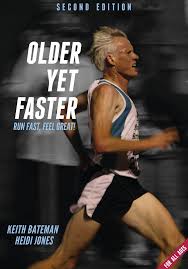
We may have done that one, but I have to. Yeah. So at the top of the podcast, I said, you know, when you get older, you get slower and it's maybe not. And that's because Keith, you are the author of a book called Older Yet Faster.
And this is now the second version. Second edition, yes. I have to say it's Heidi Jones, my wife as well. So we must have to say that.
And sadly, Heidi is not joining us because she's not feeling well today. Otherwise we'd have her in on this as well. So Heidi and Keith are responsible for this book, which is it's not just for older athletes and not just about getting faster or not getting. Tell more about how you frame the book.
It's for people who are here over this year and they will ask you. Fascinating. Well, I've never got older year after year. It was faster.
Kind of hovered right around 39 for a while. Then she got 10 years older and she hovered at 49 for a while. Now she has Alzheimer's. So she thinks she's 30 again.
It's awesome. Well, I think I'm still 26, but still. So the subtype of the book, obviously, have a copy here, you know, is the secrets are running fast and injury free, which is obviously you've got to be injury free first. And so Heidi has a big input here.
Most people have weakened feet as you will go because they've had chunky shoes on and they're just not using them. So the first thing we try to do is spend six weeks if possible on doing a foot program that Heidi are using her dietary business. And that's all on video as well. So you really want to get your feet strong first if you haven't been walking around Bethany.
And then we have a very simple set of lessons that I put together over the last 10 or 12 years to basically really re-educate the brain, make you think differently about how you run. So you can perform a different action. And once you start performing that different action, you build up muscles to support it, which generally tend to be new muscles like calf muscles, glutes, lower back and the core muscles. And from it's a very quick change to change your action, basically.
And then it takes time for the muscles tenders and ligaments to catch up. So you started with something that has been an argument that I've had with Irene Davis. Not really an argument, but Irene Davis is a researcher at Harvard. And she's really one of the biggest promoters of research for about natural movement.
And I mean, similarly, when you work with her, you start with a foot strengthening program for a number of weeks, and then a bunch of walking before you get in running. And I say argument with big air quotes. I mean, we just get along swimmingly and this is just a fun debate we have. I say that in lieu of doing foot strengthening, which is fine, but there's no amount of strengthening or walking that you can do that is actually the same as running.
It's always healthy. It's very specific. That's right. Yeah.
It's like, take a really, really short run, like 20 seconds. And then when that feels comfortable, you can add it to there. And I think fundamentally, it's really the same idea just from a different skill. We work exactly the same way.
My clients really start off with maybe two kilometers at the most. They might be running 20 or 30, but now they go down to two. And then they wait and see what it's like the day after. If it's all they stop, they stop for two days, maybe very slow at the beginning.
But then it rapidly increases after they get to about five or six kilometers. Yeah. I literally, for some of these people, I literally, you know, 2K would be way too far. I mean, I'm talking like 200 meters.
I want to see people, because there's some people who they've been overstrolling and heel striking for so long. But frankly, at the end of, you know, 200 meters, they know that something is awry. And they're going to have to wait until the next day to figure that one out or day after to figure that one out. And then I'm going to come and I've also seen one.
This one amazing, I'm curious what your thought is. I've been on tracks where I see someone training or warming up like this happened a couple of years ago, a guy in a pair of five fingers and I'm watching him warm up really slowly. And his form look great was nice and quiet on the track. Everything was nice.
And then he started going up to speed and I could tell him he was going up to speed because I could hear him just like slam, slam, slam. I'm just curious what you've seen when you've got people who are coming to what you're doing in that same regard or if you've seen something similar. Well, it's basically the same for everybody whether they're a runner, I've had some customers who were running 30 minutes to 10K already. And I do exactly the same thing with them all because the movements are the same.
It's just a matter of refinement. So that's slapping noise. I've never known it not to be somebody just touching but they're here first and then the foot slapping down. That's really so they are lifting or trying to place their foot or that they somehow they are advancing their foot, lifting the knee or lifting the foot and trying to place it.
If you lift your foot, you're not lifting your body. There were two work against each other. So please say more about that. Describe what you've seen.
You're basically a good runner who wants to lift the body. They want the whole body to come off the ground. Got it. Two ways of doing that.
One is to push off your toes which would be an acceleration. The other way is to try to land as near as possible to vertically aligned. And then your body becomes a spring and it springs your ground. So you get free energy almost off the ground.
So a good runner will have a lot of the spring effects and very little of the push effect. You and I have actually gotten into also arguments as well where I describe something like that where you want to initiate your foot coming off the ground from your hip rather than your calf. In other words, you're not pushing off the ground with your foot. But think about the image that I'd like to give as I said, imagine that you stepped on a B.
You wouldn't want to get off the B by pushing down harder with your foot because that would drive this thing or further in. You want to lift your foot off the ground. It's almost a reflexive thing for getting off the ground. Which if you're a good spring, that actually has effect.
Yeah. I don't totally agree because we deliberately say that people do not lift your feet at all because a good runner doesn't lift their feet in the same way as they don't engage their core or engage their glutes. They're not actually thinking about it. What's happening is they're getting a natural bounce off the ground and the hips go off the ground and the feet follow.
If you put the point of your head goes forwards so you lose that springy position to come more bent. If you lift your foot in front of you, then you sit back and you lose that beautiful upright position. We find with thousands of clients that just something simple like leave your foot on the ground a bit longer and go past it and it will come off the ground on its own. I think if we looked at people who are doing what each of us is describing, it would look not only look the same but an EMG would show that the muscle activation is the same.
Yes. It's very difficult to be totally precise and let everybody interpret what you're saying in the same way. Somebody asked me they said, can you make an app where it just gives us the right cue? I went, no.
Sometimes you get the same cue to someone on day one. It has no meaning on day two. It's the perfect cue. Yeah.
What we've done actually, we've got lessons one, two and three. We've started moving. Lesson four is a separate drill. It comes with everything moving.
Lesson five is how to start a run. It actually listens one, two and three to get up. You start moving. There's a couple of cues in there that you can try.
One of them is just a 360 degree spin. If you do that successfully and you come out of it, you're running, you're near vertical when you learn and you're aligned when you take off. That's a good one. You mean just jump up and rotate 360.
Don't even jump up. Just turn along and just kick your momentum and gain. It's obviously a slow spin. You get to a spin.
Brilliant. Four or five of the places after that and then a spin the other way. If you can't do it smoothly, it means you're throwing your leg or something like an ice skate out in front of you. It's a very simple subject.
Do you have videos on this one? Yes, all of it. Everything's on video. Yep.
You're definitely going to want to see that. If you do it, they'll spin better one way than the other. Everybody does. Yes, that's right.
If you're doing a series up and you're alternated, so you don't get busy. Well, there's the dizzy thing, but I was finding it really funny watching just the difference between doing something one way or another. I did something, I think on the podcast last week, I can't remember where it was just like Cross Your Arms and then Cross it by the way. Yes.
Yes. I can't remember which one is the way that I normally do it. It took a while for that. Yeah.
On that note, we say in the book asymmetry is normal. Everybody has different legs, different size hands, feet. It's all, so let's not try to make it perfect. Let's just go with what we've got.
I have a sign that I wrote that I kept on my bulletin board now for probably 35 years. It says distrust symmetry. Yes. Very good.
We think very much alike. I'm just going to go on to it. We've got Heidi's strengthening program. We've actually got a rehab program as well for people who come in, do get injured.
You know, you can't do too much, because you know, calf muscle problems or even tendon problems. But the, as far as the technique is concerned and going back to your point about different things work for different people, we've got about 10 different tricks on the run tricks. We only need one of them, but we get people to try them all and see which one works best. So it's a matter of, do you give it a go?
If that one works great, stick with it, that's all you need. So yeah, on your point about different things work for different people. Different times or the same thing person different. Yeah.
And can you give a couple examples of what those are? Okay. Well, the first one we call the pendulum. Okay.
And it's basically, hopefully, you've got a bad foot while you're running along and you deliberately lean back. You feel the pressure on the heel. You want to maintain some speed when you do that. You deliberately tilt the body forward.
So you feel the pressure on the forefoot and you will accelerate and then you very gradually, only gradually come to find the middle balance position. Then you repeat it. And this time you lean back a little bit less than before and a little bit less forwards and then you repeat it before and upright and you keep repeating it until the person running next to you can hardly see you moving and all your feeling is the pressure towards the heel, towards the ball of the foot and then on both. So the focus of the book is to get a balanced landing.
That sounds a bit vague, but if your foot is pressing on the ground behind you, you are accelerating. Or you could possibly be falling over, but you'll be accelerating. If you put the pressing on the ground in front of you, which it has to, there's some degree, then you are breaking. And what you're looking for at constant speed running is as near as possible in the middle.
We're not being prescriptive exactly what angle it is. It's still not formula. There's a guy Chris Powers, I think is the USC or UCLA. I can't remember somewhere in Southern California.
He's got a whole idea about the body leaning forward just a little bit. So you're getting a little bit of a hip angle, which engages the glutes a little bit more, but that's sort of independent. It makes it a small difference. Sometimes I see people who are running.
It's actually what you're saying is actually I give a better example or one that I think is more relevant. There's times where I'm working with people where they're way over striding. There's putting on the brakes with every step and they just can't feel that. And one thing I'll do with them is I'll have them stand upright and I put my hands on their shoulders, and then I'll run backwards as they're running forwards where their feet can't catch up with them.
Some points are down the way. Because what you're describing is something I love of just exaggerating a little bit so you get the feedbacks so you know what you're doing. Exactly, it's all about feel. Yeah, because we're so used to what we're doing.
It feels normal and like a little change we'll feel like you're making a big change when you're probably not even getting where you need to go yet. That's right. Heidi's facing her section for buttometrists about, I think it's just got a buttometrist section at the back which is controversial, of course. She says about your perception of upright is different if you were shooting.
I don't know if I've told you about this. I had this undergraduate research on cognitive aspects of motor scale acquisition. In part from that, I developed this idea. I like to say, the simplest instructions for running barefoot is find a nice smooth, hard surface.
Take off your shoes, go for a very short run. If it hurts, do something different typing at a good time. Some people, their brain map is so de-differentiated. Their brain just literally doesn't know they have feet at the end of their legs for all practical purposes.
Because they haven't been getting the brain stimulation for so long. They can't tell it hurts. Some people, they can tell it hurts, but they have, like you were describing bad proprioceptive skills, they think vertical is something different it is. And they need video feedback because they just won't believe you until you show them what reality is versus the way they think it is because they're so used to it.
And then the next group of people, they have good proprioceptive skills. They need a good cue. They shorten the learning cycle. And then the last group, their naturals.
And the problem they have is they have so much fun that they get tired because they do too much and revert to one of those previous levels. So you maybe think of a question that I'm really curious about. I'm going to Europe next week. And there's a really interesting difference between Europe and America.
In America, people will walk up to me and go, oh, is this about barefoot or minimalist with a kind of scowl on their face? Because they have the idea that there's something inherently wrong with it. In Europe, they walk up the other way around. I was like, oh my God, are your shoes minimalist or barefoot?
Because they believe in this idea of natural movement. Where does Australia fit into that spectrum? Yeah, probably somewhere between the two. I think it's just when I walk around here, we live by the beach.
But when I walk around here with shoes on, people stop in the street and say, oh, you've got shoes on today. I have to say. Every time. Every time.
And I'm only 800 meters, 800 yards from the shots. I had that in a Costco where they stopped me and said, well, everything okay? I said, why? Because you're wearing shoes.
I'm normally in restaurants and gas stations and everywhere barefoot. But yeah, it certainly makes people think. I mean, if I go and do one local, we have a park front, see, I know you have a few now in America, but 5k big ones. A lot of people are running.
But you turn up and you don't put your shoes on. I was in Wales with Heidi at the year before and Heidi was sitting somewhere back in the field in the middle there and I was out the front and I was doing some strides in that. And somebody said, you see that grey? Whitehead guy out the front?
I mean, no shoes. I'm crazy. When I ran that one in 1712 and so. So.
So. The lines I have in the video I made was shit runners say two barefoot runners. And so it's the guy saying, hey, you can't really run like that. Hey, wait, wait, wait.
That's exactly right. Yes. That's the way to do it. Yeah.
I mean, I'm not going to go full speed barefoot on a modest track surface. I can go anything up to about 60% of full speed and people look at me like I'm crazy. But I'm doing it. I mean, arguing with reality that's right in front of your face.
You would say that the general perception just among normal human beings is not either necessarily very pro or very anti they don't come in with some big preconception. Oh, some people do. Some people too. We've got a friend who was in orthotics of 35 years and now we've rebuilt him injured for decades.
And we've rebuilt him. It might even be really good at that too. He's taken three years. He is running like a professional 800 meter, 1500 meter runner.
He is looking super. He's been very cautious at the moment. But once he gets back racing, he's going to be around about 32 per 10k maybe. Nice.
But his coach or his previous coach phoned him up and said, oh, don't stop that money. Stupid barefoot running that won't help you at all. Which watch me ignore that. What's so ironic about this isn't I know Australia and New Zealand are two different countries.
But of course, Arthur Lydiard, one of the most famous running coaches of all time, most successful coaches of all time, he had people running mostly barefoot or in shoes that he made. They were super thin, so they were actually a lot like ours. That's why we're a lot of Lydiard runners who like what we're doing. I mean, you know, it's incredible that there was that influence and people just it's seemingly gone from their minds.
And it's just that they just have no memory of what the impact was. Yeah, that's right. I do all my barefoot or in the thinnest of thin shoes. Yeah.
You alluded something a minute ago that I'd love for you to say more about, which is just how Heidi is a podiatrist. How what you guys are doing is received by the podiatry community. I'd love for you to say more. Well, we don't really know because they sent to ignore.
Heidi did send a book to something one of the local universities' lectures there and then she met her later on. She said, oh, I'll get that to my daughter to read. And she said it was quite controversial. That was it.
So Heidi is just keeping out of it, basically. She does quite a lot. She has to have professional development points and she does a lot now on video sessions, podcast meetings. And some of them are just absolute rubbish.
There's the occasional one from a surgeon, not somebody who's, it's really interesting. But as far as running concerns, it's just ridiculous what's being taught. Well, all the people that I've ever heard from their medical professionals who come down against natural movement have never tried it. Yes, it's absolutely.
It's a simple set up set up conference very early on. This is like nine years ago. And there's a bunch of medical people saying, well, you know, if you're going to make the transition, it's going to take you years until you could possibly do anything. And, and you definitely want to stay on grass.
You don't want to get on concrete. I said, how many people other than me have run at least a mile barefoot on concrete and no one has went up? Yeah, I know yours would. And it was incredible.
Like, you know, they were all just making up these theories based on zero experience whatsoever. In fact, the whole thing is going to take you years till you can do it. That crap, you know, because they literally didn't know anyone who had spent years trying. The whole idea was so brand new that they had a set of zero for that idea.
So, which occurs to me. I never thought to ask this is a screaming obvious question. How did you get into the whole natural barefoot thing? I was training with a very good squad in 2003, my coach, Sean Williams, and it was his elite squad.
And I was three of the members that were happening in the Olympics since it was a really good running squad. And a lot of them felt probably 50% or maybe even more didn't have the shoes on on the grass training. And so I tried that and I just carried on from there. And now I, if I go out for a run around town now, I don't have shoes on.
I'll do 10k. The first 10k of my Sunday run, I'll go out barefoot and then I'll join some others for maybe 8 or 10k on the grass at the end. How many times have you met someone who says they're a barefoot runner and when you ask it turns out they've never had their barefoot on the ground? No, I don't.
Well, you mean wearing minimalist shoes? Yeah, yeah. Yes, it happens a lot. Yeah, yeah.
And look, obviously I'm not against minimalist footwear, but I always say to people, it's not the same. I mean, get your feet on the ground. It's a wonderful experience. And footwear is for when that's just not the appropriate thing to do for whatever reason that may be.
Exactly right. I coach for a local school here on the technical head coach for the cross country team and also for the middle distance. I wish I could get them to have their shoes off. It's a nightmare.
I just can't do it. They won't. Safety issue. What safety issues?
Yeah, I know. I know. But I just, the interesting thing though is trying to get the boys to actually wear some cross country, a cross country or something like that. I try, before the season starts, I try to get this information out and they go to the local athletes who are by something that's about 15 millimeters thick.
That's the finish they had. But this last week actually, I've had three parents speak to me and say, oh, those black shoes you've got the chains or whatever. It speaks to me. It's problems.
There you go. One of the fathers said, I was really scared for what you were saying, but I've got a pair of zeros now. And they're great. So actually through the boys are getting through.
So the big problem is, I'll say something to the boys and they'll relate to the parents and the parents will just dismiss it and go to their pediatrists who gives them orthotics or whatever. It's amazing. Yeah. Elena's niece was a cross country runner in high school and was just wearing our sandals.
And she had to sign like all this paperwork that she was absolving them of any responsibility if she got injured. And of course she had no problems. Everyone else was getting injured. Yes.
Yes. I've had officials stop me at the side cross country. I'm like, there are root street routes there, you know, on the course. Yeah.
That's all right. Yeah. Well, I was in, I was in a whole foods barefoot and they said, you can't be in your barefoot. I said, why?
I said, why? Well, I said, you step on things, right? And they said, oh, I said, well, you let dogs in here. Why can the dogs be hurt?
You're worried about them stepping on something that was very confusing to them. So I want to back up to oldest faster because your implication was that it's not just for old people. So I'd love for you to talk about just the differences and what you're seeing with, let's call them younger people versus older people and how you, which is what you notice and actually if you want to say just something about what your experience has been as an older athlete. And I'm kinda thinking about, I don't wanna put this.
When I go to master's track meets, there's a demonstrable difference between how much less the distance runners have gotten slower versus these sprinters. I'm going to master track me. They're actually the senior games. And a bunch of the 60 year old guys are saying, man, when you become 60, it just falls off a cliff.
And the 80 year old guys walk out of the way. You don't know what you're talking about. Just wait. So sprinting is a whole different thing than running.
But I'd love for you to talk about just what you're doing. Obviously, it's not just applicable to people who are over some particular age. But I'm curious about what you see for people who do get older, whatever that age is, or older than whatever that age is. Right.
Well, it's obviously all about progress, the individual's progress. But we do see some, we get results from everybody. Basically, if you're more efficient, you're going to go faster with the same effort. It takes longer for the muscle spenders and ligaments who are dats with older people.
That's the main thing. But the increase in speed can be phenomenal. In my case, I went when I was 47, 48. My best 10K time was 36 and a half.
And that was from when I was 40, I think. But by the time 55, it was 3150. And that was basically technique change. And all my times, all except the marathon, which I didn't really run, were massively improved.
And it just the technique change. And then being able to train more because you're not getting injured and building up the strength in the right places. You don't have to have a target time. You don't have to have a target time.
All you have to know is that if you get your technique, your body will build strong with that technique in the right places. And you will go faster. How much faster you go? Well, that depends on a number of factors.
It's funny. You remind me of all these things. When I was at the World Master's Track and Field Championships, it was about 10 years ago or so in Finland. I hung out with all the guys who were 85 plus.
And actually just 80 plus. And because there was very few that were 85 plus. They were very entertaining. But all the 80 plus guys, I said, how much of what you're doing is nature versus nurture.
And they all had the exact same answer. So, you know, the only thing is all training. Right. Yeah.
How do you respond to people when they ask you how long is it going to take for me to adapt or learn or make this transition? Well, number one, it will take as long as it takes. But the change in your running action is almost immediate. Quite a big change, immediate.
Then it's impossible to refine it immediately. It'll be a gradual process while your muscle tends to make them build up. So if you take the building as media, so which is usually weak in most people, you're not going to be able to hold yourself up along if you're weak there and hold the form. So you have to get as near as possible to good form, and then you'll be able to do it longer so that you get better at it so you get stronger.
That becomes a vicious circle. And that's why towards the end of transition, you're making more rapid progress. A vicious circle, yes. A vicious circle.
Irene Davis does an event with Brian Hideschite. And the guy I mentioned earlier, his name just felt completely on my head, down as a good powers. It's Chris Powers. Wow.
And what was interesting, they each have different ideas about what causes running injuries and what you want to do to address them. But they all notice that the biggest, most common things is weakness in the glute medius. Yes. We don't think that is a weak glute or weak cause of the injury.
I think the cause of the injury is the action you're making. And the glutes and the core don't get strong because you're not landing in the right position. I think they would ultimately agree. I think it's like difference.
It's sort of like the difference in opinion about whether you should do strengthening first or just make the running change first, and let the strengthening happen. It's a sort of similar thing from them. So some of them were really suggesting aggressively or not aggressively, actively working on glute medius and glute max and strengthening while you're making these form changes. Some were doing the form changes first, which would activate the glutes and then let that just kind of take over.
Yeah. Heidi is very much into it. Somebody who's been had a big heel strike over strike for instance and they're going to have big quads and very weak glutes, the glute medius anyway. So she has an exercise in the book for building up the glute strength because if you can't hold yourself up, your femur's rotating inwards and you're going to get injured.
So there has to be a certain strength. Yeah, I'm on the same way, then, for both of those. You'll have to have a certain strength to start. But then if you're not doing too much, you're going to build it up as you go.
There's nothing like a running action to be strong for the running action. I agreed. What's the exercise that you recommend? She calls it Courtney Squat.
What? So you're actually just dropping down your hips about this much. I don't know what that is. It's basically standing on one leg.
Your torso is upright and you are just putting your knee over your middle toe down and up again. And if you don't feel your glute medius working, you're probably bending over too much. You just let your body talk backwards a bit until you feel it working. And she does set to 30 of those, I think.
So that's a mirror that we can get to the running action. That's why we go to squat all the way down to it's just the sort of distance you get when you're getting a rebound when you're running. I've been reading a lot lately about strength training for running and how much does or doesn't transfer to actual running. So like you were saying, squats are deadlifts and how that transfers and how much general strength and conditioning can apply.
It's tricky because some of it, like you're saying, there's no substitute for running or if you're walking or whatever it is, the actual action that you're doing is going to be the thing that's going to be the best for you. And general strength and conditioning can be useful if you really need that. But by and large, you know, just doing it and doing it injury-free and safely is going to be your best bang for the buck. Yeah, we definitely agree on that.
I feel that all these strength work that people do is for people who aren't running technically well and then, particularly, very injury because of their stronger and supporting their body with strength, the parts that are getting overused. So I think it's, yes, it does prevent injury, but you don't need it if you're running well. So I'm going to see how you respond to some of these other things that I hear on a databases. When people say I need arch support, what do you say?
They don't make a feet weak. I wish this wasn't just like talking to a mirror, but it is. And when people say I have high arches or flat feet, what do you say? It doesn't matter.
A lot of Africans, Asians have flat feet. It's not a problem. Flat feet find weak feet about. Okay, but that's for flat feet.
What do you say when people say I have high arches? High arches. I don't think that's generally a problem. Is it a problem with anyone?
The thing that I hear from people when they talk about high arches is usually the arches are just a little stiff. They think they need support because I don't know why. I might as well say I used to have flat feet until I started doing this. For people with high arches, I'll often say you might need to work on little flexibility because you haven't been using them or they're hypertonic.
So they're just continually flexing in ways they don't have to. The same thing. Let them move naturally. That'll get stronger.
Yeah, that's probably the question of body. Yeah. So let me do this funny thing. Tell people where they can get a copy of the book, obviously, and how they can find out more about how they can do what you're doing.
And even more, I guess the better question is what recommendations you have or how would you talk to people who obviously aren't going to come in contact with you personally or they don't happen to live in Australia for some strange reason? Well, the book is, most of our sales are the UK and America. The book. But if you go to our website, which is www.oldiegetfast.com, then you'll see all the places where you can buy the book.
Most people get it through Amazon. We've got a color edition. We've got one which is the standard black and white internal pages and we have electronic versions as well. But if you go to Amazon.com, if you're in America or wherever you are, that's fine.
If you can't get a copy, then you'll see on the website we've got some printed in India and that's actually a bit cheaper in India. And so the postage is probably about the same price. And next week we'll have booktopia, the old booktopia as well worldwide. So we're getting out there.
For people who think that if they're going to make these changes in a definite natural form, that they need a coach, they need someone local, they need what do you say about the best way for someone to learn how to do this when they're dealing with books and videos that are not seeing you or someone personally? Well, we have started a very active Facebook group, which I remember, I believe. So if you just go to Facebook and look up oldie at faster, you'll find the group, come and join. There are many, many people there who have been all going through the system.
I think there are 500 different members at the moment. Two of the contributors, James in the UK, has actually started coaching some friends and doing a fantastic job. So we've been communicating on that. And Sam, who works at Google, has been putting on some sessions for Google employees.
And we've been talking about those before. So that's sort of unofficial coaching, but people on the forum put up videos of where they're at. And Heidi and I really have to do nothing because the people on the forum have learnt so well. They come up with all the right answers and we help people that way.
That's a very satisfying thing. When you go to answer the question, you see that someone beat you to it. Brilliant. And the other thing I did last week was I asked people if they wanted to be icons in their name, place on the map where they live.
Oh, fun. We've just done that. So far, there are about 70 members for progression in India is 1770 kilometers from the nearest person. On another continent.
But there are some people around New York who have met up because of that. And we're trying to get little groups going on people so they can work together. Oh, that's great. Which is good.
We do have a little group here that we run in Sydney in Australia, but not many people can come across from that. We are going to have a gathering next year though. I was just going to ask that. Yes, we decided we just set aside two weeks next March.
I think it is. And said anybody wants to come and we'll just run together and talk. No, that's great. Excuse me.
I'm sorry. Is there anything that we didn't chat about that you want to chat about? Yeah, well, the difficulty is we're in agreement on just about everything. I think that's a fine thing.
I don't have a problem with that. I think it's important for people to hear the same or similar messages from different people and different angles because to a certain extent, you know, we are fighting. Right before we started this, I made a little video because just remind myself of something that I want to say. It goes like this.
I say, do your feet feel better at the end of the day than they did at the beginning of the day? And if not, you're not alone. And it's probably because Big Shoe has been lying to you about what makes comfortable footwear and healthy, strong, happy feet. And I know that sounds like a conspiracy theory, but you know, when you're things like this, you find yourself going, yeah, that makes sense.
Like, you know, using your feet is better than not using your feet, which flies in the face of what people have been telling you for decades. And so I think hearing it from different angles and with slightly different even accents is important because otherwise it seems like, you know, I'm the only crazy person out there. It takes a certain critical mass until what we're talking about really takes hold. And we thought it was going to happen after, you know, things got popular in 2009, 2010, but there was a lot of deliberate efforts on part of Big Shoe companies to make that not happen.
So we're having this conversation is important, whether it's people agreeing with each other or disagreeing with each other. Because frankly, when I'm talking to someone who disagrees with me, the other person sounds insane because I say it's like using your feet is better than not using your feet. And they say, everybody needs our support. It's like, what do people do prior to our support coming about in the late 60s?
What happened in third world countries where they don't have our support? How come they don't have problems? Oh, you know, so I think all that's really important. Yes, definitely.
I think it would make a good bear say, you know. You know, I'm really glad that I'm not. I think it would probably bring out the worst aspects of my personality. So, I don't know.
The highest patients come in very skeptical. You know, they've spent thousands on orthotics and they come in and they're uncomfortable and I'm not just a guest. Let's get rid of those and just be one session and do my quick program. You can have it on video and you just do that and keep in touch.
And that's all you're going to have to do. But they say, oh, that sounds really sensible. That's logical. Yes.
You know, once she explains it, she doesn't very well. Yeah, that's very sensible. So, you know, this is the thing that amazes me. And I say this with a genuine kind of admiration as a marketer, that when I see what shoe companies have done in the last 50 years by convincing people of things that are just frankly complete bullshit, it's utterly amazing.
And what we're doing now is trying to just wake people up to what they already knew. I mean, Irene Davis again points out really well. We know that humans have been making footwear for 10,000 years because that's the oldest piece of footwear we found. In the first 9,950 of those years, it was just as little as you could get away with it gave you some protection and something to hold out on your foot and then it changed.
And when people hear that, it's like, hey, wait a minute. So everything we're saying is logical. It does make sense. One of the things I like to point out is, you know, when you put padding under your heel, you end up landing on your heel, not because you necessarily want to use the padding, but because you end up hitting it.
It just lands on the ground first before you have a chance because it gets in the way and your heel is a ball until a ball is unstable. So then they added motion control. When you do that slapping thing that we talked about at the beginning of the call, when your lander heel, your foot slaps down, your arches in a place where it's weak when it needs to be strong. So then art supports so you don't need to use it.
I mean, everything that we know about modern footwear was developed after the problem that it created. I think it's normal because everyone does it that way because the footwear industry is just a bunch of copycats. Whatever. Right.
Now that we're second two generations in, its parents teaching their children instead of the companies have to do it. They're doing the work for the shoe companies. I'm hoping that this doesn't take longer than another generation until it changes because I'd like to live to see it. But I don't think it needs to take that long with what's happening with social media.
What we're all doing. I think that it can change much faster because again, we're not trying to convince people of something that's bullshit. We're just reminding them of what they already knew. So I'm hoping that this whole idea of making natural movement the obvious, better, healthy choice the way natural food is happens way, way faster.
And frankly, what we're trying to do as a company is first of all, support other companies and people that are doing this. And secondly, get the resources that we need to tell this story on a much bigger scale because that's what it's going to take. I'm looking forward to it. It gets me very excited and antsy.
If you see, I'm in Davis, by the way, she has a copy of our book. I don't know if she's read it yet, but Heidi sent her a copy because she admires what she does. I don't know if she's ready to see her. We don't have plans in the immediate future.
There are a couple of events that we're doing coming up where we'll definitely bump into each other. And so I will definitely mention that. And by the way, it is a wonderful book. I have a sack of books about this.
It's been really fun, actually. So you and Mark Cozzella has his book Run For Your Life. And there are a couple of others that have come out recently. The people have sent me.
And there's actually on sprinting training, there's a great book. It's a very expensive book from Joel Smith. And so there's one or two that I'm forgetting right now is making me crazy. Again, I can't do names any longer.
I don't know what's wrong with that. And I find it very disturbing when the name pops into my head when I'm not paying attention. It's like everyone says, you're subconscious working on it. It's like, yeah, yeah, let's just parse that.
There's a part of me that's working behind the scenes and I should just be okay with that. That's like Ricky. But Carlos, John Beverly, his book as well. So there's a lot of people who are starting to have these conversations.
And unfortunately, I can't get through all the books as quickly as I want to. So I just go to the parts that I like and I adore all the parts that I've gotten through on yours. We took this four years of very, very hard work to get it into the form. It is.
And we use the number of editors. Well, somebody who worked with me who's extremely pedantic. I was editing in a cafe one day and he lived in the same block as me and he walked in and said, Oh, what are you doing? And I said, I was going to book.
And he pointed to an eight-horse sheet of paper and said, Oh, they were two using that word. And what? That's just that's just need as a blickers. And he spotted that from a distance.
Nice. So for the next three years, we spent two or three days a week sitting three or four hours at a time, getting the detail of it. And then we put it to an editor who rearranged it for us. And we did the same again.
And then we put it to another editor, a different first one was a runner. And the second one was a government tax scientific editor. It's gone through, I think, about $20,000 worth of editing as well as their own work. So yes.
And also after the first edition, we kept in touch with readers and we saw the problems and the misinterpretations that they made, things that you've drawn. And each time they made a note of that, we built it in so that hopefully people wouldn't make the same thing again. Yeah, there's nothing more fun than putting out something like a book or a video. And then a couple years later hearing someone claiming to be quoting you and saying the exact answer.
What you believe. That's exactly right. And we tried to get out and get that message out in the book. And we still have to now, even people say things and say, be careful.
That's not really what we meant. Don't focus on this. But we've got I think 15 or 16 Amazon reviews and they're all five star, except one, except one three star, but we're going to ignore that one because it's very vague. So we know we're doing the right thing.
No, it's great. I mean, I'm a huge fan. Obviously. The other one that I love is that you'll have multiple professional editors go through something and there will still be a typo or something that happens.
And people act like you're an idiot when it happens. Like, I don't think you get it, man. We had a lot of smart people. Look at this.
This just happens. I'm going to put my head on a lot and say there are no errors in the book now. Wow. That is ball.
No typos. No typos at all. What gets me is on our website when someone emails me and says, I found a typo on this page that's eight years old. It's like, how did no one tell me this before?
Either they noticed or they just didn't tell me. That's right. And they're all apologetically. No, I'm thrilled.
I don't have a problem being wrong. I just want to correct it. So I always appreciate that. And I also know that my personality, I try to get things out of my head quickly.
And while we have multiple people in the office will proofread things. I know. I know. We went through all this process.
It's 100%. And then Heidi's mother picked the book up. Page 72 said it's a word missing there. And then even she didn't spot.
And then it was about six months later that there's one little one little spending mistake on the back cover with an eye missing after they've been able to do something. But we've acted those two now. And that's the degree of print on demand. You can actually update.
So. Brilliant. Brilliant. Well, Keith, two things.
First of all, thank you very much for you. I hope you go check out Odie at Faster.com and check out the book and check out all the videos. And we are of course dying to hear what you experienced. Please say hello to Heidi for me and let her know that we will have this probably exact same conversation with her because she has her own perspective from the podiatry standpoint, which I'm really looking forward to sharing with people because yes, we'll go rearrange that.
Well, and it's another thing, you know, people will say to me, well, where's the science behind what you're doing? It's like, whoa, we're not the intervention. The intervention is footwear companies ask them for the science for what they're doing. It doesn't exist.
And that's the one where they should. I had a guy in fact, it occurs to me when I was on this panel discussion with the American College of Sports Medicine. The guy from Adidas at one point says, you know, we want to prove that we're reducing injury and improving performance. But to do a study that demonstrates that would take a long time and be very expensive and have a lot of confounding factors and all I can think of is dude, if you could make a shoe that's scientifically demonstrably better than the guy sitting next to you, that's worth billions of dollars a year.
And you're telling me you're not doing it because it's difficult? Okay, good answer. So anyway, so yes, we will continue all of this and for people listening and watching do let us know what you experience. And we love to hear your feedback on that note.
Make sure you go to join them movement movement.com and find out all the places you can experience and interact with what we're doing on Facebook, on YouTube, on Twitter, etc, etc. If you have any questions, please send them to move at join the movement movement.com or of course you can post them in comments and everything we're doing here. If there's anyone that you want to be on this show or you want to be on then let us know about that as well. I know there's other things that I'd like to say other than, oh, obviously the simple thing, if you want to be part of the tribe, please subscribe because this is a movement when we say the movement movement.
It's because it's obviously about natural movement, but it's about building this community of people who understand this and share this with other people. So we can create that grounds well, that critical mass where this just becomes the obvious thing and what people have been doing for 50 years looks completely absurd and just like we were all delusional for some short period of time. And on that note, Keith, once again, thank you and everybody else live life.