
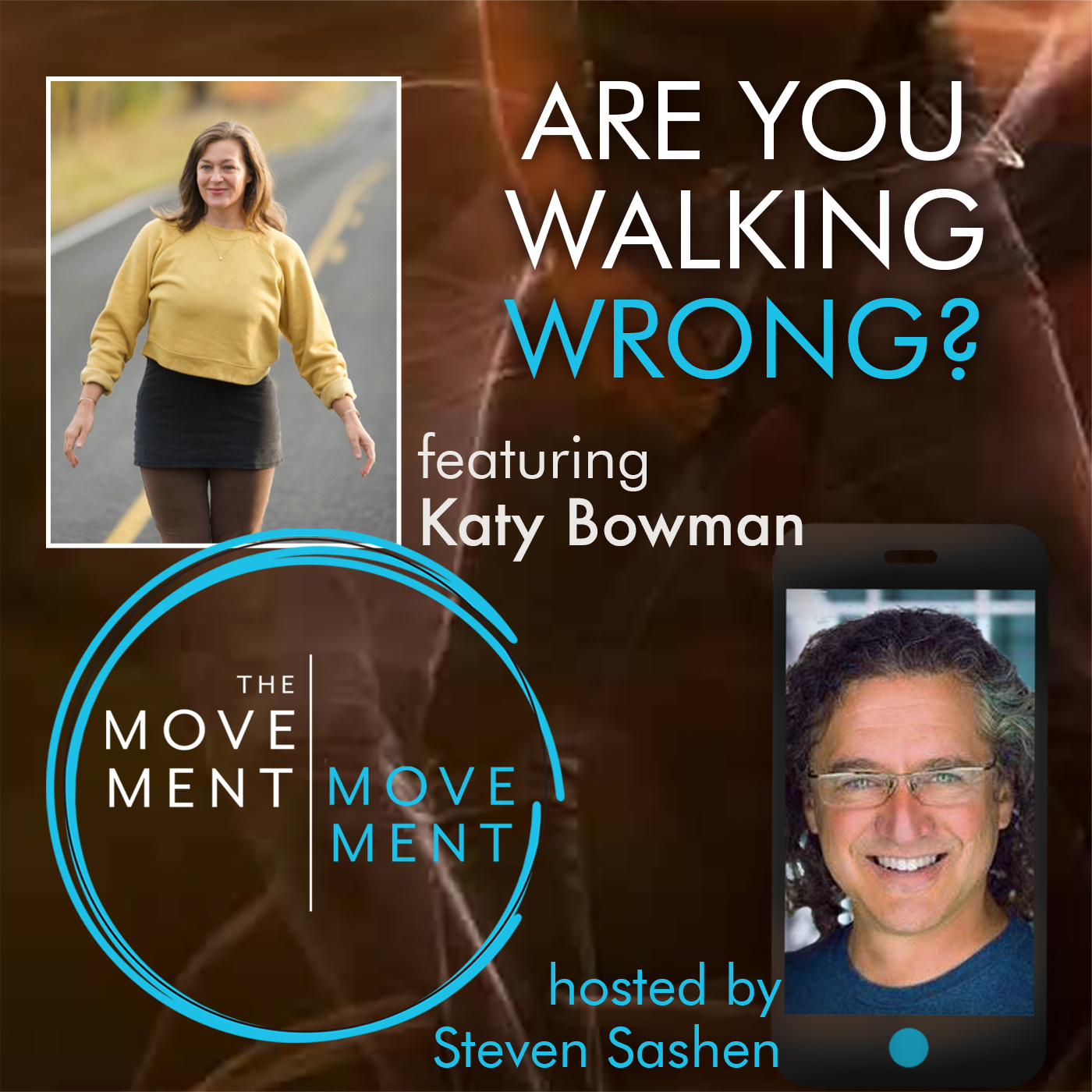
Walking is one of those fundamental things that human beings do. Walking on two legs is what makes us human beings. What if we're all doing it wrong? That's right.
The simplest thing, walking, we're doing it wrong. Well, we're going to find out about that and much, much more on today's episode of the movement movement podcast, the podcast for people who want to know the truth about what it takes to have a happy, healthy, strong body starting feet first, usually because those things are your foundation. We're going to break down the propaganda, the mythology, sometimes the outright lies that you've been told about what it takes to run or walk or hike or play or do yoga or cross it, whatever it is that you like to do to do that enjoyably, effectively, efficiently and dimension enjoyably because if you're not having fun, do something different until you are. It's one of the messages here.
The other message is spread the word because we call this the movement movement because we're creating a movement that involves you about natural movement. We're basically trying to help people rediscover that natural movement is the obvious, better, healthy choice the way natural food is and that involves you. So go to www.jointhemovement.com. You can find all the previous episodes.
You can find different ways of interacting with us on YouTube, on Facebook, on et cetera, et cetera. And of course, then you can share and like and do all those things that are part of passing the message out and spreading the word. And short, if you want to be part of the tribe, please subscribe. And so let's jump in.
I'm thrilled to have our current guest on the show. This is someone who I've known since really the beginning is starting zero shoes. And we've crossed paths a number of times, but I'm glad that we have this time to chat. So Katie Bowman, hello, how the heck are you?
I'm crazily busy. I could use a nap and a clone and a assistant for my clone and a clone of my assistant. How about you? I could use a nap.
I mean, I don't know if I really want to try to like ramp up what I'm doing to match the frenetic. I'm going the opposite way. I'm going to slow way down and see if things fall off my plate. That would be dreamy.
I like the idea of having less to do, but it seems like that isn't happening for us at this point. But let's back up and have a step. I'm going to tell you what your connection to this whole natural movement thing is. Just a little taste because I know that's what we're going to be diving into for the whole of this conversation.
But just give them a little something. Well, I think most folks might know me as a biomechanist. So that biomechanics is a science that looks at the Newtonian physics, the forces, the loads, the pressures of living systems, not limited to humans. But in this case, I write mostly about humans.
And then my book, Move Your DNA was probably where, well, it was the beginning of, I would say the concise thesis that I was putting forward, which is there's a mechanical environment and the mechanical environment is not really being considered. I talk about movement in a slightly different way, the difference of exercise and physical activity and movement and why those need to be delineated well, more for like the academic or scientific purposes. But ultimately for all of us trying to make decisions based on the information that's coming down to us. So that's what I do.
And I do that through the internet, like most people, through writing books and through live engagement. So I mean, I've got like all of your books. We have a bookshelf sitting right out there and I have all of your books there. I was going to bring them in here and show them off one at a time, but I was not smart enough to have done that before I hit record.
So do you want to tell people what the other books are? Just think that my jogs and people's thoughts and have them already starting to search. Well, my first book was Simple Steps to Foot Pain Relief. So I actually started in feet as far as writing things out.
Whole Body Bare Foot is another book. I'll move your DNA. Like I already said, alignment matters, movement matters. Don't just sit there and die space is right deep, which is an addition of the abdominal.
So those are all the titles so far. Love it. So it sounds like you're just moving up the chain eventually you have something for ears and eyes and something in there. So before you actually dump it and you know I'm going to do this, there's all these cool things that are if people are watching that you have in the background.
I want to tour because I make it don't do it yet because I'm teasing my curiosity. I may fit in this gadget geek like there's no tomorrow. So you want to know things that I've never seen before, it makes me very excited. But because we call this the movement movement podcast, we like to start with a movement.
Do you have anything that you can think of? I know you can think of a million things. Something to share off the top of your head that people can do just to do something new with their body that might help them discover something or feel something that you like. Well, one of my favorite moves so that people can kind of wrap their, I believe that we all need to experiment the things that we hear about.
I'm going to be talking a lot about alignment today probably. And so what is alignment? It's idea that you can have a movement that happens in a number of different ways. So we're going to talk about the calf raise because I imagine that most people have heard of calf raise.
And it's simple. You're going to be standing and you're going to have your feet flat on the ground and then you're going to lift your heels away from the ground, which is going to elevate you up. Now, if I were to go into an anatomy book to say, which part of my body is doing that calf raise? Oh, the calf is right there in the front.
I use my calves. But the way that I talk about alignment is to say, we're really off. We are so far off and how our bodies are moving that we're not even using the parts that we think. So I'm going to have everyone do the calf raise now.
You can do it too. I'm going to stand up. Hold on. It's a rain.
Okay. And you're going to look down at your ankles as you do. And this is a move from the whole body barefoot. It's going to go straight up and straight down.
But I want you to look down at your ankles and I want you to do a few calf raises. And I want you to notice if you stood in front of a mirror or if you can see when you're bending over, if your ankles indeed go straight up and down or if maybe one is sort of twisting to the right or to the left or to the left or if they're dropping away from the midline or towards the midline. So if your calf raises are not calf elevators, then you're not actually using your calves. And that pattern that you see right there, you're going to see every time you do a plant or flexion motion in a walk or a run.
So if you see something that's moving to the right or to the left or rotating interiorly or externally, immediately or laterally, then you're watching. And all the humans that would be clockwise, counterclockwise. Well, clockwise doesn't work. It doesn't work.
If we're looking down, I'm just giving, like, for people who don't quite, if they're not watching this, they don't know medial versus lateral. Don't even worry about it if they're twisting. Don't let them twist at all. So now I want you to hold them in place and stabilize so that you are making calf elevators, not just calf raises.
And you will be using a lot more of your body parts. Love it. That's a good one. Yeah, it was also interesting here when I'm going to move the camera back down.
So am I doing that? Because my right leg was just totally straight up and down. And my left ankle did a tiny little twist at the very beginning, then re-centered itself. So trying to find the way and then came back.
And of course, what I really loved is by the third or fourth one, everything was all up and down. It kind of figured its way out. And I never looked at that before. Right.
Love it. So most people who are bio-mechanists, I don't want to put this. What got you, talking about, I mean, I'm curious how you just found yourself interested in this and then following this to begin with. But then also, the practical application is the part that I find really intriguing.
Can you tell me more about how that evolved for you? Well, biomechanics is sort of a, I mean, it was the program is closing behind me. It's just sort of a lot of the movement sciences are sort of closing or dying off. Like, I mean, even, I think UCLA had a bio-mechanics and exercise science program.
It's just slowly reducing. I'm not exactly sure why movement. I mean, I have my ideas of why movement is sort of being lost across the culture. You're seeing like newspapers take out their fitness columns because it's not important.
We've got much more important things to be talking about because it's always had sort of a stigma of exercises for those who care about their body and everything else is for those who care about their minds. You know, like, there's definitely this dichotomy. But anyway, so I started, I was just really good in math and I went to school thinking I was studying physics. So I started there.
I started in math and then I was like, I was good at it, but it was really boring. Like you talk about the fun factor. The fun factor was really low. And then at the same time, I was emerging exercises.
So I was very sedentary as a bookworm. I was a very sort of nerdish immobile kid. I frankly, like thankfully was bolstered by the fact that kids just moved a lot more. I grew up on a farm.
So I grew up being moved my environment. There was no computers. Like there was no smartphones. There was just bicycles and a cowbell and the rule that you couldn't come back in until it was time for dinner.
So that kept me moving, but that was really the amount of the rest of the time I'd be sitting in still. So around 18 or 19, I discovered walking. I discovered exercise. I discovered I was on the swim team and it was a physical transformation, but I think more like a really open my mind.
Like I just started being more of a person in that my experiences were greater than simply having read about so many of my experiences. I would say that the bulk of my experiences were coming through what I was reading. So like to be so experiential in my body was very liberating to me. And then I came from a sort of sedentary family.
Half of it was sedentary. The other half was more active. So I started tuning into activity and I'm at college. I'm like, this is boring, but I'm good at it.
So then I switched to physics because they're like, well, if you're bored with math, you might enjoy the more real world problems of physics. And like now I'm just dealing with like lines and balls and point masses. And I was like, I don't know if this is fun for you, but it's not fun for me. And I think it's because simultaneously I was really being physical for the first time.
And so I used to hate running the mile, for example, as a middle school high schooler. But when I was 18 and 19, I was like, wow, I can get better at this. And I was like learning how to run. And I was getting to the point where I could run like a seven minute mile, just training myself on a treadmill and a gym.
And then I found when I was like, I've been at college for too many years to not enjoy what I'm doing here. And I found this program called Biomechanics. And I realized that I had already done almost all of the work for it inadvertently. And all I was missing was some physiology and a whole bunch of movement classes, which I wanted to take anyway.
So that's where I first found what that was. And like I said, it already closed the program, but they had to hold it open for anyone who came in during that catalog here. And so I graduated with that whole love of movement and training. I was a runner at that point.
I started becoming an exercise teacher. So I got used to breaking down movement. But I was also a nerd by DNA. And so I loved sort of making anything technical.
So I was like really helping people who weren't movers naturally figure out why and how to move. Like I helped that group of people really figure out why and how to move. So in that first group, what were you doing with them? Well, so I got a job at a gym.
I was mostly teaching in fitness. I was doing some sports coaching because when you were in that department, you worked in a human performance lab. So you have access to athletes and different people. But for that other group, they're mostly injured.
So like when people who have sort of any pre-existing condition that precludes them from the general exercise, so just any cardiovascular risk factor or episode, or if you had surgery or PT, when you go to a gym to get like a free assessment, they'll put you with a trainer while I had a degree in biomechanics and exercise science. And so I would get all of those people and they're like, listen, I hate to move, but I know I'm supposed to. Everyone was extrinsically motivated. They didn't really have, they were doing it because their doctor said they needed to, their family said they needed to.
They needed data about themselves to look different. There was no joy or belief that there would be joy in moving on the other side because it had always been such a chore and such a coming from someone else that you needed to do it. So I was able mechanically to say, oh, you know, well, I know that you have a sweat fracture that, you know, is always coming up or maybe you had your medial meniscus or your ACL repaired or hip replacement. Let me show you what it is about the way that you're moving that contributed to that stress riser and the first place, stress riser being like an engineering term for repetitive use in a particular area to the point of failure because they're like, I thought my knees were just old.
That's what they said. You have one knee and both of your eight knees are the same age. So you just take that simple, that simple, that simple trope and put it aside. That's just such an easy way to allow yourself to continue to not move.
So I just sort of did that and then all of a sudden there was more transformation and people were like, I love this. And I was like, okay, well, what do you want to do with your body? That's not just exercise that you can't. Oh, I want to be able to, I've always wanted to climb a tree or go across the monkey bars or play with my kids or do this 40 mile walk for this fundraiser.
I'm like, let's train for that. Like to train for general fitness. They come in three times a week or these minutes. I'm like, that's like, it's like joyless and it's nutrient, it's not nutrient dense.
It's like, it's not going to be sustainable for you. You're not going to have the conversion to being intrinsically motivated. So that was that group. And then I went to graduate school because once you get, if you get for four or five years, all the people who have been injured or whatever, you start to see so many patterns and like people would walk in.
I could see, like I could see in a minute. Oh yeah, you have osteoporosis in the left hip. Like how could you tell? And I was like, because I can tell where your weight distribution is.
And so I know how bone works. So let me show you a centered stance would be and how that puts more weight on the hip. That's atrophying because you're not putting weight on it. Instead of letting you stand with all your weight on that hip and have you do like 500 reps of an exercise, why don't you just learn how to carry your own weight better so that every minute is getting you more towards this more robust structure.
So that's how I came to be. Well, I hear an interesting pattern. So for you, and this is something that I discovered as an undergraduate as well, actually I'll tell you the story, when it got to a certain point when I was in college, I was a pre-med and everything was intersecting. So what I was doing in physics and in math and in chemistry and biology were all intersecting.
And I came up to the head of the chemistry department at that time. And I said, you know, this is so interesting because you need to physics to understand the biology to understand, I mean, like all of them in a related. And I said, if you taught it that way, it would be so much more interesting because it's in many ways real world that you're then dissecting to find out how things work. That would be totally fascinating.
He looked at me and I swear to God, he said this, then how would we weed out the pre-meds? And it was the saddest thing I ever heard. But what I heard from you, and actually a variation on this, I remember the hardest class I'd ever taken was psych stats, just figuring out how they were doing statistical analysis and psychology was just super hard until I started doing primary psychological research. I did research on cognitive aspects and motor skill acquisition, a couple of things about rhythm and a bunch of things.
To figure out if my research had any meaning, I needed to do this statistical analysis. And then when it was practical, it was super interesting. I heard for you that getting out of the bookish part into the practical part into biomechanics is what made the difference. And interestingly, with the clients that you first started talking to, it was the same thing.
Getting out of the linear thing and into the more practical application was the thing that was making a difference. And I think that's really intriguing. It's like, some people say you need to have a why. And most people, their why is not as clever as what you help them come up with.
It's, I want to make this pain go away. Not, oh, I want to be able to enjoy playing with my kids, to run a marathon, to hike a mountain, to be able to walk to the grocery store without paying, whatever it might be. But just a practical side is what's often grossly missing. Yeah, I think of it as in terms of density, there's not a lot of density when you are approaching it for only one sort of external purpose.
I mean, it certainly relates to you, but it's just not, I mean, you have with a psychological background or a background psychology, probably better way to say it. Yeah, for people of those ways. With that background, the motivation and exercise adherence and adherence to even following the things that you yourself want to do but can't seem to make happen. That's a big one, is that it's not really relevant to you.
You haven't made it relevant. Right. Well, it's funny. So I was a gymnast from, since way back when, and when I was 32, I was just warming up and I landed and twisted at the same time and heard that and now I just come out of my knee.
You know, that's the end of my gymnastics career. And I spent the next 10 years trying to find something that I enjoyed doing that was just intrinsically wonderful. And I found a bunch of things that I like. I got really the service arts.
I was doing Chinese poll and like all these crazy aerial things that I really enjoyed, but there was no application. I was never going to end up in Cirque du Soleil. I was never, and this stuff was hard and it was painful too. I mean, some of these things looked really wonderful, but they're hurt to get them.
And it wasn't until I discovered a master's track and field that it all put itself together because it was hard. It was challenging. But to have the end goal of competition and of trying to continuously improve because you can never get it right. The thing with sprinting in particular is there's always something that you do wrong, like in every race, in every race, someone will say, how'd you do it?
And my answer now is do you just want the number or can I give you the excuses first? But to have that, to have some, that reason to do it is one of the things that drives me, even now with during COVID without any competition. I'm still basically training as if there's going to be a meet at some point in the near future. And just that little complete fake thought, if you will, is enough to get me out of bed and work harder than any human being has a right to for, you know, there's no sponsorship money at the end of it.
There's no, I'm not going to win valuable prizes. No one cares about the medals, but it's just, it's just really fun. And I'm curious about your thought about this. The other thing that makes it work for me, it was funny, it was on the track yesterday with my training partner and we realized that we've been training together for like 11 years, 12 years.
And just that, the social component is huge. I'm wondering if there's, if you've noticed anything about the social component and the work you've done with people. Well, so a specialization that I had more in my undergrad, although I guess a little bit, I did a little bit of work in graduate school was in the term gerontology is so bad, I swap it for a golden or, but it is really looking about looking at what are the reasons that do get people to come to movement and community is definitely one of them. And one of the ways that I've tried to expand sort of the understanding of natural movement, meaning like there's a, there's a range of movement and a range of movement types of that we need that we are that are cells and are all the different types of our body tissues required.
Each one of those slightly different, but I try to expand it to say like movement, we come from a very exercise centric understanding of movement and that's very limiting, but you don't have to go very far. You have to go, you have to step out of your own culture, but when you across culture, you realize that movement has always been ubiquitous and movement has always run parallel to really most other human experiences that we would put under things that humans require. So others is something that humans require, but moving together was one of those things. So when you could provide not only exercise for, especially groups of people that tend to have fewer people in their homes.
So older adults, for example, in this culture tend to be much more isolated. So if you're going to design a exercise class for goldeners, knowing that what they're coming for is probably more the camaraderie or the community than the movement itself. So knowing those things as you're developing these programs, so I really try to put for children, for families to understand that movement is a lot easier to get when you can figure out how to layer it or increase the nutrient density of that movement with being with other people. And that it's probably going to be the moving with other people that keeps you committed because part of another part of the theory that I have, this sort of body human body use theory, is that humans naturally, all living systems really tend to conserve energy.
So it'll always be easier for you to not exercise, but it will be harder for you to not do the other things because we don't have a people shedding tendency to our personality. We want to be with other people. We're not going to necessarily do that. We have a learning tendency.
So when you can add movement to be less of the same sort of movement over and over again, you have much more adherence. The difficulty is that people talking about, the people doing the podcast and the people leading the movement, movement and the exercise movement are probably the archetypes, not the right word. They're like the constitution of people for whom movement was the thing that they came to express. So you have the movers, the natural movers, sort of leading the movement and they're missing the point.
So I think it's kind of my rare exception that I was a non-mover who got to it through not the constitution of moving that gives me a much different perspective because I could see it, by the way, maybe 90% of the population actually view it rather than the people already who could get up every day and who are going to do it no matter what, trying to tell everyone just do it. It's not landing for everyone. No, no, no. It's sort of like the first time I heard about the whole 10,000-hour theory for becoming an expert.
My initial thought was what that's bullshit. And the sub-haut was speaking as a sprinter and a gymnast. There's no sprinter or gymnast who's ever put in 10,000 hours because you literally can't for what it takes to train for either of those things. But the other thought that I had is the kind of person who wants to put in 10,000 hours is a different kind of person.
You can't just force yourself to do it to force yourself to expertise, that's what whatever that intrinsic motivation thing is interesting. And I'm curious because it's definitely a different group of people. And the other thing with let's call the natural movers, or people who just gravitate towards that, is many of them, how do I want to put this? They don't have the ability to look more carefully at what they're doing to understand what the common factors are or what the causal factors often are to sort of pull out some of the mythology from what they've done to find something more essential that they could share with other people independent of their own experience.
I mean, we all tend to teach our own experience rather than figure out what the thing underneath that is that might be more universal. And again, that's for the same reason you mentioned, I mean human beings were wired to do as little as we can get away with. And so if you know how to do it, you tend to stop right there. Or one of my favorite examples, I was working with a friend slash branding coach who we're doing this one drill and while basically it's kind of a jumping drill, if you will, and he says, you know, you need to have your hips, how do you say it?
He's in the air there, you need to get your hips over your feet more. I said, dude, I'm in the middle of the air. I can't rearrange my body that way. What you're really saying is that I didn't take off in a way that put my hips over my feet in the way that you want.
And he's like, oh, yeah, I guess so. So he was just a natural mover. And someone had told him this line, get your hips over your feet. And he was just regurgitating that because it worked for him because he didn't need anything more than that.
But it doesn't work for most human beings. So that sort of movement to human translation is a skill that a lot of natural movers don't have. And maybe anyone trying to teach, like they're teaching and coaching and being able to break down the thing that you do and see when a person isn't getting it and to be able to create 10 steps below that to me, that's really, that's what teaching is, is to not be able to depend on any language that really anyone gave you before, but to see it thoroughly for yourself. But it comes from a lot of time being exposed to it, but it also could come from simply moving through it.
Like there might be a knowledge or an understanding of going from point A to point B yourself that allows you to have a different experience of the experience and someone going, now that you're at point B, tell me everything that you did between point A and B. But you can possibly do it. But I think that one of the things that you bring to the table that's so interesting and unique though is that sort of analytical methodological mindset that's required for math and required for physics and to apply that's a different story. And that's an unusual piece as well.
And there's also just a thing, I don't know, I refer to just having good eyes. And a lot of people don't have good eyes. In other words, they see, again, my favorite example of this, this is bad eyes, is you go to any high school track meet and you listen to the parents yelling at their spritter kids, get your knees up and people think that knees up is an actual cue. But having your knees be up is the side effect of applying force into the ground in the right direction in the right time.
And so, and I see coaches doing the same thing because they don't see, they're looking at the end result and not what is either the cause or potentially the cause, so that's sort of tweaking that. So, having whatever combination of skills would be, and I don't know what it is, maybe you have better insight, leads to being able to see well and then having that curiosity to examine and figure out if your theory may be right and if your interventions might be right. That's the thing that I appreciate about what you do is that you're bringing that kind of vision to the table. And again, that's a very unusual thing in my experience.
Well, that's a bio-mechanist, right? A bio-mechanist understands not only what it looks like, but how it's made. So there's kinetics and then there's kinematics, right? So you see knees up, that's the easy thing to pick up.
The harder thing is the invisible thing to know that knees up could be made in one way that's helpful in a way that's hindering your performance and to be able to communicate to that person. It's like, all right, you're going to bring your knees up this way, now you're going to bring your knees up that way, and then now the person has experience and then they have that knowledge. So, for me, the way that I've become a movement teacher in the world is to teach people how to have, as your language, good eyes for themselves. I don't want you to depend on me to see what I see.
I want you to learn how to objectively look at your position in the world. So, calf raise, calf raise, maybe get your heels up higher, heels up higher, right? So, heels up higher, if you have someone who's really rotating, they just did extreme pronation. That's the exercise that you just had them practice, which now is going to, that was the thing that you wanted them to undo during the time of offsetting that.
So, to say, well, there's something more than heels up, there's heels up and malleolae or ankle bones in this direction, all right, now we're going to do it. And people, I mean, we're inherently, if we're inherently energy conservers, we're also inherently observers of natural phenomenon. I mean, that's our bag. And so, to be able to finally receive some instruction in how to see yourself move, that's what's missing.
We're just giving sort of the dogma of exercises. Do this for this many men's and this and this. No one's really being taught how to see their own shape. And so, I like to do that because once you own how to see your shape, then you have the power to adjust it in the direction that you want.
But you can't really do that if you don't know how to see yourself yet. What's your experience in working with people who may come in, I mean, we'll stretch this metaphor until it's breaking point, who are, let's say, that they're body blind in developing that ability to see themselves. I have this, I have a whole theory about cognitive aspects of how people adapt to new movement patterns that I can, I'm not going to bore you with in a moment. But I'm curious what you see as how people progress or if there's some people who have difficulty progressing, if so, what do you do with them.
And again, without giving away, I'd say that some people are just better wired for moving through that process than others. But I'd love to know how you move them through it. And then what happens if you see people who sort of hit a sticking point or limitation or the edge of what they're able to do that might not be as far as you can imagine. Well, I do think that learning how to observe yourself is challenging no matter what you're talking about.
It's movement. Am I freezing up here? You first split second, but you're back now. You're frozen right now.
So I'm going to wait for you. Oh, here. Okay. There you go.
So I would say that self observation, no matter what field or context in what you're talking about is tough. It's really hard to see our own behavior and how it relates to things. It's hard to see the choices that you make and the assumptions that you're making all the time, the biases that you hold. So I think when we're talking about physical or physical bodies, there's a lot of things that have happened to people, humans along the way that have made them ashamed of looking at themselves, you know, like to look at yourself and observe yourself is to be in a very vulnerable position.
So creating, you know, like in that case, groups might not be the best place, you know, like if you're, there's a lot of coaching, right? That's gone. And so like we're going to kind of publicly yell at you in front of everyone else so everyone can see that you're doing wrong to get you to really, right? So, so coaching hasn't had the best track record, if you will, of, of helping people get to that spot because we're not really going to form than other experiences outside of ours.
So I actually, my graduate work was in female pelvic floor disorder. So the alignment that I was helping people work through were really of the pelvic and the spine much more intimate of an area in your body. So I've just always done it through using a mirror and then also noticing if it's hard for you to look right now, then you're just going to look at this place and if it's hard for you to look at options, 10 steps. It's the same thing.
Like if you can't jump up onto a 24 inch box, I'm going to drop it to 22 inches or 11 inches or three inches. I'm going to set you up to be successful and I do the same thing with observation. I'm going to ask you to do this sort of looking at yourself and if you can, I'm going to give you a smaller area to look at. If you can't, I'm going to send you home with a task to look at it when nobody's looking and I'm just going to, it's step-wise.
It's simply step-wise. One of the things that I've always been intrigued by is how we hold certain beliefs, especially beliefs about things that you can't prove or disprove as in the same way we hold our sense of who we are, that literally our beliefs are locked in with our identity and it seems that there's a similar thing with movement. I mean, learning new movement patterns is of course neurologically challenging to begin with. You have to lay down new neural pathways.
You have to let others sort of fade away. But I think there's a big chunk of that that is very tightly tied in with our identity in ways that most, we don't really even have a language for it. We don't really talk about how movement patterns or lack thereof, which is another kind of movement pattern, really relate to how we see ourselves. I'm always, it's always fascinating to be watching kids who move just like their parents.
And I'm so curious how much of that is genetic and how much of that is a learned behavior to try to fit in with some sort of mirroring behavior and it becomes an identity. And you have people move out of that and sometimes it's liberating, sometimes it's terrifying. What have you, what's been your experience, if any? I mean, I'm just, this just popped into my head with this whole relationship between movement and identity.
Well, I think that, you know, like everything exists within your identity or within your culture, right? Like, these are all, everything's and elements of it. Movement is off of our radar. We don't necessarily see it.
As you pointed out, us not moving is also a movement choice. We're making movement choices. We're responding to movement. So I, I try to explain, I try to explain movement.
I try to use non movement examples. So I want to talk about human movements. I try to use non human animals to make examples so that you're not so feeling overwhelmed that I'm talking about you, right? Like if you can get the, if you can get the principle in a way that doesn't threaten your identity, then the principle can come in and do the work itself.
And so I talk about language. You know, it's one thing is about gates. You know, the way that we walk, it's the way that you walk is so, it's like a fingerprint. It's so unique to you.
It's so, it's, you could spot people from a hundred yards away from their walk. You know, it's like that's built. Well, but they use that, they use satellite recognition. You know, they use it as a way of, you know, if they're trying to find somebody, they will use gate because you can have face surgery and you can change your language, but you can't really change your walk because we don't have, we don't have that technique going in yet.
Right. So part of who you are, but, but you can also see family members walk side by side and you can see what's going on. But, but you've inherited, you've been bequeath is probably a better word. So, so much, so much more.
Like, right? You, you dress in the same way. You sit at the same frequency. You walk the same distances.
You carry the same loads. Like you, you share more physically. So I explain it like language. You know, if you're in your family have an accent, humans are just like many other mammals.
We, we learn through modeling. And so you, you get so many of those same pieces. And I have a friend whose father was in a motorcycle accident who lost a limb and had a particular gate. She had that gate by the time she was two of his sort of, right?
So it's just, there's a whole biological thread that's going along here. Like this is how mammals are in certain ways. And there's so much to that tied up in our movement. And I think, you asked before, like, how do I like desensitize it?
It's like, there's not judgment. And I really work hard to not have judgment and use words like good, bad and things like that. Because I don't think that helps in this particular case. It's like, it's not judgment.
It's just geometry. You know, so, you know, I can explain like, you're not a lesser person because you stand and like, look at what I do. I do this all the time. I don't feel bad before doing it.
I recognize where it comes from. And I recognize the work to go a different way. And I recognize that there's bumps along the way. And I realize the hierarchy of importance of it is constantly shifting.
And to hold a complexity of it, we're not really great at holding nuance and complexity right now. And that is the skill that will keep you, I think, out of how easy it is to feel overwhelmed or ashamed of certain things. Like, just hold the complexity. Hold the complexity.
It's a lot of work. I'm willing to do a lot of work for you. You know, I try to create a space where that's happening. Yeah.
Have you noticed, I mean, you've worked with the world. Have you noticed different cultural effects? Well, I think when I was in graduate school, when I came to graduate school, I was the first day, it was the first day in a seminar of just general biomechanics. And the question to the group was like, what do you want to talk about?
And I want to talk about cross-cultural data because even our anatomy books are really written around like a European centric perspective about what the body is opposed to do. And that's heavily informed by Western thought, Western movement experience, which is extremely low. And so here you have the whole science being sort of shaped by said-interism, which is what I write about in movement matters. Like, movement matters I'm trying to explain.
Like, why we say that this is what the ankles do is because these are the ankles that we're looking at and these are what the ankles that we're looking at have done. So let's expand across cultural data in that particular way, certainly working with different bodies in different parts of the world and then also just pulling from data that is examining many more bodies that I could ever see and pulling out those. Like, I definitely utilize cross-cultural data quite a bit because movement culture is so different. Like, we have a very good outline, movement culture, not necessarily worldwide.
I mean, we do right now. Like, I don't have seats in my house, I don't have furniture, like chairs and couches. And it's like, oh my gosh, how could you ever be? And it's like, the ability to perceive that that would be like, why would you do something?
So how could you even be a human in that situation and to realize like, this is the thing that I do is what the bulk of the world, you're the outlier, you're the behavior, the outlying behavior. So trying to reframe that of going, it's really hard to see outside of your own culture and also just your own personal culture, your family culture, your community culture, and then your greater culture. It's just, I'm fascinated by it, especially the movement thread that's working through all of it. There's a thing that I've noticed lately that I find really interesting.
And I'm not sure what television shows were the influential factor in causing this new movement pattern, but I'm seeing more and more people, including myself, either part-time or full-time, holding their fork the way they do in Europe, or the way they do in Britain. So you know, point curve down instead of curved up like a scoop. And I'm seeing more and more of this lately. I'm curious.
I haven't really looked into it. But I'm just so fascinated that that's something that started happening somewhat organically, like people are experimenting with this other movement pattern. And I find, and what I like about it is that both of them suck. So like when you're doing with the curved part down, you can't really scoop things onto your fork well unless you have stuff that sticks to the back of the fork.
And the other way around, if you have the times pointed this way, it's not as good for poking things. So like they're both bad in certain contexts. And so that makes it even more fun for me because I like switching it up as necessary, but I watch people who are, you know, who they're locked into one of those where it's clearly not working. But the fact that it's moving at all without anyone having discussed, you know, you should really hold your fork this way and getting an argument about proper fork handling technique.
I just love that one. Do you find your teaching changes when you're dealing with people from different cultures? Well, how you have to do things or even what you're doing? I don't often, I mean, at this point, I teach on the, like, are you at your jet?
Just taking off the back of it. Yeah, that's what it is. Yeah, it's my jet. It's actually the office next to us.
They're apparently drilling into the walls, which is very exciting. Pretty soon I'll see someone poke through like, what are you doing around? You went too far. Always.
Mostly what I teach now, you know, I'm not really gathering groups of people together so much anymore. Like I'm writing books for the world and there is a world audience. And so everyone is coming to the single bit of work that I have put out. So, so I do have to, you know, I'm always working hard as I'm writing and creating something to be making sure that the language that I'm using is as inclusive to any of the particular audiences that would hear it.
So, you know, like the idea of there being like a right or wrong way to hold a fork, like that's up for discussion. The idea of which direction of the foot would need to happen to get the maximum amount of rotation out of your ankle is less open for discussion. But where it starts going to discussion is, well, it starts going to discussion into like the place of like, well, what's the terrain that you're on or what's the speed that you're going or what is on your feet or what's the purpose of what you're doing. So there is still nuance there and I can't, you can't write truth in that way because it's so nuanced.
It's a quantum physics problem. So, not everyone understands that, but at least if I do and I'm writing my own body of work to say that there's a level of nuance that we can't possibly get into 300 pages. And here's how you would, here's how you would adjust it to yourself if you can't or your situation, like I just try to keep that in and I find that that meets most needs. But of course, the people coming to me are probably like, you're probably not going to have outlying if a culture isn't, you know, on social media or looking for exercise in alignment, like these concepts are already cultural, you know, in that particular way.
Yeah, yeah, that's a good point. So there are a couple things that I want to dive into, but I want to take a couple of detours. The first one, something that I alluded to at the beginning, as I mentioned, massive gadget geek over here and you have some very cool things in the background. Can you give me a tour of what cool stuff there's back there?
Can you see those floating stairs? Those are stairs with chains holding the stair part up. Great. And wait, oh, and they tell us what, so this is sort of like, it's the stair version of a big floating, what's the word I'm looking for, like a bridge.
You see this on any given competition show, there will be somebody walking across some big bridge that's really unstable or things about to break. This is like the state version of that is what it looks like. This is the insurance approved version of that. So I saw this in a playground in Scotland when I was teaching a class there.
And I thought, this is what I need because if you're trying to teach someone how, if you're trying to, it's not teaching, if you're trying to set up an environment to allow someone to have the experience to see that they don't have the ability to stand on a leg for more than 15 seconds, like a stand on one foot. So the first thing is like that's often what an exercise class is, is like I'm holding the space for you to have a physical experience because you don't have any space in that for your life. And the good thing is just by simply going to the experience, you are moved and you see like nutrients for going through it. But that's all you're ever doing is really going.
I'm going to pass this physical experience, see what it was. And if I keep doing that physical experience by nature, my body is going to make going through that particular experience easier and easier and easier on me until one time, if it happens to be sort of, if it's going to require an adaptation that isn't, let's say, how could I say like suitable for the entire body and then that will be an injury. But I am like, even you sit so much, not you, Stephen, but we sit so much as a culture. Sitting is our most practice athletic skill.
Like our body is completely adapted to make that, which we do the most volume above the day, easiest on our physiology. But there becomes a point in which the other parts of our physiology, the ones that are sitting, feel that, but everything else is sort of dying off. So, so, go ahead. Okay, go ahead.
Okay. I heard a commercial on the radio when I was driving home the other day about an ergonomic chair with, you know, like 15 different adjustments. And I was thinking, this is so funny. It's like you have to build all these different adjustments in because the fundamental way we're sitting is so not natural that if all we were doing was either standing or squatting, you don't need a whole bunch of ergonomic adjustments and no one knows how to take 15 different things and turn that into whatever comfortable sitting would look like to be in with that.
That's neither here or anywhere. So, so people on those stairs, I mean, the thing that's so obvious is that if you're moving from stair to stair and you're not moving your center of mass properly, you're not getting your weight over your foot in a way that's balanced before you're stepping that next step, you know, you can go flying in many other things. What do people learn on these floating stairs, which I totally want to play with? I know.
Well, so it's even more nuanced. So, as a bio-mechanist, like, you know, if you went to PT physical therapy, you might have had rehab, you know, those listening or watching for like the ankle or the knee or the hip. So, they put you on something that's unstable, right? So, they put you on a bow suit or something that allows you to tip right, tip left because they want to see how your body can react to that experience because our brains and our nervous system works in conjunction with all of our tissues to make moving over the planet, you know, not detrimental to us.
Like, we're at the point where moving has become detrimental, which is really like part of the way from how it started, right? So, so as a bio-mechanist, the problem that I was having is there are parts that stabilize you, you know, right to left, but what's missing is the challenges, the transverse destabilization, meaning I can see how you might be not able to stabilize yourself sliding right to left or front to back, rotating clockwise or counterclockwise as you regular people like to stay. So, so this is a plane, like you could be totally balanced in a bow suit, master of all these other instabilities, but it's on this thing that you see that every time you step, that part of your stepping up includes a push off to the right. Or that when you hit the stairs, like if you're wondering why the balls of your feet or your socks are always wearing out faster, I would see when you step on this that you don't actually step down, you're actually, yeah, you're like kicking every single step.
So, you can only really, you know, like if I gave you a list of like here's what I found on your computer program, you step too far forward on your left foot and you're right foot twist out and here's your corrective exercises, you're gonna, you know, do so many rotations in the other direction that you're weak, you know, we've got this really sort of, we've got this really sort of take the problem and just balance it out on the other side, it's like a symptom of too much algebra as a kid, I don't know. As I say, all I, the reason that you're having an experience, the reason you're not able to stabilize a transverse plane is your whole world has had a fixed transverse plane and that's an unnatural environment for you to be moving on, you have no movement experience, so I'm gonna create this and I can take someone with the greatest fall risk, I mean they're out there safely, but they're not comfortable, so first you have to get over the fear, right, because the fear itself is actually a risk factor for falling for a particular group, so you have to get over the fear and then you go up a couple times and it's merely the exposure to the load that allows your body and its wisdom and its amazing computer system to fix it for you, you don't need a bunch of corrective exercises to balance, you just need to engage in an un- Yes, you need, yes, you need the experience of what moving in a transverse plane feels like, I don't have to teach my kids how to walk and say right, you're gonna lift your hips up, eight degrees each side, you're not gonna do it, we just give them the experience and then you'll learn. Well the example that you gave about you know if you're wearing a bottle of photo of your sock is telling you that you're applying excessive horizontal force and that's causing that friction which causes that wear etc, but what I love about these floating snares is exactly what you said, is it's giving people a direct experience of that rather than in real time rather than the after fact and the reason that this is so interesting to me, not surprisingly with zero shoes, will have some people say, hey look, this is my favorite story, someone emailed me and said there's something wrong with the rubber and your shoes have worn out the heel, that's a while you're overstriding and heel striking to do that because that's what causes that force that would allow that to occur and you know we can't we can't disobey the laws of physics, friction is friction, so that's the way it is, but I don't do that, well that's the only way you can apply force there that would allow that effect like you know, wearing out the ball of your foot and your sock and I said why don't you send me a video so I can take a look and maybe I'm wrong, I'm open to that, so he sends me a video and not only was he overstriding and heel striking but it was screamingly obvious and it took me 20 minutes going through frame by frame until he finally went oh yeah I guess I am overstriding and heel striking and then his next line was the most amazing thing I ever heard, he said but I don't do that, but there's a video of you that you made of you that you sent to me of you, it's you and so the one of the problems with, well anyway one of the problems is a lot of the feedback that people get is so removed from when they are doing whatever that movement is that it's very hard to make the correction in real time in a way that trains your brain and your body want to do but that's what I love about these is it's clearly immediately giving you information that you have to adapt to that is telling you something that you didn't know before which is super fun. Well and it's a difference between someone telling you and you experiencing it like so I mean even with your own experience my point is that if your own experience can tell you you have to be able but if you're dealing with it out of real time that makes it challenging like for me you know my second barefoot run the initial experience was sheared pain because I had a gaping hole on the ball on my left foot from a blister from my first barefoot run and it was only in getting that immediate feedback of this hurts, this doesn't that my brain figured out how to move in a way that didn't hurt and therefore wasn't causing that friction that caused that gyplist to begin with but for many people they're not getting, they're either not getting that feedback in real time or they're not sensitive to that feedback in real time or they're not necessarily skilled at generating new movement patterns to find other ways around that or they think no pain, no gain and that the pain is actually a good sign when it's 99.9% of the time not so you know again that's why I'm in love with these stairs I want them.
What else you have? I don't know what to be, I mean there's just a bunch of bands and things in big space and Bosepaw's and oh man I just love that I just want to have that kind of big open space that would be that would be happy. Oh now you're frozen now you're back. So you said something important there's two things.
We opened up this conversation by saying maybe you walk all wrong so why don't we talk about people walking and they're wrong walking. I just said that we weren't going to be polarizing or judgmental but yes that is, I know I know. So yes I'm thinking about that person who wrote you about heel striking or he he he that the material was wearing away in a particular spot so so there's this idea that I mean how also I want to say it. I don't know how let me how we start that again.
Which part I mean I mean I mean I mean I mean struggling as well it's it's good struggling it's fine it's like how is your walking experience working for you I guess is the question. So you know this idea that if something hurts that you can that the experience of moving with something hurting is what allows you to sort of adjust and move around it I think to a certain extent that is helpful because it shows that you can constantly adjust your alignment right. So your alignment is the alignment is the orientation of parts and the forces that you're creating as you're as you're moving in this case let's say we're walking from point A to point B. I don't think one that everyone knows that they have the ability to change the loads that they are experiencing while they're walking I think that that's that's huge so let's say that the first way of walking wrong is that you might not have as many options available to you that your ability to adjust is very narrow and that part of that adjustment is one you just don't think about it you're just like every time I walk my low back hurts and so you just stop walking rather than think maybe I can hold my torso differently but I do think that people naturally are moving around their pain and that that's actually what gets them further down the pain or injury road you know you're like sort of like leaning to one side when you see people moving but their movements are you know like their torso is going from side to side or they're leaning or their hips are flexing what they're doing is trying to move forward they're trying to walk trying to emulate locomot despite right what or not despite or like they're doing it the best they can't they're doing it do you know what prolotherapy is prolotherapy those are injections for dementia yeah that's good most people don't so the one of the things I mean the underlying thing before you would get an injection into your like a painful injection into your late on new muscle tissue and make things work better is this basic idea that when you're injured what your brain slash body is going to try and do is figure out how to get around that as quickly as possible until you're able to do what you need to do not optimally just to do it and you will most likely have developed some on some non-optimal movement pattern in order to do that because there was no evolutionary advantage for getting back to perfect there was an advantage to getting back to being able to run away from that thing to your lunch and so yeah but I mean what you just said is one of the things that I find most interesting is that people we move without thinking about how we're doing because we just habituate to it and many people don't have that whatever it is I'm not sure of its curiosity or just a paying attention to certain kinds of feedback and cues to be able to try different things especially after they've compensated into something that's functional it'll have to get past that injury but created potentially more problems that are no longer even connected to that original injury so they're not putting two and two together and going back to that initial cause.
Well thinking about movement that's the un that's the outline condition that you and I maybe have like so like like that's what I'm like trying to really thinking about movement I think is helpful in the sense of wow we just discovered that movement was something we could think about like that's been a discovery that only a sedentary group of people could have come to the conclusion that they just make that discovery so now the point is like now that we know that discovering we have a context for it how do we how do we look at environments so to me environment is a really big deal you have looked at the environment of the shoe and said wait a minute how could someone possibly restore a gate function that didn't have some what's the word for it like premature wearing of tissues in certain ways without looking at the environment of the shoe but of course a balancing balancing part of that is would we have could we get to this point without shoes given the larger environment that we created so every technology has sort of come on and then sort of like become where it's playing pushing us around you know we're like we're gonna move the world in this technology and the technology is like damn and then you're like okay down great technology well here's a favorite example of what you described of let's say you know concentric circles of cultural adaptation so walking around Colorado barefoot people think I'm crazy if I was at the beach people think it was normal so you know in Colorado you can't they want there's a bunch of stores that say that you have to where she was to walk in the store when you walk around the beach and they don't have that so you know the barefoot experience can be the same but the bigger cultural that that larger concentric circle puts it in a different context where people are very unwilling to step out of that one and try something new I mean I've said that I said that to someone yesterday it's like what's the problem I mean you know this well we sometimes have glass on the floor I said well I have eyes in my head so what's the big deal and if it were a different place we wouldn't have had this conversation they would have just taken care of it to begin with frankly yeah I mean context is there yeah like it's everything so walking yes right or wrong walking right or wrong but so yes like the first thing is to let people know you have you have way more control over the lows on your body when you're walking then you probably realize yeah however due to how you have been moving to date the capacity for you to adjust might be very low right now because you need access to moving all the particular parts individually because that's how you distribute forces differently so here's an exercise you want an exercise let me get exercise yeah so you're going to if you can be on shot if you're listening or watching kick off your shoes if not just try this in your shoes is one can you spread your toes away from each other like not just not have them pushed together by your shoe but can you physically just like I'm doing with my fingers display them and then it's can you lift only the big toes by themselves could you lift just your big toes then holding the big toes up could you lift your second toe and your third toe and your fourth toe and your fifth toe and put it back down then can you shift your pelvis to the right so that you've got more weight standing on your right leg and then can you shift your pelvis to the left so that you've got more weight standing on your left leg then can you shift back to the right and put more weight not only on your right foot but on the front of your right foot can you get all the way there and then can you shift all the way to the left and put more weight on your left foot now can you while you're on your left foot scrunch your toes just a little bit and you'll feel even greater pressure application so the experience that you're having let's just say with your feet right now but it's really goes over multiple parts is equally the way that you're steering your body around it's not just your anatomy or physiology it's it's used and so the stiffer all your body parts are the less options you have and so there's that cycle of you hurt so you smooth less or you move in one more narrow range I think it's stiffer and then now now when you move you only have the way that hurts you to move as your option and so we have to break that open a lot so a lot of work that I do is we're not even gonna deal with the bigger movement like walking or running right now I just want you to basically make sure that all of your parts move into individually from each other so that you have more options when you go and even if you even if you don't even think about any of these things while you're walking the practice of you sort of breaking these smaller parts away from each other getting really sticky spots only when you go to take a walk if you land hard on a rock that you can just make that you can move your pelvis and glide on your hips one half inch away and not have to leap you know six feet to the left and then land hard on your left ankle and twist it right so many even the things that we perceive as injuries are all about we've lost the subtlety of sensation and the most minimum reaction that you can make to allow you to continue to move forward so that's inefficient in the larger sense right we're inefficient because we're inefficient because we're trying to use the same pattern on the same straightaway on the same surface and we can't we're not adapted we can't go anything off of it anymore and so then the amount of the world that's available to you is very small because you're like I can't go I can't sleep on a different bed or hurt my back it's like that's the opposite of adaptability that is you are stuck in a rut that's what that means and you know to a certain extent we are fighting human evolution because I remember when I was in high school I my memory is that it was a fundraiser for PBS some guy doing doing some sort of talk I don't remember what but his opening question was what's the purpose of thinking and everyone had all these answers and he finally broke the broke the whatever loggium by saying the purpose of thinking is to stop thinking in other words thinking is the process of taking incoming information developing patterns so that we don't have to process that incoming information again it just comes in and we know how to respond accordingly so we're wired for just coming up with these fast solutions and sticking to that one thing and and it takes it takes a certain kind of again effort curiosity something or or other reason backing up to the beginning of our conversation other reason to even explore these other options and what to your point one of the things that I love so much about the amount of time I spent barefoot over the last 13 years is just my feet have become more flexible things that I used to step on that were hard to step on because my foot was less flexible now or easy my reaction time is to fast-rise step off of things without having to work so hard to be but and it all came from just having more time and more feedback on different surfaces and different surfaces can be literally and it's my favorite thing like the what's the word not the let's call it the sidewalk outside of Costco versus the smooth floor inside of Costco you know just that difference and feeling that within just a few moments it's it's always just getting the feedback opens up new possibilities for other alternatives because you're getting all that extra sensation that requires something different to happen it's just it's just straight up a different movement I mean if you can only think about it I mean the easiest way to think about it is to not make so many different categories with different terms it's just more movement like it's like they're you have more movement but of course simply putting on the shoe doesn't give you more movement you've got to you've got to increase your environment you know but you know but even if you put on a shoe in the exact same places that you work that's more flexible that's more movement like that it's a choice that you can make in the morning just for more movement all day absolutely well I want to I want to wrap this up with a question that I want to ask you this came from something Irene Davis said to me which was if we got kids just growing up in middle is footwear we wouldn't have to treat adults for in 20 years for the billions of dollars they currently have and it made me think you know I wish there was some curriculum that in to graduate high school not only do you have to pass these classes you have to be able to do certain movements if you can think of something that you could change wholesale in society if you will especially for kids that in 1520 years would have this massive ripple effect that would make let's say you know that our goal is to make ourselves obsolete what would that can you imagine what that would look like not humans absolutely me you and I doing our work so late yes people yes people doing things to help improve movement would be would be unnecessary well I think for me the school environment I have to school age children so you know you can kind of see what that's like so more dynamic education period you know I mean that's that's a lot of things to invent just in that way and the reason I would put that over I'm writing a book right now on kids grow wild and it really has a parallel as a section and it has the home environment as an environment but it's there just needs to be more physical movement overall so I don't know is it I only see less versus adding you know right so it's like taking away taking away the environment is facilitating sedentrism right now it's the environment so like so our gadget culture that likes to build things and make new technologies like you know we talk about exposure to cold and moving more in fresh air and all these things but the response has really become to then put the nature thermometer on the inside of the house so that the thermometer just takes you up and like it's gonna be a cold day today so now every house has to be filled with like every house now a healthy home design includes something that'll take you to extremely high and extremely cool and and um like we're at that point where I'm just really more about stripping away what would school look like if you got rid of desks for example if you just if you just got rid of one thing and everything else about the structure stayed the same or you or you change the shape of it but again a question like that is just set up to not see the nuance of it that it's all interconnected that is a cultural wide phenomenon so I refuse to answer that question that's my final I'm okay like it just popped into my head it's like you know if we're gonna try and change the world what's the thing that we could do and yes I agree I mean there are so many other factors it's not like there's one thing that's gonna be the thing but there may be a couple things that really do lead to whatever that next thing is and just you know that's where we are right now and I'm just trying to imagine what more we could do that would have a bigger impact on the line but more importantly we'll have to do that on another chat because I got to get out of here Katie total total pleasure obviously we could keep doing this for hours and we'll have to do version two and figure out if there's any specific thing that people want to dive into more we could do that if people want to get in touch with you and find out more about what you're up to how they do that nutritious movement dot com if you're just movement at any of the social media stuff that's right off any perfect well once again thank you thank you thank you I really look forward to everything you're doing because there's nothing more fun than someone who is thinking about this as deeply and nuanced as you are and there aren't very many of them so again total treat right I'm gonna do something resembling a sign off and say thank you to everyone else who's been listening or watching and again go to www dot join the movement movement dot com to join the movement movement to be part of what we're doing here of spreading the word about natural movement and the benefits and fun that you can experience doing that if you have any questions or requests or anyone you think should be on the show drop me an email move at jointhemovement movement dot com and again if you want to like and subscribe and do all those things to spread the word as I like to say if you want to be part of the tribe please do subscribe and as always go out have fun and live life feet first