
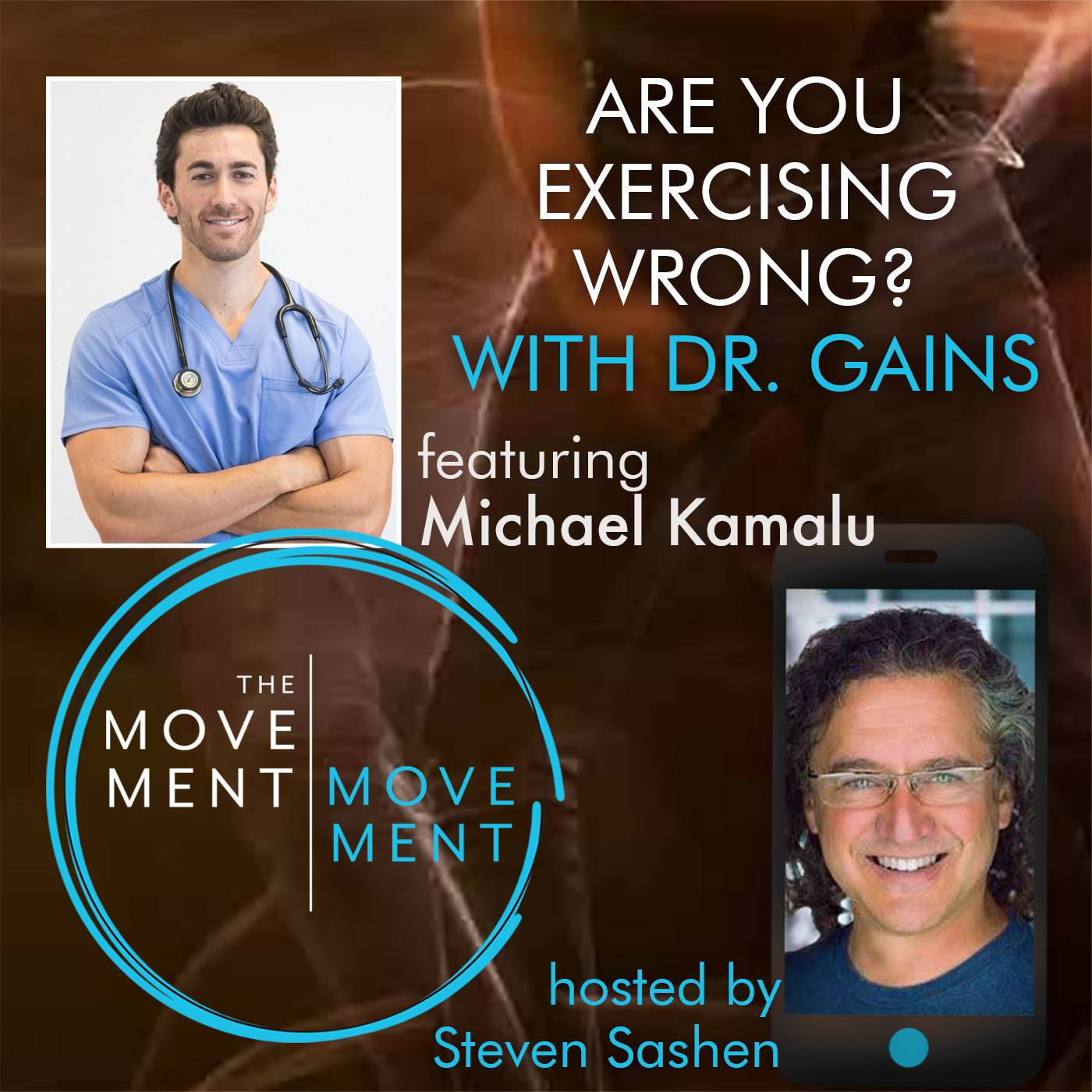
What would you do if you were watching a bunch of fitness influencers and people telling you how to work out how to get in shape, how to look better at set rep, better performance, and you knew that what they were saying was just complete crap. What would you do? Well, we're going to talk to someone who went through that little moral dilemma today on today's episode of the movement movement, the podcast for people who want to know the truth about what it takes to have a happy, healthy, strong body starting feet first. You know, those things are your foundation, although we might talk about other body parts first.
But here on this podcast, we break down the propaganda, the mythology and sometimes the flat out lies that you've been told about what it takes to run or walk or hike or play or to yogurt cross it or whatever it is you like to do and to do that enjoy and efficiently and effectively that I mentioned, enjoy. That's a trick question, of course, I did because look, you're not having a good time. You're not going to keep doing whatever it is you're doing. So find a way to have some fun.
I'm Stephen Sashan, CEO and co-founder of Zero Shoes, and we call this the movement movement podcast because we're creating a movement. We'll talk about that. We part of that about natural movement, helping people understand that your body works great if you let it do what it's meant to do. Now, the movement part that involves you, like these spreading the word is really simple.
Go over to our website, www.jointhemovementmovement.com. There's nothing you need to do to join. There's no secret handshake or money involved. You can just find previous episodes of the podcast, all the ways you can find us on social media.
And of course, if you're not hearing this podcast from someplace that you like, you'll find other places you can get the podcast. So with that, oh, and spreading the words to keep things. So give us a review and a thumbs up and hit the bell icon on YouTube and subscribe and all those things you know what to do. And in short, if you want to be part of the drive, just subscribe.
So let us get started. Michael, pleasure having you here. Do me a favor. Tell people who you are and why in God's name you're here.
Thank you, Steve. I mean, first time I'm a little disappointed. There's not a secret handshake. I mean, that...
There's a secret handshake for people on the podcast. You didn't get the email about that? No, I'm the same one. Well, check your spam folder.
We'll figure that one out. Alright. Well, my name is Michael Kamalu. I am the founder of the Dr.
Gains Health and Fitness Brand. And I'm here because I have somewhat of a unique take on fitness, specifically resistance training, but general fitness and health as well. And I started the brand after becoming frustrated from what I saw with various fitness influencers online, what I felt was often just straight made up. Things that sound good, but are not correct.
And other things that lead to significant injury. So that's... Well, hold on. You left out the best part of this story.
The best part of this story is starting when you were a med school and your wife basically told you, you know, put up her shut up. That's true. Yeah. So, yeah, this is my first year of medical school at Mayo Clinic.
And my wife was pretty into the fitness influencer scene on Instagram and YouTube. And I catch her watching things and tell it out. That's wrong. Don't listen to that.
That'll get you injured. Never watch that guy again. And after complaining about how bad everything she was watching was, she said, you know what, why don't you go ahead and do something about it and tell everyone to decide, all right, I'll start a fitness man. And how long ago was that?
That was 40. Yeah, almost 40 years ago. Not that long ago. Well, and I'm going to say something about you.
This semi-personal just so people have a context for this. When you check out Michael's site and we'll... May as well drop the hint now, Dr. Gaines.
You can give the URL or tell them where to find you on social media. Usually, this is the end of this important for now. So go for it. Yeah, dr-gains.com.
That's the website, the YouTube channel is Dr. Gaines and then I'm Michael Kamala, one of the other socials. And we'll have all the spelled out for you and it'll be in the show notes. So one of the things that's very interesting about Michael as a fitness expert slash influencer for lack of a better term is when you start out, you know, and you're wearing your doctor's lab coat and you're looking like a normal human being, you don't look like your average fitness YouTuber, for example, or fitness Instagrammer, because you don't look huge.
And then you do something crazy like take off the majority of your clothing and everyone goes, oh shit. Okay. I was greatly mistaken. And what's interesting to me about that is your body type, and of course, a lot of this is just genetics 101, but your body type is way, way closer to what normal humans, if I could use that term, have the ability to become, then what you see with these guys who are claiming that they are natural and often aren't, or just have mind blowing genetics and you will never look like that.
No matter how much you lift diet, take whatever drugs you can think of, et cetera, et cetera. And so this is going to be a weird question following that weird intro, which is how do you feel about that? Yeah, that's a great point. And that's when people have a skewed perspective of what big is and what is realistic because the 99% of the people you look out online YouTube and they're just huge.
They're not natural. They're the ones who say they're natural, they're lying, or they think because they're not taking this specific subset of steroids, they can say they're natural when they're taking all sorts of other anabolic, you know, supplements, et cetera. So, yeah, what somebody can naturally achieve, and of course there is some variability with genetics, but you can tell, you can really tell. And it's unfortunate because that unrealistic perspective also prevents many, many people from even starting, right?
Like I'll like, they go to the gym a week, two weeks, et cetera, and they get this idea, I'm never going to look like that guy. So why try? And then there's also just, you know, I often, when I get people saying, oh, you should be bigger, et cetera. I'm just as big as I want to be.
I don't want to be any bigger, any bigger, and you start losing functionality, you start losing flexibility. It's no longer beneficial really from any health standpoint at that point. There's a guy, I'm not going to mention it by name, but he's got a very successful YouTube channel and he's a science-based fitness guy, but he's also 100% admitting, yeah, I'm taking a bunch of drugs to do what I'm doing. And he did a really, really interesting interview about the up and downsides of being that big, and there were way more downsides.
And he was really, really just wonderfully honest about that in a way that, you know, there's no question it didn't make anyone go, well, I don't want to do it, even though it undeniably should have, because he was really saying, you know, things like, when you break a sweat, I mean, like a full body sweat, while sitting down, that's a problem when you're that big. You know, when you can't get into a car, that's a problem. And, you know, and he was, and he wasn't trying to sugarcoat it, but people really, they leave that out. I was really impressed that he was willing to, to, to fess up conversely.
I got a kind of Queen's, who is a former world champion bodybuilder back in the 80s, who to this day will not admit that he took any perspective of the world. I mean, he took any performance enhancing supplemental things, which is hysterical because all of his peers are now on, if they're still alive, they're all getting online talking about exactly what they did. So it's fascinating just what people will or won't say, but it's really wonderful that you, I think you are not someone who's presenting something that is so unrealistic that it either turns people on for reasons that are inappropriate or turns people off for the, for the opposite reason, because they think that that's just not even attainable. So you're in a whole different world.
Anyway, that is a may. So, so, so, so, back up then to what you were bitching about and then that led you to starting the starting the, the, your actual business is a fitness person. Let's talk about some of those because these are things that people are often doing on a regular basis or think they should be doing on a regular basis, and they could be causing problems. So what you're, you know, like, rough, not rough more top four things that you see that makes you want to scream and, you know, run into the gym and throw weights out of people's hands.
Yeah. Are you talking about the media to for that? You know, they're first ever like come to mind them. One is no days off.
It's a rally cry, you know, in the industry, just to show how, how mentally tough you are. No days off is a great way to not achieve any gains because for one, you don't build muscle while you're lifting. You build muscle during the recovery phase. If there is no recovery phase, you're not building muscle, right?
And then two, it will inevitably lead to overtraining injuries, which will then prevent you from being able to lift. And, you know, you're, there's a point where more is less, I guess, is what I'm saying here. So there should absolutely be days off. And there's a lot of different strategies you can use, which I won't dive into now, but just from a general perspective, yes, you should take days off.
And generally a lot of people work each muscle too often. Now we're talking specifically for resistance training here, not cardio, but people don't need to work unless well as often as people think that you do. And then probably the next one would be lack of variety. People have this, you know, this core set of lifts that they do and they just stick to that.
What they don't realize people don't appreciate how complex the human body is, the musculoskeletal system in particular. These are people saying, you know, a contraction is a contraction doesn't matter how it happens. Just, you know, working with one exercise is the same as working with a different exercise. And that couldn't be farther from the truth.
There's a principle called region specific hypertrophy or non homogenous separation activation, where muscles, they are not activated equally across the muscle. So they're set. It can be broken down into even sarcomeres is a no functional unit. I don't know.
We want to get to technical here, but you can get technical. And then if I feel the urge, I will ask you to dumb it down for people who are not that technical and dumb it down is a hard way to make it more understandable for people who don't have the knowledge of biomechanical lingo. Thank you. All right.
So, so, yeah, so please explain the sarcomeres. Different sarcomeres can be activated to different degrees and they are activated to different degrees based on the variety of factors. There's, you know, the range of muscle range of motion of muscle being used. There is the angle of resistance.
There is whether it's an eccentric or eccentric depending on how you pronounce it or concentrate or asymmetric contraction. Those all work different regions of the muscle in different degrees. And then there's whether it's a compound lift or nice relations or as in is it moving two joints to hit that muscle or just one joint. And there's a whole slew of other factors that all influence which reason of muscle is being used the most.
So, if you only work each muscle the exact same way each time, if this is for one, that's how people get lumpy. They're big, but they don't really look good. They're just lumpy, right? Because they're using the same exercise every single time.
And so they're not getting even balanced muscle growth. And then it also leads to injuries because if you're only strengthening a muscle along, I say one line of resistance in life, you know, you don't live life along one angle of resistance. Right? Like this dynamic.
You're twisting and you're turning. And once that muscle gets placed in a point of stress, at an angle that you haven't strengthened, that's when you get injured. So, variety is absolutely essential with resistance training. And I think it can be applied to pretty much any type of exercise as well.
But too much of one thing is generally detrimental. But does that make sense? Let me ask you two questions about that last point. One is given that, let's start with this one.
So, let's use an example. So, let's talk biceps for fun of it. So, talk about different exercise you can do for biceps. And I will add a little caveat or maybe a little teaser that I've noticed at least in the videos that YouTube is recommending that I watch.
There's always in the fitness world, there's like things that kind of catch on for a little while. And maybe they stick around, maybe they don't. And lately, I've just been getting a whole bunch of videos from a whole bunch of fitness guys who were talking about doing pull ups in a particular way or chin ups in a particular way, rather than doing bicep curls because for a number of reasons. But that's a bit of a lead into.
Let's talk about a few different ideas of what you would do for biceps that are different exercises that have a different effect on that particular muscle group. That's a great one. So, I'll put a caveat here that scientific research is really just getting to the point where we can prove that there's differences in regional activation within the same muscles. So, some of what I will say is more based off of how I've applied to the principles and able to see the results myself.
They haven't been actually proven in scientific research yet. So, I'll start with something that has the biceps performs supination. So, you know, rotating your thumb externally, rotating your forearms, that your palm is up, your bicep does that. If you grab your upper arm and then go like this, you will feel your bicep contracting.
So, yeah, for people who are listening, grab your, you know, using my left hand, I'm grabbing my right bicep. I'm turning my forearm and wrist palm, well wrist palm up, hand palm up, but not just at the exclusion of the rest of my forearm and definitely feel like contraction of bicep. So, bicep is the primary supinator of the forearm. And, but there are two different heads of the biceps, the long head and the short head, and each head performs different ranges of supination.
So, like if you start with your palm facing down, going from there till your palm is almost completely face up, that is done by the short head of the bicep much more than the long head. Then from almost fully supinated to past the supinated position, so rotating your thumb out even more so that your hand is facing out to the side, that is done by the long head of the biceps. So, that's, that's an example, but it, you know, that's talking about different heads of a muscle. There's also different regions within the same head.
So, another thing that has improved in is, say you're doing bicep curls while standing up, and if you're using a straight bar or a preacher bar, doing curls in that position, that is going to mostly work the upper or superior region of the biceps. Now, the whole thing will be activated right? It's not exclusive, but it will work the upper portion more than the lower. Whereas if you put an angle of, it's got your, you're making it so that the 90 degree point of maximum resistance, so the point where the muscle is feeling the most load is when it is more contracted than not.
And then it's towards the top of the range of motion. Now, let's say if you were to, I'm trying to visualize this, if you were to have a flat bench in front of you, and then you were to lay your arm to the back of your upper arm is on that bench. And then you put a dumbbell in your hand and your forearm, but now we're handing off the edge of the bench. In that position, maximum resistance is when the bicep is fully extended, right?
It's when your elbow is straight. In that position, you are working at the lower region of the biceps more than the upper, right? So there's various different positions you can use to work biceps at its point of maximum extension, but that's an example of a differentiator. That's an interesting one.
Since another thing that's been popping up a lot lately is inspired by some research that came out about birds building muscle from just having basically a weight on their wing, just at a stretch point, and just that stretch initiating hyper traffic response. And what's of course been interesting is that that seems to be true for many muscle groups, but not all muscle groups. But to that point, just being in that stretch position, which is what you just described for that second bicep exercise, it would make sense that would act differently than if you're when you're stretching essentially around the elbow joint or stretching around the shoulder joint, the other end of the bicep. And but what's interesting is even people who recommend those different exercises, they aren't recommending them with the kind of, for lack of a better term, understanding that you just laid it out with about why these things are doing, what they're doing, and what the effect could be, which will give people an ability to think through what they're trying to accomplish.
And of course, there is going to be some genetic variation about whether you're doing something in a stretch position, like that example of the bicep, whether that is going to demonstrably dramatically change the shape of your bicep, because there's going to be different things that might come into play, but it leads me to the second question I wanted to ask. Given the human beings really like cookie cutter paint by number, just tell me what to do, and then I'll just do it more than they like to try to figure out on their own. How do you manage that as you're getting people to think about these different exercises to do for different reasons and different regions, if you will, of a muscle group? Yeah, I always emphasize the importance of understanding the why and the how, and not just the what, and that is probably one of my, you know, Mount Rushmore top four things that I emphasize, because once you understand the fundamentals, right, then you don't have to just trust what some influencer says is true.
You can actually analyze exactly what they're saying, what are the principles behind it, does this make sense or does it not. So yes, I mean, there's a lot of people who just want to go straight to the what. But if you don't understand the why and the how, you're not going to be able to perform the what as effectively as you can, and you're definitely not going to be able to personalize it, right, because there's, like you said, there's so much variability and cookie cutter work outs. They are far from optimal.
You have to be able to adjust and customize based off of your own body, you know what, what you're feeling, what your actual needs are. And so that's impossible unless you really understand, you know, the fundamentals behind it. So exactly what the muscle is doing, you know, how, okay, what's its origin and assertion, what movements can it perform what range of the movement is being worked here. And you can go far, far deeper than that, obviously, but understanding just those few basic principles of the underlying anatomy, the movements that it performs, then even with just that, you can analyze any exercise and really get a good feel for exactly what it's going to work and why.
And I'll say, go deadlift, for example, that is a very complex exercise, right, it involves virtually the entire body. But if you just say, okay, I'm going to go do a deadlift because somebody said it's going to work this, this, this, you're missing out on so much because there's so many different variations of the deadlift, right. Or I can do it with my knees a little stiffer rather than bending down all the way, or I can do it with my feet spread a little wider. And if you understand the underlying anatomy behind the movement, you know exactly what each of these variations will do to various muscles being worked.
So I say, I mean, you have a hamstring strain, right, you want to be able to do a deadlift still, okay, I'm going to choose a deadlift variation that takes load off the hamstrings, right, and emphasizes other areas of the muscle. So yeah, absolutely essential to understand the underlying why the exercise. It is interesting. I think that there's maybe one other benefit that just occurred to me that if you have this understanding and it may sound complex, but it's not like the example you gave on the bicep of just what you experienced with supination.
Once you sort of just get that, it's not rocket science. And so one of the things I appreciate, I appreciate about what you're doing is sharing information this way where it's just really obvious or simple to understand without having to have a master's degree in anatomy, for example. And so it raises a question that or something I'd love you to talk about, which is a term that people use and rarely define it, which is mind-muscle connection. They want you to have a good mind-muscle connection when you're lifting.
And it occurs to me that if you don't have some of this information that you just described, it's hard to have that. So let's start with your definition of that and how that applies once you have some understanding of the different ways you can impact a muscle with different exercises, different angles, et cetera. That's extremely, extremely powerful concept. So I was actually a neuroscience major of my undergrad degree.
And so I'm fascinated by how the brain interacts with the muscles and how you can influence various outcomes. So I guess my definition of my muscle connection, my body connection would be just instead of going through the motion kind of roadly, being able to very intently focus on a specific outcome of that exercise. So why am I doing this? Okay, I want to actually improve this specific region of a muscle or whatever the outcome is.
And then one actually really good example of this is studies have shown that if you touch a muscle region during an exercise, you can actually increase the relative amount of engagement of that specific region. So let's say, you know, you're doing a chest fly and you want to try and emphasize the inner region of the fibers. You can actually find working from doing the fly with my right hand on a cable machine or something. You take my left hand and actually touch the region of the muscle that I want to emphasize, and it will increase the amount of relative engagement in that area.
Sounds crazy. It's been proven that the power of the mind is really unbelievable. And science is really just kind of breaking the surface of what this can achieve. That's an interesting one.
So just getting that per perceptive feedback or is actually more than per perceptive feedback, that kinesthetic feedback is intriguing for me for two reasons. One, I see that with runners where they often don't, they don't have that kinesthetic awareness. They're a perperceptive awareness. They don't know where their body is in space.
And there are, and it's trickier to put your hand on a perperceptive body if you're running. But one of the things that we're trying to do with people, in fact, one of the things that we're doing with our product is giving people more sensory input, more feedback, which can change motor patterns. Pretty effortlessly as a result of that. But I'm also thinking that there are people who just don't know what their body is doing or they can't feel what their body is doing because they haven't used certain parts in so long.
Their brain is sort of shut down. So it's an interesting thing. Just pondering, you know, ways that we could improve learning new movements just by adding that kinesthetic feedback. And the second thing that made me think of, so I shoulder surgery, I was called eight weeks ago, something like that.
And so when, and biceps surgery as well, thanks to being an older former gymnast, like way older, way former. But regardless, it's interesting. So when I'm lifting to get that bicep working again with my left arm, what I've been paying attention to is paying attention to the muscle, paying attention to the bicep and contracting the muscle as a way of initiating the movement instead of just doing the movement. And that's another component to, you know, in my mind, for my muscle connection is like that kind of a ten of this.
Now, some people again may not be able to feel that. We need to get that extra kinesthetic feedback, just feeling something to see what's working. In fact, this just made me think of this one. Dr.
Emi Davis, when people come into her lab with some sort of running injury, one of the first things she does for almost everybody is she pokes, takes her finger and pokes their gluteus, pokes them in the butt. I had to say gluteus, max first, otherwise puking the butt sounds like it could be a very different thing than what she does. And basically says, you know, squeeze your butt so you can feel that you're getting resistance to my pushing in that muscle. And many people can't do it more and more accurately.
They can't do it if you're asking to flex their butt independently, then she pokes them and says, naturally. And even then, many people are able to do better, but they still don't know how to activate that muscle yet. And they're getting more feedback eventually. They figured out and then it has to become internalized.
So it's just a fascinating thing about how our brain either can help with making these movements and be beneficial or just just tune out and you've got to wake it up somehow. Yeah, you know, the brain is very plastic. It's called meaning it can adapt and change very quickly, very easily, far more so than any other organ in the body. And it's ability to hone in on specific muscles and the other specific regions of a muscle is incredible, but not necessarily naturally.
Like you said, especially if it hasn't been trained, hasn't been very intentionally grown. But once you doesn't take a whole lot to get there, though, you know, again, once you understand what muscles are involved in how like, for example, if I'm doing a front raise, where I mean, should I explain what a front raises are? Sure. How's it fun?
See how well you can do on this one? Okay. All right. So let's say doing it with a cable machine and you have a cable set fairly low.
And just one arm, you have the arm neutral, so hanging down by your side with the elbow straight, holding the cable handling your hand. And then you slowly flex your shoulder forward. You know, people will say extend your shoulder, but that's actually the opposite of shoulder flexion. And moving the shoulder forward and up and then back down.
And there are three different primary muscles that perform that movement. There's anterior deltoid or front delts. There is pectoralis major chest, and there's also the biceps and the biceps cross the front of the shoulder. So they're performing that movement as well.
And when I'm doing it, I can focus in on one of those three more than the other just by using that my muscle connection. And they're okay, I want to work my front delt with this exercise and my front delt will work far more than the other two muscles, yet if I wanted to work my biceps with that exercise, I could do that as well. So, yeah, there's really limitless potential to how you can leverage my body connection. Yeah, the focusing is fascinating.
And since I'm recovering from surgery, when I'm doing things like a front raise or lateral raises or or scapstone raises, whatever, it's as a former gymnast when I was doing those, I was focusing entirely on all those muscles in the front because that's a really important motion for gymnastics. And now I'm working, thinking about all the muscles on the back because I got to get my shoulder back in the right place and staying there. And it's so fascinating for me, literally 50 years after the first time I did one of these exercises to be paying attention to the quote wrong side of my body to initiate that movement. And it took me a while to even realize that's what I wanted to do because I had so much in my brain of doing the way I had done it for well over a decade.
And it's a riot that you can get, initiate and perform the same movement and have the impact be completely different muscles, which is it makes your brain hurt if you think about it too hard. And you actually touched on one of the things that I also hit on a lot is the shoulder imbalances that are so frequent with resistance training, because the vast majority of people's focus is all in and forward, right? It's the chest, it's the biceps, it's the front delt, everything that pulls your shoulders in, you know, it pulls them forward and rotates them in. And then what happens eventually, well, that closes off what's called the sub-achromium space.
And that's where your rotator cuff tendons, you know, pass through and so it ends up grinding your rotator cuff against the bone and then you get the impingement, the teariest. The labral tears, the bicep tendon tears, all of that. So it's absolutely essential for people to work just as much, the external rotators and the retractors of the shoulder. But most people don't do any external rotation specific exercises.
So that's something I've done a lot. Well, there were two thoughts that I had about that. One just fell out of my brain entirely, so I'll go into the second one. As I've been doing, especially all the shoulder stuff, it occurs to me that a lot of sports that we encourage our children to get into and as a child I was into, we're not, oh, I know what I was saying.
We're not at that time, even strong enough to be doing any of those things properly. Like when I was a 12-year-old gymnast, I literally didn't have the kind of strength in my back, those external rotators, those retractors, to keep my shoulders in the right place while I was doing all those other things. I mean, it was just not even possible. And it wasn't until, you know, well past my career that my body was in a place where I could actually develop that kind of strength.
And so I've just been pondering lately how often we get kids involved in sports that they're just physically not ready for unless they have perfect technique, which is really, really rare, because that requires perfect coaching. And the other thought that went along with that before I lose it for the third time is one of the reasons we're so focused on all those things in the front. And I wish I remember the name of the guy who did it. He's a psychologist who's written a bunch of books about how the literal construction of our perceptual mechanism impacts things we do.
In other words, we rise in the front of our head. So we're very attentive to the things that we can see in a mirror or you can see when we look down. We don't have eyes in the back of our head, so we don't pay attention to that. And so similar thing with running.
People don't understand that if you don't overstride, that doesn't mean your gate is somehow magically shorter. It just means that you're putting your foot down in front of you and your gate is extending behind you. Your leg is just standing behind you differently than having your leg extending in front of you. And then it just barely doesn't go behind you.
But because we can't see those things, it's really hard for most people to then make these changes that they, again, just simply can't see without eyes behind them. Yeah, that's a prevalent concept in weightlifting as well. I mean, you perform a deadlift, for example, you think you're doing everything perfect, but you don't see yourself right from the side or from the back. And so that is one of those areas where having a coach, someone knows what they're doing and can walk you through those things.
You can't see. It can be really important. It was a moment of great pleasure for me when I was working with a sprint coach who was talking about, and this is remotely, he was in the UK. And he was talking about how, for the exercise where you're going to be able to hip hinge, being able to bend the right way, giving your back flat, et cetera, et cetera.
I'm not going to get into what a hip hinge is. And he spent like an hour talking about this and said, so send me some videos, you know, you hip hinge. So I send him the videos and he just called me back and went, all right, well, you don't need any hope for that. So I was very happy about that one.
Because it's one of those things where you can't see it at all. It has to be either you're looking on video or you're feeling, because even if you have a mirror to the side, just looking to the sides and going to mess up what you're doing for most people. So it's a fascinating one. Do we leave anything out of here?
And we did a, we did a wrap, not rush more, but maybe there's a couple other things that pop into your brain. Like if I could make people stop doing this forever, that would make me happy. Yeah, there was a few that I thought about as you were talking, you know, a couple of them already went out the other side. But one is people are way too focused on how much weight they are lifting.
And honestly, I haven't tracked like what my one rap max is or anything of the sort for a very, very long time. I don't really care how much weight I can bench. It kind of harkens back to that, that my muscle connection. I know when I'm lifting away, if it is enough to trigger the various type of benefits that I want, just not, I just make adjustments.
But if you're too focused on the amount of weight, then form inevitably suffers, right? And it can be very, very small, you know, differences in form that can have just drastic impacts. You know, with a bench press, for example, if what you are focused on is getting the right contraction in the right areas, then you will use perfect form throughout. If you are focused on just moving a specific amount of weight, then instead of keeping your shoulders retracted, you'll push them forward.
Instead of, you know, moving both sides evenly, you'll start rocking your shoulder side side, trying to get a little leverage here, leverage there to kind of get that weight up there. And I'm so dangerous. And inevitably, we'll lead to injuries and balances, first of all, because one of the reasons you have to rock side to side is because one of your sides is stronger than the other. And so when you do that rocking motion, you're not balancing out the strength.
And so you're just worsening that discrepancy and all sorts of different injuries and the balances will occur. So I, unless you are a professional or a competitive power lifter, where that is your focus, don't be too concerned about how much weight you're using. Yeah. You more concerned about getting the contraction done the right way.
Yeah. It's an interesting thing to get over the self-consciousness of using light weights, admittedly. I mean, let's not be coy about this. If you're in a gym and you're doing whatever exercise with something, basically, if you're taking the weights that some woman who's half your size is using and removing some plates, that's a hard thing to do.
That's the right thing to do. I mean, I will say it was fun for me when I was pretty much at my strongest, when I was in my mid-40s as a sprinter. And I was doing a lot of dead lifting. I got really good at it.
And I'd go into some gyms and it'd be some really big guy who had 350 on the bar. And then he'd see that I was going to get on the platform and lift next and he starts to try and reach for the plates. No, no, I'll be adding some. I will admit, I really enjoyed that.
And the fact that now I've got to come up with my spine, not for that reason, that A, I can't really dead lifter is not smart for me. I can do single leg stuff, so I'm using even less weight and then using even less weight and really focusing on whether it's working. It has taken me years to be okay with that when I'm in a public gym. And more accurately, to be okay with the fact that I wish I was lifting some huge amount of weight instead.
And that's just a thought in my head. And then I just keep doing what I'm doing and going, yep, that'll be really fun, but that'll be really stupid too. Yeah, you're right. It's just kind of got to put away the ego.
You're never going to put it away. You just have to pat it on the head. I completely agree with you. We're just not there.
It's kind of like when I got back into sprinting, it took me two years to learn that when my brain says, let's just do one more. That was the time to stop because for the first two years, let's do one more is what got me injured. And it's just a similar thing to what we're talking about here. It's so easy to, because again, we like to have that cookie cutter thing.
The weight is a definitive thing. It's measurable. It's uncontrovertible. It's other words that I can't think of that you would find on the SATs that were simpler words that weren't coming into my head.
But you know how much weight it is. How much you're feeling, getting used to doing things by feeling. It's such a radical idea, especially when we're such a goal-oriented group of human beings over here. That makes sense that we'd be obsessed with the number instead of the effect and the feeling and the way you're doing it.
Well, there is a technique you can use that can, you know, qualify the ego and still prevent injury. And that is to use the eccentric again to people. You know, eccentric. I think that's just reminds me too much of eccentric people.
So, eccentric faces of the exercise for one. So, you know, eccentric contractions are better for you. Actually, they trigger strength and hypertrophic gains more at a greater and faster rate than concentric. Now, I guess I should explain, eccentric is the negative phase.
So, if we're talking about a bench press concentric is pushing it up. Eccentric is it coming back down. So, it's pushing you basically. So, that negative, most people are really only focused on the pushing out phase.
That's what they're trying to do. But the eccentric, the negative is actually far better for you. And you're stronger in any eccentric contraction. You can lift more weight that way.
You can put out more power. And it is much less likely to result in injury. One reason just is, you know, how the muscles themselves are put together. But the other is, again, using the bench press as an example.
The concentric phase, you're really focused on getting that up. That's the goal. I got to push this thing up. And I'm going to do whatever it takes to get there.
I'm going to arch my back, et cetera, whatever it is. Whereas on the way back down, like you know, you're not trying to move it somewhere. It's moving you, right? You're just kind of resisting it as it comes back down.
And so, if you were to load up a ton of weight on a bench press and do only the eccentric phase, you know, you're not going to be pushing that back up. So, you're not going to arch your back. You're not going to twist your shoulders. Right?
You're just kind of resisting it as much as you can as it comes down. And so, you'll maintain proper form. So, that is the way you can put a lot more weight on whatever exercise you're doing and not sacrificed form and not risk injury is just focusing on, and again, better results, just focusing on the eccentric contractions. Well, I asked you a question about that.
Something I've been thinking about lately. For most people, they think of the eccentric as literally just a little call it for the bench press, the lowering phase. And they, for them, and eccentric is about just slowing down the lowering. Whereas the real value for the eccentric like you described is that you can handle more weight.
Let's say you can push on making up an number. You can push 150 pounds. But if someone put, and I'm totally making up numbers, they suddenly put 300 pounds on the bar. You can resist that coming down before it crushes you.
You can resist it pretty significantly. I have the idea. And again, I'm down here where you think that the way most people think of the eccentric, again, just the slower lowering is really just increasing time under tension because it's not really taking advantage of the overload phenomenon or the overload possibility in eccentric. But of course, to do just the overload part, there's certain exercise where that's really easy, pull up dip, et cetera, where you can, you know, step on a bench to get to the right to the right to the for pull up step on a bench to get to the point where you've got your chin over the bar and slowly lower yourself.
Dip, same thing. Step on a bench till you're fully extended and slowly lower yourself. Not so easy, especially on your own for other exercises unless you have some electronic or electric equipment, electric motor equipment, like a tonal gym or whatever, where you can program it for that. So what's your take on an overload at eccentric, like a legit eccentric where you're doing everything you can to not to resist that motion versus just slower slash time under tension?
Yeah. So it depends on if you have a partner or not. But let's say you don't have a partner. The key is unilateral exercises or one side at a time.
So let's take the bench press. In this case, you will be able to do a dumbbell press then. And let's say in a dumbbell press, the most you could press would be, you know, 80 pound dumbbells. Well, then I'm going to get a hundred pound dumbbell and I'm going to start with the on my chest with both hands on the handle.
I'm going to press up with both hands. And then I'm going to let go with one and just resist it coming back down with the other. Right. And then again, I push up with both hands and then you kind of have to shift it to one side before you let it drop down.
But I do this frequently on my own. And you can do this with virtually any exercise, any muscle group. You just have, even if you're on your own, you just have to do it one side at a time. So, you know, bicep curl, same thing.
If the most you could do in a curl is 40 pounds, then take a 50 pound dumbbell. Use both hands to curl it up. Let go with one resist it as much as you can on the way down. Yeah.
Let's be clear, especially on the bench press example, when you use both hands to push it up, make sure you only like go one hand and not two because that would turn into a whole different thing that we are not responsible for. So that is. I can imagine I've seen some crazy things in the gym and I can imagine someone that will exercise. So that's a clever way of doing the bilateral on the way up and the ladder on the way down, which will seem again awfully weird to most human beings.
But if you try it, it's fascinating. People, I think the first time someone does a real negative where they're just seeing how much weight they can load up to then just slow down how much it's going down. They're stunned at the difference between how much they can push for so much they can resist. And to be fair, if you really do any centric workout, you'll be I think the technical department, please correct me.
I'm not a medical professional is sort of shit. Did I get that right? You got that perfect. Again, it comes back to a variety and how, you know, so many factors determine how a muscle is worked.
So if you haven't focused on eccentric workout, Stangath, for a son, you do that. You are going to be insane. But, you know, and I said earlier, eccentric is hard for you in general. You know, you can lift more and they trigger size and strength gains better and they prevent injury better.
But even then you don't want to do the eccentric exclusively. Right. Variety is key. So you still want to be working working in, you know, concentric contractions, isometric even.
Isometric is when you're pushing or pulling, but there's no movement. It stays the same slot. I think it's an example of for eccentric that they may not even have thought of. If you've done any hiking where you're going uphill in a big way, you know, you can get to the top of the hill or the mountain, whatever you're having to be.
And, you know, you feel like you work down. You feel pretty good. But then that coming back down is where you end up your quads are on fire for the next days. Like, and that is the eccentric.
You're just trying to slow down as you're bending your legs, you're going to slow down how you're going down. Is it a better way of putting it? And that's, you know, it's a good one. Anything we missed from things that we wish people would never do again.
And if I, I got to tell you, there's a time where I was sitting at the on the path of the Boulder Creek with Denny Dryer from G running and Danny is a great running coach. And we were just watching people running by and simultaneously going, Oh, God, you know, just seeing so many things that people are doing that they'd be having much more fun, let alone being more effective and efficient. If they weren't doing those form things, having this form problems that we were seeing them having, but we elected not to run up and tackle people and try and tell them what to do instead. But anyway, in the time we have left any last.
Here's one that you really really get your go. Yeah, I mean, most of the rest would kind of be a movement specific, right with specific lists of movements. There's always things that people do wrong or little tweaks they can make to emphasize different areas. I think probably the last thing that I can think of right now that is a big pet peeve and also a significant detriment.
People's success is swinging weights using momentum, right. And this comes back to the ego. People want to be, you know, look like they're using more weight. So let's say it was the bicep girl, they'll get a big dumbbell and then rock their back, swinging the way as they bring it up.
And then they got this kind of back and forth swing emotion going on. That's doing nothing for your biceps. Right. So, and I guess I should say there is there are areas and advanced level where you actually do want to use momentum, very controlled, very specific ways.
But that's that's pretty advanced. A general rule of thumb is don't use momentum. Don't swing weights, you know, use slow controlled contractions, focus on mind, body connection, exactly what it is you're trying to achieve with that specific exercise. And it'll be far more beneficial for you even though you'll be using less weight than you otherwise.
That is a good one. Well, on that note, first of all, thanks. Let's wrap this up. Do me a favor once again.
Let people know how they can track you down and find out more about what you're doing so they can do more things for themselves that will be beneficial as they continue to live a human life. Yeah. So the r-games.com that's with an S not a Z D A I N S and I have a weekly newsletter that I send out just called Fitness Tip Friday. Just a brief email where I send out the little week something that is immediately applicable for your life.
Something has to do with health or fitness and you can find that on my website. And then the YouTube channel is Dr. Gaines and my other socials, Michael Kamalu KAM ALU. Perfect.
Well, Michael, a absolute pleasure. B, really looking forward to what's next. I'm looking forward to hearing what people experience when they track you down and find some of the things you're doing and get involved with your work, which again, I'm just really impressed by because there's so few people who, you know, almost any physical activity who take the time and effort or have the inclination to really listen and look at what people have been saying and doing that's just been passed down and passed down and go, yeah, hold on for one second. There may be another angle to this pun intended or a different way of thinking of this or maybe you're just flat out wrong.
And so, but it's just the way people have been doing it. So I appreciate what you've been doing. Anyway, for everybody else, thank you for being here. Go check out Michael at dr-gains.com and Dr.
Gains, et cetera, et cetera. He gave you all that stuff. I need to tell you again. And for our end, don't forget, go to www.jointhemovementmovement.com, find previous episodes, find all the ways you can engage with us on social media, et cetera.
And as always, if you have a request or suggestion, someone you think should be on the show, ideally, it would be great if I could finally get someone who thinks I have a case of cranial rector orientation syndrome and we can do it out and see what happens when I just ask questions like really wish approved. But either way, you can drop me an email at movemov-e at jointhemovementmovementmovement.com. And until then, go out, have fun and live life-y first.