
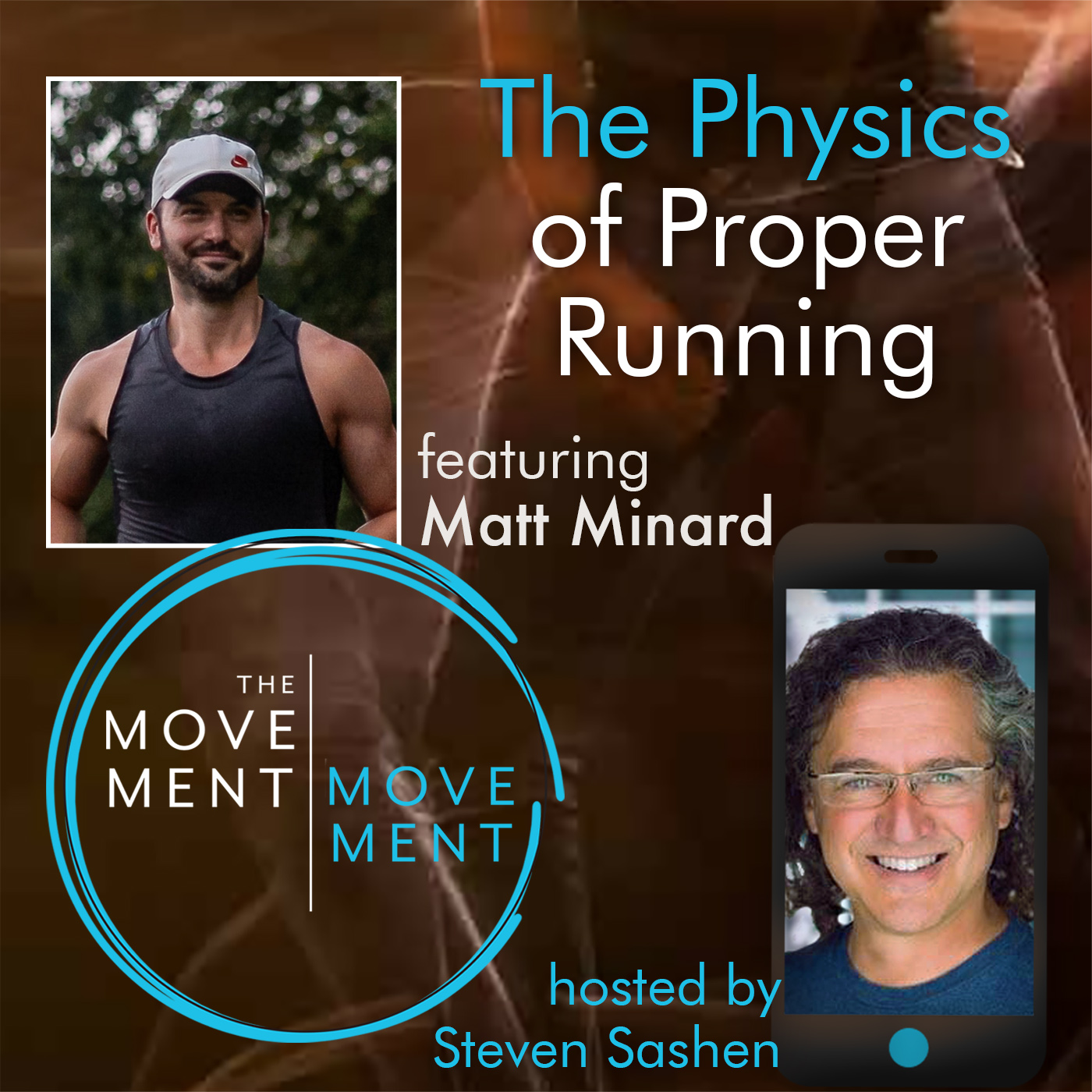
I did a call, some of you may have seen, if you didn't, I'm going to point to it, you're going to want to see it. There's a guy who calls himself Chase Mountain, he did a video about how basically Bae Fritches are better. Actually, sorry, how the barefoot industry is lying to you. And I called him out on that, and happily, he took me up on the offer to have a conversation rather than doing what people do on YouTube, which is like reaction videos back and forth and back and forth.
And he says, why me and Bitchy, he had a conversation. It was really, really interesting. And what I really love is that conversation led to this conversation. More about that.
When we get started on today's episode of the movement, move at the podcast for people who want to know the truth about what it takes to have a happy, healthy, strong body starting, first, you know, those things are your foundation. And we are breaking down the propaganda, the mythology, and sometimes the straight out lies, you've been told about what it takes to walk, or run, or play, or to yoga, or cross, or whatever you like to do. They do it enjoyably, effectively, efficiently. Wait, that's the Friday that I said, enjoy, right?
Of course, I did. I said, I didn't mind you. I did. Because if you're not having fun, you're not going to keep doing it.
So make sure you're finding something that you like to do. I'm Stephen Sashank, co-founder, co-CEO of Zero, she was here to prove it. And we call it the movement movement because we, that includes you, we're about that in a second, are creating a movement about natural movement, letting your body do what it's made to do. The U part, simple.
Feel free to go to our website. It's at www.jointhemovementmovement.com. There's nothing you need to do to join. But you can subscribe to hear about future episodes.
You can see all the previous episodes. You're gonna listen to the previous episodes. Find us on social media and find other places where you might want to get this podcast. You don't like the one you're getting it from now.
And if you want to help move the movement, then like, share, review, thumbs up, bell icon on YouTube. You know, the drill, if you want to be part of the tribe, please subscribe. All right, let us jump in. Matt, do me a favor.
Tell people who you want to know what you're doing here. My name is Matt Meinert, technically Dr. Matt Meinert. And it's pronounced Meinert.
It's easier to remember. I was made fun of it when I was younger, but I'm trying to use it for my advantage in marketing. My nerd, I'm a huge nerd. But basically, I'm on a mission as well to just help the world run safer.
And I think movement is so much a part of life. And when we don't have movement from a mental and a physical standpoint, everything goes downhill. And I'm just really passionate about helping people move smarter, safer, and faster, mainly with running, but also with walking and standing and squatting. I just want people to be able to enjoy and have an outlet of movement.
So that's my mission. And I thank you for saying I'm passionate about instead of saying my passion is, I don't know why, but that just gets on my nerves. It seems a little too pretentious in my brain. It's like passion.
Yeah, I don't really care. I'm interested in that. I like that. I never thought about that way.
Now I'm never going to be able to hear that again. Thank you for running that for me. There's a handful of us. I'm not a fan of certain nouns that have become verbs.
I don't like when someone says I was tasked with or gifted by both of those make my head explode. I don't know why. Now they're going to make my head explode. Also, the one that really gets me very unique, like it's either you're not, you can't be more one of a kind.
Yeah, good. I'm glad that's not in my vernacular. I won't be saying that. Yeah, I refuse to be with vernacular.
No, that's not true. I also, just because, and hopefully people will chime in with their verbal pet peeves. Miriad of that one gets me. It's like, Miriad is much many.
You don't have much. It doesn't work that way. Anyway, I think that's all my verbal pet peeves of the day. So back to you.
Also real quick, I want to give you and Chase Mountain credit because the fact that he posted that interview with you guys afterwards, I thought it was courageous because you did such a good job of explaining and breaking down what he said and got him to really admit that it was clickmate for the title. I thought it made him look not great. The fact that he still posted that, I thought was really courageous because he did a great job. I think the thing that I was grateful for is that he cut it in a way that worked because that was like, we talked for like two and a half hours.
I got it down to an hour, which was great. I think he came out looking good because he was willing to investigate his own thinking and go, oh, okay, here's why I get your point right now because many people aren't. Most people, when you confront them with a lot of, I'll tell the story this way. My best friend calls me like 20 something years ago and he starts the conversation by saying, you know what your biggest problem is?
I'm like, oh, this is going to be fun. As you like to tell people when they're factually inaccurate or logically inconsistent or in some cognitive bias or just wrong about something because you like to hear things like that. It makes you go, oh, and then you know, you think about what's going on. But I'm here to warn you, most people just think you're an asshole.
And I said, oh my God, you just explained the last 30 something years of my life. I never put it together. You're totally right. He goes, see, you just did it.
Did that change anything for you going forward or no? No, I can't, I still can't help myself when I hear it. I mean, the best I can do on a good day is I can walk away. If I can't walk away, I just can't stop myself.
And I try to find ways of highlighting these things in a way that is as un-imnautious as I can where it almost sounds like I'm agreeing, but I'm kind of putting a few question marks in there. This happened recently with someone close to the family and what they believed was completely not true, but there was just no way I was going to get them over the fence. So I just threw in a couple of things to inquire about and or threw in an alternative explanation that was simpler and let them do what they will. But it's almost impossible for me to not say something.
Yeah, I feel like if you can keep the emotions out, you can have a really productive conversation and learn and see from both sides and just not get too worked up or take it personally. You want to look, look, this is going to get speaking to you personally. This is going to get crazy personal. Something that's been happening in my relationship with my wife who I adore.
We've been having a 20th anniversary coming up in a couple weeks. We knew each other and been together. We were together for almost four years before that and we knew each other for four years before that. And only now, coming up on a 20th anniversary, we started exploring our relationship in different ways where I discovered things that I thought she did or thought and found out I was completely wrong, which was just wonderful.
But the biggest thing is I will admit, I got this from a psychologist, I think it's a psychologist named John Gottman who's done a lot of research on relationships. When my wife has some issues, some problems, some complaint about anything, including me, and this is where it gets more challenging, I literally grab a piece of paper and a pen. And my entire job, the moment she says, you know, can I talk about something, is my entire job is to understand what she's saying from her perspective so that I can say it back to her. Like I'm writing down every feeling that she says and what's going on.
And my entire job is to be able to say back to her. Okay, here's what it sounds like. And it makes total sense to me that if A, then B, and I'm not allowed to then correct it or do anything with it. It's like, just understand it.
And having that job is great. In normal conversations, I don't have that job. And it takes effort. And I want to do it with someone who I love to do it with some Rando who is telling me that, you know, what we do for a business here is bullshit.
I'm just not there. Yeah, I'm with you. Yeah, there's a time in place for sure. Yeah.
So all right. But the fact you brought up on Chase and well, I want to ask two things and you can start with either one of those one given all the things that you're doing with people. I want to know how that happened, how that started, what we were doing before, what led to that. But also, yeah, just do that.
Screw the chase and maybe we'll come back to that. Yeah. So I've known I want to be a physical therapist since I was in high school, like a lot of people that are physical therapists. I had an injury and that's kind of what let me down.
I was a baseball pitcher, had physical therapy for my elbow. Always knew I wanted to do something in the medical field and I just love helping people. I've always been into exercise and working out. So I'm grateful that I found physical therapy in high school and knew what I wanted to do.
So went to physical therapy school afterwards, I wanted to keep learning. I'm a lifelong learner. I came down to Charlotte, North Carolina, did a one year orthopedic residency just to specialize because in school, you get a lot of like the books and kind of anecdotal stuff, but not the clinical aspect. So I did a year of a residency to specialized and then fast forward the last 10 years, I just, I'm always trying to improve in some aspect of my life.
And when the pandemic hit, I went from working two jobs. I was still doing outpatient orthopedic physical therapy full time and coaching and orange theory in addition. And then the world shut down. And I didn't realize how much of my self identity I put into my job and just helping people and everybody was running outside because all the gyms and everything were closed down.
So I took to Instagram and started just putting out free educational information about, Hey, how can you run? How do you get started running mechanics and more simple stuff? I try to say it in such a way that's more relatable. And over the last three years, it just kept growing organically.
And I took the leap about a year and a half ago, I took one year off from corporate physical therapy, and I just built programs for military members that are training for races for running training plans, education information. And I've really spent a lot of time reverse engineering, the mechanics of running an efficient movement. And then how can I teach this and describe this in such a way that I can get this to the masses and teach the teachers and just how we can all be on the same page a little bit more from just movement and movement standpoint. So that's kind of where I'm at.
I've got a podcast, I've got Instagram, I'm back to treating patients in person because I missed, I missed that aspect. But I'm just really passionate about helping runners because a lot of times runners have a lot of anxiety, they have a lot of stress, they running is like their outlet, mental and physical. And when they that's taken away, things get ugly real quick. So I love empowering people to just be able to if you choose if you don't want to run, that's fine.
It doesn't bother me at all. But if you do want to, I want to help you to do it smarter, safer and faster. Well, so I'll go back to the reverse engineering part. So talk to me about what you did there.
And if there was anybody that you were reading, studying, looking at in that process, or if you were just doing your own analysis. Yeah. So I went a lot with just biomechanics, anatomy and physics, in reverse engineering, the goal of running at the end of the day, it's moving forward. And so then we can ask, is what we're doing going towards the goal or the principle of moving forward?
And if it's not, then it's not efficient. So I've kind of reverse engineered three aspects of moving forward to try to pay on the principle, so to speak. The first one is leaning forward. And we talked about this a little bit how you'll go in front of somebody, put your hands on their chest, have them lean forward.
And what that does, it helps to shift their base support and their center of mass a little bit closer so they don't break or slow down as much. So leaning to help maximize momentum. And then gliding, propelling how they move their body forward is pushing the ground backwards, instead of down and backwards. So we should see this more when they leave the ground moving purely horizontal, not moving up and forward.
And the third aspect of like, okay, is this helping towards moving forward or not was the arm swing. The arms should help work with the legs reciprocally forward and back. But some people don't use their arms at all and then the legs have to work a little bit harder, or they're moving their arms. But they're doing what I call an axing motion where they're going up and down and up and down.
And if their arms are going up and down, up and down, their legs are going up and down, up and down. And so teaching more of like movement from the shoulders, like a handsaw forward and back, forward and back. So from a biomechanics and an anatomy standpoint thinking which muscles are responsible for pushing backwards, extending backwards. And every action there's an equal and opposite reaction pushing the ground backwards.
The result is my body's moving forward. And I can say, well, if I'm on a flat surface, do I need to use my calves to propel? What do my calves do? My calves planar flex?
I push down. And as a result is going up and kind of separating out the propulsion piece of running versus like the landing in the shock absorption and the eccentric component. But that's kind of what I've done is just whittle down of like, is it necessary? And then tying it to different analogies like a canoe in a paddle, just trying to conceptualize.
If I'm in a canoe, how I move forward, if all I have is a paddle, I put the paddle in the water and I push the water backwards. And that's the same analogy of my body in my leg, same with like a skateboard pushing the ground backwards. Then I can think, well, it's not super efficient then for me to push the water back with the paddle and then take the paddle up, up out of the water, maybe even go around to kind of a circumduction motion and then put it back in. We can start conceptualize, is that helping with the goal of moving forward?
Yes or no? If it's not, let's get rid of it and just how to kind of focus. Okay, so I'm going to ask people to rewind and listen to that like 10 times. So there was a whole lot packing there, which is really good.
Now, I'm going to throw a few things in there. So I'm about to go to an event called the Mountain Land Running Summit where they have three or four, actually more than that, a number of people presenting information about running form and about running injuries in the causing cure thereof. And the, if you look at most, especially treadmill data, you can see this out in the wild too, if you film something on a track, there is about a three to five centimeter up and down thing of your center of mass. So you land, it drops a little bit at toe off, I don't want to use toe off.
I'm once your foot's leaving the ground, I don't want to imply that you're pulling your toes off the ground or pushing off the ground together. Then you start to rise again. So even when you see sprinters and it looks like their head is like just on a plate moving flat, if you look at their center of mass, it's bouncing, going on a nice sine wave about three to five millimeter, or three to five centimeter difference. Are you suggesting that that should not be happening?
No, so you're really up to a really good point. That vertical displacement that happens, ideally is happening lower than their height, lower than their vertical height. And like you said, when they land, there's that eccentric that shock absorption where they start come down, but then they come back up to their starting point. But what I'm not insinuating is they think they'll up above their height.
Like ideally, they could run in a room. I'm six foot one. I could run in a room that has a ceiling height of six foot one because I have that softening in the knees, because I have that lean forward. And all that up and down that's occurring is occurring closer to the ground.
But yeah, if there is no movement at all, then there wouldn't be any shock absorption, it'd be a very stiff hard landing. But yeah, I'm definitely saying less is more from a vertical displacement standpoint and just making sure that it's occurring lower to the ground. I think that we just came up with a new biofeedback running training device. So something that just rolls along with you that's maybe a half an inch taller than you are.
And if you're smacking your head on it, then I've had fun ways of trying to like, how can I, it is hard to want to treadmill because I'm trying to teach people to push the ground backwards. Let's just make this short. Creadmill suck. They're very challenging for working on me.
What I have done though is I've made that ceiling where I have kind of like the doctor's office where they measure your height, I've put that on the wall and I have a cardboard ceiling, and I'll have them stand up vertically and I'll measure it to their height. And then I'll, at least if they're, you know, if it's cold or whatever out, if we don't have the ability to go over ground to show them what that feels like and say, hey, don't bonk your head or hey, can you move in such a way that minimizes the up and down and this more gliding and translating the body forward versus up. Well, there's two things. So I say treadmill suck most of us, I keep thinking about some people have done research and they go, hey, you know, the kinematics of how you move.
Basically, the way your body is actually moving is the same on a treadmill versus on the ground. Like, yeah, but the muscle activation is completely different. I mean, when I'm on a treadmill at full speed, I start over strong because I just want to catch the front end. I want to catch the front and not follow my face.
And I know that all I need to just catch it and the treadmill is going to get me to midstand. So I'm fine after that, but I'm tracking on to that on treadmill, I do because it's holding game and it looks the same. It's just not. But the crap was the other one along with that.
Oh, but here's my question for you. If you give people this idea of sort of thinking about moving forward and about pulling or pushing the ground behind you and pushing is the upper word. And we'll be addressing that here. But actually, let me say this way.
So Dr. Armin Davis, when she was at Harvard, I don't know if she's doing it at the lab. She has now at the University of Southern Florida, would use a force plate treadmill. And there's the screen in front of the treadmill and she shows you how much force you're hitting the ground with.
And she would put a line on that screen. So keep the force under that level. I don't remember if it was 13 newtons, 16 newtons, some interesting number, but I can't remember. Anyway, I said to her, how many people start running?
And when they do, they look like they're walking like groucho marks really fast. They're putting their footway out in front of them. They're catching the ground. They're pulling behind them, barely pushing behind them, but pulling it towards them and then a little behind them.
And she's like, yeah, I see that happen. Yeah, because you get people the idea of one idea moving forward, for example. And there's so many different ways of doing that, especially if you want to keep the same height. You can literally like groucho marks at Ben, your knees and just like walk really fast with a big long, crazy, crazy stride.
Did you see people doing that when you first started thinking of this or? So that's, I mean, the difference of walking versus running is just there's that period of flight time where both feet are off. Oh, no, they're still both feet off the ground. But again, the key thing they were doing was reaching way out in front of them, plantar flexing.
So they're landing basically flat footed and then pulling them, pulling the ground underneath them. And what I found is instead of focusing on the landing, the foot that's coming to the ground, focusing on the foot or the leg that's on the ground and pushing the ground back and kind of separating out the front of the side, so to speak, in the back of the stride. And it does require some patience to land, have that fore momentum, my body's translating forward and then push the ground back versus if someone's doing that, they're kind of shuffling, they're not actually opening up their hip, they're just quickly moving their feet forward and back. So it is, and that's what is cool is some people we've talked on my podcast about the tennis ball necklace where I take a tennis ball, fill with pennies, put around a shoelace and teach people to run using the queue, keep the ball as quiet and still as possible.
It's so cool. So I want to describe that a little differently, because you went really fast on that. So you put some number of pennies in a tennis ball, which you can't do by magic, you need to put a slit in the tennis ball and then thread a shoelace through that, put it around your neck. So the thing is, you know, like what, sternum height or no, actually, on your the belly button, closer to the center mass, I did that on purpose under the answer.
And then again, you know, keep the keep the tennis ball from making a bunch of noise. So I so continue. So what's cool though is some people with that will immediately get it. And some people it has absolutely no effect or it can make things worse.
And like you've talked before about, you know, different types of learners and how people process feedback. But that's what's cool is just that's just one option. How can I give feedback to the runner, some people are visual learners, some are auditory learners, some are tactile, and just using different forms of feedback to try to enhance the learning or quickly learn that. But but to your point, yes, some people will do more like kind of shuffling, though, they'll, and the key is to with the lean, if somebody is, if you're looking at somebody run and you're looking at them from the side, I talk about their torso being like hour hand of a clock.
If somebody's at a 12 o'clock posture, meaning they're straight vertical, they're actually leaning back. If they're not having that slight forward lean, it's usually in their low back that they're arched. And what that does is that keeps their center of mass back. So they're landing and loading in front.
The other that people will do is they'll be that one o'clock posture, well, they'll lean forward, but they're hinging at the hips. And that also is keeping their hips and their center of mass back, which again breaks or slows down. It ideally is that 1230 posture where there is that slight forward lean of the center of mass, but still keeping the head, the shoulders, the hips and the ankles kind of vertically stacked, but not vertically perpendicular to the ground. I don't know what you just said in all of that that made my phone start dialing someone's number.
But Siri heard you and started calling somebody. Maybe if I read, no, it wasn't. It was somebody in Colorado. But if it happens to anybody else, I want to hear about it because that's pretty funny.
So no, that's really, really good. The, you know, the, what I like about this also, and let's talk about walking briefly, because this is the instruction I get for walking. I say, and if people haven't heard it, cool, if you have my apologies for the next minute. So I say like, stand up, lift your left foot half an inch off the ground.
Don't do anything with it. Just let it hang there with your right leg. It's on the ground, push the ground behind you like you're a skater and use your left leg just to keep you from falling on your face. Like don't try to walk.
Just push that foot behind you until you have to put your left foot. Just naturally touch the ground because that because you're not doing anything with it. And then it'll keep you from falling on your face. Then bring your right leg forward, but just to, you know, even with your left leg, keep it half an inch off the ground and push your left leg back like you're pushing the ground behind your figure skater or speed skater.
And if you do this, you're going to look like a bad version of Frankenstein's monster because you're going to go like, uh, uh, one step at a time and then slowly just try to find a way to even that out. And the next thing you know, the fun part is you're using your glutes and hamstrings. You're not using your hip flexors overly much. And you're just kind of gliding across the ground just like you were describing.
You're not going up and down. You're not doing any of these extraneous motions. And the one place where I do it differently, it's really fun. It's actually the exact same thing in a weird way is going uphill.
I add one of the twist, literally I had a twist to it. So if my right leg is going back, I twist my body to the left, because then as I'm going to lift my right leg off the ground by twisting back, like the stretch in the hip flexor makes that right leg spring and come forward. And because I'm going uphill, it's just going to like hit the ground right underneath my center of mass as I'm twisting now towards the right because my left leg is behind me. And it's a really cool way of using just using the hip flexors to and just that twisting motion to make it so you don't even have to push the ground behind you.
That should happen naturally as you sort of twist your way uphill. You look like a complete dork, super fun because it takes no effort. I love what you said about the walking. That's exactly why I had this aha moment.
It's like we separate out walking, running, jogging, sprinting, but the direction is still the same. It's still forward. So we shouldn't do something different. So exactly what you just said for walking, same rules apply for running.
It's just the three F's, more force pushing the ground back further and at a faster rate. But that's ideally if we were to watch you walk in the sand. And as you go faster, and there's that point where it's more efficient to leave the ground to move further forward, we should see an incremental increase in the distance of your step length between each step. But yeah, exactly the same thing with running.
Push the ground back. The front leg is just catching you. You don't want to kick stand and land too far in front. But you also made the reference before of the funstones.
I like that of just how they move the vehicle forward is they go backwards. They push the ground backwards. Yeah, they're behind them spinning. They never catch up.
Yeah. Well, you know, you just raised another point that's fun, which is that you in a weird way, you kind of alluded to it. But we never brought up the question of where you're supposed to land on your foot. And I did this game up in the conversation about walking.
I didn't ask me anything on Facebook the other night. And someone asked me something about where you're supposed to land on your foot. And I kind of lost it. And I said, who gives a shit?
And it's like, the answer is, if for running and walking, it's the same thing, you want your foot to be underneath your center of mass as much as you can. And then where it lands, whether you roll over your heel, whether you're landing on your midfoot, landing on your foot, it's going to vary based on whether you're uphill, downhill, fast, low accelerating decelerating. Don't worry about that. It's like one of these things about running and walking, especially in the barefoot world, that's just become mythologized and misunderstood by people who don't have flies to see in my opinion.
I have a somewhat controversial statement, but you probably will agree with it. To land on anything other than your heel is not efficient. If someone's landing on the ball of their foot, they're jumping or they're breaking. If somebody's landing on the midfoot, they're shortening up their stride so much or they're also jumping.
But same with like walking. If you try to walk and land on something other than your heel, it's slow, it's awkward, same with running. And it's more about the relationship to your center of mass than it is part of your foot. But that does make a difference.
If you're making contact to the ground with the front part of your foot, the ball of your foot, that's further away from your center of mass, which also is going to break and slow you down as well. So I will disagree. And here we go. So if you, if you, if you, first of all, you watch any sprinter, no sprinter ever lends on the heel.
And their foot is at best, you know, if you may be a foot like the head of their center of mass, only because there's no way to do it. But there's no sprinter ever who lends on their heel, nor do they ever land midfoot. They're landing on the ball of your foot for a number of reasons. And it's actually faster, because if you were doing anything else, if you're trying to land on your heel and roll forward, there's no way, if you're sprinting, you can't spend that much time on the ground.
A good sprinter, your foot's on the ground for less than a tenth of a second. And there's no way to roll across your foot and less than a tenth of a second. Yeah. And that's good.
And remember, it's sprinting. It's high, high power output, short period of time. True, but so yeah, yes. Well, and it's that combination.
And part of the high power output is because of the short period of time, you're going to maximize that tight springness of your body that does start with your foot walking. What I found or the, my thing there is it's totally, well, how do I want to say it? If you are leaning forward even a tiny bit and starting to run even a tiny bit and you're landing with your, with your foot underneath your center of mass as much as possible, your heel is already, it's just not going to get there. So the only way you can, you can heel strike is with a little bit of overstriting.
So it's sort of like, I don't want to say this. If you actually, here's the thing I'll say, if you stand on a, if we talked about like this, three to five centimeter thing that you're doing with your body, stand on something that's like three centimeters high. And for people who don't know what a centimeter is, that's a little over inch. So stand on something that's any time and step off of it and see how you land.
And you're never going to land on your heel. You're always going to use the whole spring mechanism. You're going to engage the arch. You're going to use the ankle.
You're going to bend your knees. You're going to bend your knees. You're going to bend your head a little bit. You made a good point though, but that's above or higher than the ground.
If you just take a step and we're running on a level surface, there isn't that that upwards part. And with sprinting, too, like you said, the ones that it is efficient, if they land, if they land on the ball, they're foot, they pretty much stand the ball, their foot the whole time. They're keeping the heel usually doesn't even hit the ground. They're there, but they're, but they're doing more of a high cadence or high frequency.
Like there's different ways to increase your speed. You can increase your cadence or the frequency, or you can increase the power output and increase in the power output, pushing the ground back with more force and further, which does increase your contact time on the ground. And that's like with that paddle analogy to go faster. If I told you how to go faster, you would put the paddle in the water and you would push with more force and further back.
So there's going to be more ground contact time, but some people will choose to not do that part. They'll just increase their frequency because of depends on the muscle fiber orientation, fast versus slow. So there's kind of different schools of thought of how genetically or how people will choose to run really, really fast. Well, it's interesting.
It's interesting question. Again, with sprinting, you're not going to see increase ground contact time at all. In fact, quite the opposite is, but it depends on where, well, let me say that with a qualification. There's three different phases of the race.
There's the drive phase. There's actually four, if you think of this way, the drive phase, where you're getting out of the block, you're trying to get to speed, the transition when you're going from basically leaning forward to getting more upright, maximum velocity phase where you're practically just bouncing because it's mostly vertical force, you're applying to the ground. And then that last phase of the race where you're just holding on and trying not to fall apart because you always slow down at the end of the race. The question for what makes a better sprinter is how long, how far you go until you're in that slowing down phase, and then how slowly you slow down.
But if you look at ground contact time among sprinters, and there's two points to this, first, if you look at ground contact time among sprinters, it's pretty consistent. And there's no one who's really pushing the ground behind them. It's really, especially max velocity from 50 meters on. It's very, very vertical.
But the second thing, is that the example that I gave is a bit of a problem because this is an idea that I first heard from Nicholas Romanoff who came up with what he calls pose method. And is that the better you get at anything, the more the people who do that, what they're doing starts to converge into a few very common factors that are practically identical. Small bits of idiosyncratic difference, but very, very small that don't impact those key things that people are doing. So I want to be clear some of the things I'm talking about.
It's a bit of a rarefied world to a certain extent. But I would contend that when I'm running and not sprinting, if I'm running in super slow mode for me, whatever that is, I'm still, I literally can't get my heel on the ground first because of where my foot is hitting the ground. It's just I would have to have so much dorsiflexion to pull that off that I'd be sort of stomping the ground with my heel instead of using my foot, my foot by landing sort of midfoot ball in my foot. Yeah, and that kind of depends on your lean too.
Like if we were to look from the side, like where's your center mass? Where's your posture? A lot of times with barefoot or getting that feedback where it doesn't feel good. If you hit the ground really hard, we'll naturally tend to kind of adjust our center mass and our posture such that it's less stress through the foot.
But there's another point I wanted to make too about like when you talked about the sprinters in the pushing, imagine my goal is to jump as high as I possibly can. Okay, how do I do that? I squat down. We're starting for stand.
Okay, got it. Yeah. And how do I go higher? I push with vertical force straight down through the ground and I go up to move forward.
There has to be some component of also pushing back. Otherwise we just be going vertical. Well, well, kind of again, this is one of these things. I mean, there's Peter way into taking a look at this again, just using sprinters as an example for the summit at max velocity.
And they're only doing this for between 10 and 20 meters tops. And that's elite sprinters people at my age, 10 meters on a good day. But when you're at max velocity, it's literally just bouncing up and down because you've already built this speed. It's just momentum and you're trying to just not to slow you're not you're trying to keep that momentum.
And you don't need to do anything other than that little bit of bouncing off the ground and then it starts to slow down things are a little different because the other research is the people who are faster do have a slightly greater horizontal component when they're when they're doing pretty much everything. But it's very, very timey at that point. Because again, you built up this crazy momentum. A fun example is I have two videos on our website about this.
One is I think I might have two runners when I'm showing this. I know there's at least one running across a skating rink, which is fully iced and they're running full speed across another use like carpeting to get to full speed. Then they just run across the ice after that. And the reason they can do that without a problem is that it's almost all vertical force.
There is nothing horizontal and it's happening quickly enough that they're not creating that horizontal force that turns ice into water and then they fall in their face. So, but then the other one that I find really interesting is the Boston Dynamics robots, where if you watch what they're doing, it's mostly again, predominantly vertical. Now again, I'm not saying this is what humans do, but it's interesting to see the way they made robots run is it's mostly bouncing. It's mostly vertical, the tiny bit horizontal.
And so, but to put the use made though is, and I'm just asking this to hear what your opinion is. So, clearly, if you take off your shoes, you're not going to overstride for, well, you can overstride and land on the ball of your foot or midfoot. You're not going to overstride and heal stride because that just hurts like there's no tomorrow. And that's usually the thing that we're teaching people is that, hey, take off your shoes or give something, get something where you're going to get that feedback that's showing you even overstriding your landing on your heel way too far back, etc.
So, are you suggesting that the form you would adopt from running barefoot because it hurts to have minor heel is not what you should be doing, even if you're in a flat shoe? No. What that I said that would lead you to think that? Something about, well, just the whole idea of landing on your heel, you were saying that if you're just landing on the ball of your foot or midfoot, then you're whatever you said before, like before.
But like what you said, what's most important is wearing a relationship to your center of mass. That's the most important part of it is wearing a relationship. But yeah, I think I just got to always root back into the physics and Newton's third law of every action, equal and opposite reaction in order to move up, there has to be a downward force in order to move forward, there has to be some bit backwards force. And yeah, there could be a lean and gravity can help create some of that fall, but it's really more about your momentum and trying to slow yourself down less, less breaking when it comes to that.
Yeah, to be clear, I mean, and Danny Dryer is a dear friend. So you know, he's he's she running is like where they talk about more than anywhere else about this using the lean to let gravity pull you forward, let's be clear gravity only pulls you down. Right. What's happening when gravity is pulling you down to prevent yourself from falling on your face and just going down, you do something to move yourself forward at the same, basically, in a similar way to the speed that you're moving down, you just have to move forward a little faster than that or go falling on your face.
Yeah, I mean, it is, I'm with you. And it is like if I'm in normal standing kind of stable stack position, that center that line of gravity is going through my shoulders to my hips and arches, when we do kind of shift the weight forward, it does create some of an external moment where if the muscles aren't on, then you will fall on your face. But you're right, it's not a lot of speed. It's still it's pulling you down towards the ground.
But it's not like a and that's where they're crazy, the post method they talk about. It's not the muscles that move you it's just the lean and gravity like that's no, no, I don't think I've actually talked to a lot of them about that and got into about that. I'm not getting decks. I'm like Roman off sitting two seats down for me for three hours and he never said that.
What Nick said and pose method, I'm not suggesting that everyone get into a post method or not. I mean, you know, either way. But what's interesting about pose method is that where it came from was he was working with ballet dancers in Russia, where he was born and seeing that it's all about here's these postures. Every movement has specific postures that you go through to do the movement correctly.
And it occurred to him that people aren't doing that with other sports. So he was curious like, what is the what are the poses? What are the positions that you have to hit to run effectively? And in fact, one of the things that I really like is is if Nick saw you or logo behind you, where it's showing where the runners knees are in relation to each other when that person, they're not quite at mid stance.
But they are ground contact is he would say that ideally you want that back knee that trailing knee just a little further forward so that your knees are almost in line with each other. If you're a sprinter, possibly even having your back knee becoming your front knee. So it's a little ahead of the foot that's on the ground, the knee of the foot that's on the ground. I went through all the post courses back in 2014, like I went through all of it.
And I used to until I started actually asking some of the questions about that. But but anyways, the big thing with them is they're more about pulling. They talk about pulling the feet up and yes with dancers, they're kind of their base support. They're kind of staying still where it just completely changes is if we're moving forward.
If we're moving forward versus just standing still and staying within our base support. Well, let's look again. I'm not trying to be a defender of pose, but I'm going to be a defender of what happens once you start getting other people teaching what you say. So they do have this thing of getting your foot off the ground and flexing your hamstring, etc.
Only because someone came up with that as a cue, not Nick, someone came up with that as a cue for how to get that back leg that recovery leg moving forward faster. And so it's misunderstood is that because if you're just lifting your foot off the ground, you're not doing anything obviously. But but it will be like, and here's here's my big complaint with pose. So what Nick did when he was here, he took a video of me running in the street.
And he said, now let's take a look at that. This is 240 frames a second. And let's compare you to Usain Bolt. Not saying you're going to be as fastest Usain Bolt.
But we're going to use him as an example of great form. Now, the joke is when you look at a video of Usain Bolt in slow motion, he's got great form. And then you look at the other seven guys in that race, they do too. It looks exactly the same.
So what you see is when his foot hits the ground, his knees are practically lined up with each other perfectly. When my front foot hit the ground, I got three frames worth of video before my knees catch up. Because you got to get there, you got to get that knee forward faster, which could mean that the front leg is coming back faster as well. So it could be more scissor like, but either way, here's my complaint.
My complaint is I said to him, well, how do I do that? And he said, it's about awareness. And I said, that can't be the answer because I'm really aware of what's going on, but I can't seem to be doing it differently. So I need something else to cue on to figure out how to get there.
And I haven't found that yet. And I think that a bunch of people came up with cues like that whole thing of lift your heel up. It's like a bad cue that can be helpful, but it's not really, but to your point, yeah, the physics of it's out of whack. But it could be a cue that for some people gets them to do the right thing, even if the cue was the wrong idea.
And like to compare you running at your speed to same bowl, it's like comparing apples to oranges at that speed. He's going like 15 or 16 miles per hour. No, no, no, no, when you say so I was in Berlin at the world championships when he said the world record at the 70 meter mark, few rose off the track with a free beer in my hand because I was in the VIP section because my wife's best, one of her good friends, her husband has had a burlant tourism. That's just the fun part.
Anyway, he's running by me at just shy of 29 miles an hour, which by the way, when you see a human being running by you fast enough to get a ticket in my neighborhood, here's what your brain does goes, what? But here's the kicker, if you took Usain Bolt and so my top speed, I haven't measured it in a while. It's somewhere around 21 miles an hour. Sorry, you were sprinting when you videoed you.
Yeah. Okay, that's I thought you were just like going like a normal pace. So yeah, then what I said has no has no relevance. If you're looking at sprinting and sprinting, that's fine.
Where I get into problems is when people will do that though, they'll compare Usain Bolt to someone running at like a gear one or a base pace of like, oh, yeah, nine minute mile. That's what I thought you were talking about. But yeah, it was sprinting. Yeah, that's a well, I'll tell you what is funny, but you look at Usain Bolt and you look at Elliot Kachogay, fastest marathoner, and their form is so close to identical.
It's crazy. And this is the thing again, mostly first of all, different shoes. And that does make a difference because you know, if Kachogay's got a shoe with a two-inch heel, you're going to land on the heel. You basically can almost not avoid it.
Actually, wait, I take it back. Hold on. I'm being full of shit for a second. You look at Kachogay in the beginning of his races, total four foot midfoot guy.
I mean, like 100%. When he gets tired, and he's still going crazy fast, totally heel striking. But you know, the guy's doing what he has to do to get a race in two hours and a few seconds. But fundamentally though, it's still the same.
He's still getting his foot underneath the center of mass. He's got more backside mechanic than frontside mechanics. He has striders behind him. He's pushing around behind him.
And I want to come back to that in a second. So it is interesting that basically what we're and I've had arguments that haven't had them in a while. Thank God. But you can have arguments with people online where they say, well, how fast do you think you could go to Kachogay?
You could run 100 meters. And I said, I don't know, like 13, five, but he runs 15 second hundreds for 26 miles. I went right. He can't run much faster.
And you're forgetting that you have to accelerate to get to whatever top speed is that takes a bunch of time. So he can run about 13, five, trust me. And people go crazy about that. They lose their minds.
But I want to highlight something from biomechanical standpoint, because we said this and I think we touched on it a little more before. The idea of pushing the ground behind you rather than pulling, which again, if you're overstrolling or always pulling at that first phase, talk, I said this when I want to hear from your voice. Why is that a bad thing pulling around towards you? So I think just making sure we're clear on the terminology to like pushing is moving away from the body versus pulling is moving towards like a row is pulling a bench press is more pushing.
So and it changes when the perspective is when your feet are in front of you versus behind you, the body is still the reference point. But when it comes to like the pull, that's that analogy I use of the paddle in the water. If I'm focusing on, and like you we've talked before about driving your knees, if we're focusing on pulling up, that's not where we get a whole lot of that power from. It's more the paddle in the water and pushing back going away from your body versus if we're bringing that paddle all the way up out of the water, it's not necessary.
And there will be some passive organic, the faster we go, you will see the heel and the foot come up higher off the ground. But they're not, they're not trying to do that. It's just happening as a result of running faster. But to focus on pulling up, that's the key is just reverse engineering forward going up.
There's creating some vertical movement with it. I'm thinking more about this phenomenon where people are typically overstriting, they're pulling the ground towards them, that part of the pulling. Because for some reason, it comes along with this idea of being taught, you're supposed to land your your roll on your foot and then pull the ground behind you and then push your toe off at the end. There's like out of those five things I said, four of them are like way out of whack.
But I'll poison the well and just tell you what I was thinking. Because many people, when they think about pushing the ground behind them, they are going to think that it may start with their foot in front of them where they're doing this initial thing that's a pull before they get extension start pushing. And I find it's all about the lean. Overstriting, just where the lean is, it's just the definition of just where's my weight, my center mass relationship to my base support.
If someone's able to even pull the ground when they're feet are in front of them, usually they're going to be a little bit more upright or not leaning. Because if you have that appropriate leaning forward, hinging at the ankles, the ankle, it's really almost impossible, almost to pull the ground back. But I like just what you said even before about walking, just pick one foot barely off the ground and just focus on the foot and the leg that's on the ground. The other leg is just kind of catching you.
Yeah, that's it. It's just catching you. Because if you're trying to meet the ground sooner or faster, muscles are good at absorbing shock and force when they're relaxed. If you hit something when the muscles are already in a shortened position and already contracted, they're not going to do a great job of dissipating forces.
So to have that much of an active response when your feet are coming down to the ground, it just won't be as effective for shock absorption and force dissipation. Yeah, I kind of think once you're, you could call that pose position or that mid stance position where the body is at the lowest vertical point, arms are even thighs are even. That's that moment where things are balanced. It's the moment after that, the frame after that where the body goes forward, the foot starts going behind.
Yeah, yeah. I agree. And in fact, my suspicion, and I could be completely wrong, but it'd be fun to check, is that if you looked at the total amount of horizontal force that a sprinter is applying and you take the time out of it, just literally just the amount that because well, forces function of time, regardless, but you know what I'm going. And you look and you compare that to someone who's even running slowly, you might find that it's basically the same kind of thing for or more accurately, I'll say this way, for someone for two people of identical mass to move forward some amount of distance, the amount of horizontal force you have to generate has to be the same, but the amount of force you're applying to the ground and the angle you're applying will be different based on how short or long your ground contact time is.
That was physics 101. Yeah, it kind of depends on how fast they're trying to move their body, how quickly they're trying to get there. But in terms of the actual distance, the amount of distance, two people of equal mass, it would have to be the same amount of horizontal force fundamentally, unless, yeah, now I think that's more like kinematics versus kinetics, the kinematics should be the same, but kinetics, when it comes to more like the amount of force, I think in order, I mean, if we're just a measure of like somebody's posterior backwards force to the ground to get that forward movement at slower speeds, if they had that amount of force production at a slower speed, it would be it just it would be like they're kind of hopping or skipping. But I think the direction is still more the same, the kinematics of it, but the kinetics of just how we create more force, how we move faster is more more force.
Yeah, yeah. No, I agree. I'm just thinking about just again, trying to in terms of reverse engineering, like what are the common factors? And clearly, yet to move forward, you've got to be pushing something backward.
And if you're going to move faster, you get to a certain point where you have you don't have the luxury of keeping your foot on the ground that far or that long, because you won't be able to move faster with that same ground contact time. And then you start. So it's kind of like, remember, I'm organization is not my skill set. So one of the things that I have lost over the years is a study that I saw that was showing what happens to the amount of force you apply to the ground when you increase your cadence.
So for people just to be clear, the number of steps per minute, without running faster, just changing the number of steps per minute. And so you shape curve. So the faster your cadence was going, the less force you were hitting the ground with until you get to a certain point at the bottom where it reverses very quickly, because that's when you start sprinting, and then it goes through the roof really fast. So it was a fascinating thing.
Because first of all, in the barefoot world, there's this idea that 180 steps per minute is a magic number, which is not true. It depends on lots of things like your limb length and weight, etc. But regardless, it was a really interesting thing to seeing that dip in force as cadence went up and then the reverse of that. And so basically in my little thinking experiment that we just went through for no real good reason about horizontal force moving forward, that was partly in my brain.
Yeah, I think in the cadence like 10, 15 years ago, that was really all that was the main thing that people were doing was manipulating cadence. And there is some good research showing like a 10% increase in their self selected separate can result in a 10 to 15 decrease in vertical ground reaction forces. And I think subconsciously why it happens if someone has that metronome and they're trying to increase the number of steps, they tend to stay lower the ground. They don't really have as much time to go up in the air.
They're trying to stay lower. And the other thing is the they're not going to reach their foot. It's not going to keep going on in front of you talk about they're reaching in the front. If they have less time, they're trying to increase that land closer to underneath them.
But I can show some people it can just increase in their step rate can make those changes. But a lot of times it doesn't. That's why I work on other ways to try to do that without just burning them out with increasing their step rate. Well, you'll be happy to know that at another event that I go to called the science of running medicine, which is a couple of people again, presenting their stories on what causes and cures running injuries.
When it was Irene Davis and Dr. Brian Hidershite and Dr. Oh gosh, powers on blackness first name I always do. Is it like powers?
Chris Powers. Chris, thank you. So Chris, his whole thing was about lean. Brian, his whole thing was about cadence.
Not entirely, but that was like their focus. So what you've described is putting them together. And when you put that together, it leads to Irene in an interesting way, which is just saying, yeah, just get your feet underneath you and stop doing stupid things. So which is a gross oversimplification and apologies to Irene if she by chance over here is something to see her next week.
But but the thing in fact, what's interesting with Irene's research, the biggest thing it was showing is another thing we talked about is once you get out of regular shoes, that clears up many, many things because you can't do things that hurt and that cause problems when you're out of shoes. You can't have certain kind of form issues that you can have when you can't feel the round or when something's getting in the way of your normal kind of matters would be. And so you get that idea feedback. Exactly.
I mean, she's got videos of people who had massive, massive problems who at the moment they took off their shoes instantly gone. And I saw that when I was in the lab with Bill Sands too. We took a bunch of runners and just getting them out of their shoes for 90% changed their date entirely in the ways that we're all beneficial that we could see with all the research that we were doing. And for those 10% that it didn't change immediately, you just had to say things to them like, Hey, stop doing that.
Just one piece whether it's one misconception or one piece that once they can address that, everything kind of smoothly falls together. But I'm a huge fan of Brian Heidrichide. I've taken a course in person with him. I think I mentioned before Irene Davis, my professor at University of Dayton got his PhD with her from her and I'm doing research at the University of Dayton on my tennis ball necklace theory.
And there's going to be collaboration with Irene. She's just she's been a great force in the running research world for a long time. Yeah, she's the godmother of it. And it's just it's just one of my favorite people for so many reasons.
It occurs to me, when are you going to market your tennis ball thing? You can't use an actual tennis ball, you have to have something made, especially for you. Yeah, I don't know. That's that's more your expertise I could pick your brain about.
I'm not I do sell them and I have a course where I pretty much teach you those three skills of swinging your arms leaning and gliding of what the ball should do and what the ball shouldn't do and how to interpret what the ball is doing from an auditory standpoint or a tactile standpoint and how self correct and then take the tennis ball necklace off and mimic the mechanics. But I do I've had people over the world just making them and most people just want to buy one though. Like here's free. Here's what I do.
This is how my business started. So I started I made videos saying here's how to go make your own barefoot sandals. Here's what I get the materials here's whatever or you can buy it from us because we already got it. And people are like, I'm going to buy it from you.
So we'll have a licensing conversation later. There's there's another one that's really fun. I have a video about this on our website too. Did you see the guys from Stanford what they did with a rubber tube to teach proper running?
I don't think so. Oh, this was brilliant. These guys were working on exoskeleton stuff with some people from Harvard. And for some reason that joint venture fell apart but the PhD's in postdocs in Stanford wanted to see if they could prove their theory was correct about maximizing the amount of or minimizing the amount of energy used when you're moving quickly whether you're walking or running with an exoskeleton.
Well, the gist of what they came up with was they took a short piece of surgical tubing and tied it to their shoelaces once you're the next. And on the one hand, it makes you run with good form because you can't overstride because your back leg is pulling your front leg backwards when it lands. And I said, Oh, it's just about good form. They went, no, because we took someone who already had good form and it actually reduces the amount of energy you're expanding to run because when your when your leg is coming forward and your knee is opening up, your foot is coming forward before it starts going down to the ground that your hamstring has to slow your leg down from opening.
And that's wasted energy. What's happening now with the rubber tubing is as your hamstring is opening, it's pulling your back leg towards you. So it's saving, it's recycling energy was their turn. It was totally brilliant.
And I still on my list to actually commercialize that product because I want to recognize that. I like I think there's so much room. The whole running mechanics of form. I think a lot of people just either we make it too complicated, but it's such an untapped potential of how can you move faster now?
How can you pay more on the principal? How can you move in such a way that you just you can it's safer and which can be faster? But people like more of the performance. They don't care about safety until they're injured, then they value safety a lot more once they get injured and they can't do whatever it is they're trying to do.
Well, and that's a whole other thing. Look, I'm going to put a pitch in now for something. People go to footwear truth dot com slash 250. It's an ebook that I helped it together.
Pardon me. I'll take up some that's combining two pieces of research. The first is from Dr. Isabel Sacco, where she took runners and regular shoes, split up into two groups and one group did an eight week foot exercise program that I reed about actually.
And then the other group did the exercise program over the course of the year long study had 250% fewer injuries than those who did the exercise program. Hence, footworkthrough.com slash 250. And then I say, I added this part in the ebook research from Dr. Sarah Ridge showing that you don't need to do the exercise program, even though it takes a couple minutes a day, because you can just walk around in a pair of minimal shoes like ours and build foot strength as much as the exercise program.
So the injury thing is very interesting. I remember when I got into sprinting, I got back into it and I talked to this one coach, I was getting injured a lot, he goes, how much can you need deadlift? And at the time I never deadlift it before. So I went and tried it and it was like 250 felt okay.
He was calling me when you're over 300 because once you get to double your body weight, a lot of things get better. And it's true for all runners and so few runners actually do anything to make their body strong enough to be resilient enough to be resistant to injury. So that's a whole other thing that we can talk for hours about. Yeah.
And the foot is the first connection between the ground and your body. And if you don't have a stable foundation underneath you, it's hard to build a house on sand. You have to have there's a point in diminishing return where once you have so much stability, but having too little can be a nightmare as far as so. I like that, people should like that better instead of doing all these exercises every day for a while, just put the minimalist ones on like you have and just walk and just move and just run whatever the hell you want, just wear these as soon as you're done running.
By the way, I'll make your shoes last longer. So all right, well, we've given people a whole bunch of things including the idea that you're going to come by tennis ball filled with pennies from you and hopefully not count the number of pennies you should put a diamond every now and then. Yeah, a little golden ticket. Yeah, exactly.
Definitely have a golden ticket. I'll be up last. How can people get in touch with you and learn more about what you're doing, which I utterly adore? Learn to run Instagram is my main thing.
Learn dot to the number two dot run on Instagram. Learn to run as well on YouTube. I've got a podcast learn to run with Dr. Matt Minard.
And for more of the training plans and programs, learn to run 101.com spelled L E R N to the number two run and then one zero one dot com where I have options for clinicians, military members for training and all things all things running. Matt, as always, a total total pleasure. And I do hope people take you up on checking out what you're doing. It's it's delightful finding anyone who's willing to look at something from the ground up on intended rather than just regurgitate things that you may have heard from somebody else and which often is cues that work for some human being but never anybody other than that human being.
So I love that you're putting into it and the work you're doing and what if we can be helpful? Obviously, let me know. Well, thank you. I really appreciate you and your passion and way we both have just different ways but we have the same mission of just trying to help people help people move.
And it's a rewarding thing to be able to help people. So thanks for the work that you're doing. And you bring quality and education, which I think is probably the most important and you do all that and you really put yourself out there and educate the masses. So it's been honored to be on here and to get to meet you and to get to know you.
So thank you for having me on. Well, they'll get over that part soon. I hope so every now and then I'll meet someone they're like, you know, they act a little starstruck and I have to say, I got it like say Dick Joder something just snacking up. So anyway, everybody else, thank you all for being here and just a reminder.
Feel free to go over to www.jointhemovementmovement.com and to check out all that stuff. Find the previous episodes, find the ways you can subscribe to hear about new ones, find the ways you can find us in social media and engage with us. They are in a course, leave us reviews and thumbs up and five stars and hit the bell icon on YouTube and you know, the whole thing. And if you have any suggestions, recommendations, requests, complaints, whatever, I'm open, just drop me an email, move, m-o-v-e at jointhemovementmovement.com.
And until then, go out, have fun, live life fee first.