
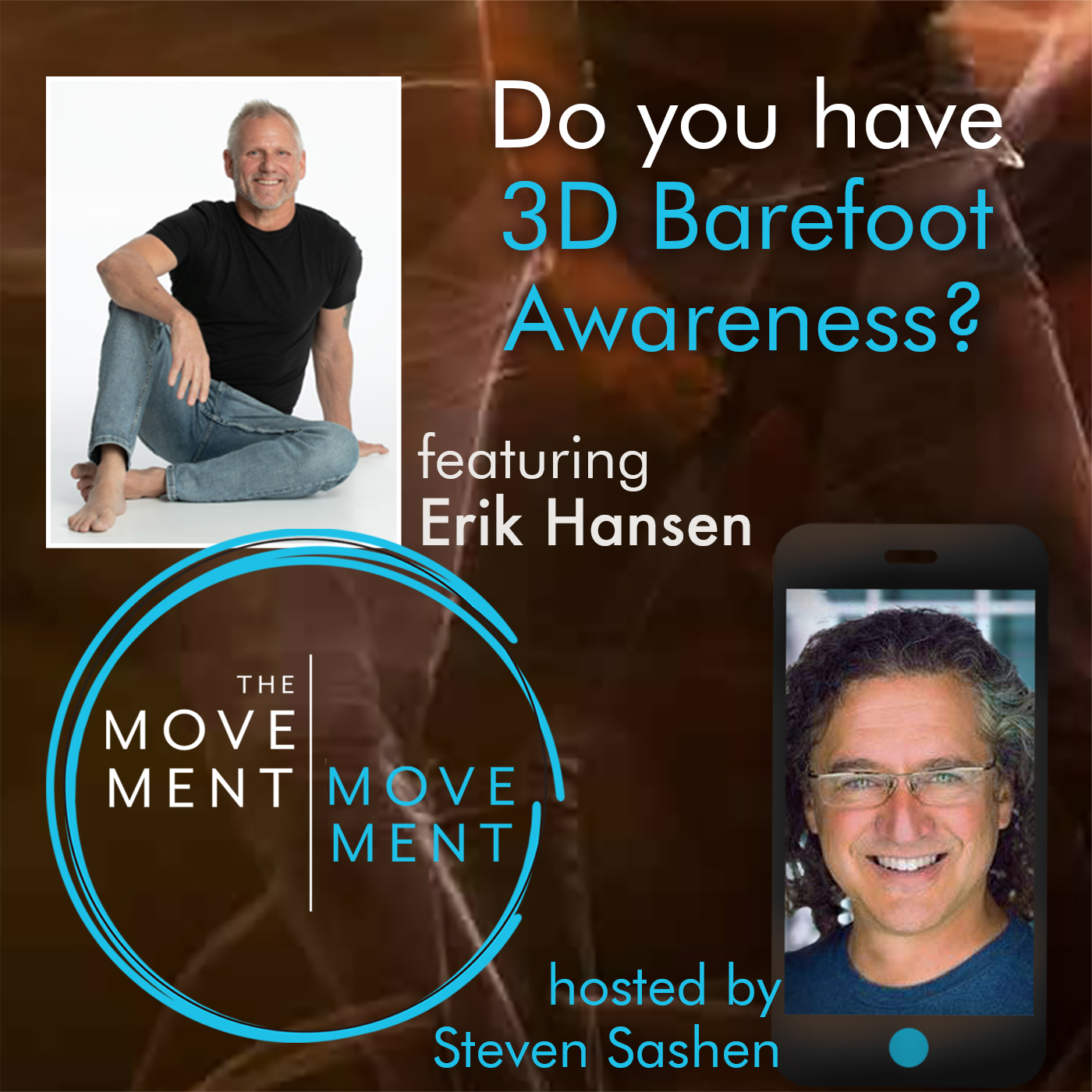
Today we're going to be chatting with someone who has perhaps been running barefoot for longer than I think anyone I have ever met. But more importantly, what he knows about feet and how to make them work better and how that can affect the rest of your body, not to make the rest of your body work better too, is really unparalleled. This is someone we can talk to for hours and hours and hours since he and I have done that and we barely scratched the surface of the things we want to talk about. But we're going to keep it normal, kind of join the movement movement distance and maybe we'll do version two and version three anyway.
This is going to be super fun for all of us. Today's episode of the movement movement, the podmaster, for people who want to know the truth about what it takes to have a happy, healthy, strong body starting feet first, those things at the end of your legs at your foundation. Where we break down the propaganda, the mythology, sometimes the flat out lies you've been told about what it takes to walk or run or hike or do yogurt or crossfitter like this revelation or whatever it is you like to do and do that enjoy it efficiently and effectively. Did I say and join me?
Wait, I know I did. It's a trick question because we're not having fun. You're not going to keep it up. So find things you like to do.
If you didn't like to do them before, maybe getting your feet working better. We'll help you do that. I am Stephen Sashankos, the co-founder of Zero Shoes and we call this the movement movement podcast because we and that includes you more about that in a second are creating a movement about natural movement letting your body do what it's made to do without getting in the way. And the part that involves you is really simple.
Go over to our website www.jointhemovementmovement.com. There's nothing you need to do to join, but you can sign up to get notifications about upcoming episodes. You'll see all the previous episodes. You can find all the places you can interact with us on social media.
And the important thing is spread the word. That's the movement part about natural movement. Spread the word. Tell people give us a thumbs up.
Give us a good review. Hit the bell icon on YouTube. You know the drill. If you want to be part of the tribe, just subscribe.
With that, Eric Hanson. Welcome. Tell people who the hell you want. What you're doing here.
I have just been passionate about health and wellness as far back as I can remember. The first lessons around health and wellness that I recall started at the age of three. Although my paternal grandmother said that she started peeping me at about 18 months of age. And the very first thing was I had a breast knotted one hand and a yumbo Florida avocado in the other hand and that led to me being taught by her how to feel the energetic of the vibration of health and tissue, unhealthy tissue, which ultimately led to me becoming a massage therapist.
As early as 1979 when my fellow college roommates, they realized that my hands would do for them what they had an experience with anybody else. I felt into my way. I can't even tell you how out of context, how wrong that sounds. So we will not take that out of context.
But I just had to throw that in there for the fun of it. So. So one of my buddies in college who was a runner and I wanted to become a runner and I had so much so many aches and pains in my legs and the pediatric, the New York City told me that I should never run because of the deformity, the defectiveness and all sorts of things that I had been having going on with my feet. But I really had the passion if I didn't have a body of water or a bicycle, how do I get the point B without pain?
And so I began a painful running process. The aha moment took place when I was in a triathlon and the bike to run transition was quite a few miles, about 20 plus miles away from the initial start of the triathlon. And I came off the bike about 10 minutes faster than the race director anticipated anybody would come up. And my shoes were not there in the transition area.
And after standing around for a couple of minutes, I decided I was not going to lose the race by standing there without my stalking shoes, with my pussomade or a thought. And I was just going to run barefoot. And I didn't end up winning the race. I took second by a matter of seconds by another gentleman who also became a professional triathlete.
But the beautiful thing was the next day waking up, I didn't have any of my leg pain because every single time before, and I've done a lot of triathlons by this point in 1984, I always had to be a pain where I literally could not run for at least a week or more. And if I had to race a week later, which was very common, I just ran with painful legs. But this time I woke up, I didn't recall any pain in my legs whatsoever. I laced up my sock and his shoes and I went for a run.
And lo and behold, all of that very familiar frustrating pain was there. And things started to go off in my mind. But it took me until 1985 to actually begin to resolve the underlying reason why my arches were flatter than pancakes and why I had so much pain. And then by January of 1986, I had decided to completely throw away my shop absorbing motion control, cues and my orthotic, and just put into application what I had learned from just head to the grindstone research on the whole muscle skeleton, but really focusing on my feet for quite a period of time.
So that's what kind of kicked me off to running barefoot. I don't want to throw a sock on the under the bus because you could have put in the name of pretty much any brand and it would have been the same story. So just an FYI. So how did that when you had that experience then and you had this at that time massage therapy practice maybe that involved by then, how did John really change what you were doing, but how what you were doing with the people that were coming to you for help.
What changed for me was really basic. I stopped looking for something outside of my body to give me the results that I was looking for. And I was told that I needed something to absorb the stock. I was told that I needed something to control the motion of my feet to literally ask my foot into a period of position.
And what I realized in my research is that the whole muscular system of my feet were incredibly weak. From the age of five being a competitive swimmer, we're not exactly weight bearing on our feet. And so for all of those years as a competitive swimmer, although I did do some rock climbing in my early teens and some hiking, but it was for a very small period of time. It wasn't long enough for my feet to evolve.
And so in working with some other professionals in the bodywork industry, we were working on each other feet. I was also came up with a series of exercises that still had not changed to this day. And so I started to figure out ways to move my toes, to move my foot and ankle, and different ways to begin to strengthen those muscles. And it took me about six months time of really putting 100% of my time and energy into it, where I found myself out in California running the Berkeley and Oakland, the Mount Diablo Trail barefoot.
And I can literally run a marathon's worth of distance in my bare feet, and they always felt great. What's happened since then? I've had so many, literally I stopped counting at about 10,000 pairs of feet with foot issues, and I just kept teaching person after person, and also using hand-on skills to go ahead and start to work with the tissues to speed. That process of adaptation or awakening the intelligence of the feet.
One of the biggest regrets that I have about my transition from regular shoes to not is that I didn't take pictures from day one and compare them to day whenever, frankly. What did you notice about how your feet changed as you started discovering this and applying the exercise? And by the way, we'll talk about those a bit. So, might be literally if you look at the inside edge of my foot and you look at the outside edge of my foot, they were both completely 100% beautifully contoured to the ground.
Whatever state you're now with, that was the state that my feet were. And I also didn't have the thought to go ahead and do before and after pictures, but my arches, and you've seen my arches of my feet, I would say that's a medium to an higher edge of arches. And I found that most people, the inner edge of the foot just really begins to lift up, and then they start to get this beautiful spring. I show them where the entry point of the foot is, and it's like loading into a trampoline, and it's just beautiful.
It's this smooth energy. It's not like this, the kind of type of image of the frequency and where they get to load, and they get that energy back. Yeah, so just I want to highlight that and like the same in a slightly different way. Many people don't realize that when you're using your foot directly or when your foot is working correctly, your foot comes down as a land tickly on the outside edge.
What people refer to as supinated, but most people use the word supinated or pronated as descriptions of what they think of as problems. That's what I was saying. There's this natural kind of almost wave-like motion of loading the tendons and lemons in the foot, and in a way that's totally supported by the bones. And then that does create this spring like action.
It really is like being on a trampoline except trampoline is your foot. So there's not an extra thing. This is what's so funny. With all the big giant thick shoes and carbon fiber plates, people who don't know anything about physics are saying things like, oh, those carbon fiber plates act like a spring or a trampoline.
No, they don't. Not at all. For many reasons, the reason that police, which means that even if it was acting like a trampoline, what's making trampoline work is your legs. You'll notice if you watch professional trampoline artists or competitive trampolenists, that's an actual way of referring to themselves, they're only trying for a relatively short amount of time.
And you start seeing they're getting lower and lower with every jump because it's your legs doing the work. The trampoline is just accentuating what you can do, but it's still you. And with the carbon fiber plates, it's not even doing that because what you need to make a trampoline work is external support, external left and right of your feet, front and back of your feet. So it actually can absorb what you're doing with your legs, not your feet.
And then that comes back if you get the timing right and do things like that. If you put a normal human being on a trampoline next to a guy who knows how to trampoline, the guy who knows how to jump is going to be jumping three times higher, the trampoline hasn't changed. It's your legs. So now, and again, anyway, back up a little bit, it's the one study that I don't think has been done, or at least I haven't seen it, the results of this, of the effect of foot exercise programs or barefoot training or barefoot running or anything on arch height and arch wellness strength has been done, but not arch height.
Just people think that's just the way it is. You're born with flat feet. It's a problem. And a story.
And my story is similar. Once I started basically running around barefoot, I developed arches in my life while on a top-level flat feet. I get out of a hot tub. It looks like a foot with toes instead of a oval with dots.
And I wish my parents were alive to see the change because they used to tease me about this all the time. And now, none of these... So, since you mentioned that you developed these exercises that affected you, and then you started applying those other people, can we dive in and chat about those? Yeah.
So, back up, most of the following standards, all these nerve endings on the bottom of the feet. And we were all born barefoot. And the design of the human body wasn't having to rely on anything to protect that foot. And I believe that all of these nerve endings on the bottom of the feet are to communicate, right?
To connect us with our environment and what's going on. And what happens though is that when there's a shoe that contacts all of those nerve endings on the bottom of the feet, that initial neurological design is communicating to the control tower, that this foot is already in contact with something. And I think of the heel as like a kickstand. And though I don't have a kickstand on my bicycle, right?
But if I saw my motorcycle or put a kickstand down. And so, I thought that we were designed to walk and run heel-to. But what I realized was that when I put my shoes aside and started to figure out how to strengthen my muscles, I noticed that I never walked heel-to, unless if I was walking around a house and at the carpeted floor, and I could get away with my heel coming down into that nice plush carpeting. If I'm outside walking in sand, I can be going heel-to.
But as soon as I start to pick up the pace, I will never go heel-to. I will be that heel may make just the lightest brushing as I load into that foot. When I first begin working with people, if they're at my facility where I've got a treadmill or we have access to a treadmill, I'll have them actually begin going sideways on a treadmill, alternating the leg gaps away from the console. It's going to alternate cross-cling in front.
And then the other foot comes alongside of it. And then the next time that downstream let foot crosses behind, we can call that step all different things. But when a person begins doing that, they could go heel-to, but they will be the most clutchy, goofy person on a treadmill. And so it's natural to be on the balls of the feet.
And we'll also notice that they don't have their heel-like way up in the air, that their foot has this really cool biomechanical relationship to the surface of the treadmill. And then I'll have them also begin going backwards. Once they've had that awareness, and oftentimes these are folks that got onto the treadmill with whatever shoes they came to my facility with, and when they're running, they'll talk about whether it's foot pain, knee pain, hip pain, back pain, neck pain, shoulder pain, right? All of those areas come in at some point.
But what I notice is that as I have them take the shoes off and they're going sideways and backwards, they go, how? What are you feeling? They do not, in almost every case. There's a few exceptions, but it's that one in 100 cases.
They no longer have that pain. So now the next step is I created a device that will attach around the ball of the foot, and it can attach into different resistance of a called surgical tubing that's attached down by the floor, against wall or underneath the piece. Furniture depends if somebody has one of the gym in the bag. And what we begin doing is we begin doing the side-to-side motion of the ankle.
And because they're connected out to the ball of the foot, those muscles are connected all the foot to the heel they're working, but the muscles across the ankle are working. And also the muscles that cross their knee, they're beginning to develop knee rotation, which is great for the ligament development and healing of the knees. The other piece too with the feet is that for every action, there's an equal and off to reaction. So if they've been strengthened all inner pathways of their ankle and leg, because nothing's going to be stabilizing them.
I want them to literally be able to have their heel on the surface that's super slick so that they can't get any friction as they're beginning to do those exercises, so that if they're strengthening the inside ankle, it's strengthening the muscles to where the thigh attaches to the floor of the pelvic. Then they'll go over to the other side and they'll be working all the muscles on the outside of the ankle, the outside of the knee and the outside of the hip. Once we begin strengthening that, we also work with the different amounts of plantar and duerse of flexion, and we start to play in with putting toes in different positions because of how these muscles are all interrelated. They all work finally.
They just know how to communicate with every step or every stride, anything that we're doing with our feet. So as these people begin to realize what they can't do with their toes, but then they can see what, it makes sense that, oh, I should be able to lift this toe up while there's others are down or vice versa. I should be able to ideally move my foot side as I was my toes curled and my toes extended. They can begin to feel the muscles that are below the knee that are above the ankle or even into the feet and really awaken them.
Then the next piece is I have them straight onto this and they start to work the muscles like, you can have them. Plus, one second, before we move on to the next thing they're going to do, I want to back up a little bit just to for anyone who didn't catch the gist of the design of what you're talking about with your coach in a bag. We'll talk about that a bit more later. So imagine, and please correct me if I'm getting this wrong for people, even though I've used this, but I want to make sure I'm describing the way that you like.
So imagine you're sitting on the floor facing the wall, maybe three feet from the wall with your feet, three feet from the wall. So your legs are extended and what you have is a big one foot, doesn't matter, let's pick your right foot. And there's a strap that goes around essentially the ball on your foot, right underneath the med heads, the metatarsal heads, basically what we think of is the big ball behind your first toe and your fit toe. And then connected to that strap is some surgical tubing that's connected to the wall.
It could be connected to the wall, you could instead have it connected, instead of facing a wall, you're facing a door, there's a connection that'll go under the door. So you'll have this surgical tubing connected to whatever, whether it's a wall, piece of furniture, or under door, something to give you some resistance as you're doing these motions in one motion. Imagine that you have your on something slippery like you mentioned, so you can't rely on using your heel as a fulcrum, but pull your toes up, for example, or have them kind of point as late with the wall and just move your toes, your whole foot, pointing out, pointing out as an example. So the whole idea is that you're doing these motions under the resistance of this surgical tubing.
If people think of band work out, similar idea, but with the surgical tubing instead. And again, one point you're making, if you're going to be moving in one direction, working in the strength in one direction, at some point you're going to switch to the other direction. So just as an example of that, taking a slightly out of context, many people will think about strengthening their lower leg by doing calf raises, so you're pointing your toes, but most people would never think to do an exercise where you're pulling your toes to your knees, which is strengthening the exact opposite muscles, the muscles that pull your toes up instead of the ones that point them down. So you developed a very cool system, gym in the bag, that allows you to do many of these things, but just to get people to get that image in their head, is there anything you want to tweak on that?
So I call it four-way foot ankle, and so with this tubing, it's three of those four relationships, and so if you can picture, there is that center that's straight on with your leg going towards the wall, and that's going to work in front of the ankle in the back of the knee, in the front of the hip. But then you're also sitting parallel to the wall, so that cord is coming off of your foot perpendicular to the wall. I think you're sitting at a hundred degree ankle to the wall, but that needs to be in there. And so you're strengthening all of that.
And again, traditionally in personal training, we've oftentimes been, I was taught, to help people to isolate a kick of their joints or muscle group, and one of the things that I found with developing the feet is that I don't want to isolate a kick of the joint or muscle group for any part of the body. And so that's what's really key with this exercise, and again, I'm not up in my gym area, but a surface that you're healed to be on, like a vitamin cap or some cap where it's almost like it's so slick there would be zero friction, so that if you relax the muscles either on the inside of the outside of the body, it's almost like a muscle. And so that's either on the inside of the outside of your leg based on which relationship your leg would go off to the wall. And oftentimes, so if this leg has the cord coming off, oftentimes that people brace that leg and just move their ankle and they're like, oh my goodness, it doesn't feel right, because it dissociates from the linkage.
And this is something that's really important when people are going from where they're at foot and ankle health or disease, getting them connected all the way through their leg is so important. We could never translate only doing an ankle exercise with becoming a better walker or a hiker. It's connected all the way up through, and our legs literally connect all the way up to the chest plate here, right? Our legs come up that high in our body, and so this exercise develops every single muscle from the end of the toes, all the way up to literally the 12th or after vertebrake, because those that know the anatomy of the body.
You mentioned something, everybody, like all the anybody that goes through gym at some point, has done some heel lifts, their calf exercises. When we look at the structure of the body, I think of the calf muscles, it's like the propulsion system with no steering mechanism. And so the calf muscles come down to the heel, that's for propulsion, but these other eight primary muscles, so there's a lot more than eight, right? There's over 100 muscles that are involved with the foot and ankle.
But there's eight of them that have to do with our pinnests, our steering, our control of our feet that we are developing with those initial three positions with the corded exercise. But now the next piece is, instead of going on a traditional like seated calf raise or maybe a standing calf raise exercise where I've got some resistance in my shoulders, my heels going up and down, that's stabilizing me and that's guiding me. And I want to literally, I want to have that person step away from that. And for those of you listening to this, if you want to hit pause in a moment and come back to this, if you're not watching this live right now, have the, have your, the ball of your foot, on say a book.
So we're going to describe this so people can listen and get in their head. So keep going. Think of it from adding description for what you're showing and I'll chime in to do that as well for people who are only listening. So continue with it.
I have people start on flat floor, put your feet together, close your eyes and then lift one foot up off of the ground while your eyes are closed and just become the observer. What do you feel on that foot and ankle and that leg that you're standing on? What do you notice that people are amazed at how much their muscles are working in there? And then they switch to the other foot and sometimes they feel like, wait a minute, I wasn't so bad.
I was able to get away with balancing on my wand, but I go to the other one. Like my arms are flailing all over the place. And there's this natural progression and patience. It can take some weeks to get this proprioception, this kinesthetic, this balance, or everyone to call it, to get all these morons and muscles to begin strengthening and to communicate with each other so that you can get into this like Zen State.
If I were standing on one leg right now with my eyes closed, the Zen State is like, I'm just totally quiet. The next step would be to have a surface that's maybe elevated to chin and quarter-ish depending on the size of your foot, put the ball of your foot on there. And again, start out with your heel, put your rest on the ground, that's well within active range. And then you can close your eyes, feel what it's like now with the ball of your foot higher than your heel, but then start to lift your heel up off the floor.
And people are all over the place. And as I say to people, and as I said, the definition of running is you're not on more than the ball of one foot at a time. And so this is when I call it constitutional exercise. For everybody listening to this, if you have only one takeaway, stand on one foot on the ball of your foot with your heel slightly off the ground and close your eyes and develop that until you become a master.
And I've shared with Stephen a story about marathon runner who had an injury. And when they mastered that, it took them 11 weeks to master that. They hadn't been running because of the nature of their injuries and they hadn't agreed with me until they mastered six particular exercises that they wouldn't run. And they were 10 minutes faster than they're all time best in a marathon.
So I'm going to break the cause and effect of that down because we passed. Professional marathon runner, King Me Do You Injured, you gave them a number of these exercises and during that time said no running until you master these and one of the key ones is what you described. And he just elated in his eyes closed, totally stable until you knew that you can't run. Part of the story left out is that she called you like the night before the Olympic trials and went, got it.
And he said, okay, so you can run the next day. And that next day said a 10 minute PR, which is just unheard of. So think of running as aerobic, right? A aerobic function.
And the reason that you like to stop at 100 meters and they're just about thinking. And so what I like to get across the people is that this body, your body is this vehicle and there's so many things that are out of sync. And so if it was a race vehicle, we would have it in the shop and we'd have people working on that vehicle. It wouldn't be out there on the track constantly trying to get better and better on that running the trailer running the track.
No, it's getting to these systems. And so with developing the feet and this challenges the triathletes and the runners that come to me initially. And that's why with this person that was going through their Olympic trials. And literally had to have her hand right in a group.
We didn't hand right it. We were really clear. Eye to eye. He agreed that until she mastered the six exercises, the six movements, and that was the last one for her.
The other five really didn't have to do with the feet. It had to do with what her injury was that she came to me. But you can imagine after those two weeks, like that two weeks time of not running, he was getting panicked. Right?
She literally was like emotionally stressed. You got to get running. And I said, but we got to the green. You got two of those six already.
And she was sick with the plan. You're going to be okay. You're going to be okay. And unfortunately there were other people in my clinic going, trust them.
Oh my gosh. I came in here in a cane or a walker. Trust them. Just follow the protocol.
And she was willing. So that was the exercise that literally that night before. And we had agreed many weeks. We had agreed basically at 11 weeks out that even if she couldn't master these six movements that I suggested for her vehicle, he was going to race in the Olympic trials.
And so we had agreed on that no matter what. But she literally, instead of running and putting two, three hours a day of that type of training, he was putting in those two or three hours into tuning up her vehicle. And we worked on a lot of other systems that were completely non related to quote the feet for her particular area of injury. Even more to highlight an aspect of this is it's not just that her feet and or ankles got stronger from doing this.
It's more than that. So talk about that for a bit, please. There were a lot of pieces. One of the things that we hadn't mentioned is that she was an identical twin.
And her identical twin had run faster than her bare minimum, like three minutes faster every single marathon. So there was a part of this training also that is, and I used an acronym, MEES, is the acronym. I call it the MEES method. And part of that is moving, eating, sleeping, and the posture is taking ownership of how we move eat in our sleep.
But then there's also the emotional and psychological and spiritual part. And so also part of her training brought her into a level of consciousness that is just not taught out. It's not part of becoming a personal trainer. It could be part of some types of massage dial.
But basically, every muscle in the body has to do with a particular one of the 12 primary organ systems. And the ankle exercises, the ankle muscles in general, and oversimplifying it has to do with our adrenals, our fight or flight. And if we have anxiety, if we have emotional stressors, we can do all the best exercises in the world. We can be eating all the best from nature's essential food groups I develop.
But if we're not getting into that mentally emotional, the psychological and the spiritual aspect. And so she got to work on those additional parts and pieces. And so as she was doing any of her movements or anything else she was doing at my wellness center, she had that whole MEES method, acronym, working through her. I use an example for her way back when there were three groups of basketball teams and one was to strictly focus on making their shots.
The other group practiced their shots and also visualized the shots. And the third group only practiced taking a shot. They weren't encouraged at all to do the visualization. But by my answer, the group that only visualized was almost as good as the group that visualized and practiced.
And so much of her training had to do with meaver therapy so that her body developed that methodology that system for her to be going at a higher rate of speed and to be able to dissipate to maintain her core temperature at 99.1. We did actually in a clinic. We would do fever stuff to bring her core temperature to 99.1. This is something that's not talked about in athletics.
But that's like the ideal operating temperature. If we take the same person and we compare them say running on a treadmill at 98 degrees, which is so common, actually people are at 97 to 96 degrees, you have them on that treadmill. But then we start to look at the data and the information 99.1 is almost always the ideal operating point for somebody that's fat or somebody that's skinny or those of us that are somewhere in between. So there's a lot of pieces that I could go on for 10 days to retreat the more around.
First of all, thanks. But the irony, of course, is I was just going for something simpler, which was that instead of just developing strength, there was a neurological proprioceptive component to this that was being shifted. Because like you're saying, when you stand on one foot, eyes closed, whether your heels lifted or not, the first thing you're going to feel is that instability. And it's less about strength.
It's less about muscle things than nervous things. It's more of that feedback loop and how that hasn't just, it just hasn't been used, it hasn't been turned on. And where you went, super fun. I will say, I'm going to, and one of the things about the best visualization thing, just as an FYI and this will end our friendship, I've looked for that study for 20 years and never found it.
And more, I said, let's do the math on this. If you could, because the way it was actually, the first time I heard it was someone said, basketball players who just visualized taking free throws got 20% better after eight weeks of visualization. And I said, if that's all it takes, give it how important free throws are in a basketball game, two things. One, everybody would be doing it and they'd all be shooting at about 90%.
And two, everyone would then do it again and then they'd get to 98%. So that hasn't happened yet. It's just, this is completely tangential. But I remember hearing for the umpteenth time, a story that goes like this, this is in the kind of a new age manifestation world where there was a study of the graduates of the 1953 Yale class where they tracked them 20 years later and there was 3% of the people who were more successful than the other 97% combined.
And the only difference was they had written down their goals. Now, I've heard this thing. It was Yale. It was Princeton.
It was Harvard. It was wherever it was 1953, 1956, 1975. And then one day I just did the math and I just did a spreadsheet about what the average income of various people would be and realized that A, if you just, if in any given Ivy League class, one of the people was the son of the Sultan of somewhere. He had more money than everyone combined, no matter what, from day one.
But then just for the really fun part of the story, it just hit me like, this just feels like urban mythology because you can't pin it down. So I got online and I put out a bet or a wager or something and offer. I said, I'll pay $1,000 to anyone who can show me the study. And I also said, I'll even give you $1,000 if you prove it didn't happen, even though it's hard to prove the non-existent.
So something five minutes later, the guy who started Snopes.com sent me an email, 20 minute article, I think it was in Fast Company where someone had spent like a year trying to track down the study and could never do it. It always was a data network, or from someone who heard it from someone who heard it from someone and concluded that it never happened. And I said to the guy from Snopes, I got to tell you, you did that so quickly. I got to be honest, I feel a little anxious about giving you $1,000.
He said, I got to be honest, I didn't think you'd ever give me anything. I said, oh, cool, then here's $500. So some of these things, I'm not dismissing the value and I'm going to use a word differently, the value of visualization. I'm not going to dismiss the value of mental rehearsal.
As an all-of-former, all-American gymnast, I did that all the time. I'm going through my routines in my head all the time. People will sometimes say, if your body can't tell the difference, it can tell if I can tell the difference. Doing an iron cross for real is different than imagining doing the iron for us.
Yes, you might be sending little signals to your body that kind of activate something. It ain't the same. But the rehearsal thing is, really cool. In fact, I would always rehearse having things go wrong and what I was going to do to fix it.
So not just making it perfect, what's going to happen, every little possible thing. But I will add one part you'll get a kick out of. In my senior year of high school, when I was doing this, I would imagine it in my mind all the way through to the score. And for that season, every competition I was in, my score was one tenth of a point higher than what I had imagined, exactly one tenth of a point every time.
At some point, I didn't try to second guess that I just went to school. But I don't have a story about that or an explanation of that, nor do I particularly care. But anyway, I just wanted to throw that in for the... Frankly, I can't help myself when someone says, well, I can visualize it because your body doesn't know that.
Or when they talk about left brain and right brain. And I can show them the article from the guys who came up with the concept of left brain versus right brain who say, oh my God, that was the biggest mistake we ever made because yes, there are parts of the brain on left and right that are primarily responsible for. But every one of these functions is actually your whole brain doing things where when people say we only use 10% of their brains. So sometimes I just can't help myself and that was one of those times.
It's actually beautiful because as I've read through a lot of white papers and that over the many decades, sometimes we can draw conclusions to things that's really not what it is. One thing with athletes and training is that visualization is just one part of the formulation. Activity specific, there's nothing that will ever replace that activity specific. And so when we combine those two together, it's massive.
When I work with people also on their biochemistry and when I have folks do all different types of labs, there's generally reference ranges. And what we do is we don't look, did they hit somewhere on the target? That's a reference range. What are the bull's eyes?
And as I work with folks, some people, they have other factors that maybe nourishment doesn't seem to be like their tipping point to make or break them. But we know that when we start to work with it, that's one less thing that's going to hold them back from their peak potential. I have a fondness, obviously, for when people say something for looking for a counterfactual. It looks as if there's an opposite situation that might be as valid.
And I love when people talk about the importance of sleep. And I say to every highly competitive athlete that I know, how do you sleep and I perform at that? Oh, you're kidding? Well, not going.
Not quite what people think. Or one mutual friend of ours who talked about how when she was winning all of her races, how she got into the zone and she spent like an hour at dinner with a bunch of people talking about getting into the zone. And then I said to her, everyone was like going on about her in his own stories. I said, do you ever win a race when you didn't feel like you were in the zone at all?
In fact, you felt sick and didn't even want to show up. She says, oh, yeah, that happened a bunch of times. Ever felt like you were in the zone and it just could barely make it out of the blocks. You know, that happened a bunch of times too.
There went down to zone for out. Here's the bottom line with what you can add other factors that you want. But the fundamental thing is for whatever reason, you were the fastest person in the world for a good turn your stretch. And one thing that did, your competitors is scared of the crap out of them.
You had the psychological advantage as well as well as that they knew the odds were high and you were going to crush them. Now, the other stuff may have something, but I just, for whatever reason, I just like getting the simplest thing and I had the sleep stories well. I never sleep before a race. And I had that once I'd die thing when I was a kid.
I woke up and I looked at my mom's watch, which was on the dresser and it said nine o'clock. And I was supposed to meet people at eight, 30 to go to this meet and I run out of my room. I'm looking around and I can't find anybody. And it looked like everyone had left already.
And I was very confused and I realized I looked at my mom's watch upside down. It was three, 30. And then I just went or whatever the upside down of three, 30 would be. You can.
And then went back a lot around until eight, 30 then found everyone and went to meet and it's an interesting thing. When I was 12, I would get all sorts of levels of anxiety, right? I get those nerves and stuff and this coach that I had at eight, 12, her name is Penny and Penny said, Hey, Eric, don't worry about that. That's actually your body is getting ready for you to be at peak.
So that when that gun goes off, man, you're exploding. So just be kind of welcome all of that adrenaline and all of that like laser focus and thinking about your terms and you're this that. And wow, just that shift in perspective was massive fast forward. So two summers ago, I was up in the mountains.
I was going to do the highest altitude, 10k open water, cold open water, swim and I decided to bring my sweetheart with us and we're going to camp out the night before. And I said, I'm there with her. I'm focused on her. Right?
And we're normally the night before a big event. I'm like in my box. I'm just like nothing else exists. It's just me, my mind, my physical body.
And in the morning, we get up and there's plenty of time before the start of the swim. We go for this walk around the lake. By the mind is like, I have done no preparation in my mind. And like they, because of COVID, they're having a start, I was 30 second part of it.
No mental preparation. I go out into this low 60 degree water. I don't know how many meters out it was maybe less than a quarter mile. I literally had to get my mind to calm down because I was so anaerobic that I literally didn't even feel like I could even figure a way to float.
I had to just stop and go on my back and just let the parabolaite, being anaerobic and that warmed up to take it in. And I turned over, so I made another 30, 40 strokes. I said, nope, I'm going to lay on my back here. I'm going to just gently move until I feel like I am ready.
And so that just proved to me the power that I need to have some window of time. I call up like a bumble bee effect where supposedly a bumble bee, and I don't know if there's a way that it's got to get its core temperature up before a bumble bee can actually fly. And so there I was out there in that low 60 degree water trying to get my metabolism on my body going. And then I was fine.
But I literally had a split second moment, little more than that, that was around. And I have like the proficient swimmer and I'm going to freakin' drown. So my mental preparation and physical preparation. Yeah, the simplest thing I can say is everybody wants to make it simple.
Everybody wants to think there's a way to do it that works for every situation. People talk about having rituals that they use where for when they start because the ritual is helpful. And then same thing, I said, have you ever shown up late for a race and just had to run, jump up the blocks and go and they went, yeah, I got to do it. Oh, I won.
Again, I don't know why I like to pull the rug out from underneath people's religious beliefs, but I do. And because for me at least, and I imagine for them as well, it adds some freedom. So you don't have to be so rigid about it. So you can listen to what's going on in that moment and extend that you can if you have the time and the way of all to do it.
And if you don't, you just go and do your best. And ironically, that's all it takes. I had a weird flashback. I was acting in a play when I was in college and we brought in a professional equity actor.
This guy was in his 70s and he was doing this for 60 years. And we just were chatting before our entrance. And we didn't do any of our warmups, we didn't do anything. Because we just got in this conversation and suddenly we realized it sounds weird on stage and we had missed our cue and they had been ad-libbing for a minute.
And he just looks and he laughs and goes, okay, here we go. We just went out and had the best performance of either of our lives. Because we had no choice but to just relax and go with the flow and see where it went. And we were just really there.
We weren't anticipating in advance. We weren't like running our lines. It was like, it's already in there. We already know what to do.
Let's just let it do its thing. It was a blast. That relaxation piece also, as many of us, since people are probably, they hike, they walk, or whatever, they've seen all sorts of that, like events. The best and then sport always makes it look so much easier than the second best.
And I would use that word. It just appears so incredibly relaxed. And it's funny. It's funny.
What's funny? Tyson Gay, who was the fastest hunter-man in the world before Usain Bolt beat him, was the exact opposite. He just looked like his head was about to explode and pop off of his body. The guy looked like every move was just screening against gravity in some way, certain angles.
So more often than not, totally true. Again, I love these little exceptions. Take a look at that guy. And by the way, Tyson Gay, I think it's like the saddest thing in the world.
This guy, fastest man in the world for a good year and a half, and then is ready to officially win the world championship. And then Usain Bolt shows up. What the hell? All that prep, all that everything.
Out of his control. And I was at that race just to happen in Munich. And they're starting in Berlin. And just for the fun of saying it, Usain Bolt was so far ahead of Tyson Gay.
He was so far ahead of Son of Paul. I'm at the 70-meter mark about five rows off the track. And I thought, this must be a false start. There's no way these guys should be so spread out.
And besides Usain Bolt was at the 70-meter mark was running at 28, 29 miles an hour. And when someone runs by you at a speed where they would get a ticket in my neighborhood, your brain goes, what? It literally doesn't seem real. So anyway, I'm totally taken back to you for the win.
I want to ask you a question, because you've been, one of the things that I really appreciate about you is that you have taken your work both personally and professionally, if I can say it that way, as an ongoing exploration and experiment. And what you have discovered and done with people is unlike things almost anyone's ever seen, it's a shame that more people haven't. But I'm curious, what are some of the things that you, one of the questions I like to ask people who went to medical school, for example, I'll say how much of what you're doing every day relates to what you learn in medical school, what percentage? And if anyone ever says anything over 20%, I know they're lying.
So what are some of the things that you've discovered in the many years you've been doing this that kind of either most surprised you or most validated something you were thinking or it has been like the most, let me just leave it those two possible options. There's so many parts and pieces when you mentioned it's like, what am I doing today that I had learned in school, in your formal school? And I really don't have that background, right? And you have a witch raising you, right?
And she was a nurse, right? She did have some of her own formal training in that. But we're talking about energetic and stuff like that. It's not really a very, more and more today.
So almost none of what I do in my practice is anything that came from academia. It came through empirical evidence. And in that even, what's up? Is there something that you're doing now that you found through working either on and with yourself or with other people where it was one of those holy crap moments where either things kind of consolidated or just moved to a whole new level because it's something that just showed up in that moment.
That's now a big part of what you're doing. There's quite a lot of those moments. And I used to have a wellness center in Boulder, Colorado, and there are the leading people in all of the different fields and stuff. And there were still people who still had health issues going on.
They had been there to see the best. And they would be like, hey, go see Eric. And one of the huge gifts that came about from having decade after decade constantly, new people coming in, I would ask them, what have you done? What did you like?
What didn't you like? And I get them to start to share their experience. And then over time, it started to become really clear that there was this triad. And so I always look for the three or more things that are conspiring to get the person in their particular medical condition.
If there's something that has really surfaced that is true in every single case, and it blows people away, right, where really the mental, the emotional components. And so we can have two people, one's eating great, one's eating junk, right? The person in junk doesn't have a particular disease as other person has this particular disease. Or one can be skinny, one can be fat.
There's so many different variables. And a couple of things that I've instilled is to make sure that the person has specific with movement, that their movements are three-dimensional versus isolated. Anytime that a person is trying to have tension in a particular muscle, they are the farthest they could possibly have the other end of the spectrum. And so I want people to learn how to move and allow the tonic allies of the body to just take care of themselves.
And when it comes to eating, I find that people are missing two or more of what's been now known as the essential food groups. And they're missing really key raw materials that their body is, I don't have more glass around, but I got duct tape. I could put duct tape on that crack window or whatever it is. And so there tends to be something nutritionally deficient.
It's another part of this triad of the foods. In this day and age, what was never an essential food group until recent history, seaweed. So many farming practices, the soil is very deplete. And when they use science called gaffin and the chromatography, you get just use spinach as an example.
In 1956, the US government and you can find these online. The US government did analysis of a certain number of vegetables, spinach being one of them. And in one cup of spinach, there was a certain amount of iron. By 1990s of these dozen or so components that they were checking in spinach, now you required 75 cups of spinach to get the same amount of iron as that one cup.
But then they also noticed other compounds that used to be found in spinach are no longer there. And so we need to get into what's known as regenerative farming practices. We need to allow the microorganisms of the soil and the acylamine. There's a whole science behind this.
And so seaweed now, the ocean's probably not going to be deplete anytime soon with these particular nutrients and so forth when it comes to the body's needs for these things, seaweed now is an essential food group. So that's going to be one of the one of them. Another example would be mushrooms. Mushrooms are really key in so many facets of their complexity of their proteins, their ability for immune modulation.
There's so many different dynamics. So mushrooms are also an essential food group. And I'll just throw in a third one. Live active cultures.
So foods through thousands, thousands, thousands of years, culture foods, people used to drink from the water in the stream and the ponds. And the creaks now we drink municipalized water that is dead, right? There's chemical compounds in there. And so making sure that you have live active cultures, the dilemma is if somebody puts something on the shelf and it's a lie, think produce.
So you cut off that from the plants or whatever and you have it on the shelf, it's only got so much shelf life. The same thing is true with these active cultures is that if it doesn't settle in a fairly small window of time, the profit and loss is going out of balance. And so many things that used to be live cultures are now actually killed to then have shelf life. So those are the three examples of these kind of 18T areas that I taught the people and very efficient.
Hey, thank you and be just to get you back on what you were talking about, the triad of things and the nutrients in the second. So I took this little tour, you got to go on to the third. Yeah. And then I'm really looking at what are the three things, the X, Y and D act is where it's like here, it's landing, it's got this label or it's got this area of body of pain.
And I've yet to find anybody that it was just one thing that caused their particular condition and it's rarely two, it's generally three or more. And when I get people coming in, whether it's foot issues or back issues or neck or digestive issues or they've got like a cancer diagnosis, they've typically got four or five, six different things that are disharmonious that I really helped them to bring back into alignment. I like that your looking at the body is not just a mechanical thing and I like that the way you're looking at the mechanical thing is a very different flavor than most of me. The whole idea of getting things, I hate these word balance, but I will so that as you were saying before things move smoothly rather than with tension and effort and force.
This is a thing that is, it's interesting. And in fact, again, personal thing, I remember a sprinter that I worked with who was a very successful collegiate swimmer said to me one day, don't you love it when it's going really right and it feels like you're just barely touching your own just lying and I went, what? Because his form is just utterly perfect and there's a hitch in my giddy up that I think I recently fixed. Someone gave me a cue that when I use that little cue about how to run, I instantly felt a change in my gate, but I haven't had time.
It's been below zero on the weekends here. So I haven't had time to go out and videotape it and see what it feels like a full speed, but even it's my kind of casual thing, it just, everything feels so much more relaxed. Everything's just in the right place. I'm not going to have to fight myself and I'm waiting to see if A translates to what I'm actually seeing instead of what I'm just feeling and then B, I want to see what that does to speed and happily it is now as we're recording this two weeks away from the end of the year and that means the indoor track seat is coming up.
So I'll be able to put this in the test in about three or four weeks. So two things on movement is, and since I still compete in swimming, I still am constantly consciously aware of all the different aspects of my stroke, right? I'm still always in awareness of that. Coming back though, if most of us have seen a door that can swing in two directions and I say the door never thinks about where it's going to come to rest.
That door ideally is in that closed position when it's at rest. But if it's not, we want to work with whatever its hinge mechanism is. And so in the human body, a lot of people don't realize how balanced they are. And so I had a person come in and I'm working on them and they're right side of the low back, the tone quality muscles are radically different.
And I go, do you find that you're repetitively turning to your right on a regular basis and rarely ever turn into lunches? Absolutely. And so the thing is I'm on a stool and so my legs are going off back that way as I'm here. So that was turning left, but this is turning right.
A lot of people don't realize how they're habituated movements. And that's where there's three dimensional stuff. When somebody comes in and they begin going through these three dimensional movements, the painful side sometimes is the side that's actually working. And it's the non-painful side that's not working.
And that explains various things. And sometimes the painful side isn't working. So we can't really just because of how the pain is, we just need to get them to explore. I think that was really phenomenal.
So there's something called the journey. And generally in the journey, it's a verbal guidance right to get a person to drop in, to heal cellular issues in their tissues. And then there's an evolution of that work where it's called Tuck of the Divine, where now once you've got that person into that cellular memory area and we're doing body work on them based on the Enneagram gets convoluted. But if a person has something called a no-go zone, right, they got this black box, no matter what I do body work-wise, it's not going to get into there to get cleared.
So then I developed, this was back in 2010, 2011, I had an opportunity to work with a bunch of journey practitioners who have depleted all the training they're accredited. And some of them wanted to learn this three-dimensional movement. And so we've got a small group, six of them and me, and inevitably almost every movement sessions, somebody would just, like all of a sudden there was an explosion of an emotional memory that would come up. And the simple thing is that they would see me demonstrate a movement, like, the forehead or fingers put them out of what the movement was.
They saw me do it and they're like, actually I can do that. And then everybody's beginning to do that movement and they can't do that movement. They just can't do it. And actually they know that their body is designed to do this easily, naturally and effortlessly, and they can't.
And that black box now is almost like somebody just detonated it. The beautiful thing that I looked was that the other six of the seven of us, all of us, are training this work. And when the person would share what the cellular memory was, usually one or two people so then feel called to literally process and clear it through. And the masterfulness of it's like two to five minutes later or something, it's usually done never more than eight or 10 minutes.
Now we ask that person to do this three-dimensional move and it's like they never had an issue and they were doing it never before. It's just like they have the full range of motion spontaneously almost. I love and I'm going to just for the people who may have a different relationship to some of the things you've described, I'm just going to do the simple version of that where it's because I've seen similar things where without the same framework for describing it or working with it, but I've seen things where like, simply what I do, I say this on the podcast a bunch of times. One day I just was aware and I put on my pants left like first, so then I decided to do right first.
And I've seen people when I say things like that or I cross my arms and normally my left arm is over my right arm so I learned to do it the other way around. Which way is which, but I'll ask people to try and just switch and simple movements and they're like, their brain is just completely fried by it. And to that point, you can ask a simple question about even something as simple as just feeling feel familiar that you can't do this thing. And it turns into surprisingly big emotional whatever.
And once they shake that off and suddenly they could do this thing but they could do it a second ago. Nothing changed in their body. Something changed in part of their brain that nothing to do with that movement. It's fascinating.
Google neurogenesis, neuroplasticity, it's fascinating. And bringing us back to the biped and most folks, I don't know, we all got these two legs, right? That's where we can jump around like funnies and stuff. But if I use the example of violinism, an opportunity to work with just some incredible violinism where their heads are always like this and they got this neck pain and they're having to quit the career because they're getting this like all sorts of diseases, right?
And numbness and long listening. All I happen to do is go ahead and take that violin from that shoulder, put it over the other shoulder, pull the bow with the other hand, go to that hand and have your camera on, videotape it and like, oh, I have it. Like they're like, it's like they can't, but it makes sense that they're designed, right? There's nothing unique about the cervical spine or the arms in this position, but they can't do it that other way.
And so when people come to me with, whether it's foot, knee, hip, back, neck, shoulder, whatever, we look for these habituated patterns through their lifestyle and they clear quite quickly. And I'm just going to throw out there. I'm not an advocate. It takes three weeks to create a behavioral pattern change where it's automatically everywhere.
There are some people that can take months as a matter of being patient and having objective markers to know objectively, how do I know that I am improving? And getting better because that's where the inspiration comes. And so oftentimes when somebody, when people aren't getting the results they want, it's like they quit before the miracle happens. And so that's another piece, whether it's somebody working with their feet or any part of the body, for them to know objectively and also have their subjective inventory.
And I don't really say, you came to me with one or two problems and now you're telling me how great you're doing and now you're listening to 20 things, because so oftentimes as they have that awareness, I never thought about that. That was from an act that I had done or I was when I did this and that then and I was like, well, you've met my sweetheart who made your amputation, basically, and that tissue in that area had no, couldn't feel it. And it grossed me out because oh, guys, there's no feeling. But this is over two and a half centuries later, they're close to two and a half centuries later of no neurological feeling in there and she has beautiful feeling.
I can't get away with touching your leg under the table, she's got her prosthetic, she knows instantly. She can feel it. That's not considered possible. And so with the feet, with any part of the body, how do we, again, these objectives, measurements that give us inspiration and using previous successes in our life to help us until we can get those positive objective measures, life becomes so incredible.
And I just shared this too and that's not on my website. But there've been a number of people who have started out with me running and after a couple of years of them integrating this program, they're just like, man, if I can just go run barefoot, I'll carry my shoes in case like the field out back here. I'll go home, right? And so if I'm running long, I start to get these pokey things, I'll go ahead and put on my zero sandals and continue to run that way.
But once you come alive in your body, your whole emotional, I would just inspect them of emotions in a second, those three, that's 12, maybe, then you literally, your body, you get excited for life at every age. No exception. I can't think of a more perfect way to wrap this up than that. And I know it's going to make some crazy because that last little bit seems so big.
But if you really go back to even the beginning of our conversation, everything we're talking about is leading to this because it's all about, I don't mean to talk to you, all I can say is there's much more to it. Pardon me. Anyway, Eric, do me a huge favor. For people who want to find out more about what you've been doing and experience more importantly, what you've been doing and what can be useful for them, how can they find you?
Thank you to COVID. I work with people virtually around the world that are having to fly everywhere, but I do still love to fly places. You can go to nliveenergy.com and read through some things and there's a link on there that you can schedule a couple of minutes a minute, session with me. So that's nliveenergy.com.
The other thing is you would like to learn like a small series of exercises that you can do for your foot and ankle or maybe your knee or your hip, right? Be specific. Email me. Please don't email me at my business.
I use that for current existing clients. I use Eric the healer at gmail.com, E-R-I-K. Make sure you spell my first name, right? Eric the healer at gmail.com and just send an email and say, please send me some of the exercises for my foot and ankle or if you've got a neck thing or a shoulder thing or a hand thing or you've got a particular diagnosis of a disease or whatever it is, right?
If you even see things up, I will then send you complimentary from a place of gratitude for receiving having me on here. I will reply to 100% of you who send me an email. You don't get a reply back. Chet.
Did you put Eric with a C or K for kindness? Really? I'm a wonderful, gracious, offer and I really look forward to hearing what people describe when they take you up on it. First of all, thank you again.
As always, a pleasure. We have much more to do when we'll get to that in another time. We may be too of this as well with other pieces of the puzzle, but for everybody else, until then, just a reminder, head over to www.jointhemovementmovement.com. We're again, you'll find previous episodes, all the ways you're going to engage with us on social media, other places to find the podcast.
If you don't like the podcast, you've already found it. If you have any questions for me, any suggestions, any recommendations of people you think that should be on the podcast, ideally, if you can find someone who's willing to talk to me who thinks I have cranial reorientation syndrome, I'm happy to do that.