
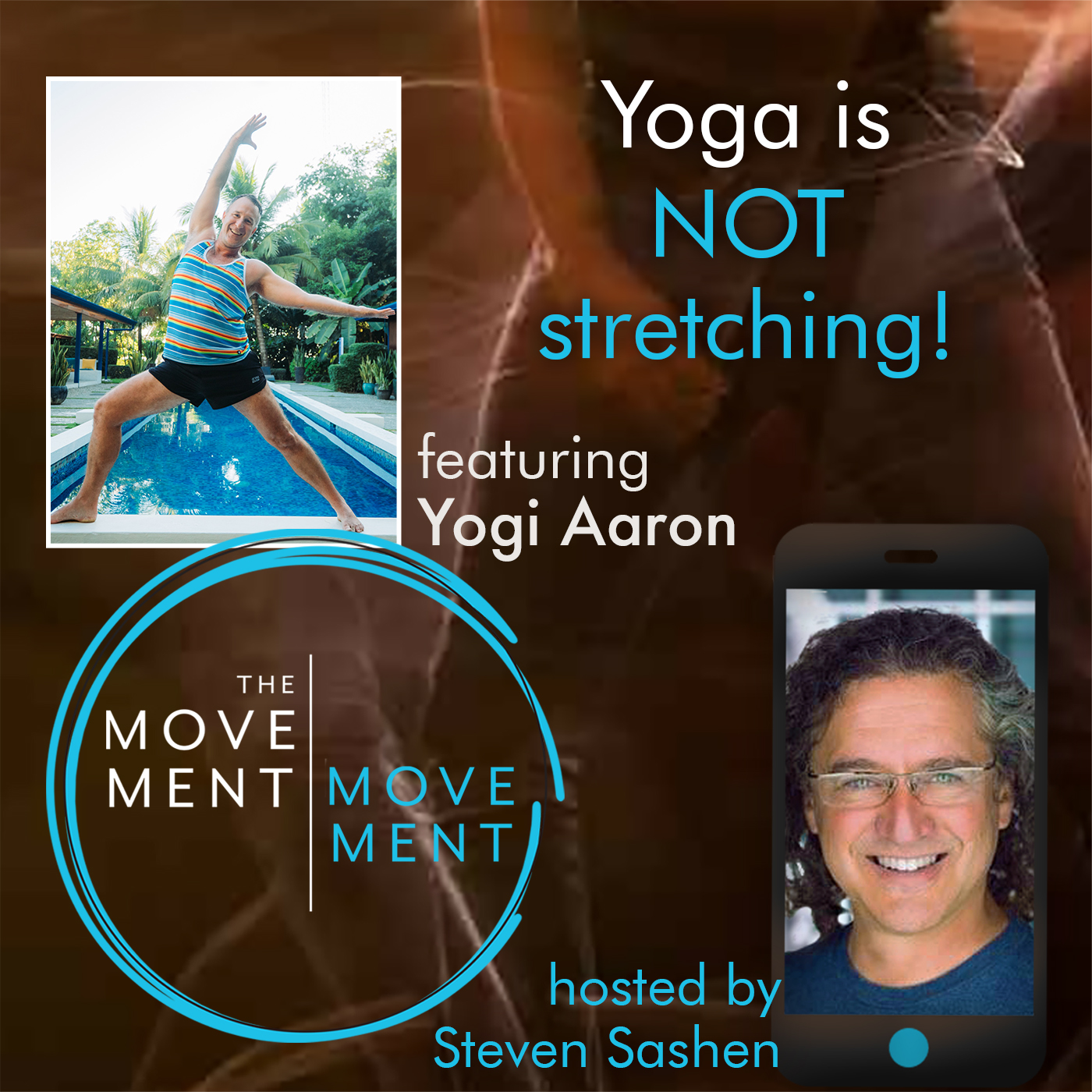
So you want to get flexible. Maybe you want to do some stretching or do some yoga. What if that is the worst and stupidest thing you could do? That's what we're going to talk about on today's episode of the movement movement, the podcast for people who want to know the truth about what it takes to have a happy, healthy, strong body usually starting with your feet because those things at the end of your legs are pretty important.
But we also on this podcast breakdown, the propaganda, the mythology, sometimes the flat out lies you've been told about what it takes to walk or run or play or to yoga or cross bed or whatever it is you'd like to do and to do those things effectively and efficiently and enjoyably, most importantly, enjoyably because you're not having fun. You're not going to keep it up anyway. So make sure you're doing something you enjoy. I am Stephen Sasha, CEO and actually co-CEO and co-founder of Zero Shoes along with my lovely wife and brilliant wife.
That's the same person. Laina Phoenix, here's the t-shirt to prove it if you're watching. And we call the movement movement because we're creating a movement that involves you. Tell you about that in a second.
About natural movement, letting your body do what it's made to do without getting in the way. And the way you're involved is really pretty obvious. It's just we want you to spread the word. If you like what you hear, leave a review.
Give us a thumbs up. Hit the bell icon. Give us five stars. We're going to give us five stars.
Give us 10 stars. I don't know how this works. Go to our website, www.jointhemovementmovement.com. There's nothing you need to do to join.
You don't need to spend any money, learn to seek your handshake, wake up and do a special dance every morning. It's just that's where you find the previous episodes, the ways you can find us in social media and the ways you can find the podcast. You're not happy with the way you found us already. Okay.
So basically if you want to be part of the tribe, just subscribe. It's really simple. So let's have some fun and get started. Aaron, do me a favor.
Tell people who the hell you are and what you're doing here. I'll give you the quick version. My name is Yogi Aaron. I'm the owner of Blue OSA Yoga Retreat in Swan, Costa Rica.
I started a few yoga movements. The one I'm working on right now is to stop stretching. I've been teaching and doing yoga since I was 18 years old. I need 25, 26.
I need to hang out with you more often. I'm 51 at this moment. But the short story is that I, as soon as I got into yoga, which I got into it when I was 18 to stretch, 25 years later, I ended up in an emergency room of a hospital with a surgeon telling me that I was going to need a spinal fusion in my lower back. And that was a huge come to Jesus moment for me.
Because I think the appropriate thing for a Yogi would be a come to connect an ash moment or a come to connect an ash moment or Shiva, whichever way you go. It really doesn't matter. Yeah. Anyone else.
But no, that just made me do a whole restock or re-inventory of everything that I thought I knew. And a friend of mine was teaching muscle activation technique or not teaching, sorry, doing muscle activation technique. I went to see him and he did this thing with me where he got a group of muscles strong and then passively. And when I say passively, I also mean gently.
Like he really gently stretched me. And where those muscles were strong, they all went weak. Like it was like turning off a light switch and it blew my mind. I then decided to pause on that one for a second.
So for sure what happened because I'm following it. So muscle activation technique in short is a process where they will do certain things, literally just like some pressure often to wake up some muscles or let me say that differently. To remind your brain that those muscles are functioning because it's a neurological thing and get them to turn on. And then there's things that they will test you with, different movements, different positions, et cetera, to see if your brain then stops and those muscles turn off and become weak and inactive.
There's pretty good muscles that he had gotten strong by doing this, quote, activation, and then just to scratch suddenly they're weak again. Did I get it? Yes. Yeah.
And the thing with muscle activation is it's not really about the muscles. It's working with the neuromuscular system, which I mean blows my mind because so many bodybuilders can be walking around with like really big muscles and none of them are working, which is why a lot of bodybuilders get injured all the time. So he tested me after he stretched. They all went weak.
He then I like to use his expression, turn the muscles on. So he turned the muscles on and they just started to become strong. And I've conducted this experiment many times on students who come in and are questioning whether or not I'm a nut job or not. And it's fascinating to watch their eyeballs jump out of their head when they feel themselves strong and then feel themselves weak.
But going back to the story, I decided to study muscle activation technique myself. It was created by Greg Roskoff who's got a school outside Denver, Colorado. And in that world, there was nobody translating this into yoga. So then I took it upon myself to do it.
Initially did it just for myself and for my students. As I started to see people becoming pain free as a result of this, which is a direct result to muscles working properly, people get out of pain really quickly. And so I decided that we need to have a real conversation, not just in the yoga world, but also in the fitness world and any kind of movement world, because we are stretching and it's actually making us use this word very strongly and intentionally crippled. We are crippling ourselves.
And I know that we're recording and we're live, but I have a very fascinating story to tell you not now, but later about it's about my mother because your whole thing is feet. I have been really starting to study feet recently. And my mother just all of a sudden started getting planter. I never pronounced it right.
Plant fasciatus, fasciitis. And she may be but keep going. Enormous pain in her feet. And so she asked me what to do.
I've just started putting out some exercises for the feet, which of course don't involve stretching in the message. She said, I've been doing some stretching. I said, stop stretching. Just start doing this.
And within literally, and I'm not exaggerating 24 hours, her pain has gone down like 90%. And she's able to walk normally. So it goes back to what I was saying. Once we get the muscles working in the body, the joints are supported and the stress is released.
It's no longer being inflicted by stress. And a lot of people forget that the byproduct of stress is inflammation, which is causing the pain. So if we get the muscles working, no more stress. So first of all, thank you.
There's a lot of things to tackle in there. So one is I'll start with your mother and please don't take that line out of context. The thing that happens often, people say, I planer fasciitis and I will look at them and they go, and they go, like, what? I can see it from a mile away.
You've actually got really tight calves. They're hyper-ertonic. And so I don't say stretch them, but I say, let's do some things so they're not hypertonic, but they're not just constant stress. And people are like, oh my God, that helped.
And my story actually, it's fun. It was a special ops guy who I met at a trade show. And he said, we all switched to barefoot shoes. We all got planer fasciitis and I said, again, I can see it.
So can I stick my thumb on your calf? And I can see the spot that's super tight. And I just put my thumb right there and started digging in. This guy is like, 650, no body fat.
Hits the ground. And I just had their, you know, grinding on his calf for a few minutes. And I said, that's it. So that's one part.
The next thing is, as a kind of sprinter that we mean, the thing that's been very interesting to me and by interesting and frustrating is the research couldn't be more clear and agree with you that the worst thing you could do prior to something like sprinting is stretch. And yet you go to any track meet and guess what people are doing? They're stretching. And at best people have gone from doing static stretching, like sitting down and doing her or stretch to doing dynamic stretching, which is fundamentally not really any different, especially the way people are doing it.
So, you know, the news is out there a little bit, but it's just not making it down to humans in the case that we value before them. And the other thing, I had two more thoughts on my head. One, of course, and it's too late to make this joke work, unfortunately, but I'll tell anyone. It's a comic and I wish I remember who it was who said this.
I'm doing a really long time. In fact, I've been doing it so long that when I started doing it, it was just called stretching. And I just really got lying, but again, given our conversation, not at all funny now. But last but not least, the thing that occurred to me is the people that I know who've gotten really good about getting really flexible didn't do it by stretching.
They did it by making the opposing muscles really strong. I had a hunchy with not your head, something like that. So anyway, and back to your point about bodybuilders, one of the guys who's a friend of mine who is famous for this is a guy he calls himself Jujimufu, otherwise known as John Call. And Jujim is famous for doing splits between two chairs while either holding a human being Heidi Klum on America's most wanted or a hundred and some amount of pounds on a barbell above his head.
And he will tell you, when he was a kid, he was doing martial arts and they did stretching, but you want to get that way. You just need to get your quads and your hip flexors super, super strong. And that's how he got that way. And there's other people who've done, oh, I wish I remember, I probably got this book somewhere in my bookshelf.
It's not the basic idea. So I was the fact you're nodding your head, I can say, we're heading in that direction. So I'll use that as a springboard, which is a thing that doesn't really stretch to riff on what I just said while I get a drink. So I loved your yoga joke that is priceless.
And it's where we started to move to so many yoga teachers today, self-proclaimed yoga teachers were ex aerobic instructors who were told by their manager that they had to start teaching a yoga class. And so they just figured it out. And that's why we see this like warped idea of what yoga is. You need to go to yoga class, put on a light show, have the most amazing playlist of Led Zeppelin and ACDC and to make people happy because they kind of expect that.
And so that's why I was laughing so much because we just, we don't have enough on his conversations in the yoga world about why this madness has started. Oh, don't get me started. Anything. I'm getting you started.
I'm starting you. What I mean is, look, I live outside of Boulder, Colorado. I live in Boulder, Colorado for 20 years. And I'll say this as a jumping off point for somebody to rail against me.
One of the things that amazes me is there's no willingness to question things like Buddhism. So there are people who will have a lot of opinions about Christianity and its various forms about Islam and its various forms about Judaism and its various forms. But Buddhism is like off limits. It's cool in its mind.
It's immune to all those things. And I would argue that it is as necessary for there to be conversations about that world as anything, basically anything that's in the quote self improvement game needs to really have some attention focused on it. And honest conversation about what is working, what isn't working, what's going on right. And look, even in the business world, I have a fantasy I say, when my wife and I sell the company and we have buckets of money, I want to go around the bookstores and buy every book on how to succeed in business and then take them into the parking lot and burn them.
Just any domain that seems to be about the idea of making yourself better is just full of propaganda and mythology and superstition and all those things. And as you probably have discovered, when you put this out to people, they don't just go, oh, cool, let's take a look. They get defensive and want to kill your children. It's a very wacky thing.
And I say that, I'm only half joking when I say that, when you question or more accurately, seemingly attack someone's beliefs, then you respond like you're trying to kill them and everyone that's ever been related to them. It's a very fascinating phenomenon. And my suspicion is because the way we hold our very sense of self is connected neurologically in some way to the way we hold other kinds of non-proval beliefs. And you get in there and you're messing with someone's sense of identity and respond well to that typically, the average human being.
But before we back up to how you're done, how you've took, how you took this. And I quickly respond to that because you just said something that I personally dealt with before I ended up in the surgeon's office, I myself had already started to read research on the detriment of stretching. And so in my kind of mindset, I really had a hard time grappling with some ideas. Like I understood it fundamentally.
And it did affect the way I taught yoga to some degree. But part of it was like, I am a yoga teacher, therefore I teach stretching, therefore if I don't teach stretching, who am I? That was a really hard thing for me to get past. And I empathize with yoga teachers.
Like I'm critical and hard on them. At the same time I've walked in their shoes and I can understand that struggle of who am I? If I'm not teaching stretching, I was teaching at this yoga festival. I had this woman come up.
She teaches the deep stretching kind of yoga. Sometimes people call it yin. And she also works in a stretching clinic. And so she stretches the heck out of people and opens their hips.
And she looked at me after we had some time talking to us being as respectful as I could, just giving facts and just saying, did a demonstration with her. She goes, who am I? If I'm not stretching people. But I think now is the time that you stop calling yourself Yogi Aaron and change it to Yogi-ish Aaron.
But this is also part of it. Like one of my catch phrases that I say all the time what I'm about is flipping the script on yoga and stretching. And so that has many different double entendres. But one of them is the fact of the matter is nowhere in the yoga world, in any yoga scripture, sutra, is there a mention of stretching or the need to be flexible?
Like it's just nowhere. Wow. And so that's interesting, but I'm also flashing back. So I was in India 15 years ago, 16 years ago, I don't know something like that, her friends wedding.
And one of the people who was there was researching the history of yoga and she was really into it. And she was getting some sort of like big deal scholarship to do this research. And her premise was that she was going to find this deep historical long lasting spiritual path of whatever spiritual lineage, whatever. And what she found was no, the yoga that we know today was a political movement.
And it's actually a couple hundred years old. And same thing, what do I do with my practice that was all based on this whole spiritual thing when I just discovered that was actually a recent idea that was mostly done for marketing. Yes. Okay.
So let's just kind of. So once you start it, first of all, actually, I got asked this because as a guy's got a, I'm going to use a medical term, pardon me, for anyone who doesn't understand it. And I want to come back to dynamic stretching, but we're going to get the raskin about that. Yeah, but I want to ask you a quick question.
I was saying we have something in common, maybe, and again, I'm going to use a medical term to describe my experience. My back is fucked up and that's a medical term. The describing it is I have an L five S one spondylosis, great to spondi with a part of the effect. So I imagine you had something similar.
Okay. Yeah. So my L five S one is basically writing into each other. And there's definitely, I forget the term spindinosis.
I think it is, I always forget that term. And now you say that I have a, I have a disc herniation between L four and L five. And so that's pressing into nerves. And it was actually that push, push me into the hospital.
I just went into this inflammatory process that lasted almost a good part of a year and got to the point where I just couldn't even walk anymore. It was that bad. That's interesting for the other boy. Okay.
So let's do two things. Talk about the dynamic stretching part. Jump into once you started having this realization, what change, what you started doing, let's talk about what you're actually doing with people that isn't stretching that is yoga. Can I answer the first question or second question and circle back to the first question?
Because I think that'll be very well. You can do whatever they want. So another, but it was really that it was really the answer to your first question is from the second question. I started to, I had to sit with this, like, how am I going to teach yoga if I'm not teaching stretching?
And I feel like I have to back up one second because you raised something really interesting. How did these yoga postures emerge? And what is the purpose of yoga posture? So if you ask, like, most yoga people, they'll say that the purpose of yoga postures is to prepare the body for meditation.
And that's true, but not really true. And it just depends on what lens you're looking at it. But the yoga postures, so we have this only take a minute of less than a minute of explanation, but we have, potentially, the great stage. He gave us the yoga sutras.
He gave us a roadmap for the mind to understand suffering. He's then in jumping forward to Sutra 246. He describes exactly the qualities of an Asana. So the Asana that he was describing is how to be seated, like how to sit for meditation.
And he said, there's two qualities. You have to be comfortable. And by the way, the word comfortable also is the word suka. And one of the interesting translations of suka is joy and potentially also talks about shrada cultivating shrada, which is a sense of faith.
And this other great stage came around and translated shrada as a joyful state of mind. So there's this one. Hold on. Hold on.
I'm going to lose it. I'm going to do this. So how do I want to do this one? So I've done a boat of meditating.
And again, I've done in 20 plus 10 day programs from sitting for 20 hours a day. And one of the teachers that I sat with is a woman who was a still is Burmese grandmother. And the way her whole path, if you will, what got her to be a meditation teacher was actually very simple. It didn't involve a whole lot of effort and suffering and all the rest.
And so there are times when we're all like sitting and we're supposed to sit unmoving for an hour times and it's supposed to be all totally silent. There are times where I've sat with her and she will suddenly get irritated and point to someone or go grab someone who's in this meditation hall and scream at them, get out. And everyone's, what the hell just happened? And when I talked to one of the people to whom she did this, he said, she came up to me after she forced me out of meditation hall and said, take a walk, take a nap, some cigarette, have a joint, do whatever you need to do.
Meditation isn't something that she was to suffer for. If you're not already in some state of comfort and spaciousness, you can't get there from here, come back here, relax, and then see where it goes. And most of the people in this particular lineage, I'm not going to dive into that one. They think it's the exact opposite that you've that it's all about endurance.
And putting yourself through hell to get to basically point where your mind snaps and suddenly you've got some pleasant things going on and she's no start with the comfort and they just work on that. Yeah. Yeah, it's a great point. And so potentially said, Suka and which I find is the trans one of the translations is joy also easy and comfortable, effortless, effortless is a really good word.
And then the other word is stira and stira translates to a few things, but it means and or still. So we're getting really still, but you have to be stable to get still. And that's it. That's it.
Those are the two qualities that you need to master and just to jump ahead for one second to sit your two 48, he says, if you can master both of those qualities and embody them, you can overcome all pairs of opposites of life, meaning that nothing disturbs you in life anymore. For a little while, and this one, I will not throw this under the bus, but I will mention it by name, I for a couple years was doing bigger and bigger and bigger, just because and for a while, I said, it occurs to me that if you could master the corpse pose of Sibosana, then you've mastered yoga. Yeah. And they look at me like I was crazy, but that's exactly what you just described.
If you could master lying down effortlessly, then all the rest of it is taken care of. I wouldn't be still. I would argue for the fun of arguing or diving into it, that the idea of handling opposites is not about being unswade, but having a, I don't want to put it. Boy, where to go?
If you're upset, if you're happy and you're not arguing with either of those, nor are you selling one as the antidote to the other or the obstacle to the other. So it's not about being immobile. This, I think this is one of the actual misconceptions about meditative practice or spiritual practice, everyone think of that, is that you do get to this imperturbable state rather than where you're just not arguing with reality in that same way, where there's a certain open-heartedness to the for lack of a better term, part of you that is out of sorts and open-heartedness to the part of you that is happy, knowing that's not going to last forever. But there is this idea that the opposites are somehow supposed to be resolved and do some thing approximating imperturbability and perpetual equanimity, rather than having an actual human life, but just not doing the added bonus of beating yourself up when it's not the way you want it.
Sure. It's also one of the ideas of this, the pairs of opposites is pain and pleasure and that our boat isn't constantly being rocked by them, that we're able to see, as I think you mentioned, see the ultimate reality of life and be able to make decisions that are from a place within, rather than a reactionary kind of. It's funny. I'm thinking about this in a weird way.
I have a line about when we're in some sort of emotional distress and people have the idea that they should also tell this way. When I was in college, I was hanging out with a guy who was a meditation slash yoga teacher, he and his wife both were, and he had just helped bring this American guy back from Thailand. He'd been meditating on a mountain for God knows how long. And so my friend, the meditation teacher suggested that a way of bringing himself back would be to coach Little League.
And so he was coaching, having a fine time, then they had their first game. And I happened to have dinner with them all after the first game. And this guy was beside himself and just so frustrated, so upset, got so agitated during the game because he's coaching about just seven year olds. And I remember him saying, I've got to go do some more meditation.
And I remember thinking, no more on coaching about just seven year olds is frustrating. But we have this idea that if we learn the right meditative technique, the right psychological technique that when we're really upset, either it shouldn't have happened or we should be able to snap ourselves out of it. When I say you can't be smart when you're stupid, when your brain turns into a mode, you're in super mode till you're not, you can't deliberately get yourself out of it. So back to the pleasure of pain dichotomy.
Both of those were a form of stupidity is what I would say. And like when we're in that bliss, in that bliss of a new relationship, we're unbelievably stupid when we're angry at our partner for being themselves, we're unbelievably stupid. So but again, if for whatever reason you can have the wherewithal to not just add on to that, I shouldn't be like this. It shouldn't be like this.
Then it's just a weird thing where that dichotomy just doesn't have the same sway, even though you might have to save your partner calmly or not. I'm in dumb mode. I'll check in with every point on the install. So I think if you read the story of God, we could go down this path for one time.
I don't want to go. I'm going to do this one thing. If you read certain stories of the life of the Buddha, for example, he was not just like living in a perpetual state of bliss. He was having a very human life frustrated with his students, having difficulty with the government, just like normal every day.
What's we're looking for? Not bullshit. I wasn't looking for an adjective before bullshit. I have to go to whatever.
Anyway, the DMV. That kind of thing. But bureaucracy. Yeah, bureaucratic bullshit.
That's what I was looking for. But that doesn't mean that there's not something valuable to learn or something valuable, whatever, but people just mythologize this stuff in ways that again, if you read the text carefully, and I guess what that means is without with some inspection, without just buying the mythology, then it's a very different thing. Then putting someone on a pedestal and trying to emulate them to become something that no human being has ever become. Yeah.
So anyway, we can go down that path forever, apparently, and we will at some point. That's the non-scredging yoga. That's what people came here for. Oh my God.
As the people in this conversation. Where I was going with that really quickly, I'll just segue into this, but that we had this yoga potentially was like, you've got to deal with the shit in your mind. And then these people decided that it was, it's hard to sit. It's hard to sit.
It's hard to sit with yourself. Over the course of the millennia, there was different groups that popped up. And one of them is a group of yogis actually called the Noth Cult. And the Noth Cult discovered like this body has a lot of energy in it.
And if we do certain things with the body, we can start to affect its energy. We can start to move energy in a different way. And so this whole idea of Asana came about was a way for us to access the energetic body. And before some people think like it's a little woo, we know that if we do a twist, for example, we start to affect the nervous system differently.
If we go into a back bend, we get we affect our energy levels. We affect our nervous system differently. That's the reason for these postures is to start shifting the momentum of our nervous system. If you take someone who's depressed and there's tends to be, I think, a little bit of lethargia around them, if we can get them doing, for example, some backbends, all of a sudden, their nervous system starts to get rewired in a different way.
And they feel different about life because they're feeling different. Do you know about the interstition is something that has only in the past few years been discovered in the body as either an organ or a system and people aren't really sure it's it's there's a collagen matrix that surrounds pretty much every cell. And the interstition is part of that matrix. And it's basically a little kind of fluid filled tubes.
The amount of fluid is about one quarter of all the fluid in your entire body. And no one knows what the hell it is and what it does. They're still figuring that out at all. But what's interesting is there are some parallels and I'm not saying they're equivalent, no one who's researching this wood, but there are some parallels.
They're still being explored between the inner and when people refer to things like energy body or Chi or prana or all these things, that maybe some of the things that are happening is that there are places where the flowing of the interstition has been impeded for God knows what reason and some of these movements or acupuncture or film the blank may help get that flow going. And it literally may be a biomechanical thing that's happening. That does have a neurological response where you feel it and it makes you feel good, better, more energized, et cetera. Those are all words that we use to, you know, really badly describe feelings.
But but it's a fascinating thing because there are people now having questions about how does this relate to yoga or are you very medicine or Tibetan medicine, which by the way, the Dalai Lama's doctor 40 or 30 something years ago didn't speak word of English, took my pulse, smelled my pee and gave me the most accurate diagnosis of every medical event I've ever had in my life. Crazy. I don't know. Maybe it's interesting to say, let's open up this conversation between people who have been at odds with each other, whereas like proof for how I can punch a word for pain reduction, which we can argue with just releasing dopamine or whatever that is.
So anyway, so maybe this energy body don't know is related to this interstition and to your point, whatever it is, it is having this neurological neurochemical effect that's fascinating. Okay, so are we completely fascinating because you can see some you describe going to be crumb before? It doesn't as much as like rags sometimes on some of these other kinds of yoga, like beakrum. For example, the fact of the matter is is people go into these yoga classes, they do some postures, they breathe and they're like things start to shift in them.
How do you explain that? And he it's just the heat. Well, a hundred and thirty room with 95 percent humidity for now. Really that too.
So this idea of stretching is not in the yoga anthem at all. And it just it's something that has come out in this last this last 50 odd years especially we saw it really start to pop up more so in the 70s and 80s. And as I said, people started getting to yoga. All of a son of Robic instructors were faced with this dilemma of, oh, I don't know anything about yoga, but I'm going to start teaching it and I'm going to put some music behind it.
I'm going to put on my leotards and leg warmers and a headband. And we're going to call that yoga. And of course, all the men got scared, which is a whole other topic. And then it just it's completely changed into something that it was never, of course, intended to be.
But in the whole anthem, there is no mention of stretching or of flexibility. So when I started going down this path, one of the things I started asking was what is the intention of yoga? What are the postures supposed to be about? And that started to inform me about, OK, we don't it doesn't matter how far, for example, you fold forward.
If you fold forward a little bit, 10 degrees, you breathe, you bring in intention, you practice Suka and Sira, you're doing yoga. And that is like a really profound experience. So that was one part of the equation. Another part of the equation.
Can we pause on that one for a second? Yeah, because I think people can have the experience of it. So can you imagine people are sitting somewhere? Can you walk just simply, you have a 10, three, four, band or whatever you want to do with the right mindset, etc?
Can you walk people through that in for a minute, just so they can get us the feeling for what you just want? Yeah, sure. Let's do even something a little bit more simple because if people are sitting and listening to this, which they probably are or running, not driving, though, if you're driving, stop the car. You're trying to pull over and stop the car.
Thank you. But you just talking about a back bend and the energetic effects of backbending. So if you bring your arms up to the sky, have them in a V form. And with the thumbs pointed back and then just close your eyes and find your chest lifting up a bit, feel your shoulder blades, not necessarily drop.
Don't pull them down. Just allow them to be comfortable. Now take the thumbs and drive them back about three or four degrees and you start to feel your chest opening up. Lift your chin about three degrees up and now just breathe in deeply and exhale deeply and feel the oxygen feeling your lungs hitting down to the bottom of your chest cavity and then exhaling completely and do about two more breaths just like that, inhaling deeply.
Now see if you can bring your arm bones back just a little bit more and maybe just lift the chest a little bit more and then exhale, let the arms come down. And as you come down, just take a moment, a very brief moment and notice the quality of your mind and there you practice yoga. I want to highlight the especially the Suka part in part of that, whether it's the in the middle of it or the releasing of it. In paying attention to quality of your mind, if you notice just that sweetness, if you will, that little bit of pleasure, doesn't have to be a lot, just a little bit.
That's from what I'm hearing from what you're saying. That's it. That's it. And just doing that little movement and breathing consciously, intentionally, is enough for us to start shifting our momentum and you just think about the typical office worker.
What do they do when they get tired? They literally do that pose. They bring their arms out, lift the chest and now it's a little bit more forced and it's only for a brief second, but they're trying to shift their momentum. There's this innate quality within us to want to move in a different way, energetically speaking.
And so that's one part of the equation. It's like the very one of the very first questions I always ask my students who come and train with me is how much flexibility do you think you need to have to be happy? And so if you have that question in your mind, like, how much do I actually need? And what am I really doing this for?
Am I doing this with the goal of becoming more stable, becoming pain free in my body? Or am I doing this with the goal of trying to look like a certain shape? And if that is the goal, is that really going to make you happy? I don't know a single person who can bring their forehead to their knees and is happy as a result of doing that.
It's so interesting because human beings always seem to do is try to predict or imagine the things that we need to do to be happy in some imagined future. And we're horrible at guessing what that would be. And we're worse at remembering how bad we are at making that guess. And of course, we think that we're special.
And if a million people told us that it wouldn't work because they tried it and it didn't work for them, we'd still go, yeah, but it was me. I know that everyone who won the lottery is no happier ever. They want the lottery sometimes worse. But if I won the lottery, I'd be different.
OK. So that was one part of the equation. Another part was to then say, OK, if we are going to work towards a forward fold, for whatever reason, because we want to do a forward fold and we want to hold that post for a little longer, maybe of course, we're always working within people's ranges of motion. But if we are working towards something, what do we need to do to prepare?
And so this comes into that whole dynamic stretching, working on activating the agonist muscles. And so one of the biggest mistakes that people make when they're stretching it, why they hurt themselves so much isn't because they go deep, by the way, that has absolutely no bearing at all in my humble opinion on it. What happens is let's use a hamstring stretch. OK, so people like the runners you were talking about running earlier, they're going to go and they want to stretch.
And so they're like, oh, I've got really tight hamstrings. I should loosen them up before I go for a run, which is interesting. One of the most fascinating things in my mind that just blows my mind, you and I and all the people listening right now, when we were in great school, we learned biomechanics, we learned how muscles work. We learned that muscles work by contracting.
What do they contract for? They contract to move bones so a bone can only move when a muscle is contracting properly. And the other thing they do is stabilize joints. We also learned another fact about muscles that muscles work in pairs, as you alluded to earlier, when one muscle is contracting, the opposite muscle is releasing.
Now, you can use the word stretching. It's not that's not really I think the best biomechanical term for it. If you really want to look at what it's doing, it's just letting go. It's letting go to allow movement in a joint and it only does that when the opposite muscle is contracting properly.
So with the hamstrings, the reason why people are having tight hamstrings is because the quads are not contracting properly. And so what is interesting is why are the muscles then tight? The muscles tight because the body senses instability and the central nervous system sends an SOS message to the body basically saying tight not like there's instability in the hip joint. There's instability in the knee joint, so tighten up.
And the correct thing to do then would be to go, my hamstrings are tight. Where is the source of the instability? The logical place would be to go, my hamstrings are tight. Therefore, probably my quads and or my hip flexors are kind of part of the hip flexors to activate them and get them working properly.
And so where I'm going with this is coming back to yoga postures. The biggest mistake that people make is stiff biff. For example, you get stiff biff in your yoga class and he can barely touch his toes. So what do all like if we took a thousand yoga teachers, what would a thousand of them say?
I bet you if I was a betting man in Vegas, I would bet every single one of them would say, if you need to stretch your hamstrings, biff, your back is too tight. Biff, we need to open your hips. One of those three things pretty much all of them would say. And what do we really need to do with Biff is get his core muscles activated.
They're not contracting properly. They're not shortening properly. His quads are not shortening properly. And when we focus on just stretching in stiff biff case, the back muscles and or the hip flexors, sorry, not the hip flexors, the hip extensors and or the hamstrings, if we're just focusing on that, we're negating the whole problem, which is these muscles are not firing properly, but this is what makes it even worse is when you start to stress out the muscles, the hamstrings, you're now going to have a reciprocal effect, a negative reciprocal effect on all of the muscles that should be working, all of the front body muscles too, because they in turn lose their ability, even at a greater range to be able to contract properly.
So in the kind of how I started flipping the script, again, the flipping the script has a lot of connotations to it. But one of them is no longer worried about stretching, but activating the agonist muscles, activating the muscles that should be shortening as we go into certain postures. That's really interesting. So I imagine and please correct me for giving an example that in a class that you would lead, if you are doing some sort of forward bending, for example, your your cue would be about contracting the muscles that would allow the forward bend to happen.
Am I? Yes. So what would that sound like, for example, it would sound a couple of different ways. Number one, I would do certain muscle activation practices to get all of the trumpt flexors working properly.
So if you come into a range of motion and those muscles aren't working, then you're going to create more stress and that stress then will shut down more muscles. So just doing simple muscle activation practices to get the core muscles working. Muscle activation practices are not that complicated. There's a lot of crossover between certain yoga postures and the muscle activations.
For example, in most yoga classes, you'll see plank pose, cue, plank properly, like the upward pushup position, for example, or lower plank when you come onto your elbows. If you cue it properly, you then start to activate all the transverse abdominis, for example. So right away, you're now starting to activate some big trumpt flexor muscles, right? But then when you are doing a forward fold, let's just imagine, for example, if I was going to teach a wide leg forward fold, there's a couple of ways that I would do it, but one of them is I want to take the arms out of it.
So I don't allow people to just fall forward in using gravity to pull them down. I cue it, say, bring the hands to the hips or bring the hands, clasp your hands behind your back. They won't use their hands at all. Now I say, stand tall, extend the spine and then come forward like 10 degrees or 20 degrees.
And as you come forward, feel the pubic bone lifts, weaves the sides of the belly in towards the midline. And now you're starting to use your core. But the thing is like a lot of these muscles start to engage, especially like TVA, for example, transverse abdominis, it'll start to engage once the body is off its center. And so by having them stop at 20 degrees, now the muscles are really starting to get kick started.
And that kick start then signals to the nervous system in the form of gamma motor neuron co-activations, say that 20 times really fast. Gamma motor neuron co-vacuation. It sends a message to the nervous system saying, hey, we're here. And the nervous system sends back the central nervous system sends back a message and says, OK, contract.
And so we're reinforcing this feedback loop. While I'm on this topic of gamma motor neuron co-activation, when you stretch, what actually starts to happen is that gamma motor neuron co-activation, in other words, the telephone communication system becomes desensitized. It actually cuts off. And that's why people become weaker because it actually desensitizes that communication system.
And I've actually heard people that know the science of stretching talking about that as if it's a positive thing. And I'm like, are you kidding me? Because you want that system to be working properly so muscles can contract and contract on demands. So anyway, that was great.
That was basically the short version of kind of living through the idea of a class without actually experiencing it. Clearly 180 degrees different from anything anyone has probably experienced going to a yoga class and arguably something that makes more sense, logically, philosophically, etc, without the net, add any woo or additional woo. So that was really interesting. I got to be totally candid about this.
I don't know what that means. I'm going to be totally candid about this. When I think about my post retirement life, I thought, maybe a yoga class would be fun, but I never found most yoga classes in any way. Really interesting.
I had a couple of really cool experiences in beakrum, like doing this one particular pose where something in my back is seized up in this massive cramp. And once it let go, I had more flexibility in my shoulder than I had in years. That was pretty cool. But beyond that, seeing a bunch of people who were semi-clad at 6 a.m.
That was entertaining too. But what you describe makes so much sense and seems like such a much more interesting exploration than just try to get to the pose the way that person in front of you who has rubber bands or legs can do. It sounds compelling. Of course, Costa Rica, what's your what you go wrong?
Exactly. I one of the biggest, I think compliments, if you're going to use that word that I've received is from people who have said, and especially I've had people that have been in yoga for a long time come up to me and say that they've never felt so much in their body under words. And when you're doing this, see the thing is like we always say in yoga that it's about developing a mind body connection, which is very true. We're becoming kinetically aware of our body, which is a positive thing.
But what we're missing is the proprioception, that proprioceptive connection to our body and by stretching, we're actually cutting it off. And I would argue that if we improve proprioception, which by the way happens at an unconscious level, it's not conscious. When I'm testing people, their muscles are going to contract or not. They have no willpower over it at all.
But if we improve that proprioception, by the way, which ties into the work that you do with people's feet, you're improving proprioception in a big way, you're actually going to improve kinetic perception. You're giving me the opportunity to clear up a misconception. A lot of people think proprioception is the experience of feeling the ground. What it actually is the awareness of where your joints are in space.
Yeah. And that doesn't mean that when we're talking about barefoot running or minimalist footwear, it's not about proprioception. It is not the thing of, oh, I'm feeling the ground. It's that you got becoming more aware of how you arrange your body in space, if you will, and where your foot is landing and what that does to all the other upstream joints.
So it's we like to say that our wife came up this line, she goes, our shoes are not a medical device, even though they may produce medical benefits. They're actually used to coach. They're giving you feedback that you can use. Actually, I'll tell you my favorite proprioceptive story.
I thought he last week and said his father in law has, I think he might have just either died back in the property or properly, I'm not sure, but his doctor tested and just put a scraper thing on the bottom of his foot and the guy couldn't feel anything. There was no reflex arc. There was no nothing. Just couldn't feel the bottom of his foot.
And yet he's living in an assisted living facility where they have a number of blind people and what they've done to accommodate the blind people is have different types of carpet so they know where they are, say, in the hallway. And so this guy, he said, his father in law can't feel anything with the bottoms of his feet, but he can close his eyes and we can move him around the place and he can tell you where he is because he can feel the carpet when he's wearing your shoes. And I said that's because he's getting proprioceptive feedback from the position of the joints in his feet. He's not feeling the soles of his feet.
He's getting that other information, which is cool as shit. Yeah, it's so cool. That's the point. The whole idea is really amazing.
Again, what happens when we start getting muscles working properly and we build up that proprioception, which again, it happens really is this feedback loop with the central nervous system. It's happening in the autonomic nervous system, but then our peripheral awareness just dramatically increases a lot. So that's the circle in how I went from teaching regular yoga to introducing this idea. Unless you really knew me, if you walked into one of my classes, you probably wouldn't know what I was doing.
You wouldn't know to differentiate it with the exception that I don't do pigeon pose. I don't do child's pose. And there's some things that I just won't do in my yoga classes and I definitely don't play ACDC and turn the heat up. So you got to do this.
So explain what those two poses are and tell me why you'll do those. So when I ended up in the hospital, one of the number one poses I was two poses I was doing was child's pose and pigeon pose. And so pigeon child's pose is when you come onto your shins and you rest your stomach onto your thighs and your forehead comes to the ground. It's a very typical pose that most yoga classes will have.
And a lot of yoga teachers are just trained and it just rolls off of their tongue automatically without any process of thought. If you need to rest, just come into child's pose. So that's like out there and it's the norm and it's the worst yoga pose that you can do. And the reason why is because you are over stretching all the back muscles, you're over stretching your hip extensor muscles.
So all these muscles start stretching and now you're forcing your abdominal muscles to shorten and all of your hip flexor muscles to shorten. So all of these muscles now are becoming disabled literally. And because a lot of those muscles relate to trunk and spine rotation, now there's five groups of muscles that are basically shutting down major muscle groups that are shutting down. And the other thing is that you and I both have back issues, right?
I would argue that either most people, if not all people, have some sort of disc herniation or are doing things in their life that will lead them to a disc herniation. I think if you did an autopsy on most older people, obviously, after they pass, you would find some form of disc herniation waiting. So the point is like when you look at what child's pose is doing, it's actually exacerbating that disc herniation. And if you look at how most people are sitting throughout the day and then go look at child's pose, it's actually mimicking that body posture, which is not what we want to do.
In fact, your original point, if you were going to do that pose, do it by engaging the muscles in the front to get you there rather than having this thing that's essentially just relaxing in that position. Yeah. But the thing is that most people's bodies, when I say most, I would argue probably somewhere between 95 and 99 percent, don't actually do that. And here's the reason why when you want to see what somebody's natural muscle function is, take everything out of it, take gravity out of it, take any kind of ability to get you there outside force and by that, lie on your back.
You don't do this now, but lie on your back and then bring your arms to the sides. And then with your muscles, pull your knees to the chest. Most people would have a good five, six, seven, eight inches from their chest to their thighs to their knees. But what are we doing in child's pose?
We're actually forcing again those muscles to contract. So even if most people did prepare for child's pose, I would I still wouldn't put them in it because you're again, you're passively forcing muscles to do what they're not ready to do. There's no one of the words I like to use as accountability in biomechanics. There's just no accountability.
If I wanted to do that pose, the accountable way to do it would be to have someone lie on their back again, arms to the sides and then use their muscles to bring their knees to their chest. Of course, that's no longer relaxing. So that would take the relaxing part out of it. But if you the alternative to child's pose would be to come and do this great yoga pose, which is a relaxation pose.
It's called crocodile pose or macrosina. You come into your stomach and you just rest your forearms on top of each other and your forehead to the forearm. And that is a great pose to really begin oxygenating the blood and to breathe because you start breathing diaphragmatically and all the blood starts to pool down at the base of the lungs. And so it's a great oxygenator.
I love it. Aaron, this has been a total pleasure. And again, there are very few people who dive into something that they already know well with the willingness to discover something new. So hats off to you.
And yeah, so it's absolutely treat. If people want to find out more about this and you and how they can experience what we've been talking about, please let them know how to do that. One of the ways to do that is go to my website, yogiarron.com. And we're going to put a link in the show notes so people can click on that link.
I know this is going to sound silly, but this inspired by the fact that I have a physical therapist named Amy and she has a spelling that no human being other than her has and so to spell out your domain name so people can really get it in their brain. Yogi is YOGI and then Aaron A R O N dot com Yogiarron dot com. Awesome. I hope people do take you up on that and hope they were inspired to either visit yoga in this perspective for the first time when we visit yoga in a whole new way and see what they discover and that would be really exciting to hear.
So thank you. A, thank you and B, don't just wrap it up by saying everyone else. Let me know what your experience is. Leave some comments in all the places.
Leave comments. And again, give us a review wherever a great one, obviously, and thumbs up. And bell icon on YouTube and like it on Facebook and, you know, to do again, like I said, if you want to be part of the tribe, just subscribe and you can subscribe, actually, to hear about coming up. So it's good to our website.
You can do this on YouTube also just by hitting the subscribe thing, the bell icon. But on our website, www.jointhemovementmovement.com. If you find previous episodes, you can subscribe to hear about the upcoming ones. You can find all the places to interact with the social media and if you have recommendations or suggestions, people that you think I should chat with.
Ideally, I'm still looking for someone who thinks I have a case of cranial reorientation syndrome. I would love to chat with them. You can drop me an email at move M O V E and join the movement movement.com. For people who are watching this on video, something Aaron said at the beginning, this that I have in address, I'm doing this podcast from my home office and behind me is a sign that says shoplifting is a crime.
I want to be clear that when I was in college 40 years ago, I stole that from the bookstore. I am, I do have my 40th unit coming up in a few months and I'm hoping to get some press out of returning it because the statute of limitations has passed. And I will let people know in advance that if they do have another sign that says shoplifting is a crime that one will not be there when I return when I leave. Anyway, all that said, just preparing for my eventual incarceration.
So thank you. All again, just remember to give me a favor. Go out, have fun and live life. Be first.