
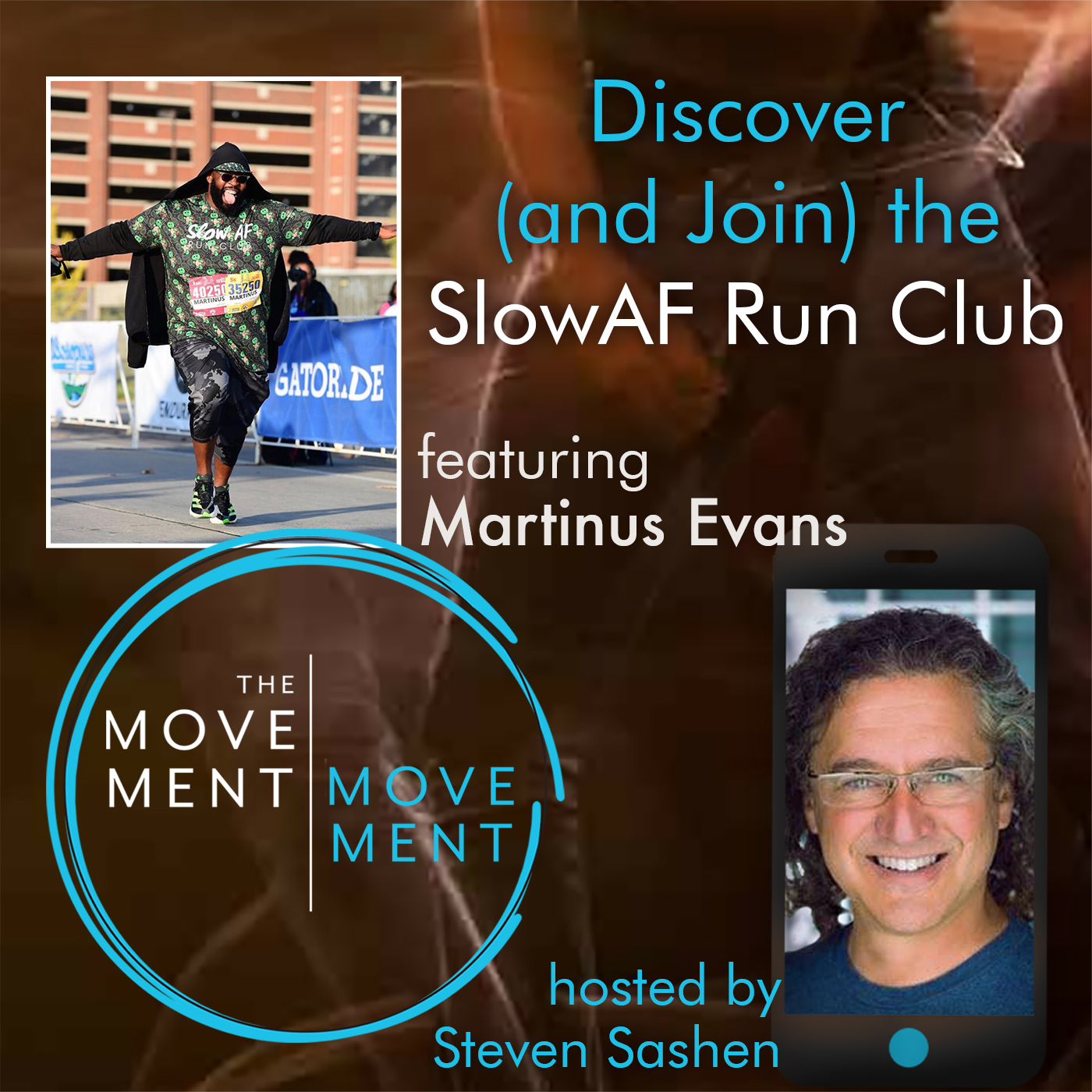
If you're going to take up running the obvious goal, get fitter, get faster, or is it? Maybe that's what's getting in the way of you having what you want when it comes to running or actually anything else you do in your life. We'll get into that. On today's episode of the movement, the podcast for people who like to know the truth about what it takes to have a happy, healthy, strong body starting feet first, those things at the end of your legs that are your foundation.
We are here to break down the propaganda and the mythology. Sometimes it's straight out lies you've been told about what it takes to walk or run or hike or play or to yoga or crossfit or whatever it is you like to do. And to do those things enjoyably, efficiently, effectively. Can I say enjoy it?
Trick question? I know that if you're not having fun, you're not going to keep it up anyway. So make sure you're doing something you enjoy, which is something we're going to be talking about on today's episode. I'm Stephen Sashan, co-founder of Zero Shoes, and here we are with some Zero Shoes behind us, the host of the movement podcast, and we call it that because we're creating a movement that involves you, really simple, more about that in a second, about natural movement, letting your body do what it's made to do without getting in the way with things that are supposed to be good for you that may not be.
In fact, actually aren't. So how can you get involved? It's really easy. You need nothing to actually do other than the obvious.
Spread the word. Give us a thumbs up. Give us a five-star review. Give us any sort of review.
Share this all over the place. If you want help doing that, go to our website, www.jointhemovementmovement.com. You don't need to do anything to join. That's just the word that's in there.
But you will find places where you can subscribe to hear about new episodes, where you can find all the old episodes, how you can find us on social media and engage with us there, and as they say much, much more. So let us jump in, Shaoi Martinez. Do you want to say hi, tell people who you want to what you're doing here? So Barry, you want to get up and get up and get up and get away from you.
We're on Monday's, Marching is the time to spend our slayer from our club with community to get 40,000 of us worldwide, and our dollar is to get one million people to start running and to buy you to have right now. So we're going to talk about the slow AF run club. Actually, yeah, say something more about the slow AF part, and then we're going to talk about the body you have part, and then we're going to back up to talk about some other things. Yeah, so slow, yeah.
I think when it comes to just running industry in general, if you run anything, Florida in a 10 minute mile, then the running community don't see you as a runner, but there's thousands, I would say even millions of people out there who run at that pace, and we're just there to firm them, let them know that they are runners. So that's the slow, yeah part. What was the next part? Body's a big type.
Body's a big type. I think that's another thing that kind of goes into it, right? Is that the thing about people who are at the thoughts when it comes to running, right? You see a 300 pound man who's ran over eight marathons and a hundred other different races, including the three of the six world majors?
Probably not, but that's me, right? And I think just letting people know that they can be a runner in the body that they have right now, they don't have to change it. You don't have to do any of that stuff. You can just start where you at and just move in there.
When you tell people that you have run all those marathons and all those other races, and you are not the typical body type for in their mind for runner, what's their reaction? And then how do you respond? They're like, oh, wow, good. That's for you.
They kind of give me the condescending good for you. For me, it's one of those things where I am who I am before I got here, and it's one of those things that I'm quite proud of, like to be able to run as many races as I have and I'm quite proud. I love the condescending compliment idea. I have a friend who was, I haven't seen her in a number of years.
So let's say I had a friend whom I haven't seen in a while who was maybe like, you know, five, seven, close to 300 pounds. I mean, this woman was round and she was a triathlete and just did lots of tries and always amazed me watching exactly what happened when she would tell people, you know, I'm going to do a triathlon this week and you would just watch them again, try to politely respond in some way and never ask like, what would be the obvious question? It's like really talking about doing that in your body type because that is not what I ever imagined, which would have been a much more interesting conversation. Does anyone ever just like, you know, just come back at you with this straight question to have a real conversation?
Absolutely not. I don't think that's the thing about the running industry and or die culture, right? Like everybody has a preconceived notion of what a runner is or what a person who waits is. So it's definitely a question that rarely anybody asks me.
Well, happily I am that guy. I'm also the guy who when someone's riding by an electric wheelchair, I will stop them and say, okay, seriously, what's your top speed? And or if they've got, if they've got artificial legs, like, okay, what can you do with those that you couldn't do with regular legs? I mean, I'm just really curious about, you know, things that are not the norm.
So from your experience, I mean, given the number of people that you have in slow AFRUNNING club who are both slower and often bigger, what's the difference that you experience and how do you work with people about not only the running part and what may be different for people running if they aren't slower, a larger, but also literally that societal cultural part of how to go out of the world and address this. Absolutely. I was like, there's two things you have to worry about, right? I think the first thing is like teaching people how to run and letting them know, like, the traditional wisdom out there is completely useless for you.
Oh, wait. So then I want to pause there before I go to the social part. So again, let's break that down to the teaching that I had to run. I want to hear more about that and then whatever the other sentence was that I lost about how it's just a completely different part.
So just completely useless. So, you know, just think about me as a 300 pound man, right? And you think about your basal metabolic rate. You know what that is?
Like that's the amount of calories you just burn just by the student in the bed, just being, right? Yeah. Oh, my basal metabolic rate is about 3000 calories. So now you think about that and you add on training for a marathon and you know how they like, well, you know, average you burn 100 calories per mile.
Not a lot, but yeah. I mean, yes, you added up. I mean, people actually expect that or think that running marathon that's that map don't map for me. Yeah.
No, no. Well, so you just maybe think of Dean Carnassus who when he ran 50 marathons in 50 days in 50 states would order a pizza and tell people who were going to deliver it roughly where he would be while he was running to meet him and delivered and then he would roll it up like a burrito and eat it while he was running. That was the only way calories. So imagine that, right?
I even think about like just like salt intake or the amount of salt of potassium that you are expiring while sweaty. Completely different when you think about just the mathematics and and distribution running industry and all of the math is based off of some of this like 125, 150 miles. Oh, dude. The entirety of the running shoe industry right now is based on that same thing.
You know, it's like, Hey, here's these magic super shoes. And the companies know that those are all tuned to wait and speed. I mean, if you're basically, you know, you can run, Oh, the 800 and under two minutes and you wait about 145 pounds. That's great for anybody else.
Not so much. So the whole industry is not geared towards what you're describing. So yeah, that just because a lot of parts that's really, really interesting. So back up, let's go back up to the teaching people to run part and that's different than what's happening for other people.
And I'm going to preface this. Do you know, oh God, Heather Vincent at the University of Florida. Don't hold me to it. No, no, no, no, no.
You're going to want to do the intro between the two of you because she's a researcher. She's an academic researcher, but her big research is on heavier runners and the differences between them and, you know, quote, spell runners. So I think you get a kick out of chatting with her. But what's been talking about just the teaching people to run part and how even just the running mechanics may be different for those people, you know, slower and larger than quote the normal runner.
I think this is very interesting, right? And I'm trying to put this in the way that maybe seem like a man. So but you're among friends here. So, you know, I'm a sort of five run coach, right?
And I think about when I became a sort of five run coach and I gave us like the Jack Daniels book on running. And it was like, this is your Bible, like this is what you're going to need to run. And you think about like all the other people who just follow that that notion whether it's the forums, whether it's rabbit, rabbit, whether it's let's run, all these people are like, yeah, Jack Daniels book is the book. And for slower individuals, another stuff works.
Not when they don't have a pay start, they go pass a 12 minute mile or 11 minute mile, right? Or like someone that advice that I've seen in there, right? Most and I would just say this like most how to running advice comes from elite athletes or coaches of elite athletes teaching you how to run their way. So like the whole notion of like, oh, you know, you need to have a cadence of 180 steps per minute.
Like, and we really like taking this just watching a elite athlete running, he counted steps and like, yeah, that's what you should be doing. And then you try to take that to like the novice runner and then they don't do it or they get injured and they blame themselves versus being like, no, this is the system. I think you just nailed the whole one of the biggest things sort of across the board with athletics, but especially for running is exactly that. I think that major companies have literally trained people over the last few years to think that if you're having problems because of you, not because it's something they've done whether it's a product or a teaching method.
I find that utterly is, I don't want to put it, it's intellectually amazing. It's morally repugnant. Yeah, absolutely. So when so someone comes to you, they've never run.
They are whatever size, whatever way they are. What's the first thing that you do? Well, the first thing I do is tell them, go run for 15 seconds, go run for 15 seconds and walk for 90 seconds. I love you so much right now.
I keep it. Yeah, please continue. Okay. Then what's the second?
So, well, now let's start there. So they run for 15, they walk for 90. Give me the range of experiences that people have had and what you do with them after that. Well, the first thing is really to get them to understand like what is running to them.
Like what do they have in their head when it comes to running? Is it an all-out sprint? Is it a coasting? Just getting people to really understand like what is running to you?
So 15 seconds, I think for me, when you think about a novice, like you can get a lot of information like, whoa, that was too much. And so you wind it, like you're tired of the 15 seconds like, yes. It's like, all right, you're doing it wrong. Like you're doing it too fast.
Like you're doing it too fast. You're going out too fast, right? So I think for a lot of people, it just gives them that, I don't know, I lost the word, but it gives them the notion to let them know like, oh, they're going too fast or they're going too slow to start out. I totally love that.
Especially with people who are going out too fast, it makes me wonder how many of them are potentially former runners or were more fit or thinner or something in say junior high or high school. And now they're coming back and they still have that in their brain, but a body that doesn't match. Absolutely. So I think by myself, like I played football and high school in college and running was a punishment.
And when it came to running, it wasn't, oh, you run at this pace. It was run 110 yards at the fastest pace as you can. And you get there, you don't turn around, you don't do that again over and over and over until you throw it. So really getting adults now who are, you know, adult onset runners or individuals who are just getting back into the sport.
So let them know like, oh, this is not your high school running. This is not your collegiate days or your middle school days. Like your body is way different than it was back then, which means you have to do things a lot differently and think about running in a different way. It took me two years when I got back to sprinting.
It took me two years to learn that maybe two and a half that when I have the thought, let me just do one more. That was actually the key to stop. What was it? How long did it take for you to catch up to your brain to catch up to your body?
Oh, man. It's a constant battle. And one of these I even talk about in my book was this time where I just came off the injury and I went to get back to where I was at, like a car accident and I was able to run. I was like, all right, I need to get back.
So I'm going to do one of those run streak challenges that goes from like Halloween to the new year. And you think to yourself, like, oh, it's just only one mile a day or at least one mile a day, right? I was at one point getting up to like eight and 10 miles, like only like a three week spare year. And then thinking like, oh my God, like my knees, my Achilles, like all this stuff is hurting.
It's like, duh, I tell you to run eight miles, eight miles a day for three weeks straight. Well, that's the thing that's the thing with sports is that it's one of those things that can be a gateway to like assessments. Yeah. Okay.
So that was the wake up call. But again, how long did it take till you were able to back up enough that you were not being crazy and stupid? Again, I'm messing up two and a half years on my end. Well, it's in.
You know, related to that. So I'm 61 now. So the thing that I've had to adjust for in the last 15 years is the aging part of that. And so and just acknowledging things like, well, first of all, since I'm competing, competing, it's right in front of my face.
The All American times get slower every year. And so the idea that I'm going to crush some 30 year old, I mean, I know it was that stupid. But now, you know, my goals have changed to, hey, I can say the All American times every five years when they change, I'm going to be a happy, happy man, regardless of how slow that gets because that's that's good enough for me. And I think for me, just keep showing up.
Like it's literally just being able to run in body to have right now and do that for as long as I can. And I'm happy. How many people come to you with the expectation that by me? Let me ask a slightly different question.
When people come to you, how much do they already know about your philosophical stance? And what happens if somebody walks in thinking something very, very different because they haven't taken the time to check you out? Oh, man. I would say it's probably about a 60 40 split in which direction.
I mean, in the direction of people don't know my philosophical stance. Oh, so what happens there? You have to come to a meeting of mine. And that's typically the thing right.
I've like, for example, my latest client, they are like still doing like the KV Man, paleo type thing. And like having this whole conversation, I'm just not feeling good after my right. Like I feel like I'm bonking. And like, you just want to be like, girl, just go eat a piece of bread.
Like, why are you like your goals? And not adding up. Like you say you want to run a half man time, but you're doing this diet that does not translate to like your goals. Like go eat some bread.
And this is so conversation up like, Oh, I should be able to do this by just eating proteins and fats because that's what everybody else says. And it's like, that's dumb. And like me coming from a coast to be like, I can't say that's dumb. But like, that's what I'm thinking.
Like that's dumb. I think you would say I don't think there's a problem there. I think, you know, there are, let's say the well, I don't know if it's rare enough. There are some people for whom a low carb diet can be functional.
But I think this is a part of mythology about bigger people is that, Oh, you got all that fat, then you could be burning that's like, no, no, no, the muscles under there have their own agenda. And so, and like for you, you know, coming out of football where you're primarily a fast twitch guy, you need carbs. I've never met that I talked to a nutritionist. I've actually talked to a lot of people who think that I eat too many carbs.
And I say, find me one power athlete, one sprinter who doesn't have a high carb diet. And they go, well, okay, I can't think of any point, point the closed or whatever the phrase that should be case closed. That's what I was looking for. This actually one of the reasons if you know Dr.
Peter, one of the reasons that I really like Peter, we become friendly and he was Mr. anti carb for years. He spent a lot of money with other people proving that carbs were in fact not good for you. And that if you ate nothing but protein and fat, basically, even if your calories were equal, you would lose weight because of some hormonal thing.
And when the study did not show that at all and showed that no weight loss was all about calories regardless of composition, which has been done repeatedly, Peter changes mind. And now his thing is, okay, well, you want to get enough protein and then you want to play with the carbs and see if you know what happens to your blood glucose over an average of some amount of time, not just immediately after you eat something. And then that'll let you know what your body is currently and it may change currently able to tolerate for carbs. And now you know something.
And of course, that's more complicated than just hey, don't eat carbs, which is ridiculous. Looking at the research because my background is in exercise science and just looking at the research in itself about these high protein, high fat diets and athletics. And it does not help with performance at all. No, I mean, it is really it cranks me up for as much as people try to emulate 105 pound canyons who are running slightly over two hours in a marathon and look at what shoes they're wearing and what shorts they're wearing and whatever whatever.
They are paying attention to the fact that those guys are like carb machines. Exactly. Wait, how can you lift out that part of the equation? Because that's the unsexy part, the sexy part is the shoes and the workouts and speech training and everybody want to do the sexy part, but there's the unsexy stuff that actually gets you there.
Oh, see, I think the food is the sexy part. This is me. Yeah. So, so, so we had had one of the thoughts in my brain from something you said.
All right. So backing up, they go out, they do their 15 second run there and whatever state they are, good, bad and different. Again, what happens next? We talk about it.
We talk about it. We talk about it from there. We adjust and then we go out there and do it again and say, okay, try 15 seconds. Let's see what 30 seconds.
I'm like, or let's see what a minute looks like. Let's see. I said, I'm walking for 90 seconds. Let's see what walking for a minute looks like.
And we start to dial in like what they are like base interval for just starting to run. It looks like and then start to adjust from there. One of the things I always like to tell people is that it's not what you start is where you going, right? So you can start anywhere and you start zero and get where you need to go.
So yes, like, yes, you start with a 15 second run, but I don't mean that's where you're going to end up when it's all said done. How much do you pay attention to or teach anything specifically about form? Oh, all the time. That's another thing, right?
I think first though, for what I'm not just from the people that I train, like they don't necessarily get form just right off that, like trying to teach a form, like form to somebody who's off the couch and be like, all right, I want to go around. I used to run high school. Like, let me do the do it. You'll do XYZ.
Like it don't necessarily hit them, right? It don't hit them. The way it needs to hit them versus like coming back after like two weeks. And then like, now I'm like, oh, like, you know, I was running and he feels funny or my hip.
And it's like, okay, well, yeah, let's talk about form now because now it makes more of an impact to you and you really understand what what I'm about to say to you versus coming right off the back to be like, okay, let's talk about put placement in, you know, holding your hand lightly so that like a pebble can move freely, but it won't fall through or so on and so forth. Like, like holding the bag of chips where you want crunch it, right? Like, like that stuff won't hit them is probably right off that versus hitting them a couple weeks afterwards. You don't think that suggesting to a 300 pound runner to imagine holding a bag of chips wouldn't be a problem?
I'm just thinking now. I wouldn't be able to handle that one. That's the point. But those are the music that those are the music they give us though.
Like, well, no, no, no, no, it's worse. No, the queue is usually, you know, I think about holding a potato chip in one hand and that works, maybe you want to reach for the bag. So, you know, I'm not a bingy guy in general, unless it's potato chips or french fries or anything crunchy, actually anything crispy crunchy. You know, you can't get in my house.
It's really, it's just bad news. But potato chips in particular, especially if, and look, this is not a plug, but I'm going to have to say Maui onion potato chips pure crack, just FYI. All right. Well, since you said the word placement, I'm going to come back and ask you about that.
What do you say about foot placement? A couple things, right? One of the things I try to get people is like, we just go, just run in place. Like, let's start from running in place.
Like, how does this feel? How does your legs and your feet land under you? This is running place. And I just work on these two queues of like, what should lean like and how are you landing?
Again, I can't tell you much. I love you. This is a thing that I did way back when I met a guy who was a big deal venture capitalist and he said, well, you know, I love what you're doing, but I mean, I can't run in your shoes because I got a plantar fasciitis and I looked at him and went, I actually think you do. He's like, what?
I said, well, it looks like you have tight calves, but let me just prove it to you. I said, let's see what happens. Can you just get up on your toes just like literally off the ground? He goes, yeah, I said, any problem?
He says, no, I said, hey, you don't have plantar fasciitis. Can you run in place? He goes, yeah, and tried it. And it's like cool.
How's that feeling? I said, great. Lean forward just a little bit. And he starts running and as he's running away, he's like, God damn it.
And I still want gas surgery because, you know, I'm just a hippie looking dude and his expensive doctor told him he needed surgery. The thing that I'm going to toss out there, there's two things. One, there's an event at the end of last year called the Mountain Land Running Summit. It's a bunch of researchers about running and coaches as well coming out, talking about the causes and cures of running injury.
And for the first time, they had more speakers than ever before. And for the first time, there seemed to be universal consensus. The number one cause of injuries is overstriting and a story. Put your feet out in front of you when you landed your screw.
And everyone agreed. And then there was one guy there doing gate analysis, my friend Doug Adams from RunDNA. Everyone of the people he tested overstriting and did not know it. That's the part that gets to me.
And I'm happy to report. I was not one of those people. And that's one of the things that got rid of all my injuries. When I was overstriting sprinter at first, I didn't know what the problem was.
When I went barefoot, I realized I was overstriting, stopped doing that. And I basically had a sprinting injury in 14 years, which is kind of 15 now that I think of it, which is pretty much unheard of. So I love exactly what you said. Second thing to reiterate on that.
Do you know Nick Romanoff from Pose Method Running? No. You don't need to. I mean, I love Nick dearly.
The important part is the same thing. He's like, the key thing is getting your foot landing underneath you. That's it. And if you do that correctly, a lot of the other things are going to work out.
So his basic idea is as you get better at any physical movement, the better you get, the more you become like the other people who are really good with, you know, minor personal idiosyncrasies, idiosyncrasies, but the fundamentals look the same. And for the fundamental for effective running is when you're landing your foot, you're not overstrotting your foot, you're not overstrotting your foot, you're close to your center of mass as possible. And your knees are basically aligned or, you know, you're trailing, you can be a little ahead of your stance leg, but that's all that's right. And then what he does is like watch it shows you on video and then gives you some cues to try to figure out what you need to do to get closer to that more ideal thing.
And back to Heather Vincent, what she found was heavier runners tended to have better form that way because they just couldn't actually move as easily to do things like overstride or have their trailing leg way behind them and, you know, then catching up. So she was saying they were often having better form than runners after size because they didn't have much of a choice at that point. Do it that way, you will. That was a long tail after my compliment for loving your loving your, your, your, get your feet underneath you and lean a little bit.
There's something that I do with people when I'm teaching them about barefoot running, but the barefoot part is actually not relevant. But that's why they come is we'll go out into a park and I go, take a look at those like three, two-year-old kids. Their heads are just ginormous. And when they run, they basically their head kind of leans forward and then they try to catch up to their head and they can't.
So do that. And then when just when you think you're going to catch up, tilt your head in a different direction. And then just like, don't have to go in straight line, don't circle as exact, but let your head be the thing that moves you and try to catch up to your head. And trust me, people will think you're an idiot, but they're far enough away.
They're not going to recognize you. And if they do, they're going to want to come over and play because we're going to look like we're having a blast in about 30 seconds. And then slowly I'm going to, you know, not lean their heads so much, not fall over so much and they're getting their feet underneath them. So I just adore that that's the foundation that you're starting from because without that you're going to be screwed.
Yeah. Just as simple as that. I'm a no-nonsense type of guy. I try to keep things as simple as possible.
I like it. Well, I need to back up way, way back to your story, which is the simple thing. How did it occur to you to say, I think I'm going to become a slow AF marathoner? I don't think it occurred to me.
Well, it happened one day. You didn't find yourself at the end of 26 miles going, where did I just go? This is it occurred to me. So it started more or less like this.
I'm working the job, commission sales job and then it's warehouse. I was on my feet eight to ten hours a day, developed some hip pain because I was wearing a hard bottom dress shoes on my feet. I went to go see a doctor, sat down, told the doctor I was having some hip pain. He was like, oh, I know why you're in pain.
You fat. You lose way to die. So we had to see argument because he's like, you know, you need to start walking to lose weight and all this other stuff. And I'm like, so you didn't even hear that I said I'm on my feet for eight to ten hours a day.
Like I'm literally in a suit and dress shoes walking around. So since you're calling me fat and telling me I'm going to die, well, I'm going to run a marathon and he laughed at me, told me I'm just thinking he heard all his years of practice. Madison, he also went on to say if I did attempt to run a marathon, I was going to die on the course. So now you didn't tell me I was going to die at least three times doing this doctor's appointment.
And I just left. And on the way home, I remember driving to a running shoe store or like driving a driving pass or running shoe store. And I made a legal you turn and went inside and told all you running shoes and the rest was history. So is saying screw you to authority something that shows up in other parts of your life?
Absolutely. Absolutely. How is your authority? Yes, you are preaching to the choir.
I've never had a what's it called job? Yeah, because I don't know. My dad actually said to me one day when I was asking him for some money for something I was starting, he said, why don't you just get a job? I said, and that wouldn't end well for anybody.
And so what was the experience of both training for and then doing that first marathon? How did it compare to what you were mentioning? So it was a lot. I even think about my first run.
My first run was literally 15 seconds and I fell off the treadmill because I was inconveniently sandwiched in between two gazales who were running like eight, nine on a treadmill and I thought to myself, you know what, I'm going to do seven and that did not end well. So I thought, you know, I'll bruise my ego and stuff myself up. I'll say, I already need to figure out like how this stuff works and I bought every single running book and like just try to teach myself how to run. And I would say it's something about 18 months from the time that I met that doctor to running my first marathon.
During that period, like I was running a train like house to five K and then train for a 10 K and then did 10 K and then run a bunch of 10 Ks and then ran a train for a half marathon and then like ran a couple of half marathon and I was like, okay, I think I'm ready for this full marathon. So what point did you send a picture back to the doctor? Oh, haven't you? Yeah, I said at what point did you send a picture back to the doctor showing you crossing the finish line?
Never because I never won't. Come on. You didn't get the pleasure of demonstrating that you were. But yeah, but you at least could send him an email and say, hey, take a look.
You know, the thing is it's been 10 years, actually 11 years now. I don't even live in the same place that I even went to, you know, went to the doctor's at. It's been so long that I don't even know the doctor's name. I don't even know where his office is at.
Like he's not even in my lexicon anymore. So I really don't think much about it. No, I can appreciate that one. Well, then from there, so you're.
I'm just like, I don't think about me. Like I'm just a, I'm probably another fat. I think I'm just another fat man that the doctors call it fat for that day. I don't think about me.
Yeah, no, I'm sure that's true. I hope that someday that doctor hears what you're up to and publicly apologizes. That's going to be a fun book and do a chapter book into a chapter. That's a horrible mixed metaphor.
So you're starting to run marathons at what point did it did and how did slow after running club happen? It's like a friend of what happened when I got help running New York City Marathon. What did someone say? Somebody called me slow spot can tell me the hall.
And what did you say in response knowing that you don't handle things like that with the plumb of the late Queen of England? I gave him a middle finger and I kept running. And then after I finished the race, I was like, you know what? I'm going to put slow you up in front of my shirt because like I'm pro.
I'm being slow. I could not be out here, but I'm out here and you know, I'm getting criticized from somebody who's on the sideline drinking a beer. And I'm the one who's actually running. That's brilliant.
The when I was living in New York City, they had a fiber of bicycle race and they put all the weird bicycles up front, along with, you know, whoever they thought was going to win the race. I had one of those weird bicycles. I think they need to get like, you know, whatever that front pack in any marathon where it's always the elite, whatever's I think they need a pack of slow runners. They do.
Like starting the race front of the race. I think so. Yeah. You know, it really is, I don't want to put it.
Yeah, I get really angry just about how companies have manipulated the messages about athletics and about physical activity, not even athletics. Let's just say physical activity in ways that make it seem inaccessible to the people for whom it will be the most beneficial, not even for, you know, again, competing just like for their lives and enjoyment and do something like, you know, put the slow off runners up with the everyone else runners. I think it would be a really nice step to start a conversation. Yeah, you know, that is a good question, man.
And I think I think another thing to add to that is that like, you know, you think about the notion or the study always like to put up like 80% of the US population is like overweight or obese. And I look at these larger brands and being like, but you are not like money because you are always targeting the 20% versus the 80%. That's really interesting. If they were going to that, you know, it's what I'm having a flashback though to when Dove did their campaign and it was all overweight women, I mean, whatever that term means.
And the conversation was fascinating. I mean, part of it was like, Hey, good for you. And the other part was you're exploiting these people. And I can't argue with both of those because yeah, it's a good thing.
And B, it was exploitative. It was it came out of nowhere in a way. It's sort of like, I don't know if you've seen this. I had this conversation with a member.
One of my favorite things about being a sprinter is that when I'm on the track, most of my friends and most of the people in hanging out with are black. So we get to have conversations that I don't have to get to have in Boulder, Colorado, where it's very diverse. There's every kind of white person. And so when the outdoor industry started saying there's not enough representation of black people, suddenly the cover of every magazine was black athletes and I was saying to my sprinter friends, does that feel like you're starting to get attention or that it's just pandering?
That one. So in a similar vein, I mean, for one of the big companies to address bigger, bigger runners, runners, athletes, whatever people are doing, I think that one of the challenges is to do it in a way that still feels authentic and not exploitative. And I have no idea how they would do that. Well, they got billions and trillions of dollars.
I'm pretty sure they can get creative or hired people who can get creative. It can be that way, right? I think that's another thing about equity. Like, okay, we got the resources.
Well, then let me ask you the ball. It's a question. Why aren't you applying for that job? Because it's not available.
Oh, come on. You're on job, dude. This is a, I'm totally serious. Look, so I'm going to talk about my company.
If we had the resources and you came to me and said, I want to build out this, you know, this piece of the puzzle because your product can and does work for athletes of all sizes, all shapes, all whatever. And this is an underserved population. I can't tell you how much I would be jumping at the chance to find a way to make that work. And we're a small company.
We do not have billions of dollars floating around. We're not on a, you know, hundreds of millions of dollars campus with more money spent on the fountain outside of the front door than they actually spend developing a product. So I'm not saying that we have that job open. I'm saying, hey, that's an interesting conversation.
But I'm also saying for places that have bigger resources where it could make a bigger difference, hell, where's the downside for? I mean, I'm not saying you should take the job or if you've wanted, but I'm saying this is an opportunity. I agree with you. Someone should try and make that move.
I agree. So I'm trying to make that. And I think the other thing is that, you know, I've had partnerships with very large companies and things of that sort. And where it really comes down to is that they don't really care.
Okay. And I'm going to back up a minute or so. I don't know what resources it would take. I can't, not making a job offer.
I can't legally do that. But we need to have this conversation offline and here's how it's going to start. I can't think of anything. I mean, this has been a total, total blast.
And I hope, you know, this is going to sound funny. How do I put this? If somebody shows up for a slow AF running club and they are not, you know, 300 pounds plus or whatever, they're not making up numbers, you can just quote, you know, I don't want to use the word normal. It's so horrible.
Are people who are not what we've talked about of being bigger, slower? Are they showing up and what happens when if they do? You know, yeah, like someone do show up and I think someone show up because we don't have the, I want to say taxi that someone running industry have, but we are a low, low to no pressure type of group. So they show up because they know that we're not competing.
I love it. You know, the competing side, my favorite thing about that is no one's ever honest about it. So like when I show up the starting line and there's a whole bunch of guys who are like really, really intense and they're like, I'm a good person. I go, Hey, look, look, there's no prize money involved.
We're all old. We just want to get to the finish line and be healthy and have fun. And I totally want to kick your ass. You know, and if you're told, if you're honest about both sides of the equation, then it gets really, really enjoyable.
And so, you know, so they're yet coming out because there's no pressure. I think that is dreamy. So, so one of the things I used to tell people is like, you know, I wonder if things I learned in general is that most races are permitted as a parade. So if you think about nothing, like we are just participating in a running parade.
And like, if you're not a elite athlete, like none of this stuff matters. Like we pay to get a stale bagel, a half a banana and a medal and they cost $3 in China. We pay for all that. So like, that's just all because of the finish line safety safely and half on along the way so that we can do it again in a couple months.
I love that. And if I were a better man, I would end it on that, but I'm not my, my thing is as a 60 one year old sprinter, I'm in this horrible, horrible age bracket. So the guys up at 35 are still rocket fast and everybody pays attention. The guys over 75 or as crazy slow with the fact they're doing it, everybody pays attention.
In my age group, they're going out to get a beer. So, Martinez, people want to find out more about you, let alone slow F running club. That one of the ways they can do that. Yeah, that's what you do to go to slowyoffrunclub.com as slow.
Hey, uh, run club.com or you can find me on all socials. I'm at 300 pounds and running on all things social media or at slowyoffrun club. There we go. That's what I mentioned.
You said that got to have you say it beautiful. Well, once again, Martinez, total total pleasure. I'm thrilled that we were able to make this happen. I am going to get you some shoes to play with.
Do that. We will. Thank you. I want to hear your comments about this.
I want to hear you going out and checking out slowyoffrunclub, seeing what you discover and remind your go back to www.jointhemovement.com to find our previous episodes to find all the places you can engage with us on social media, all the places you can get this as a podcast or on video. And if you're not getting it where you want to get it right now. And of course, like I said, give us a review and a thumbs up and a like. If you want to be part of the tribe, just subscribe.
That's sort of just that. And last but not least, if you have any requests, any suggestions, anyone you think should be on the show, any other recommendations, if you think I have a case of cranial reorientation syndrome, doesn't matter to me, you can drop me an email. Just move M-O-V-E at JoinTheMovementMovement.com. And until then, just go out and have fun and live life-feet first.