
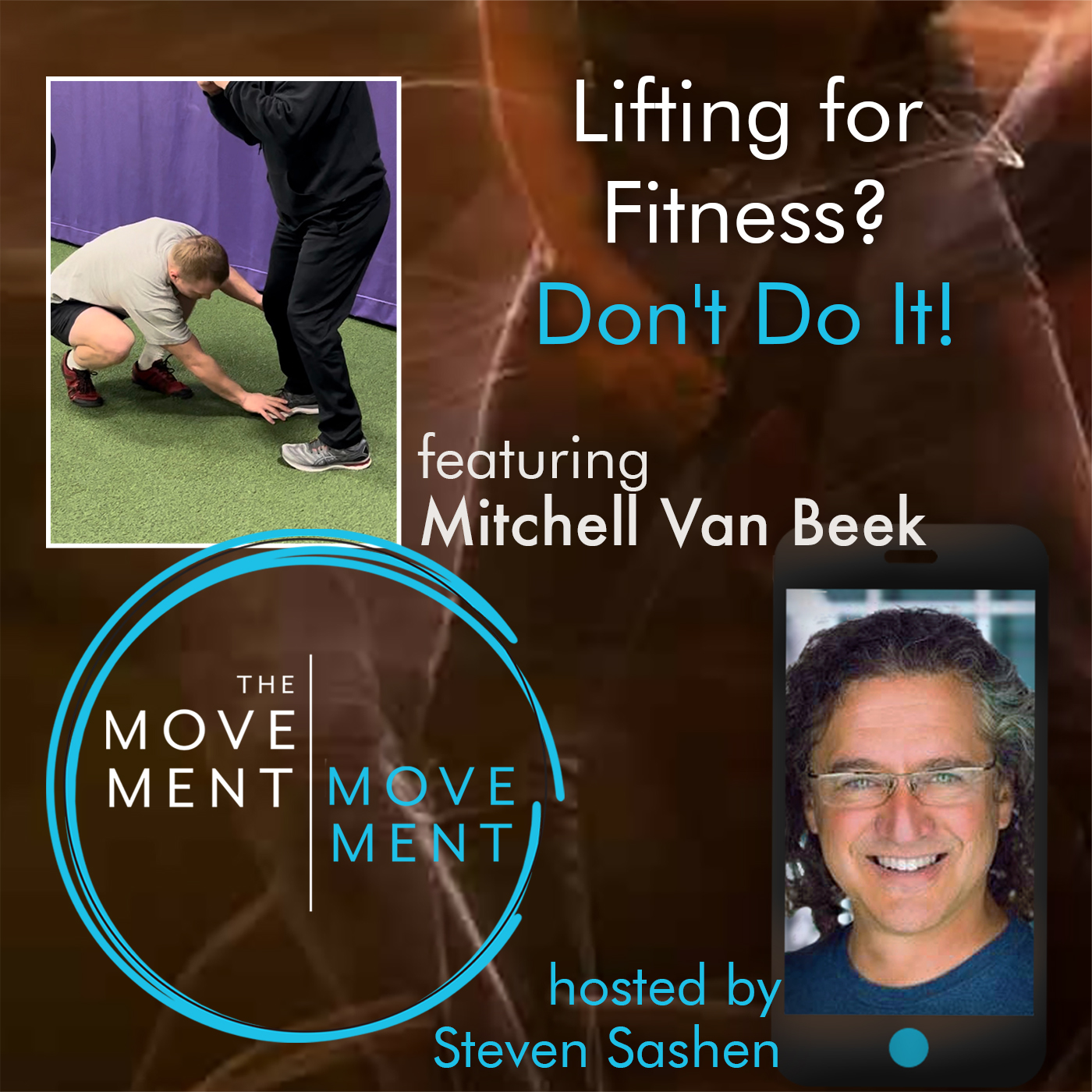
Everybody knows that if you want to get in shape, you need to do some lifting. You've got to do resistance training. You've got to go to the gym. You've got to throw some metal around, right?
Maybe not. We're going to find out more about that on today's episode of the movement movement, the podcast, where people who want to know the truth about what it takes to have a happy, healthy, strong body, starting feet first, you know, those things that are at the end of your legs, that are really your foundation. We break down the propaganda, the mythology, sometimes the flat-out lies you've been told, about what it takes to run or walk or hike or do yoga, or cross-fit or pretty much do anything. I'm going to do that enjoyably, affectionately, effectively, and I say enjoyably.
I know I did. It's a trick question, even though I'm recording this on a Monday morning when my brain is working. So, look, if you're not having a good time, you're not going to keep doing it. So, make sure you're having a good time.
And I am Stephen Sashan from Zero Shoes.com, your host of the movement movement. We call it that because we and that involves you, more about that in a second, are creating a movement about natural movement, letting your body do what it's made to do without getting away with technology that might not actually be helping. So, the way you can participate is easy. Just spread the word.
Give us a thumbs up. Give us a like. Give us a nice five-star review. Give us a hit the bell icon on YouTube.
Go to www.jointhemovementmovement.com and subscribe to hear about upcoming episodes and find previous episodes. And that's kind of the gist and short. You know what to do. If you want to be part of the tribe, just subscribe and spread the word.
Alright, let's start and have some fun. Mitch, do me a favor, tell people who you are and what you are doing here. Well, I'm Mitchell Van Beek and like you said earlier, I disagree with the mainstream fitness industry on whether or not lifting or lifting based training to speak more generally is really all that good for us. So, a little bit about my background before people think I'm insane for that.
Oh, no, you might think you're insane even after you share your background, but nonetheless, please continue. I hope so. But I am actually the founder of a training system called the Move Pain Free System. And what we do is we do personal training focused on movement behavior therapy.
So, we're actually changing how people walk, run and train in the gym so that they change how they feel they get out of pain. And what brought me to this was I struggled with back pain for 10 years when I was really young. I'm actually 12 years when I was really young. And so I went down this fitness, this fitness path.
I studied exercise science at a small college in Iowa called Northwestern College. And I studied about a dozen other exercise systems trying to figure out how to fix my own back pain. And what the conclusion I came to was with the help of others was that it was my movement patterns, my movement behaviors that were keeping me in pain. And a further along the line conclusion was that my training behaviors were causing those movement behaviors.
So the lifting based training that I was doing was actually promoting these painful movement behaviors and causing pain down the line. So my take is that lifting based training is not actually that good for us. And it might be causing the issues that lead to long term movement dysfunction. We are not surprised I'm going to dive into that.
But first things first, Iowa sounds like they're a little precious. If they can in the middle of the country have a university called Northwestern, that just seems wrong. Yeah, right. Yeah, I think it's called Northwestern College because it's in the Northwestern corner of Iowa.
Yeah, I'm not buying it. I mean, yeah, I get that's what they would do it. But I mean, that's kind of like a where the center of the world sort of move. Yeah.
So, so backing up. So the movement patterns that you were that you discovered you had that were caused by lifting or at least exacerbated by lifting. Can you say more about what you discovered or what those patterns were? Yeah, absolutely.
So I kind of want to back up even more and just kind of talk about what the difference between lifting, based training and movement based training would be because our body is very similar to a hammer if we simplify it all the way down. The hammer has two functions, right? It can pound the nail, it can tear the nail out. But you're going to use that tool in a completely different way to do those two functions.
So if we take that and complicate it extremely to to compare to our body, our body will move us through space or it will pick things up. So there are two different patterns for that. There's the movement pattern and there's the lifting pattern. And that movement pattern is going to be more of a spiral rotating pattern starting from your spine moving through your hip down to your ankle and actually using your foot correctly, which I'm sure we'll talk about today.
Oh, yeah. And then the lifting pattern is going to be more of a core bracing pattern where we don't want to have a ton of range of motion in our spine to lift optimally. So if I was training a professional weight lifter, I would not train them the same way I would train a marathon runner. And I think everyone would agree with that.
So the lifting pattern is going to be that core bracing hip thrusting heel pressure pattern that will optimize the lifting function and then movement. The movement pattern is going to be that spinal rotating correctly using the foot pattern that will push us through space, optimally, and efficiently. OK, so let's put a bookmark on something because I do want to talk about the relationship between strength and strength training and some of those movement things. So we'll come, but I want to back up to where this little tangent started about what was the movement pattern that you discovered for yourself that was leading to the back pain you were experiencing.
Yeah. And that's a really good question because when I was in high school track, I was always pulling my left hip flexor, pulling my left hamstring. And what I found was I didn't have a lot of space in my left hip. My left femur head was actually stuck in the front of my hip socket, is what I saw.
So when you have that, your kneecap is actually this identifier of where your femur is in your hip socket. And when I was running, my left kneecap never didn't point outward away from my midline. It would always stuck at about a 22 and a half degree angle away from my midline. And when you have that, you're not able to transfer energy from left side to right side.
I was fine loading it into the left side. But what the issue was is anytime I spine would rotate into my right side, my left hip wouldn't be able to close, shut or internally rotate to follow that spinal action. And that was causing compensations. And my back took the brunt of it.
So that's a really specific thing to have discovered that a normal human wouldn't have figured that out on their own. So how the hell did you find that one? So I won't I won't pretend like I figured this stuff out on my own. Either I studied a lot of different training styles and a couple systems that did slow motion movement assessment, right?
You you break it down and you've talked about this a lot on other episodes as well. You can see very specific actions happening in the body and when you scrub through frame to frame, then you can see if they are or aren't happening. And that's where I diagnosed that problem. So the the fix was to start to regain that length in my glue to actually allow my hip to start shutting.
Because really, if your kneecap is pointed out and your feet are pointed out to compensate for that, you probably have really short glutes that are just pulling your femur into external rotation at pretty much anytime. That's. Yeah, so let's let's break that down a little for people. So many people don't think about the relationship between their feet and their butt.
And unless you were kicking someone in one with one, but this is a really critical thing. So your glutes are designed to do a couple of things. One is hip extension. So imagine if you're standing, you're standing, that's driving your hip backwards.
But also it's responsible for rotating your femur, your thigh bone, in or out, depending on what it's doing. Mostly it's made to rotate an outward. And so if what you're trying to do if you're glued is perpetually shortened, whether that's literally physically shortened or just hyper ten, and then it will rotate your femur outward. Now, FYI, what you see with many runners is the exact opposite.
You know, you'll watch somebody running and their knees look like they're pointing towards each other or banging into each other. And that's mostly because their glutes aren't firing properly and externally rotating. So to think about externally rotating rotating, if you don't know that term, if you look down at your legs, external rotation would be to spin your right leg clockwise and left leg counterclockwise, basically turning them outward. External rotation, not a very complicated topic, but it sounds really fancy when you say it that way.
It'll make you popular at some dinner parties and other others. So, so, so, so, so, in fact, I don't know if I, when I told this story, in my neighborhood, there's a lot of runners and many of them are very, very good. The other day I was walking my dog and I saw this woman coming towards me and this is not fat shaming, but I have to say she was relatively overweight. And it's important because what I noticed, just because I can't help but notice how people run, her left leg looked great.
I mean, everything was totally perfect. Right leg, her right leg was internally rotated. So her knee, her right knee was kind of banging into her left knee. And the, at the same time, her foot was externally rotated.
So her knee was pointing in her foot was pointing out. I went, God, that is weird. And as she went by me, I noticed her left glute really nice and full and her right glute may as well may as well have been nonexistent. And it was, I've never seen anything like that.
It was wild. So anyway, bit of a tangent. So you discovered that you had this glute shorting thing or your glute was just hyper tonic. What did you do from there?
Yeah. So that's where we kind of get into the movement based training ideas because when we want to start repatting how we move the best way to do it is to go back to where we all started. So we do a lot of developmental training. And what that means is we get on the ground, just like you would have when you were a baby or a toddler learning how to crawl first and what do toddlers and babies do before they crawl is they rock in place.
So I did a lot of what we call rockers. And what a rocker does is bring you into hip flexion, take you into hip extension, but your shins are actually locked into the ground and your feet are as well. So you are teaching yourself to use essentially your glutes and your hip flexors to produce these actions and resist that rotation so that when you start to use your spine to transfer energy from inside your body, that tension will allow you to go back to the right. So we started to allow everything to move in this cosine wave, this spiral wave through space.
So I started with a lot of rocking. And then once you come up to your feet, that's when it's time to teach your foot to behave properly. And this is actually when I started getting into zero shoes because I needed something that would allow my foot to work properly. And I can't wait to dive into all the things that I discovered and talked about with the foot and why people should wear barefoot shoes, but it started with ground work.
And then I had to teach my feet to behave properly because I was stuck in that heel pressure situation where if your heel is pressurized, your shin is just going to be compressed in your foot. And it doesn't matter what your hip does then. Your hip isn't going to be able to work with your ankle and your spine or your back is going to have to pick up the slack. And that's where I was running into back pain.
Got it. So let's back up to rockers. Just so people can experience it. I'm sure many people put two and two together and figure out what you're describing.
But the gist and well here, I'm going to let you if you're going to teach someone how to do it, where you're not seeing them and they're not seeing you describe it. And I might interrupt to break it down slightly. I found that many people are really well, anyway, you start and I might stop. I might stop at some point.
Yeah, absolutely. So for a child rocker, we'll cause it's just our basic forward and back rocker. You're going to be on your hands and your knees with your armpits, your hips and your knees, all that 90 degrees. And what you're going to do there is make sure that your ribs aren't flared up because we don't want huge extension with our chest really pointing up toward our hands.
You're going to make sure that your nipples are pointing at the ground and from where I got way too many jokes. I'm trying not to say. No, but you don't want to be arching your back. You want to be, you know, relatively have a neutral spine.
So, OK, that's our starting position. On there, all you really have to do is push yourself back with your hands and push yourself forward with your legs. And when you start really quick, toes on the ground or top of your feet on the ground. Yeah.
And that's usually what I coach after they start pushing themselves around as then it'll change how it feels. So push yourself back with your hands forward with your legs, but to make it easier or harder on yourself, depending on who you are and how your hips are functioning at the time, you're going to make sure that the tops of your feet are pushed into the ground and you're going to keep your big toes inside of your heels. So your big toes need to be toward your butt track compared to your heels. Oh, interesting.
And here, this is going to sound like a weird question, but I'll explain why I asked it when you answer. What kind of pace are you doing this at and for how long? Yeah, and kind of depends on the person, right? If they're already established athlete, we might go like a one second, one second, one second, one second, just push back, push forward.
But a lot of people who have no glue length at all will have them push back and hold it for 10, 20 seconds. And that'll give you a really healthy burn in the glutes, to be honest. And so we used to push back to be pushed back from the hands. So and then, OK, and then how far if they're pushing back from the hands, how close is your butt getting to your ankles?
And that's a good question, too. And it all depends on the person, right? So what we always start with is keeping the tail nice and high. It's like you're trying to touch your butt against the ceiling, so you're pushing your butt back and up.
And that's going to maintain your natural landmark curve. And this only really works if your nipples are staying at the ground, pointing out the ground because if you're rib flaring, your tail will fall as you go back. You'll go into the opposite of a natural spinal position. So very finicky exercise.
But we have people who, if they need internal rotation and they need a lot of glue length, we'll have them bring their butt all the way to the ground as well, because you need you need one bar flexion as well. So and it's something you can play with, too. I when I go on my runs, I'm always staying with my tail nice and high because I want to induce some tension in my in my glutes and lower back just to make sure I'm pushing myself forward. But if I'm trying to relax, I will bring my butt all the way to my heels.
It's more of a Cesar position then or Cesar. I would be saying that. So I go and then and then so people doing whatever that whatever pace is appropriate and I guess for people who are not seeing you, they can just experiment with that a little bit and see what where it goes and for how long, like what's the kind of reps and set idea or time under time under movement idea. Yeah.
So when we first start, we'll have people do 10, 10 reps holding it about five seconds in the in the hip flexion, which is just pushing your butt back. So having pushed themselves back hold it for five seconds, rock out and hang out for a second and then go back. So 10 reps will do a lot or just a chronic back pain. You'll feel barely instant relief because your body's like, this is an environment where I think I can heal.
And that's that's really the whole point of every exercise we do is to give the body a natural environment for it to heal. So the reason that I asked about speed is I don't know if you know this. And frankly, if you did, it's only because you've been stalking me. My undergraduate research was on cognitive aspects of motor skill acquisition.
And so the interesting thing there is to learn some complex motor skills, some very new thing. Ultimately, you have to start very slow and deliberate because you don't know how to do it correctly. And over time, you become more efficient and you're able to go a little faster. You're able to be a little more subtle about it.
When I was doing this research, I, one of the ways that I supported is I learned how to tap dance and I would record. I think it was either three or four different simple steps, shuffle steps, shuffle steps, shuffle steps, one of them. And I would record these and do do them for a minute and see how many I did and how accurate I was. And I'd just track this over the course of three months.
And it was amazing to watch how it just is a neurological change, not surprisingly, that allows you to get better and faster. And it's a little push me pull you about the better and faster. Some of you go faster and you're not doing as well. Sometimes you go better and you're not going as fast.
Sometimes you overdo each one of those until eventually, you know, you're just cranking it out about as fast as you can do it. So, so I know we're going to have to get off the ground to really engender this continued new movement pattern. And I mean, I mean, interject something in there about the twisty, twisty, sinusoidal thing that happens in your spine and doing that too. But so after we're on the ground for a while, what happens next?
So once we stand up, we actually have coined this term, the MPF squat, the MPF squat. And what that is is just a rocker, but you're on your feet now. So the reason the rocker works so well is because it's patterning these actions of the hip together. You have flexion and internal rotation.
You have extension and external rotation. And when we stand up, the same thing is going to have to happen. But now we have to set our feet correctly. And this is where we'll start talking about the foot and how it's supposed to function.
Please do. And the way I think about the foot is this this tri arch structure. So there's three arches in the foot, right? And if one of those arches isn't locked into place or one or two or all three aren't locked into place, we aren't going to have this stable platform for movement.
So and this is where the bad shoes come into play as well. Let's start with, let's start with, describe where those three arches are. Since most people only think of the medial longitudinal arch. Yeah.
So you have the medial longitudinal, you have the lateral arch of the foot and then you have this transverse arch, which runs across where your laces are, I would say, on your shoe. And the idea of your foot is it's all these bones that their only job is to lock into place when your foot lands. And people think that heel pressure is how you get this strong foot, this tripod foot idea. But I think the tripod foot is trash when you're talking about actual movement patterns, because the tripod doesn't lock your foot arches into place.
It pressurizes the heel so that it really takes away some of the structural integrity of your foot. And so what we do is, and this is kind of a cue that I take people through as well, but you're going to get your feet three, fifth distances apart with your pinky toes pointed straight forward. Your big toes will actually be pointing a little bit in. And I'll explain why we do that later, too.
But we're going to have our pinky toes pointed straight forward. And what we're going to do there is turn our knees in to push the ground apart, like you're digging your feet into sand. We don't want to pause for a sec about pinky toes pointing in because I know some people who speaky toes are stuck underneath their foretoe. So basically we're talking about the fifth net of tarsal, that the bone that would go to your toe, you want that one to be parallel and pointing forward.
So if you're a pinky toes doing some wacky ass thing, pay attention to the bone, not the toe. Yes, exactly. Yeah. We got a pinky toes pointing forward, which means our big toes are pointing in a lower root, but we're doing a little internal rotation.
So our knees are coming in a little bit. And then the idea is pushing the ground out underneath us. Go ahead. Yep.
And if this is your foot, this is your big toe, hand is a little wonky, but you're going to pressurize the skin right between your big toe and your second toe and push out through there. And that's what we find locks the foot into place for this squat pattern. And of course, the foot is extremely adaptable. And that's why we're doing this.
We want it to find comfort in that locked position, the triage lock position. So any surface that we land on, the foot will be able to find this locking tension. And from there, we just tell people to do the rocking, the rocking action. And that is really just pulling yourself down into flexion and pushing yourself up into extension.
And this is another concept that I don't think a lot of people think about, but the squat pattern, a lot of people think when you're descending in the squat, that's going to be like the landing pattern, because I guess our knees bend as we land on the ground. But really, we have to think about what action is happening when we're descending in the squat and that's that's hip flexion. So if our hip is flexing in the descent of the squat and our hip is flexing in the reset of the run or the, I can't remember what you called it. But when you're pulling your leg through when you're running, is your recovery or swing?
Yes, recovery. Yes. That you called it that in another podcast. Hey, I didn't make it up.
No, and I didn't make up the reset where it is, but the hip flexion aspect of the reset or the recovery and the hip flexion aspect of the squat are actually in my mind, the same thing. So the descent of the squat is how you pull your leg through. So you want to be pulling yourself down into the squat with your hip flexors. And that'll allow your glutes to lengthen to their proper length.
And then when the muscle is long, then it can shorten to produce force again. So when people are squatting and they're opening their knees, shortening their glutes during the squat, they're actually, in my opinion, taking away some, some power of that squat pattern. So that's interesting because that's going back to what you were saying. So when people were pointing their knees out when they're squatting, it's because they are trying to activate their glutes, which if they're doing that is shortening, then we're strengthening them or locking them into something that is a more tonic position, which is the thing that you found was causing your problems.
So, and also just playing with this, I'm sitting down while I'm doing this, but I'm playing with the whole thing of getting my fifth metatarsal, pointing forward, et cetera, et cetera. And as I push out, especially my knees mildly internally rotated, it's a very funny thing because it's the same kind of one's trying this. When people talk to me about having flat feet, one of my favorite things to do is I go stand up and squeeze your butt together like you're trying to hold a dollar bill between your butt cheeks and keep your feet locked in the ground. Don't let your feet move.
Don't let them twist or do anything. And if you keep your feet in place while you do this, it tries to create external rotation in your, in your femur, but your foot's not letting it and actually creates a mild bit of an arch. What's interesting with your version, it's doing the same thing. So the whole thing of that pushing the ground out with the position that you started in is doing that same thing.
I'm really, I'm feeling the longitudinal arch really engage. And it's a very, again, very different way of getting to something similar, but in a way, your way, my experience of it is that it can get more intense than just doing the glute part alone. And I like the idea that it's a cue from what you're trying to do with your feet, push your feet as you're trying to spread the ground out. Cause that's an easy verb for people to understand.
You know, squeeze your butt together. Some people can't even do that, but try to push the ground away. So if you're getting pushed away, that's an easy action to do. You know, I'm going to, I'm going to throw somebody on the bus metaphorically right now, Nicholas Romanoff from who created what he calls pose method running and I adore Nick and I adore pose method.
We disagree about one cue. The key cue for them is to pull your foot off the ground and which is fine. I mean, for some people, it works really well. Somebody gave me a cue for what you're trying to do.
This is when you're running about what you want to do to get your foot off the ground. The cue he gave me was, it's not just even give it just to me. It's a guy named Adam's from Run DNA. That cue is to enter foots coming off the ground.
You want to think about needing a soccer ball towards somebody in front of you. And what's interesting about those two cues, the soccer ball, the support of the ground, human beings understand the concept of needing a soccer ball, pulling your foot off the ground as a little foreign. They both do the same thing. They both work on what your foot is doing to get off the ground properly and to get that swing phase, that recovery proper, but just coming from a different direction.
So that's what we're changing for what you're saying is a similar version of coming from the feet side rather than the glute side for understanding what that kind of spirally motion is and what that can do to your lower extremity. And actually I watched the episode that you did with Doug, I believe, and I, that was a really good cue because I think of that about that as well. And the running cues come away later in this, this movement transformation process because we have to give people the pieces in parts and then go ahead. Well, no, so you will, what you just said, you and Nick Romanoff love each other about that because where Poe's method came from is, Nicholas came out of the, the Russian sports training world where they focused a lot of things like ballet.
And when people think about ballet and you think about between pliers and relevés and all those things, those aren't there just to be exercises. They're there to train your body in a very specific movement pattern that you're then going to be using for more advanced things. So you're just providing a similar thing of getting these movement patterns down, doing that retraining so that as you, because you can't, this is a weird phenomenon. There are things that I could do in slower motion with my running form that I could never do in a race because once I'm in a race, my brain turns off and it's just autonomic.
But what's happened now is I, so you have to build those patterns and then eventually get faster and faster because that's what ends up in the back of your brain. I had a coach slash friend, he's still a friend, not a coach who said the goal with doing running drills is do them until you can do them right and then keep doing them until you can't do them wrong. And that's just another way of describing how they've been internalized. Yeah.
And that's exactly what we're doing. We're trying to internalize these movement patterns using your foot correctly, making sure that whatever you land on your foot is going to lock into place and then we can start using our spine and our hip correctly to push ourselves forward. And that's, I figure that's what we can go into next is almost there. When people are doing the, you know, kind of the rocking version of standing or the standing version of rocking and they're doing this squat and extended by the way.
So if we glossed over this, my apologies, hip flexion, just imagine if you're standing up, just lifting your knee. So that's making the angle between your femur and your body get smaller. So that's the hip flexion part, again, extensions, the other way around. When you're doing the squat, how far down are they going?
Again, same questions for the floor version. So you et cetera, et cetera. And it's going to be a very similar answer, right? How do you?
Depends what they need. And we always start with going to about 90 degrees at the hip, 90 degrees at the knee. And it really depends on their foot. Cause when I first start with people, I tell them to push their knees as far forward as they can without their heels coming up.
Still going to be pressurizing the front of the foot, but we're not going to let the heel climb really high. And that's kind of the interesting thing about when we go into a deep squat and in the move pain free system anyway, we let the heels come up so that the heel is reacting to what's happening at the hip because with the movement based mindset, I don't really care if your heels can stay on the ground when your hip is in deep flexion. Of course, if you want to have a resting squat, now we can turn the knees out and pressurize the heel and you can chill out there and do arts and crafts on the ground. But when I'm training someone who wants to move pain free, I want their, their ankle and their foot to be reacting to the hip.
So what we start off with is just getting that knee as far forward as we can, getting the hip as far forward as we can without the heel coming up. Cause that's going to put a lot of tension in the connective tissues of the foot, of the Achilles, of really everything running up and down the leg. So yeah, that's the top deep we go. It's not, it's not a hardened fast rule though.
Sure. Okay. Then moving on. Yeah.
Yeah. So moving on from there, the squat is really the basis of everything we do because when we're descending and ascending, we're actually going to resist rotation at the hip the whole time, we want that knee cap to be pointed straight the whole time. And what you'll find is the deeper you go, the more internal rotation you're going to have to use to keep your knee cap straight because your femur and your shin, they will fold onto each other to get into that deep flexion. And as we're doing that, we're building this, this tension relationship between the hip and the angle.
And then when we start doing other drills, like rotating into one side of the body and we'll do that right away. You can just stay in your squat and then rotate your spine. You'll still want to resist that rotation at the hip. Keep that knee cap straight because then when you start to run using this movement pattern, your spinal action will actually force external rotation on your weaving leg in your hip and in your ankle.
So your knee cap will point out during the run, but we don't have to train it there because if you start training it there, we're getting into the same glue, the glue dysfunction issues or shortening it for no reason when we really want it to be long and tension. And then of course, it's the same idea when we start moving through space, we'll start taking steps, making sure that the foot is locking into place, rotating the spine into that side. And then to leave the ground, all we're going to do is teach them to rotate their spine the other way and then everything else below it will function correctly. Have you heard me talking about walking uphill?
Yeah. Yeah. That's what you talked about the first time we hopped on a call and yeah, and you nailed it, right? To leave the ground or to push yourself, all you really have to focus on is your spinal action.
And that comes down to the spinal engine theory, right? Even even if you don't have limbs, you can propel yourself using spinal action and amplifying it with whatever's touching the ground and it helps to have. I love it because, you know, so you discovered this, however you discovered it. For me, it was just goofing around and kind of an accident and for people that haven't heard it, I'll explain it for people who have my apologies in advance.
But if you haven't tried it, go try it. So the gist is in the area behind, well, all around our house, there's much hills. And what I found is if I'm going uphill, I can do it kind of effortlessly. It's almost like a slinky going uphill.
And so what I do when my right foot is planted on the ground and my left leg is going to be in the air swinging. I'm twisting to the left, I'm twisting my spine. So I'm facing, you know, like, if facing forward is 12 o'clock, then I'm twisting to about 10 o'clock. And that's putting a string, putting a stretch into my right hip flexor.
And because I'm going uphill, I don't reach my left foot out front of me. I just let it hit the ground wherever it's naturally going to go. At when I've done this twisting thing, which interestingly, it lands pretty much right underneath my center of mass. And then all I do then is twist to two o'clock.
And what that does is when I'm doing that twisting thing, it lets that right hip flexor that was stretched, release, and kind of like a rubber band is releasing. It kind of shoots my right knee forward just enough till it hits the ground again, going up. And so I'm basically just twisting my body counterclockwise clockwise and letting my legs just relax as much as possible and using that stretch and release in the hip flexor to be the thing that moves my legs. And what I find is that basically you go uphill with almost no effort whatsoever.
It's really, really wild and fun. And if you start playing with that, and I'm guessing you're going to go here, you just need to tone down version of that. And that's how you can walk to and it doesn't have to look. Now, when you're doing the uphill thing, you look like a tall door.
No question about it, but who cares? And, but when you're doing it, you know, walking on flat surface, it can be much more subtle and, but you still get the same effect. Yeah. And what I would challenge you next time you're playing around is try doing that same method, keep twisting your spine, but now turn your feet out, do that for for about 50 yards and then try to turn your feet in and just see how the natural tension that you are using to move yourself just goes away because if your foot is not in this correct place to lock into place, your spinal action isn't going to be as efficient.
Yeah. Yeah. Yeah. I'm not going to make any, I don't want to say out loud, but I'm imagining the difference between turning my feet out and being with me because I want people to go and experiment with and discover for myself.
So my lips are sealed on that one. Do we want to keep going or there's now a good time to bring back that question that I want to put a bookmark on about, especially for runners where lots of runners are weak in various places, often typically the glutes, but other things as well. And there is data showing that strength training can reduce running injuries and make running more efficient, et cetera. So where, if anywhere does, you know, how do you reconcile that component of things with what you're doing?
Yeah. And I love that you use the term strength training because I believe in strength training, resistance training is a valuable tool. It's just this lifting pattern. That's the issue.
So what we've done is we found ways to train the movement pattern with resistance. And it really comes from a few things, right? Just the technique of where you're putting the load on your foot, how you're using your hips, how you're using your spine, but it's also the loading, the loading techniques of your body. So when everyone thinks of lifting, they think of like the back squat, right?
So let's use the back squat as an example. When we're directly spinal loading with that bar, it's going to change our posture. In some cases, a lot, in some cases, not a lot because people are already stuck in this rib flare idea, but that right spinal loading, put it here, you're going to naturally rib flare yourself. And that's going to put a lot of compression in your T spine.
But what it's really going to do is force your, your one bar to change position. And then you're not going to be able to use your hips as efficiently. So that's why we see people when they go deep into that back squat, their knees are going to turn out to their feet, probably will turn out too. And it's going to be patterning that lifting pattern instead of the movement pattern.
So what we've done is found ways to load the body in the movement pattern and our substitute for the back squat would be the zercher. Have you ever, have you ever done that? Yeah, describe it for people who don't know it. Yeah.
So instead of taking the barbell and putting it across your back across your scapulas, you're just going to hold it in your elbow pits. And what we do is actually shrug the shoulders up. Hold on. I'm going to break that down for people who aren't watching.
So actually, here's the easy way I can describe it. I've never thought of doing it. Imagine doing a barbell curl and you're all the way at the top. And now just take the barbell and let go of your hands and it'll end up falling into your elbows.
So I mean, I'm oversimplifying, but the gist of the zercher squat is that you're holding the barbell in front of you in the grip of your arms. And it does some very interesting things to your balance and what you need to do. Accomplish that. Yeah.
And when you're there and then you're pulling that barbell into your ribs, actually going to maintain that natural T-spine flexion. It's not going to force you into a rib flare or T-spine extension. You're just going to take here. And sometimes we'll see people who will hold it really low.
And then if they get into deep flexion of the hip, they'll hit their thighs. So we want to shrug it up and hold it here. And what you'll find is you're not going to be able to squat as much weight doing that. And that's fine because you're going to be able to find a lot more tension in your body, especially at your feet, because if you aren't opening your hips to get down into that deflection, your feet are going to have to do a lot more work, especially if you're already tearing the ground apart, locking them into place.
It's extremely difficult. And I won't say it's easier than the back swap because it's not. But so this is a movement based pattern that we use to gain strength. We'll work with the trap bar as well.
The trap bar is actually a great tool because it's still hand loaded. And that's a topic I want to talk about because if your hands or your arms can't handle the load, you're probably not promoting and organized a full body organized movement, because if you can just load it on your back, your body isn't working totally together to wait. And there's a lot of compensation patterns that come into it. And I won't deny the part where you can build a lot of muscle using lifting based training.
But what I will say is you aren't promoting full body organization by using those loading techniques. Yeah. Using a trap bar, which again, if people don't know, just basically easiest way to this is not accurate, but it's the easiest way for people to know to describe something like it. Imagine a hula hoop with handles.
You put the hula hoop on the ground. It's got handles you can grab it. You can just grab the hula hoop. But it also has two things.
A little poll that extends out of each side. Pointing at three o'clock and nine o'clock. You can stack weights on again. Trap bar is usually hexagonal.
But anyway, you know, whoo-hoop. That's a good. I'm glad you're such a wordsmith. My storytelling.
No, no, you're fine. I just have. I mean, I wrote I developed a piece of software way back when and I've gotten really good. I'm just breaking down what a movement is into the smallest parts that I can think ever what a thing is in the smallest parts.
I'm just kind of going through frame by frame to make sure that I don't miss anything to the best of my ability. So there was something else I was going to ask about that. What's also interesting to me, there's a big debate in the sports world about what they think about as strength versus power, how much can you lift, how fast can you move? And there's a company that makes strength training equipment.
It's all based on power. It's all based on speed. And the clever thing that it does is you know, you pick a weight where you can move as fast as you can for the number of reps that you think is relevant. And it basically tells you to stop once you're moving only 10% slower than your fastest because after that you're kind of dysfunctional.
And it's really, really interesting seeing the people who do that work versus doing traditional strength work, you know, higher, higher weight, lower reps, you know, running out to you can barely make that last rep versus hold on, you know, you just slow down a little bit, you're done, which fascinatingly it for many of the sprinting coaches that I know, that's the way you teach sprinters like we're going to measure and have faster running and as soon as you're 10% off of that or 5% off that you're done for the day and we don't care if that's three reps or 10 reps. That's when you're fatigued. That's when you're going to do something stupid, go home. Yeah.
And that's actually another thing that we find with people doing this these movement based loading techniques is when your fashion system, when your connective tissue is loaded correctly, it's not very hard to move that weight fast. Right. The limiting factor is if you put too much weight on your body's going to revert to this lifting pattern because that's what it wants to do. Your body's really smart in that way is it will figure out how to not let you die under that weight.
You will get it up, but you might revert to the lifting pattern to do it. So loading it correctly is really important. And once you do that and you're staying in the pattern, you will move that weight very fast until your fatigue, right? And then your body might hurt.
So I'm like, well, and this is not for say a shout out to zero shoes, but it may be think of something because this is true for using your feet in bare feet. We were at a powerlifting meet and having people try to choose. And this one one is trying on our force of trainer and suddenly they call her name for the bench press and she's like, Oh my God. And she says, I gotta go and runs over there and comes back a minute later.
I just said a personal best. And she said, you know, I felt like my feet were screwed into the ground and I was using my feet more. Most people don't realize the bench press does start with your feet. But that whole thing of getting that alignment correct and being able to get the feedback, the sensation to know if you're doing that, that seems to be a critical factor.
Hey, let's talk about the bench press a little bit. Okay, let's that is. It's interesting because to me, the bench press is a movement based exercise in and of itself because you're moving the way to away from you. It's not really lifting anything like bench presses, basically just pushing.
And with your feet, we actually cue the same thing as the squat and the rocker there. So we'll have the pinky toes straightforward. We will say to tear the ground apart or push the ground apart. And of course, in the powerlifting meet, they have that huge rib flare already.
They're trying to minimize range of motion, which that's the sport. So I'm not knocking any of that. And when you start to train in relative internal rotation with the bench press, it's actually amazing how much more attention you can find. And people have no idea when they experience it.
So I'm talking by the way, the superhero movie that would involve you is that you're training a number of people and you say, get your feet locked in place and just try and tear the ground apart. And then there's somebody in the class who actually does that. And that's how they accidentally reveal their super humans. Yes.
That's the point. I mean, I'm just saying for a future career, that would be the thing to go. So we've gotten off the ground. We've gotten on to our feet.
Where do we want to go from here? Well, the final aspect of of movement-based training is traveling drills and then actually running. Right. So a traveling drill is just where you are pretty much walking, but with an extreme focus on the details of the system.
So it's pretty much what you do when you walk up hills. We do what's just called a walking launch, really, but it's very detail oriented. So you're bringing your foot out in front of you and you're keeping those kneecaps straight because we're resisting the rotation so we can create proper blue length, proper hip flexor length and lock the foot into place. And then you're just letting your spine work.
And that's like the final exercise that we would introduce to people because that shows that they have all the pieces and parts to do these things in an organized fashion. And then it comes down to actually running or walking. And that's where the running cues come in. And that's where I've actually been using the knee, the soccer ball thing, because a lot of people think that you have to push off the ground really hard when you're running, like you're pushing yourself forward, but really it's pushing yourself from foot to foot.
And the best way to do that is to pull your knee through. And I don't, I wouldn't say me a soccer ball right in front of you. I would say knee a soccer ball on your other hip. That's coming toward your other hip.
No, so it's going to still be in this spiral fashion because you're spine, you're going to pull this leg, your right leg from the ground. Then your spine needs to rotate to the other side and then you'll land on your other leg, your left leg and you'll pull your right leg through. But if we pull our right leg to the left side of our body, then it's maximally transferring that spinal energy all the way to the other side of the body. And that's a big thing that we'll see.
Have you have you ever heard of a tib flick, a tibia flick? No. All right. So a tibia flick is where instead of your leg pulling to the other side of your body or toward your other loaded leg, your leg will just pull off the ground and open away from your midline.
So your spine rotates from your right side to your left side, but your leg pulls off the ground and just opens. So that's what was causing my hip flexor and hamstring issues is I had a tib flick. My tibia was flicking away from where my energy. Oh, oh, yeah, I didn't have that term, but I've seen that happen.
Yeah. Yeah. And that's a huge issue, right? It's a sign of disorganized movement.
Yeah. So if your leg doesn't follow your spine, you aren't transferring energy. Properly or efficiently. So that's a huge cue that I've been using now.
I wasn't calling it the soccer ball thing, but you pull your leg up and toward your midline or across your midline and that will do a few things. It will allow energy to transfer efficiently from what was once you're loaded side to your new load inside and it allows you to load your new loaded leg correctly just by spiraling with your spine properly. So we don't want tib flicks. Right.
I will say that some of these movements change with speed. So there's two funny things about this. So as a sprinter, there's so little time on the ground that some of that in motion. If you did that, you'd be slowing yourself down.
If you're really going to more, you know, quote normal clip, then that's something you can play with more and it's not that it's not happening when you're sprinting. It's just you're you're resisting it more so that you're staying as centered as humanly possible because it's just the way to move the fastest, not even necessarily the most ideal, the certainly the fastest. And it made me think of, um, I want to go. Oh, my friend David Weck, the guy who invented the Boseley ball, which is that sort of upside down half ball on a platform.
He likes to point out that when you look at most sprinters from the front, they're kind of rocking back and forth a little bit and their head is going sort of opposite. And I pointed out to him that a lot of that's happening because those guys, their thighs are so big that they can't run basically in a straight line. They're kind of always running a bit of a zigzag, having to accommodate that, which they're feeders far enough apart because of the size of their thighs. They're kind of just bouncing back and forth a little bit instead of just bouncing straight forward in the way.
But regardless, you know, as you play with this, for people listening slash watching or getting it via messenger pigeon or smoke signals, then there's something to experiment with and see what happens with speed as well because you're going to find that it's kind of changes with the velocity. Yeah. And I will say that these aren't things that I'm going to be telling people to think about when they're in a race and what you'll find is if you're trying to pull your leg across your midline, it's not going to get there. You're not going to have your knee.
Yeah, it won't happen, but it's a good thing to you to be queued in and understand that that's kind of the action that we want to happen. And it's the tension of the body that's stopping it from happening and building as we go. And yeah, like we always said, it's head over foot. And yeah, that is because we aren't pushing ourselves forward when we're running and locking, we're pushing ourselves from one foot to the other foot.
And that head over foot, this lateral shift of weight, actually what I found is allow your foot to lock itself into place even better. So if you're staying right in the middle when you're running, your foot's going to collapse more inward than it would just because of the center of gravity. That's that's happening. And again, if you think about it for just imagining running, if your feet were literally landing on a line, right, that bisect your body, that ain't right.
And it will it will put that weird s torque on pretty much everything. Yeah. And I had a phase where I was teaching people to land really tight with their feet, like one fist distance between them because I was I was working with another system that that trained that and really wanted maximum external rotation as we were landing. And because that because external rotation and hip extension is what drives us forward, right?
But if we aren't using any internal rotation, your glute isn't long. And then it doesn't have any distance to exactly. It's funny. There was one of the world champion, 100 meter guys got him auto Bolton, ATO.
And he ran with his right foot, like totally externally rotated. I mean, not 90 degrees, but pretty far. And he said, well, I used to play soccer. I can't make it used to that regardless.
It's one of these things where people used to say, kind of imagine what he would be like if his feet were straight, it's like he wouldn't be able to run because he's basically figured out how to use everything properly, even with that external rotation of the lower leg. And in fact, it may have helped him. People loved whatever Monday morning quarterback would be for sprinters, which like, yeah, you know, people, I mean, I also love when people did that with you saying well, just imagine what he did with this. Like, dude, the guy was the fastest man in the world, perhaps ever cut the cut of some slack.
He was fine. Yeah. And that is again, another thing, right? My training is mostly for people who are looking to get out of pain.
There are clearly ways to optimize very specific actions of the human body that that don't align with what I'm talking about. But these principles, they do really carry over because you see so auto Bolton, I would guess is his foot is really violently externally rotating or his leg is violently externally rotating as he's striking the ground. So he's still using this long blue to smack the ground and push himself forward. It's just kind of where his foot is comfortable into place because I'm sure he had great foot locking tension as well.
I'm really fast, right? He's not losing a lot of energy. No, no, all of the thing. Well, so speaking of that was a perfect segue for people come because they're in various forms of pain.
Do you want to describe some of the things people come to you for as a segue for as we bring this slowly to a close, how people can find you and experience what we've been talking about? Yeah. So most of the people that we work with are back pain sufferers. And that's only because me and the guy I work with suffered from back pain for way too long and really went down this path to figure it out.
But we've worked with spinal fusions. We've worked with actually a lot of ACL patients after their PT is done and they want to get back to running. We work with quite a few ACL patients and those are mostly word of mouth because I'm in the sports world. I coach football wrestling and I played football in college.
So I know a lot of those people, but we've worked with shoulders. We worked with Achilles sufferers. I'll call them. I'm not really sure the word for that.
But people who just have chronic Achilles pain and what we find is it's all about movement, efficiency and energy transfer and all of these issues. They go away once you start to find more space in your body, get it back to alignment and use it the correct way. So my main website, I'll call it is Twitter or X. I don't host a website per se just because X is a very powerful outreach place.
So you can follow me on Twitter at movement, Mitch movement underscore Mitch. And I'm really open to DMS if you have any questions too. But I actually love the idea that you don't find the need to have a normal website or other web presence that you find a way to make that work on a single platform. That would make life a whole lot easier for a lot of people.
Regardless of which platform it is, I'm not going to get political about any of that. Don't know. Don't care. Not my issue.
So this has been an absolute pleasure. Anything that we left out that we need to highlight before we call it today and let people go back to whatever horrible thing they're doing out there and listen to this, which is the highlight of their day. Well, actually, I think we kind of glossed over this when I was talking about why we have our pinky toes straight in the swag. Oh, let's do that.
Yeah. Yeah, because I do want to nerd out just a little bit more. But when we are sweating, I teach people to keep the pinky toe straight because then when we start rotating in the run, your feet will naturally start to land straighter while you be the internal rotation that we've been fostering in the swag pattern. So that is something that I wanted to kind of throw out because I used to train big toes straight.
And what I found was once you start rotating with the spine, your feet will just naturally turn out more to find that locking tension in the foot that we talk about. So it does look a little weird when you're in the gym and your feet are pointed in toward each other. But once you start to get out on the track, out on the running trail, it all lines up. So yeah, we're about looking weird in the gym, right?
Well, essentially, I'm just thinking about what happens if you aren't paying attention to that when you're running and you do have proper biomechanics, I'd have to watch video, sort of playing video and see what's happening. My suspicion is that what you've identified is a natural movement pattern for people who are doing things correctly. And again, going back to training it in going back to ballet, doing those pliers, doing those relays to get your brain to go, OK, this is the right way to move, eventually at full speed when you're not thinking. That sounds like a perfect way to go about doing that.
Yeah. Yeah. And I guess kind of a plug for zero shoes is if you are doing this type of training, you're trying to find foot locking tension in soft shoes, you will not be able to lock your feet into place because in arch, just the essence of an arch, if an arch has pressure from the bottom, it will fall apart. The whole idea of an arch is downward pressure on the keystone.
The keystone of the arch is that middle stone that when it's pressurized, it just dissipates the force all the way through the arch. So if you're doing this in soft shoes, it's not going to do what you think it is. It's still my time. It's still my pattern, fairly correctly.
But what I found is with zero shoes, you can find foot locking tension so much easier and everything that you're doing in the gym will then transfer much more efficiently to your actual movement pattern. So a little shameless plug for for your shoe. I will never I will never stop that from happening. I appreciate it.
Well, Mitchell, this is again been a total pleasure. I'm glad we have to do this. And I do hope that people find you on your Twitter slash X channel. I'm waiting to see how long it's going to be till we stop referring to X as formerly on Twitter the same way we talked about, you know, the artist formerly known as Prince for completely different reasons, obviously.
But it'll be interesting to see what happens with that. Anyway, for everybody else, thank you also for being part of the movement podcast. And again, in addition to checking out movement underscore Mitch at X slash Twitter, then check us out at join the movement movement.com. There's nothing you need to do to join.
There's no secret handshake. There's no money involved. There's no dance. We do any morning before we go to work.
Although that would be pretty fun. But it's just the domain that I got. And you will be able to subscribe and quote, join to hear about future episodes and things like that. I'm going to talk to you about the questions people you think I should talk to topics you want me to cover.
If you find someone who's willing to talk to me who thinks I have a case of cranial reorientation syndrome, aka my head at my butt, I'm happy to. They don't seem to be perhaps rightly so. But hopefully we'll find someone who's willing to have that conversation as well. Anyway, you can email me for whatever reason at move at move the e at join the movement movement.com.
And until next time, just go out, have fun and live life.