
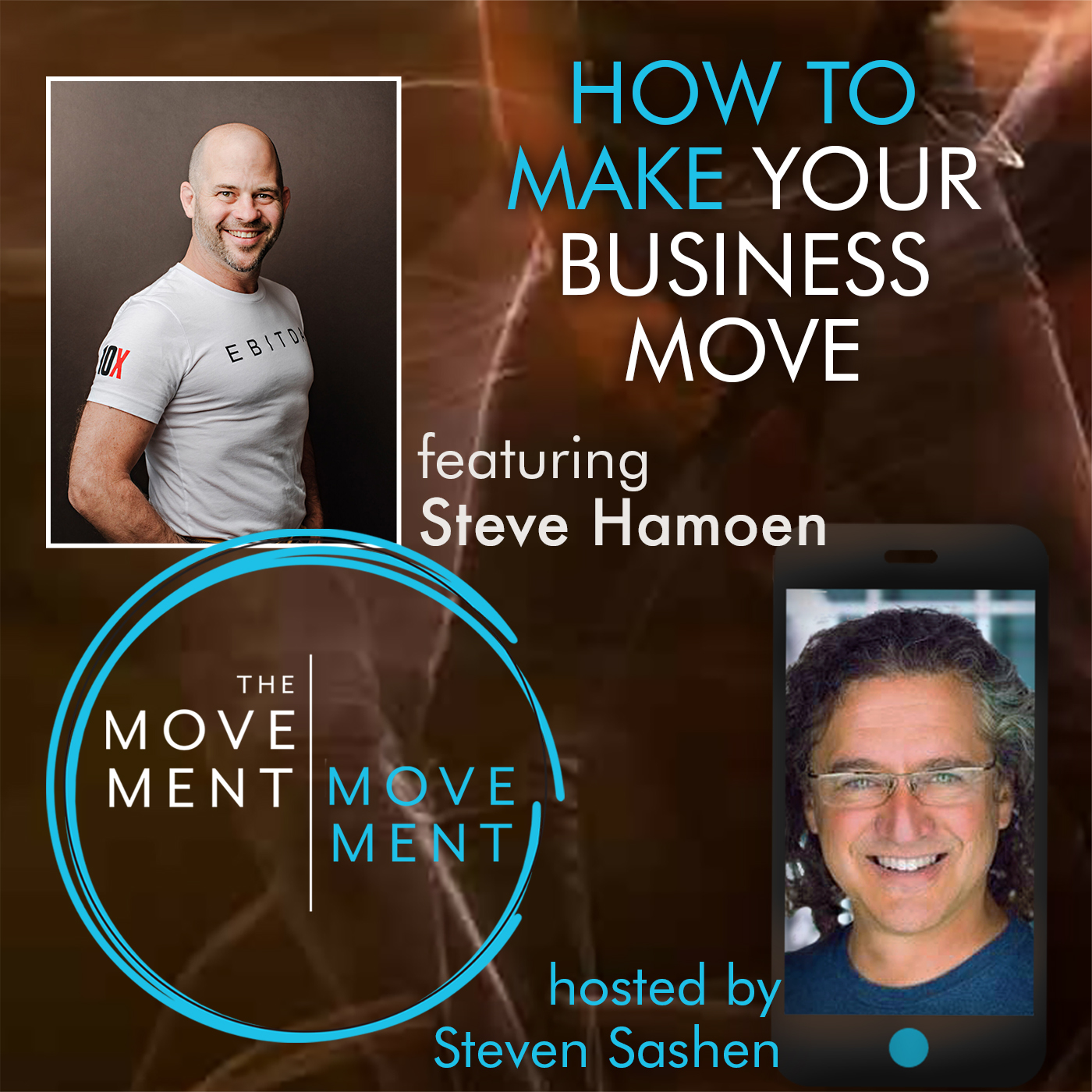
People often ask, Laney, my wife and co-founder and I have zero shoots happening on the movement movement podcast. I can do that. We don't really talk about all these movement things, but you know, moving a business is a thing. A lot of people have asked about that.
So we're going to talk about that today on today's episode of the movement movement podcast, the podcast where we tell the truth about what it takes to have a happy, healthy, strong body, starting feet first, but also maybe a happy, healthy, strong business starting wherever that starts. And we break down the propaganda, the mythology of the sometimes outright lies you've heard about what it takes to run, walk, hike, play to yoga, cross it, et cetera, and run a business because there's a lot of things in there. I talk about them all the time, but I haven't done on the podcast. We'll be able to.
Anyway, I'm Stephen Sashan, co-founder and now chief barefoot officer at zeroshoes.com. And we call this the movement movement because we are creating a movement. We involves you more about that in a second about natural movement, sharing the benefits of natural movement with the world. And what you can do to be involved in that movement is to spread the word.
So share, give us a thumbs up, give us a good review, hit a bell icon on YouTube. So you hear about future episodes, go to www.jointhemovementmovement.com. You'll find all the previous episodes, which there are a bunch. You'll find different ways you can find the podcast, if you don't like the way you found yours, you can subscribe to hear about upcoming ones and you can find out how to follow us on social media and engage in conversations there.
I think, look, this short verb is this. If you want to, the short form, man, I can't talk today. The short form is, if you want to be part of the tribe, just subscribe and let's have some fun. Okay, Steve, give me a favor.
Tell people who you are and what you're doing here. Well, I'm the host of the Money, Mindset and Mentoring Podcast and I'm here really to talk about the idea that you actually can't have it all. A lot of people, what they do is they say, I want to focus on my health. So then they take some time off their business.
I want to focus my business. Then they take the time off their health and they're always trading things. And I think the most impactful word is that needs to be removed is the word or, and I think the most impactful word to put in that vocabulary is the word. Here, use the word and just see instead of saying, I can't do it, say, how can I do it and start from there?
Cool. I'm going to argue with you from day one then. There was a guy who wrote a bunch of books about work life balance back in the 90s and they sold bajillion copies. And then in the early 2000s he wrote a book that I don't remember what it was called but it may as well have been called, I was completely full of shit.
And I become a big fan of Scott Galloway's lately because he and I agree that a lot of things and one of them is sometimes things take precedence. And for example, my wife and I are taking perhaps our first real vacation in 14 and a half years starting on Friday. And it's because this has been an all-encompassing thing. So when people ask me, you know, what my life is, I go to work, well, I roll out of bed, I go to the bathroom, I walk the dog, not necessarily in that order.
Usually getting out of bed first but the dog and bathroom can hopefully forever. And then have some breakfast, get to work, come home, make dinner, watch some TV, lather and some repeat. Actually, with a couple of times in there where I've got a crazy intense workout that I do with the trainer that only takes 10 minutes but wipes me out and is the most wonderful thing I've ever done, that's three times a week and then on the track one or two days a week. And that's only for like an hour.
If I was trying to do any more, my brain would blow up. So, how do you want to riddle that one, Riddler? Well, the way that I first do is I look at Home Depot as a model for success when I'm looking at time management. And I look at my slots of the times that from when I open my eyes to when I close my eyes is shelf space at the Home Depot store.
And so basically- Keep in mind though, at the Home Depot store, you can never find anyone to help you. Well, that's true. I'm self-servicing on this. I'm already running that in a virtual online store.
But the idea is I'm looking at each of those slots and I'm saying, how do I make those slots the most effective? Because Home Depot, if that shelf space is taken up by something that's not selling, they're going to find something else they're going to pull it off and put something else in. So, all I do is I assess what is my total available space and based on my total available space and I say, what are the biggest things that I need to focus on? Put those things in first.
And so the first thing I do is I believe in health. Like health is the basis for everything. So I do Brazilian Jiu-Jitsu. I'll train anywhere from 10 to 20 hours a week of Brazilian Jiu-Jitsu, makes it a little bit of Muay Thai and MMA.
And so that's my first thing that I put in. Because if I'm not healthy, I can't look after anybody else. The second thing that I do is I make sure that I put in my time slots for my family. I always, if I'm traveling, it throws a little bit of a mix, but I'll do it virtually.
I always want to say goodnight to my kids every night. That's extremely important for me to do. And then I look after the next things and I say, okay, what about my business? My business supports everything.
So now my health, I've got my family now. It's my business. What can I do in my business? That's the most impactful things in my business because I think a lot of times we find ourselves doing things in our business that could be either in source or out source.
And that usually comes down to the thing that I think is so fundamental in business is focusing on revenue because people don't focus on that. I think when they're first starting a lot at the beginning and they do so many things themselves, whereas if they would just grow a little bit, give a little bit more room in their vision, they can fit more people in their business so they can get more things done through leverage. We had a really interesting, let's call it problem early on. It's going to sound weird.
One of course is that we had no money. So we started the company on credit cards by accident really and we didn't, I don't remember how long it was till later and I took salary. But we certainly, it was a stretch for us to bring in someone to handle fulfillment just because that was taking a bunch of time and then a stretch day of bringing someone to a customer service because that was taking up not a bunch of time. Frankly, I'm the wrong person to do that because whenever someone's calling with a problem, I just want to solve the problem as quickly as possible, which means I'm not interested in hearing someone's story about the problem.
I just want to alleviate my own anxiety and solve the problem, which is not the best bedside manner necessarily. But those were difficult. And then for the kind of people that we needed to run a footwear brand, we were unbelievably lucky to the point of incomprehensibility that we met someone who had been in footwear for 35 years and had just retired and loved what we were doing and it changed his life because there was literally no way we could afford any of the people that we would need in a footwear business for years because those people are racy. And in fact, I've seen a lot of footwear companies start and disappear because of exactly that.
The second way there was another part that went along with that. Oh, but the other problem, seriously, is that I've been an internet marketer now for 32 years, so 14 years ago, whatever the hell that was. And I'm really, really good at a whole bunch of product marketing things. My wife is a brilliant finance operations person.
So the challenge in terms of outsourcing or insourcing anything was finding people who were up to snuff. And that's a tricky one. I literally say that it's a problem, that we were really smart and knew what we were doing. And still is, frankly, part of my, I confess part of my moving to chief barefoot officer is because people said to me, you're giving us too many ideas.
You got to slow down. And because I just move way faster than the average bear. So I agree with you as the best thing I can say. And that's one of those things where there are weird circumstances.
Like a lot of time, it's a really tricky one when you could do it better faster than the other you're paying. And to, I guess I'm going to throw out this one this way. We've had to do some split testing to see if my versions of things are demonstrably better than other people's versions of things. And then I have to decide, am I okay with 90%, 80%, 50%, whatever the number may be in a specific situation.
And it's a tricky dance. Oh, absolutely it is. When you look at, if you hired somebody who would say even 50% of what you are, it's going to feel like a huge drop. It might actually be.
That's the thing. Yeah, it could be. But then if you hire four people, that's a hundred percent increase. Dude, if I could find four people who could write copy 50% as well as I could, I'd be a bit a millionaire, but I've been writing copy for 44 years and finding good copy register.
This is actually another interesting thing that I'm curious about your take on it is that I don't want to put this. Creative talent is very, very tricky. There are a lot of people who think they have it because they typically been overpaid by people who didn't know any better, but there are very few people who have it. And I called a friend of mine not too long ago and said about one particular creative talent.
I'm not going to mention what it is. Give away a punchline that I don't want to give away. But I said, do you think the ability of someone to do this is nature or nurture? Let's use comedy as an example.
So that was my day job for a dozen years. So comics, if you ask, sorry, comedy was your day job that usually most people's night job? It was a night job, but since I rolled out of bed around one, we can help everyone. You go to bed around three or four, roll out of bed around one or seven, start all of it, and then have fun and then start all over again.
But the gist is if you ask any comedian, is it nature or nurture? Our comedian is born or may. They'll all say the same thing. Comedians are born.
If you're not, if you weren't the funniest kid in school, you can get funnier, but you're never going to be the funniest kid at the comic strip or a catch-right or whatever you happen to be if you started out not funny. You can get technically okay. You can rip other people off and imitate them, but you're not a limited lifespan. But a lot of the creative stuff, whether it's copywriting or graphic design or video editing or even shooting.
We had a photographer who was married to a videographer. I will throw them under the bus. The photographer was actually great, except she was trying to be a really good photographer. And what I mean is she'd edit everything in the camera.
The shot looked perfect. But what you needed to make it work, like for a catalog or online, was you had to back up like five feet. So there was just more stuff around the frame. So you had room to edit.
Her husband, the videographer, didn't know how to edit to save his life. The first version of the 45 second video he gave me was three minutes long. And after I screamed and ran around like a crazy person, my wife said, just walk away, come back a day later and look at it. And what I did is I took all of his rough footage and I should recut the entire thing.
I was like, I'm a master's in film. So I forgot about that. But cutting is one of those things. You feel the rhythm like comedy or like a music, which I can't do at all.
Like I'm musically, completely incompetent. But those are so again, I'm going to agree with you in principle, but I'm going to argue with you in practice. It's taken me, it took me a year and a half to find a really good copywriter. We went through a bunch who thought they were good and looked like they were good on day one and by day 10, it was like, oh, yeah.
So and we are still looking for that, that first, that second, third and fourth person in a number of the creative jobs. So if they're technical things and even software coding, my God, we've gone through dozens of programmers who think they're good and seem good until they get a difficult problem. So anyway, I'm going to, I think a lot of the times when you look at the recruiting process, I think you got to look at where you are and where you want to go. And this is why I love the whole 10x culture and 10x mindset is that if you're looking for today, it's going to be a problem because you're never going to have enough resources for the thing that you need today.
But if you're looking to say, if I 10x when I look at doing and I'm trying to hire to the 10x result today, then you're going, okay, how do I get to that point? In other words, pull the future into the present. And so basically what it's going to do is allow you to think bigger and higher bigger, recruit bigger and bigger. And again, I'm going to, pardon me for being argumentative about it, but there's no one who has a bigger vision for our company than I.
In fact, the biggest problem that I've had is people have told me that I've been completely full of shit for 15 years. The real problem is actually that I've done everything that I said I was going to do. It may have taken a little bit longer, but the secondary problem after that is a quote, Peter, I think it was Peter Atia who brought this quote up and misquoted it and I looked up, it's a Nietzsche quote. And the quote is, and if you're like this, when you ask a person, when a person has to change their mind about someone, he will hold the inconvenience he causes very much against him.
In other words, all these people who told me I was full of shit and I've proven that they were wrong and I was right. I've not given me the time of day because they don't like that. So vision is one thing, but I'm just going to go to the practical thing. A competent CFO, a really good CFO for a business the size that we were, would have required us to pay them a quarter of what we were making that year.
We've done, even our product guy, before we hired him for $30,000 a year, his previous job a week earlier was paying him $300,000 a year. That was the level of talent we needed. We couldn't afford that. I don't care how much our vision was.
We just didn't have that year. We made 50,000, this is our second year in business. We made 400 grand, 500 grand. And this guy, his normal job would have been 300,000 of that 400.
He only worked with us because he had just retired and loved what we were doing. And we eventually gave him options that we ended up being worth a lot of money. But that was a rare situation. We literally, because we were self-funding our inventory, which the requirements were doubling every year for many years, we just didn't have the cash to find the kind of talent that we even, I'm trying to describe this.
Let's say a year two, the talent we would have needed by year five, we couldn't afford that. At year five, the talent we needed at year seven, we couldn't afford that. We literally only got to the point where we could afford the kind of talent we needed for the indeterminate future a year and a half ago, after 13 years in the biz. Again, I like what you're saying.
I hope that it's provocative for people to think about that. But I'm going to say, at least in our situation, we never had that luxury. In fact, here's a funny weird version of that. One of our employees was friends with Madonna, the musical one, not the Jesus one.
And so just in case. So he was bragging to her one day about how well we're doing and we were profitable, even at our smaller size then. And she said, oh, then you're not marketing hard enough to which I said, we need the money for inventory next year. We don't have as much money as you have in your wallet right now to buy inventory.
We have to be profitable. So in other words, I'm trying to do two things. One, well, I'm going to turn it back to you. But some of these ideas sound really good and they work for certain people in certain situations, but similar to work like balance.
If I had a family, if we had kids, this would have been a whole different conversation about that part. Since we don't have kids, we didn't have to prioritize that. And Lane and I often say, had we had children, there's no way we could have done this. Absolutely not.
The first five years, I was doing 17, 18 hour days, not because I wanted to, but because it would blow up on a regular basis and I was the guy who had to fix it. Yeah. What I'm saying is the word balance doesn't have to exist in that sense either. There's no such thing as balance.
You're just, you're going full tilt on this pillar and then you're going to go full tilt on this pillar and then you're going to go full. So there is no balance. If you're going to the self, I love when people say, I'm going to go be self employed and be my own boss. It's going to be great.
And I'd laugh at that. I'm like, you're going to fail so miserably because you're thinking this is going to be some walk in the park and it never is. And what you're describing over your 13 years or 14 years or whatever, like that is a very practical case of building success. The only question that I have is around the one big thing that's happening in Canada, for example, is Canada right now is having this map.
It's just the vast exodus of talent and of resources because of just what's going on. And this one person said it very perfectly. They said it's all this risk capital is leaving. And it was a beautiful way of saying it because I thought about it.
I was like, investors is risk capital. And so the question is, if you had more risk capital injected into the business early on, would it have changed the objective where you are to that? I'll say yes and yes and qualify. It definitely would because in fact, in December 2020, we did take on some private equity money in a minority position and that helped us half the cash to hire the people we need to move forward.
The problem we ran into is back to the point of everyone thinking I was full of shit. No one was willing to invest in us ever up until practically then. In fact, we had to use credit cards for a lot of this. I had a lot of high limit credit cards that I was just shuffling around.
I did that in my first business too. I was shuffling around like a couple of hundred grand a month. I never had to pay any interest because of the way that all worked, which was fun. Collected a lot of frickin' flyer points didn't pay any interest.
So it would have definitely helped ish. And the ish is that it's easy, depends on how much money we would have gotten. But again, nobody was willing to give us anything. We met some people, somewhat early on who gave us some debt financing.
And we had to pull teeth to get a hundred thousand dollar lot of credit. Now, over time, because we kept growing and we kept paying it off. They ramped it up and ramped it up and ramped it up. We had to fight to get a SBA loan that was barely enough to do anything.
One of the hardest times I've ever laughed in my life was it went for the SBA loan. I had to sign something that on the first line said that I personally guaranteed that I will repay this $2.7 million and I think we own nothing. We don't own our house. The only thing we own arguably is a cap.
And my cap is collateral. Yeah, I wanted to. We each had cards that we owned. Or maybe we only had one card that time.
We had no assets. So that was just comical. But the yes-ish is that I've seen a people do the wrong things of money because they don't know what they really need. Especially if they get a lot of money.
Those value companies who get huge amounts of capital and then throw a hundred thousand dollar party or a million dollar party is a moron. I had a friend who had to convince us that if we did get something like an investment of any sort, that we should go buy ourselves dinner. And I mean, that's an extra hundred bucks. You just have to celebrate that.
Go do it. And the other thing I think about the ish part is had we gotten money earlier, I don't think we knew what we needed because we were in a business we knew nothing about. So we were pretty naive. So it probably could have helped in some ways.
It would have helped with the inventory or what we call the February problem where we have to pay to get our inventory in December. It shows up in late January or early February, but we can't sell it till March. And we're sitting on a bunch of inventory that we just paid for without the capital to handle everything else we need. So it could have solved the February problem, which would have been really, really handy.
But in terms of growing the business, the amount of, yeah, again, I don't, maybe it's the best thing I can say. I'm just thinking of all the people that I know who did get funding. Actually, let me back it up. The other part of the ish is it depends on what the terms are for that capital.
So to call it risk capital, I would, I'm going to argue that the only person who's taking the risk is the person who got the money. I say that because now that we have private equity money and I've talked to hundreds of people who've gotten private equity and venture capital money, in the financial world, there's one truism that no one is willing to say in their outside voice. And that is got me man to guess. But you can look at, you can evaluate a business, a business model and a business plan and the people involved in everything you want, but as a guess, you can have, I used to say, you could have had the greatest business plan in the world for a Middle Eastern tourist agency and then September 11th happened.
But if that same day you opened your duct tape and plastic sheeting store, you're going to be a millionaire. Yes, it's a gamble. And unfortunately, what the venture capital and private equity will do, not all of them, almost all of the venture capital, most of the private equity. What they do is they build in rules and financial structures that actually hamstring the companies they're using to try to make money.
Yeah. Also, they're answering different masters. They have their own business that they have to run and all the people, if they have bosses, which they almost all do, those people. And most of those people, many people don't know this, most private equity companies and even venture capital too, actually, the fund that they're using to give the company's money is actually being funded by limited partners by other people and other companies.
So they have to answer their limited partners before they answer to the company. And they will throw the company on a fire to make the limited partners happen. Because that's how they get paid. Absolutely.
And that's where it's the injection cap. I love how you said, by the way, is that when you inject capital into a company, it's like putting kerosene on a fire. The questions of the fire you want to burners of the fire, you don't want to burn. And that to me is something that's really important.
And then when that money comes in, does that money come in as what I like to call dumb money? In other words, it's capital that's just working capital. In other words, you use it, it's discretion here to you. Or does it come in with a series of rules and restrictions?
Right. Or if you take it to the positive side, does it come with advice and people who've done it before? You can come up with your hope. That's ultimately what you hope.
I think even in those situations, there are a couple of things. One is early on, I remember Lena saying to me, she was upset. So I don't feel like I know what I'm doing. I said, well, no one knows what we're doing.
We don't know what we're doing. We've never done this. You definitely don't know what you're doing. No one's ever done this before this way.
And even if you had done it before, the world has changed since when they did it. So I've seen people get what they think is smart money, but not so smart. Because when we took our private company money, one of the things that we do when we launch new products every spring and every fall is we have a sale for the brand new products, because we want to get them out the door. And the people that were involved in our company, investing in us, thought that was incredibly stupid.
They come from a long background in retail. It's like, why are you putting on sale the day that you launch it? And they didn't understand that the first time they got the hint because we made enough money to pay off the entire inventory bill. They went, okay, but it took them literally years to go.
Okay, that's a good idea. And there are various other things like that where if someone's not in your business day to day, they're probably not as smart as they think they are. Unless what you're dealing with day to day is frankly, it's not that complicated. So I have seen that where someone can help me.
There can be some universal complications that exist that you could find in a shoe business as well as a plumbing company. And that could be just how you leverage employees or that could be a leadership style, that could be a mindset shift. Those are complicated issues that can exist outside of an industry specific vertical. Oh, well, I would agree.
They'll exist everywhere, all of those, but they're so idiosyncratic. Again, my problem, and I say this seriously, I'm not patting myself on the back, I'm going to say it. My skillset is coming up with a lot of ideas. And my skillset is even going when I go into something that I know very little about on the granular level, I'm pretty good at figuring it out on the macro level.
So I can't write a line of code, but I can help my programmers write code because I'm just seeing it conceptually. And they're in the details. So what was the point of thing? So there are things that I'm bringing to the table that are hard for people to understand, and there's things that there's just like prioritization, I just can't do it.
It's just not my brain doesn't do that. My wife asked me to give me my top five things that I want to be able to do. And I gave her a list of 20. I said, I can't do five.
Here's the top 20. And even then I can't prioritize them. So I would say, yes, you're right. And to find someone clever enough to help you optimize the ones you're good at and get out of your hair, the things for which you're not.
Absolutely. And that's where you and I are very different. You have hair and I don't. That explains it.
Yeah, yeah, yeah. I have a hard time getting things out of my hair. Okay. Just give it off.
We have why for April Fool's a couple years ago, we did a Photoshop thing for me bald and half the comments were no, we have for hey, that looks good. You know what? You got to have that woodwork for being bald. I don't know.
It'll never leave. I'm not sure. It's thinning out as I've gotten older. And when you see someone who's got some really messed up scalp and you realize that they shaved their head to get that way, it's like how bad was your hair?
I had this most amazing comment in one of my YouTube videos where this guy said, I'd love to pay attention to what you're saying, but I can't see past your huge forehead. I was like, man, that was the best and I pinned it to the top of the comments because that was my favorite statement. That is terrible. Well, I get a lot of people who tell me who they think I look like just because of the hair.
Every now and then I get, oh, Kenny G, I'm insulted because if you don't know the difference between curls and ringlets, that's just not okay with it. That's a big difference. I got curls. I got curls.
You know what I would put you close to would be that guy on the phone is his name. He looks like a guy from Guns N' Roses almost esque. He's had a show for years. I don't know.
I don't have to think about him. He'll be back to you on that one. There is somebody who definitely looked like everybody looks like somebody from the right angle. I can see that.
Yeah, yeah. Yeah. Yeah. Very young.
I like when his older. That is so close to all Jews look alike. Which is arguably true. The Jeff Ross, the roast master general was doing a thing where he would go to people's offices and roast them in real time.
And he goes to Jimmy Kimmel's office. I think it was Jimmy Kimmel. And in his office, he shared an office with a writer. And Jeff Ross says, oh great, another Jewish comedy writer.
And she was a judge. And Jeff Ross says, I looked at him. I loved the Tom Brady roast. That was so good.
I love it. I love it. He was a miracle. Nikki Glaser, Sam J., Tony Hinchcliffe.
And there was one other. Oh, Andrew Schultz. The four of them were. But Nikki just said, oh, Nikki was just on another level.
Nikki owned it. That was so much fun. I'm thrilled to see that. Anyway, back to other things.
By the way, in the early days when people would bump into late in and say, oh, you have your own business, that must be really fun. You've never done this before, have you? Yeah. Look, here's, I'm going to throw this one out for you.
Our naivete knows no bounds. We met guys who've been in the business for 35 years when we had just gotten started. Who said, actually, we would do this with you because we think natural movement is the most important thing and no one's doing it. And we believe in you guys as well.
And we would start the company with you, but we've been a footwork so long that we're not stupid enough to try and start a shoe company. And we literally said, we know we're hyper optimistic and naive, but that's just how stuff gets done. But we didn't know how naive we were. We literally thought we'd be able to run this for a few years, sell it, and then we live modestly.
We knew how much money we would need and never have to work again. It wasn't very much. And nobody would ever say yes. It's because we didn't know how buying and selling business work and how people invested in work.
We just assumed if we had something that was growing like crazy, people would be into it. And in fact, at one point, someone we were talking to say, well, we can't invest in any company doing less than five million in sales. We were two and a half at the time. And Elena said, why?
And he said, well, that's just our limited partners require that. And she said, how come? And he said, it's a proxy for sophistication being at five million. And I said, you've looked at our company.
Is there anybody in your portfolio who's more sophisticated than we are as a company? And he said, no. I said, why do we have the five million dollar limitation? He said, because I couldn't talk to my limited partners into thinking about something different than what they just mandated.
Like, again, it's just such a weird thing, but backing up. So yes, so you are correct. There are fundamental. There are categories of things that you're going to have to deal with no matter what you're doing.
So you're going to have to be a business, the particulars of where you're going to meet the road as it were. Yeah, I think you've got your trade focused issues. And that'd be whether you're a plumber, whether you're an accountant or whether you make shoes. And then you have your strategy focused or your principles focused elements, which are universal that you could find in each of those businesses.
And one doesn't necessarily mean that there's a hierarchy to that. It just means that they're very different and they both have to be addressed. One of the things that there's a guy who's a marketer that I met 30 years ago, had a great line. He says, making money is easy.
Figure out where the money is flowing and getting the way of it. And what that meant for what that means for many people is getting to this services business, getting to advertising or something where you're providing services for businesses that they need. There are not a lot of products. That's not true.
There are a lot of products where people need those as well. Sometimes getting into those is much more difficult because if the need has been identified, there's already people handling it and what are you going to do that's better or more efficient or whatever. I want to move this in a direction with one of it. What's the most counterintuitive thing that you can think of that's important for people to understand about growing a business?
And maybe it's just a myth that people have because they've read it in business books that are complete bullshit or it's something that people just walk in believing for some reason that maybe they're 180 off base. I think one of the biggest things that people make a big mistake on is they spend way too much time in the planning phase. And they work too hard in the planning phase. I believe that massive action beats perfect planning every day.
And because I think once you get into the action phase, you can expose yourself to things that you wouldn't have seen in the planning phase. A million years. I remember I got a talk at the Small Business Administration in New York. This is 35 years ago or so.
And I said, it was all these people who were building out a business plan for something that hadn't started. And I said, how many of you heard the idea that you should end your business plan, just double your expenses in half your revenue because that'll be closer to reality when you get going and they all raise their hands. And I said, yeah, don't do that. They said, why not?
You'll make half as much of a constant twice as much as whatever you write. I'm going to tell you right now, one day you're going to have a $100,000 legal bill. And you're going to tell me that I'm insane. And I promise you, it'll happen to every one of you.
Early on with the people that we met who said they wouldn't start the company with us, they were talking about their $5,000 a month FedEx bill. And we thought that is insane. I would kill for a $5,000 month FedEx bill now. Well, for my business, I would think that'd be a little bit much because most of our stuff is digital, so we don't really ship a lot on the FedEx.
But for you, it must be enormous. So what do you see people doing when they're planning planning, planning, rather than just getting the ball rolling and what do you think the best way to get the ball rolling instead of planning would be? I think it's, and you can apply this to business or any aspects such as a physical endeavor is people, the first thing people always do is when they want to get to do something, they feel like they need to be inspired. So they grab their phone and they do scroll for all of that fun little short thing that gives them the dopamine dump to say, I'm so motivated.
But the thing is when people actually get stuff done, motivation has nothing to do with it. Absolutely not. My belief is when they get into the moment of discipline, which is actually systems and models of moving forward, then they can actually start to see that. But the challenge with discipline is discipline also needs to be fed.
So discipline happens as a system, as a model, is something that you commit to because discipline shows up and motivation doesn't. And then you get into that process of doing, but you need to start celebrating successes immediately. And I don't care how big or how small the successes are, whatever you're doing, you need to start to celebrate the one thing or the two things that happen every day. I believe start the day with a celebration and the day with celebration.
Even if it's like the day that I received a multi-million dollar lawsuit from my one construction business long ago, I had to celebrate the fact it was a birthday for one of my staff because I had to find something that I could be happy about that day because that one just didn't feel so good. And so the idea is always get into that celebration moment because success fuels your willpower, your willpower fuels your discipline. And if you papper in a little bit of motivation here and there, just as a little kerosene, there's not a bad thing to do that. But those are the things I think that are the ways to get into action and getting things done.
I would add to that knowing that you got to pay the bills is a big motivator. One day in my first company, I realized that there was only 20 people in our company, but we were responsible for the livelihoods of 200 people. And the day that I did that math and realized that I was like, holy crap, that gets a fire in your butt. You're paying a lot of mortgages.
We're paying a lot of mortgages. We're making differences in a lot of lives. And what we're doing now, even bigger per me, I'm going to be myself for a second and clear my throat. So, the things when you look at paying a bunch of mortgages and the people that you take on, what you've done is you've elevated the lid of your business.
You've elevated the vision of your business to include those people. That is hugely motivation because your motivation is external about the people that you support, not internal about the things that you desire. For us, it's always been that when we started the company, we thought this would be a little car payment kind of lifestyle business. Actually, a couple of years, I said to Lena, wouldn't it be nice to have a little business?
Takes two, three hours a day online, makes us a couple hundred grand a year. She's, that's what we have. But it can't stay that way. For a lot of reasons, the biggest was that we'd be too vulnerable.
But the other one was we were just hearing from too many people saying, oh my God, you're changing my life. And the, I'm going to use this word, positively. The positive burden of hearing people say that is what gets us out of bed in the morning and what gets people working for our company. And it's something I feel an incredible responsibility for and incredibly grateful for and incredibly lucky that we fell into this and something that I say to almost anybody, especially people who are freelancing and doing creative work.
I go, ideally, you want to work for a company that's able to do two things. Tell the truth and change people's lives. There are very few companies that are legitimately doing that. But when you can do both of those, it's like having a superpower.
Absolutely. Well, you never want you attract the right talent. You're trying to write client in that base because you're really making an authentic connection with your market because it's not something that's been boozled. And I think a lot of times when people think about growth, they think about, they have a, it's almost like they have a negative relationship with success or a negative relationship with money because they look at success and money in the wrong way.
To me, if you have, if your product or your services, the best thing that's out there and it needs to get up to the world, if you continue to think small and do small things, you're actually robbing the world of something that's amazing. So you're actually punishing the world by your small thing. So if you look at it, it's actually greedy to stay small than it is to grow big. And the irony in there is that, I don't want to put it, again, I have this very, very big vision for the company when one of our investors was courting us and he said to us, do you think this is going to be a billion dollar company in 10 years?
I said, oh, God, no, seven. And is it going to happen? I can't promise that. Can I paint the picture in a way that makes sense?
Absolutely. Do I take it in any way personally? No. Do I think it's going to make me happier?
Absolutely not. But it's, it's a thing that's, it's so much bigger than I am. I feel a responsibility to it. And it's a weird way of framing it.
But that's the way it feels in my brain. It's, I'm like the guy who's walking down in New York City Street and somebody yelled, baby, and I put out my arms and caught a baby that fell off the roof. And so I've got a responsibility for that baby. And it's a weird, not even my baby.
That's a whole different, somebody asked me, they said, Hey, your company for sale? I said, no, unless the price is right. And he said, what's the right price? I said, I'm going to pretend you asked me and I'm the 1980s Supreme Court and you asked me to define porn.
Their answer is my answer. I'll know it when I see it. And so someone said, well, you know, what would you do if we wrote you a big check? I said, well, it depends.
And I'm gonna do it. I'm gonna do it. I like it when I'm good at it's not taking all of my time. I'm happy to do it.
But otherwise, if you're maybe a big check, come visit me on the island. I bought it with your money and they laughed and said that's a really good answer. I said, what do you idiots say? And they said, yeah, it's my baby.
I got a vision. No, no, no, it's my baby, I got a vision. I had a side hustle selling vision impaired babies. So, I know how the game is played, but the bottom line is our goal is we don't have some goal of making some amount of money or selling the company at or when or whatever.
Our goal is to do the right thing for the brand every day. And whatever that looks like, it can look like a bunch of weird things. But that's the motivator. It's funny, people, when I get interviewed a lot, people do ask me what do you do to say motivated?
Like what are you talking about? Just waking up in the morning is more than enough. In fact, I can often not sleep enough because I got so many things that I'm thinking about that we have to do. So that makes me think of Les Brown.
Les Brown says this is if you do things in life that are easy, your life will be hard. If you do things that are hard, your life is going to be easy. And by saying that, yeah, this is a noble task. You're looking after the mortgages of all these people and you're building this brand and this brand is well, you're a part of it.
You used to be it, but now you're a part of the brand because as it grows, it's new dimension value to the brand value. And so as you're building that out, it's a noble task and it's a hard thing. But yeah, so easy to do it. It's easy.
It's not easy. It's obviously misnomer is that there's just no real choice. And so you don't argue about that. It's not a there's no deliberations like, Oh, God, I do this.
One of my favorite quotes from Grant Cardona success is my duty, my obligation, my responsibility. And I really identify with that because in the sense of what you're saying is I have no choices because you're saying it's my duty. It's my responsibility and my obligation. Except I don't use the word success because I have no frame of reference to what that means.
People use that word for various things often related to have much money to have in the bank, which makes no sense to me. Yeah. So that's another one people people will. It's funny.
I actually was nominated for some business leadership award and I refused to take it. I said, that's it has whatever you think I'm doing. It's not what I'm doing. So I can't stand there with a smile on my face and thank you for giving me this thing that I don't know that I had anything to do with what you're thinking I'm doing.
So it's a weird. I think it's a verbal play in the word success because success has a personal meaning for everybody. And some people, you're right. Other people, it's impact to me.
I think when I look at people's relationship with money, money is just a currency for impact. And if I have a billion dollars sitting in my bank account, I have a billion dollars worth of just part impact that I can be using. And when you sell something, you get paid in a commission. The commission comes in the form of money, but it can come in the form of other commissions.
It can, when I train Brazil and Jiu Jitsu, I don't get paid to do it. I never want to get paid to do it ever because I get paid so much in so many other ways to coach people and watch them go to a tournament and win to watch people change their personal opinions about themselves or their physical stature or whatever else it is. That pays me in so many commissions that money is so irrelevant. I think it was an actor, but I don't remember who said, it's such a treat to get paid for what I used to love.
It sounds like a little feral thing. It wasn't a little feral thing, but it's so true. Whenever I hear someone waxing on about how they just love everything they do, I know they're lying. I know that they love, maybe they love the moments they get to do the thing, but the before, after and in between, it's not so much.
The negative reviews, that's a good. It's the few people who somehow maybe have pulled off that they are only doing what they love and they are getting paid at whatever they want for doing that. There's such outliers to use them as whatever a goal it just seems statistically absurd, but they do. I want to back up to the planning versus going to go on.
Maybe you answered this and I might bring it off. If somebody's stuck in the planning phase and you want to and you're going to give them some suggestion on what to do instead or doesn't have to be one suggestion, what would you say? What would you do? I first addressed the idea of fear and consequence.
A lot of times what people do is a fear of something or something that they can see or something that they can't see that's holding them back into getting into action. That's why they keep them going back into preparatory work. Because they want to make sure that it's perfect as they go out the door. The easiest thing is always tell people we help people start podcasts.
So I always tell people go to my first episode of my podcast and see how terrible I was. You can see no problem. The very first time you do something it is going to be terrible. Just expect that.
If you expect the outcome to be terrible, anything that's slightly greater than terrible is going to feel pretty good. But expect terrible first. Then once you can get past it and say no problem, it's terrible. I also tell people really at the end of the day, especially if you're doing videos like your first YouTube channel video, there's really going to watch it anyways.
It's going to be you and your uncle Louie in your alt account watching that video. So nobody's going to watch it anyway. Just get the practice in. The very first video that I had so many ums and aus and you know and writes and all this stuff.
It's terrible. I got a great guest but I was the awful host on my podcast. But now a lot of that stuff has been cleansed out. And I cleansed out in me not using AIs because I think that's a cheap way of getting a cheat right and getting things done.
And so I get it from me so then when I show I can authentically be myself, I'm out of room in person on stage or on a podcast. And so it's just getting to that action. Well, I think there's a book called, I think it might be called It's All About This Little Verbal Fellers. It's really fun.
I had a year ago. I wrote that. I think that's a great idea. The in comedy, almost every comic, not every one.
Many, many comics have the unfortunate story that their first set went really well. Yeah. And this second one goes horrible. Oh, really, really bad.
It takes years until you got off the cycle of a good show followed by a shitty show followed by a good show. It's like where there's just no control and no rhyme or reason. But yeah, this first couple of years where it's like this, I actually did a set at Catch Rising Star in New York for a television show, crushed the next night in Bethlehem, Pennsylvania, same set, could not buy a laugh with a million dollars. And that's the way goes sometimes.
But I think it goes back to your idea of when I said success is my duty, my obligation, my responsibility. And you had the response to success. And what I might say is failure is my duty, my responsibility, my obligation. Yeah.
Because if I get addicted to failure, it means I'm always pushing to a limit that I've never achieved before. As a marketer, I say to people all the time, I've been doing this for 32, 33 years, which means I have a lot of ideas and a lot of opinions, but it means I don't get crap out any tomorrow. I just want to test them to see what works and what doesn't work. And I want to see if something doesn't work as fast and cheap as possible.
And there's nothing I like more than finding out somebody that I had that I thought was really good was complete crap. Because then I know not to go down that road anymore. It's okay. It's no big deal.
No one, it was John Wanamaker for those of you who live in around Philadelphia, Wanamaker department store who back in the 20s maybe said, or I don't know what it was, made some comment about I know that only half of my advertising works, but I just don't know which 50%. But when I talk with a lot of heavy marketers, they say the same thing as well. You never know what's going to hit. And just constantly testing, constantly being in the testing mode is going to let you think this one video that you just, you crush it on the hook, you crush it on the video shifts, you crush it on the music, you crush it on everything.
And then it hits like 250,000 views and you're like, what the heck just went wrong. And then you put this other one that's just you sit in the park like eating a Cheeto and all of a sudden that gets 3 million views. And so the idea is views is your outcome. I'm just using that as an example.
That is you never really know what's going to hit. And the same thing happened with our business with, as we were iterating the podcasting business, what we thought originally was the direction we were going to go six months later. It's completely different. Oh, absolutely.
And it's super exciting. Yeah, I do like to say if you, if every six months, which can be every day, if every six months you look back and everything that you were doing six months ago made sense, something is very wrong. Yeah. Absolutely.
In part of you, in part because of the world changing, the things that have changed in our world, not even just in the footwear world, like all of our worlds with social media, with politics, with a whole bunch of stuff. So there was no one who predicted that six months earlier. And it's had far reaching and global impact on all of us in various ways, even some that are invisible. So it is pretty fascinating to see that.
And yeah, if you don't think you were a bonehead six months ago, then you're a bonehead now. Well, yeah, if you're looking around trying to look for the dumbest person in the room, you might need to look at me. No, when we did Shark Tank, they take you in a van to go tape with typically three other companies. And that's the joke.
If you can't figure out who's going to be Chum, it's you. And happily when we get in the van, it wasn't. We spotted who it was. That's not an idea.
That's good television. That's not an issue. Exactly. It's good television.
It's good idea. And sometimes those bad ideas ask good television. It may deal. And now to your point, yeah, you don't know what's going to hit, but you can get a pretty good sense of what's going to fail.
That's the thing that people don't seem to guess. You can look at something and go, oh, that's really not good. I go, that's an opinion. No, no, that's really not good.
You want to put it to the test? I'm happy to. I actually did this once with one company. They were doing really work that I thought was really bad.
I said, look, I'll spend $1,000 to prove it to you. I go, why don't we run this ad? I'll spend $1,000 on it. And you'll see that it generates no sales, just so you can find out that you don't know what you're doing.
And we need to reframe this. So I spent a grand and it made no sales and what to see. And they didn't know what to do with themselves because to the point we made before, the Nietzsche quote, when someone has to change their mind about you, they will hold you and give you to your comments very much against you. Yeah.
Yeah. Most people, I think to your point, many people don't ever develop the skill. And it is a skill to take criticism as a benefit or at least at the very least, as a well. I don't want to frame this.
If you say something bad about me, Stephen, you are a, there's nothing you can say that I probably want to agree with. And if I agree with it, I may have not, I might not like it. I might not like that thing about myself. I may have been trying to hide it from you and other people.
But if you call me on it and it's in my brain, then we agree. So why would I argue with you? You say, Hey, you're errant. Oh my God, you have no idea how bad it is in certain contexts.
In other contexts, I'm completely naive and I feel like an idiot. But in some, I definitely think I'm the smartest guy in the room. And if that comes across unpleasantly, what suggestions do you have? Because I'm obviously not trying to piss people off.
I would prefer they all like me. But if that's getting in the way, what do you got? And that's literally a skill of just recognizing that pretty much anything. And if you make a list of every bad thing somebody could say about you and ask yourself, do I think that sometimes and you go, yes, yes, yes, yes, yes, yes.
Then why argue with someone who says it to your face? Absolutely. The guy who talks about my forehead, I'm like, you're right. My forehead is massive.
Someone asked Jeff Garland, who's on curbing enthusiasm and co-producer, they said, get you upset when Susie in the show calls you a fat fucking goes, I'm fat. Where's the confusion? Yeah, that's right. Thank you for letting the blatantly obvious tips.
Now, as we wrap up, what I want to do is really thank you so much for the conversation today because I think you have such a very interesting opinion on so many items on running a business. And I'm so glad we did this movement discussion around business, around family, around mindset. And I think it's amazing to have that conversation with you, especially because you've achieved so much with the business that you're right. Well, A, thank you.
B, I hope that people got the through line of what it takes to move something and it doesn't have to be your body because that's where it was in my head. And B, I'll say thank you, even though I don't, this is a tricky one. I have a very difficult time looking at what we've done with a sense of accomplishment because of how much is in front of me with a sense of possibility. And also because I was an all American gymnast way back when and the meat that I qualified became an all American, everyone came up and congratulated me.
And I remember being confused because it was something my coach and I had deliberately planned for and mapped out for two years. So we just executed the process and it was successful for many reasons that were out of my control. My grandfather was a gymnast. I did not know that.
Tell us in my 40s. My coach, who was our junior high gym teacher was a like, I think three time world and five time national tumbling champion, one of the greatest teachers of any kind ever. And it just happened that he was teaching at the junior high and then coaching at the high school that I was at because where I haven't done live. Again, so much of it was luck that I have a very hard time taking it personally.
I can look at the business and say, wow, that's a pretty outrageous thing. There's nothing like this that has ever existed. No business has ever been like this one, even in the footwear world. But and there's so many other people involved that I don't take it particularly personally.
I'm happy to be part of it. And perhaps this is something that I need to work on, but I don't do, I don't think about accomplishment in the same way. I don't think about success. It's just all a process and something will happen.
Could be good. Could be bad. Could fall apart in any day. Could blow up in any day and long for the ride.
And I'm in doing joy, certain parts of the ride and other parts of the ride. Let's just say on any given Friday, it's not uncommon for me to call one of my best friends ago. Do you want to know if you're a student for $9.37? So that's part of the moment, right?
Like when you look at success. And that's why I say you need to celebrate those small moments of success. And that happen every moment because you never know what the tomorrow is going to throw at you. Like you said, if you haven't spent a hundred grand in legal bills, it's coming.
You just don't know when. And so you just got to be prepared for that fact. I think the celebrating success, I realized something last year to make a very medium length story very short. I had a life and death health thing.
Happily, it's all seemingly resolved, except eventually I'm going to die. Just not a bad. And I realized that I had it in my life of postponing enjoyment. So I'm going to take your celebrate something every day, beginning and end of day, even like a little one.
And I'll tell you the one that popped through my mind is I don't know how long with the longest time you've ever had a song stuck in your head has been, but I'm now going on a week of having the moody blues, the voice stuck in my head. And I love that song so much that I haven't been in celebration of that. At the very least, if I can't write that song on my radio and enjoy that'll be part of my daily celebrate. I love it.
You love it. You have to get in touch with you and find out what you're up to. Do me a favor, tell them how to do that. Yeah, it would go to the Money, the Mindset and the Mentoring Podcast is the easiest way to find me.
I'm on Spotify. You can look me up on YouTube, which is Steve Hamoon, H.A.M. O.N., easy to find me that way too, or post everything there. Or you can just go to SteveFamoon.com and that's the easiest way to find me, but those are the three ways.
Awesome. Well, much, much appreciated. This has been a lot of fun. And I want to also appreciate you.
There are very few people who when we get into a conversation like this and we have places where we wear the Venn diagram overlaps and chunks where it doesn't, who are able and willing to have that conversation instead of just like screaming yell and hang up the phone and whatever it is. That is a testament to your interest in willing us to explore things and grow and help people. It's been an amazing conversation. And I love having different opinions and finding middle grounds and finding where we're stoic.
And I think that's a good conversation. You know what? It's the one conversation that is completely lacking from public discourse right now. 100% agree with that.
Just really makes me want to cry. Yeah. Okay. Before I burst into tears, I want to thank everybody else for being part of this conversation.
I'm going to go to www.jointhemovementmovement.com. There's nothing you need to do to join. That's just the domain that I got. But you can by subscribing, giving us a review somewhere, a thumbs up wherever it is, a five star or something.
Like I said, if you want to be part of the tribe, please subscribe. If you have any questions or comments or feedback or recommendations of people who should be on the show, ideally if you know someone who thinks I have a case of cranial retinal reorientation syndrome, that would be fun. Let's see if they can have the same conversation, Stephen. I just did.