
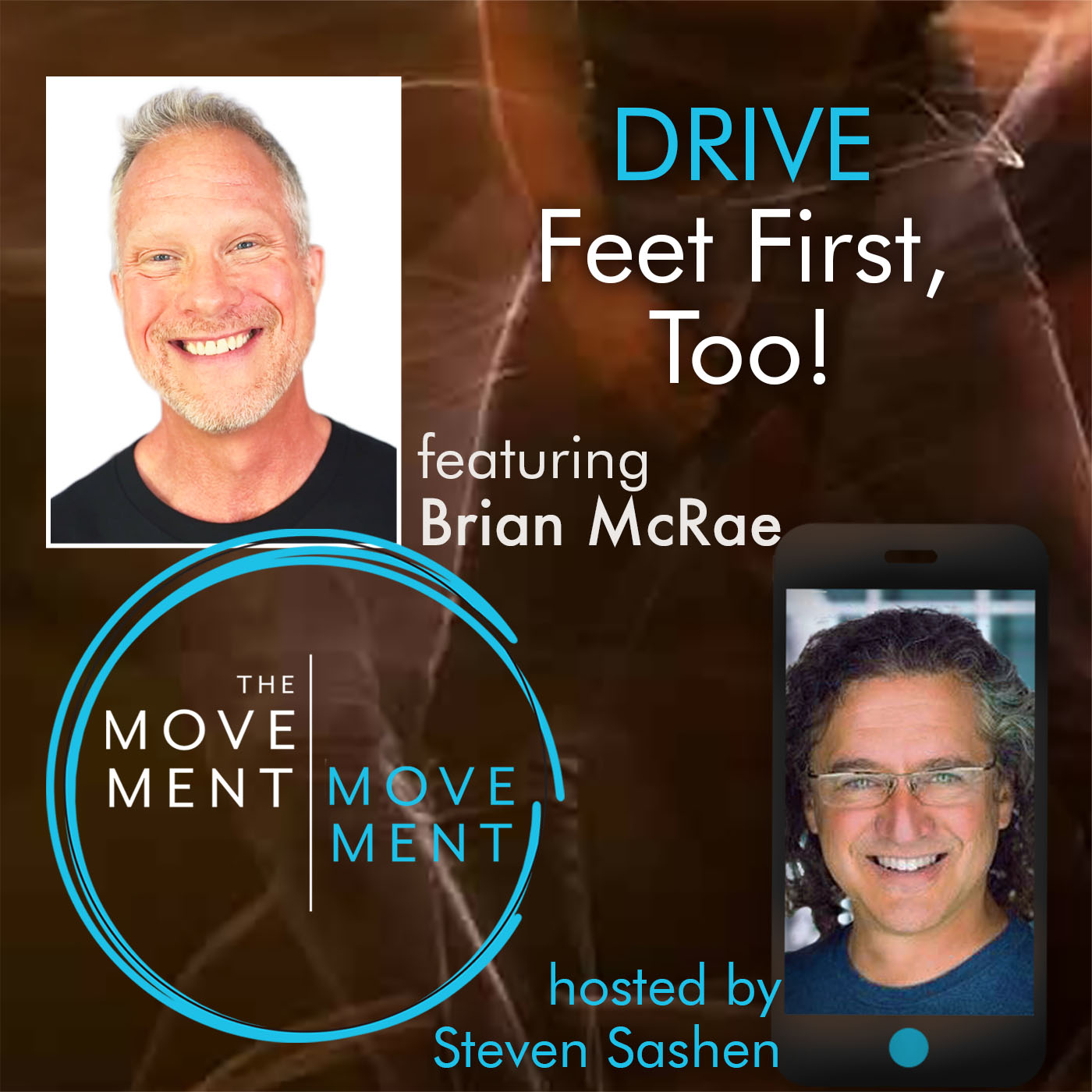
If you're looking for the right shoes to wear when you're driving 200 miles an hour, have I got news for you, especially if you're doing that 200 miles an hour without leaving your living room. We're going to talk about that on today's episode of the movement, the podcast where people want to know the truth about what it takes to have a happy, healthy, strong body starting feet. First, you know, the things at the end of your legs that are the foundation for everything you do. We also break down the propaganda, the mythology, and sometimes the flat out lies you've been told about what it takes to run, walk, hike, play, do yoga, lift, anything you can think of and do that, enjoyably, effectively, efficiently, say enjoyably, don't answer that I know I did because I said all the time, because look, if you're not having a good time, you're not going to keep up whatever it is you're doing.
So find something you enjoy. We're going to talk about that today. I'm Stephen Sashan, co-founder, chief barefoot officer here at Zero Shoes and we call this the movement movement because we, including you, more about that in a second, no obligation, no cost. We are creating a movement about natural movement, letting your body do what it's made to do without getting the way and causing problems and then claiming that you're actually providing cures for the thing that you just created.
So here's the we part. It's really simple. Just spread the word, give us a thumbs up, give us a five-star review, hit the bell icon on YouTube to hear about new episodes. Go to our website www.jointhemovementmovement.com.
Nothing you need to do to join. No cost. It's just, you know, best of the domain I got. But you'll find all the previous episodes of which there are quite a few.
You'll find all the ways you can find us on social media and how you can find the podcast in somewhere other than where you found it now. If you're not crazy about the place where you found it now. So all of that said, let's get started. Brian McCray, tell people who you are and what you're doing here and how it is that you can go so fast in such a tiny little space.
Well, it's going fast in the office. It's a little bit different. I am a professional sim racer. And for those of you that don't know, that's kind of like playing Gran Turismo on your TV, but on steroids.
We have a racing team class, simulator equipment and gear in our offices and it has the fidelity of flight simulator training scenario. This is something that real race teams use to train and those of us that can't afford or get to a race track use them in real life to actually race other people. And so it's something that we do at a very high level. It's something we enjoy.
We treat it like racing. It's just another discipline for us. We go 200 miles an hour over stand until the whole time. Well, it occurs to me.
How many people have gone? I mean, how many professional racers use sim for training? And the really fun question, how many sim racers have actually gotten in a car on a real track? And what's that experience like?
That's a fantastic question. And just about every racing driver uses simulations. They all do. Every professional race team has a, has a thing leaders all the manufacturers have seen and have always been a part of racing.
And your second question is how many sim drivers have gone on to real racing? Well, there's a story that's actually a movie made about this kid who won the PlayStation Academy, the Grinch Reesma PlayStation Academy, went on to run the 24 hours of the offices way back in the early 2000s. Since then, there have been several NASCAR drivers, time in the jeskeys won, and who have made a leap to real racing William Byron, who has won several NASCAR races at the couple of them started as a simulator too. So it's become both a training ground.
But the reason that it's such a training ground is that evens the playing field that makes racing accessible. Because if you can race in the sim, odds are you could probably race in real life. And so it's made racing something that's not very accessible to any of us. It's made accessible to all of us.
Well, my question, especially going from sim to a real car is so I way back when I was doing a day trading, okay? I have a friend who's still doing that. And of course, one of the things you try and do when you're trading a system is you want to test your system and you can test it in real time with simulated trading. And then you put some money on the table and everything changes, even if it's a small amount of money, whole different game.
So I'm here, I'd be fascinated to talk to someone who's made that transition from sim to real about what the difference is when you know that if things go wrong, you don't just fall out of your chair, it can go bad. And I have to tell you, I'll tell you funny or funny, very interesting story about someone who didn't go from sim to real, but my only racing story. I'll tell you that a second. But.
Certainly that's having I've actually raced my car at the circuit of the Americas. That's a world-class, one race track here in Austin. And I've raced that track in the south, thousands and thousands of laps. And I can tell you in no uncertain terms that the feel of the car not grated.
We have limited, we can only interact with pedals, interactive steering wheel and interactive visually. So we don't have the tactile, we don't have the G-forces, the noise, the smell, all the things that makes real racing fantastic. So we have to rely on the inputs that we do have, but those inputs translate directly. I mean, directly to the way that a car behaves.
So I can actually tell you a real story about a time I was at the racetrack. And I saw a race car make a mistake in a corner. I saw exactly how the car behaved and how the car spun off the track. And I knew exactly what that driver had done because I made the same mistake in the sim at least 100 times.
That's it. It's a direct core. It's uncanny how much a high fidelity simulation can increase your overall ability to drive a regular race car. But now let me say I'm going to reframe this in a little way.
In the same way that people when they talk to Laina and I about starting zero shoes and being entrepreneurs, they say something about our ability to tell her at risk and I go, no, I don't think you understand. We don't perceive this as an anyway risky. It's never occurred to me that this is risky. I mean, yes, I could end up bankrupt.
I could be catching fish and bahana. That's the way I survive, which is I mean, have this entrepreneurial failure fantasy, which if everything just went completely crap, I would make sandwiches at Quiznos and then I show up at a high school reunion and people say, what do you do? And I go, Quiznos. And they're going to say, oh, Frances, no, they're not even going to cut the red now.
I don't have my identity too tied up with anything that I do. But so I wonder for anyone who's making the transition from sim racing to real racing, if it's a similar thing, that the idea of the difference in genuine risk is just not even something that pops into one's mind. Or if it's there and then you learn to deal with that and what that process is like. That's I think probably one of the biggest differences.
And I felt that I mean, I was a track vehicle. So it wasn't a public section race. It wasn't an actual race. I mean, race probably was getting paid to drive, but it's dangerous.
Racing at any level is very inconvenient. It's very expensive. And so all that is extraordinarily risky. And so yes, it absolutely affects the way that you drive on a racetrack.
And that's one of the things I don't have to worry about because I can just say, right? Well, it is interesting. I mean, I do know just from listening to a few people that I know who are really into racing, especially F1, is that the while it is risky and dangerous, way less so now than it was 10, 20 years ago. I mean, it's totally smokes.
And so much of that is this technology, which brings me to my one story. I'm going to talk about why we're talking on my podcast about sim racing. I had a friend who, I have a friend who was one of the first people developing a real-time biometric sensing device. It was basically a palm pilot with a knee-pre-invest that had a whole bunch of sensors in it.
And so they were getting real-time data about what was happening with your breathing and your heart rate and a bunch of other things. And so they had fighter pilots wearing this thing and a bunch of people doing very interesting activities. And one was a racer. I don't remember what type of racing I don't remember if it was F1 or probably NASCAR, but don't hold me to it.
Either way, they're looking at the monitor and looking at all of the guys biometrics. And it's all very interesting. And suddenly everything just got really slow. And they're really slow and they're tapping the machine.
They're checking the connectors. Then they look up and they see the guy's car rolling bad. And when they got him out of the car, they said, we were a little shocked. I mean, we just watched all your vitals slow down.
He goes, yeah, once the car starts rolling, there's nothing I can do but wait. It's so true. The fundamental truth behind that. Yeah, it's true.
You'll see the tuck under their hands off the wheel and pull it. It's all you can do is just to turn and wait for the hit. It's a very real difference. It's fascinating.
It's fascinating. It's like the times where I have admittedly accidentally stopped on ESPN when there's a motorcycle racing. And you watch someone wipe out on a motorcycle at 150 miles an hour and they just skid for 100 years. And they stand up like nothing happens.
Like, oh my God. Yeah. There's a big question that we have to ask. I have to ask you.
What if you could deliver say 75% of the fidelity of being at the racetrack. So you're not all the way there, but you're pretty much there. And what if the simulation's fidelity was enough such as you could trick your brain that you were really on the track. And this happens.
This happens because our brains actually don't know how to do it. So while I may not have the perceived risk, I can guarantee you that there have been times when I've been in my digital race car. My brain thinks I'm on an actual racetrack. And I have to kind of come back to reality a little bit.
That's how good the fidelity of the simulation has gotten. Well, that raises a question. One for me is, so I've been in like, you know, this 3D fake rollercoasters, for example. And I now, I like rollercoasters in general.
Those things nauseate me like there's no tomorrow. So I mean, have you found yourself at any time getting that sort of physical effect? Absolutely. Especially when I first started, like, for example, I do a lot of NASCAR racing.
I do a lot of NASCAR racing. I do a lot of NASCAR racing. I do a lot of NASCAR racing at Daytona. Those are drafting tracks.
We're literally racing too much as I'm from the car in front of the car. There's another car too much as behind you. And even though I'm on a digital car and a digital racetrack, I'm scared enough. I'm going to rack it so you're right.
Can't tell the difference. So, seven, one of my early teammates, he put it very succinctly. He says, you have to get yourself to where you're comfortable feeling uncomfortable. Yeah.
That's a good point where you're comfortable in this really uncomfortable place. Well, you know, I would imagine that, I mean, one statistic, and I don't actually have the statistic. One thing that I know, you can give me the statistic if you know it. That is related to that.
I mean, that kind of being uncomfortable. You're still having all of the attention and stress responses going on, which tell me how many pounds does a racer lose during an actual race? I mean, actual race, these guys are pro athletes. They have their putting heart rate monitors in the car.
They're heart rate's going to be 160, 170, and there's 110 degrees in the car. They're going to pull fire so these guys are going to flat out the whole time. So, they're, but even in my air condition office, after an hour and a half of the race, I'm drenched in sweat. My heart rate's going 130.
It's like a texturize. So, it's just a different kind of exercise. The intensity of the race. Well, you know, for people who don't grasp how real it can be, I don't know if there's anything to search for on this, but they're my favorite sort of augmented reality or not even virtual.
It's hard to explain. Experiment was they have somebody put on a whole VR headset and what they're seeing in front of them is an avatar of themselves. So, when they move, it moves. And what the researcher will do is simultaneously stroke someone's back with like a little stick while they're seeing the fake version, the cartoon version of them from them getting stroke with a stick.
And after a few minutes of doing this, they'll do something shocking to the avatar and the person feels it in their own body. Like you literally, your brain makes you start thinking you are that thing outside of you, which if you think about, I'm not a guy, I haven't done hallucinogens, but you know, you hear certain stories. And then suddenly it's like, oh, your brain has this weird ability to, to, when you look for where am I, it might point to places that aren't pointing towards your chest or your head. I had an experience like that.
This is very specific. I was racing. This was a NASCAR race at Kansas. Can't see by the 1.5 mile an hour oval.
It was nighttime. It was a night gorgeous. I love racing. You said 1.5.
I want to have my level. So sorry. The normal, the normal, the race tracks. Nothing special about it.
But this particular night, I can't tell you exactly why. About halfway through the race, Stephen, I swear to God, I thought I was on a racetrack. I thought that I was there. I thought that I was in the crowd.
I really, really believed that I was on that racetrack and I had to reel myself back in. I really had to like wait a minute, hold on a second pattern interrupt or sitting in an office. It was that, and there have been several times when I've gotten close to that, but nothing ever came close to that. It was like my brain forgot completely that I was in an office and thought I was in a race car on a racetrack.
It was uncanny. I'll never forget it. The closest thing I can come to that is when I was, let's see, so I went to film school. I got a degree in film from Columbia and simultaneously at the request and advice of one of our teachers who was a very well known actor who said you should actually be taking acting classes as well.
During this one acting class improv exercise, I'll do the shortest version of the story possible. I was at a moment, so I'll have to get a little preface. This exercise, you have a partner and you establish a relationship. We established that she was my roommate's best girlfriend when we were in college.
She was living in New York. I had moved away. You give each other just enough information so they have a context, but then your job is to make up some other story and one of the characters walks in the door with this other story. They start the scene.
I think the exercise is called there's a knock at the door. At one moment, this is where I'm abbreviating grammatically. My brain went, you have two choices now. You know this is fake or you can go for the ride.
I decided to go for the ride. Where the ride was, I made up the story that I'd always been in love with her husband. My roommate had always told me if it weren't for him, she'd be with me. I bumped into him at a bar in Chicago and he told me that again and I killed him.
It gets better when I realized things were kind of weird and awkward. I made some comment like, well Bob always told me if it weren't for him, you'd be with me. I used to say that to get rid of you. I never liked you.
And at that moment when I realized that I had just killed someone by accident, my brain exploded. And for the next 10 minutes, I felt like I had just made the biggest mistake in the world by killing someone, I'd all let alone for the wrong reason. It was the most, and I was having emotions and movements and everything that were, you know, an out of Stephen Experience. Never anything like it before or since.
It was in a weird way, the most freeing thing I ever had because it had nothing to do with the familiar parts of me. It was so wacky for everyone involved that for the next three weeks, no one in my class spoke to me. But that's the point of improv. I mean, you're just going to go.
You just went with it. Like as we supposed to do. Yeah, you're open to whatever happens and you just go. Now, I know lots of actors who say they've had that experience or something similar, but 90% of the time it doesn't happen.
But like when that does happen, that's what makes you come back. That's what makes you go. I got to do this again. You know, that actually speaks to something that we take this with my teammates and my league mates.
We take this very seriously. We are, you know, our cars are painted. We've got liveries. We've got sponsors.
We treat our cars like real race cars like we great. We try to race like real race is like we do everything that we can possibly do to make the experience as authentic as possible, even down to the races. We cross the finish line and we drive all the way back around the racetrack and back on the pit road as if it were a race car. Now, it sounds ridiculous, but the idea is that first of all, the more that you contribute to the realism and the fidelity of the simulation, the more real it gets and the more visceral it becomes.
Now, that effect gets amplified when those that are racing around you do the same thing because we have a community of people that are dedicated to realism, dedicated to truth, dedicated to fidelity. And Stephen, it's that same experience, that same level of emotion, that depth is the same experience because the environment becomes so rich. And I'm happy this is why we do it in three nights and weeks because we have this collective of people who race this way. And that contributes to the realism more than any technology, more than any graphics, more than anything else.
It's the community around us. It's uncanny. It actually reminds me very much of improv. It's very similar.
I'm now dying to know who's driving like a Sim F1 car in real life. They've got a Ford Focus. Well, I've got to go to the gaming room. That's being right here.
Okay. Now, I do have one friend who's also SimRacer and we rarely talk about it. He's another entrepreneur and has been too busy and a little stressed out. I do want to ask you later about what it costs to get involved in to do this, but let's cut to the chase.
The reason we're having this conversation is you reached out to me a little while ago and said something that has to do with what I do related to what you do. Shall you tell that story? I would love to. It starts very simply.
You by accident made the perfect SimRacer. What I mean by that is we like race car drivers. There are purpose-built shoes for racing. There are driving shoes that are built to do that.
I'm going to pause there. We've had a number of NASCAR drivers reach out to us who wear our stuff when they're training. Like you said, these people are athletes. And they said the only reason we're not wearing your shoes in the car is they're not fireproof.
That's it. I bought a pair of these right here at HFS's. I've got at least a half of these things. I bought my first pair and I came back in from the world of Jim and went on to run and hopped into the Sim and I realized that these things were perfect.
Because the fact that they're so little material, they're so flexible. Pull the insoles out and it's just this tiny layer of rubber on top of the pedals. And it solves a couple of different challenges immediately. I mean, it was one of those things hitting like a lightening ball because I tried racing barefoot, tried racing in socks, tried racing in shoes.
Nothing works because any sort of shoe has so much material that whatever tactile feel that you get from these pedals you lose. Because we don't have the same as the same ability to get an actual race car. We've got purpose-built pedals, but their feedback is limited. So anything we can do to maximize the feel that we get out of the pedal is what most of us race barefoot are racing socks.
But that doesn't give you the grip and consistency that you need. So I'm hooking these things up and they stuck right to the pedals and how the same feel as if I were barefoot, it was the best of both worlds and it was immediate. So ever since then I started just wearing your shoes in the Sim and then I decided to reach out to you and say, hey, I haven't found some racing shoes, they don't really exist. And so it wouldn't be neat to be able to put these out into the world and tell more people about the story.
And it's something that we're having more conversation about that. And I've talked about a drive issue for a while. There's a couple of things that we'd want to change to make that work better. So you started with HFS, that's what we now call the HFS original.
Where did you go from there? Did you pick up anything else? I did. So there's a couple of different applications.
The HFS, the original HFS is great. I call it my sprint racing shoe. So if I have a short race, it's where one I'm going to have a lot of footwork. It's my go to because it has solo material and my HFS are so broken and it's almost like an extension of my foot.
So it's the least amount of material I have between my foot and pedals. And new go to though is the new speed force. Oh man, new speed force even. What shoe?
I, and it's actually so my new kind of campaign slogan is from the center of the gym because these shoes work from not only in both places. And it was actually you're the one that turned me on to these a long time ago. And when you never started talking a couple months ago, you told me about the new ones. And these things are incredible.
And it's even lighter than the original HFS. The soul was even thinner, but the back of the soul is such that the shape to more like a traditional drive issue. So just the shoe architecture and architecture of the soul likens itself more to a drive issue. And there's even less material in the upper slope breeze just phenomenally.
And then in the gym, the platform, I get in the gym off these things is something really special. So I wear them all the time. Yeah, the original version of that I co developed originally with a guy who was at Nike for 30 years and researched ways that people may choose where they had no technology or whether it's because of an availability or that they were 400 years ago. And the original version, you could sew it together with four pieces of fabric.
And frankly, it was never quite the way I originally designed it. I could never get up the factory to do it right. But then we commercialize it pretty good. And then we also knew that the original design people either loved it or hated it.
But we always try to make it so that there's not a reason to not buy something and then redesigned it with the new upper, which is even lighter and taller. There's some people who still love the original. I like it too. I wear them both.
But yeah, this is the shoe that has a sprinter I race and compete and train in. So in the gym, I wear it because it's like nothing. It's flat, not messing with my posture. What's my toes really work.
We've had a number of power lifters who swear by that shoe as well. Actually, all of them. But that one, because it's the closest thing to, like you said, close thing barefoot. Let your toes actually work.
Most people don't know that, especially for heavy lifting and for professional, like powerlifting. Bench pressing starts with your feet. And you said to me, when we were talking about driving with your feet? Oh, absolutely.
You drive race cars with your feet through the brake pedal. It's the peak. The old one of your first questions of race car driver asks is what's the brake on it for? And people say, it's going to stop the car.
So it's not going to stop. It's going to turn the car. So it's going to turn the car. So you drive the car with your feet as much as you do the steering wheel.
In fact, you want to drive the car with your feet because if any input on putting it into the steering wheel is wearing out the tires, I'm just going to take your shape time off my lap. So if I can drive the car with my feet, I'll have to use the steering wheel as much as I take my tires. So you're going to do your feet? Absolutely.
That's an ever-professional race driver. I would tell you that. That's right. Well, one thing I know about performance driving, and I know this only because I've had a number of delightfully fast cars.
I like things. I don't drive. I don't speed, but I accelerate. That's what I like doing.
So my last car, I sold it to get what I'm driving now. That was a Subaru BRZ that I put a supercharger in because, you know, a lot of cars. And so in researching that, and I've driven a couple, I mean, I actually drove a lot of some era recently, which was very much fun. And so one of the techniques for effective driving for people who don't know is referred to as heel-toge for shifting.
And can you describe that? I'm just very curious about what your experience is doing heel-toge shifting when you got a shoe that's wider or foot-shaped rather than something that's squeezing your toes together. I can't, I can't, heel-toge in any other shoe. I've worked since 15 years on 6-foot-4.
There's a lot of me to run anyway. And the pedal box of a sim racing, just like this is a good for an office on a race car. Do you want to describe how heel-toge works for people so they understand the cut? Sure.
So whenever you're operating three pedals, so if you have a clutch and a brake and a gas, whenever you are down shifting, you actually want to split the throttle to bump the revs up so that the gears engage more quickly. Well, you might be on the brakes when you do that. And so the effect is you either press the brake with your right foot and heel the gas and then move your left foot to the clutch. So the heel-toge, heel on the gas, toe on the brake, or vice versa.
If you're a left foot breaker, you heel the clutch and put your foot on the brake and heel to the brakes. So it depends on the technique. It depends on whether or not you're a left foot breaker or right foot breaker. The classic technique is the right foot.
So your left foot, your right foot goes on the brake, your left goes on the clutch and your right foot operates the gas with the heel. And the right foot. So you'll see here some static videos. You'll see some classic quick red software videos doing that.
That is for me impossible to choose. Just can't do it. In these shoes, I can. But still a challenge.
It's still very much a discipline. And especially most of the cars that are running out of paddleships. I don't have to do that as much. Yeah, that's really interesting actually because you have paddleshipping.
It's just so fast. Especially now. Oh my God. I went just for the fun.
I'm going to get a kick out of the sun if I told you this. Last week, I did something that was really stupid. And for watching a bunch of YouTube videos where YouTube just showed me this one video and I watched a bunch, I went and drove the car from the videos that I'd seen. The car right?
It was very dangerous. It was a Mercedes AMG GT63. I think it's a $225 car. I do not have $225,000.
My last car, net was $15,000. The one before that net was $15,000. The one before that net was $15,000. Get a hint.
And that is, you know, bought the car sold what I had before. But oh my God. I mean, the thing shifts so fast. You don't even realize it's happening practically except you just get plastered it back in your seat again and again and again.
And it ruined me. I mean, it really ruined me. It's completely. It's the drama around it.
That's actually driving cars like that. I mean, those cars came from race cars. They're all the AMG's in part of the race. They're racing their race cars.
And so see how technology has advanced over the years. You know, the last 10 or 15 years to be able to go out and drive something like that and just see how, but not really fast. Now, it breaks. Now, everything works.
And no one is racing. It pushes out along. That's one of the reasons why I love it. I have to tell you, one of my favorite things in that car has nothing to do with racing.
I mean, it does a little bit, but it's more effective when you're parking. It has rear wheel steering. So if you're turning to the left, the rear wheels turn to the right and the way they told me about it, we pulled into the dealership to drop the car off after I was just giddy and we pull up. We're like driving up between a row of cars and we want to be in a turn left and it was like barely a car with to turn into.
I said, I'm going to have to do a 10 point turn. I just try it and the car just like it was as if it was on a turntable. It's like rotated in and it was really cool. And that is the geekiest thing that I can possibly say.
No, no, wait. No, it wasn't about it. Actually, wait. Here's the geekiest thing.
The key is things that car is super, super low. And so if you're going either over a speed bump or the opposite of speed bump, which we have in our neighborhood for dealing with water or even the curb in front of our driveway, it's almost impossible to not crunch the front end. The car, you can raise the front end. This is not the key.
The key part is coming. You can raise the front end a few inches so that you don't, you know, bottom out the car. The geeky part is when you do it in this car. It remembers where you are with GPS.
And when you get close to that location and GPS automatically raises the car for you. Wow. That's a lot of years. I think that's probably, that's $25,000 of the $25,000.
Yeah. Holy moly. What a trip. So you mentioned, send to the gym.
Talk to me just, you know, how many sim racers are really treating it, you know, as serious as real racers and going to the gym and just for the fun. You alluded to it, but say some more about your experience in the gym with zero shoes. So I didn't have anywhere in zeros in the gym since the very beginning. That was actually going back to the original to fast.
I think one of the downsides of, I think just gamers in general, anybody in that genre is one side and it's sitting down, even if we're, we're going to stay. It's a lot of people who are still sitting down. So there is a tendency, you know, of course, an action towards being leading that sedentary lifestyle, snacking too much, et cetera. So I'm going to, I'm going to fit in my feet.
I'm trying to stay healthy, trying to stay young for my wife and for my kids and fitness is just part of it. And it becomes more of a part of it as you know, the older we get. So I tried to incorporate that as much as I can into my lifestyle. And so these shoes are the perfect to do the perfect compliment because they do go from the center to the gym.
I'm going to have to change shoes. So that's kind of where that came from is this idea that, Hey, you know, we know that as a genre that we're sitting in the dark. Let's go outside. Let's make sure we're staying active to keep ourselves healthy at the same time.
But my experience in the gym, so I was a competitive baseball player in my late 30s or 40s and I trained with a guy in a private gym. We trained barefoot. So first time we trained every good, sprinting exercises, we'd all the way lifting everything was barefoot and I'd never done it before had no ideas. That was actually when I started that.
That's when I bought that first pair of zeros. I said, I want to replicate that feel in real life as much as I could. It was a whole loop roll up. I started doing that.
Did you know, I mean, had you had any, I'm poisoned well by asking the question this way. Did you either have any issues, any joint, whatever things that changed or did you notice any change of performance once you're actually using your feet? I'm going to preface this with John Wildley, one of our VP of product development has a great line. You know, people go to the gym, they work on everything from the ankles up and they ignore the part below the ankles that supports everything from the ankles up.
And we just see we've been a sponsor of lifetime fitness. We just see with the trainers and the members who were wearing our shoes. It's been really fun. Like I helped lead a class.
We led the class and then we put gier issues on their feet and we did a few more things again and people were like, I just said a personal best. Yeah. Hi, for me. I was a catcher and so wearing a chair on your legs is a catcher.
It's just one of the things you have to manage constantly. I was really fortunate. I didn't have too much of an injury history, but I developed since when it's about hamstring. Just the two or I was continuously managing that when I started training barefoot that one way.
Like once I could talk about my videos, it was hard to learn how to walk again. I had to learn how to run again. I had to get that alert. We learned biomechanics doing it.
And that proper biomechanical field was what I was trying to replicate with all these shoes that I was trying. But it was that once I started now, this was 10, 15 years ago, but I don't have low back problems. I don't have hamstring problems and I don't get shins with anymore. 100% of treatment to the type of training that I do, but also shoes on their wear.
Well, and you said it, I'm going to reiterate it. It's about form not footwear. It's a certain footwear. It gets in the way of good form and other footwear can support that.
So we're just not getting in the way is really where it goes. Okay, let's get to the fun part. So describe what a sim racing rig is like and the range of costs that one can incur. What's just like a real car?
You can bolt a $500 steering wheel to your laptop and then try it that way. And then many people get their start that way or you can actually get a. You got an unfurf as a background. But the fuzz about yourself is going to be very interesting.
No, you're so fuzzy. Do do do do do do do do the jeopardy theme song. Okay, stay on target. Okay, show me what you got.
So this is a one that's nice. It doesn't have motion, but it doesn't have. Wait, wait, wait, doesn't have what about. We'll come back to motion because what?
All right, keep going. This is that. Before night, it's why screen and that why screen is on a floating panel. I can basically put it right next to my face.
The wheel is a direct drive steering wheel. So it actually has just as much resistance as a regular race car does. You can see maybe the puddles down there too. So this is fully functional, but it's a kind of a racing sheet.
It also looked like you had a subwoofer behind there somewhere. That's the piece. Okay, the runs inside. I run through headphones.
I'm not going to have super high fidelity headphones for that application too. So my mind is you can get all kinds of lights and bells and whistles and button boxes and all kinds of motion and all kinds of things. So I found that fidelity really fiddellies about the wheel is about visuals of the monitor by the quality monitor and those three things that that's where I spent all my money and all my time is on those three things and enhancing that fidelity is made all the difference. So if someone's going to get started, I mean, you know, like low end high end.
What are we talking about? So low end say $1000 high end three to five thousand. So you can spend 10, 15, 20 if you want to do. There's some seriously expensive rigs out there.
So is this one of the sports where for lack of better term some ritual white guys spend a lot of money even though they don't have the skill to use it. So you know, somewhat, I found that if you can race, you can race, you can race and I have raced against guys who were beaten me with the most quality wheel there is that skilled or if you're far between. For my own personal, I'm especially getting older. I don't have the fast switch in the reaction time.
So I found that upgrading my equipment, especially the wheel that made a huge difference in my business. And that's very interesting. Yeah, that reaction time thing and that speed thing. Oh, man, and I'm way older than you.
So it's the clock is undefeated. The first I think was the first time I was at the senior games when I just turned 50 and there was a bunch of six year olds there who were saying, God, do just wait, when you turn 60, it falls off a cliff and they're having a bunch of 80 year olds saying behind them and they walked up and guys, you have no idea what you're talking about. There's always somebody older. Well, you know, all American times, not only do they get slower with each new age group that I've been going in, but the amount of slow slower they get gets bigger and bigger and bigger.
I just turned 55 and I feel like this is I've been fortunate enough to feel pretty young that I'm feeling that I feel like I'm not comfortable in my life and having to work harder, having to really have to manage it will never do before. The biggest thing that I've noticed, I'm trying 63 in a couple weeks, is that I mean, I've actually been lifting a lot, saying it for the last year, a little over year, and I've got more muscle mass than I ever had in my life. But I'm not lifting as heavy as I used to, partly because I don't want to be an idiot because I've got to screw it up fine, so I'm not doing heavy squatting, heavy dead lifting at all. But the biggest thing is the physical changes are very fun.
I enjoy them thoroughly. But psychologically, it's difficult because I have to be way more recovery and rest. I can't get into much volume and the changes, either the amount of weight than I'm lifting or what's actually happening in my body are so much slower. And frankly, partly I started doing this because I wanted to see how much bigger I could get before I inevitably got smaller.
I've never seen Jack Lelain, I've talked about this a bunch of times. I remember seeing a video of Jack Lelain, he's like, 1992, and they're showing that he's still lifting. He co-invented the Universal Gym, which most people have never seen. He was one of the first all-in-one things.
And he's doing the bench press, and he's like, if you look carefully, he's lifting 20 pounds. But there's 90-something years old. And again, I know, if I can just live to 100, I can possibly break that record only in the 100 meters, only because there's probably nobody else who's going to be racing. So there's just a bunch of that.
So it is a fascinating thing discovering how to adjust to something. Not everything's inevitable, some of it is. I mean, I've definitely staved off quite a bit with what I've done. I'm sure you have as well, but not everything, man.
I mean, I've learned to adapt. I think one of the things, like I used to take, I would work out three four days a week maybe, and I'd be sore all the time. But about a year ago, I started working out every single day. So I worked out every single day.
Now, I managed my workloads. I'm not either throwing much weight working out two hours. I haven't been doing it very cautious. But it's almost like I've trained my body to be ready to work.
Because my body is producing the chemicals and hormones that I need to always keep working because I never get sore. I'm not tired, but I never get sore. That's interesting. I mean, the workouts that I do, it's three times a week.
It's legs is one day, and I always do that first because it's so unbearably difficult that if I did that anything other than first, I wouldn't want to do it. The other day, the other two workouts, which is back and shoulders and chest arms abs. I look forward to the other ones. I mean, they're really hard.
Like the trainer that I'm working with. I mean, I was on the floor gasping for air after working my biceps two days ago. So because he just beats me up really good. But it took me, I said him at one point, is the rest of my life where I'm going to have half a day when I'm not sore?
Because my workouts are like Monday, Tuesday, Wednesday. I don't even need to space them out because of the way they are. And he goes, yeah, pretty much. But it's not true.
I mean, in the last couple months, I still get sore or I still feel the effect of the workout for a day and a half. But I'm not getting sore the way he's done. Definitely able to tolerate more. And I've been craving a little more volume, which he just tells me no.
Not a rest. So it's a bit of a push me pull you. I just become more active on those non-workout days because I do have a built up tolerance, which is very, very interesting. But at the same time, like last week, our leg day was an exercise I had not done.
And we pushed it really hard now. And we pushed it really hard. And it was five days until I could sit on a toilet without having a hard time getting on. I don't want to do that anymore.
I don't want to do that anymore. I don't like it. I mean, that's why I hurt. Because I'm working on it every day, I can't do that type of workout.
So I was getting older and being not injury prone, but certainly being to having to watch injuries and having to change the way it's working on every day is kind of a perfect signal because you just listen to your body. I've never done it before. And I think it's also happening. I'm better if I can do something every day.
I have a similar thing. If I'm doing something for 10 minutes every day, it's easier than doing that than doing 30 minutes three times a week or something like that. For whatever reason, the pushing hard thing I find very gratifying and satisfying. And he did give me a compliment.
I mean, this guy, if you work with him, his name is Kevin Richardson. The way you become a client of Kevin's, he'll give you a free workout. And if you like it, he'll give you a leg day. And if you come back after that and say, yeah, I want to pay you, I'm not in a money.
You're an idiot. And so, yeah, I know, I mean, that's how he weeds him out. And the thing he did say to me, so knowing that, all of my clients, they push hard. Just that's what we all have in common.
I have to tell you, you're the winner. You will push harder. Nothing. I'm not lifting more weight or whatever.
But you know, you will just keep going until you can't over and over and over. I go, well, yeah, that's what you do, right? That's true truth. If it's something that I'm really into, yeah, go in pretty far for whatever that looks like.
But the physical stuff is, it's a different thing. Like, I don't want to talk about this. My brain is goes very wide. I'm not going to prioritize.
I'm good at coming up with a whole lot of things. But when I do physical things, I need them to be short and intense. I'm a sprinter when I lift it the same way. I mean, and I'm very focused when I do that.
My physical stuff is a whole different thing than my mental stuff. And I don't know if that's common or not, but it's definitely, that's just the way. It's just for you to spread it because you have to be like that. Every little version matters.
Oh, no, it's horrible because you can never do it right. Or you never do it perfect. Like at the end of every race, you know, people go, hey, how'd you do? And I've started answering, oh, can I just give you the time or can I give you the excuse and the time?
Because there's always an excuse. I mean, for all of us. At least you're doing this in real life. It's like, you know, you have a race, you have a bad race and like, say, whatever, I have a bad race in a pretend race car.
It doesn't even fit in my day as ruin the next day. It's been the whole big muddering to myself about what I did, whatever. It's insane. Well, the thing that's changed for me is that I know that things go wrong.
And when they do, I really don't care so much anymore. I mean, like this indoor track season, I went to a race and I didn't get a race because, well, for the fun of it, you can look it up if you didn't hear about it on the news, a guy died. The hammer throw, it's a different thing. It's like the hammer throws a weight at the end of a chain that indoors a weight with a handle.
And it cleared the barrier and hit a guy and he died. It was, I don't know who I felt worse for, the guy's family or the kid who threw the thing in because holy moly. So I didn't get a race in the next week. I go to the CU Invitational warming up felt great and I went, let's just come out of the blocks before the race actually starts.
And I set the blocks at a slightly different angle because I usually set mine at 45 degrees. They had either 40 or 50. I went to 50. So it's a steep, like a more, there's more motion with 50 degrees than 40 degrees.
And that little bit extra, that five degrees extra was just enough of a stretch response to my cap. Whoa, whoa, whoa, and my calf seized up and then I was done for the day. I didn't rip anything. Just like, I just wasn't used to that much stretch.
And then I lost that day. And then the next week we had like a snowstorm. But my response, now is kind of whatever. I wasted a couple hundred bucks and what am I gonna do?
So you have a good race, you have a bad race. Don't care so much. Show me. Show me.
That could be. I just lived through it. I mean, I've had enough times where I've gotten injured and gotten all upset. And then after a while, you know, it's like when I was doing comedies, you have good sets, you have bad sets.
And it takes quite a number of bad sets to know when it's you versus the audience. And once you know, sometimes it's just not a big deal. I had one show going way off track. I did one show.
It was a third show on a Saturday night, midnight show. And I'm supposed to be 45 minutes. And I get up there and I do my opening joke, which I don't remember what it was. But you know, it's a hundred percent and it got nothing.
And then I do another joke that I knew was like really strong and it got nothing. Then I do the bit that I close with, which is like, you know, standing ovation, walk off like a kind of thing, nothing. And I just looked at the audience and well, that's the funniest shit that I got. Good night.
And I walked off the stage. And the club owner was on the floor laughing because he's seen it happen to everybody. And just, you know, it's like, you know, you learn to roll with it. That said, there was one time where I was actually being featured on a television show.
And they take me a catch rising star one night in New York and I crushed it. And the next night in a club in Bethlehem, Pennsylvania, and I couldn't buy a laugh. And my girlfriend at the time, she's now famous and her father managed famous comedians. And afterwards, I was very unhappy.
And she said, is there anything I could do? I said, find me some chocolate cake and I'll see in the bedroom. She's like, oh, those. And I worked out okay.
So yeah, it's, it, but it is interesting, you know, for being there, I guess the real thing that I'm talking about is, especially as we get older, finding the right way to handle having a competitive urge and what it means about winning, losing and training and actually competing. And knowing there's that, that intermittent reinforcement of sometimes it's better than others. And that's what's coming back or sometimes worse. And that's what gets coming back.
And it's a fascinating psychological thing to explore. And so that's really the theme of our last 10 minutes for anyone who is approaching any age really, but certainly, especially at this one, which is the time when people our age are prone to buying $225,000 cars and doing stupid things. So you've just found a way to channel that in a way that's quite brilliant. I, you know, that's one of the reasons why I love it so much is enough to escape to allow me to do something that I love to do without the risk of my family.
And so, you know, fills me up in the ways that I get to. But like you said, I'm older. I don't have, I don't have the money or the time or the health to go out and run a fast car around the racetrack. So I do it here and I can express my love for the sport, grow my love for the sport, teach it, you know, followed in different ways.
What do you want from? Speaking of following, can people like watch races that you guys are in? So our early broadcast hour, Sunday night races are broadcast on YouTube. And so there's actually a live broadcast team that calls the race as it's going down.
So that it's just, our big race is for tonight's week, but that race is the only one I can celebrate. Well, that's the perfect segue to if people want to find out more about sim racing or they want to watch what you're doing or just get in touch with you to find out more. How can they and should they do that? Yeah, there's two ways.
The best way is either on Facebook and so top flight sim racing on Facebook. They just say it against low down. Top flight sim racing to all of them. It were the same on LinkedIn.
So I have the profiles on both of those places. That's probably the best way to get older. And then from there, they want to watch a race, which I imagine could be very, very interesting. How do they do that?
So that's your best best to go to YouTube and just go to iRacing, go to iRacing's main channel. They have really high fidelity broadcast there. And then our league is called the OBRL. So if you go search for the OBRL on YouTube, you'll find our channel and you'll find all of our broadcast races there as well.
Oh, I love it. That's definitely a way to do this. Now, well, Brian, thank you so much. It's been an absolute pleasure.
And I hope that really it's not only a smart people to check out sim racing, which is fascinating, but just the idea of different things that you might be finding that you can do in a pair of zerushus. It's a bit of self-serving to say that. But I don't think that people need to wear zerushus for everything they do. There's a time and place.
But what I found from talking to people like you or people who are in the Dance Revolution or all these things that people contact me about where they're going, your shoes are perfect for. And they didn't know and they found out. It's like experiment C, because what I'm hoping is people can send some video or reach out and go, Hey, here's this crazy thing that I'm doing that you're not going to believe is your shoes are perfect for. And it's half those conversations because that's my favorite thing.
It's just suffering all the off-label stuff that people do that where we can be helpful. So anyway, it's like... It was like striking gold. It was like striking gold.
But it happens like that. I've got to be able to share that with other people. So I'm really happy to be with you. Thank you.
It's a pleasure to have your support. So for everybody else, just a reminder, head over to www.jointhemovementmovement.com. Find previous episodes where you can find us on social, where you can reach out to contact us. If you have any recommendations, suggestions, people that you think should be on the show, especially if you know anyone who's willing to be on the show who thinks I have a case of cranial reorientation syndrome, I would love to have a chat with them and find out what things that I may be wrong about.
I'm gay. And again, give us a good review somewhere where you can give reviews or a thumbs up or a new thumbs up or hit the bell icon and subscribe. If you want to be part of the tribe, just subscribe. That's the way it goes.
And most importantly, whatever you're doing, go out, have fun, and live life-feet first.