
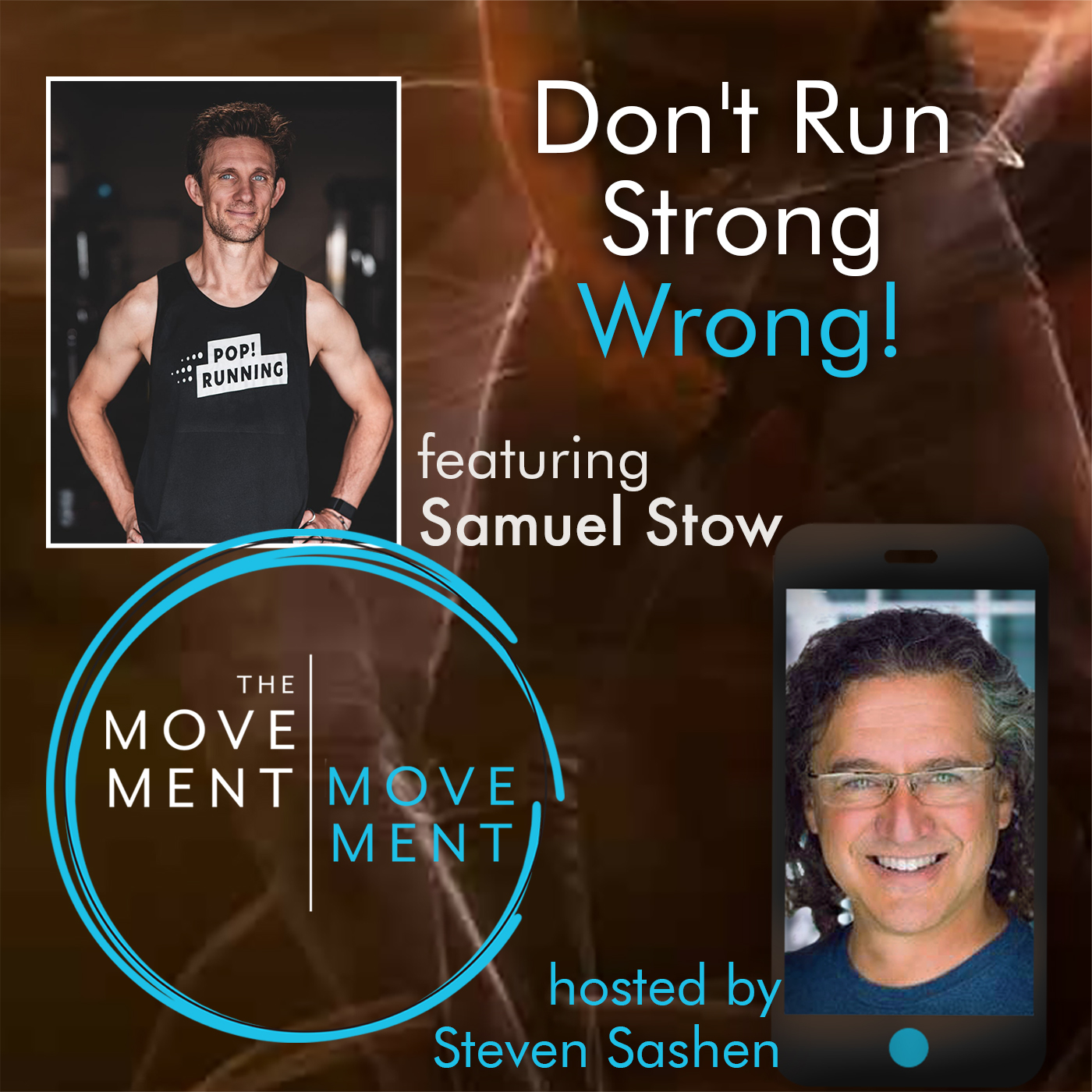
You know, getting stronger is something we pretty much all want to do, whether we're running or just in our daily life. But what if there's something you need to do before you go to the gym, before you go to the gym, before you go to the gym, before you go to get stronger, if you don't do, could, well, make all that, frankly, a waste of time or worse. Mmm, we're going to find out about that on today's episode of the movement movement, the podcast for people who want to know the truth, about what it takes to have a happy, healthy, strong body typically starting deep first, you know, those things at the bottom of your legs. And here on the podcast, we break down the mythology, the propaganda, sometimes they're flat out lies you've been told, about what it takes to run, walk, hike, do yoga, crossfit, play, whatever you'd like to do and do it, enjoyably and effectively and efficiently with today.
Say enjoyably, trick question, I always say that one first, because look, if you're not enjoying it, you're not going to keep it up anyway, so you may as well find something you like and we're going to help you try and do that today. I'm Stephen Sashan, co-founder and chief barefoot officer here at Zero Shoes, and we call this the movement movement, because we, including you, nobody will tell you how to say it. We are creating a movement about natural movement, letting your body do what it's made to do, not getting in the way and causing problems. So how do we do that?
Well, it's really simple. If you want to go to www.jointhemovementmovement.com and you'll find all the previous episodes, the ways you can find out some social, you can get the podcast, wherever you're currently getting it or anywhere else. And basically, give us a review, give us a thumbs up, give us five stars, give us a like or hit the bell icon on YouTube, you know, the drill, if you want to be part of the tribe, just subscribe. That's what gets the word out.
So that all said, let's get started, Samuel Snow. God, I can't even talk. Samuel Snow, this is because I have two friends who are SSs other than me. We're both SSs, but they're both synodes.
And so it was in my brain. Samuel, welcome. Tell people who you want to hear. Hi, thanks, Steve.
I'm excited to be here. I've been a long time follower of you. And yeah, I'm Sam. I am a runner, ultra runner in particular, and my passion is helping people to move well.
And the reason I'm here is I really want to help spread the word and the message that we can learn to move better. And that should be our priority before we do anything else. And from your action, people can obviously tell you from Texas. Can I get Texas right?
Yeah, yeah, yeah. It's Australia. It's near France. On a globe, on a globe it is.
I actually had to say that to someone. I was in California for the first time. I'm in an elevator with a woman from California, and she said, where are you from? I said, I'm from Washington, DC.
And she said, isn't that near New York? And I said, on a globe. So first of all, let's back up to the ultra runner thing, since that is the opposite of my life. I mean, I run the hundred meters up there, 60 meters indoor.
So were you always an ultra kind of guy or had to get into ultra? It's been a long journey. I've been doing. I'm doing a lot of pun intended.
Yeah. Yeah, you get a lot of puns with running. It's quite funny. Yeah, I've been doing endurance racing of various forms for over 20 years.
And I think that the trip, the switch to ultra running happened when my first kid was born. And when he was six months old, started crawling, I realized I didn't have the time to cycle and do all the other training that I was doing. So I decided to just focus on running because it was a bit more time efficient. I'm so glad you didn't say what was in my head, which was once my kid was born, I was trying to figure out how can I get as far away as fast as humanly possible.
So it's actually like an old Ray Romano joke about three kids. So it's good to be here. It's good to be anywhere because I have three kids. So how old your child now?
So I have three, my oldest is nine and a seven year old and a four year old. And so the running stuck, even though maybe you have a bit more time. And then how did you then, where was the process of starting to investigate how running works, or lack of a better term, and then putting together what you're doing to teach people, which we'll talk about in a moment, but I'm just curious how people get to where they got. I guess it started the beginning.
You know, when I was at university doing triathlon, I actually did a thesis in my Foni Euro, did aerospace engineering. And I studied the biomechanics of cycling and modeling track performance on a bike. And so I always had this kind of analytical brain when it comes to sport. And yeah, when I, it didn't click initially with running, it took me about four years.
So 2009, I found G running, you probably heard of that, right? Absolutely. Danny Dryer and his wife, Catherine, and my wife and I go back before zero shoes and back before G running. Yeah, well, awesome.
Yeah, and I got a lot out of G running and it made me a lot faster. And so I basically stuck with that until about 2017. And then that's when I started doing ultra running and I started to get really tired hips in particular. And I was like, I haven't figured this out yet.
You know, and then sort of a little bit back before that when I read Born to Run, which I ran in 2013, I read it and I started doing barefoot running. I got minimal shoes. I got some ultras, you know, the flat shoes. And that sort of stuck with me just like on and off for a while.
And there 2018, I really went nuts with barefoot running and I found Keith Bateman, who I know you don't know, and started doing his stuff. And he kind of really helped me by looking at me and saying, no, you're not doing what you should be doing. And that's when I kind of went, oh, OK. So it took me a little bit, you know, 2019 was when it finally clicked.
Well, it's actually you say that because one of the things that I've noticed is that human beings in general have, well, two things working against them, one, mediocre, appropriate, septo skills, mediocre skills in knowing where their body is, what they're actually doing. And the other is we're kind of wired to get into a movement pattern and then habituate to it and stick with it. So you put those two things together and when someone is trying to switch from the form that you adopt when you have a almost any shoe, frankly, but especially a big, you know, padded normal shoe or even a flat shoe that still has a bunch of padding, people often don't know what they're doing or think they know what they're doing or doing something very different. I've had people send me videos where they swear to me they're not overstrying and heel striking.
And then I show them on the video that they sent me of them. And I show that their foot is landing way in front of their center of mass, way in front of their knee. And I've literally had people say to me, while looking at the video, that they sent to me of them say, yeah, but I don't do that. It's like, you sent the video.
So do you remember what Keith noticed that then kind of changed things for you? Well, he has a very specific way of looking at people. And you know, I think it's primarily around like, well, your knee, the timing of the movements of your knees and with respect to like, you can see whether someone's actually getting a good hip extension or whether they're kind of swinging their legs, you know, and that's sort of like key distinction between whether you're using the front of your body to move you forward or you're using the back of your body, you know, this is so interesting. People don't, unless you are a high performance athlete, people don't really think about what the referred to as front side mechanics and back side mechanics, you know, what's happening in front of your body, what's happening behind your body.
And even then, I noticed it's often misunderstood because people think that like I was literally talking about this morning as I was racing someone in our warehouse, we did a track workout in the warehouse. And it's commenting how, well, it's not as impressive as it sounds. We were literally running on the rather dirty floor, not dirty, but dusty floor. And so when we actually decided to race, I kind of slipped out of the on my first step because I had so much dust on the bottom of my shoes.
Regardless, I was saying, you know, what people don't understand when they think about front side mechanics, like you go to a high school track meet and you hear the parents yelling to the sprinter kids, get your knees up. So you know, your knees up is what's happening from the backside mechanics makes the knees go where you think they should go. And if you're yelling these up, it's already too late. They're not doing that.
So people don't understand that division typically. And I guess we're going to be talking about that and what the important thing is to play with that. So for you, it's interesting. You came to this basically.
I mean, there was a bit of a hey, this doesn't feel great, but it sounds like more from the how do I optimize performance standpoint than the I've got an injury or I've got, whatever, it's like, what can I do better? Yeah, yeah, yeah. That's just the way I work is I've always wanted to be optimal, you know, and because I come from I started in multi sport and like nobody knows how to swim just off the bat, you know, you throw someone in a pool. They're going to drown unless you give them a lesson, you know what I mean?
And so as a triathlete and a multi sport athlete, I had to learn technique for swimming and then with cycling, there are techniques to a degree. And then obviously I also did kayaking and I had to learn how to kayak well and obviously so then I also had the chi running. I was like, oh, there's a way of running. And I was fascinated when I went and went to run about the whole barefoot thing.
And I, yeah, after a while, obviously took a while, but I realized that a lot of people can run barefoot, but still run poorly from an efficiency perspective. Yeah. Yeah. No, it is interesting.
I mean, I've similarly talked to people who, well, I don't think I'm throwing anyone under the bus as I'm not mentioning names, but they think of themselves accomplished barefoot runners. And what they've figured out to do is run barefoot without having problems per se, but certainly not effective or efficiently, like seeing people reach their foot way out in front of them and kind of catch the ground and pull it underneath them. So they're not putting too much force on their feet, for example, but they are still not. I mean, it's like grouchy marks walking fast rather than running.
And they're the ones who will proudly talk about all the half marathons they've completed and say they're, you know, excellent, barefoot runners and when anyone who understands the proper biomechanics tries to say something, that's what they'll fall back on and get very upset when you accuse them of not being was actually, it's funny. They seem to be more attached to doing it fine than learning how to do it better, which is again, a human thing. We think that we're all doing great. We don't like telling us where we could be better.
So which brings us to you. You figure this thing, you start putting all these things together for yourself and then you started teaching. How did that evolve? And then let's jump into, you know, what do you want to talk about for letting people know what I teased at the beginning about if you're trying to get stronger.
And so we can talk about what needs to get stronger and then the how part and or in whatever order you prefer the how and what people are doing out of whack or out of order to make that efficient and effective. So what's the first part of your question? Sorry. I don't know.
I got lost by the middle of that. If I can't follow it, I'd expect anyone else to. So when did you start? So when did you start?
I actually kind of figured this out. What was the transition for you to decide? I want to start teaching this because that in and of itself, you know, is a little unusual for most human beings to do. Yeah, that's true.
I'm a sharer like I really that's what I like to do. I don't keep things to myself. I like to be able to share what I land and I was living in Silicon Valley in Mountain View at the time when I was doing all of this. And I had a really good coach and making roaches quite well known in the ultra running community.
And I also worked at Google. And so basically I was in a very good place because one of the things that Google is obviously thousands of people, you know, and there's quite a big running community and there's also big there's gyms all over the place and they had this program called Google to Google. And so basically any Google can teach any other Google anything they want as long as I'm someone that's interested to do it. So I basically went to the G fit people and said I want to teach running and they're like, cool.
So basically just put up some pliers and started doing it because, you know, it's very not common to like even start thinking about how you run, you know, more often than not to be speak to someone about how you run. They're like, what are you talking about? You know, it really is amazing. People do think that while you just run it is so funny that for almost every other activity, including ones you already mentioned, people know there's a way to do it well or better that they probably don't know.
But from running since we kind of all were doing it in some way, even though, you know, not everyone was the fastest or the longest runs or whatever. It's kind of like everyone thinks they can write because they had to write essays in school or book reports like, you know, very interesting thing. So you started, so you were teaching the Google peeps and I imagine, you know, I mean, people in that world are early adopters to begin with. So I can see that would have been your shoes were very popular there.
I saw a lot of people rowing the pre-os in the gym and different things like that. So I got to somehow take advantage of that. Yeah. And so talk to me then about, since we tease this at the beginning, where strength comes into what you're teaching.
I mean, if you want to give it like the highlights of what you're teaching, well, since we teased it with strength at some point, let's land on that one. Yeah. Well, it took a while. You know, I came to it as a runner.
I had done a personal training certification before I left Australia for the US. There was a previous career before I started doing software engineering. And but then I didn't really get detailed into sort of like physiology and anatomy and like biomechanics from a muscular perspective until I came back to Australia. But I understood like how we were supposed to move sort of from a biomechanical perspective.
I just didn't have the depth of knowledge that I currently have with muscles and so on. So I didn't necessarily have that perspective then, but I was still going in similar way to like tree running. Okay. This is how you're going to hold yourself.
This is where you're focusing your effort, try and feel your bum. Basically, you glutes and all that. Yeah. I think I'm not sure if I answered the question.
No, that's good. And so I'm assuming actually, I do know this, but I'll say that I'm assuming you discovered something that I've seen often, which is for whatever reason, and there's debates about this, I have seen so many people who who's glutes just don't work. They can't if you ask to flex their glutes, there's nothing happening. I mean, what I've done when I do this in the appropriate setting or some like, say the inappropriate setting, I will do one or two things.
I'll like, you know, poke my finger in someone's glue and say, squeeze until that's going to get pushed out, which they can't. And they'll say, just to give you a hint, you know, do that to me and see what you feel. And they're like, Oh, that's, that's very different. So what's your technique for having people recognize that their glutes are not doing what they're supposed to do?
Yeah. So this was the last thing to twink for me. You know, I was able to teach people the mechanics and everything, but as I said, it wasn't until I went real deeper into the sort of musculature and so on, that I realized how little glue function a lot of people have. And but now I have a process to really, you know, fix that.
So one of the things that I start with is I have like the Glue Activation Program and I actually taught my dad recently. He's 71 and he, you know, this is an interesting story, actually. So he has very poor or has had historically very poor posture and like no glue awareness, but he's a sailor and he had a boat and he was trying to push this boat, which is a yacht. So it's quite heavy, but it was on land.
And as he was trying to push it, he tore his calf muscle because he was trying to push from his calves. And so after that happened, because he loves hiking, he's a very active person. I said, okay, we've got to fix you. You can't be running around trying to push with your calf all the time.
And he, yeah, when I started testing him with squats and things, he's like, I cannot feel anything. So that's how I came up with a program to help him activate through his bum. And then we actually took, we did that and didn't actually take that long, surprisingly, it only took about a week. And then after that, he was able to do the other exercises and now he can walk with a lot more power and he's got much better posture.
And I have the videos on my website. I love it. So if people are listening, like watching this and they want to check and see if they're actually using or activating their glutes, what would you recommend they try to find that out? Yeah.
So I actually talk about this. I've got an ebook and there's a free version and then there's a longer version, which is only five dollars on my website. But basically there's a test in there and it's a glued activation pattern. First, actually, probably the simpler version is, let's say you're just standing up straight, clench your bum cheeks, right?
Everyone mostly can do that. Right. Everyone can clench their bum. Right.
So that's great. Now the next test is, can you lift one leg off the ground slightly and clench just one bum. And the thing that I find often is most a lot of people can't. Wait, we don't.
So if you're lifting your left foot on the ground, yeah, and it's on the ground, you're squeezing that one. Got it. Yeah. Yeah.
So that's called glute dissociation, like left foot is right. I'm sure you can't. You know, but that's a really basic one. And then, yeah, obviously there's so many different movements that tests you can do.
But yeah, I've seen, I've heard people, for example, they're trying to do, for example, you know how I don't know if you've seen them, but there's this glute guy and he's got all girls doing these hip thrusts with barbell on the Brekanturas. Probably. Yeah. And one of my clients says she was doing a barbell hip thrust and she was getting like pain in her car.
And I'm like, ah, okay. Yeah, because you're not even using your glutes. It's like, you're trying to push the barbell up for your car because your glutes don't work, you know. So it's really interesting.
That's why I'm kind of talking about like these dysfunctions that people are not necessarily 100% aware of that we need to sort of resolve before you can actually do effective exercises. All right, we're going to drill into that in a little bit. But when I before we get there, so talk just about, you know, because we mentioned frontside backside mechanics. So let's loop that back into the relevance for being able to use your glutes properly and running.
Yeah, I think that a big piece that I'm always illustrating when I talk to people, I'm helping with the running perspective is that distance runners are not sprinters. You know, and so there's a very big distinction between like being efficient over a long distance and being fast and powerful. And I think because so many people seem to look at sprinters and think that's the model of efficient running form, but then, you know, because we have very little posterior chain awareness and core awareness as well, generally. Then the thing that we can most easily do is the front, right?
So we can put our arms up. We can put our knees up and you know, we can do everything that looks like that's what the sprinters do, but we kind of neglect the back. But to be honest, as a distance runner, you know, I've learned from experience of running hundreds of kilometers in one go that the most efficient way to run any further than say a couple of kilometers is not using the front. It's using the back because I talk about this in my books.
Basically, we have two advantages. One is gravity because if you land and then you're pushing from your bum, you actually get an elastic recoil effect. So you land, it loads up the spring and then you push from the posterior, which recoils. So you get a lot more efficiency than if you're just lifting your feet, you know, because then you're just removing the spring aspect.
Yeah, this is one of the things that I see in my neighborhood. There's a lot of good runners, but there's a variation on that where they're wearing big, thick high heel shoes and they even with high heel shoes, they're not there. Heels not coming near the ground. And so they're not utilizing their kiddies the biggest spring, literal spring that we've got, let alone, you know, what they could get from loading and unloading the glutes.
It's really. And of course, I'm not going to stop and tell them that I don't want to get punched while I'm walking. So again, so let's again dive into that a little more. So can you, what more can you say just about, oh boy, what's someone's going to look for in their own body or look for if they're watching a video of themselves to see if they are doing what you just described or not?
Yeah. So I don't typically look at this in the way, you know, you see a lot of people offering like form analysis, right? Running form analysis and it can be helpful. But I personally prefer to talk to people about how they're feeling and what they're feeling in their body because that's more sustainable, you know, like coming up with corrections and trying to do a correction on yourself is much harder than understanding what it's supposed to feel like.
And then just maintaining that feeling. And yeah, so generally, you know, I start with postural awareness, so improving your posture generally. So understanding how to hold yourself in a straight posture, usually using a wall is a really great way to do it. You know, so having your shoulders open, your head up, you're not looking up like this or down like this, you keep your head straight and then you tuck your ribs down a little bit, you know, because some people hyper extend through their back.
So the ribs down a little bit and then you tense your belly muscles and then you kind of that level with your hips and you should feel your bum turning on. And then that's your ideal kind of like neutral posture, you know, and that can feel quite foreign to a lot of people because they're not used to holding themselves in that position. And so you need to find that position in order to be able to use that when you're running. So that's why I said step one, you know, and what are the other feeling tone things that you're asking people to look for or that you're listening for when they describe what they're doing or not doing?
Well, you know, when I talk to a runner and finding out like what problems they're having, I'm like, well, which muscles get the source, you know, when you do hard runs, whether it's a race or a long run or an effort or work out. And usually it points to what the thing that they're doing wrong is, you know, like if they get a sore lower back and saw hamstrings, it means that they're they're core isn't working. And if they get sore cars or sore lower legs, it means they're over using their calf muscles and they're doing what you said, where they're heels not touching the ground. And there's usually there's an indicator.
It's like, okay, I mean, the quads are getting sore. It's more often than not, they're over striding, you know, so you kind of go, okay, well, based on what you just told me, this is what we're going to focus on. But at the same time, it always comes back to having good posture, getting your glutes on and actually getting that efficient movement pattern, like wired in and starting at a really low level, like really low intensity baseline, just so you can understand it because it's like, you don't start driving in a race car. You want to start in something very controlled and sustainable.
So you want to start slow and then build up once you become competent. So you're you're now describing my undergraduate research at Duke on cognitive aspects of motor scale acquisition. So I made this whole map and think about trying to learn to tap dance because that's what I studied. And when you first try some really simple thing, like a shuffle, literally, you're kind of kicking your foot out, you scrap well, you tap your foot on the ground as it moves out, you tap it on the way back.
It sounds really simple and then you're trying to do it like 30 times in a row and you'll have no rhythm and you'll miss half of them. It's like you're going to feel like a moron because it seems so simple. So then you slow it down until it's just like like super slow motion. And over time, as your brain starts to understand that movement pattern, it becomes more ingrained until it's like super fast.
You can't not do it right because it's just way back in your brain. So this is a brilliant thing and most people, they'll want to just go out and do it too much to try it instead of getting the feeling first slow and small and then building up. Look, this is a thing, even especially as a sprinter, you can work on form things. But once you're going full speed, you can't think about any of that.
That's like it's turned off anything that you have control over. And so actually I have a whole theory on how to train sprinting based on what we just talked about. Cost about 100 and a half and we'll find out someday. But you know, you have the ability to do that.
So for you, what does slow and small look like? If you're going to tell someone you want to try this thing and they're going to dive into your book at some point, I hope. But you know, because one person, the number of times someone has said to me, I decided to start small. I just went and did 10 miles.
Like, Oh, God. Yeah. So what does that sound like for you? Yeah.
Well, the clue is in the little one. I caught on my functional. So basically that's what I've come up with is to help people go, OK, can you do one step? Right.
And it's that's, you know, firstly, you've got to have a loop function and that's step zero is glute function. So sometimes that might take a week or two to people to get that. And they don't necessarily even know that they don't have it, but you have to become aware of that first. And then the next one is the pun intended.
The next step is the step, right? And that basically all it is a reverse lunge. But you know, you make sure you when you're doing a reverse lunge that you're actually doing it with your core and gauge, then you can feel your glute on, etc. Right.
And then from there, you kind of totally ignore the fact that you have a traveling leg, you know, so basically you're trying to get your traveling leg to move without using it. Because the grounded leg, which is initially the front leg when you're in that reverse lunge position should be driving from your hip, from your glute. And you use the momentum from driving there leaning forward to get your traveling leg to come forward. So you're actually completely switching off the front side aspect.
Have you watched my video about walking? No. So this is exactly what I talked about for walking. And then I'll give you this one.
It's kind of fun. I figured out a wack and extreme version of this for going uphill. And then after doing that for a year, I figured out it works downhill too. So imagine for the fun, but we're walking uphill.
And so you've got your right leg planted and your left leg is trailing and you turn to your left. So you're literally pivoting from here. So you're just twisting slightly to the left. So you're stretching that right hip flexor.
Yes. Then as you twist back to the right, if you do that, it will kind of release the left hip flexor, which is the way to do it. Hold on. Yeah.
So I've stretched that way. Yeah. And then as you turn back to the right, it can pull. So like the right foot turn to the left right now, as you turn back to the right, if you're going up a hill, it'll swing that left leg forward just enough.
So it plants it, you know, slightly in front of you, but basically you're set a mass up the hill slightly. And then you just reverse it. So you're literally just twisting your way of hill. Yeah.
Yeah. Yeah. So like, you know, you've got to build in steps, but absolutely like the rotational side of things is really important. And like, there are so many different systems of like spring kind of type mechanisms in our body that we can actually harness a lot of them.
You know, like as you are fully aware, there's probably like three different like spring arches in your foot. Right. And then you've got like, obviously your whole body when you're talking about you're using your glutes and everything, that's a spring, like in the normal up and down sense. But then you've also got, you know, like you might have heard of David Wek talking about the spinal engine, which is the rotational.
So there's actually a rotational spring as well. So you can bring all of these in together. And that's what I've been implementing myself in this year and seen ridiculous results. I love it.
Yeah. I'm not suggesting people run the way to describe walking up hill. And again, you do that same thing going downhill and you don't end up putting on the brakes. If I put it in front of you and you do it, it's really weird.
It sounds crazy, but it's funny. So I love what you're describing is, I mean, that functional step is just a brilliant way of making sure that you've got that first part correct. And then, okay. So after someone can do a step for the next step, I like to call it like mindful walking or, you know, mindful steps, you know, so actually just learning to walk in the way that I taught my dad, you know, which is actually using good posture and good glute activation and propelling yourself efficiently.
And because the good thing, and this is why it's, you know, it seems to me like just like obvious, this is that when you cannot actually use your glutes of your posture is bad. So it kind of forces good posture because you have to have an upright posture. You have to have your core engaged in order for this whole thing to work. So it means that you're walking around with good posture.
And I've had clients tell me like, I've tried physio, I've had massage, I've done all these different corrective exercises to fix my posture and nothing worked. And then I just worked with you and like after like four or six weeks, everything's better because they're just moving and like it's self reinforcing. Does that make sense? Yeah.
So I have to back up because I misrepresented my walking video where the analogy in the analogy or metaphor analogy, anyway, the example that I get is like thinking about walking like ice skating or speed skating in reverse in that you've got a planted foot. That's the one that's actually driving backwards versus in speed skating. Planet foot is actually not going into the foot that's the back foot is pushing you forward, but it's a similar idea just which foot is planted is upside down from skating. So like leave the trailing leg from leave the trailing leg alone.
If your stance leg can push backwards similar to what you're talking about, then you don't have to do anything with that back leg. It will naturally end up landing basically under your center of mass, setting you up and extend that hit perfectly. So I'm just using a speed skating metaphor because I don't know why because that's what I love the way you map that out. And I did notice something that you wrote that I really liked.
I would argue that and if Danny or she running people listening to this, they might get upset with me. This idea about gravity propelling you forward gravity just pulls things down. It definitely it can help with having to do something to propel you forward because otherwise you will just fall down. But gravity doesn't pull you forward.
It pulls you down and you've corrected that error in physics, I would argue. Yeah. Yeah. I think the notion that you want to lean forward to move forward makes complete sense.
The thing that really helps is when you actually think about your body being a spring so that when you fall forward, your body lands and coils up like a spring and then you uncoil and the uncoiling, you know, this little David Wex style talking because he's very much about the coils and so on. But it's the uncoiling, which is basically extending that extension aspect. That's where you're resisting gravity, but that's what creates the propulsion. Yeah.
Here's a this is a way in the weeds question that some people will be interested in other people will have no interest in whatsoever, perhaps. When I was in the lab with Dr. Glans, he used to be head of biomechanics for his Olympic committee and had a great lab out in Western Colorado at university there. He identified something in me that he said, I've identified in almost all runners that's related to what we're talking about.
He said their glute medius is basically super weaker turned off. Maximus can be fine. Media is not fine. And he thought about that.
We might have to explain what the two are for people who are not hip to. Yeah. So the glute medius is the one that's responsible for trying to keep your knee out, right? It keeps your hip like we're not just your knee out, but it keeps your hip level and keeps it from dropping.
Because if your glute medius is weak, it's on outside of your hip, then your whole hip can drop because you kind of collapsing that hip and then your knee will collapse in and then you'll over pronate and all kinds of problems happen. Right. So yes, you definitely need that muscle to activate in order to keep your hip level and your knee from collapsing in, which is going to help you be more efficient. Yeah, you remind me of something and so well, actually before I jump into that.
So is there anything specific that you're working on? Again, the thing we tease people with is you've got to do something before you work on getting strong. And if they haven't put two or two together, is this alignment and getting proper posture and using your body correctly? Is there anything that is different when you're paying attention to glute medius?
I think, yeah. So a lot of the focus in running is often on the forward and back side of things where, you know, if you actually completely ignore the forward and back side of things and just think about leaning forward and using gravity to move you forward, the side to side and the rotational things are way more important because that's where you can actually generate all the power and stability and so on. And so, yeah, so you're focusing interestingly, like what you're saying about the speed skater, that side to side aspect is what will activate those muscles. So you're thinking about the side to side movement more than the forward and back movement, and that will actually help you get that activation.
Interesting. I was, you reminded me of something I saw about a year or so ago. I was on one of the trails outside her house. And there was a woman who, as she's running towards me, I see that her left leg looked perfect, looked totally.
Her right leg was like way internally rotated. Her knee was like, you know, way pointing, if you imagine, face a clock, her left leg was pointing at 12 o'clock, her right leg was pointing at like 10 o'clock. And as she passed me, she was a little overweight and she had a very full glute on the left side and on the right side, practically none. I'd never seen anything like it.
I don't know if she had an accident or whatever. But it was one of the most interesting things I'd ever seen because, you know, normally there's not something that extreme that's painting the picture of, Hey, here's a little bit of a picture. What's going on? Yeah.
Totally fascinating. So, all right, we figured out the first step that we get, you know, next steps. So the functional step is over your left shoulder over your right shoulder. It says pop running.
I have a sneaking suspicion we're transitioning to that part of what's over your. You say so. No, no, no, yeah. So pop running is my company and that's what I kind of started creating, you know, okay, I created it when I was in America and I actually called it pop running form.
But then I, when I came back to Australia, I just abbreviated to pop running because it's catchier and more all encompassing. And yeah, it's over time with all my ultra running escapades and the teachings and various things. It's kind of become a philosophy, I think that I kind of have, which is something that I've learned from, you know, probably running hundred kilometer, 100 mile runs, 24 hour runs, things like that, that trying to be efficient, but also just trying to kind of go easily, you know, and not try and force things. That's kind of where that all ends up.
Well, for me, without knowing it just had that feeling for me of like when you are using these sort of built in springs in your body, that's kind of the feeling of it. And I'll never forget when I got back in a sprinting, a guy who was a very good division one college sprinter. I think he probably weighed about two, 10 at a time. Now he weighs about 260 and he's still fast because he's really efficient and seven hard time dropping weight.
But he said to me, sometimes when it just feels like you're just flying your feet or barely touching the ground and I went, no. But as I, my form changed, I want to actually back up to what we talked about at front and backside mechanical more, which basically as my front side mechanics got better because my backside mechanics got better. And I'll tell you how in a moment, now it does feel like that. Now it full speed, it does feel like as long as I'm maintaining maximum velocity, it does feel like I'm just barely touching the ground.
And I'm going to give credit to the person who gave me this cue that you might get a kick out of. He's got a dog Adams, he has a company called Run DNA, they do a gay analysis and retraining. And I think I've had Doug on the podcast. And the cue that he likes to give people, and he gave me, I don't even know if he gave it to me because he certainly hadn't analyzed my running.
I think I just overheard it maybe or made some comment about it. And the cue was, and he just looked people on a treadmill, especially if they're overstrying. He'll stand in front of them and he'll say, I want you to imagine that as your foot is coming off the ground, you're going to knee a soccer ball towards me. And it's a very interesting cue because many people confuse that with knees up.
But the only way you can knee a soccer ball towards someone when you're running is by getting your foot in just the right spot when it hits the ground and coming off the ground in just the right way. It basically corrects backside mechanic problems. And when I tried that, I went from working harder to like holy crap, I'm just popping off the ground and like pop running. It literally just goes like pop pop pop pop pop pop.
And when I look at video for sprinters, the frontside mechanics are more or kind of more obvious than backside mechanics, but the backside mechanics are more aggressive, frankly, is the best way that I can put it for distance runners. But anyway, it was a very interesting thing to see that relationship. But like the joke is, it's my backside mechanics having gotten better from that weird cue that you think is about your frontside mechanics. And it's more visible for sprinting in front side because the amount of force you're putting into the ground, the reflexive, the Newtonian response of hitting your foot in the ground at the right angle is that it does this knee up thing in the front.
You're not lifting it. It's just that's where it goes when you're backside mechanics are more efficient. Anyway, that's my sprinting tangential rant. Let's back up again, pun intended to talk about frontside mechanics and what that what that looks like before and after people activate their glutes and start doing what you've been describing.
Yeah, well, I think it's interesting because on my one of my patients on my website, I've got the version of my dad before and after. And if you imagine like an old man walking, right? Wait, pause for one second. Your dad's only seven years older than me.
So I'm not talking about my dad specifically. I'm just talking to Jen. Because if you go far enough to the oldest version, that's when it becomes the most obvious, the most extreme, right? But basically, they're very hunched forward, very stooped over, you know, and you can imagine like the Zimmer frame style thing where they have to hold onto a frame because if they don't, they're going to fall forward.
And then they're just like picking each foot up and shuffling forward in front of them, right? That's the extreme version. Like, so if you take it back 30 to 40 years to someone who's like middle age, but they still slightly stooped forward and they still have no core activation and no glute awareness, then they're just going to be swinging their legs in front of them, you know, in order to move forward. And you could obviously make that better by driving the knees up to get your knees a bit higher, but it's still going to be all front focused, you know?
Well, I'm going to ask you because I'm saying something that's also all in front of you, but differently when people are, especially if they're in a higher field shoe and that's making them having to lean back so their hips are a little forward. It's a similar thing. I'm seeing people like just there. All they can do is get their feet in front of them because they don't have even the room for hip extension.
So yeah, yeah, variation on the theme doing the same effect for slightly different reason. Yeah, I mean, that's a thing like it's quite common in pregnant women, for example, because they've got this big weight on the front of their stomach. So they kind of lean back and then hips instead of their hips being forward, like anteriorly tilted, which is a lot of people's challenge, they actually become posteriorly tilted so that their glutes get tight and their hip flexes and get extended and stretched. But you know, they still have the same challenge where they can't effectively activate their glutes.
Yeah. Okay, so we have these two situations and I would, I would contend that most people for various reasons are in that second one where they don't have any hip extension because there's nowhere to go with their, when they have posterior tilt when basically if you, for people who don't know what that is, just imagine standing up and just, you know, just sticking your hips forward. I mean, just, I mean, just, I don't know how to describe it. I don't have a better way of describing it here.
It's kind of like, you know, I think some women think about themselves having a flat bum. Oh, yeah. No, but yeah. Yeah.
Get rid of your butt by showing your hips forward. That's, yeah, that means there's just nowhere for your feet to go other than in front of you. And are you seeing then that same kind of thing when people were running where there's just nothing happening behind them because of this alignment and, and, and, Yeah. Well, it's either of those things, you know, some people when they're running, they look like they're leaning backwards and they're swinging their legs out from them, but then other people hunt forward and they're swinging their legs out underneath them, but they cause not working.
So they've got like the opposite. They've got a duck bum. Yeah. They're poking that.
You know, yeah. I've seen the people who've learned or heard the phrase, run tall where they think they get their head up towards the sky. That often turns into leaning backwards. Yeah.
You know, that same problem. Okay. So as we're then activating the glutes using these spring things, what does the evolution of that look like? What does it look different for people to try to imagine that?
Yeah, I think it's just like, you know, it's basically like thinking about, you know, obviously the functional step side of things where you kind of like, you try to propel yourself forward by leaning into it, but pushing and extending through your hips. And then all you're going to do is get your bend, you know, that's the key point of what you were talking about when you're soccer ball. It's when we run, we want to bend our knees and swing through because if you think about your elbows, it's like arm swing. So if you keep your elbows bent like this, then your arms are going to swing quickly.
Whereas if your leg elbows extended, your arms are going to swing slowly because you've got a long. For people listening, if you've got like a 90s rebound in your arm, you basically made the whole thing shorter effectively. So it's easier to swing because there's not as much weight further out, which makes it harder to deal with. Yeah.
And so the same applies to your leg. You know, if you bend your knee, then all you've got is a swinging lever. I guess if you want to call that if you're femur rather than the lower leg because then the lower leg is collapsed behind the knee rather than you having to swing like this big weight of your lower leg underneath your knee, which is what most people tend to do. So, I mean, if you can, I want to try and break that down for people who are trying to visualize it.
So, pardon me, I've also got the take up solo son. So you've landed, I'm going to say you've landed on your right leg. You're not worried about your trailing leg, which at this point, I mean, if you're doing this properly, it's not trailing very much. It's really that's a different story.
You are using the springs and propelling yourself forward with your right leg. So talk about just how and when that leg bends as it's in the swing phase, as it's coming through and how that relates to these springs that we've been chatting about. The left leg that's traveling through that we're talking about. Yeah, sorry.
Well, yeah, I was already a little further past that in my mind. So I'll see what that way. You just sit your stance face or your mid-state. So you're, let's do it this way.
Your right leg has just touched the ground. It's not even just just first touch the ground. What's happening with your left leg? Yeah.
Well, I think that's the key distinction. You know, so I have walking courses and running courses and the key distinction between walking and running is you bend your knee. If you want to walk, all you got to do is keep your leg fairly straight, swing it out in front of you. And then you kind of like touch down on your heel.
You still push, but you can kind of roll through it. But that's what people are often doing when they're running. So they're kind of just doing walking but faster. And the difference is when you actually do it well, you bend the knee as it's coming through.
So then instead of you swinging your leg and landing your heel out way in front of you, your foot lands underneath the knee. So as you come through, it comes up and then comes back down and lands underneath your knee. So I want to try and get people to picture like how much bend we're talking about and how to change our speed. Because again, I'm thinking about running.
I'm thinking about the people running in my neighborhood where any of them have learned that they're trying to use it. I was going to sound ironic or upside down from what we're describing. They want to use as little energy as possible. So they're bending their again, your right leg is the one that's the stance leg.
It's the one that touched the ground, your left leg is swinging through. They're bending it just enough so that their toes don't scrape the ground. They're bending it maybe a little higher. So their toes are at sort of ankle level as it's coming through.
Toes of point towards the ground, ankle level ish. What are you describing different from that? I don't know. I think, you know, I don't like to make it too mechanical.
You know, I like to make it more feeling oriented. I think that the analogy that you gave earlier on is a good one where you're like nying a soccer ball. It's just that you want the knee to lead rather than the foot, right? So ideally it's just that you want the foot behind the knee when you're running so that when you fall and land on the opposite on the next foot, that it is underneath and then you can immediately activate the spring and continue.
I think you just want you to survive. I want to slow this one down because that will give me a chill because it's really fun. So one of the cues that we like to give, I don't know who we is in that sense that I like to give. And I know I'm not the only one.
There we go. But I don't have a we in mind is that when so you're right, like, started on the ground, you're left like swinging through. You're going to be in the air at some point. When your left foot is the one that hits the ground, you the definition of over striding is that your ankle bone is in front of your knee.
If you draw it straight line down from your knee, if your ankle bone is in front of that, you're over striding. If it's behind that, you are not. And the only way you can actually activate that spring well is if it's behind under or behind that knee because then it started to activate like right away instead of having to deal with excessive forces and wait for that to get to the point where you're using it, which by that point, you've lost that whole spring mechanism. Now you're having to like reengage strength from the bottom up, which is completely efficient.
Did I get that? Yeah. Yeah. And I think that, you know, it's all that happens very quickly.
And you can't really think about it too much. But what the resulting outcome is that you kind of end up with a natural midfoot landing. You know, it's like some people try and focus on the midfoot landing or the top where you know, four foot landing or whatever. And like that's an outcome.
It's not the goal, you know. But if you can make a natural midfoot landing happen because your whole body is moving forward, you know, so your core, your center of mass is moving forward as your knee is coming forward. And then you as you come down and you land on your foot, it's a midfoot landing. And your foot is very much close to underneath your knee.
And then everything can just activate immediately and keep you traveling forward in the most efficient way. Yeah, it really is. What we're doing is kind of like trying to describe the flavor of a cake or trying to analyze a joke. I mean, everything it does all happen rather reflexively and quickly.
But again, to what you're saying, starting with the functional step, starting with the like, learn how to feel that slowly and deliberately. And the more you do that, the more it goes, becomes more high in brain and allows you to do it. That I'm going to think. Yeah, yeah, you can't just make it happen by thinking.
You know what? Well, again, I will argue that you can with the device that I'm imagining building when I have a boatload of money and I can make the device one of the Elon Musk like brain implant. No, no, interesting. No, but I'll tease it this way and see if anyone figures it out.
They can leave it in a comment. It's so as a former all American gymnast, one of the things that you do, especially for very difficult twisting and flipping moves is you give yourself more time. You're able to slow it down and give yourself more time with a spotting belt, for example. I think there's a way of doing something similar for running so that you have enough time to feel these things and build up the speed from really slow to faster and faster and faster.
And there's another component to it where about getting the right kind of feedback in the right way. But the biggest thing is to be able to really feel something if you don't have those perperceptive and sensory skills, you need to do it slow. How can you do that with running and then build up over time as you get with that, like reducing gravity? Go to space.
I kinda kind of mean that's a part of it. But you don't have to reduce gravity. You need to optimize gravity. Let's say that way.
OK. Well, I'll tell you an interesting example that I had actually yesterday. I've been doing some more kayaking again recently. And we did a session where they had to put us we had to put resistance on the front of the boat.
So we actually had the foam resistance under the boat. And then we were doing sprint sets where we're trying to push against the resistance. And, you know, it's similar to dragging a tyre behind you right when you're running around your hips. So you're having to really drive a lot harder with the paddle to push against this because the boat's not, you know, floating.
And so then we did 10 sets of that and then we took them off. And it was amazing doing I did 10 sets after that without the resistance, how efficient I felt and how powerful and quick everything was because you're learning how to get the most efficient, powerful stroke under duress and then you take the stress away and then it's much easier. There's a for sprint training. There's two other couple of versions of that one is using parachute with a quick release.
And the other is there's some really well, there's a device that if I had way more money than sense, I would only one personally. I don't think any I don't know any people that own them. It's like, you know, universities and spring programs. It's called the 1080 motion.
It's basically a cable on a wheel with a computer controlling how fast it either extends or comes back. So basically, it's for it's really good for doing that resistant running similar to what you described. It's also going to turn around and connect it to your front and it will drag you forward. So you're doing over speed.
So just to keep on your face, you learn that you learn that you could probably move your legs faster than your brain is used to and learning just to get faster turnover. It's a tiny bit. So all these things to basically exaggerate what you're doing in various directions. I like when I'm sometimes when I'm trying to teach someone how to run barefoot, I show them what they're doing wrong and I have them do it wrong or because they can feel that they're doing it wrong.
And once they feel like worse, they're like, Oh, yeah. We've got a whole bunch of those. Like what's the version of having the phone thing in front of you for running or that would be very clever. Yeah.
I love using resistance bands. I think that they're the most accessible thing that you can use to kind of help, you know, apply more resistance. And then that gives you that kinesthetic feedback as to where the effort is supposed to go. You know, yeah, it's a fun thing.
I mean, one thing that this winter's do is just they'll have someone just not even an elastic band like you do elastic, which is literally like a belt and someone behind you holding it and you're running and they're trying to keep you from running and they just let you go and just like fly. Yeah, 100%. Yeah. Absolutely.
That was super fun. It feels like you're managing it. If you're not really running any faster than you were a second ago. Yeah, because a lot of people are afraid of leaning forward, you know, like especially the older they are, you know, and that's where like people like my dad from 71 and I work with other older people, you know, trying to teach them that they actually need to lean forward to move forward because they're propelling from the back.
So it's all very counterintuitive and they're like, it's like it's going against my inbuilt safety mechanisms to lean forward because I feel like I'm going to fall over. It's so funny. I hate to do it this way, but I mean, I'm thinking back to the walking video. I mean, and while I have this old sort of like technique for getting used to some things similar to what we're subscribing, I think it's one when I say if all you do is lean forward a little bit and don't try to swing your leg forward.
That'll take care of 90% what I'm talking about. Yeah. Yeah. Why am I talking about that?
Yeah. And it's not like you're leaning forward so much that it looks like you're walking into the wind. It's a tiny little bit. It's like, yeah, it was just enough.
It depends on how fast you want to go a little bit, but it's just enough to generate forward movement, really. So back at the speed and backing up to knee bend. I mean, it is one thing that people I encourage people to look at is like, find some video of someone running the distance that you want to run. And by the way, I'm making this off on the fly.
So correct me if you think of full of shit. Find someone who's running the distance you want to run. Let's say you're a 10k guy, find someone who, you know, like a good 10k runner, a little bit 10k runner. And watch them towards the end of the race, not the last 100 meters, not the last 200 meters, but like towards the end of the race and watch what that swing leg is looking like.
Watch the knee bend that they have. Now granted, they're going faster than you probably will. It's not going to be the same, but just to see what the sort of end result of the highest level of elite, whatever looks like. Yeah.
I think that would be really informative because most people don't know where they haven't really paid attention to that because I don't know why I just noticed people don't pay attention to backside mechanics. Yeah. I think you want to find a good example. Like for me, good examples are like Ella, we could chogy and Jim Walmsley people like that because, you know, like Jim Walmsley, like 70 miles into 100 miles still doesn't look like he's run like a mile yet.
So that's a pretty good example because I think like really the goal is that for it to be effortless because if it's effortless, that's the only way you're going to be able to maintain it for 100 miles. Yeah. Well, and kept chogy is an interesting one. And again, you don't want to find people like at the end of a race that they're trying to set a world record or compete because they're going to do whatever it takes to get to the finish line.
And sometimes, you know, form breaks down and it gets all crazy. But if you catch them, it's kind of like, well, certainly the beginning and often in the middle too, it's still looking like freakishly good. But then like in the sub to our marathon, my favorite thing is kachogas wearing the shoes that are that according to Nike are designed to facilitate the heel to toe rocking motion and never touches the heel of that shoe. And where he was like trying to get there under two hours and whatever method you can find, you're going to do it.
Really anything that we left out just about again, you know, where we started of this whole idea of getting stronger, we're learning to use your glue so they can propel you as you're doing as you're using about it the way it's actually meant to be. So, look back now, yes, people do are fascinated by sprinters, butts. I will confess that I think that's a way of for Americans to pay attention to track and feel that we have much better way to advertise track and field is just, oh, my God, look at that. But is what I accidentally said if you remove the comma.
So that's kind of where we begin. And again, you know, that alignment is necessary for the proper use of the musculature that you're using that leads to us. We're talking about using the springs properly and using lean properly. Is there anything we left out that we want to kind of touch on before I let you tell people how to find you and experience what we've been talking about?
Yeah, I think that, you know, like a lot of people might think that this is a very like fanciful conversation about like complicated biomechanics, but, you know, at the end of the day, it's actually fundamental movement. And it's not only about running. It's about being healthy and able to move well for a long time. So for me, it's about longevity as much as it is about efficiency because, you know, my dad has seen a lot of benefits to being able to move efficiently and with good posture.
Like it means that he's going to be able to walk efficiently and he's not going to develop that hunched openness. Like, for example, his dad had it a bit more as he got older when he hiked. So it's a longevity tool and it's just a general health and wellness tool as much as it is about like being able to run well, you know? One of the greatest things about being a master sprinter is hanging out with master sprinters who are wailed with me.
Like, I'll never forget. So, you know, there's all the things about the All American Times that hit this time to be an All American. And as you get older, the numbers get bigger and bigger. So you're running slower, just kind of the way around that.
When I first went to the senior games, when I turned 50, a bunch of 60 year olds came up to me and went, you know, boy, when you turned 60, it kind of falls off a cliff. And then a bunch of 80 year olds were standing behind them and they went, you have no idea what you're talking about. But the thing that's really fun is you look at all these guys and just like you strived, they're not hunched over, they're active, they're moving. It's, you know, it is not for some of them, certainly not ideal.
They don't look like they're 25, but they don't look like any other 70, 80, 85 plus people that you've seen. And I don't, I think that it is, I don't want to put it. It's not, I mean, they're probably some genetic component to it, but it's also just this continual using your body and paying attention to your body. And I'm very curious to see, you know, sick, well, not 63 out of three more weeks, but I'm really curious to see what happens.
Because right now everything feels fine. And I can imagine it falling off a cliff other than the fact that I'm getting, you know, a little slower every couple of years. It's, you know, there's a tenth off from whatever my previous time was. So be it.
Yeah. One of the fun things about Master's Track is you do have these weird goals. Like all I want to do is hit All American Times. If I can keep doing that and if I can hit them, age group behind mine, thrilled.
And having those goals is really blast. Like find a Master's Track meet and go look at some of these people. They're really inspiring. Yeah.
Yeah. I mean, I'm surrounded by ridiculously fit looking 70 plus year olds, you know, because I live on the Sunshine Coast and it's kind of like a mecca for, you know, retiring athletes. You know, because it's a nice place to live. And yeah, like there's I paddle with an A T plus year old and he's still pretty decent, you know.
One of my training partners is a 75 year old woman, former world champion. And actually one of my others is a cross country champion who's also like 75. And it's in fact, it's really annoying because I'm the only person I train with who isn't a former world champion, but that's good though. Yeah.
Now, look, the guys in my age group who are world champions, they were all like Olympians, national team people. I mean, some of them are still taking a load of drugs, but that's cool. I mean, again, all I want to do is be in the conversation. I'm not looking to dominate the conversation, but you'll get a kick out of this.
There's there's a track that we've had. We've had to not have it for a couple of years, but we've had it for a while. And it's coming back at the end of the season, outdoor season. It's an age-graded 100 meters.
So the older you are, the less you have to run. And the age grading is so accurate based on all of us working on the assumption that we're all like, you know, really good, that it's almost photo finish, not for first, for all eight places, like there are videos where you can't figure out who was in the last half a step. Everything converges. But again, it's super, super inspiring to see it because there's some guys who are only running 40 meters and then there's young guys who have to catch them from a hundred from 60 meters behind them.
And it's a it's a real who, but again, you know, find a master track race, go check it out. It should be inspiring. Any of that's my message. But back to you for the win, Sam.
People want to find out what you're doing so they can experience what we've been talking about. What are the ways to do that? Yeah, my website, poprunning or one word dot com dot au. That's there's lots of different options there.
So there's a free intro to the functional step and there's also my ebook in a bundle. So I actually wrote a book which encompasses just not just movement, but also like the whole philosophy, which includes breathing and mindfulness and like how to, you know, make the whole process of moving and exercise much more enjoyable. And then if you give the bundle, that's also got a activation workshop, the glued activation program that I mentioned to. So that's the best way.
But if you want to catch me on Instagram, I'm Sam dot poprunning as well. So yeah, those are probably two main places. Well, a thank you, be brilliant. See, I hope people do check it out and D I want to hear what you all think when you do.
So please let me know. And back to me for the win. Don't forget to go over to ww. Join the movement movement.com.
There's nothing you need to do to join. There's no membership for you. There's no song. We sing every morning.
It's just that's the domain that I got. And you'll find all the previous episodes of which there are quite a few. All the ways you can engage with us on social media. And any comments, any, whatever suggestions, if there's someone you can find who wants to be on the show who might think I have a case of cranial rectal reorientation syndrome, that would be super fun because I would love to have a conversation with someone who is on the other side of the spectrum as it were.
So drop me an email for whatever reason, move to M O V E at join the movement movement.com. And most importantly, between now and whenever we hear each other again, although I'm not hearing you, but you get what I'm saying, go out, have fun and live life. Feet first.