
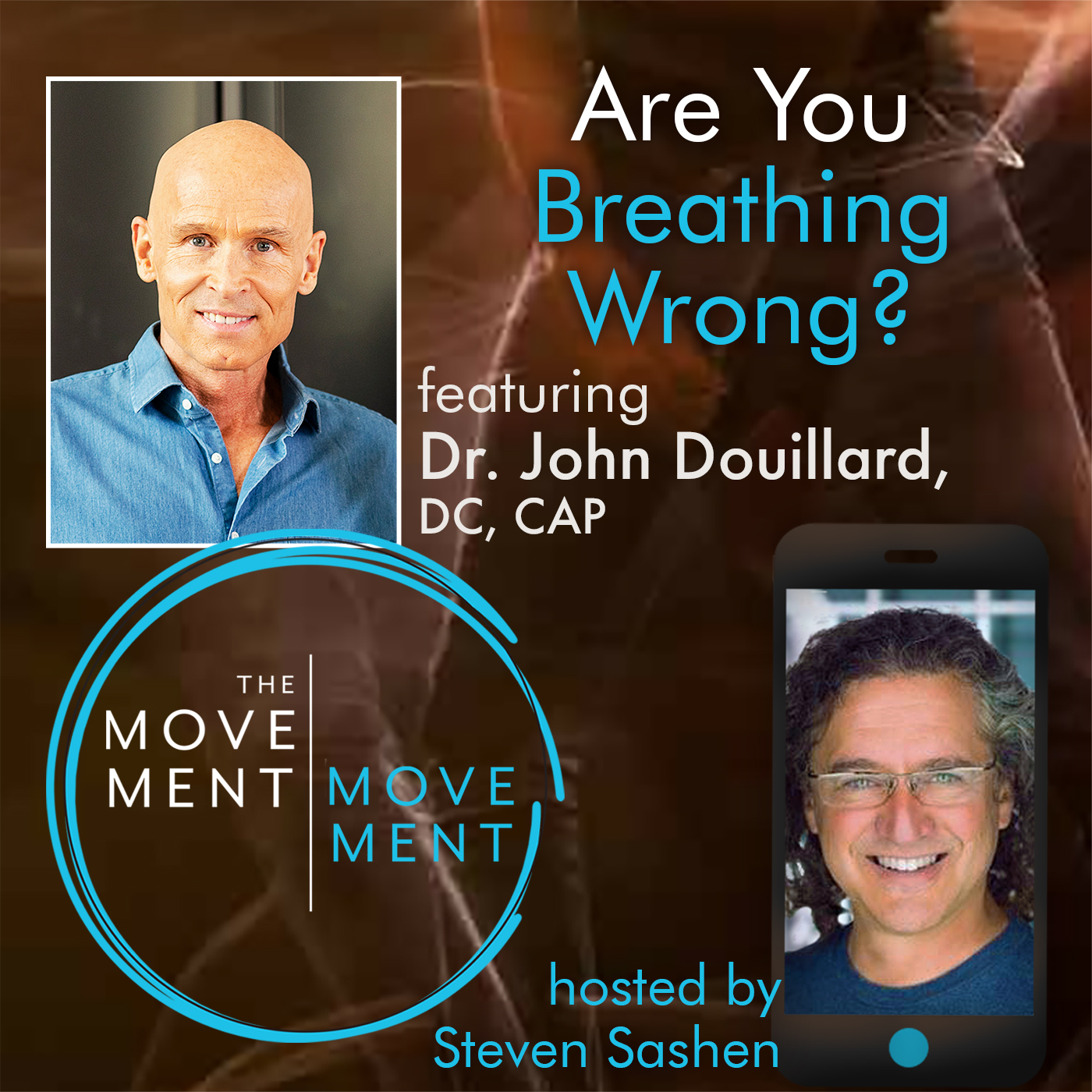
Are you breathing wrong? I know that sounds crazy, but maybe you are. Maybe you're not. We're going to find out today on this episode of the movement movement, the podcast for people who want to know the truth about what it takes to have a happy, healthy, strong body, typically starting feet first, you know, those things at the end of your legs.
But we're going to be, you know, moving up a little bit to talk about things above your legs this time, and including your legs too, frankly. We also break down the propaganda, the mythology, and sometimes the flat out lies you've been told about what it takes to run, walk, hike, play, do yoga, cross it, whatever it is you like to do and do it enjoyably and effectively and efficiently. I've been going for a while, have I said enjoy it. I know I did.
It's a trick question because look, if you're not doing something that you enjoy, you're not going to keep it up anyway. So find something that works for you that you have fun doing because that's going to make the big exchange that consistency. I am Stephen Sashin, co-founder and chief barefoot officer here at Zero Shoes here at my t-shirt improvement. And I started this, we call it the movement movement because we're creating a movement, and by we mean all of us, everyone listening and everyone you talk to, we're creating a movement about movement, letting your body go to what it's made to do instead of getting in the way with things that are sold to you as, you know, better versions of something without a whole lot of evidence behind it.
And the we part is really simple. Spread the word. That's it. Share with your friends.
Tell people to come here. If you want to find out how you can do that, go to our website www.jointhemovementmovement.com. Nothing you need to do to join. There's no secret handshake.
There's no money involved. We don't get up every morning at 6am and do the same chant. It's just a place where you can find all the previous episodes, all the ways you can engage with us on social media and all the way up places you can find the podcast and you can share that with people if they don't use the one that you use to find podcasts. And basically give us a like and a thumbs up and a five-star rating and, you know, the drill, basically, if you want to be part of the tribe, just subscribe.
All right. Let's get started and have some fun. John, welcome, welcome. Really good to see your face.
Tell people who you are and what you are doing here. Hi. My name is John Dyard. I have been practicing pyromedatic medicine backed by modern science for about 41 years now.
And my first book was a book called Body, Mine, and Sport, which happened back in the early 1990s. It was really one of the first books on nose breathing versus mouth breathing exercise. We published studies in the International Journal of Neuroscience and I ended up kind of introducing nose breathing to a lot of athletes, Billie Jean King, Martin, never told me to look forward to that book. I worked with many tennis players, ended up getting a job as the director of player development within the jersey nets in the NBA and taught them how to nose breathe.
And it's been a wonderful journey kind of diving deeper into how we breathe. When I first started, you know, I would talk to medical doctors, pharmacologists, comparative anatomists, and they always say, there's no difference between nose breathing and mouth breathing. And now you probably have heard that everybody's talking about nose breathing now. And I'd like to maybe today talk about some of the original research we did, which is mind-boggling.
And I was fascinated by the runners high in the zone and that best race is my easiest race to experience. And we did years of research and literally proved that we can make that happen. That's what I want to share with you guys today. Well, I'm not interested in any of that.
So it's nice talking to you and hopefully we'll see each other again. But oh, well, good job. Actually, I went back up. So you and I met, I mean, I started zero shoes with my wife, just shy of 16 years ago.
And I think you and I met like a year in. And this is one of those things where we had our lives within a few miles of each other. And I think this is the first time we've seen each other in about that much time. And this is, you know, not even seeing each other seeing each other.
So it's wacky. But anyway, it's a pleasure. Okay. So that said, definitely we'll talk to you about all of that.
And the reason I want to kind of be candid up front, the reason that you are on this call is the one word that you used. And I don't remember, I'm not going to give the exact word. I don't remember if you said scientific or science-based, but either way, that part. And there's so many people who are doing work that could sound similar to what you're doing, or what's going on now with whole, you know, fat of nose, breathing and mouth taping.
And if anyone listening or watching doesn't know what that is, just do a search and it'll blow your mind. And there is some research coming out about some of that. But by and large, a lot of people who are promoting it do not, they haven't done any primary research for sure. I don't know how well steep they are in any of the research at all.
And of course, research in general, I'm not going to poo poo it and say that it has no value. But there's a lot like in my world, the number of studies that have no value because they don't understand that we're not talking about footwear as much as we're talking about form. And that it takes time to adapt to a new form. And the number of studies that say things like, oh, we get people five minutes to get used to running barefoot.
It's like, no, that doesn't work. So, you know, understanding how to even read a good piece of research, or understanding how to read to see if a piece of research is good is a whole challenge. So anyway, with that as a giant, you know, caveat slash umbrella slash whatever, where would you like to begin? Let's do the simple things.
I know this is going to sound really dumb. This will be the dumbest question. I think I've ever asked and I'm proud to do it. Can you tell people, I know this is going to sound really silly?
What's the difference between nose breathing and mouth breathing? And I actually have a reason for asking that makes it not quite so stupid. But I know that sounds really stupid. I'm all in.
I mean, there's the basic things your nose is a filter. It it rarefives the air. So, when you breathe into your mouth, it comes in kind of in a big, through a very big tube, your trachea. But when you breathe into your nose, it goes through the turbanese, which are like a turbocharger, which swirls the air into a rarefied stream that drives it all the way down into the lower lobes of the lungs.
Take a horse, for example, their obligate nose breathers. When they breathe, look where their noses and look where their lungs are. It's a long way away. So, the only way it's going to get into those lungs, and they have massive capacity for endurance and sprinting, is to actually create a turbocharged drive of the air.
When they first created the engine that we use today, the internal combustion engine, the air would mix with the gas and they would have a spark and boom, it would blow up and the piston would move in your car would go, right? But they had a problem where the explosion kept happening in the same place and basically wearing out the engine very, very quickly. So, they actually changed the valves that let the air in, that the air in, and it came in like a swirl, which is the beginning of the turbocharger. And when that happened, it drove all the gas, mixed all the gas in the air into the entire piston chamber, and that's what we have today is the internal combustion engine, this thing that can last to 200,000 miles.
That's exactly how we're designed. We're designed to breathe her nose, we're obligate nose breathers, we learn how to breathe through our mouth as we grow up, feel stressed, get stressed out, and every time that we get stressed out, we breathe a little different. The rib cage responds to that and that stressed out upper chest version of breath becomes normal to you. And then another chest comes along and that becomes normal to you.
And next thing you know, you're breathing more shallow, open in your mouth, and there's all kinds of problems that take place with that. So, other than moistening the air and filtering the air, it does this kind of turbocharger effect to give you respiratory efficiency, but it also drives the air through the olfactory plate, which activates things like nitric oxide, which are the Nobel Prize winning gas that was researched, was done in 1998. They called the panacea gas that you make only when you breathe through your nose and you make zero of this panacea gas when you open your mouth and breathe through your mouth. And then also from the Ayurvedic perspective, which I love their idea from the Pranayon perspective.
And now we have research to back that up, is when you actually breathe through your nose, you activate what's called the brain lymph and glympatic systems, which numb three pounds of trash plaque out of your head every year while you sleep at night. And if you don't drain well, study show congestion of the brain lymph and glympatic systems are now linked. They only discovered that about 15 years ago, maybe 17 years ago now in the University of Virginia. In congestion of those channels are linked to anxiety, depression, cognitive decline, inflammation, and autoimmunity.
And study show early in COVID that long haul COVID was linked directly to the congestion of the brain lymph and glympatic systems, which are pumped by the diaphragm number one breathing muscle, which when you're using the diaphragm with nose breathing, you're going to get a natural pumping effect of the brain's lymph and glympatic system. I can go on and on and on, but that's a good intro. So you just did something that is challenging. And what that is is you referenced a whole lot of ideas that obviously, since I have not taken a diet into the research, I can't comment on.
And the odds that more than a fraction of the people listening or watching this would be any different is pretty low. So that's a request, which is, I want to make sure that we can reference all of that so people can take a look and see what's some of the research that's going on there. This is not a do your own research thing on the internet where you're just looking to prove something you believe, but definitely wanting to look into it. I mean, I'm thinking about some of the things you said from a causal direction.
So the phenomenon, I mean, what you may think of is I remember the first time I bought a shower head that was designed to be a low flow shower head, but put out more pressure. And the way it did it is it had these little air intakes and was literally compressing everything from a bigger pipe into a smaller pipe injecting air into it, and it actually was a low flow high velocity shower head. So that's an interesting phenomenon. The way I'm also going just for the fun of being a complete dick when I say things like this is a tricky to compare what we're doing to.
While I like the analogy for the internal combustion engine in terms of getting the air in the right way, of course, we are vacuuming the air in with the diaphragm moving rather than forcing the air in, which does create a different thing. I don't know if it doesn't get different. And the other, my last sort of fun thought is for some of the things that we're talking about, some of which I have heard and did raise my curiosity, hackles, if you will, not in a negative way, which is like, oh, that's an interesting statement. I want to check it out.
Is the thing about nitric oxide and for, which is not the same for letting people know as nitrous oxide, which is what you get when you go to the dentist if you ask really nice, or what you get if you were one of my friends in high school who stole it from his dad, the dentist, but nitric oxide, which just for the fun of it, another, my favorite thing I discovered about nitric oxide is how it's produced in the blood vessels from just basically, if you just kind of bounce up and down a little bit, that shearing stress creates nitric oxide as well. Anyway, the nitric oxide thing and the turbulent, not in a negative way, the turbulence, I'll put it, I think it talks about with horses, that's the kind of thing that I imagine both of those would be relatively, well, the first nitric oxide one would be easy to see, just get a sample further down from here after everything goes past about here. And you're breathing the horse one, I keep imagining something like a wind tunnel, there's got to be some way of actually seeing that, which would be cool as shit if you can. So, anyway, that's my weird collection of responses to lots of info in there, some of which, you know, some of which obviously I have no way of making any intelligent comment about other than, cool, it'd be fun to take a look at that and some of it's like, oh, here's some interesting ways I wonder if people have looked at that so that people could, some people are going to write it off right away, and what I'm really trying to do is get people, wait, I'm going to say something really weird, people call me all the time, they're trying to sell me on marketing programs to help our company do better.
And I say, wait, where the hell did this not go? Come on, I can do it, this is working on not nearly enough sleep after getting back from Europe. I, oh man, I totally lost it. It was something about not proof, but some easy thing.
Marketing program you were talking about? Well, like when people try to sell me on something, they're always trying to sell me on the good news, and oh, that's what it is. And I'm always giving them every edge case and every reason why what they're telling me won't work, because the only thing I can control is how much money I spend and whether I'm going to lose it or not is managing risk. But what they don't realize is what I'm really doing is saying, here's all I'm looking for to make me give you my money.
So, when I say something that sounds not, I mean, it could sound critical, it's really an invitation to say, cool, since I don't know enough about that, where can I go so that I can see if I'm going to give you my money? And I'm being highly metaphorical with that one, obviously. But anyway, that's why I'm saying I hope we put together a good resource page for everyone. Yeah, well, I appreciate your request for research, and that's pretty much kind of my world.
I know that's why I'm just not only that we publish studies on this, but on my website at lifespy.com, there's over 1500 articles, and my stick is kind of to look at ancient medical wisdom and find the science to prove it. And if you have something that's around for thousands of years, and it's still here today, and you have science to prove it compared to science along which can prove whatever it wants, coffee can be good or bad. Anything you name it, I can give you studies on both sides of that aisle with something that's around, and you have science, I feel like it's something we should at least look at. And my first foray into that world of ancient wisdom and modern science was nose breathing, which I learned when I was training in Ayurveda in India.
And when I came back, we published studies on this. So there's really good science on the difference between mouth breathing and nose breathing from nitric oxide perspective that is just used to PubMed nose breathing nitric oxide, and you'll see that is absolutely hard science. The idea of the nose creating a rarefied stream of air is based on what we call turbinates in your nose. They turbo charge your air is pretty logical.
And when you suck the air in through the contraction of your diaphragm, it's as if it's supposed to a big hole. It's going to not have the effect of the ghost through a turbo charger, which is your turbinates. So logically and well, scientifically documented, there's a complete difference of how the air comes into your lungs, if you're nose or your mouth. And then what's kind of cool is what I was fascinated by was the runner's high, the zone experience.
And how do we get that? I really wanted that. I went to, I must have been in the early 1980s, I went for a lecture on Ayurveda medicine and meditation and yoga. And I was training for an iron man at the time.
And I went to this guy afterwards, I said, okay, I'm training for an iron man. What do you think about that? All this training from the Ayurvedic, yoga meditation perspective. And he goes like, what is the iron man?
And I told him, I was swimming, I was on a bike, a marathon and all that. And he looked at me and said, why do you do that? And I had really no answer for that. I never really know what ever asked me that before.
And he looked at me like I was sort of an idiot and he said, do you meditate? I said, yes, I do. And he said, do you sleep like a meditate? And I said, deeply, I get this real deep, knock out sleep.
And he looked at me again, like I was an idiot and said, meditation is not sleep. Meditation is a state of being alert and resting at the same time. It's the coexistence of opposites. Your mind is aware, but your body is getting deep rest kind of like a hurricane, you have the calm and the winds of the storm at the same time.
It's a law of nature. And that's what meditation is trying to replicate. And I was like, wow, I didn't realize that I would get this deep, deep sleep. And he goes, you're exhausted, dude.
And you should probably stop doing all that. And I was like, but what if I meditated more and trained less? And I didn't fall asleep. Could that work?
And he goes, yes, yes. And he went like this kind of shove me next please, you know, just to get rid of me. And so I started doing exactly that. I started training less.
I started going on weekend meditation retreats. I went on about four or five of them. I started, I went to a two week meditation retreat, right? They wouldn't let me run.
I could only walk in meditated yoga, breathe meditate yoga, breathe all day long for two weeks straight. I came back out of that shot out of the cannon. I started competing at a significantly higher level, started winning and placing many of the events trial funds. I was in many of my friends.
This was in the South Bay in California in early 1980s when the trial funds were just kicking off. And everybody thought I was on steroids. Some of my dear friends, why train was they started meditating right away because they were like, what are you doing? And that just got me fascinated in this idea that less is more.
And I had this runner's high thing for about three months, not just in my training, but in every aspect of my life. I was just like, had a level of capacity. I was in my clinical internship at the time. I level of capacity that was like, I was on some drug for like three months and then I wanted to get it back.
So I was able to then get invited to go. Well, I think that I went to India in 1986 for just a three, four week vacation to try to learn Ayurvedic medicine and getting invited there. I stayed there for a year and a half, closed my practice in Boulder and started learning all about Ayurveda. And that Deepak Chopra there came back, started running his center for eight years.
And that's when I started teaching medical doctors, where I had to put the ancient words in the modern science together. So that's why I'm very science based in this world. So then we did, we published, we did a study on nose breathing versus mouth breathing with athletes. And we had them nose breathing, you know, one day and come back to the next workout with a mouth breathing 200 watts of resistance on exercise bikes.
Pretty good workout. And when we had them breathe through their mouth, their brain waves, we had a brain wave test done, their brain waves were in a fight or flight beta state. It's pretty stressed out like you're driving in traffic. They came back the very next day, and their brain waves went into a meditative calm, all alpha bursts throughout the brain throughout the brain.
And that was the first time anyone had ever seen alpha in the brain brain and vigorous exercise with unprecedented fighting published in the international journal of neuroscience in the early 1990s. And you can get that on my website to type in those breathing and all that will come up. And we also measured how many breaths they were taking during that workout when they had you do the fight or flight state or the alpha brain wave state. And when they had their mouth closed, they were breathing at 14 breaths per minute doing 200 watts of resistance on a bike.
When their mouths were open, same kids, they were breathing at 48 breaths per minute. So imagine doing the same workout one day, you're breathing 48 breaths per minute. The other day, you're breathing at 14. Most people sitting here watching the spot gas are probably breathing at 16 or 18.
Now you're running as hard, pretty much as hard as you can go are pretty darn fast, so maximal at least in your breathing four breaths per minute slower than you are sitting in your chair. We measured their perceived exertion, which is their, you know, we're at 10, it's the worst you could feel asking you, how do you feel? How do you feel? One to 10?
When they're breathing, nose breathing, mouth breathing, they're at 10 out of 10. When they're breathing with two to three nose, four out of 10, same workout. So imagine you're in a competitive state or you're driving in traffic and you're handling life stress. This is a model.
Exercise is a model for stress. If you can handle the stress of exercise from a calm place, why can't you handle the stress of your life? And that's like how we take it off the mat, not just like I meditate, I feel good, then I go, you know, light heat, you'll get stressed out and burn myself out. The idea is to take it with you, right?
And we also did a study where we measured the fight or flight nervous system and the sympathetic and parasympathetic nervous system. And normally in exercise, any kind, fight or flight goes to 100% and your sympathetic goes to zero, which is your rejuvenative system. And our study, what happened was the sympathetic only went out 50% and the parasympathetic didn't zero out. It went down, it only went down 50%.
We had the two opposite nervous systems coexisting. And that was the magic because that's what was the runner's high. The idea of the runner's high is my best race is my easiest race. You know, I feel this incredible effortlessness, but I'm going faster than I've ever gone before.
You know, you know, Roger Bannister, when he broke the four-minute mouse, I felt like the world was standing still yet. He was running faster than any man alive. It's a real phenomenon. And since those studies in the 90s, we've now proven that when you are in the zone, your brain flips into a meditative office state.
And when you look at the fight or flight nervous system, you need to have the dynamic activity and the composure and calm at the same time. I call it the hurricane effect. So the bigger the eye, the more powerful the winds. So the idea is that you actually don't break your body down to build it up with fight or flight stress.
What we do in traditional exercise is to create a level of efficiency with those breathing that activates lower lobes of your lungs where the receptors prepare a sympathetic activation, the vagal responses in the lower lobes of your lungs. And that will tell the body that even though I'm going harder, this is not an emergency. And we have a whole protocol of how to actually make that happen every single time. It's pretty cool.
The obvious, there's so many obvious questions. One that kind of comes to me, but I have a very different answer. People say, well, if this whole unbearable thing or natural movement thing is so good, talking to everyone isn't doing it. And my answer is because we're not paying those people the way they're getting paid to wear big thick stupid shoes.
Yours is a very different thing. But so the magic question is, what's your take on how many people are doing this or found this and for those who haven't, what up? I mean, more and more. I mean, James Nestor wrote a book called Breath, which was a NASA bestseller.
He's a dear friend of mine. He actually cited my original research in the very beat started his book with my original research. And he finished that book with my original research, which was pretty cool. And then all this new research in between that's happened since I did that study back in the early 1990s.
So it's become way more of a, you know, Patrick McEwen, who's more of a buttego kind of a guy, he's pushing, you know, pushing the needle out. There's a lot more. When I started it, I was laughed at. Now you have there is real good science, you know, backing up why we should become those breathers.
And I don't necessarily suggest you should breathe only through your nose, but you should be able to breathe your nose under a certain amount of stress, indicating that was cold respiratory efficiency. Otherwise, what happens? Like I said earlier, every time you get stressed out, we change how you breathe. And that becomes normal to you.
And the rib cage without even knowing it gets tighter and tighter and tighter. And the diaphragm gets weaker and weaker and weaker. In one very recent study, and you get the citations on the website, 91% of athletes that were tested did not have a diaphragm relaxing and contracting fully, right? So these are the best kind of, you know, the best respiratory fit as we see.
And their diaphragm isn't working as effectively as it could or should. So every one of us need to do this, because as we get older, our rib cage gets tighter and we shallow breathe or over breathe. And what that means is that you're breathing in faster than you need to. And in one study showed that 75% of the oxygen, the folks were breathing in.
They were breathing that 75% out, unused. So we're just jamming in oxygen into oxygen saturation. That's already 98%. But the body can't take anymore.
And they're breathing off all this excess oxygen because you're over breathing. And when you're blowing off all that excess oxygen, you can't use your blowing off CO2. And what happens is you're in your blood, is your oxygen levels go to 98% saturation, but your CO2 goes very, very low. And that's the perfect storm for stress and anxiety, which is why when people have an anxiety attack, you put a paper bag over your mouth, you read the carbon dioxide, CO2 levels come back up, and you get calm.
And what also happens is when that CO2 levels are low and oxygen is high, the bond between the oxygen and your hemoglobin stays very tight. It's called the Bohr effect, which means that the oxygen is reluctant to actually leave your blood and get into your tissues so you walk around somewhat hypoxic. But as you learn how to nose breathe, which slows the breathing down, we talked about 48 breaths versus 14, it slows the breathing out. It gives you more time for CO2 levels to naturally build up.
There's a receptor in your brainstem for carbon dioxide tolerance. And as you train yourself, you become more able to hold your breath or breathe slower without the need for panicking and breathing in an emergency state. And the more you build to go to tolerance, the CO2 rising is the trigger to release the oxygen from your hemoglobin into your tissues and you restore this chronic hypoxia that people have walking around, particularly notice over 50, 60, 70, and 80 when they walk around and they can't really breathe. And I was going to tell you one quick story about this.
I was coming out of a restaurant about a year ago and there were a handful of elderly folks in their 80s or 90s coming out and they were really struggling. Their mouths were open, they were really frail and fragile. And I was helping them get out of the door and I was like, Ali, if someone would have just told them that they could breathe five minutes a day, like 10 years ago, the studies show that would, that five minutes of breathing a day, strengthening the diaphragm in a specific way, Western medicine calls it maximum respiratory breathing techniques. It would reverse their heartburn, gird, and reflex, which has shown about 15 different studies.
Lower their blood pressure, don't see you bolder faster than in three minutes a day, faster than the Western medication or as well as the Western medication. It'll pump their entire lymphatic system to detoxify their brain lymphatic system and combat this tendency for age-related cognitive decline and it'll actually help move their entire lymphatic system because nobody knows that the diaphragm is the number one pump of your lymphatic system, which is critically important for carrying your immune system, taking the trash out of every cell of your body and of course delivering properly digested fat into every cell of your body. So if you're tired and you're compromised and you feel like your skin is breaking out or you're holding on to water and you can't get through your filotoxic, this is most commonly a lymphatic concern and your diaphragm is the pump for that and most people are walking around with a level of respiratory inefficiency and have no idea. Okay, I'm going to pull one tiny thing out of that to dive into a little bit.
So the kind of, you don't have to be in that one of those breathing all the time, that's not the expectation. Talk about the times or situations where it's not and of course one of the things I think about, since I am not a distance person, I'm a sprinting person and of course you watch sprinters and especially a good hunter-meter runner, maybe you have three breaths and some people are know, some people are not, some people are not, it doesn't really matter but the one thing that is common is as soon as you finish the hundred, there's a lot of this going on. I'm just trying to get some air in since it was a totally anaerobic thing to do and it's an argument I've had with people who talk about high intensity interval training and they say, oh, sprint for 30 seconds, rest for 30 seconds, I do that eight times and I go, if you've done that more than twice, you're not sprinting, you might be running as fast as you can but you're not sprinting and I had this argument with somebody and finally I said, look, when you go all out for 30 seconds, how far do you run? And the guy very 50 meters, I said, okay, that's cool.
I'm twice your age and I run about 225 meters in that same 30 seconds. So we're doing a very different thing biomechanically and energetically and energetically and in a sense other than putting out energy and putting out force of the ground. So other than when you are trying to recover from some massive anaerobic something, what are the other situations where people might find that mouth breathing is just nothing? Well, you know, first of all, from the endurance side, I've worked with so many endurance athletes.
I mean, my world was the triathlon world originally and I've got, you know, Scott Molina who was one of the, who was the Iron Man winner champion and worked with so many triathletes over the years. John Weissenwriter was number one mountain bike rider racer in America at one point when my book first began out and I worked with him and he was a nose breather mountain bike riding in Colorado. So that's the powerful piece. You know, tennis players, Blue Jean King, Martina, they nose breathe.
So it's a matter of creating a level of respiratory fitness. Now, if you're breathing for your mouth all the time, your rib cage is going to take advantage of that by doing what it only knows how to do, which is squeeze all the air out and the rib cage will become like a cage squeezing your heart and lungs 26,000 times per day where so if you don't get that dive from engaged and get that rib cage moving, which is also part of the pump and lymphatic system, then you're going to, you're going to lose your ability to breathe and just from the mechanics of breathing, getting the air in again, this use throughout is going to be compromised. But all the other signs about that's connected to how the breath connects to everything else is critically important. But if you're, you know, when John Riceen, when I was climbing up a hill mountain bike riding, he didn't have his mouth closed the entire time.
You get up, you have to get up to the top of the hill and then you try to recover and reach, reset your nose breathing on the way back down. And when I first, when I booked first came out back in the 1990s when I was here in Boulder, I taught a free class in North Boulder Park. You may have heard of it here in Boulder as well. I'm only there every Sunday with friends for a picnic lunch.
Yeah, well, this was like every Wednesday at like seven o'clock in the morning. And we had all these nose breathes. People come to learn nose breathing was a free class. And then one day this fire trucks came in part and they put all their stuff on.
They came walking over to my class with the helmets and the gas masks and the tanks air tanks. And I was like, what do you guys up to? And they go, we're here for the nose breathing class. I'm going like, really?
And they said, yeah, we have a competition every year where we see how long a tank can last and the record's 28 minutes. And we had this little kid who's one of our interim guys and he, he'd been coming to your class and he broke the record by like, he was like 35 minutes. He goes one minute and say, well, he blew it up. So we're here to learn this.
And that's like, okay, let's do it. So we taught him the nose breathing stuff and ended up doing this service in the Denver Fire Department teaching him how to nose with it because he created that level of efficiency. So it isn't like you have to, it's wrong. Obviously, we have to, I'm breathing through my mouth as we speak.
But when I go to bed at night, I do and we are designed the Native American children in India, I saw studies where they had trained their children in a traditional way to touch their chin, sleep on their side and become nose breathers. Because when you breathe through your nose, you do produce nitric oxide, which is the body's most powerful antiviral gas. And so after we talk and interact and breathe whatever during the day, you go to sleep and you wash your respiratory track with this antiviral gas, which again, another piece of the respiratory immune response. So you don't get exposed and give the viruses a chance to proliferate inside of you.
It's just such a beautiful understanding of how this diaphragm and this breathing is really a part of everything in our body. And it's not just breathing only with people think, you know, so given what's been what's happening of late, which we both referenced before with our nose breathing, a.k.a. mouth taping, talk to me about your thoughts on that. I don't think that you have to mouth tape for the rest of your life.
I think that's a little ridiculous. However, if you wake up with a dry mouth ever, and that means that you when you open up your mouth, you are actually drying out the bacteria in your mouth that actually and there's about a thousand different species of bacteria, that are anti bacterial. And when you dry your mouth out, there's opportunistic bacteria that take advantage of that try to one called Shepthococcus mutans, which is straggling to the plaque on your teeth that get that bacteria gets into your mouth and 64% of the plaque in your arteries comes from that bacteria. So the entry point for these bacteria clack causing bacteria come from your mouth, which is why I'm going to pause right there to highlight something.
So my father was a dentist. And one of the things that dentists will say that people do not seem to put two together about is after certain kinds of dental procedures, you are at a higher risk of a cardiac vent. And people have no, it seems so crazy, but you just explained the why of that in a way that when people, when I sort of tell people that years ago, because I heard it directly from my father, it sounds crazy. It's like why getting my teeth cleaned is that making it likely that I'm going to have a heart attack or have some other stroke or any other ventricular event or vascular event.
And so do me favor and give me that one again just so people hear it because it does sound crazy off the top. So there's when you dry out your mouth, like you're sleeping through your mouth while you're snoring or sleeping with your mouth open, you're going to dry out your mouth. It'll dry out the environment that supports a healthy microbiome in your mouth. When you dry it out, the good bugs sort of the environment disappears.
They go first, you're ended up with opportunistic bacteria called Streptococcus mutans, who can get in through leading gums and into your blood and it's responsible for 64% of the plaque in your arteries. And they're also research showing that same bug might be responsible for the plaque in your brain related to Alzheimer's. So there's a lot of research going on about that, but it goes even more than that. So even there's, you know, we all heard of nitric oxide and it's a panacea molecule and there's a lot of research on how do we get that and a lot of people are eating beets and taking orginine and citrulline and all these things that are arugula to get more nitric oxide.
And it turns out how that actually works is the nitrates and foods like arugula and watermelon and beets and lettuce and things like that. When you eat that and you chew it with your saliva, the saliva, the bacteria in your mouth are actually converting those nitrates into nitrites. And then when that and you swallow that, that's what triggers the nitric oxide in your body globally, not just in your mouth. However, if you have a dry mouth and you're killing all the bacteria, which are responsible for converting the food into the nitrates in food to nitrites, you don't get that.
And also, what happens if you're using alcohol or fluoride toothpaste or anything like that, you're killing those bugs that change the nitrates into nitrites to give you nitric oxide. Nitric oxide, by the time you're 40, you're already producing about 40% less nitric oxide than you did when you were 20. So it's one of those age-related decline factors that are directly linked to the accelerated aging and aging in cognitive decline age-related concerns. So you really want to show your food with your saliva.
You want to have saliva that's got the right bacteria in an Ayurvedic medicine. What they would do, I saw this for the first time, it was an idiot like in 1986 and there's this guy in a fountain and he was taking a bath in a fountain. I was like, just staring at this guy and he had a little bulb of oil and he was putting oil over his body in the fountain. Then he would put the oil in his mouth and he was swishing at his mouth.
And now we have science. I've written articles about the science of what they call oil pulling. And when you swish your mouth with oil, especially to be as effective as the mouth washes without the alcohol that kills 99% of your bacteria. And that is obviously really bad.
It actually kills the bad that you're equated to the environment for the good bacteria to proliferate and sets you up for what we actually need on the most subtle level to take the nitrates in that food to actually convert them into nitric oxide. And that happens in your mouth when you chew the food with your saliva. So all sort of, you know, roads in that regard lead to oral hygiene. So what I recommend people do when I get this at our local grocery store, it's called, it's a neck scare tape.
It's facility King Super's here in Colorado. And it's a micro pore tape for sensitive skin. It's a blue color. And what you do is you put it on your mouth like this, vertically.
And then you can still talk to your wife or spouse or whatever partner a little bit. And if you wake up in the morning and it's on the ceiling somewhere, it didn't go well. But you wake up in the morning after a couple of days, you'll wake up, it'll still be there, which means we're starting to breathe better at night. And once you get there, then go here, seal it all, you can't put lotion on, seal it all the way.
And again, once you get that where that's there, you know, on every night for about four or five nights, take it off, you've trained yourself to nose breathe and you'll not have a dry mouth. Once you start waking up with a dry mouth again, you can do a little kind of re-education for it. But that's how I look at it. Because we really do want to breathe properly as we know.
And even the guy, the original, I can't remember the guy's name, but one of the researchers told me the guy who invented coin the phrase, sleep apnea, yeah, said it's all about the long term chronic dysfunctional breathing through your mouth and snoring while you were sleeping. And if you were actually keep your mouth closed, you mitigate all that and there's research on kids and they breathe through their mouth. They don't get facial development, airway development doesn't happen. There's so much research on, you know, kind of a V-shaped palette versus a nice wide palette in your mouth that creates airway space that we just don't have as a culture denser.
So now seeing people who actually don't even have room for their wisdom teeth. And because they're calling it a devolution, but we're actually devolving to have a smaller jaw because we don't breathe properly to keep it open and wide to make room for the teeth. So now we're having kids that are being born and they don't even make their wisdom teeth anymore. We've changed that much because of this sort of dysfunction where traditional cultures were training their kids, the papusan, the Native American cultures were designed to keep their head like that, little babies head like that, which forced their mouth closed and therefore made them into nose breathers.
It's just amazing, really. Yes, quite, and I had somewhere that I was going to go from there, but now I can't remember that at all. So what I'm trying to think of something else, so if people want to start experimenting with nose breathing, and this kind of goes back to Nestor's book in a way, when they're being active, talk about that about getting that habit. Or because I know that I know some people who I've talked to who have played with this, and they kind of try to go all in, or they're putting out too much effort or doing something, where they have the idea that they should be doing this, but they try and they go, it doesn't work.
It's kind of like when someone says, I tried this barefoot thing and it didn't work. And the first question I asked is, where do you actually barefoot? And they go, well, no, I was wearing shoes that are sold as barefoot. And I go, which one?
And they go, well, these and they're looking at each stick. And then I also say, look, it's about form, not footwear. So that's a whole other thing. So if people want to start experimenting with this, what advice can you give them for having a positive experience, or at least knowing what to do if they don't?
Yeah, absolutely. And, you know, after my years of teaching that course outside North Boulder Park, I was invited into a health club to teach it inside a health club, because it became quite popular. And I said, it's fine. I'll do it in health.
You have to let the public come into your health club for free. So they gave me a bank of treadmills. Okay. And this is what I would have them do every time.
And it's written as an article at Lifes by the Congress type in, the runners hire the zone, and that article will pop up. And so what we do is you get on a treadmill two miles an hour. Everybody can pretty much walk pretty slow two miles an hour. Now while you're just walking a zero degrees elevation at two miles an hour, breathe deeply in through your nose and out through your nose really long and slow and deep.
And the key piece here is to notice the space between the top and the bottom of each breath, right? You're not breathing in out in out, you're breathing in and out like a sign wave, nice long and slow, natural linking of each breath. So you're walking at two miles an hour and out. Now, to make it a little bit better, if you do what Ayurveda calls Ujai Pranayama, you constrict the back of your throat, that will engage your abdomen and force your abdominal muscles to contract on your diaphragm, which contracts onto your heart, which is where the vagus nerve is, and that creates a vagal response, which tells your body the war's over.
This was Carl Stosworth, who did the research with the Olympic team in the 1964 Olympic team. When it was the first time they were going to do the Olympics in Mexico City at Altitude. So they hired this breathing expert, who taught opera singers, and he taught them how to exhale all the way, which they weren't doing. I think it was Evans, who won the one more gold medals there in Mexico in any other time before, and they were all taught to fully exhale.
And that's really important because that creates the abdominal diaphragmatic cardiac massage, which puts the brain into an alpha state. So we want to have a full exhalation during this process. So inhale long, so and deep, exhale all the way, squeeze your abdomen, get that air out there, secondary muscles of breathing. So after about five minutes of just getting the rhythm down, then we're going to increase the elevation, one degree of elevation, every 15 seconds.
So every 15 seconds increase it a little bit, a little bit. But you're watching that breath that's face between the breath. And if you begin to lose the space between the breath, say at four degrees elevation, you go right back down to zero degrees elevation and re-establish that calm, linking of the breath. And I'll be asking people on the treadmill at their four degrees ago, are you breathing the same rhythm of the breath you were with the space between each breath you were in the very beginning?
And they're like, oh no, I'm gonna go back to zero, right? Because we are so conditioned to exercise to the blood lactate threshold that we're right on the edge of anaerobic activity way before the breath loss that's faced. Now we're doing this breathing through our nose ready to go into full-blown mouth breathing exercise. So you need to pick up the stress earlier on and you probably know that when you're exercising, your muscles can convert the blood lactate metabolic waste on the muscle side back into glycogen.
But when you ask the body for too much, it's gonna ship all that lactic acid back to your heart. And then what's gonna happen is you're gonna have to breathe faster and heart's gonna have to pump faster. And that's the beginning of when that breath rate starts to get a little bit faster. So if you can become tuned into that and then slow it back down.
So at four degrees, you lose the space between the breath, you go right back to zero, re-establish the link, the space between each breath. Once you get it, go after it again, one degree every 15 seconds. And this time, and I did this for 10 years every week for free for so many people, thousands and thousands of people. And I've never had anybody say go, because you didn't see their breath rate go like some four degrees.
Now they're doing eight degrees. And now the breath gets short. Then they go back to zero. The next time they're doing 12 degrees, breath gets short.
Now they're zero. And then when then you just increase the speed to three or four miles an hour and go through the same process. And people would literally be able to document the fact that they're doing more work with the same exact exertion level that they had in the very beginning. And that's how you start building that eye of the storm.
You're building a level of composure and calm. That's allowing you to handle more stress. You don't have to break your body down to build yourself up. Of course that works in the world of athleticism, in the world of sports.
But we're trying to squeeze out as much performance from an 18 to 25 year old as much as we possibly can with no care about what happens to them in their 30s and 40s and 50s and 60s. You know, and we're just trying to squeeze it out, get as much stress, recover, stress, recover. And as we all know, as we get older, we don't recover as fast. We can't handle as much stress as we want to sit.
So we break down, stop exercising. But when you actually get respiratory efficiency, you are able, and here's the best part, the final phase, the first phase is called the resting phase in my book. You listen to the space between the breath five, ten minutes, the listening phase and the next phase. When you listen to it, you go a little faster and you listen carefully.
Is your body saying this is going to be calm or going to be a stress? So as that breath gets short, you bail out. And the final one is the performance phase. This is the runner's high phase.
So what happens? This is the magic. All of a sudden, as you go on that treadmill, you start going a little bit higher on elevation. Your body is going to choose instead of breathing faster.
It's going to realize it's more efficient to breathe deeper, longer, and slower, because that's where all the oxygen exchange is. If you're fully exhaling, you're squeezing all the air out, the dead air space, 500 milliliters worth of air out. So you can breathe in that much more air. So your body started to realize, I'm a more efficient machine when I actually breathe longer, deeper and slower, building more carbohydrate, more, more, more CO2 tolerance.
And that's driving oxygen to my tissues better, more efficiently. It's sort of like a free diver, right? They're diving down 300 feet down there for 11 or 12 minutes without any oxygen at all. Their CO2 levels are rising.
The body's saying, dump all the oxygen I have into your tissues, and they're happy down there. Unless they die, which happens, push it too hard. But there is a phenomena, it's called intermittent hypoxia when you hold your breath, which is really well studied. And that happens very gently and gradually when you begin to become a nose breather in transition, I've only been able to breathe through your mouth.
I've got two, maybe two or three thoughts. Not number one. I'm a friend who was a therapist, but also did a lot of breathing work and was living in Colorado Springs and had a bunch of Olympic athletes that came to him from the Olympic training center. Most of the, he said the majority of the endurance athletes that showed up, asthmatic, which was fascinating.
The second one, another friend who invented the first real-time biometric sensing device, it was basically a neoprene vest, bunch of sensors in it, and a little palm pilot that was recording all that data. And they had this on a race driver and they're watching him in a race, you know, averaging about 200 miles an hour. And while his pulse was pretty high, like, 161 or 170, his breathing was not slow. I mean, this is, you know, like a crazy event.
At one point, they suddenly see the breathing drop and the heart rate drop dramatically. And they're like tapping the computer to see what's going on. They're checking all the wires. Then finally, someone looks up and they see the car rolling.
And when he finally came out of this fiery wreck, everyone said, what the hell happened? I mean, we suddenly saw everything just slow down. He goes, well, once it starts rolling, there's nothing else I can do. Which I bring that up as a training that, you know, it is a kind of breathing training that there's nothing happening there.
There's no reason to be stressful. But they just learned this from just time and time again. Like the best thing I can do is just like, wait and see if I make it. And, you know, they did it.
And frankly, racing's gotten much safer in there very few days. I hope so. I can't tell you how many letters, because this is way back before email, all that when the book came out, that I got with people of exercise-induced asthma. Yeah.
Just like you said, I mean, study, I mean, patient after patient after patient, I would take these, I remember one big rugby player. He came in, I said, well, came to our clinic. I said, well, let's go for a walk. I went to teach you how to breathe.
He goes, no, no, no. I can't walk because I don't do that. I have my bag of inhalers. This big monster of a guy couldn't even go for a walk.
And I was like, let's do this. You know, so I worked with him for a week. And he, after a couple of days, he was like, man, I haven't taken a walk like this in years and years because of my exercise-induced asthma. The thing that causes exercise-induced asthma can be fixed by proper breathing.
I mean, absolutely. I've seen it so many times. And that's because they're huffing and puffing, creating this fight-or-flight emergency response, shallow breathing, upper charge breathing, the case-get-sider-in-tider-in-tider. Now you've got a cage.
You've got a problem. Once you get that opened up and get that diaphragm involved, which is pumping lymph, which is the lymph is taking the waste out of your heart and your lungs. And if that's not, everything is going to back up and you're going to be in a fight-or-flight breathing state. So I've definitely seen that.
You know, the race car drivers, you know, I think it is like this, you know, cut the baton and see what happens. Yeah. I got two things I'm going to say both because I'll forget one of them. I don't.
The first one, oh, the first one. So when we talk about breathing about this slow, full inhale, exhale, and really squeezing that last bit out, we kind of gloss over a little bit about the space between the breath. So I want you to dive into that a little more. And then I'm going to give you the other one because, again, I'll forget otherwise.
I'm curious what your experience has been with people who have chronic fatigue, which is similar to some of the things we've already talked about. And one of the things that they often report is I don't remember there's a term for it, but basically any sort of exercise or exertion has a paradoxical effect on them. It isn't helpful. It's often the opposite.
But anyway, I don't want to poison that well and prejudge your answer. But talk about the space between breathing and then if you have anything to add for chronic fatigue people, I've heard from a few of those now. Great, great, great question. And so the simplicity of this is you go for a walk and you breathe long, slow and deep, right?
And long, slow and deep. And you tune into the space between the breath and then you start going up a hill and then you see if that space gets a little bit shorter. Keep asking yourself, do I have the same space between my breath, same comfort between each breath as I did when I first started as I went up this hill? And if you didn't turn around and start walking back down the hill until you get that space back down back.
And once you have it back, turn back and go up the hill again. And you'll find that hill you couldn't do today, you know, week or two, you'll be able to do it. But you're right. I always tell folks, be prepared to suffocate for the first three weeks because you don't know how to do this.
Your cage has gotten so tight and rigid you're not going to be a nose breather day one. So just give yourself some time to kind of make this happen. So it's really very, very simple, very simple, simple technique. You can also, simple technique is go for a walk and just count how many steps you take on your inhalation, one, two, three, four steps for your inhalation.
And then count how many do for your exhalation, one, two, three, four, five on your exhalation. Your goal, always through the nose and out through the nose is 10 steps for your inhale and 15 to 20 steps for your exhale. That's your goal. And if you have more on the exhale, that gives CO2 more time to build up.
That tells your body to calm down, turn off the alarm bells, and also drive the option into your tissue. So that's another really simple way to kind of enter into this as well. Now with chronic fatigue syndrome, we know that the lymphatic system, which is pumped by your diaphragm, those three things, carries your immune system. It takes out all the trash from extllular fluid in your body.
And it also delivers fat as properly broken down, properly broken down, fatty acids for energy to every cell of your body. Now, if your lymphatic system is congested, you're not going to deliver that energy and you're going to be chronically fatigued. When I see Epsteine bar virus in my practice or a chronic fatigue syndrome, I practice, I always evaluate their lymphatic system on my website. At lifestyle.com, you have a lymph quiz.
You can take a quiz and ask yourself all these questions about different types of lymphatic concerns. There's brain lymph, there's skin, skin, and social lymph, there's gut lymph, there's respiratory lymph. They all have different symptoms associated with them. And once you see, yeah, that's me.
Then we can treat that lymphatic system with hydration, with Ayurvedic or city stagnate that. It would exercise obviously clearly number one is breathing. Of course, breathing only while you sleep at night can be another piece of that puzzle as well. But chronic fatigue doesn't mean we need to give you more B12, Gerona, caffeine to stimulate your adrenals and drive your body, make energy that you literally don't have and drive you further into debt.
Even though symptomatically I feel good for 20 minutes, it's a deeply resolved and understanding the upstream cause of this problem and address the lymphatic concern. And where does the lymphatic system start inside your digestion? So a troubleshooting, really deep dive troubleshooting you're wanting to find, so every aspect of your digestion is critical because your digestion is your ability to not only deliver energy but also detoxify. They use the same pathways.
If your limbs congested, back up, evaluate digestion. We have another article you can get off for free called the digestive health quiz. Ask yourself all these questions about your digestion and find out where that's broken. And you can fix that and then fix your lymph and then get the breathing going.
And then all of a sudden you've treated some upstream stuff and a lot of your problems are going to disappear simply by doing those things. Love it. Anything we left out, this is quite comprehensive. I know people tease me, they go, your podcast is one of the only ones that I don't listen to at double speed because I couldn't understand it.
But this one is a similar thing not because of talking fast but because of just the amount of information I know people are going to want to take a look at. So anything we left out before we wrap it up? Well, the other thing I would just say is just kind of tease everyone to understand, you know, I learned the nose breathing when I was in India. And that's the world of pranayama, right?
Breath, you know, breath training. And pranayama means breath and yam means to pause, hold or extend the breath, right? So what we're talking about here is slowing down your breath. And study so when you actually slow down your breath, like a free diver, they're not even breathing, right?
That slows down the breath. The body goes into a state of what's called intermittent hypoxia. So the original pranayama technique was to train your body to hold, pause or extend your breath. That's what the Ayama of pranayama means.
And when you do that, there's incredible science. So when you learn how to slow down your breath really slow, six breaths per minute or four breaths per minute or three or even two or one, you go into a natural state of intermittent hypoxia and it's got three or four articles on this on my site to dive into the details. But when you're in intermittent hypoxia, which is the original pranayama idea, you produce this intermittent hypoxia, which is called, which is when you produce stem cells, the EPO that Lance Armstrong got busted for injecting, you make yourself when you hold your breath, you produce endothelial growth factors to protect the lining of your arteries, you produce guardians of your genome transcription factors that protect you from age-related expressions of genetic weaknesses or tendencies that can oftentimes take us out. It's been shown to increase your nitric oxide, change neuroplasticity, which is old, crazy, mental patterns of behavior that make us the same dumb stuff again, lower blood pressure, blood sugar.
It's sort of crazy what they found when they started studying these free divers. They're like, wow, they're holding their breath. They've got to skill do that and look out what they're getting in benefit and return. Of course, if they don't push it too hard.
So that's where this really goes. It gives you the idea that this breathing thing is ignored. The diaphragm, the biggest muscle in your body, nobody exercises it because you can't put a dumbbell on it, but it's the most important muscle in our body. That's the takeaway here today.
Try some of these breathers, an article called The Best Iraphomatic Exercises, another article called Lateral or Horizontal Breathing. Watch those two. Get your diaphragm back online. Do some nose breathing for fun and enjoy the ride.
Other than going to Lifespot.com, anywhere, anything else people should check out or any other way. People want to get in touch with you. They should do that. I'm on all those social platforms as well.
We also have a podcast. You run my podcast as well. You can check out when I dive into deeper in discussions with other people on some of these topics as well. But yeah, Lifespot.com is where you can go.
You can sign up for our newsletter. We put published three articles on ancient medical and modern science a week. We're constantly putting out new content, taking a deeper dive into things like nitrovoxide, nose breathing, so much more. I love it.
Well, John, first of all, as I said, great to see you again. Thank you for all of that. For everybody else, I do hope you take advantage of looking all this information up, putting it into practice more importantly and getting in touch with John to let him know what that has done for you. I want to hear about that too.
Speaking of which, a reminder, head over to www.jointhemovementmovement.com. If I'm previous episodes, all the places you can find us on social, all the things you can do to spread the word, to share and like and give us a thumbs up and hit the bell icon on YouTube. Like I said, you know what to do if you want to be part of the tribe and be part of the movement movement, just subscribe. And more importantly, if there's anyone you think I should have and have a conversation on movement movement, let me know.
Drop me an email. Move, M-O-V-E at JoinTheMovementMovement.com. And if you know someone who thinks I have a case of cranial reorientation syndrome, you can get them to talk to me for a while. That'll be a blast.
No one's taking me up on that yet. I've tried. Has worked. And last but not least, and again, I think most importantly, between now and whenever we chat next, go out, have fun, and live life.
Be first.