
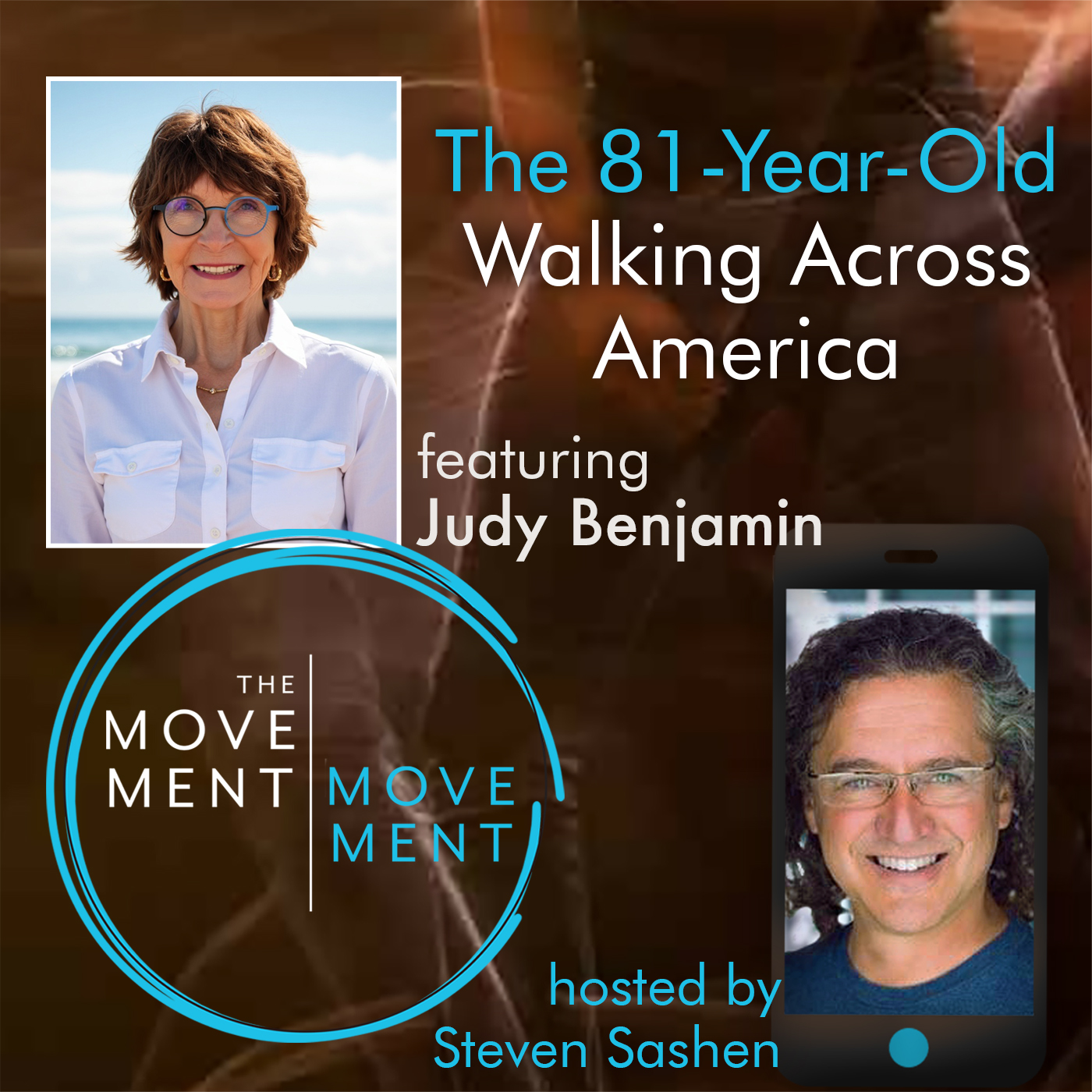
Some people say I'm going to go for a walk, but the person you're about to meet on today's episode of the movement took that to an extreme that you probably won't believe, but will inspire you and hopefully make you take some action about why she did what she did. But more about that when we get started. For real, on the movement movement, the podcast for people who want to know the truth about what it takes to have a happy, healthy, strong body starting. Speak first, you know, those things that you're under your legs that are there to support the rest of your body, everything above them.
We also here break down the propaganda, the mythology, sometimes the flat-out lies you've been told about what it takes to walk, run, hike, play, to yoga, cross-fit play, the NBA even. They do that effectively and joyably. And I say enjoyably because if you're not having fun, you're probably not going to keep it up anyway, so make sure you're having a good time. I'm Stephen Sanchin, co-founder and chief air-foot officer here at Zero Shoes, and we call this the movement movement because we are creating a movement that involves you more about that in a second, about natural movement, letting your body do what it's made to do, and not getting in the way with some things that are artificially probably cause problems that they sometimes claim.
They are there to cure. Now, here's how you can get involved. Really easy. Go to our website www.jointhemovementmovement.com.
Nothing to do when you get there. You don't really need to join. That's where there's previous episodes. All the places you can find the podcast.
All the previous episodes. All the places you can find us on social media. And basically, you know what to do. Give us a thumbs up, share, like, leave a review, the gist of it.
You know how it works. If you want to be part of the tribe, just subscribe and spread the word. So let's get started. I'm very happy to have our guest here, Dr.
Judy Benjamin. Do me a favor. Tell people who you are, where you are, where you were, and what the hell you're up to. I love it.
Thank you, Stephen, for that introduction. I'm so thrilled to be here with you today. Well, I am actually in Tallahassee, Florida. I'm just outside of Tallahassee.
I am. My name is Judy Benjamin, which you're correct to say. And back several months ago, I decided April 5th, I started out on a little walk from San Diego, California to Florida. And I just decided, you know what, I can do this.
And here I am, 2600, turn 2600 today, 2600 miles later. All on these. Well, this, I've gone through a few of you, you know, but these are my current daily favorite and I have not worn any other shoes other than these. I will tell you that I love them.
But I wanted to do something different because two reasons. My mom passed away from Alzheimer's about 20 years ago. And in those days, there was absolutely nothing. I mean, even today, people will just give you a diagnosis and say, get your affairs in order.
And that's it. And she sadly took about 20 years that she finally gave into the disease or the disease finally got her and she passed away. And so I kind of want to honor her by making calling attention to the fact that there now are things you can do. And I'm not saying that everybody can cure Alzheimer's and that you can reverse it 100%.
I'm going to tell you if you are interested, I'll tell you kind of how I did it. But so that was part one of my reason. Part two of my reason is that I myself was diagnosed with early Alzheimer's 13 years ago. And I know it was coming because I started getting all the symptoms.
I won't go into it right now, but I was having the classic symptoms the same as my mom had. And I was absolutely devastated. I said, I cannot put my family through this. I know what's ahead.
And I was just incredibly depressed. A very good friend of mine happened to know Dr. Dale Bredison, who's a neurologist out in San Francisco. And she said, you know, Dr.
Bredison is working on the theory for reversing the cognitive decline in dementia. Call him up. Go see him. So I did.
She called him actually made an appointment. I flew from New York out to San Francisco and spent about two and a half hours with him. And he told me what I could do to start reversing the basically its inflammation in your brain, but you know, a lot more to it than that. But I came back just with a burning desire to this is my only hope.
I'm going to do this come hell or high water. And that's kind of how I'm looking at the walk really because I feel like if you have a little grit in your attitude, you can make things happen. And that was my attitude about this whole thing. And I thought, if I can walk across the country and tell people both from media or just meeting people along the way and let them know it gives a lot of hope.
And that's what I found so far. I've been through now. California, Arizona, New Mexico, Texas, Louisiana, Mississippi, Alabama, tiny bit of Georgia, just a little snippet. And now I'm in Florida.
And I'm 81 years old. So anybody can do it. So did you have a birthday while you were walking? Did actually because all of my pre advertisement said 80 year old woman in June, June 11th is my birthday.
Wait, wait, wait, wait. How did we never figure this out? We had the same birthday? Really?
You're getting me. Oh my goodness. Well, great minds come from great places. But you know what?
We have different years at birth. Yeah. Well, that's true. I mean, I'm 63.
And my mother, I mean, well, part of it, I want to back up and tell some people, you know, how this conversation started away. My mother similarly had Alzheimer's. My father's mother did. My father died before we would know if he was going to develop it.
And my mom passed after 14 years of dealing with it. Just a year ago, a year ago, just a couple days ago, actually. Sorry. A couple days ago.
And yes, really, really unpleasant. But when we started chatting and I want to highlight something that you said, and it's frankly the reason that I continued my conversation with you is you say, look, here's what I did and it worked for me and it might not be right for everybody. And I couldn't appreciate that more because so many people love to have a single answer for everything, especially when it's something as profound as Alzheimer's or cancer or things like Parkinson's or MS. And there's always going to be someone who claims they have a cure and that it works 100% of the time for everyone.
And if it works at all, it's usually not for everyone. So your honesty and integrity was hugely important for my decision to see what we can do to help you out. Well, I'm so grateful that we had that conversation. And it's just turned out to be an incredibly important part of my journey.
I have to tell you that, you know, really. Well, let's just, you know, I mean, the idea, it's funny. There's a guy named Dean Carnassus who's famous for having done 50 marathons in 50 days. And it's a similarly, you know, kind of wacky thing.
And when I met him, I went to introduce myself, he goes, oh, I know who you are. I said, I don't think you do. He's even passionate. No, I'm the anti-dean carnassus.
So what I said, you will wake up and say, let's go for a run and you finish it a day later. I will wake up and say, I'm gonna go train on the track and I'm done with my workout in under 15 minutes. So it's a whole different game. But I mean, there's so many things that one could think of to do to bring awareness to Alzheimer's in general and the treatment and everything around it.
But seriously, what made you go? I mean, what were you doing prior to mapping out a path across the country that made you think, okay, walk across the country? Well, actually for, you know, let's just say pre-COVID for a minute because for the last 25, 30 years, I've been very much involved in international development and humanitarian help assistance. And I did a lot of contract work for USAID and for the UN and the World Bank.
And I go to these war affected countries and do evaluations and figure out how are we spending the money to help these people and what are we doing. So I had a really exciting job and I loved it and I was always traveling and high stress level. And then when COVID happened, my last assignment was in Afghanistan. So I'd come back from Afghanistan.
I was writing up my report and then no travel. And so I did a bunch of stuff then during COVID. I became a contact tracer with the DC Board of Health and kind of kept myself really busy. But as all of that passed, thank goodness, and we're now in, you know, more or less, in some sort of new normal.
I just found that I am a board certified coach, a health coach, and I love working with people and trying to tell them what I've done and guide them and help them. I love that. But my level of energy has always been so high that I found I got to do something different. I want to do something different.
And I love to exercise. I love to walk. I'm a yoga teacher. So I'm all about don't fall.
Good balance. And I don't know. I just kind of hit me one day. I think I'm just going to walk across the country.
I mean, there was nothing really inspiring the other than that. You know, I just thought, why not? You know, what do you have to do to prep for it? I don't mean like physically, although you might have done that.
I mean, like, logistically, this is not something where you literally just put on a pair of shoes, grab a thing of water and throw your pack and go for a walk. Well, that's a great question, Steven. It really is because I thought in the beginning, you know, I used to have done some marathons and mountain climbing and stuff like that. And I always prepared for it.
But I thought, you know, how am I going to do this? So the first few weekends, I mean, that after I had this idea, I would put a backpack on, get my water and I would just see how many hours today can I walk and feel comfortable walking? I would never walk that length of time, you know, and it's different from a marathon because there you know, you're trained and you know, it's going to be X amount of time based on your speed. But this was just like going.
And so I did this for a couple of weekends. And then I thought, this is nonsense. There's no way I can train for this. It's either going to be, I'm either going to do it or not do it.
And I loved it. And I watched, I had to tell you this because I really owe you a note of gratitude here. I watched your YouTube on how to walk in different ways of walking uphill downhill, how to place a foot. And I honestly didn't really know that before.
I hadn't thought about, you know, how to place your heel, how to align your shoulders and your hips over your knees. And so I thought, I'm going to try this. I would go out practicing. I'm thinking, I watch your videos.
I'm like going really crazy, kind of slow with it until it became a natural rhythm for me. And I realized that no matter how far you walk or I don't want to say what condition you do have to be healthy in order to do this thing that I've done. But it's putting one foot in front of the other and stepping, but having good posture because I watch people now all over. Many people younger, many years younger than I am in their 50s and 60s.
And they're walking like bent over or hunched over. And I'm just, I want to go over and like press them into shake. I don't. But because for me, even if I get tired, you know, I say, okay, straighten up, put that string up here, you know, get that straight line.
And that cuts down your fatigue, at least it has for me. So I get up every morning with great enthusiasm and just go and I feel great. And the end of day, am I tired? Pure am.
But I walk eight to 10 hours a day. Just walking. And what have you done for backup support along the way? I mean, what before you can get there?
Like, how did you plan the route? Because there's some sections of that where, you know, there's like nothing for a long time. Tell me about it. I could, I thought I would die before I got out of the state of Texas.
I think it was three months. I mean, at least two and a half months in Texas. And I went to Southern Road. I'll tell you why in a second.
But it was just a desert desert desert. I saw so many tarantulas crossing the street. I mean, amazing. Armadillas and tarantulas.
I mean, lots of. But the way I planned it, basically, is I used the Adventure Cyclists Association's mapping for cyclists because, as you know, many people ride the bike across and they've got three primary routes coast to coast. They've got a Northern, a Middle, Central area and a Southern. And I decided on the Southern because I calculated the distance and that in a straight line from San Diego to St.
Augustine or Jacksonville, basically the same was the shortest route. And I thought, well, I'm not trying to prove the longest route. I wanted to go that route. The other part of that decision was I didn't want to go through the Rockies when it was really icy or cold, much more of a hot weather person.
And I made that decision. There were days in Texas when I thought, you know, you are stupid. You should have caught it. But I take a sauna every day at home and I have a sauna in my home and I'm used to hot temperature.
And it really didn't bother me. My drivers for my support vehicle were they were complaining a lot. But for me, it was not that bad. But so the planning was the bike maps.
And then I have a small RV that goes along not next to me, but they I leave them in the morning and two or three hours later, they'll catch up, give me fresh water, a snack, change of shoes. Sometimes I switch out my shoes and especially, you know, if it's rain or anything. And then I go another two or three hours and that's how we do it. What are they doing while you're walking and they're staying on the RV?
I don't know why that's a great thing. I think I'm maybe watching videos. I don't know. Actually, I'm being a little facetious because it depends.
I was very fortunate because I've had I had two filmmakers in the beginning. One of them was Mike and he's a very talented filmmaker. He was working for a while and he would be editing and working on other films that he had done. And then my next driver was Fabio and he was a drone pilot, a really talented drone pilot.
So he would fly the drone or, you know, chat with his friends. And I've had a couple of my girlfriends. And they've done, you know, red books or take done photographs. And then currently a whole friend of mine, David, he's a violin player.
He plays in an orchestra and he loves when I'm not in the van. He just practices the violin and does some video and so forth. So people find things to do. I mean, it's amazing.
So most interesting or fun, least interesting or fun of what the whole trip or pick pick pick pick events that stick out of your mind. Because I mean, I'm mostly just imagining I'm imagining two things. One, these sort of unusual things that you didn't expect. And then which could be people showing up or things happening or that's kind of it's called an extra thing.
Versus unusual, unexpected internal things. Just what's happening in your mind is you're doing this. And I can imagine both, you know, up and down for both of those categories. So I've got a good two by two matrix for internal, external, good, bad.
Yeah, that's a great. It's a thoughtful question. And I should probably have given it more thought. But I think what's interesting, what's been really interesting to me is, you know, there's a lot of solitude about walking alone.
And I actually love that. I mean, I am a people person, but I've really, really embraced the fact that I'm out there. I don't have any interruptions, except when the state patrol stops and ask if I need water or something. Trying to give me a ride.
They've been very nice. But I'm thinking, and what has happened to my brain in that sort of quiet solitude is that I've had memories come back from my early childhood. I've remembered things that my parents said to me that I totally forgotten about, you know, or my sisters or friends that I knew. And it would just like come to me and I thought, wow, that is a gift that my, you know, that being in a peaceful state and the rhythm of walking, putting one foot in front of the other.
And to me, it's very therapeutic. So I love that. And I love the fact that needing all kinds of people. I mean, so many stories.
I'm writing them up because I think they're worth other people reading about them. But things I didn't know that I wouldn't like as much as I don't like it is I'm never going to afraid of heights. You know, I did kill a manjaro. I've done, you know, flying, flying aerobatic airplanes and hanging out of planes.
Never had a feeling of height, but it's going over all of these long cosplays with the bridges and the trucks go and they vibrate and everything. And I look over at the water and I think, really, I got to a point where I really don't like that. It really gives me like a weird physical, queasy feeling in my stomach. And I don't know what that means, but it's something that I've developed on the walk.
You should watch videos of like those Nepali and Tibetan buses that are going up the Himalayas on a road that is barely wide enough for the bus and sometimes like having to put wheels up on the mountain itself to fit. And that'll just desensitize you because that stuff is insane. And that's crazy. So any people show up to walk with you, any fun people you ran into that you didn't imagine bumping into or conversations.
I imagine that there's also like three or four questions that anyone who bumps into you asks nonstop and you have to have your favorite answer without making you want to punch somebody including yourself in the face for saying. Well, of course, everybody wants to know like they're usually very amazed and if I got hold, I am and then they want to know like, why are you doing this? You know, that's the big question. So basically answered in a shorter form that I answered with you.
But the kind of people, I mean, I've met some really interesting people. I just think of one of the funniest things that happened that was and it's getting close to Halloween, you know, now it's in October, but I spent a few nights, a number of nights in the Walmart parking lots because I'll be in places that don't have a hotel or motel and I feel well, just sleep in the RV. And so I've got an extension on the back of the RV that's a rectangular thing with a black zippered bag that I put extra stuff in and it's kind of like a hump shaped like that. So somebody called the police on me in Walmart because they said I was carrying a body in the back of my vehicle and the police came out and it's really nice officer.
His name is Moore and he was just a life alternative. And he said, ma'am, I'm going to have to ask you to open that in the back because when I looked at it, I thought, yeah, it kind of looks like a body. And so we last opened it up and showed him and let him know that I didn't actually have a body, but I thought that was so funny that people seriously enough to call the police. I was carrying a body.
Once he checked you out and proved that you didn't have a body, now you're the perfect place to have a body. I know. It's that time of the year. But it's just kind people.
I've had people walk with me to answer your question and just write to me on, you know, I have Instagram and Facebook and TikTok and all of those. And when I can, I don't get to answer everyone and I don't actually have the time to lie well eventually, but I haven't had time to answer everyone, but they'll want to meet me. I still have people meeting up in the next couple of weeks. I've only got I'm finishing up November 15 and I've only I really need to drag my feet a little bit because I'm kind of going to get there a little sooner, but that kind of had to take a date so that we could have a little media coverage and that sort of thing and get my family down to go across the man.
I want to put my toes in the Pacific Ocean. I want to put my toes maybe my whole body in the Atlantic Ocean when I get there. So that's kind of my my goal. But yeah, it's just been an incredible journey.
The people who've walked with me have been great. You know, I've had a few things like the Hill in the Hill country of Texas where they had the flooding, you know, so bad. And I was supposed to walk right through that area. And when we got really close, I went into one of the local sheriff's office and we looked at the maps and I got their advice.
And I was told, no, the river's up 12 feet, the roads closed. So I basically had to modify based on that. And now it was sad because so many people were really, you know, their lives were really badly affected by that. And, you know, and I went through the Apache reservation, which was huge is huge.
And then people were just so fantastic coming out to me and saying prayers over me and blessings over me. And that was really, really a treat. I didn't realize how many people have dogs that are not kept, you know, like in the fence. And so that's one thing I've been really kind of experimenting with.
I love animals. I'm not afraid of dogs. And I do have walking sticks that are metal. So when I've been, I had five dogs in the Apache reservation area come out big dogs.
We're not talking like little ones, big dogs. And they had like, they always have like a lead dog and they kind of circled me and you know, they get closer and closer. And I just did this sort of swirling dance with a plane and clanging them together. And I think they've dogs looked at me and thought, but is she crazy?
You know, we're not going to bother her. So I haven't been bitten. And I hope I don't. I bought a box of dog bones, the milk bones because I figured I could at least throw them some bones and maybe that'll distract them.
But I've had more episodes with dogs than I cared to mention. But so far I'm on the winning side of that one. I had an ex girlfriend who used to complain to me one day. You just treat all dogs like they know you and like you.
I said, yeah, because they do. I'd never had an experience otherwise. So I'm going to stick with it. And it worked out so far so good.
So we're exactly finishing up. Well, the plan is to finish in St. Augustine. Okay.
On 15th Saturday, the 15th. There's a possibility that we may go up to a beach about 25 miles up the coast. And the reason being that there's a special annual event that's going to take place starting that day called the festival of lights, which they do every year. And I didn't realize that.
And it's going to be a pretty congested traffic and road closures and things like that. So we just are discussing it now. A lot of you say no to see our beach right outside of St. Augustine.
So well, first of all, I mean, we're not anywhere close to wrapping this up. But while we're talking about itinerary things, let people know where they can find your itinerary. So if anybody wants to join you in these last couple weeks, they can do that. That would be great.
Yeah. Judy walks calm is the website and it shows them that where I am. So that's one of the best places, Judy walks calm. And then on the Instagram, it's Judy walks America.
And that that clicks into TikTok, Instagram and so forth. But the route is shown on Judy walks calm. And how's the back to the part about education people educating people about Alzheimer's and about reticence protocol? How's that going for you?
Well, I think it's going really well because everyone wants you to start talking about it and letting people know what you're what I'm doing and sharing my own story. I think that it's relevant because I do have a personal story to tell. They want to know what can I do? Well, unfortunately, it's more complicated than being able to stand there and do an elevator pitch and say this is all you have to do.
So I usually refer them to Dr. Beddison and Dr. Beddison's books and I give them the basic idea of the basic seven principles, which is exercise, diet, sleep, lower your stress rate, make sure you're not in any toxic environment like mold, or you're not out in where they're spraying glyphosate or roundup and you're not using roundup in your garden, even golfers. I mean, they put this stuff on golf courses all the time and they go out and play golf, kick up the grass, and then they wear their shoes and their homes on your carpet and whatnot.
And it's really, it's very bad. There's a lot of very good research that's pointing to the inhalants, the toxic inhalants that we should avoid, especially for things like Parkinson's. Parkinson's is Parkinson's disease, particularly in that direction. I mean, pointing to the fact that's one of the primary things.
So I do my best to refer them to a source and then I ask people if they want to write to me and when I always say when I finish my walk, then I'll be able to be more responsive to that. But it's essentially, you know, exercise is probably one of the most important things because as you know, when you exercise your blood, your heart rate increases, your blood flow is better. Therefore, you're getting oxygen throughout your body, but especially to the brain and the brain needs a lot of oxygen to function. So if you can exercise, it also produces what's called brain derived neurotropic factor or BD and F.
We need that. And so that is why daily exercise, not like once or twice a week, but you know, people need to move more. And walking is perfect. You don't have to run a marathon to do exercise or spend your life in the gym if you don't want to, you know, get out in nature preferably.
But if you have a treadmill at home, you can do that too. So exercise and then related to that oxygen is sleeping. A lot of people have sleep apnea and they don't realize it or they deny that they have it, but you know, certainly snoring is one of the factors that, you know, tells you that you're not breathing through your nose, you're breathing through your mouth. And that needs to be addressed because if you spend the entire night not getting enough oxygen to the brain, you lose neurons.
You actually have neurons that die. And we don't want that. We want all of our brain cells to keep firing. Right.
So that's it. And then eating is just giving up junk food, not no more. I mean, staying away from processed food and eating real food, you know, it doesn't have to be, it doesn't have to be vegan or vegetarian or whatever it could be whatever works for you, but it should be real food and not made in a factory with 1000 names that you can't pronounce in the ingredients. That's not good for.
We're not chemistry experiments and we're ever meant to digest and process all that stuff. Well, some of it does, I mean, admittedly, some of it does break down because of the hydrochloric acid in your stomach, but you're, but the point is still that there are some molecules that get carried along for the ride that we don't know what the effects are. I mean, we don't even need to get into talking about micro nano plastics, which is just freaky that we have a credit cards worth of plastic floating around in our body on any average, which is just bizarre. And if it was a gold card, that would be one thing, but if it's just one of those am I agreeing to get any benefits from it and people who are you.
So I must say the stand up comic in me or the former stand up comic in me knows there's just an infinite number of jokes about someone going for a walk about Alzheimer's and just accidentally going across the country because they didn't know which way home was. So I don't need to dive in there to looking for home, but that yes, you have to have humor. You have to have humor about all of this. It's otherwise life is going to be too dull.
Can I tell you, I have two very funny stories about from my mother with Alzheimer's. One of them is not safe for work. So people have to find me privately for that one. But this is one of my favorite things ever.
My sister and I would constantly test her to see sort of where her mind was at any given time. So we sit down. My sister is Ellen. We sit down with my mom and my sister says, do you know who I am?
My mom says, no. I said, do you know who I am? She goes, I don't think so. My sister asks again, do you know who I am?
She goes, I feel like I should. I ask again, do you know who I am? She goes, are you Mark? No.
My sister says, do you have any children? My mom goes, oh, yeah. Oh, how many? She's three or four.
Just do. And my sister says, do you know their names? My mom says, Stephen and Ellen. It's like, oh, so my sister says, wow, do you know who I am?
My mom goes, no. I said, do you know who I am? My mom looks around conspiratorially to make sure there's no one around. She leans in.
She goes, do you people know who you are? That's a great story. I love that. I love that.
You know, I realized I was my mother's child in that moment because as her mind was disappearing, the only thing left, everything she said was an attempted a joke. Sometimes it was sometimes definitely wasn't. But clearly that was the goal. And I was like, oh, okay, yeah, I'm just her turn up to 11.
And I interviewed her at one point. We had brought in a soprano singer and she sang show tunes for about an hour. And my mom sang along, knew every word, which amazed me because we never had music in our house. I mean, I have no idea where those came from for her, but she knew every song, every lyrics to everyone in the songs.
And at the end of this hour, she said, wow, I haven't felt this good in days. And I said, oh, so you can compare how you're feeling now to a memory of how you felt in the past. And she goes, nah, I just say things like that because it makes people feel better. But I then questioned her about her experience.
Like she lost the ability to understand photographs. She didn't know who people were in photographs. We didn't recognize it at all. And then she also didn't understand mirrors.
So she complained about how there was a lady in her bathroom who just wouldn't shut up, which I thought was terrible. So I asked her about her experience. I couldn't tell if some of her answers were an accurate representation or just the mind making up stories to come up with an answer to the question. But if you didn't know, I was speaking to someone with late stage Alzheimer's, this could have been someone's guru.
I mean, it's like, so, you know, do you think about what you're going to do tomorrow? No, I have no place for tomorrow. I'm just aware of what's happening now. And even now it's just leaving me the moment I pay attention to it.
It's like, geez, people have paid thousands of credit from somebody wearing a low-income, off in a mountain in the Himalayas. Just like over and over that it was fascinating. Just hearing kind of the essentialness, awareness and consciousness as much as she was able to communicate it. And then there's just the other phenomenon, which is that the options for long-term care are so limited and so acceptable, frankly.
If my mother knew that we actually was still alive, you know, my mother used to say my sister and I were when we were children, if I'm ever worse than that lady and would point to someone who was way better than she had been to the last 12 years, she'd say just back the car out of the driveway with my chair at the end of the driveway and forget to look back. And if she had any idea, she would have taken herself out. Not an option. And if she had any idea how much we spent keeping her alive when all she could do was sit and stare, she would kill my sister and I.
So it's really, it's one of the things that we want to do is help try to bring awareness to just treatment and alternatives. I mean, the irony for the places that do have some sort of assistance to a side youth and age of program for people with Alzheimer's, you have to be of sound mind to say yes, you want to do it, which bit of a paradox. It is, it is such an important topic and it definitely affects every family when there's a diagnosis of Alzheimer's. And it's, you know, I know my sister and I, we went through and tried everything and it just, you know, it's just really, really one of the hardest things that that will happen to any families.
But I know that what I saw happening with my mom, there was a time in early on in the disease where she knew she had a memory problem, she knew she had a problem and it bothered her. But then there's that bridge that they go over that they don't know anymore. It's like some of the comments that you're talking about that your mom made that and in a way, it might sound a little cruel, but in a way, it's a blessing that they don't know because my mom would have been like yours horrified to know that. And it's just that's where it shifts to the family.
That's where you and Ellen had the brought because you still suffer seeing your mom do that, but your mom is in a different space. Well, that was the thing, you know, while I was at that soprano performance thing, I realized something very similar to what you did, which was nobody in that room had the idea that had a problem. I never thought she had a problem. It never occurred to her.
What was amazing was she was completely willing to accept when my father said you can't drive or you can't cook or you can't whatever. Actually, it's another one of my mom's moments when my father died. My mom, everything had to be in the right place or it would confuse her and she kind of get in a loop and just starts on the other side. So one night, a couple of us are sitting around and she says, I'm just going to have a couple of spoonfuls of ice cream and then I'm going to go to bed.
So she'd have two spoonfuls of her favorite, Breyer's Vanilla, and then on the way to the bedroom, something was out of place and it would set her off and she'd come back. I'm just going to have two spoonfuls of ice cream and then I'm going to go to bed. And then for the fifth time she comes back. I'm going to have two spoonfuls of why is there no ice cream in this house?
That was the extent of what she proceeded as a problem. So I'm in this room and the first thing is again, no one in that room thought they had a problem. And then it occurred to me that what we people who are the children of these people who are relatives or friends think, oh my gosh, I'm going to suffer if this happens to me. But no, look, like you said, they're not suffering.
Now again, for my mother never had any suffering, never was aware there was a problem. But so our projections about how bad it's going to be, they're wrong too. And that's a lot of what's keeping, let's call it the Alzheimer's industrial complex alive is sometimes, I mean, look, there's like people, there are people who are suffering. Look, there's like people, there are people in places making a lot of money, keeping people alive, who otherwise would be in fact, and this is a kind of public service announcement.
My mother, she did have long-term care insurance, which ran out after a while, and we moved her into a facility that we were paying for. And then we just couldn't afford to keep her at that facility. And so we found somewhere that was like a Medicaid facility, and we said to the place where she was, we're going to have to move her. And she'd been there for like five years.
And we said, we're going to have to move her. And they said, why? They said, well, we found somewhere less expensive. They said, how much less expensive?
We said half this price. They said, oh, what does drop our prices? Excuse me? For the last five years, you've charged us twice what you were willing to accept.
And so this whole thing just I think needs to be examined from the what we think is going on for this person. Sometimes people are keeping someone alive out of just, you know, that's the word, not sympathy, but just you're keeping your memories alive. They're already going. My father's mother, when she had Alzheimer's, my father was very upset once when she didn't recognize him and thought he was his brother.
And I was about 14 at the time, I'm thinking, it's not personal, but he took it very personally. And so, you know, the understanding what their experience is, more exploration of what our experience is, the family members and friends and how true or not true it may be and how we deal with that. And then the technical part of it as well and the financial part of it. And there's so much to dive into, especially with an aging population.
And so I'm just so thrilled that you bring attention to the whole thing at all, let alone what people can do to improve their health span. And as you said, the only thing that is currently clearly beneficial for longevity and health span is exercise. Absolutely. And the whole thing is even if you buy or get extension of your health span by five years or one year, but five or ten years, that's a gift.
I mean, there's no, there are no side effects to living a healthy lifestyle except for good side effects. You know, and that's the message because people don't want to give up what they enjoy doing that's detrimental to them. And that's when I said in the beginning about having grit, you know, having the willingness to do what's necessary. And I remember reading years ago something to the effect, I'm going to misquote it probably, but successful people do things that unsuccessful people aren't willing to do.
In other words, you keep showing up to do what you need to do. And sometimes it's hard. And, you know, if I'm talking to people who have a real sweet tooth, for example, and they want to eat a lot of sugar, sugar is the neurotoxin. And if you have so much of it, it's just not going to be good for your brain, for your blood pressure, for anything.
If they really say to me, look, I can't give up my sweets, then you can't keep doing the same things and expect a different result. You know what I mean? It's like you've got to be willing, make some sacrifices here. And I don't mean that to sound hard-lined about it, but I know that it works better if you're willing to do the right thing.
There's all, you know, there is the tricky phenomenon where people that we know who've done all the right things die early of something or cancer in my eye came out of nowhere. No one knows what's caught, what caused it. Happily, my doctors say they never seen anyone who healed from this as well as I have. But at the same time, you know, when I go to the Melanomer Research Foundation Gala to support research, I'm sitting with people who have stage four Melanomer, which is not just continuous skin cancer, but Melanomer can be in your brain and your bones and you're all over the place.
And it's going to sound really weird, but it's so wonderful hanging out with these people. I had a 12-week window where I didn't know if I was going to live or die. They know that they're on the way out and they are just making the best of it. And so we have a really good time at these events, but we all know people who have longevity in their genes and they smoke and they drink and they do whatever and they live to be whatever.
I mean, the bottom line is we just don't know what that last day is, which is a whole other question. It's a great hanging out with friends question of would you want to know when you're going to die? My answer is definitely. So you didn't get him or fun or what?
Absolutely. Well, I know and among my friends for someone who's diagnosed with something terminal saying in that same conspiratorial way that my mom said, you know, who you are or do people know who you are, I will turn to them and go pretty amazing, right? And they will to every one of them has said the same thing, which is, oh my God, I'm only doing what I want with who I want for as long as I want. I'm not making any excuses.
I'm having the best time of my life until, you know, just the physical stuff gets very, very difficult. And then you can then there's a whole conversation about that. And the humor part, you know, you got to choose your battles on that one. My wife's nephew had an operable brain cancer.
And at one point, you know, like halfway into it, the whole family was being very morose. And I just said to him, you know, actually, it's a good thing that you have cancer in your brain. And he goes, why is it? Well, it's not affecting the part of your body that you ever use.
And once he cracked up, everybody was cool with it. But the point is, you know, there are things that we know can have a demonstrable impact now even. And whether we're whether the cards are so that as soon as you finish getting up chocolate cake, you're going to get hit by a bus, or you can eat as much chocolate cake as you want in the bus misses you every time, we don't know. But, you know, being judicious with chocolate cake, not that I have a thing about chocolate cake, but being judicious.
And not that I know where the best chocolate cake in the world is, debar and dumber. But regardless, you know, if you can't enjoy things in a way that allows you to enjoy the rest of your life, then that's problematic. So I totally agree. And I never say to people don't do anything ever because life is quality of life, really.
You know, you've got to enjoy your life and do something. But there's also a period at which you do have to figure out there's a responsibility for taking care of one's body. Just like if you have a fine automobile, I love anti cars and sports cars and things. And people spend so much more time taking care of things like that, their boat or their car, then they do thinking about their own body and doing the exercise or, you know, eating properly or making sure that and that's the message really.
It's not like you have to be a t-totler constantly all the time. Even what you said about Bredis is protocol, when I read about it, the vast majority of it is just straight common sense. And then after that, there's some tweaks to that, which is also what we all know, which is keep, you know, refined carbohydrates down a bit. Good, fast up protein appropriately, fiber is a good one too.
And these are not news. This is what people have been saying forever. But we just, to your point, I think part of it is that we become so detached from finding and preparing and enjoying food that comes from food that it seems like a lot of food. And that's what we're talking about.
And so we're talking about the fact that it seems more complicated than it actually is to get an protein, to get the right kind of fats, to get enough fiber, et cetera. And there's ways of doing that that are enjoyable enough, that becomes your default rather than something that you're forcing yourself to do. Now the exercise thing I will confess is, especially as we get older, finding the thing that you like to do that works for your body and your psychology could take a bunch of experimenting. There's no question about it.
But well worth it. I mean, I'm now doing a workout that is, I've been an athlete my whole life. I've never done it. It takes 10 minutes, three times a week.
And I am gassed at the end of it. And I'm recovering for I said to my coach that I work with. So is the rest of my life going to be that I'm only not sore one day a week? And he goes, yeah, pretty much.
So I get some days where we're suddenly I'm not feeling sore somewhere. And it makes me so happy because that very intense, very short thing that produces results is fits my body and my psychology. Perfect. I did this one exercise today.
I'll show off for the people who know it's called a Nordic hamstring curl. So you basically support your, like imagine lying on the ground, put your feet under something and then you're sitting on your knees. And then you just go down slowly until your face is on the ground again. And ideally, then you come back up.
It's a hamstring exercise. Well, I went all the way down, all the way back up for 30 seconds, and then just do the negative part like down as far as I could until I fell for the next 30 seconds. I'm a 63 year old dude. There's not a lot of people who can do that at all.
And that makes me really happy, not that I mean, because I can do it because I'm doing it 63, but also it's like one of those it's insane doing that. And that makes me. Yeah. Yeah.
Well, I mean, the fact that there's the thrill that we get in the sense of a cheaper that we get when we do something like that really makes a difference. Yeah. And I feel that I think with my walk, even though I don't on a daily basis, I don't go, Oh, who right? Look at me, I walked 20 miles today.
I think it's just, yeah, do these things and it feels good that you're pushing yourself a little bit. You know, there's a point where there's a word for this. It's not that it's a dramatic effect, but there's something about, yeah, do it finding that you can do a little more than you thought you could that that some days boy, you wish you didn't do it. And other days you really are happy that you did it even on that day.
You wish you did a great way to look at it. I love it. I'd love to hear about your program. You have to send me something on that because when I'm finished with my walk, I'm going to need something.
I'm a little bit scared about what will I do when I'm not getting up and walking for eight hours, you know, that's it's a really good question that'll be interesting to see what happens in your brain and your body. I imagine you're gonna have to taper a bit in a certain way because otherwise it would just be too much to just give it up called Turkey. I think so. I'll have to do something.
Well, here I'll do it right now. I mean, there's no secret. The guy that worked out with you can find him on YouTube. His name is Kevin Richardson.
And he calls what he does naturally intense high intensity bodybuilding. It's not about. I mean, it's, you don't have to be a bodybuilder. I think he's at naturally intense.net.
I'm going to check that really quick just because why wouldn't I naturally intense. I'm pretty sure that's right. I'm right. Oh, no, something.
Wait, I'll find it. Wait, naturally intense personal training. Why is my on my computer's like freaking out on me. I can't figure out why.
Anyway, we'll look it up and we'll put it in the show notes. Yeah, I'd love to know more about it because I'm all about keeping this 81 year old body and good shape for the shape. I'm in. Exactly.
Well, I will warn people what Kevin does to see if you want to work out with him is he will give you a leg day workout. He does this on zoom. So he's walking through real time. And if you survive leg day and want to come back, you're insane.
And so the last question that occurs to me and I popped in my head once or twice. It is not uncommon that someone will say to me, well, you know, we didn't evolve to walk long distances on concrete. And so this whole barefoot shoe thing is bullshit. What would you say to those people?
I would say that what we have that we're gifted with when we're born is a very well designed foot. And that foot likes to be in the position of the foot, meaning the toes spread out a little bit and everything lined up. And if you can put if you want to cram that wonderful design of the toes and the foot into a shoe that squeezes everything together and you're going to expect that to be what was meant to be and perform well, you're wrong. It's just not happening.
So I think that it doesn't matter. I walk across grass pebbles gravel dirt sand and concrete and I love the fact that I can tell if I close my eyes, I know what surface I'm walking on and what I'm about to have my body needs to adjust itself to keep balance. So that's my answer to it. I don't I don't agree with these two three-inch stacked foam rubber that puts your body in a leaning forward position, which doesn't make any sense at all to me.
I also like to say we didn't evolve to do standing backflips either, but if you want, I'll do one right now or fly that planes or do in. I mean, there's lots of things that we didn't evolve doing, but we are capable of doing. Anyone else you can't walk long distance in the middle of the shoe. I, of course, just tell them to look at you.
Well, exactly. They can look me up because I'm clocking my miles and I'm keeping excellent records. So I have not walked a single step without airfoot shoes. So there you go.
Thank you. Thank you. So no problems. I know you don't like to focus on that, but I can tell you everybody was actually, well, do you have any knee pains?
Do you have any ankle pains or foot pains? I have to honest, as of today, I do not. I don't know what will happen tomorrow, but as of today, everything works well. There you go.
You mentioned that how to walk video and I'll put a link to that in the show notes as well. It's something that everyone thinks why not walk? And it's like, well, that's an interesting thing to say. If you go to different countries and watch how people walk, there's like a difference in different places.
If you watch family, you tend to walk similarly and different from each other. So there are ways that bodies can move more effectively and efficiently and enjoyably than others. But we can habituate to things that are not good. And then we just lose the ability to recognize how not good they are until we discover something that feels better.
And like you said, it takes a while to get that in your brain enough that your brain goes, that's the default. So we'll look at that. Absolutely. Absolutely.
Judy, it's been an absolute pleasure. I'm so thrilled that we've been able to help you in the small way that we have. I wish we could have done more frankly, but this has been this is an amazing accomplishment for any human being. And for you personally and for the reasons that you did it, I'm just thrilled and grateful and can't thank everyone enough.
Do me a favor and just hit everyone with URLs again where people can find you and what you're up to for these last couple weeks. And even if it's after November 15, 2025, go there and find out more about how you can be helpful. And certainly it's Judy Walks.com and Judy Walks America for the Instagram and TikTok account. And if they really want to send me an email, they can send one to Judy at access longevity.com access longevity.com.
Well, once again, you're putting it in the show notes and thank you for inviting me and thank you for supporting and sponsoring with the shoes. Honestly, I honestly believe I would not have been able to do this without zero shoes. That's honest truth. It's wonderful to hear.
And like you said, sometimes doing things to be successful, you have to do hard things. Running a business like this is really hard. And it's hearing stories like yours, not extremely yours. But hey, you've changed my life in some way.
We hear it every day. And it's why everyone in this company is committed to what we're doing. And my wife and I couldn't be more grateful. I mean, after 16 years, we never imagined this is where we would be.
And that we would help millions of people discover the comfort, fun and benefits of natural movement. And we just want to do more and more of that. So if you've been listening to this and you want to help as well, it's really easy to do that. Head over to our website for the podcast at least, which is www.jointhemovementmovement.com.
There's nothing you need to do to join. There's no fee. There's no dance. It's just a place where you can find previous episodes, always to engage with us on social media.
If you want to find the podcast somewhere else, we can show you where to do that. And the gist of it is help us spread the word and create a movement. Give us a like and a thumbs up and a review and a five-star rating somewhere. Just spread the word, subscribe to hear about new episodes.
And like I like to say, if you want to be part of the tribe, just subscribe. And more importantly, most importantly, just go out, have fun and live life-feet first.