
EPISODE · May 1, 2026 · 17 MIN
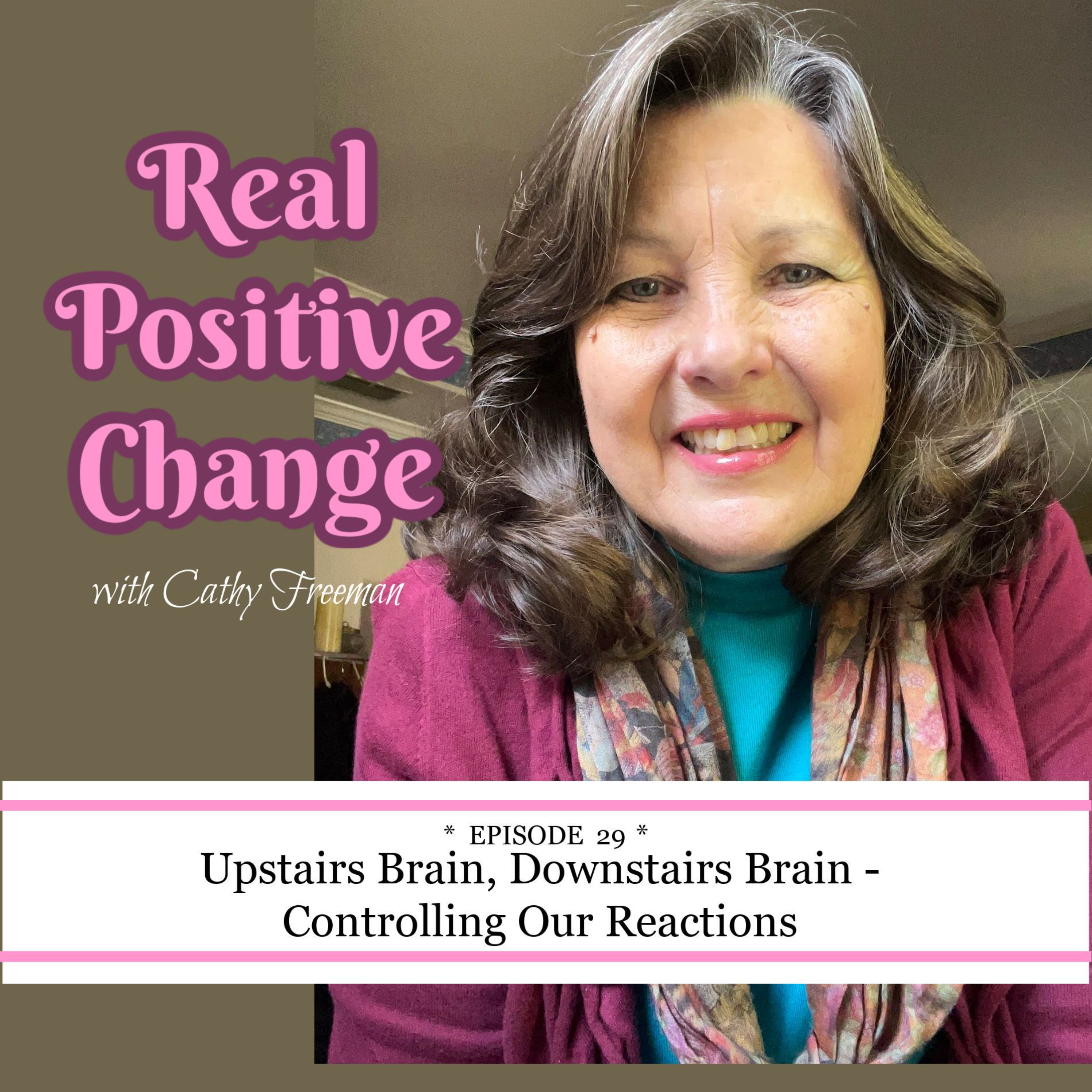
Episode 29 - Upstairs, Downstairs - Choosing our Reactions
from Real Positive Change: Creative Renewal for Women · host Cathy Freeman
https://www.realpositivechange.com The brain is often described in two parts: The downstairs brain—which is fast, reactive, and emotional. And the upstairs brain—which is thoughtful, reflective, and steady. Now here’s the key: This isn’t about emotion versus no emotion. It’s about reaction versus response. Your downstairs brain reacts. Your upstairs brain responds. What Each Part Does Let’s take a moment and understand what each part does. Your downstairs brain is always asking one question: “Am I safe?” It scans for: rejection disconnection being overlooked anything that feels like a threat to belonging And when it senses something—even something small—it reacts quickly. This is where thoughts can sound like: “I’m alone” “I don’t matter” “I’m not being seen” These thoughts feel true in the moment because they come with emotion. Your upstairs brain, on the other hand, is where you: make meaning reflect choose your words regulate your emotions It’s slower, but it’s wiser. ****** When I say your upstairs brain helps you make meaning, here’s what that really means. Every situation you experience—your brain immediately asks: “What does this mean about me?” But here’s the important part… The situation itself doesn’t carry meaning. You assign the meaning. For example, if someone is distant or unavailable, your first thought might be: “I’m not important.” That feels true—but it’s actually just one interpretation. Your upstairs brain gives you the ability to pause and ask: “What else could this mean?” Maybe it means: “They’re overwhelmed.” “This is about timing, not my value.” “I’m feeling disconnected—but that’s not the same as being unimportant.” That’s what it means to make meaning. And from there, you can: reflect on what you’re feeling choose your words more carefully and stay steady instead of reacting. It’s slower—but it’s wiser. It can say: “Wait… what’s actually happening here?” “Is there another way to see this?” “What do I want my response to be?” Fear-Based Thinking vs. Faith-Filled Thinking Now let’s talk about something deeper. When your thoughts are fearful, you are often operating from your downstairs brain. Fear-based thoughts are: urgent absolute emotionally charged They say things like: “This always happens” “They don’t care” “I’m not enough” These thoughts are trying to protect you—but they don’t always tell the full truth. So here’s the question: Does faith-filled thinking mean you’re using your upstairs brain? Yes… but not in a simplistic way. Faith-filled thinking isn’t about ignoring emotion. It’s about allowing your upstairs brain to: stay engaged bring perspective anchor you in truth instead of fear Faith sounds like: “This feels hard, but I’m not alone” “There may be more going on than I can see” “I can choose how I respond here” Faith doesn’t shut down the downstairs brain. It calms it. Why This Matters in Everyday Life Let’s make this practical. Imagine this: Your husband is busy working long hours. Your downstairs brain might say: “I’m last on the list. I don’t matter.” That feels real. But your upstairs brain can gently step in and say: “This feels like disconnection… but that doesn’t mean I’m unvalued.” Do you see the difference? One is a reaction. The other is a response. Or in your business: You’re around people, and you feel exposed speaking about what you do. Your downstairs brain says: “This is risky. Don’t speak. Stay small.” Your upstairs brain says: “This feels vulnerable… but sharing something meaningful isn’t dangerous.” Example 1: Friend Doesn’t Reach Out “Have you ever noticed a friend hasn’t texted or called in a while?” Your downstairs brain might say: “She doesn’t care about me anymore.” “I must have done something wrong.” That feeling can hit fast—and it feels personal. But your upstairs brain can step in and say: “Maybe she’s busy.” “Maybe she’s going through something.” “This might not be about me at all.” Same situation… different meaning. Example 2: Adult Children Pulling Away “As our kids get older, they naturally become more independent.” But your downstairs brain might say: “I’m not needed anymore.” “I’ve lost my place.” That can feel like rejection. Your upstairs brain can gently reframe: “This means I raised them to stand on their own.” “My role is changing—not disappearing.” Example 3: Walking Into a Room of People “You walk into a gathering, and no one immediately acknowledges you.” Downstairs brain: “I don’t belong here.” “They’re not interested in me.” Upper brain: “They may not have noticed me yet.” “I can take a step and engage.” “I’m allowed to be here.” Example 4: Body Changes / Aging “You look in the mirror and notice changes.” Downstairs brain: “I’ve lost my beauty.” “I’m not as valuable as I used to be.” Upper brain: “My body is changing—and it’s carried me through a lot.” “My value was never only physical.” “There’s a different kind of beauty growing here.” Example 5: Husband Distracted or Quiet “He comes home tired, not very talkative.” Downstairs brain: “He’s distant.” “He doesn’t want to connect with me.” Upper brain: “He may be mentally exhausted.” “This is about his capacity right now—not my worth.” “I can invite connection instead of assuming disconnection.” Example 6: Being Left Out “You see photos of something you weren’t invited to.” Downstairs brain: “I was excluded.” “They didn’t want me there.” Upper brain: “I don’t know the full story.” “This may not have been intentional.” “One moment doesn’t define my relationships.” How to Apply This Daily. Here are a few simple ways to practice this in real life: 1. Name where you are Ask yourself: “Is this a reaction… or a response?” That alone creates awareness. 2. Don’t fight the feeling—translate it Instead of saying: “This is wrong” Try: “This feels like fear… not necessarily truth” 3. Invite your upstairs brain back in Ask: “What else could be true right now?” 4. Pair faith with honesty Not: “I shouldn’t feel this way” But: “This feels hard… and I can still choose how I respond” 5. Take small visible steps Confidence grows after you act, not before. “In so many areas of our lives, our downstairs brain is quick to make things personal. But our upstairs brain gives us the ability to pause and choose a meaning that is more grounded, more truthful, and often more compassionate.” Your brain is not working against you—it’s trying to protect you. But it doesn’t always interpret things accurately. So the goal isn’t to eliminate emotional reactions. It’s to notice them… understand them… and gently move toward a thoughtful response. Because when you do that, you’re no longer led by fear. You’re led by intention, truth, and faith. Next time you feel overwhelmed, pause and ask: “Is this my downstairs brain reacting… or my upstairs brain responding?” That simple question can change everything.
NOW PLAYING
Episode 29 - Upstairs, Downstairs - Choosing our Reactions
No transcript for this episode yet
Similar Episodes
Mar 26, 2026 ·1m
Mar 19, 2026 ·34m
Feb 18, 2026 ·11m
Feb 11, 2026 ·45m