
Welcome to the Movement Movement, the podcast for people who want the truth about having a healthy, happy, strong body. Remember, your body was meant to move. Now here's your host, Stephen Sashin. Let's say you're a runner and you want to become a better runner.
What's the best way to do that? How about stop running and do something else instead? I will tell you what that is. On this episode of the Movement Movement, the podcast for people who want to know the truth about what it takes to have a happy, healthy, strong body beat first because those things are your foundation.
In the Movement Movement podcast, we look at the mythology that propaganda sometimes the outright lies that you've been told about what it takes to run, to walk, to dance, to play, to do, cross their parts or whatever it is you like to do to move this thing called your body. We have a lot of fun doing that. Let's see what else I want to say. If you're new to the podcast, just check us out at www.jointhemovementmovement.com, where you can find all the previous episodes.
If you like what you hear, then you know what to do. Subscribe and leave reviews and share. If you're on YouTube, hit the bell so you hear about the upcoming episodes, all those things you know. Simply if you want to be part of the tribe, please subscribe.
When I say part of the tribe, it's simple. We call this the Movement Movement because what we're trying to do here at Zero Shoes and wearing my Zero Shoes t-shirt is create a movement movement. We're trying to make natural movement the obvious, better, healthy choice the way natural food is and this podcast is all about how you can do that, whether you're in Zero Shoes or not. So let's jump into today's topic.
And by the way, I've been having a bunch of conversations with Smart Fun, interesting friends of mine lately. This is one of my first rants in a while. This one's been brewing for quite a bit though. It's literally been on my notes for well over a month and I didn't know how I wanted to approach it in part because it's going to require some video supplementation.
It might not require it, but it will certainly be helpful when I intend to provide that in the show notes for this episode. And so here, let's back up to the simple premise. What do you need to do to become a better runner? And I will tell you it is to stop running.
Not entirely, not for the rest of your life. But let's say you run seven days a week. Cut that out. Let's say you run five days a week.
You might want to back off a day there too. Let me just cut to the chase and tell you what you should be doing to supplement your running and often instead of some of your running. And this is something that runners do not want to do. I talked to runners about this and they get really nervous.
They're afraid that if they take one day off from running, it's going to ruin their career or they're going to start gaining a ton of weight or whatever it is. But all I can tell you is the research on this, unequivocal. The thing that I'm about to tell you will guarantee you a better, healthier runner who can continue running for much, much longer. Here we go.
Two words. Drum roll please. Strength training. Okay, don't turn off.
Don't change the channel. Don't do whatever you need to do to leave. I'm going to make this as palatable and as simple as possible for you. But again, it couldn't be more researched and more unequivocal.
Strength training makes you a better runner. In fact, it's been one of the reasons this has been on my mind so much is that I've been at two events in the last few months. One is called the science of running medicine and the other was the mountain land running summit. And both of these are put on by professional researchers and clinicians who are training physical therapists about how to identify running injuries, how to identify problems that running has led, wait, I can do this.
How to look at injured runners to figure out what might have injured them and more importantly how to get them back into running in a way that's healthy and better and hopefully prevent them from getting the same injuries again. And while there are a number of theories about how to do that and we've talked to some of the people involved, Irene Davis, Brian Hider-Shite, and we have more that are going to be on the podcast in the future. What's really interesting is no matter what their prescription is for helping runners get healthier, all of them shared this one thing which is get stronger in certain ways. And very specific ways that we're going to talk about in just a second.
So strength is critical and many runners simply don't have it. In fact, many runners end up getting weaker in ways that they need to be stronger because they are running or because they are running in a particular way that just exacerbates the problem that makes it so that weaknesses get weaker and strong things that over-strong, but typically weaknesses get weaker. So one of the things that at the science of running medicine at the Mount Land running summit, pretty much everybody agreed that the biggest problem that people have is weak glutes, which is a weird thing to think about because when you think about running you think, well clearly I'm using my butt to help me move, but if you butt pun intended, if you take a look at runners, like look at the world championships or the Olympics or its final videos and take a look at the difference between sprinters and distance runners. And if you're not a runner, you're not a runner.
Not a whole lot in the butt department. Sprinters, a whole lot in the butt department. Now I'm not saying that if you become a sprinter, you develop a butt or if you're a distance runner, you lose it because a lot of that really is just if you're the kind of person who's inclined to have a bigger, stronger butt, you're also perhaps the kind of person inclined to be a sprinter rather than a distance runner and vice versa. But I'm going to keep saying that.
Now it's going to sound like a joke every time. But I can tell you that sprinters in general have stronger glutes than distance runners and distance runners could really use to get some help in the glute department. One of the things that a lot of the physicians and researchers showed at the Science of Running Medicine and the Mount Land running summit is problems that people had with what's referred to as valgus, for example, which is basically, well, if we're talking about your knees, it's your knees kind of caving in. Instead of being in a straight line, your knees end up pointing inwards or coming inwards when you're running, which is not a good thing.
And a lot of people think that the solution for that might be doing something to your feet, putting it in an orthotic or some way of changing the position of your feet. And while that may sometimes, frankly, very rarely be a solution or more accurately be something that you want to do temporarily, it's really not the cause. 99% of the time what you're going to find is the cause of your knees turning in is the fact that your femurs are rotating and what's allowing your femurs to rotate is that your glutes aren't doing their job of keeping your femurs, keeping your legs, your thighs pointing in the right direction and therefore your knees pointing in the right direction. So one of the functions of your glutes, both your glute maximus and the glute medius, so the maximus is the back of your butt, the medius is the side of your butt, is to rotate those femurs out a little bit and keep your knees in a straight line.
So almost universally, the clinicians who are at these two events recommended exercises for your glutes and explicitly and specifically your glute medius. When I was in the lab with Dr. Bill Sands, who was the former head of biomechanics for the US Olympic Committee, it was something he actually recommended for me as well, which was working on my glute medius maximus, he said, it was okay, but the medius, he said, you know, really wanted to do more. It's not that he even found a problem, but it was really preventative.
Make sure you do things to improve that glute medius strength. Now let's just back up to the overall idea of strength and conditioning and that is I want to make it simple for you. I don't want, I'm not going to say go into a gym for hours a day. I want you to do just the fewest, simplest things you can.
Take one day off from your running and add this to the mix. Ideally, frankly, you want to do this two times a week or three times a week. Once you develop strength, one time a week is enough to maintain it, but to build strength, you need to be working out two or three times a week. So I want to give you something that's so, so simple that you're going to have a hard time not doing it.
If you will confess, it may be tricky for you to take a day off or two days off from running if you've been running five or six or seven days a week. All I can suggest is try it for a month, try it for two months, just see how you feel, see what happens to your running when you take a couple days to frankly rest because, especially if you have some improper movement patterns, you're just reinforcing those every time you run. And if you're not taking time off to let things rest, you're going to create continuous degenerative process that is not going to be good in the future. Just the time off to let yourself recover a little more is going to be a good thing and supplementing that with strength training is really, really going to help.
So let's talk about the simplest things you can do. I'll give you a few ideas of exercises that you might want to do as well and I'll give you a little prescription for how to do them also. First things first, squats. I mean, couldn't be easier.
Again, make it really simple. Just do quote unquote air squats. In other words, bodyweight squats, just stand up, put your legs about shoulder width apart, point your toes out about 30 to 45 degrees each. Just do what's comfortable.
There's no specific way you need to do a squat or where you need to place your feet for squat, find what's comfortable, what feels natural, you'll figure it out. When you do the squat, I'm going to give you the worst analogy I can think of but it's perhaps the best analogy I can think of. You want to initiate the movement as if you're about to try and sit back on something that's behind you and you're not even sure if it's there like a toilet. So just imagine you're sitting back and you're not sure if the seat is up or down so you don't want to go down too fast and falling to the water.
I've only done that once. I don't know about you. But the whole idea is that what you're working on is what's referred to as the hip hinge. You're not just going up and down.
You're thinking about going backwards by starting the movement by hinging at your hips, keeping your back basically slightly arched, barely arched or essentially straight. Keep your neck, your head in line with your back. So basically your head is not looking up or looking down but staying neutral for the entire thing. And ideally you want to go down all the way.
So you definitely want to go down at least to what's referred to as parallel where the crease in your hips is about at the same height or slightly below your knees. And if you can go all the way down, what's affectionately referred to as as to grass, which is appropriate for this metaphor of sitting back as if there's a toilet, but I guess pretending that you're sitting in a country where they don't actually have toilets. So you want to go down as far as you can. And if you really think about the hip hinge and letting your hips be the thing that leads you down, people worry that squats are bad for your knees could not be further from the truth.
Just go down as much as it is comfortable but you want to start moving towards going all the way down there. What will happen to your knees may track slightly like right above your toes or maybe even a slight bit in front of your toes. Don't worry about it. Just do what's comfortable.
Now I'll tell you about it like a protocol. I'll tell you now. So go for 10. See what happens.
Nobody deal. Or then if you can do 10 with no problem, try 20. See what happens. I actually, I just remember this.
I went on a little tirade. It was like the 200 squat challenge. And just to see if you can do 200 squats in a row. And I remember like I was in the 25 to 50 range and I was kind of getting like doing 75.
I was just increasing the number I did every day just to see what happened to see how long it would take for me to get to 200. And one day I realized I didn't know why I was stopping. I know that sounds weird. But I just felt like I had a little more in the tank.
I wonder if I could just keep pushing through. Not to the point of something painful. But just what would happen if I kept pushing until I felt like really couldn't do anymore. I got to about 250 the next day.
I jumped up like over 100 in a day because obviously I hadn't gotten any stronger. I just decided to keep going just to see what happened. And again, don't push beyond what feels comfortable. But you might want to give it a little tweak and see if maybe comfort is a limiting factor for you.
So if you only do 10, great do 10, then rest for a minute or two and then do another set of 10. So do maybe two or three sets of 10 squats. Now if air squats are really simple for you, you can add some weight. You can do what's referred to as a goblet squat, just getting a weight or like a dumbbell or anything and holding it up underneath your chin while you do a squat, which keeps your back a little more verbal, which might be a little more comfortable for some people.
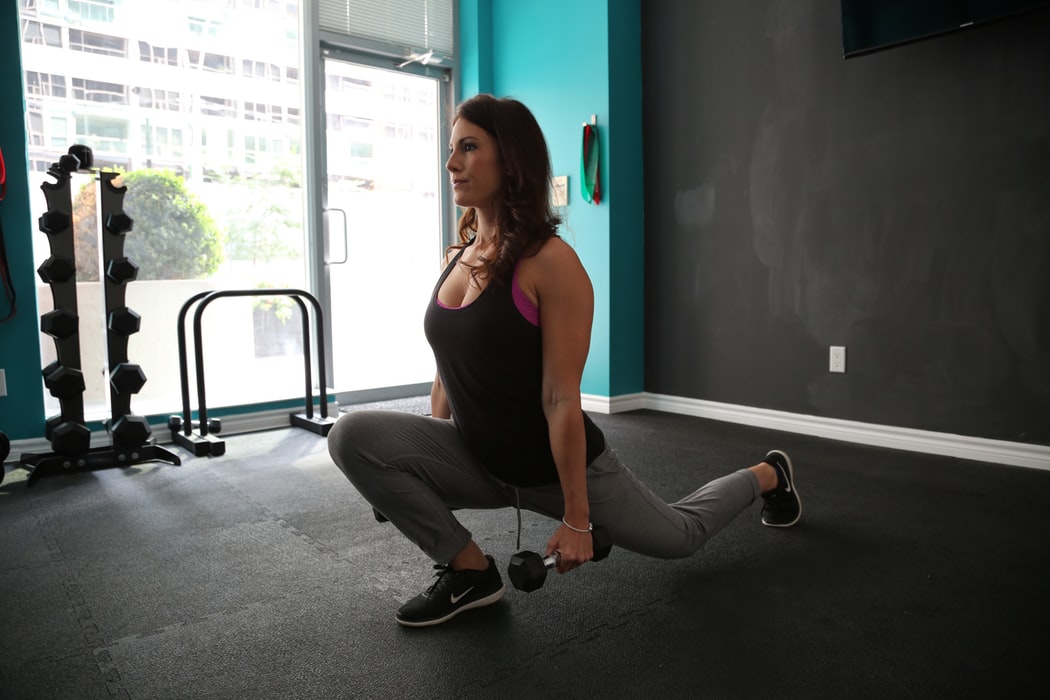
You can do a kettlebell squat where you have a kettlebell between your feet and just as you squat, the first time you reach down and grab the kettlebell and do the squats by just holding the kettlebell down with your arms straight in front of your body and just using that extra weight. Or if you really want to have some fun, do a one-legged squat and the way I recommend doing this is not a pistol squat where you're putting your foot out in front of you, but just a weird thing to describe without you seeing it. Basically, you're just going to stand on one foot and the foot that you're not standing on, kind of put it a little bit behind you and you're going to end up doing a squat with the foot that's on the ground, obviously. And the foot behind you, you're going to end up tapping your knee on the ground behind you.
You don't want to go down too fast, you don't want to slam your leg into the ground, you just want to be able to tap your knee on the ground and then get back up. And when you do this again, you're going to hip hinge. You don't want to keep your back straight. You want to let the bending of your hip guide the motion and you're going to be leaning forward in that process to that way keep your balance.
It's not rocket science if you just try and keep your balance and keep your back basically straighten your head in line. You're going to be having to hip hinge when you're doing one-legged squat. And then same thing, you can add weight to these if you want. Do a set of 10, do two sets of 10, maybe three sets of 10, really, really simple.
Okay, next thing you're going to want to do is very, very similar, a deadlifting movement, a specific hip hinging movement. Now I'm going to just recommend you go straight for the single leg version. Don't even worry about weights at the moment, but do a single leg version of the hip hinge. And what that means is you're going to stand up on one leg, let's say to your left leg and you're going to bend that left knee just a tiny little bit.
And then you want to think about being like one of those gunking birds. So again, you're going to be starting the movement by bending it to hips or another way of thinking of this is you want to see how far back you can get your butt or if you're standing on your left leg, your right foot. How far back can you get your right foot as all you're doing is just tipping your body. So you're not bending your left leg, you're skipping it slightly bent, you're not bending it like a squat, you're really just hinging.
And then as you're trying to get up, think about the way you're getting up by moving your hips forward. So you're moving your hips back to hinge down and you want to think about moving your hips forward to end up standing up straight again. I've actually done this by standing at three feet in front of a wall and making sure that as I hip hinge, in this case my right leg taps the wall behind me. So really good way to make sure that you're thinking about moving backwards when you do the hip hinge and then moving forwards by what's the word I'm looking for, extending your hips, I can't think of it.
Just basically you want to try and feel this in your butt. So the next thing you want to do, and again, same idea, do a set of ten if you can, do two sets of ten if you can, if you can do that, you can add some weight by putting a kettle bell on the floor and you pick it up the first time and just use that and there's debates and arguments that are completely silly about whether you hold the kettle bell or the dumbbell in the same hand that's got the foot on the ground or the opposite hand, it doesn't really matter. Do whatever you like to do. Again, I'm trying to make this simple for you.
Okay, next one, you want to do something to work on strengthening your ankles and the tendons in your ankles and the easiest thing to do that is just a little bunny hops or I don't know what you call them. But think about jumping rope where you're just hopping on two feet. The problem with jumping rope is that people tend to frankly jump too slowly and bend their knees too much to make that jump. So don't use a rope, just jumping up and down by just keeping your knees as straight as possible, not rigid, but you know, just this is an ankle movement, not a jumping, whole jumping movement.
It's really just popping slightly off the ground by jumping, by really using your feet in your ankles. And so make them fast jumps, make them light jumps and again, do a set of ten, rest, do another set of ten, and then build up as you want to do. I'm not going to give you a prescription for how many reps and how many sets because again, do what feels comfortable and enjoyable for you. If you don't like doing it, you're not going to keep doing it and what's the point of that.
So just fast little hops, really thinking about just making it all happen just out of your ankles, just pop pop pop off the ground. And really it should be like, oh my God, that fast, like pop pop pop pop pop. Okay, next, something for your core and the simplest thing for your core is something that's going to keep it nice and strong in an isometric fashion and that's a plank. Now the easiest way to think about a plank is get on the ground like you're going to do a pushup and if you can't do a pushup, who cares?
Because you're not doing pushups. So feet extended behind you, hands underneath your shoulders, tighten up your core and in fact squeeze your butt when you do this, squeeze your butt, squeeze your abs, try to pull your navel into your spine and just hold that and hold that for 10 seconds, 20 seconds, whatever you can do. If that gets too easy, instead of putting your weight on your hands, go down onto your elbows and if that gets too easy, take one of those elbows off the ground and stick it behind you. And so you can do a one arm plank or you can do a one leg plank or you can do a one arm, one leg plank, whatever you're in the mood to do, whatever your strength allows you to do.
Again, you want to find one that's kind of challenging but also kind of fun. And once you do the front plank, you also want to do a side plank where it's the same idea. You're just going to be balancing yourself, let's use your left arm on the ground and you're facing so you have your body turned so your whole body is facing a wall in front of you and find a way to balance and just hold that. And again, you want to squeeze your butt and you want to squeeze the side of your body, the side of your abs that's going to be closest to the ground.
That's the thing that's going to hold you up. You don't want your hips to fall down on any of the planks. You want to keep your body nice and straight through a plank. And of course, switch sides do both sides.
So there's planks. You want to strengthen your feet. Okay, so we have a squat, we've got a hinge, we've got a plank, we've got angles and let's do your feet as well. And so for your feet, we've talked about this in previous podcast, things like what's referred to a short foot.
With your feet bare out of shoes on the ground is an isometric thing. Try to pull your big toe towards your heel. It's not going to, you don't want to squeeze your toes on the ground. You just want to try and engage your arch.
Just try it like I'm doing this thing with my hand where I'm just kind of squeezing my hand like I'm trying to make it shorter. You want to do the same thing with your feet and try to actually relax your toes as much as you can. You won't be able to totally relax them. But the idea is don't grip with your toes.
Just try to pull your big toe in towards your heel. And if it makes your arch cramp, you're in the right direction just back off a little bit so it isn't crampy. Hold it for about 10 seconds, relax and do a few of those. Again, I'm not going to try and give you a whole lot of recommendation about sets and reps.
Find the thing that is, where you do it and you feel like, wow, that was really nice. I would be happy to do that again tomorrow or the day after or the day after. If you're not having fun, it can work. It's just like barefoot running.
What I like to say is you know, get on a nice smooth hard surface, take off your shoes, go for a very short run. If you're not having fun, do something different till you are. And so same idea with getting stronger. It's going to take a little bit of effort.
It's going to pay off. But you don't want to start especially by doing too much just like running barefoot. You want to start with something that's enjoyable where you feel like you actually activated some things and you can feel the difference and you want to get it going. Now we need to do one last exercise and it's not, this is an advanced one, but it needs a prop and a prop you're going to need, what I'm holding up is, it's like a big rubber band is basically what it is.
I don't even know what these things are called, but it's about, let's say it's about eight inches or 10 inches long. It's a loop that come in different strengths and different colors to indicate the strength. There are a couple things you can do. You can put this rubber band loop.
There's a word for these performance bands or something like that. You can put it and you can find them, this one came from performbetter.com. So that's where I got mine. Put it up just slightly above your knees and you can do this while sitting down, put it slightly above your knees.
It's lying down would be a clam, but just open up your knees. Just spread your knees, keep your feet on the ground. Don't let your feet move. Just spread your knees against this rubber band.
I'm going to just show that what this looks like with my arms is just doing this. So my elbows are staying in place, my wrists are going out. Again, do a set of 10 and you're going to feel that in your glute medius. That's really going to get the sides of your butt.
Do a set of 10, rest, repeat, et cetera. You can also do things with the bands like what are called monster walks where you just bend your knees and himp hinge a little bit and spread your knees until you're feeling real pressure, real tension in your glute medius and then take small steps either forward or sideways. Again, just whatever's fun to get those glutes engaged. I'm a big fan of using these performance bands for glute medius work.
Have a good time. Anyway, so all that said, you runners out there. I hope this is inspiring you to take a couple days off. Add a little strength training to your workout.
Again, the research is clear. It will make you a better, stronger, healthier runner. I want to hear what happens when you do that. So please keep me posted and that kind of sums it up.
So thank you for joining me on my little strength training rant for this episode of the movement podcast. If you want to follow up on other things that we've talked about interviews that we've done, other rants that I've gone on that were frankly more ranty than this one was. This is a little more encouraging. Head over to www.jointhemovement.com where you can find all the different places you can engage with us and find the podcast and share and like and review and click the button and subscribe.
As I said, if you want to be part of the tribe, please subscribe. If you have any questions, send an email to move at Jointhemovementmovement.com. If you have any recommendations or people you want to have on this podcast, people who are helping support natural movement, same thing, move at JoinTheMovement.com. And that's pretty much all I got.
So until next time, live life. Feet first. You've been listening to the Movement Movement podcast with host Stephen Sashan. Remember to join the tribe and subscribe at JoinTheMovementMovement.com.