
EPISODE · Dec 30, 2025 · 4 MIN
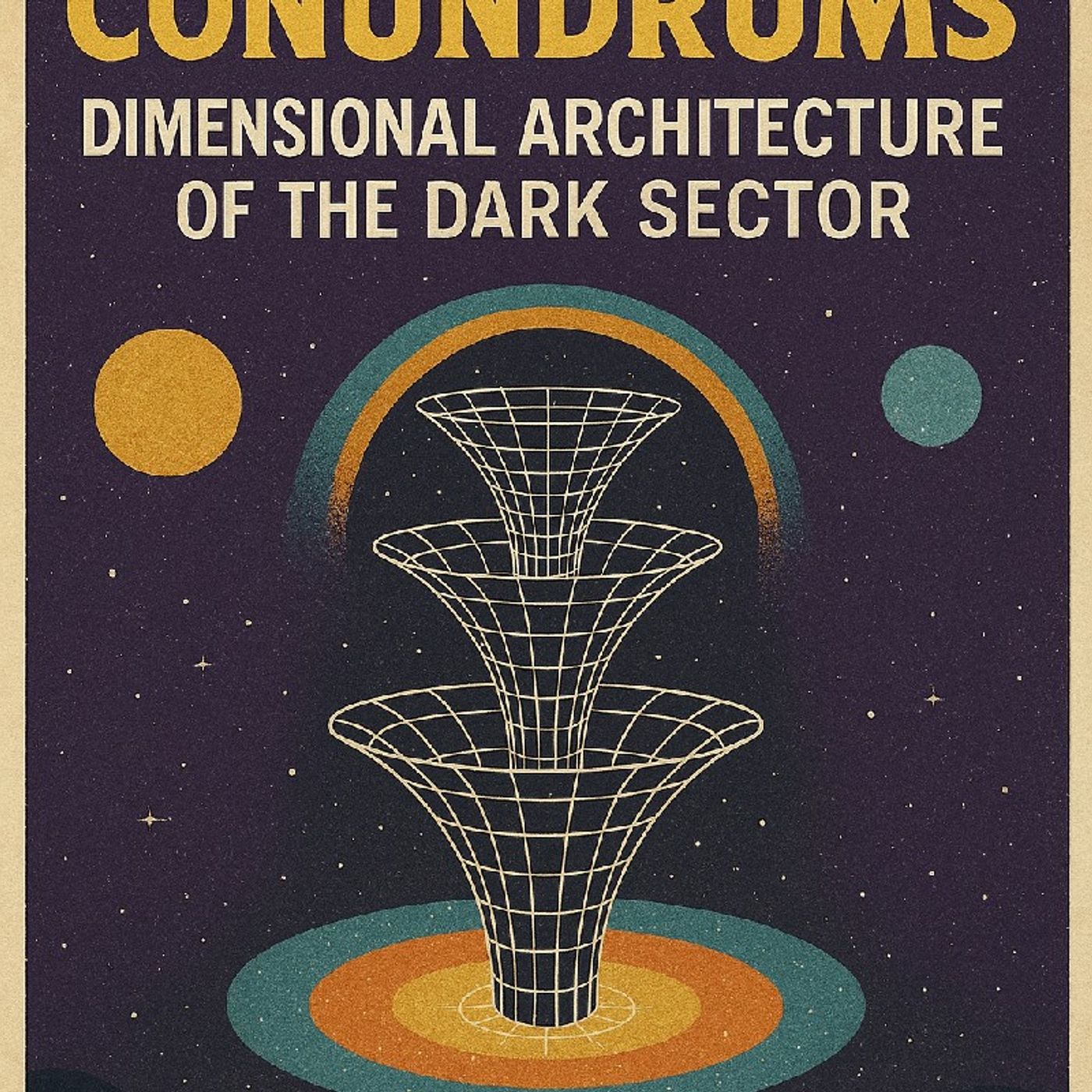
Episode 346 - Cosmic Conundrums
from Kevin McFarlane's podcast · host Kevin McFarlane
The prevailing understanding of the universe is defined by a profound discrepancy between observable phenomena and the underlying gravitational dynamics that dictate galactic and cosmic evolution. Current cosmological models, specifically the \Lambda-CDM framework, suggest that baryonic matter—the substance of stars, planets, and biological life—accounts for a mere 5% of the total mass-energy density of the universe. The remaining 95% is attributed to the "dark sector," comprising dark matter (approximately 26.8%) and dark energy (approximately 68.2%). While dark matter is traditionally conceptualized as a yet-to-be-detected subatomic particle, such as an axion or a Weakly Interacting Massive Particle (WIMP), a growing body of theoretical research posits that these anomalies may instead be manifestations of higher-dimensional spatial geometry. The "spacedepth" framework and the "dark dimension" scenario represent two influential paradigms in this shift toward a geometrical interpretation of the dark sector, suggesting that dark matter is not a substance within our three-dimensional universe, but a signature of its interaction with a fourth spatial dimension.
Embed this episode
NOW PLAYING
Episode 346 - Cosmic Conundrums
No transcript for this episode yet
Similar Episodes
No similar episodes found.
Similar Podcasts
No similar podcasts found.