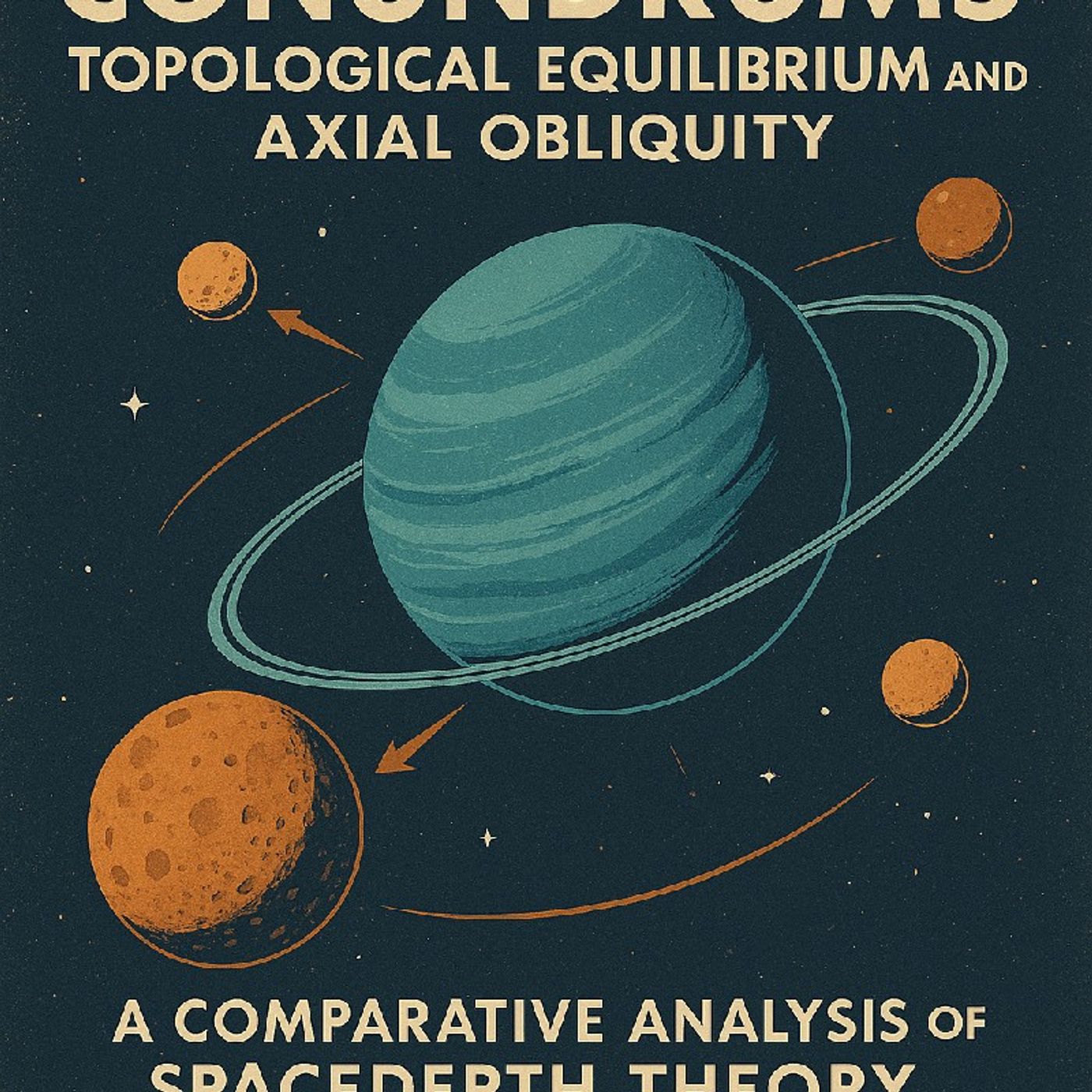
Episode 597 - Cosmic Conundrums episode artwork

EPISODE · Mar 5, 2026 · 5 MIN

Episode 597 - Cosmic Conundrums

from Kevin McFarlane's podcast · host Kevin McFarlane

​The rotational architecture of the solar system generally adheres to a predictable pattern of alignment, with the majority of planetary bodies maintaining axial tilts that are relatively perpendicular to the ecliptic plane. Uranus, however, stands as a profound outlier, possessing an extreme axial obliquity of 97.77 degrees. This orientation, which effectively results in the planet orbiting the Sun on its side, has historically been categorized as a "cosmic accident"—a deviation from the primordial angular momentum of the protoplanetary disk caused by a discrete, violent event. Traditional explanatory frameworks have relied heavily on two primary mechanisms: the giant impact hypothesis and the secular spin-orbit resonance model. While these models have been refined through decades of computational simulations, they continue to face significant challenges, particularly regarding the preservation of satellite systems, the similarity of spin rates between Uranus and Neptune, and the anomalous geometry of the Uranian magnetic field. ​The emergence of the Spacedepth theory offers a fundamental paradigm shift in the interpretation of planetary orientation. Rather than viewing Uranus's tilt as a historical relic of a past trauma, Spacedepth frames axial obliquity as an emergent property of a planet's topological embedding within a multidimensional depth gradient. This theory posits that planetary orientation, magnetic alignment, and orbital plane stability are not disparate phenomena but are co-emergent expressions of a local depth-field equilibrium. By removing the assumption that planets must be "upright" in a Euclidean sense, Spacedepth provides a cohesive explanation for features that traditional collision and resonance models struggle to reconcile, such as the coherent alignment of the Uranian rings and moons and the wildly misaligned magnetic dynamo.

​The rotational architecture of the solar system generally adheres to a predictable pattern of alignment, with the majority of planetary bodies maintaining axial tilts that are relatively perpendicular to the ecliptic plane. Uranus, however, stands as a profound outlier, possessing an extreme axial obliquity of 97.77 degrees. This orientation, which effectively results in the planet orbiting the Sun on its side, has historically been categorized as a "cosmic accident"—a deviation from the primordial angular momentum of the protoplanetary disk caused by a discrete, violent event. Traditional explanatory frameworks have relied heavily on two primary mechanisms: the giant impact hypothesis and the secular spin-orbit resonance model. While these models have been refined through decades of computational simulations, they continue to face significant challenges, particularly regarding the preservation of satellite systems, the similarity of spin rates between Uranus and Neptune, and the anomalous geometry of the Uranian magnetic field. ​The emergence of the Spacedepth theory offers a fundamental paradigm shift in the interpretation of planetary orientation. Rather than viewing Uranus's tilt as a historical relic of a past trauma, Spacedepth frames axial obliquity as an emergent property of a planet's topological embedding within a multidimensional depth gradient. This theory posits that planetary orientation, magnetic alignment, and orbital plane stability are not disparate phenomena but are co-emergent expressions of a local depth-field equilibrium. By removing the assumption that planets must be "upright" in a Euclidean sense, Spacedepth provides a cohesive explanation for features that traditional collision and resonance models struggle to reconcile, such as the coherent alignment of the Uranian rings and moons and the wildly misaligned magnetic dynamo.

NOW PLAYING

Episode 597 - Cosmic Conundrums

0:00 5:12

No transcript for this episode yet

We transcribe on demand. Request one and we'll notify you when it's ready — usually under 10 minutes.

That Hoarder: Overcome Compulsive Hoarding That Hoarder Hoarding disorder is stigmatised and people who hoard feel vast amounts of shame. This podcast began life as an audio diary, an anonymous outlet for somebody with this weird condition. That Hoarder speaks about her experiences living with compulsive hoarding, she interviews therapists, academics, researchers, children of hoarders, professional organisers and influencers, and she shares insight and tips for others with the problem. Listened to by people who hoard as well as those who love them and those who work with them, Overcome Compulsive Hoarding with That Hoarder aims to shatter the stigma, share the truth and speak openly and honestly to improve lives. The Small Business Startup School – Business Notes | Financial Literacy | Retail Psychology – For Professionals & Entrepreneurs The Small Business Startup School Inc. Starting or buying a small business? While personal circumstances may vary, business patterns remain timeless. On The Small Business Startup School, we explore strategies, insights, and practical solutions to help entrepreneurs confidently navigate their journey.Hosted by Ola Williams—a retail entrepreneur, fintech founder, and financial coach with over two decades of experience—this podcast marries financial awareness and retail psychology with optimism to deliver actionable takeaways.Join us to learn, grow, and connect as we uncover the keys to business success.Let’s continue to learn together and be encouraged to keep on connecting! DIOSA. Carolina Sanper This podcast is a sacred space created by Carolina Sanper where you connect with your inner wisdom and embody your magnetic feminine power.It is the realization that the mystical realm is where you plant the seeds of your desired reality.It is a portal to your true essence: awareness, presence, and receiving with ease. Welcome home, DIOSA. 🖤 XXX Tech by SOVRYN Dr. Brian Sovryn The crossroads between technology, sensuality, and metaphysics - and the longest running anarchist podcast in the world! Brought to you by Dr. Brian Sovryn.

Frequently Asked Questions

How long is this episode of Kevin McFarlane's podcast?

This episode is 5 minutes long.

When was this Kevin McFarlane's podcast episode published?

This episode was published on March 5, 2026.

What is this episode about?

​The rotational architecture of the solar system generally adheres to a predictable pattern of alignment, with the majority of planetary bodies maintaining axial tilts that are relatively perpendicular to the ecliptic plane. Uranus, however, stands...

Can I download this Kevin McFarlane's podcast episode?

Yes, you can download this episode by clicking the download button on the episode player, or subscribe to the podcast in your preferred podcast app for automatic downloads.
URL copied to clipboard!