
EPISODE · Jun 1, 2026 · 5 MIN
Episode 731 - Cosmic Conundrums
from Kevin McFarlane's podcast · host Kevin McFarlane
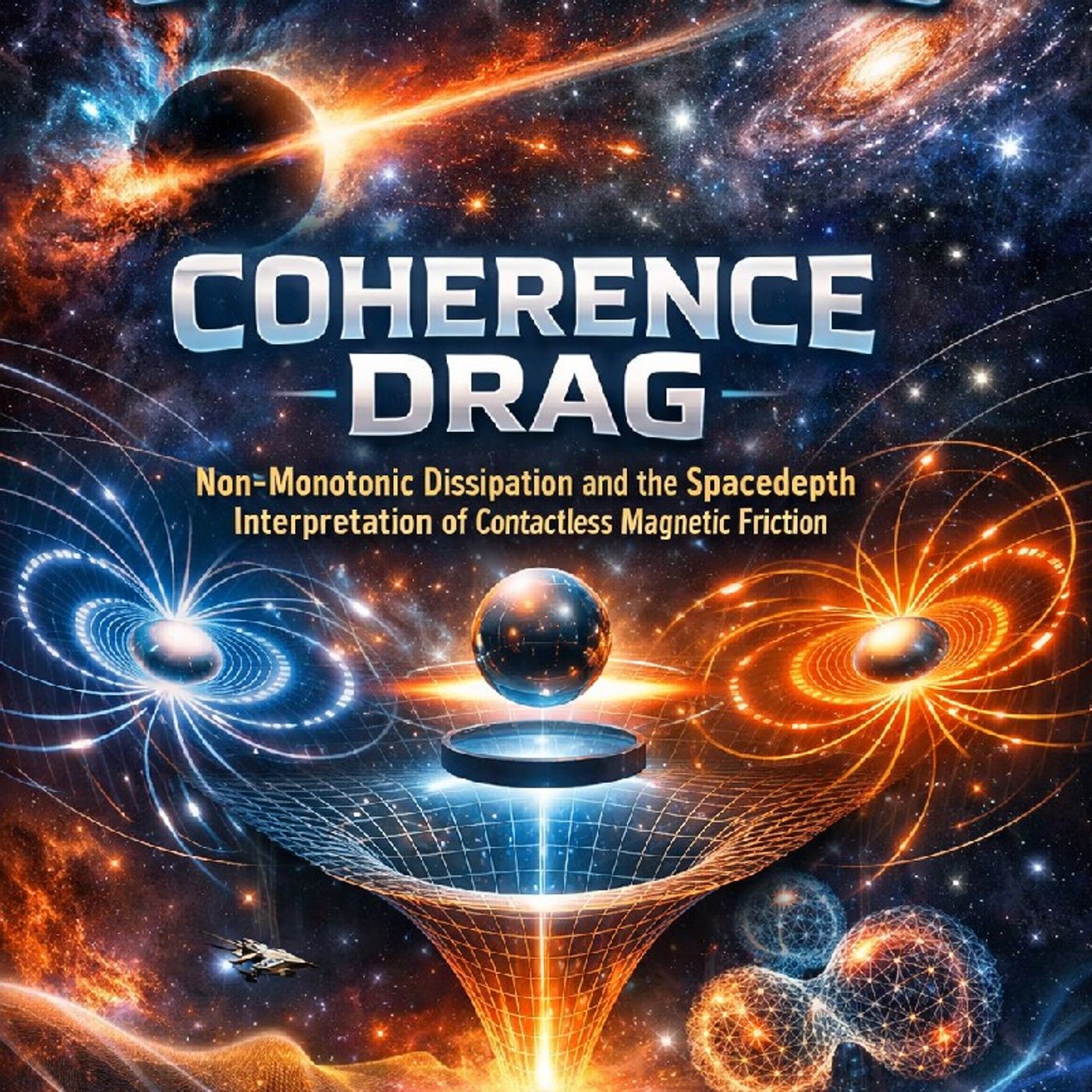
The Spacedepth model proposes a fundamental departure from the classical mechanics paradigm of physical surfaces in motion. Where classical tribology interprets solidity, resistance, and friction as contact-driven phenomena arising from physical surface roughness and mechanical deformation, the Spacedepth framework conceptualizes these occurrences entirely as coherence phenomena. Under this lens, when two physical structures are brought into proximity, they do not merely experience local electrostatic or magnetostatic forces; instead, they enter a shared relational basin where their respective internal ordering rules begin to compete. The physical gap between two sliding components is defined as a "Depth gap". When two coherence fields (such as periodic magnetic arrays) interact across this Depth gap, their internal ordering rules can become incompatible at specific separation distances. This incompatibility establishes a "frustrated attractor regime"—a zone where the joint system is structurally prevented from settling into a stable, unified relational pattern. As relative lateral sliding occurs, the system is forced into continuous microscopic reconfiguration. This constant structural reorganization is what manifests macroscopically as friction. Consequently, the Spacedepth model defines contactless friction not as mechanical abrasion, but as "coherence drag"—the precise energetic cost of maintaining structural and field identity across a shifting Depth gradient.
Embed this episode
NOW PLAYING
Episode 731 - Cosmic Conundrums
No transcript for this episode yet
Similar Episodes
No similar episodes found.
Similar Podcasts
No similar podcasts found.